ISSN Online: 2162-2086 ISSN Print: 2162-2078
An Analysis of E-Commerce Enterprises
Sustainable Development and
Financing Structure
Yucao Niu
School of Management, Jinan University, Guangzhou, China
Abstract
O2O (Online to Offline) is a kind of new e-commerce mode and has brought new development opportunities for e-commerce enterprises. Through investing and fi-nancing, some e-commerce enterprises improved their performance rapidly in the short term. But some face serious operational risk, even bankruptcy. It’s still a ques-tion whether the e-commerce enterprises have achieved sustainable development or not. The relationship between financing structure and sustainable development needs to be studied. Based on the sustainable development theory and Higgins sustainable growth model, this paper uses SPSS to analyze the financial statement data of 98 listed e-commerce companies. The empirical results reveal that actual growth rates don’t match the sustainable growth rates, which means that E-commerce enterprises don’t achieve sustainable growth. And the sustainable growth rate is correlated with the nancing structure. Lastly, this paper puts forward constructive suggestions about fi-nancing structure adjustment.
Keywords
E-Commerce, Sustainable Development, Financing Structure
1. Introduction
Recent years, electronic commerce gradually becomes a hot topic of the public because of O2O business model. Enterprises are involved in e-commerce, such as catering, transport, education and so on. On the one hand, enterprises take advantage of the in-ternet to build green supply chain, make the whole supply chain and enterprises more efficient. On the other hand, enterprises expand the market through financing, get a rapid performance promotion in a very short-term. But there are also some enterprises How to cite this paper: Niu, Y.C. (2016)
An Analysis of E-Commerce Enterprises Sus- tainable Development and Financing Struc- ture. Theoretical Economics Letters, 6, 1105- 1114.
http://dx.doi.org/10.4236/tel.2016.65106
Received: September 23, 2016 Accepted: October 11, 2016 Published: October 14, 2016
Copyright © 2016 by author and Scientific Research Publishing Inc. This work is licensed under the Creative Commons Attribution International License (CC BY 4.0).
who don’t have clear profit model. They grow too fast, the resources and management ability can’t match the growth speed of enterprises. This situation makes enterprises face serious business difficulties, even the risk of bankruptcy. Enterprises pay attention to the issue of sustainable development. From the perspective of sustainable develop-ment theory, this paper selects 98 listed E-commerce companies, uses SPSS to do em-pirical analysis. Based on the Higgins sustainable growth model, study analyzes the fi-nancial statements of listed companies. The result shows that the enterprises do not achieve sustainable growth. On the basis of the research result, paper further analyzes the relationship between financing and the sustainable growth. Finally, we put forward several methods to adjust the structure of financing to help enterprises achieve sus-tainable growth.
2. Theoretical Framework
listed E-commerce companies in 2008-2012 [8]. The financial data showed that the en-terprises did not achieve sustainable growth. He put forward that financing, profits and other factors influence the sustainable development of the enterprises. But he did not do further empirical test. Existing literature research covers industry enterprises, such as biological pharmaceutical industry, coal industry and information technology indus-try, etc.
On the one hand, the e-commerce supply chain restructured, brought performance growth; On the other hand, the rapid financing expansion and enterprises bankruptcy phenomenon existed. Whether e-commerce enterprises realized sustainable develop-ment or not is still a question. Therefore, put forward hypothesis 1.
Hypothesis 1: The sustainable growth rate and the actual growth rate are not signifi-cantly different.
According to the research literature, enterprises sustainable development of different industries show that investment and financing closely related to sustainable develop-ment of the enterprise. Thus research further analyses the relationship between the fi-nancing structure and the sustainable development in electronic commerce enterprises. Literature review showed that the pecking order theory of financing is the cornerstone of modern financing structure theory. According to this theory, the financing order should be internal financing, external financing, indirect financing, direct financing, debt financing and equity financing. Internal financing has a low cost and risk. It is good for the promotion enterprise’s performance. Enterprises financing usually choose external financing first. Pecking order theory and the concept of sustainable develop-ment have intrinsic consistency. Rong Qiu (2016) studied e-commerce enterprise fi-nancing mode, analyzed the relationship between the fifi-nancing and fifi-nancing effi-ciency. Finally, he solved the problem of enterprises financing difficulties and put for-ward constructive suggestions [9]. Jianping Tu, Xue Yang (2013) analysed supply chain finance of the e-commerce platform and its influence on enterprises development [10]. He also studied the similarities and differences between different traditional financing models. The quantitative research of financing structure and sustainable development in the electronic commerce field are not too much, the main result of quantitative re-search is financing structure and corporate performance. Although performance and sustainable development of enterprises have internal consistency, but they still belong to different object of study. So research takes the methods and ideas for reference. Based on the pecking order theory, Donglin Yong (2012) studied the performance of listed tourism companies, found that internal financing is positively related to corpo-rate performance [11], external financing is negatively related to corporate perfor-mance. Feifei Dai (2014) [12], Pengfei Zhang (2015) [13] made a research in different industries, found similar conclusion. Hypothesis 2 and hypothesis 3 are based on these theories.
Hypothesis 2: The internal financing of electronic commerce listed companies is po-sitively related to the sustainable growth rate.
Research on the relationship between the equity financing and the development of enterprises have three different conclusions. 1) Equity financing ability is positively re-lated to corporate earnings. Lixia Yu and Gen Zhao (2011) studied A-share listed com-pany data, found that the directional equity and corporate performance are significant-ly positivesignificant-ly related [14]. Xian Huang (2009) put forward that the listed company own-ership structure and corporate benefit have same direction change [15]. Lijun Liu did an empirical study of the listed companies’ financing structure in China. According to the research of financing preference, listed companies prefer the order of “equity fi-nancing, debt fifi-nancing, internal financing”. 2) The equity structure is negatively re-lated to the profitability. Xiangjian Zhang and Jin Xu (2005) found that after equity al-location, listed companies’ performance declined. 3) The equity financing and corpo-rate profitability appear inverted u-shaped relationship. Feifei Dai (2014) found that too high or too low ownership concentration are detrimental to the ascension of busi-ness performance. Pecking order financing theory is that enterprises should give prefe-rence to equity financing, then choose debt financing. But due to the particularity of capital market in China, the relevant financial system is imperfect, e-commerce listed companies prefer equity financing (venture capital and private equity) than creditor’s rights financing. So hypothesis 4 is put forward.
Hypothesis 4: The Equity financing of electronic commerce listed companies is posi-tively related to the sustainable growth rate.
As for the relationship between creditor’s rights financing and enterprise sustainable development, there are two different opinions. 1) The creditor’s rights financing and profitability are positively related. Zheng Ni and and Shanwei Wei (2006) found that creditor’s rights financing sends positive signals to the market and it is related to cor-porate value. 2) Creditor’s rights financing is negatively related to the profitability. Xian Huang (2009) found that creditor’s rights financing influences enterprise benefits in the opposite direction. Xiujuan Gu and Yaping Kong (2010) found a significant decline in performance after the issuance of bonds through the empirical study. Based on the theory of pecking order, the risk and cost of creditor’s rights financing are higher, therefore put forward hypothesis 5.
Hypothesized 5: The debt financing of electronic commerce listed companies is ne-gatively related to the sustainable growth rate.
3. Model and Variables
ac-cording to the result of the performance evaluation, adjust the structure of financing and financial leverage, achieve sustainable growth.
To study the relationship between financing structure and the enterprise sustainable growth rate, paper builds five regression models. Traditional financing structure in-cludes bond financing rate, but electronic commerce public finance data show that bond financing project is less. Inadequate data is not suitable as independent variables. Variables include internal financing rate and external financing rate. Internal financing rate can be divided into depreciation financing rate (DF) and retained earnings financ-ing rate (RF). External financing rate can be divided into stock financing rate (SF), short-term debt financing rate (SBF), long-term debt financing rate (LBF), commercial credit financing rate (CF),fiscal financing rate (FF) .
To study internal financing, external financing and the relationship with enterprise sustainable growth rate, verify hypothesis 2 and hypothesis 3, research builds regression model 1.
Model 1: SGR= +
α β
1(
DF+RF)
+β
2∑
(
SBF+LBF+SF+CF+FF)
+ε
.To study the equity financing and debt financing and the relationship with enterprise sustainable growth rate, verify hypothesis 4 and hypothesis 5, research builds regression model 2.
Model 2: SGR= +
α β
1SF+β
2∑
(
SBF+LBF+CF+FF)
+ε
.To have a comprehensive review of the relationship between variables and the enter-prise sustainable growth rate, further verify the hypothesis 2 to hypothesis 5, research builds regression model 3.
Model 3: SGR= +α β1DF+β2RF+β3SBF+β4LBF+β5SF+β6CF+β7FF+ε.
4. Empirical Analysis
4.1. Samples and Data
The definition of variables:
SGR: Higgins sustainable growth rate. SGR= ∗ ∗ ∗P A R T.
P: Business net interest rate, P = net profit/business income.
A: Total asset turnover, A = operating income/average total assets; the average total assets = (ending balance of assets + ending balance of assets a year ago)/2.
R: Earnings retained rate, R = (net profit − cash dividend)/net profit.
T: Rights and interests multiplier, T = the final total assets/initial owners’ equity. g: The actual growth rate, g = (the current business income − business income of the
previous period)/business income of the previous period.
[image:6.595.194.557.526.582.2]To do an overall analysis about the sustainable growth rate and the actual growth rate, study which is higher and more stable, the paper made a descriptive statistical analysis. Descriptive statistical analysis is carried out on the sample data, as shown in Table 1.
Table 1 descriptive statistical analysis results show that the actual growth rate is
around 20%, which is higher than the sustainable growth rate( 7.5%). From the point of maximum, the actual growth rate is higher than the sustainable growth rate. From the point of minimum, the actual growth rate is lower than the sustainable growth rate. The actual growth rate ranges at a larger extent. Compared with the actual growth rate standard deviation (0.34), the sustainable growth rate is 0.15, which is relatively stable. Data is consistent with actual situation, sustainable growth rate showes a good devel-opment trend.
4.2. Sustainable Growth Test
The sustainable growth rate and the actual growth rate distribution are unknown. To test whether the e-commerce listed companies achieve sustainable growth or not, re-search chooses non parametric test-Wilcoxon symbol rank test. Confidence level is 95%. Wilcoxon symbol rank test results are showed in Table 2.
Table 1.Descriptive statistical analysis.
N Minimum Maximum Average Standard deviation Sustainable growth rate 490 −1.3753 1.1533 0.074909 0.1467044
[image:6.595.193.554.614.705.2]Actual growth rate 490 −0.9758 1.9010 0.200693 0.3442525 Effective N 490
Table 2.Wilcoxon symbol rank test.
Variables Rank N Mean rank Sum of ranks Z Asymptotic significance (double side)
Sustainable growth Rate-actual growth rate
Negative rank 319 270.64 86,334.00
−8.350 0.000 Positive rank 171 198.60 33,961.00
Test results show that among 490 listed e-commerce companies, negative rank ber is 319, which accounts for more than 65% in the total number; Positive rank num-ber is 171. The actual growth rate is generally higher than the sustainable growth rate, there is no equal real growth rate and sustainable growth rate. Inspection results is sig-nificant. Hypothesis 1 is refused. Test results are in conformity with the reality. E- commerce listed companies take financing strategy in great quantities. Actual grow rate is too high, resources and management can’t match the fast speed. Part of the enterprise capital chain collapsed. Enterprises do not achieve green sustainable devel-opment.
4.3. Regression Analysis
Regression model 1 results are showed in Table 3: internal financing rate is positively related to the sustainable growth rate, sig. value is 0.016. The result is significant, hy-pothesis 2 is verified. Internal financing cost is low, mainly comes from retained earn-ings. It is consistent with the sustainable development principle of enterprises, enter-prises should first choose internal financing. External financing rate is negatively re-lated to the enterprise sustainable growth rate, sig. value is 0.004. The result is signifi-cant, hypothesis 3 is verified. External financing cost is higher than internal financing and the risk is bigger. Enterprises should control the scale of external financing.
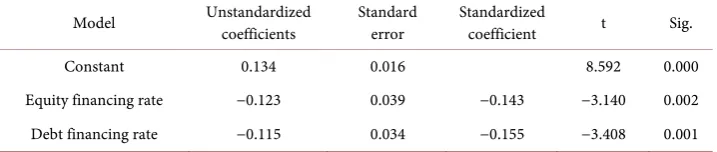
[image:7.595.193.555.517.593.2]The regression model 2 results are showed in Table 4: equity financing rate is nega-tively related to the sustainable growth rate, sig. value is 0.002. The result is significant, hypothesis 4 is refused. By analysing the present situation of electronic commerce en-terprise financing, the financing scale is over the range of sustainable growth.In order to achieve sustainable development, the enterprise should control the scale of equity fi-nancing. Rate of debt financing is negatively related to the sustainable growth rate, sig. value is 0.001. The result is significant, hypothesis 5 is verified. Debt financing cost is higher, which is consistent with the reality. The debt financing projects are relatively less.
Table 3.Regression model 1 results.
Model Unstandardized coefficients Standard error Standardized coefficient t Sig.
Constant 0.114 0.025 4.542 0.000
Internal financing rate 0.037 0.015 0.109 2.420 0.016 External financing rate −0.094 0.032 −0.132 −2.930 0.004
Table 4.Regression model 2 results.
Model Unstandardized coefficients Standard error Standardized coefficient t Sig.
Constant 0.134 0.016 8.592 0.000
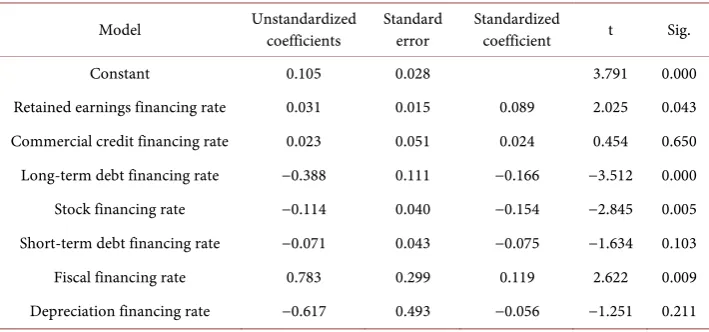
[image:7.595.196.555.628.704.2]Regression model 3 results are showed in Table 5: retained earnings financing rate is positively related to the sustainable growth rate, sig. value is 0.043. The result is signifi-cant, further verifies the hypothesis 2. The regression results of the commercial credit financing rate is not significant. Research finds that the commercial credit financing in-cludes notes payable, accounts payable, and advance payments. Less data cause unsta-ble. Long-term debt financing rate, stock financing rate is negatively related to the sus-tainable growth rate, sig. value is 0.The result is significant, further verifies hypothesis 3. Short-term debt financing rate is not significant, because the electronic commerce main purpose of financing is capital expansion. Listed companies are more inclined to long-term loan financing. Short-term financing has less amount of data. Fiscal financ-ing rate is positively related to the sustainable growth rate, the result is significantly. Because the listed electronic commerce companies enjoy the preferential tax policy in China, such as tax incentives. It is conducive to the development of enterprises. Depre-ciation financing rate has no significant relation with the sustainable growth rate. Be-cause the electronic commerce companies are mostly light assets. The proportion of the depreciation financing is small. So the impact on enterprise sustainable growth is not stable, which is consistent with the reality (Table 5).
5. Conclusions
[image:8.595.197.552.539.705.2]The innovation is combing the sustainable development theory with pecking order theory, using Higgins sustainable growth model to study the financing, the growth and bankrupt of the companies. The empirical results show electronic commerce listed companies do not achieve sustainable growth. The main contributions of research are analysing the growth rate of E-commerce listed companies and providing a model for enterprise financing decision reference. Corporate financing structure is related to the sustainable growth rate. Internal financing rate is positively related to the sustainable growth rate, external financing rate is negatively related to the sustainable growth rate. Further analysis finds that positive correlation relationship includes: retained earnings financing rate, fiscal financing rate. Negative correlation relationship includes: equity
Table 5.Regression model 3 results.
Model Unstandardized coefficients Standard error Standardized coefficient t Sig.
Constant 0.105 0.028 3.791 0.000
financing rate, debt financing rate, long-term debt financing rate. No significant corre-lation recorre-lationship includes: commercial credit financing rate, short-term debt financ-ing rate, depreciation financfinanc-ing rate. Accordfinanc-ing to the study, Chinese e-commerce listed companies can adjust the financing structure, make financing innovation, achieve the goal of sustainable development of enterprises.
First of all, from the perspective of enterprises. They need to improve the internal fi-nancing rate proportion, achieve self-accumulation of the enterprises. To establish a clear profit model and a stable partnership, enterprises should correct the selection or-der of financing. The adjustment of financing structure oror-der: 1) Internal financing. Choose the retained earnings financing according to the enterprise operating perfor-mance and profitability. 2) External financing. First choose creditor’s rights financing. The order in creditor’s rights financing is fiscal financing rate, long-term debt financing rate, short-term debt financing rate, commercial credit financing. Then choose equity financing. The order in equity financing is stock financing and bond financing.
Secondly, from the perspective of government. Promote the marketization of finan-cial system reform, further open the bond market, cultivate a stable and mature stock market. The equity financing, debt financing can have positive impact on the sustaina-ble development of enterprises. Government policy, fiscal, taxation can play positive role in promoting enterprise performance. Policy can contribute to the sustainable de-velopmental of companies.
References
[1] Higgins, R.C. (1972) Sustainable Growth under Inflation. Financial Management, 10, 36-40.
http://dx.doi.org/10.2307/3665217
[2] Bierman Jr., H. (1990) A Review of Alfred Rappaport’s Creating Shareholder Value. Journal of Management Accounting Research, 2, 140.
[3] Husband, T. (1979) Production, Operations, Planning & Control (Book Review). Interna-tional Journal of Production Research, 17, 91.
http://dx.doi.org/10.1080/00207547908919597
[4] Garbie, I.H. (2014) An Analytical Technique to Model and Assess Sustainable Development Index in Manufacturing Enterprises. International Journal of Production Research, 52, 4876- 4915. http://dx.doi.org/10.1080/00207543.2014.893066
[5] Santiteerakul, S., Sekhari, A., Bouras, A., et al. (2015) Sustainability Performance Measure-ment Framework for Supply Chain ManageMeasure-ment. International Journal of Product Devel-opment, 20, 221-238. http://dx.doi.org/10.1504/IJPD.2015.069325
[6] Zhang, X.Y. (2010) Based on the Financial Perspective Studies of Ethnic Autonomous Re-gion Sustainable Development of Listed Companies. Thesis, Southwestern University of Finance and Economics, Chongqing.
[7] Qin, H. (2015) Financial Perspective Gas Enterprise Sustainable Development Research, Based on the Analysis of Shanghai and Shenzhen A-Share Listed Company Data. Modern Economic Information, 19, 154-155.
Fi-nancing Efficiency Research. Journal of Economic Study Tribune, 24, 98-102.
[10] Tu, J.P. and Yang, X. (2013) The Performance Evaluation of Supply Chain Financing Model Based on E-Commerce Platform to Study. Management World, 7, 182-183.
[11] Lin, Y.D. (2012) Relationship between Structure and Performance of Listed Tourism Com-panies Financing Research. Southwest University of Finance and Economics.
[12] Dai, F.F. (2014) Listed on the Impact of Small and Medium-Sized Enterprise Financing Structure on Corporate Performance Empirical Research. Beijing Jiaotong University, Bei-jing.
[13] Zhang, P.F. (2015) The Empirical Study of Relationship between Structure and Operating Performance of Corporate Financing. Shanghai Academy of Social Sciences, Shanghai. [14] Yu, L.X. and Zhao, G. (2011) Listed Companies in Our Country the Financial Effect of
Di-rectional Issuance Study. Journal of Technology Economy and Management Research, 4, 119-123.
[15] Huang, X. (2009) An Empirical Analysis of the Corporate Capital Structure and Business Performance. Journal of Economic Study Tribune, 3, 41-42.
[image:10.595.194.554.425.697.2]Appendix
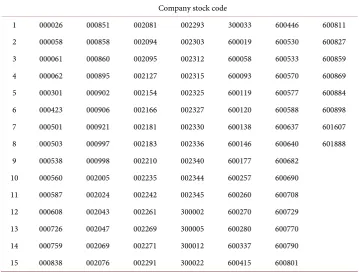
Table A1. Company stock code.
Company stock code
1 000026 000851 002081 002293 300033 600446 600811 2 000058 000858 002094 002303 600019 600530 600827 3 000061 000860 002095 002312 600058 600533 600859 4 000062 000895 002127 002315 600093 600570 600869 5 000301 000902 002154 002325 600119 600577 600884 6 000423 000906 002166 002327 600120 600588 600898 7 000501 000921 002181 002330 600138 600637 601607 8 000503 000997 002183 002336 600146 600640 601888 9 000538 000998 002210 002340 600177 600682
Submit or recommend next manuscript to SCIRP and we will provide best service for you:
Accepting pre-submission inquiries through Email, Facebook, LinkedIn, Twitter, etc. A wide selection of journals (inclusive of 9 subjects, more than 200 journals)
Providing 24-hour high-quality service User-friendly online submission system Fair and swift peer-review system
Efficient typesetting and proofreading procedure
Display of the result of downloads and visits, as well as the number of cited articles Maximum dissemination of your research work