Munich Personal RePEc Archive
Forecasting irish inflation using ARIMA
models
Meyler, Aidan and Kenny, Geoff and Quinn, Terry
Central Bank and Financial Services Authority of Ireland
December 1998
Online at
https://mpra.ub.uni-muenchen.de/11359/
TECHNICAL PAPER
3/RT/98 DECEMBER 1998
F
ORECASTING
I
RISH
I
NFLATION
U
SING
ARIMA M
ODELS
BY
A
IDANM
EYLER*, G
EOFFK
ENNY ANDT
ERRYQ
UINNABSTRACT
This paper outlines the practical steps which need to be undertaken to use
autoregressive integrated moving average (ARIMA) time series models for forecasting
Irish inflation. A framework for ARIMA forecasting is drawn up. It considers two
alternative approaches to the issue of identifying ARIMA models - the Box Jenkins
approach and the objective penalty function methods. The emphasis is on forecast
performance which suggests more focus on minimising out-of-sample forecast errors
than on maximising in-sample ‘goodness of fit’. Thus, the approach followed is
unashamedly one of ‘model mining’ with the aim of optimising forecast performance.
Practical issues in ARIMA time series forecasting are illustrated with reference to the
1. INTRODUCTION
The primary focus of monetary policy, both in Ireland and elsewhere, has traditionally
been the maintenance of a low and stable rate of aggregate price inflation as defined
by commonly accepted measures such as the consumer price index. The underlying
justification for this objective is the widespread consensus, supported by numerous
economic studies1, that inflation is costly insofar as it undermines real, wealth-enhancing, economic activity.
From the beginning of 1999, the Irish economy faces a new environment in which
monetary policy will be set by the Governing Council of the European Central Bank
(ECB). The ECB is committed to a monetary policy which has the primary objective
of maintaining price stability throughout the eleven euro-area countries as a whole.2 Regardless of the exact strategy adopted by the ECB in the formulation of monetary
policy, i.e., targeting monetary aggregates such as the broad money stock or direct
inflation targeting, the provision of optimal and timely inflation forecasts represents a
key ingredient in designing monetary policies which are geared toward the
achievement of price stability. While it could be argued that Ireland’s weight in the
overall euro-area price index is relatively small and, as such, Irish inflation no longer
warrants rigorous examination, it is important to note that Ireland has an input into
monetary policy decision making at the ECB that is disproportionate to its economic
size.
However, a more compelling argument for a continued focus on forecasting Irish
inflation is the increased importance of fiscal policy and wage bargaining negotiations
in the absence of independent monetary control. Arguably, the inflation forecast
should be given greater weight in fiscal policy and in wage negotiations in Ireland
than has been the case heretofore. Furthermore, given the possibility of sustained
1
Two recent examples are Feldstein (1996) and Dotsey and Ireland (1996). Both of these studies argue, in particular, that even low rates of inflation of the order of 2% to 4% are highly costly over the long-run.
2
differences in inflation rates across euro area currencies and the subsequent impact on
competitiveness, monitoring and understanding price developments in individual
economies will remain of significant importance.
In past studies of inflation by the Central Bank of Ireland the emphasis has been on
testing economic theory and on empirical analysis. Even though some of these studies
have been used as an input into the forecasting process within the Bank, they have not
heretofore been subject to rigorous forecast evaluation techniques. This paper and
Kenny et al (1998) set out to redress this deficiency and explicitly use time series
techniques solely for forecasting purposes.
There are a number of approaches available for forecasting economic time series. One
approach, which includes only the time series being forecast, is known as univariate
forecasting. Autoregressive integrated moving average (ARIMA) modelling is a
specific subset of univariate modelling, in which a time series is expressed in terms of
past values of itself (the autoregressive component) plus current and lagged values of
a ‘white noise’ error term (the moving average component). This paper focuses on
ARIMA models. An alternative approach is multivariate time series forecasting.
Multivariate models may consist of single equation models with exogenous
explanatory variables or alternatively may include a structural or non-structural system
of equations. Parallel research is also being currently undertaken within the Central
Bank of Ireland into the use of Bayesian Vector Autoregressive (BVAR) models for
forecasting Irish inflation (see Kenny et al, op. cit.).
In practice the formal econometric models outlined above are often supplemented by
subjective ‘off-model’ inputs. Such information may include survey data gathered
from liaising with retailers and manufacturing enterprises. Thus, inflation forecasting
is an art rather than a hard science combining formal econometric techniques with
forecasters’ experience and expertise.
Prior to the development of the HICP, each state constructed its own consumer price
index (CPI), which could differ in how they treated certain items such as housing,
health, education and insurance. Previous work examining Irish inflation has
concentrated on the CPI. This paper offers an opportunity to apply univariate
techniques to the Irish HICP for the first time.3
In this paper six time series are examined. These allow us to consider many of the
issues that arise in ARIMA time series forecasting. These series are the overall
Harmonised Index of Consumer Prices (HICP) and the HICP broken down between
unprocessed foods (HICPA), processed food (HICPB), non-energy industrial
goods (HICPC), energy (HICPD), and services (HICPE). The emphasis is on
forecast performance which suggests more focus on minimising out-of-sample
forecast errors than on maximising in-sample ‘goodness of fit’. Thus, the approach
followed is unashamedly one of ‘model mining’ with the aim of optimising forecast
performance.4
The structure of the paper is as follows: Section 2 presents a brief introduction to
ARIMA modelling, outlining the main advantages and disadvantages. Section 3 - the
main section of the paper - outlines a general framework for ARIMA forecasting,
including a comparison of the traditional Box-Jenkins methodology with objective
penalty function methods. A practical application of the framework is made with
reference to the HICP series and its major sub-components. The discussion focuses
on two series - the overall HICP and the non-energy industrial goods (HICPC)
component - as these serve to highlight many of the issues encountered when using
ARIMA models to forecast inflation. Section 4 briefly summarises a semi-automatic
algorithm developed in the preparation of this paper. Section 5 concludes and offers
some observations on the limitations of ARIMA models. Appendix A provides a
3
For information on the construction of an historical series for the HICP in Ireland see Meyler et al (1998).
description of ARIMA models and some of their theoretical properties. Appendices B
and C present results for the other sub-components of the HICP.
2. AN INTRODUCTION TO ARIMA MODELLING
ARIMA methods for forecasting time series are essentially agnostic. Unlike other
methods they do not assume knowledge of any underlying economic model or
structural relationships. It is assumed that past values of the series plus previous error
terms contain information for the purposes of forecasting.
The main advantage of ARIMA forecasting is that it requires data on the time series in
question only. First, this feature is advantageous if one is forecasting a large number
of time series. Second, this avoids a problem that occurs sometimes with multivariate
models. For example, consider a model including wages, prices and money. It is
possible that a consistent money series is only available for a shorter period of time
than the other two series, restricting the time period over which the model can be
estimated. Third, with multivariate models, timeliness of data can be a problem. If
one constructs a large structural model containing variables which are only published
with a long lag, such as wage data, then forecasts using this model are conditional
forecasts based on forecasts of the unavailable observations, adding an additional
source of forecast uncertainty.
Some disadvantages of ARIMA forecasting are that:
• Some of the traditional model identification techniques are subjective and the
reliability of the chosen model can depend on the skill and experience of the
forecaster (although this criticism often applies to other modelling approaches as
well).
• It is not embedded within any underlying theoretical model or structural
relationships. The economic significance of the chosen model is therefore not
clear. Furthermore, it is not possible to run policy simulations with ARIMA
• ARIMA models are essentially ‘backward looking’. As such, they are generally
poor at predicting turning points, unless the turning point represents a return to a
long-run equilibrium.
However, ARIMA models have proven themselves to be relatively robust especially
when generating short-run inflation forecasts. ARIMA models frequently outperform
more sophisticated structural models in terms of short-run forecasting ability (see, for
example, Stockton and Glassman (1987) and Litterman (1986)). Therefore, the
ARIMA forecasting technique outlined in this paper will not only provide a
benchmark by which other forecasting techniques may be appraised, but will also
provide an input into forecasting in its own right.
Appendix A presents a description of ARIMA models and some of their theoretical
properties. A general notation for a multiplicative seasonal ARIMA models is
ARIMA (p,d,q)(P,D,Q), where p denotes the number of autoregressive terms, q
denotes the number of moving average terms and d denotes the number of times a
series must be differenced to induce stationarity. P denotes the number of seasonal
autoregressive components, Q denotes the number of seasonal moving average terms
and D denotes the number of seasonal differences required to induce stationarity.
This may be written as
(1) φ( ) ( )B B d Y θ( ) ( )B B a
s D
t t
Φ ∇ ∇ = Θ
where,
Xt = ∇ ∇d s D
t
Y is a stationary series,
(
)
∇ = −d d
B
1 represents the number of regular differences and ∇ = −s
(
)
D s D
B
1
represents the number of seasonal differences required to induce stationarity in Yt, s is the seasonal span (hence for quarterly data s = 4 and for monthly data s = 12),
B is the backshift operator (such that B Xt Xt
0 =
, B Xt Xt
1
1
= − , B Xt Xt
2
2
= − , ..),
( )
θ B = +θ B+θ B + +θqBq
1 1 2 2
( )
φ B φ B φ B φpB
p
= −1 1 − 2 − −
2
... ,
Φ( )B = −1 Φ1sB1s −Φ2sB2s− −.. ΦPsBPs, and
Θ( )B Θ sB Θ B .. Θ B
s s
s
Qs Qs
= +1 1 + + +
1 2
2
,
As shown in Appendix A any non-deterministic stationary process can be
approximated by an ARMA process. The problem lies in ensuring the series is
stationary and in determining the order of p and q that adequately describes the
time series being examined. It is these issues which are examined in the next
section.
3. ARIMA FORECASTING IN PRACTICE
This section outlines a general ARIMA modelling and forecasting strategy. Figure 1
illustrates this process graphically. It is important to note, however, that this process
is not a simple sequential one, but can involve iterative loops depending on results
obtained at the diagnostic and forecasting stages. The first step is to collect and
examine graphically and statistically the data to be forecast. The second step is to test
whether the data are stationary or if differencing is required. Once the data are
rendered stationary one should seek to identify and estimate the correct ARMA model.
Two alternative approaches to model identification are considered - the Box-Jenkins
methodology and penalty function criteria. It is important that any identified model be
subject to a battery of diagnostic checks (usually based on checking the residuals) and
sensitivity analysis. For example, the estimated parameters should be relatively robust
with respect to the time frame chosen. Should the diagnostic checks indicate
problems with the identified model one should return to the model identification
stage. Once a model or selection of models has been chosen, the models should then
be used to forecast the time series, preferably using out-of-sample data to evaluate the
forecasting performance of the model. One common pitfall of ARIMA modelling is
to overfit the model at the identification stage, which maximises the in-sample
of AR and MA lags yields poor forecasting performance, it may be optimal to return
to the model identification stage and consider a more parsimonious model.
3.1. STEP ONE - DATA COLLECTION AND EXAMINATION
“An econometrician should always fall in love with his/her data”
A lengthy time series of data is required for univariate time series forecasting. It is
usually recommended that at least 50 observations be available. Using either
Box-Jenkins or objective penalty function methods can be problematic if too few
observations are available. Unfortunately, even if a long time series is available, it is
possible that the series contains a structural break which may necessitate only
examining a sub-section of the entire data series, or alternatively using intervention
analysis or dummy variables. Thus, there may be some conflict between the need for
sufficient degrees of freedom for statistical robustness and having a shorter data
sample to avoid structural breaks.
FIGURE 1 - ARIMA FORECASTING PROCEDURE
Data Collection and Examination
Determine Stationarity of Time Series
Model Identification and Estimation
Diagnostic Checking
Graphically examining the data is important. They should be examined in levels, logs,
differences and seasonal differences. The series should be plotted against time to
assess whether any structural breaks, outliers or data errors occur. If so one may need
to consider use of intervention or dummy variables. This step may also reveal
whether there is a significant seasonal pattern in the time series.
Consider, for example, a plot of the first difference of the log of the HICP series for
the period Q1 1976 to Q4 1998 as shown in Figure 2. From this figure and Table 1 it
is evident that for the period 1976 to 1983, the mean rate of, and standard deviation of,
inflation was higher than for the period post-1983. Thus, it may be necessary to
consider inclusion of an intervention variable for the earlier period, or perhaps, to
identify and estimate the model for the later period only.6
6
FIGURE 2 - PLOT OF DLHICP7SERIES, 1976Q1-1998Q4
-1% 0% 1% 2% 3% 4% 5% 6% 7% 8%
[image:11.595.91.510.350.631.2]A plot of the first difference of the log of the non-energy industrial goods component
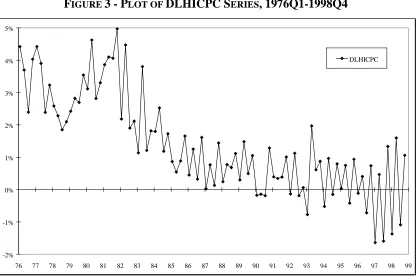
of the HICP (HICPC), given in Figure 3, also yields useful information. This series
shows a decline in the mean rate of change similar to that for the DLHICP series.
Another noticeable feature is the more violent oscillation in recent periods. This
appears to reflect a more pronounced seasonal pattern with deeper sales discounts and
subsequent rebound in prices. The more pronounced seasonal sales pattern in the
HICPC index is considered further below.
Another way to examine the properties of a time series is to plot its autocorrelogram.
The autocorrelogram plots the autocorrelation between differing lag lengths of the
time series. Plotting the autocorrelogram is a useful aid for determining the
stationarity of a time series, and is also an important input into Box-Jenkins model TABLE 1 - SUMMARY STATISTICS FOR DLHICP SERIES, 1976Q1-1998Q4
Period Mean Standard Deviation
1976Q1-1983Q4 3.49 1.79
1984Q1-1998Q4 0.71 0.56
Overall Period 1.68 1.75
FIGURE 3 - PLOT OF DLHICPC SERIES, 1976Q1-1998Q4
-2% -1% 0% 1% 2% 3% 4% 5%
[image:12.595.81.513.93.182.2] [image:12.595.92.508.378.654.2]identification. The theoretical autocorrelogram for different orders of AR, MA and
ARMA models are outlined in section dealing with model identification (Step 3). The
SACF may be constructed using equation (A4). The maximum lag length considered
is usually no more than n/4. Although sample autocorrelations for lags in excess of
twice the seasonal span (i.e., in excess of 8 for quarterly data) should be treated with
caution.
If a time series is stationary then its autocorrelogram should decay quite rapidly from
its initial value of unity at zero lag. If the time series is nonstationary then the
autocorrelogram will only die out gradually over time. Figure 4 plots the
autocorrelogram for the log of the HICP, the first differences and second differences
of the log and the seasonal difference of the first difference (for the period 1984Q1
-1998Q4). It would appear from Figure 4 that the log of levels series is nonstationary
as the autocorrelations decay slowly towards zero. At first glance the first difference
series appears stationary although there seems to be some evidence of seasonal
behaviour (the autocorrelations at lags 4, 8 and 12 exhibit distinctive behaviour and
die out quite slowly). The autocorrelogram of the second difference series is more
volatile and may indicate over-differencing. The autocorrelations of the seasonal
differences of the first difference series exhibit a quasi-sinusoidal decay pattern, which
may indicate the presence of complex roots. Based on a graphical examination of
Figure 4, the first difference of logs and the seasonal differences of the first
Figure 5 displays the autocorrelograms for various transformations of the non-energy
industrial goods (HICPC) component of the HICP. It is evident that the goods
component of the HICP exhibits a much stronger seasonal pattern than the overall
HICP. This pattern is driven primarily by the Winter and Summer sales and the
subsequent rebound. Based on Figure 5 there is a strong case for seasonally
differencing the rate of inflation in non-energy industrial goods prices (i.e., seasonally
differencing the first difference of the log of the HICPC series). FIGURE 4
-AUTOCORRELOGRAM FOR LHICP, DLHICP, DDLHICP AND DSDLHICP
-0.6 -0.4 -0.2 0.0 0.2 0.4 0.6 0.8 1.0
0 4 8 12
[image:14.595.91.507.91.374.2]Although the autocorrelogram gives some indication as to whether a series is
stationary or nonstationary, in more recent years a vast array of formal tests for
stationarity with known statistical properties have been developed.
3.2. STEP TWO - TESTING FOR STATIONARITY
The time series under consideration must be stationary before one can attempt to
identify a suitable ARMA model. A large literature has developed in recent years on
the issue of testing time series for stationarity and nonstationarity (See, for example,
Harris (1995) and Banerjee et al (1993)).
For AR or ARMA models to be stationary it is necessary that the modulus of the roots
of the AR polynomial be greater than unity, and for the MA part to be invertible it is
also necessary that the roots of the MA polynomial lie outside the unit circle. FIGURE 5
-AUTOCORRELOGRAM FOR LHICPC, DLHICPC, DDLHICPC AND DSDLHICPC
-1.0 -0.8 -0.6 -0.4 -0.2 0.0 0.2 0.4 0.6 0.8 1.0
0 4 8 12
[image:15.595.90.507.96.378.2]The original Dickey-Fuller test considered the model Xt = ρXt-1 + εt or alternatively
∆Xt = (ρ-1)Xt + εt. If the series contains a unit root, then ρ = 1 (and ρ-1 = 0). The standard t-distribution cannot be used to test if ρ = 1, the Dickey-Fuller distribution
should be used instead. However, should εt be autocorrelated, the Dickey-Fuller distribution is no longer valid either. In this case, an alternative model should be
estimated, where l lags of the first difference of the series are added until the series et
displays no evidence of autocorrelation.8
(2) ∆Xt = (ρ-1)Xt + δi t i i
l
X
∆ −
=
∑
1+ et
In this instance the Augmented Dickey Fuller test statistic should be used. Table 2
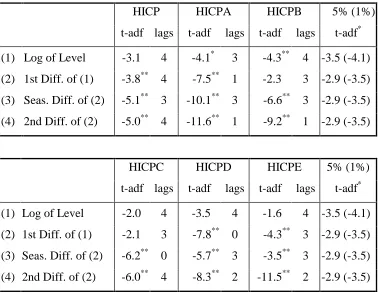
presents some summary results testing the HICP series and its major sub-components
for unit roots. The t-adf statistic is the Augmented Dicky Fuller test statistic, under
the null hypothesis that ρ-1 = 0 (or equivalently, ρ = 1). The columns denoted lags
indicate the number of lagged first differences of the series that were added to ensure
‘white noise’ error terms. The final column in each part of the table contains the 5 per
cent and 1 per cent critical values for the t-adf statistic. For the log of the levels
series, the series is tested for nonstationarity around a constant and a trend. However,
the differenced series are tested for nonstationarity around a constant solely. The
results from Table 2 indicate that: none of the levels series, except HICPA and
HICPB, is stationary around a constant and trend; all of the series except the HICPB
and HICPC series are stationary if differenced once or more.9 However, the t-adf statistics on the HICP and HICPE series differenced once are relatively low, and may
indicate the need to consider seasonal differencing.10 This issue is considered further below.
8
In practice, the number of lag differenced terms to be added is determined using model selection criteria such as the AIC and BIC outlined below. This is usually sufficient to ensure a well-behaved error term.
9
In general it is sufficient to test up to d = 2 and D = 1.
A number of less formal techniques exist for determining stationarity of a time series.
As stated above examination of the autocorrelogram can be one useful indicator. For
example, consider a pure AR(1) process. The autocorrelation at lag k of an AR(1)
process is given by φ1k
. Thus if φ1 = 1 the autocorrelogram does not decay over time. In general, the sample autocorrelogram of a nonstationary series will only decay very
slowly towards zero. However, relying solely on the autocorrelogram to determine the
stationarity of a time series tends to lead to over-differencing (Mills (1990, pg. 121)).
One way to check for over-differencing is to examine the variance of the process
(Anderson, 1976). In general the sample variance of a process will decrease until the
correct order of differencing is found, but will increase thereafter if the process is
over-differenced. Table 3 indicates that using log of levels is inappropriate for all the
HICP series. The sample variances for the HICPC and HICPE series suggest
seasonally differencing the inflation rate could be necessary as the inflation rate itself
may be nonstationary. For the other series (HICP, HICPA, HICPB and HICPD), the
sample variances indicate that using the inflation rate is sufficient to ensure TABLE 2 - AUGMENTED DICKY-FULLER TESTS, 1984Q1 - 1998Q4
HICP HICPA HICPB 5% (1%)
t-adf lags t-adf lags t-adf lags t-adf* (1) Log of Level -3.1 4 -4.1* 3 -4.3** 4 -3.5 (-4.1) (2) 1st Diff. of (1) -3.8** 4 -7.5** 1 -2.3 3 -2.9 (-3.5) (3) Seas. Diff. of (2) -5.1** 3 -10.1** 3 -6.6** 3 -2.9 (-3.5) (4) 2nd Diff. of (2) -5.0** 4 -11.6** 1 -9.2** 1 -2.9 (-3.5)
HICPC HICPD HICPE 5% (1%)
t-adf lags t-adf lags t-adf lags t-adf* (1) Log of Level -2.0 4 -3.5 4 -1.6 4 -3.5 (-4.1)
[image:17.595.89.467.91.385.2]In summary, whilst the adf test and analysis of the sample variance favour a single
differencing of the overall HICP to induce stationarity, examination of the
autocorrelogram suggests seasonal differencing. Furthermore, the variance of the
seasonal difference of the first difference of the LHICP series is only marginally
higher than the LHICP series just differenced once. In contrast, the first difference of
the HICPC series fails the adf test at the 5 per cent confidence level. The seasonal
difference of the first difference of the HICPC series passes all the tests for
stationarity. In general, when different test statistics offer conflicting evidence, it is
best to bring forward both alternatives to the forecasting stage, as the power of many
tests for nonstationarity can be quite low especially with small sample sizes.
3.3. STEP THREE - MODEL IDENTIFICATION AND ESTIMATION
Having determined the correct order of differencing required to render the series
stationary, the next step is to find an appropriate ARMA form to model the stationary
series. There are two main approaches to identification of ARMA models in the
literature. The traditional method utilises the Box-Jenkins procedure, in which an
iterative process of model identification, model estimation and model evaluation is
followed. The Box-Jenkins procedure is a quasi-formal approach with model
identification relying on subjective assessment of plots of autocorrelograms and
partial autocorrelograms of the series. Objective measures of model suitability, in
particular the penalty function criteria, have been used by some authors instead of the
traditional Box-Jenkins procedure. For a recent example of the use of objective
penalty function criteria see Gómez and Maravall (1998). However, these ‘objective’
measures are not without problems either.
TABLE 3 - SAMPLE VARIANCE, 1984Q1 - 1998Q4
HICP HICPA HICPB HICPC HICPD HICPE
(1) Log of Level 0.01280 0.00591 0.01745 0.00715 0.00222 0.02886
(2) 1st Diff. of (1) 0.00003 0.00047 0.00009 0.00007 0.00038 0.00012
(3) Seas. Diff. of (2) 0.00004 0.00106 0.00010 0.00004 0.00068 0.00010
Outside of the Box-Jenkins and penalty function criterion methods there are a number
of alternative identification methods proposed in the literature. These include, inter
alia, the Corner method (Beguin et al, 1980), the R and S Array method (Gray et al,
1978), and canonical correlation methods (Tsay and Tiao, 1985). These methods are
usually based on the properties of the autocorrelation function and do not require
estimation of a range of models, which can be computationally expensive. This lack
of computation is a significant advantage over the penalty function criterion outlined
below. However, the problem with most autocorrelation-based methods is that they
are not very useful for dealing with seasonal data. The seasonal nature of price data
makes these alternative methods less attractive for the purposes of forecasting
inflation.
3.3.1. BOX-JENKINS METHODOLOGY
The Box-Jenkins methodology essentially involves examining plots of the sample
autocorrelogram, partial autocorrelogram and inverse autocorrelogram and inferring
from patterns observed in these functions the correct form of ARMA model to
select.11 The Box-Jenkins methodology is not only about model identification but is, in fact, an iterative approach incorporating model estimation and diagnostic checking
in addition to model identification.
Theoretically Box-Jenkins model identification is relatively easy if one has a pure AR
or a pure MA process. However, in the case of mixed ARMA models (especially of
high order) it can be difficult to interpret sample ACFs and PACFs, and Box-Jenkins
identification becomes a highly subjective exercise depending on the skill and
experience of the forecaster. Random noise in time series, especially price data,
Pure AR Process
The autocorrelations of a pure AR(p) process should decay gradually at increasing lag
length. Hence, using an autocorrelogram it is not possible to differentiate between a
pure AR(3) model or a pure AR(4) model. However, the partial autocorrelations of a
pure AR(p) process do display distinctive features. The partial autocorrelogram
should ‘die out’ after p lags. Thus, the partial autocorrelogram of a pure AR(3)
process should die out after 3 lags, whereas that of a pure AR(4) process would die
out after 4 lags.
Hence, for a pure AR(p) process the theoretical ACF and PACF are as follows:
where i denotes the number of lags.
Pure MA Process
The behaviour of correlograms and partial autocorrelograms for pure MA(q) processes
is the reverse of that for pure AR processes. The autocorrelogram of a pure MA(q)
process should ‘die out’ after q lags. The partial autocorrelogram of a pure MA
process, on the other hand, only decays slowly over time (similar to the behaviour of
the autocorrelogram of a pure AR process). Thus, it should be impossible to
distinguish between the PACF of an MA(3) and MA(4) process, whereas the ACF of
the MA(3) process should decay to zero after 3 lags and the MA(4) process after 4
lags.
11 If the ARMA model φ
( )
B X θ( )
B at = t is invertible, the inverse autocorrelogram of the series, Xt, is simply the autocorrelogram of the inverted model (i.e., the ‘dual’ of the original model) given by
( )
( )
θ B Xt =φ B at. See, Chatfield (1979) for a discussion of inverse autocorrelation functions. ACF(i) ≠ 0 ∀ i
PACF(i) ≠ 0 ∀ i = 1,...,p
Thus if one has either a pure AR or MA process model identification should be
relatively straightforward in theory. Furthermore the behaviour of the
autocorrelogram and partial autocorrelogram can provide information on the AR and
MA components, in terms of sign or the existence of complex roots. For example, the
autocorrelations of a pure AR(1) process with a negative root should oscillate around
zero and decay with increases in lags, whereas the autocorrelations of a pure AR(1)
process with a positive root should decay gradually and monotonically towards zero
(assuming φ1 ≤1). The autocorrelogram of an AR(p) process with complex roots should exhibit a sinusoidal (or wave) pattern.
Mixed ARMA Processes
Unfortunately, model identification is greatly complicated for mixed (i.e., ARMA)
processes. The patterns of sample autocorrelations and partial autocorrelations of high
order ARMA models are notoriously difficult to interpret. Thus, model identification
using the BoxJenkins procedures will be an iterative process, with Step Four
-diagnostic checking - determining whether alternative models should be examined.
See Box and Jenkins (1976) for a detailed discussion of identifying mixed ARMA
process.
3.3.2. OBJECTIVE MODEL IDENTIFICATION
Because of the highly subjective nature of the Box-Jenkins methodology, time series
analysts have sought alternative objective methods for identifying ARMA models.
Penalty function statistics, such as Akaike Information Criterion [AIC] or Final Hence, for a pure MA(q) process the theoretical ACF and PACF are as follows:
ACF(i) ≠ 0 ∀ i = 1,...,q
ACF(i) = 0 ∀ i > q
(Hannan, 1980), have been used to assist time series analysts in reconciling the need
to minimise errors with the conflicting desire for model parsimony. These statistics
all take the form minimising the sum of the residual sum of squares plus a ‘penalty’
term which incorporates the number of estimated parameter coefficients to factor in
model parsimony.
These statistics take the form
(3) BIC = log rss log
( )
*n n
k n
+ ,
(4) HQC = log rss * log log
(
( )
)
*n n
k n
+ 2 , and
(5) AIC = log rss *
n
k n
+ 2
where,
k = number of coefficients estimated (1 + p + q + P + Q)
rss = residual sum of squares
n = number of observations.
Assuming there is a true ARMA model for the time series, the BIC and HQC have the
best theoretical properties. The BIC is strongly consistent whereas AIC will usually
result in an overparameterised model; that is a model with too many AR or MA terms
(Mills 1993, p.29). Indeed, it is easy to verify that for n greater than seven the BIC
imposes a greater penalty for additional parameters than does the AIC. Gómez and
Maravall (1998, p.19) also favour the BIC over the AIC.
Thus, in practice, using the objective model selection criteria involves estimating a
range of models and the one with the lowest information criterion is selected. This
can create a number of difficulties. First, it can be computationally expensive using
(3,0,3)(2,0,2) model involves estimating 144 different models. Therefore the choice
of maximum order is very important to avoid expensive computational requirements.
Unfortunately, there is no a priori information to assist in selecting the maximum
order of the ARIMA model to estimated. Moving from a maximum order of
(3,0,3)(2,0,2) to (2,0,2)(1,0,1) reduces the number of models to be estimated from 144
to 36. One useful rule of thumb for determining the maximum order is to select a
maximum for the regular terms of the seasonal span less one (i.e., three for quarterly
data or eleven for monthly data) and one for the seasonal term. Thus for quarterly
data this would suggest estimating an ARMA of maximum order (3,0,3)(1,0,1), which
implies estimating 64 different models and calculating 64 information criterion.12
Second, the different objective model selection criteria can suggest different models.
That is the ranking order based on the BIC will usually not be the same as under the
AIC. Table 4 compares the top five ranking models under the BIC, HQC and AIC for
the DLHICP series estimated over the period 1984Q1 - 1998Q4. The top ranking
model under the AIC only ranks seventh using the BIC. Furthermore, the AIC
generally favours a less parsimonious model than either the BIC or the HQC.
Third, even if one utilises only one measure (e.g., BIC), the difference between the
BIC statistic for different models is sometimes only marginal. Poskitt and Tremayne
(1987) suggest the idea of a model portfolio. This involves comparing alternative TABLE 4 - COMPARISON OF RANKING BY CRITERION
-DLHICP (1984Q1 - 1998Q4)
BIC HQC AIC
rank 1 (0,0,0) x (1,0,1) -10.646 (0,0,0) x (1,0,1) -10.709 (3,0,0) x (1,0,0) -10.773
rank 2 (0,0,0) x (1,0,0) -10.637 (3,0,0) x (1,0,0) -10.705 (3,0,0) x (1,0,1) -10.772
rank 3 (1,0,0) x (1,0,0) -10.629 (1,0,0) x (1,0,0) -10.693 (0,0,0) x (1,0,1) -10.750
rank 4 (0,0,1) x (1,0,0) -10.618 (1,0,0) x (1,0,1) -10.692 (1,0,0) x (1,0,1) -10.747
models to the best model suggested by the information criterion. Denoting the best
model as (p*,0,q*)(P*,0,Q*), the following statistic is computed for each alternative
model
(6) ℜ = −
{
(
(
)(
)
)
−(
(
)(
)
)
}
exp 1 *, , * *, , * , , , ,
2T BIC p 0 q P 0 Q BIC p0q P 0Q .
Although this statistic has no formally defined critical values, it may be used to
quantify the decisiveness with which a particular model can be rejected compared to
the ‘best’ model. Poskitt and Tremayne suggest that a value of less than 10 as a
suitable cut-off point. This implies that models with an information criterion within
( )
2log 10 T of the best model enter the model portfolio. Then, using the model
portfolio approach, not only the ‘best’ model is used in the diagnostic and forecasting
stages but all models in the portfolio. Using the DLHICP series over the period
1984Q1-1998Q4 (T = 60), the portfolio approach would consider three extra models
in addition to the model which minimised the BIC statistic. The largest portfolio
using any of the six series considered in this paper would contain five models.13
Gómez and Maravall (1998, p.21) suggest using balanced models where possible if
two models perform relatively similarly. In other words, select a model where p and q
are relatively similar rather than choosing a model with just AR terms or just MA
terms. For example, if the information criteria suggest that a (2,0,0) and a (1,0,1)
model perform similarly then Gómez and Maravall would suggest using the more
balanced model (1,0,1). One benefit of choosing balanced models might be that it
would be easier to identify common factors in the AR and MA polynomials. If an
ARIMA model has common factors it should be possible to represent the model in a
more parsimonious manner by eliminating the common factor from both the AR and
MA components.
A more general alternative approach to the model portfolio approach outlined above is
simply to select the top five or ten ranking models and carry these forward to the
diagnostic checking and forecasting stage. This is the approach adopted in the
semi-automatic ARIMA model selection algorithm outlined below.
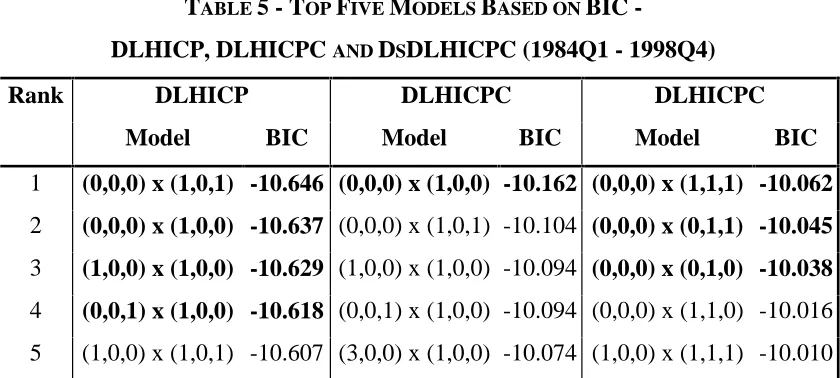
Table 5 below presents the top five ranking models as classified by the BIC for the
DLHICP, DLHICPC and DsDLHICPC series. The models indicated in bold type are
those models which would enter the model portfolio using the criterion of 10
suggested by Poskitt and Tremayne (1987).14 The results are shown for the regularly differenced (DLHICPC) and the regularly differenced plus seasonally differenced
non-energy industrial goods series (DsDLHICPC) as the tests for nonstationarity were
indeterminate between a single regular differencing and a seasonal differencing in
addition to the regular differencing. The BIC indicates that the regularly differenced
series performs slightly better than the seasonally differenced series, reflecting the
ambiguity over the correct order of differencing.
In summary, the main advantages and disadvantages of objective penalty function
criteria are as follows:
Advantages of Objective Penalty Function Criteria
TABLE 5 - TOP FIVE MODELS BASED ON BIC
-DLHICP, DLHICPC AND DSDLHICPC (1984Q1 - 1998Q4)
Rank DLHICP DLHICPC DLHICPC
Model BIC Model BIC Model BIC
1 (0,0,0) x (1,0,1) -10.646 (0,0,0) x (1,0,0) -10.162 (0,0,0) x (1,1,1) -10.062
2 (0,0,0) x (1,0,0) -10.637 (0,0,0) x (1,0,1) -10.104 (0,0,0) x (0,1,1) -10.045
3 (1,0,0) x (1,0,0) -10.629 (1,0,0) x (1,0,0) -10.094 (0,0,0) x (0,1,0) -10.038
4 (0,0,1) x (1,0,0) -10.618 (0,0,1) x (1,0,0) -10.094 (0,0,0) x (1,1,0) -10.016
[image:25.595.89.509.419.608.2]• Objective measure with no subjective interpretation.
• Results are readily reproducible and verifiable.
• BIC and HQC are asymptotically consistent.
Disadvantages of Objective Penalty Function Criteria
• Need to calculate a wide range of models. This can be computationally expensive.
• There are no theoretical guidelines for choosing the maximum order of ARIMA model to consider.
• Sometimes there is little to chose between competing models.
3.4. STEP FOUR - MODEL DIAGNOSTICS
“An econometrician should never fall in love with his/her model”
The fourth step will be the formal assessment of each of the time series models. This
will involve a rigorous assessment of the diagnostic tests for each of the competing
models. As different models may perform reasonably similarly, a number of
alternative formulations may have to be retained at this stage to be further assessed at
the forecasting stage.
There are a number of diagnostic tools available for ensuring a satisfactory model is
arrived at. Plotting the residuals of the estimated model is a useful diagnostic check.
This should indicate any outliers that may affect parameter estimates and also point
towards any possible autocorrelation or heteroscedacity problems. A second check of
model suitability is to plot the autocorrelogram of the residuals. If the model is
correctly specified the residuals should be ‘white noise’. Therefore, a plot of the
autocorrelogram should immediately die out from one lag on. Any significant
autocorrelations may indicate that the model is misspecified and may point to the
solution. For example, if a (0,0,1)(0,0,0) model of a quarterly time series is estimated,
but the autocorrelogram of the residuals indicates a significant autocorrelation at the
fourth lag, this would indicate that a (0,0,1)(0,0,1) model should be estimated, as this
might remove the autocorrelation at the fourth (seasonal) lag. Figure 6 plots the ACF
of the residuals from the (0,0,0)(1,0,1) model of DLHICP fitted over the period
1984Q1 - 1998Q4. In general, the autocorrelations are not significantly different from
zero, however, the autocorrelations at lags three, five and eight are marginally
significant.
More formal test statistics exist which involve testing the residuals of the estimated
model. The Ljung-Box (1978) Q statistic is the most commonly used test statistic.
The Q-statistic tests for autocorrelation in the residuals where Q is defined as
(7) Q k
( ) (
T T) (
T i)
ri ik
= + − −
=
∑
2 1 2
1
∼a χ
k
2
.
FIGURE 6 - PLOT OF ACF OF RESIDUALS
FROM (0,0,0)(1,0,1) MODEL OF DLHICP SERIES, 1984Q1-1998Q4
-0.4 -0.2 0.0 0.2 0.4 0.6 0.8 1.0
0 4 8 12
[image:27.595.92.507.259.544.2]time this indicates that further consideration will have to be given to the model. It
may be that the time series contains a structural break and that, for the purposes of
forecasting, only the period since the structural break should be used when estimating
the model, as there can be a fundamental conflict between estimating a model to
maximise in-sample goodness-of-fit and optimising out-of-sample forecast
performance when the series contains a structural break. A formal test for
nonstationarity in the presence of a structural break may be carried out using Perron’s
(1989) augmented unit root test. Examining the DLHICP data using Perron’s
augmented unit root test, allowing for a structural break, indicates that the data are
stationary post-1983, with the statistic on the structural break being maximised around
1983.
3.5. STEP FIVE - FORECASTING AND FORECAST EVALUATION
If the univariate modelling procedure is being utilised for forecasting purposes then
this step can also form an important part of the diagnostic checking. Using ARIMA
models for forecasting is relatively straightforward.
For example, consider a non-seasonal (1,0,1) model. The estimated model is given by
(8) Xt =φ1Xt−1+at +θ1at−1
Then the forecast value one period ahead conditional on all information up to time, t,
is simply given by
(9) XtF+1|t =φ1Xt +θ1at
as Et(at+i) equals zero ∀ i>0.
(10) Xt t X
F
t t F
+2| =φ1 +1| , as Et(at+1) and Et(at+2) equal zero and replace Xt t F
+1| with the
value given in equation (9).
(11) XtF+3|t =φ1XtF+2|t
and so on.
To assess the out-of-sample forecasting ability of the model it is advisable to retain
some observations at the end of the sample period which are not used to estimate the
model. One approach is to estimate the model recursively and forecast ahead a
specific number of observations. For example, consider a time series with data
available from 1976Q1 to 1998Q4 and we wish to forecast four steps ahead (i.e.,
1999Q1-1999Q4). We could initially estimate the model over the period 1976Q1 to
1992Q4 and forecast four steps ahead. Then re-estimate the model over the period
1976Q1 to 1993Q1 and forecast four steps ahead. Repeat this process until the
estimation period leaves no out of sample observations available for forecast
evaluation (i.e., 1976Q1 to 1998Q4). Using the actual inflation data over the period
1992Q1 to 1998Q4, this allows us to calculate 24 one step ahead forecast errors, 23
two-step ahead forecast errors, ..., and 21 four-step ahead forecast errors. These can
be used to calculate statistics such as mean error (ME), mean absolute error (MAE),
root mean squared error (RMSE) and Theil’s U.
Denoting the forecast error as et = Xt − XtF (i.e., the difference between the realised
value of the series and the forecast value), then
(12) ME = 1
1
F i et F
=
∑
(13) MAE = 1
1
F i et F
=
(15) Theil’s U =
( )
( )
1 1 2 1 2 1 F e F e t i F t N i F = =∑
∑
= RMSE RMSEN where,F equals the number of out-of-sample observations retained for forecast evaluation
allowing for the forecast step, and
N denotes the naive model of no change in the modelled series from the last available
observation.
One indication that the model specification could be improved is if the ME for each of
the five steps are either all positive or all negative. This would indicate that the model
is either forecasting too low on average (if positive) or too high on average (if
negative).
If the ME is of the same magnitude as the MAE this would also indicate that the
model is forecasting consistently either too low (if the ME is positive) or too high (if
the ME is negative).
The RMSE will always be at least as large as the MAE. They will only be equal if all
errors are exactly the same. Theil’s U statistic calculates the ratio of the RMSE of the
chosen model to the RMSE of the ‘naive’ (i.e., assuming the value in the next period
is the same as the value in this period - no change in the dependent variable)
forecasting model.15 Thus, a value of one for the Theil statistic indicates that, on average, the RMSE of the chosen model is the same as the ‘naive’ model. A Theil
statistic in excess of one would lead one to reconsider the model as the simple ‘naive’
model performs better, on average. A Theil statistic less than one does not lead to
automatic acceptance of the model, but does indicate that, on average, it performs
better than the ‘naive’ model. The advantage of the Theil statistic is that it is
‘unitless’ as it compares the RMSE of the chosen model to that of the ‘naive’ forecast
model. The ME, MAE and RMSE all vary depending on the dimension (or scale of
measurement) of the dependent variable. The Theil statistic also provides a quick
comparison with the ‘no change’ model and, as such, is a measure for one-step ahead
forecasts of the additional forecasting information the model provides beyond a
random walk model.
An additional test of the ARIMA model would be to compare its performance with
competing models including alternative ARIMA specifications and multivariate
models.
These tests should be carried out on the range of models carried over from the
diagnostic checking phase. Should some models forecast significantly worse than
others this may be an indication of parameter instability or unit root problems if some
of the factors of the AR or MA polynomials are close to or greater than unity.
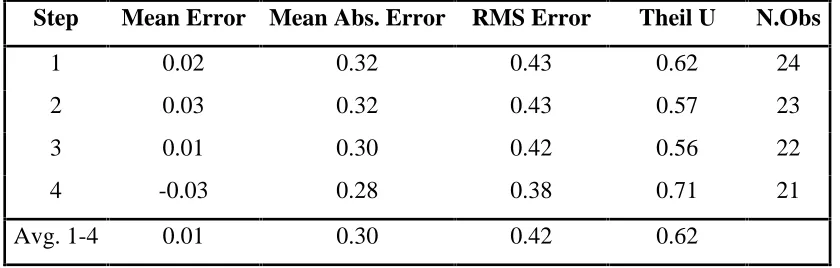
Table 6 below presents some forecast statistics for DLHICP series estimated over the
period 1984Q1 to 1998Q4. These statistics were calculated by first estimating the
model over the period 1984Q1 to 1992Q4 and forecasting four steps ahead. The
model was then recursively estimated, stepping forward one quarter at a time, and
again forecast four steps ahead. As the sample period reaches 1998Q1, obviously one
cannot forecast four steps ahead. Hence the number of forecast observations available
declines with each step. The main points to note from Table 6 are as follows:
• The RMSE varies between 0.43% and 0.38%.16 This implies a 90 per cent confidence interval of approximately 1.4 per cent per quarter. Although this
appears high relative to the mean of the series, it compares favourably with results
reported by Cecchetti (1995) for the United States who calculated a 90 per cent
confidence interval of approximately 1.3 per cent for one step ahead inflation
forecasts by a commercial inflation forecaster. These results also compare
short horizons the Irish HICP as reported by Kenny et al (1998). For longer
horizons (i.e., in excess of 4 quarters) the BVAR model outperforms the ARIMA
model.
• The mean errors are significantly lower than the mean absolute error. This implies that the forecasts are neither systematically over-forecasting or under-forecasting
inflation.
• The sign of the mean error varies by step. Again this implies that the forecasts are
neither systematically over-forecasting or under-forecasting inflation.
• The Theil statistics are consistently below unity, indicating that the selected model
outperforms the simple naive model. However, note that a straight line model (i.e.,
(0,0,0)(0,0,0) model) also outperforms the naive model.
In fact the fitted model (0,0,0)(1,0,1) is little more than a straight line model with
allowance for a degree of seasonality.17 Given the relatively stable pattern of inflation over the period, it is perhaps unsurprising that this model outperforms more elaborate
models. It does indicate that, over the period 1993Q1-1998Q4, it would be difficult to
improve on a very simple model of inflation. Thus over a short horizon forecast
statistics from multivariate models are unlikely to outperform in any significant way
the forecast statistics presented here for a relatively simple ARIMA model.
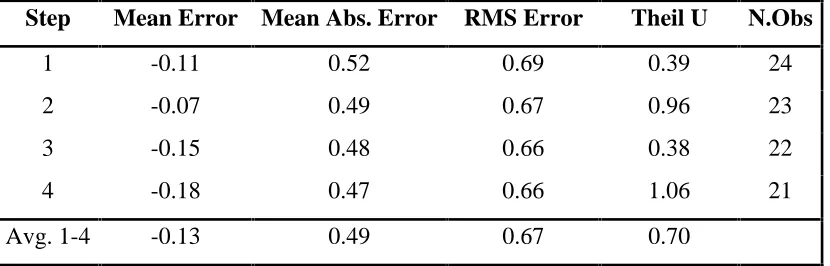
Tables 7 and 8 present forecast statistics using DLHICPC and DsDLHICPC over the
same period. Examining the forecast statistics for DLHICPC first, the impact of TABLE 6 - FORECAST STATISTICS FOR (0,0,0)(1,0,1) MODEL OF DLHICP
(1993Q1 - 1998Q4)
Step Mean Error Mean Abs. Error RMS Error Theil U N.Obs
1 0.02 0.32 0.43 0.62 24
2 0.03 0.32 0.43 0.57 23
3 0.01 0.30 0.42 0.56 22
4 -0.03 0.28 0.38 0.71 21
[image:32.595.86.506.542.676.2]seasonal sales is shown up in the Theil statistics for the second and fourth step
forecasts, which are significantly higher than those for other steps. This is directly as
a result of the volatile nature of the series, with increases in one period generally being
followed by decreases in the next. Hence, outperforming the naive forecast at odd
steps would be expected. However, at even steps (i.e., when Summer and Winter
sales and there respective rebounds coincide) the naive model will perform relatively
well. Also note that the RMSE of the forecasts is higher than for the overall HICP
indicating the greater volatility of the series. The RMSE vary between 0.66% and
0.69% (compared to approximately 0.42% for the overall HICP). There is little
difference between Tables 7 and 8. The RMSE and Theil statistics are broadly
similar, perhaps, reflecting the degree of ambiguity present in the tests for stationarity
of the DLHICPC series. The results are obtained for the DLHICPE (services) series
are somewhat similar to those for the DLHICPC series. Based on these results
perhaps consideration of Autoregressive Fractionally Integrated Moving Average
(ARFIMA) models for modelling the DLHICPC and DLHICPE series might be
justified.
TABLE 7 - FORECAST STATISTICS FOR (0,0,0)(1,0,0) MODEL OF DLHICPC (1993Q1 - 1998Q4)
Step Mean Error Mean Abs. Error RMS Error Theil U N.Obs
1 -0.11 0.52 0.69 0.39 24
2 -0.07 0.49 0.67 0.96 23
3 -0.15 0.48 0.66 0.38 22
4 -0.18 0.47 0.66 1.06 21
[image:33.595.90.505.476.609.2]The forecast results for the other series are presented in Appendix C. The series with
the highest RMSE, at 1.9 per cent, is the unprocessed food (HICPA). This compares
to a mean of 0.64 per cent for that series. Seasonally differencing the overall HICP
does not improve the forecast statistics. The RMSE increases from an average of 0.42
per cent to 0.58 per cent. All of the ARIMA models chosen outperform the simple
naive model. This is true even for the straight line fitted to the energy series (HICPE),
indicating that a Theil statistic of less than unity does not necessarily imply that a
strong model has been found.
In general for the HICP and its sub-component series considered in this paper, a
relatively parsimonious ARIMA representation has been found to be optimal both for
fitting the in-sample data and for maximising the out-of-sample forecasting
performance. This is an indication of the relative stability of inflation during the
period in question and the dominance of the seasonal influence.
4. OUTLINE OF SEMI-AUTOMATIC ARIMA MODELLING ALGORITHM18
This paper has outlined an approach to ARIMA modelling. The approach is as
follows:
18
For a fully automatic univariate modelling procedure see Gómez and Maravall (1998). Their program also allows for outlier detection, which is not available in the program developed for this paper. Nonetheless the forecast statistics for the HICP generated using the semi-automatic algorithm are broadly similar to those generated using the automatic program by Gómez and Maravall.
TABLE 8 - FORECAST STATISTICS FOR (0,0,0)(1,1,1) MODEL OF DLHICPC
(1993Q1 - 1998Q4)
Step Mean Error Mean Abs. Error RMS Error Theil U N.Obs
1 0.17 0.52 0.66 0.37 24
2 0.20 0.53 0.67 0.95 23
3 0.14 0.49 0.62 0.36 22
4 0.10 0.46 0.59 0.95 21
• First, plot data and transformations of the data (consider possibility of outliers and
structural breaks);
• Second, test for stationarity using both formal and informal tests;
• Third, run automatic algorithm which does the following:19
− Estimates all 64 ARIMA models encompassed by (3,0,3)(1,0,1) model;
− Calculate information criterion and Q statistic for all 64 models;
− Provided models have properly converged and contain no unit roots in the
AR and MA polynomials, rank models according to BIC;
− Select top 10 performing models and compute forecast statistics using
out-of-sample data;
− Select model which optimises forecast performance.
5. CONCLUDING COMMENTS
This paper has considered autoregressive integrated moving average (ARIMA)
forecasting. ARIMA models are theoretically justified and can be surprisingly robust
with respect to alternative (multivariate) modelling approaches. Indeed, Stockton and
Glassman (1987, pg. 117) upon finding similar results for the United States
commented that “it seems somewhat distressing that a simple ARIMA model of
inflation should turn in such a respectable forecast performance relative to the
theoretically based specifications.”
A framework for ARIMA modelling is identified which includes the following steps:
data collection and examination; determining the order of integration; model
identification; diagnostic checking; and, forecast performance evaluation.
Two alternative approaches to model identification are considered: the traditional
Box-Jenkins approach which can be highly subjective; and, the objective penalty
range of models, which perform satisfactorily at the model identification and
diagnostic checking phases, for use in forecast performance evaluation. This approach
is open to criticism of ‘model mining’, but since forecast performance is the
overriding objective, this approach can be justified.
A general rule of thumb for univariate forecasting is to test, test and test at all stages
of the process. Tests should be carried out across different time periods. Parameter
stability should be determined. If stationarity is in doubt estimate the model in first
differences and with seasonal differencing.
A semi-automatic algorithm has been developed for fitting an ARMA model to
stationary time series data. The advantage of this algorithm is that it uses the
objective penalty function criteria to select the optimal ARMA model, thus removing
the subjectivity associated with the traditional Box-Jenkins methodology. It also
recognises the conflict between model goodness-of-fit and out-of-sample forecasting
performance. The algorithm is not fully automatic as it is always vital that the time
series analyst undertakes a rigorous check of the models for consistency over time and
for error autocorrelation.
Although the forecasting results for the sample period 1993Q1-1998Q4 compare quite
favourably with those derived from BVAR analysis, this does not mean that univariate
modelling can supplant multivariate techniques. The period in question was one of
relatively stable inflation. ARIMA models may not perform as well with more
volatile series. Furthermore, ARIMA models are ‘backward looking’ and are
generally poor at forecasting turning points. Also well-specified multivariate models
generally perform better than ARIMA models over longer time horizons.
One possible way to improve the forecasting performance is to attempt to fit an
ARIMA model to a ‘noiseless’ version of the HICP series. This would involve
applying statistical techniques, following Bryan and Cecchetti (1993), to remove
‘noisy’ random fluctuations from the measured inflation rate. This has the advantage
that with the noise removed there would be less likelihood of parameter estimates
constructed ‘noiseless’ series, indicates that the optimal ARIMA model does indeed
A
PPENDIXA - A B
RIEFO
VERVIEW OFARIMA M
ODELSA general class of univariate models is the Autoregressive Integrated Moving Average
(ARIMA) model. An ARIMA model represents current values of a time series in
terms of past values of itself (the autoregressive component) and past values of the
error term (the moving average terms). The integrated component refers to the
number of times a series must be differentiated to induce stationarity.20
A.1. AR MODELS
A pure AR(p) process may be represented as follows, where Xt is modelled as lagged
values of itself plus a ‘white noise’ error term.
(A1) Xt =φ1Xt−1 +φ2Xt−2+ +... φpXt p− +at = − + =
∑
φi t i ip
t
X a
1
This may be written alternatively as,
(A2) φ( )B Xt =at
where, φ( )B is a p-order polynomial in the backshift operator
(i.e., 1−φ1B−φ2B2− −... φpBp), and B is the backshift operator, such that
B X0 t = Xt
, B X1 t Xt
1
= − , B X2 t Xt
2
= − , ...
A useful way of gaining insight into univariate processes is to consider their
autocorrelation and partial autocorrelation functions (ACF and PACF).
20
The ACF measures the ratio of the covariance between observations k lags apart and
the geometric average of the variance of observations (i.e., the variance of the process
if the process is stationary, as V(Xt) = V(Xt-k)).
(A3)
(
)
( ) (
)
[
]
ρk γγ
t t k
t t k
k
Cov X X
V X V X
= • = − − , 1 2 0
The sample autocorrelation function (SACF) may be calculated as follows21;
(A4)
(
)(
)
(
)
r
X X X X
X X
k
t t k
t k n t t n = − − − − = + =
∑
∑
1 2 1However, some of the observed autocorrelation between Xt and Xt-k could be due to both being correlated with intervening lags. The PACF seeks to measure the
autocorrelation between Xt and Xt-k correcting for the correlation with intervening
lags. For example, consider an AR(1) process of the form Xt = 0.8 Xt-1 + at. The first
order autocorrelation coefficient is 0.8. The autocorrelation coefficient for the second
lag is 0.64 (i.e., 0.8 * 0.8), although the partial autocorrelation coefficient for the
second lag is zero, as the process is an AR(1) process. In other words the
autocorrelation between observations two lags apart is due only to the correlation
between observations one lag apart which feeds through into the second lag. As the
lag length increases the autocorrelation coefficient declines (at lag length k the
autocorrelation coefficient is (0.8)k).
The PACF is calculated as the partial regression coefficient, φkk, in the kth order autoregression
Thus, for an AR(p) process, φkk = 0 ∀ k > p.
Some general properties of the ACF and PACF for AR processes can be observed by
considering a simple AR(1) process.
(A6) Xt =φ1Xt−1 +at
Note that the AR(1) model can be written as an infinite length MA process, providing
φ1 < unity. Denote the AR(1) series as,
(A7)
(
1−φ1B X)
t =at, where B is the backshift operator as before, which gives(A8) Xt = −
(
1 φ1B)
−1at which upon expansion and providing φ1 < unity yields(A9) Xt =at +φ1at +φ12at− +φ at− +
2 1 3
3 ....
This result holds more generally so that any finite order stationary AR process may be
expressed as an infinite order MA process. This duality between AR and MA
processes is an important property which can often be exploited when attempting to
identify ARMA models.
For the AR(1) process the value of the ACF at lag k is given by φ1k. The value of the autoregressive coefficient can yield some insight into the underlying data generating
process. For example, higher values of φ1 indicate a higher degree of persistence in the series. A negative autoregressive component indicates a process which oscillates
around its mean value.
For more general AR(p) models, the behaviour of the process is determined by the
solution to the p-order polynomial (1 1 2 2
−φ B−φ B − −φpB
p
... ), given by
21 Note, for large n, r
(A10) φ
( )
B = −(
1 g B1)(
1−g B2)
...(
1−g Bp)
=0For the process to be stationary it is a necessary and sufficient condition for the roots
of the p-order polynomial to lie outside the unit circle, i.e., 1g
i
> unity ∀ i = 1,...,p).
A.2. MA MODELS
A MA(q) process may be represented as follows, where Xt is modelled as the
weighted average of a ‘white noise’ series.
(A11) Xt =at +θ1at−1 +θ2at−2+ +.. θqat q− = −
=
∑
θj t j jq
a
0
or alternatively,
(A12) Xt =θ( )B at
where,
at is a ‘white noise’ series,
θ( )B is a q-order polynomial in the backshift operator (i.e.,
1+θ1B+θ2B2+ +... θqBq), and
B is the backshift operator, B at at
0 =
, B at at
1
1
= − , B at at
2
2
= − , ...
Note that the expected value of Xt equals zero. Furthermore, the autocorrelation
between Xt and Xt+k equals zero for k greater than q. Thus the order of the MA
process, q, indicates the ‘memory’ of the process. All MA processes are stationary,
regardless of the coefficients of the model. However, to ensure invertibility of the
model (i.e., that the finite order MA process can be written in terms of a stationary
infinite order AR process) the roots of the MA polynomial must lie outside the unit
circle. MA models can be particularly useful for representing some economic time