CRM Customer Value based on Constrained Sequential
Pattern Mining
1
Bhawna Mallick,
1Deepak Garg and
2Preetam Singh Grover
1
Department of Computer Science & Engineering Thapar University, Patiala India
2
Department of Computer Science & Engineering Guru Tegh Bahadur Institute of Technology
GGS Indraprastha University, Delhi, India
ABSTRACT
The role of data mining has become increasingly important for an organization that has large databases of information on customers. Customer Relationship Management (CRM) systems are implemented to identify the most profitable customers and manage the relationship of company with them. Intelligent data mining tools and techniques are used as backbone to the whole CRM initiative taken by the companies. Data mining tools search the data warehouse maintained by the companies and predict the hidden patterns and present them in form of a model. Strategic decisions about the customers can be taken based on the outcomes of these models. The data mining researchers have presented various mining algorithms to extract patterns in data for successful CRM approach. These approaches are however facing several problems like they are not business-focused and often results in enormous size of data after applying mining approaches. They have no relevant mechanism to provide guidance for focusing on specific category of customers for business profitability. In this article, the requirements of sequential pattern mining process for CRM environment is described, and then a novel constraint guided model for knowledge discovery process is proposed. We have suggested even how the selection of appropriate constraints can be made from the perspective of customer value analysis.
General Terms
Data Mining, Customer Relationship Management.
Keywords
Customer Relationship Management, CRM, Sequential Pattern mining, Constraint, Customer Value Analysis.
1.
INTRODUCTION
There have been various studies conducted on consumer purchasing behaviors and further implemented in real problems. A regular customer is always very important for any enterprise, as the cost of acquiring a new customer is far more than maintaining a regular customer. In fact, repeat purchase is very popular especially in consumer goods industry. So, if the marketing managers are able to find and satisfy the regular customers’ requirement, they can develop long-term and pleasant relationships with them. Many techniques including statistical surveys, data mining are used to study customer behavior. Data mining techniques search through a database without any specific pre-determined hypothesis to obtain implicit, previously unknown, and potentially useful information including knowledge rules, constraints and regularities. There are various successful applications in areas such as marketing, finance and banking. Data Mining is the process in which the enterprise extracts its
useful knowledge from a huge collection of incomplete, and random information that has been generated from the production, marketing and customer services of the enterprise. With the extensive use of databases, the application domains of data mining are becoming more extensive. It is appropriate as performs operations like extraction, transformation, analysis, and other models of treatment to the abundant business data in the commercial databases.
Sequential pattern mining (SPM), a variant of data mining is particularly more useful in commercial applications, as can be used to discover customers’ behavioral and purchasing patterns over time. It considers a dataset as being made of data-sequences, which are lists of items purchased by individual customers over time. The objective of SPM is to find all the frequent subsequences in the dataset. Existing studies in this area often focus on finding sequential patterns based on the frequency with which these patterns occur in the data like the number of customers purchase a memory card, a computer game, and a printer in sequence. For businesses, not all customers have the same value; usually there co-exist all types of customers. Any enterprise has limited corporate resources, so the customer value analysis becomes very important.
1.1
Motivation for the study
There is lot of research made in using the data mining technique for CRM. This paper contributes in the following manner:
a) It specifies the importance of sequential pattern mining over data mining techniques for CRM. b) Give fair understanding for the usefulness of
incorporation of constraints in sequential mining for CRM.
c) It mentions the need of applying constraints in a particular phase for CRM purpose.
d) It is the first paper to specify the selection of constraints based on customer value analysis.
useful, apart from frequency in customer value analysis, an integral part of CRM. The constraint guided method can assist managers in developing better marketing strategies.
1.2
Organization of the Paper
The rest of this article is organized as follows: In Section 2, we briefly introduce the work done in the area of CRM using data mining techniques. In Section 3, we describe the problem associated with the studies done so far and how we can resolve them using our proposed approach. The basis of selection of constraints for CRM customer value analysis is discussed in Section 4. We have concluded our study in Section 5.
2.
CUSTOMER RELATIONSHIP
MANAGEMENT AND CUSTOMER
VALUE ANALYSIS
Customer Relationship Management (CRM) is very important for any organization to know the relationship between customers and their organization [1]. Any focused company need to identify the problems of customers and enhance their cohesion with them. CRM is the utilization of customer related information or knowledge to deliver relevant products or services to customers. Customer satisfaction helps in achieving the bottom-line business performance. This could be in the form of increased purchased volumes or repetitive purchases. It even helps in generation of new business in the form of references and prospect identification.
2.1
Related Work
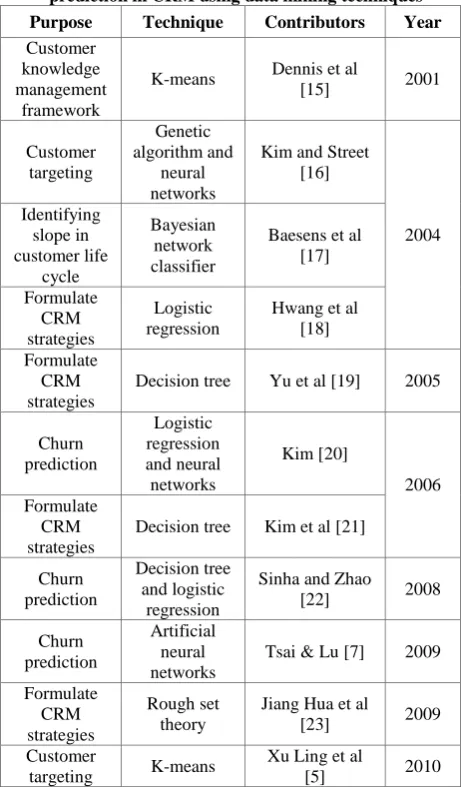
The concept of customer relationship management has gained its importance since early 1980s. Many CRM-related researches have used data mining techniques to analyze and understand customer behavior and characteristics [2, 3, 4, 5, 6, and 7]. These studies have revealed that the data mining techniques can be very vital to obtain useful knowledge from a huge customer database. To analyze and predict the customer purchasing behavior and accordingly formulate the marketing and sales strategies most researches utilize classification of customers in CRM domain. Classification tasks have been carried out for various purposes in CRM domain as given in Table 1. All these studies make use of data mining techniques of neural networks, K-means, logistic regression etc for customer classification.
[image:2.595.310.541.90.484.2]However, there are other data mining techniques like association rules and/or sequential patterns mining which are useful for the analysis of customer data. These techniques have been implemented for various purposes in CRM domain, as they are based on identification of customer purchasing patterns. There has been some study done using them as well in CRM domain. The sequential pattern is used to predict future complaint [8] and to predict network banking churn [9]. Market basket analysis to identify association rules [10] and use of both artificial neural networks and association rules to develop online personalized sales promotion [11] has been discussed. In recent time, the use of association rules to select variables for churn prediction [12] and study of the sequential pattern mining for discovering customers’ purchasing patterns over time [13, 14] has been done. They have incorporated the constraints in mining from customers’ purchasing data. However, the customer segmentation/ classification methods based on constraint incorporated generated purchasing sequences are underdeveloped.
Table 1. Research work for customer classification/churn prediction in CRM using data mining techniques Purpose Technique Contributors Year Customer
knowledge management
framework
K-means Dennis et al
[15] 2001
Customer targeting
Genetic algorithm and
neural networks
Kim and Street [16]
2004 Identifying
slope in customer life
cycle
Bayesian network classifier
Baesens et al [17]
Formulate CRM strategies
Logistic regression
Hwang et al [18]
Formulate CRM strategies
Decision tree Yu et al [19] 2005
Churn prediction
Logistic regression and neural networks
Kim [20]
2006 Formulate
CRM strategies
Decision tree Kim et al [21]
Churn prediction
Decision tree and logistic
regression
Sinha and Zhao
[22] 2008
Churn prediction
Artificial neural networks
Tsai & Lu [7] 2009
Formulate CRM strategies
Rough set theory
Jiang Hua et al
[23] 2009
Customer
targeting K-means
Xu Ling et al
[5] 2010
In our study, we have suggested the use of constraint-based sequential pattern mining over association rules. This article focuses on establishing the customer value evaluation method, an important aspect of CRM. Further, how customer value parameters could be used in selection of constraints.
3.
PROBLEM DEFINITION
Sequence data analysis is to discover patterns of sets of sequences. For example, the purchasing history of an online shopper represents the customer's online shopping behavior. If we have thousands such sequences, we can discover the several major patterns of these sequences. These patterns can be useful for us to understand the customer behavior based on the online customers' purchasing sequences and further classify them as per their purchasing characteristics.
business strategy of enterprise which centers on customers. Although there has been a great deal of effort put forth on sequential pattern mining in recent years, its performance is still far from satisfactory. The main reasons are the search spaces being large enough and the ineffectiveness in handling dense datasets. As the large number of sequential patterns results from the mining, make them difficult to understand and hard to use. The computational cost involved is high as it is not focused on users’ interesting patterns so making it inefficient. In general, sequential pattern mining techniques either result in enormous or very few patterns based on the given support threshold. For a larger support threshold, the mining results with almost no or very few patterns that satisfy the threshold. On the other hand, if support threshold is small, the mining would result with enormous patterns. Therefore, the customer relationship management (CRM) applications based on sequential pattern mining techniques [24, 25], are based on assumption that the importance of each customer are the same. Many studies in CRM show that not all customers have the same contribution to business, and, to maximize business profit, it is necessary to evaluate customer value before the design of effective marketing strategies. Therefore, the consideration to customer value is essential in the process of sequential pattern discovery. This could be achieved by incorporation of additional constraints into mining process.
A constraint ‘C’ for sequential pattern mining is a Boolean function C (α) on the set of all sequences. The problem of constraint-based sequential pattern mining is to find the complete set of sequential patterns satisfying a given constraint ‘C’. We propose in this article that constraint based sequential pattern mining can play a successful part in CRM. The constraint based mining techniques analyze in detail customer transactions for different business purposes and discover rules from resultant small but efficient and effective sequential patterns. These rules can help corporate decision makers to formulate better marketing plan or operational strategies for CRM and actively offer products that might interest the customers. This further enables organizations to optimize revenue and increase value through a more complete understanding and fulfillment of customer needs. The goal of CRM is to retain high value customers and win new customers with much potential value. This gives win-win situation for both customers and enterprises through perfect customer satisfaction and profitable enterprises at the same time. In today’s competitive market, the enterprise who has stable customer relationship will no doubt win the competition. So, the basic principle is that to find valuable information from a lot of raw data in the database to help decision-makers understand the potential connection between data, discover useful elements which are always ignored, thereby to grasp the regular pattern, forecast trends in order to facilitate business specific decision-making. This is what we could achieve with the aid of constraint-based sequential pattern mining.
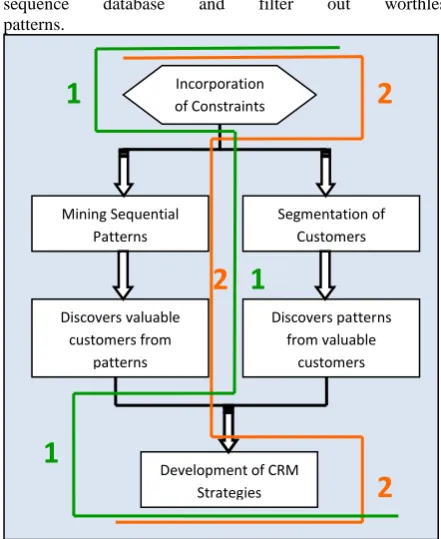
A very important next step is how and when to apply the constraints in the mining process for CRM applications. It could be implemented by two approached, as given in Figure 1 and explained as follows:
1. Perform customer segmentation based on constraints and then discovering patterns from valuable customer group [26, 27, and 28].
2. Incorporating constraints in the sequential mining process and classifying the customers based on the
sequential patterns discovered. This is more complicated as it involves the redesigning of the sequential pattern mining technique to incorporate the constraints.
The first approach has the following shortcomings:
a) This would require the fair knowledge of both the clustering and sequential pattern mining techniques. b) It works well when we have patterns of single item or items with similar constraint value to be used for customer segmentation.
c) Loss of useful and interesting patterns during constraint based customer segmentation. For example, an interesting purchasing pattern of egg and milk by a group of customers would be overlooked for a large grocery shop in compared to a pattern of expensive cosmetic item-sets, if we have to segment the customers in terms of purchase worth.
On the other hand, the second approach supported by us, requires a one-time effort. We need to redesign the sequential pattern mining approach using constraints for the first time and then it could be used to get the useful patterns. These discovered constraints based patterns could be analyzed to classify the customers.
[image:3.595.314.535.379.649.2]By setting adequate thresholds of the business specific constraints the mining algorithms search complete customer sequence database and filter out worthless patterns.
Fig 1: Approaches to incorporate the Constraints and develop business-specific CRM strategies
Recently, the concept of constraints has been integrated into the mining of valuable sequential patterns [13, 14, 29, 30, and 27]. Most of these are based on using the first approach. We in our study recommend for the second approach.
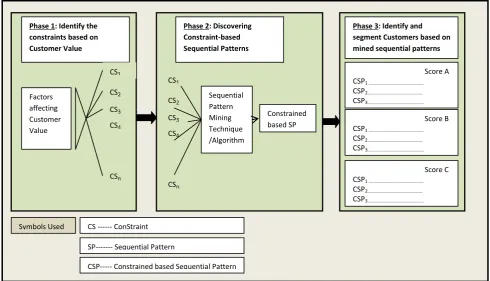
Our proposed method (as given in Figure 2) suggests the use of three phases for the second approach. In this, the phase 1, identify the constraints as per the parameters of customer
Incorporation of Constraints
Development of CRM Strategies
Segmentation of Customers Mining Sequential
Patterns
Discovers patterns from valuable
customers Discovers valuable
customers from patterns
2
2
2
2
1
1
Phase 3: Identify and segment Customers based on mined sequential patterns
Score A
CSP1 ………
CSP2………
CSP3……….
Score B
CSP1 ………
CSP2………
CSP3……….
Score C
CSP1 ………
CSP2………
CSP3……….
Phase 1: Identify the constraints based on Customer Value
Factors affecting Customer Value
CS1
CS2
CS3
CS4
CSn
Constrained based SP Phase 2: Discovering
Constraint-based Sequential Patterns
Sequential Pattern Mining Technique /Algorithm s CS1
CS2
CS3
CS4
CSn
CS --- ConStraint
SP--- Sequential Pattern
CSP--- Constrained based Sequential Pattern Symbols Used
value. In next phase, we recommend to use these selected constraints in sequential pattern mining applied on customers’ transaction database. In last phase, identify and classify/ segment the customers based on the discovered patterns. This could even be done by giving appropriate score to each customer based on the number of constraints satisfied by him in each purchased sequences. There is some work done for last two phases like for phase 2, [13, 31] and phase 3 [14]. However as far as our knowledge no study is made on how
[image:4.595.51.542.174.455.2]the constraints could be appropriately be selected from the customer value analysis perspective. We, in our study have proposed that the customer value analysis, an important aspect of CRM, can be efficiently done by the selection of appropriate constraints. The next section discusses in detail regarding the selection of constraints that would aid the CRM customer value.
Fig 2: Three phases of our proposed approach of using constraints for CRM domain
4.
SELECTION OF CONSTRAINTS FOR
SEQUENTIAL MINING FROM THE
CUSTOMER VALUE PERSPECTIVE
CRM in its broadest sense simply means managing all customer interactions [32, and 33].As discussed in previous sections, this leads to a collection of large amount of data. Any enterprise is interested in only useful information that is important from business perspective from this huge dataset. To get this application or business specific information we can apply the constraints. This reduces the number of transactions by eliminating the unnecessary datasets and focus only on useful and required business-related knowledge.
The selection of appropriate constraints for the CRM can be done with the help of customer value analysis. In general, any enterprise in order to develop new customers retains old customers. However not all customers have the same value for the enterprises. Usually, any enterprise would have limited resources, which could not be shared equally among all its customers. So, it is very important to perform customer value analysis. The evaluation of customer and classifying them accordingly can help the company to identify and focus on its real valuable customers. The main objectives of any enterprise for customer relationship management are customer value analysis and to improve customer retention rate.
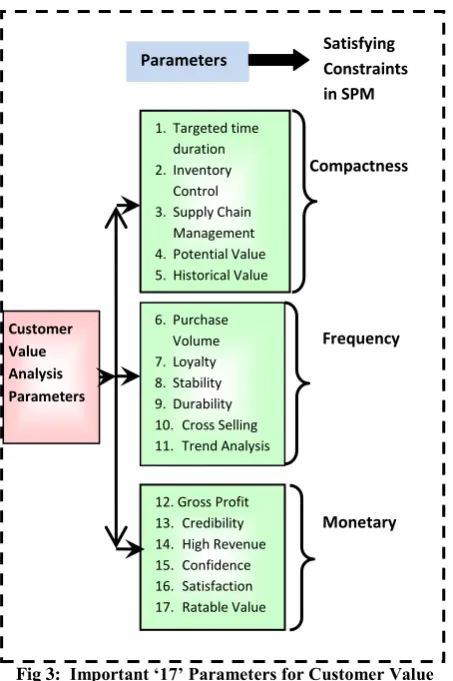
Fig 3: Important ‘17’ Parameters for Customer Value Analysis Model
4.1
To acquire new customers by studying
the characteristics of existing customers
over a particular duration: Compactness
constraint
The major indexes of business development for any commercial area include the ability of acquiring new customers [34]. In fact, the CRM initiate with the activity of identifying prospects and converting them to customers. It is vital to understand the potential demand of product/s or items for a particular duration of period to acquire new customers. This could be aided with the study of sequential purchasing patterns from the customers’ transaction databases for a particular duration using compactness constraint. This would subdivide effectively the potential customer groups, further distinguish them and help to identify the product/ product set as per the feedback rate. The division of the customers using certain product/s with the aid of compactness constraint is the basis of enterprise's strategy formulation for selling effectively and market to new customers. The customers are grouped on the basis of using a particular product or a set of products during a particular time span. Customer in each group or segment has similar attributes. The compactness constraint applied over the sequential patterns is important as the behavior of customer purchasing varies over time. A customer can be more interested in certain set of products during a festive season as compared to any other time in a
year and so on. For example, by analyzing which items/products are purchased by the existing customers during Christmas occasion, strategy could be formulated to acquire new customers. Compactness constraint signifies that the number of purchases made by the customer must be within a reasonable time period.
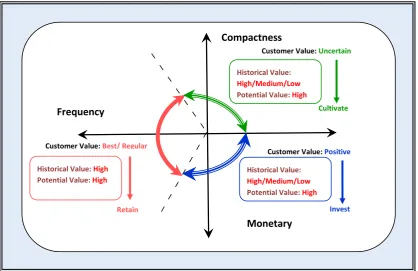
For the growth and development of the enterprise, it is required to maintain the old customers and to acquire new customers constantly. The new customer is the one who was unaware of the enterprise’s products, or the one who was not using the products of the enterprise before. No matter which kind of the new customers is acquired by the enterprise, compactness constraint incorporated sequential pattern mining over the existing customers helps to identify these potential customer groups, increase the response rate of market activities and finally to enable the enterprise to improve and enhance its business. The important goals of CRM like maintaining appropriate inventory and manage supply chain (given in Figure 3) could be further improved using this constraint. As given in Figure 4, the historical value of existing customers could be low, medium or high, but the potential value of such customers is often very high as they have shown interest in the enterprise by making purchases during some time span. Again such customer value analysis can be done using compactness constraint in the sequential mining process. So, implementing this technique we can not only acquire new customers, but also cultivate the existing customers for further purchases.
4.2
To focus on existing customers and
improve the retention rate: Frequency
constraint
The other criteria to select the set of customers that any enterprise should pay attention for improving sales, could be to identify those customers making frequent purchases by analyzing the respective transaction databases. Customer retention is a process to keep old customers and to prevent them from losing. In this process, we could come across a huge set of customers again if the enterprise is doing well.
However, to maintain and improve further, the business organization should particularly focus on those set of customers who have been loyal and stable. A loyal customer is the one who is durable, that is, making continuous consumption in the enterprise. The stability of the customer can be gauged by his consumption cycle and frequency (as given in Figure 3). Such loyal, stable and durable customers are often found to be immobile, that are unaffected by other factors. If we incorporate frequency constraint in the sequential purchasing pattern of customer’s transaction data, we could discover the customers who purchase products/items of the enterprise at short intervals. Hence such customers satisfy the important parameters of stability, loyalty and durability of customer value. In fact, stability, durability and immobility are referred as three integral pillars of the customers’ loyalty [35] [Figure 5]. Thus, the groups of frequent customers are the one that the business organization should concentrate on.
Customer Value Analysis Parameters
Compactness
1.Targeted time
duration
2.Inventory
Control
3.Supply Chain
Management
4.Potential Value
5.Historical Value
Frequency
6.Purchase
Volume
7.Loyalty
8.Stability
9.Durability
10. Cross Selling
11. Trend Analysis
Monetary 12. Gross Profit
13. Credibility
14. High Revenue
15. Confidence
16. Satisfaction
17. Ratable Value
Parameters Satisfying Constraints
Fig 4: Customer Value 360○ Model based on Constraint based Sequential Pattern
[image:6.595.82.501.81.352.2]The mining of sequential patterns of customers can be used to analyze customers’ purchasing trends. Trend analysis includes study of trending, cycle trend and changes, seasonal trend and changes, irregular random trend. The trend analysis makes the enterprise to understand customers’ consumption trends over a period. The enterprise can take decision and formulate accordingly to adjust and update the prices. This could be accomplished with the incorporation of frequency constraint in mining process.
Fig 5: Three integral aspects of Customer loyalty
Cross selling by an enterprise could also be achieved by using
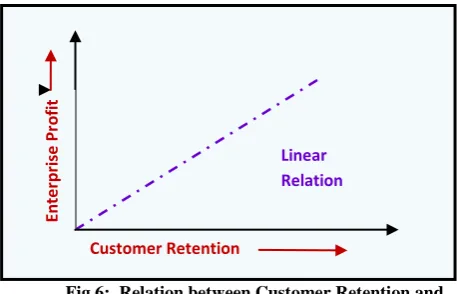
frequency constraint within the mining process. In an ever changing scenario of customer and enterprise relation, cross-selling has a very significant role. This refers to a process where the enterprises sell the new products or provide services to the existing customers. The customer have benefit of getting more easy service of meeting his demand, enterprises make a profit because of growth of the sales amount. The constraint based mining can realize cross-selling to excavate effective marketing and realize buying recommendation and upgrade sale. It supports customer's profitability at the same time as they are not required to spend their time and money looking out for new products in the market. As shown in Figure 6, the enterprise profit maintain a linear relationship with the customer retention, that is more the enterprise is able to sustain the existing customers, more regular profit it can generate. This is simply because the cost of acquiring new customers is saved in this case.
To conclude, the use of frequent constraint sequential excavate technology on customer purchasing database can find out enterprise's most frequent customer, that is those that amount to high consumption. As given in Figure 4, the frequent customers have high potential and historical value so they are the best for the enterprise to retain for maintaining regular sales. For any enterprise, it is much easier to get abundant information about these existing customers comparatively. A large amount of data for a frequent customer can strengthen the accuracy in making the enterprise’s decisive factors regarding sales and marketing. The sequential mining is excavated to find these factors, direct against different grade customer as divided based on purchase frequency, confirm corresponding marketing input, and analyze optimum and rational sales to match.
Historical Value: High Potential Value: High
Historical Value: High/Medium/Low Potential Value: High
Retain Customer Value: Best/ Regular
Invest Customer Value: Positive
Compactness
Frequency
Monetary
Cultivate
Customer Value: Uncertain
Historical Value: High/Medium/Low Potential Value: High
Customer Loyalty
Stable
Fig 6: Relation between Customer Retention and Profit of an Enterprise
4.3
To preserve valuable customers:
Monetary constraint
As the competition of each type of business, is getting fiercer and fiercer. The cost that enterprises to obtain the new customer is rising constantly. A lot of companies agree that the cost of getting one new customer is 6-8 times of cost to retain an existing customer. Hence, it is only obvious for the enterprises to pay more attention to retain existing customers. As discussed in previous section, for the high loyalty customer, enterprises make every effort to keep its good relation; however to the low loyalty customer, enterprises do not waste the financial resources to give up directly. However, using the frequency constraint alone cannot suffice the need of enterprise to obtain the data of valuable customer. For example, a customer giving a daily purchasing pattern of milk and bread from a particular grocery shop may be loyal. However, when it comes to analyze customer value in terms of generating high revenue and gross profit to the grocery shop, the customer who is making periodic purchase of complete household grocery from the shop could be more valuable.
Monetary denotes the amount of money the customer spent on the product/s or item/s. A customer with high monetary score means that it contributes higher revenue to the business. The customer profitability is also an indicator for the quantitative evaluation of customer purchases. The customer profitability analysis is intended to find the high-value customers, and to provide deeper and more detailed customer relationship management towards them. Such customers may have low or medium or high historical value but offer high potential value (as given in Figure 4). This is because such customers have high confidence, satisfaction and creditability towards the enterprise, that make them invest high in the product purchases. All these are important parameters in the customer value analysis (Figure 3). This is the category of customers who have very positive opinion towards the enterprise’s products. Due to these factors and the high ratable value of these customers, the enterprise should invest to preserve them, obtained by implementing the monetary constraint in the sequential pattern mining process.
So, the enterprises would like to divide their large number of customers into different categories based on monetary
[image:7.595.54.283.70.217.2]attribute with data classification in sequential mining. The first class is a valueless customer, infrequent and contributes low in enterprise profit. The second class is a steady valuable customer, frequent but does not contribute to revenue due to the type of items purchased by them. The third class is unstable in terms of frequency but quite valuable customer due to the contribution made by them in the gross profit of the enterprise. With the perspective of customer relationship management the third class customer is most important to be preserved, as it will reduce enterprise's operation cost and provide high revenue and gross profit (Figure 3). Though the second class is vital to be retained for constant sale and regular profit but the third class of customers is the one driving the revenue of the enterprise. This class of customers could be retrieved by using monetary constraint in the sequential pattern mining process. There is no doubt, as the customer satisfaction towards the enterprises’ product purchased by him on a certain price increases, the credibility of the enterprise grows exponentially, due to this particular customer as well as because of the word of mouth spread by him [Figure 7].
Fig 7: Relation between Customer Satisfaction and Credibility of an Enterprise
In the analysis of customer profitability, the data mining application is aimed at finding out the most suitable market environment. In this way, enterprise can handle the customer's demand, adopt the individualized marketing tactics, and offer service as per customer classification, providing improved customer's satisfaction for all kinds of customers. The use of constrained based sequential mining helps in evaluating the potential value of customers, and accordingly enables enterprises to make more efficient use of its limited marketing resources. For low-value customers, their ratable value and potential values are lower, so limited business resources should be used for them. The potential customers (Figure 4), one giving high revenue according to the business resources utilized but total purchase volume is smaller, they have higher index of credit and satisfaction with the enterprise. For such customers, companies should implement a strategy to attract them to buy, they are much easy to upgrade to loyal customers with certain investment, and tap their potential to establish long-term friendly relations. They have smaller proportion of such customers, but for enterprises, this type of customer is very important for enterprises large profits. If the customer has low potential value its better for an enterprise to reduce its investment in such customers.
En
te
rp
ri
se
C
re
d
ib
ili
ty
Customer Satisfaction
Exponential Relation
En
te
rp
ri
se
Pr
o
fi
t
Customer Retention
5.
CONCLUSION
Customer relationship management is vital to survive in the competitive marketplace today. The more effectively enterprises can use the information about its customers to meet their needs the more profitable enterprises will be. Usually, the companies are maintaining huge databases for storing information about their customers. This stored data in these large data warehouses has to be further mined to identify the hidden useful and interesting patterns. This is achieved by the data mining process, through various methods like statistics, artificial intelligence, and database research. Among the different techniques, sequential pattern mining is more adequate for customers’ purchasing patterns for CRM domain.
However, there is a severe lack of research that takes a broader strategic focus on the relationship between CRM and sequential pattern mining. Of the few study made in this area, there is hardly any work for the realization of constraints from the customer value analysis. Customer value analysis is the core for any enterprise implementation of customer relationship management. There are certain parameters that should be satisfied for effective implementation of customer value analysis. This study identifies the selection of appropriate constraints to meet these customer value parameters. The use of these identified constraints in the sequential pattern mining applied on customers’ transaction database can help to improve customer retention, acquire new customers and preserve the valuable customers as well.
This article suggests there could be two approaches to incorporate the constraints and classify the customers based on their purchasing patterns. But, we strongly recommend the use of one approach over the other due to the shortcomings of the later approach as discussed in this study.
6.
ACKNOWLEDGEMENTS
The authors would like to thank the Editor and anonymous referees for providing valuable comments and constructive suggestions. We express our gratitude towards the Galgotias College of Engineering and Technology, Greater Noida for the support being provided to complete this research work.
7.
REFERENCES
[1] Kracklauer, A. H., Mills, D. Q., and Seifert, D. 2004. Customer management as the origin of collaborative customer relationship management. Collaborative Customer Relationship Management, 3–6.
[2] Langley, P., and Simon, H. A. 1995. Applications of machine learning and rule induction. Communications of the ACM, 38, 54–64.
[3] Lau, H., Wong, C., Hui, I., and Pun, K. 2003. Design and implementation of an integrated knowledge system. Knowledge-Based Systems, 16, 69–76.
[4] Liao, S. H., and Chen, Y. J. 2004. Mining customer knowledge for electronic catalog marketing. Expert Systems with Applications, 27, 521–532.
[5] Ling Xu, Song Li, and Jie Li. 2010. CRM Customer Value Based On Data Mining. Third International Conference on Knowledge Discovery and Data Mining, DOI 10.1109/WKDD.2010.28. In proceedings of IEEE Computer Society, 32-37.
[6] Parvatiyar, A., and Sheth, J. N. 2001. Customer relationship management: Emerging practice, process, and discipline. Journal of Economic and Social Research, 3, 1–34.
[7] Tsai, C. F., and Lu, Y. H. 2009. Customer churns prediction by hybrid neural networks. Expert Systems with Applications, 36, 12547–12553.
[8] Lariviere, B., and Van den Poel, D. 2005. Investigating the post-complaint period by means of survival analysis. Expert Systems with Applications, 29, 667–677.
[9] Chiang, D. A., Wang, Y. F., Lee, S. L., and Lin, C. J. 2003. Goal-oriented sequential pattern for network banking churn analysis. Expert Systems with Applications, 25, 293–302.
[10] Aggarwal, C. C., Procopiuc, C., and Yu, P. S. 2002. Finding localized associations in market basket data. IEEE Transactions on Knowledge and Data Engineering, 14, 51–62.
[11] Changchien, S., Lee, C. F., and Hsu, Y. J. 2004. On-line personalized sales promotion in electronic commerce. Expert Systems with Applications, 27, 35–52.
[12] Tsai, C. F., and Chen, M. Y. 2010. Variable selection by association rules for customer churn prediction of multimedia on demand. Expert Systems with Applications, 37, 2006–2015.
[13] Chen Y.L. and Hu Y.H. 2006. Constraint-based Sequential Pattern Mining: The Consideration of Recency and Compactness. Decision Support Systems, 42(2), 1023-1215.
[14] Chen Y. Liang, Kuo Mi-Hao, Wub Shin-Yi and Tang Kwei. 2009. Discovering recency, frequency, and monetary (RFM) sequential patterns from customers’ purchasing data. Electronic Commerce Research and Applications 8 (2009) 241–251.
[15] Dennis, C., Marsland, D., and Cockett, T. 2001. Data mining for shopping centres-customer knowledge-management framework. Journal of Knowledge Management, 5, 368–374.
[16] Kim, Y. S., and Street, W. N. 2004. An intelligent system for customer targeting: A data mining approach. Decision Support Systems, 37, 215–228.
[17] Baesens, B., Verstraeten, G., Van den Poel, D., Egmont-Petersen, M., Van Kenhove, P., and Vanthienen, J. 2004. Bayesian network classifiers for identifying the slope on the customer lifecycle of long-life customers. European Journal of Operational Research, 156, 508–523.
[18] Hwang, H., Jung, T., and Suh, E. 2004. An LTV model and customer segmentation based on customer value: A case study on the wireless telecommunication industry. Expert Systems with Applications, 26, 181–188.
[19] Yu, J. X., Ou, Y., Zhang, C., and Zhang, S. 2005. Identifying interesting visitors through Web log classification. IEEE Intelligent Systems, 20, 55–59.
[20] Kim, Y. S. 2006. Toward a successful CRM: Variable selection, sampling, and ensemble. Decision Support Systems, 41, 542–553.
[21] Kim, S. Y., Jung, T. S., Suh, E. H., and Hwang, H. S. 2006. Customer segmentation and strategy development based on customer lifetime value: A case study. Expert Systems with Applications, 31, 101–107.
[23] Hua Jiang, and Zhenxing Cui. 2009. Optimization of Data Mining in CRM Based on Rough Set Theory. International Forum on Information Technology and Applications, DOI 10.1109/IFITA.2009.111. In proceedings of IEEE, 252- 257.
[24] Eirinaki M. and Vazirgiannis M. 2003. Web Mining for Web Personalization. ACM Transactions on Internet Technology (TOIT), 3(1), 1-27.
[25] Liu D.R. and Shih Y.Y. 2005. Integrating AHP and Data Mining for Product Recommendation Based on Customer Lifetime Value. Information and Management, 42(3), 387-400.
[26] Liu D.R. and Shih Y.Y. 2005. Hybrid Approaches to Product Recommendation Based on Customer Lifetime Value and Purchase Preferences. The Journal of Systems & Software, 77(2), 181–191.
[27] Liu D.R., Lai C.H. and Lee W.J. 2009. A Hybrid of Sequential Rules and Collaborative Filtering for Product Recommendation. Information Sciences, 179(20), 3505-3519.
[28] Miglautsch John R. 2002. Application of RFM Principles: What to Do with 1-1-1 Customers? Journal of Database Marketing, 9(4), 319-324.
[29] Cheng, C. H., and Chen, Y. S. 2009. Classifying the segmentation of customer value via RFM model and
Rough Set theory. Expert Systems with Applications, 36(3), 4176–4184.
[30] Jiang, T., and Tuzhilin, A. 2006. Segmenting customers from population to individuals: Does 1-to-1 keep your customers forever. IEEE Transactions on Knowledge and Data Engineering, 1297–1311.
[31] Mallick Bhawna, Garg D. and Grover P.S.. 2012. CFM- PrefixSpan: A pattern growth algorithm incorporating compactness and monetary. International Journal of Innovative Computing, Information and Control. ISSN 1349-4198, Vol. 8, No. 7(A). 4509-4520.
[32] Huang, S. C., Chang, E. C., and Wu, H. H. 2009. A case study of applying data mining techniques in an outfitter’s customer value analysis. Expert Systems with Applications, 36, 5909–5915.
[33] Luming Yang, and Benxin Lao. 2007. Customer relationship management. Chongqing University Press.
[34] He, Z., Xu, X., Huang, J. Z., and Deng, S. 2004. Mining class outliers: concepts, algorithms and applications in CRM. Expert Systems with Applications, 27, 681–697.