2016 International Conference on Artificial Intelligence and Computer Science (AICS 2016) ISBN: 978-1-60595-411-0
C-PNN: Multiple-instance Learning Based on Clustering
and Probabilistic Neural Network
Xi-ya ZHAO
*and Hao-ming FU
School of Automation Engineering, University of Electronic Science and
Technology of China, Chengdu, 611731, China Email: [email protected]
*Corresponding author
Keywords: Multiple-Instance learning, Cluster, PNN, Classifier synthesis.
Abstract. Due to a significant difference between single-instance learning(SIL) and multiple-instance learning(MIL), many traditional learning methods such as nearest neighbor classification, SVM and other classification algorithms are difficult to directly apply on MIL problem. Although many MIL algorithms have been proposed in recent decades, the complexity of most is high. To solve this problem, a new algorithm based on clustering and probabilistic neural network is
proposed in this article. Experimental results show that the proposed approach not only can obtain a nearly good classification accuracy in classical UCI data sets, but also the algorithm complexity is reduced in comparison with other methods at the same time.
Introduction
The concept of multiple-instance learning(MIL) was originally proposed in drugs’ activity prediction problem by Dietterich [1], etc. Under such learning framework, the training set is made up of several bags with label, each bag consists of one or more instances. If the bag has at least one positive instance, it is marked as positive. Otherwise, it is marked as negative. A learning system, which is based on training bags, is intended to correctly predict the bags’ label as much as possible.
In contrast to the plate type of the single instance’s representation, MIL can reflect some realistic problems of logical structure, which makes it has a unique advantage on the distinction between coarse label object. It has been widely used in drug reactive molecules prediction [1], image retrieval
and computer-aided medical diagnosis [4]and other fields.
There are mainly three kinds of research approaches on the MIL algorithms of the past:
Probability and statistics method. It is through mining the probability of the relation between instance and bag to solve the MIL problem. Such as diversity density (DD) algorithm [2] and DD-SVM algorithm [3].
Algorithm adaptation method. In the framework of single-instance learning(SIL) algorithm, modify the existing SIL algorithm basing on the definition of MIL problems at the same time, it makes some data processing that is specific to MIL. Such as mi-SVM, MI-SVM [5] and neural network-based BP-MIP [6].
Problem transformation method. By means of distance measure between bags or constructing a bag feature, translate MIL into other known SIL problems. Such as Bayesian-kNN [7] and MILES [8].
Related Algorithm Clustering Algorithm
Combined with a specific MIL example situation, firstly we can obtain the positive bags’ and negative bags’ cluster numbers and representative points of training set, then extract all of the useful information(similarity or dissimilarity)of training set bags(positive and negative)with the previous clustering centers related. According to the requirements of the debugging, in this article we choose the clustering algorithm of hierarchical BSAS [9] for its flexibility. Below is the brief of the algorithm:
[image:2.612.117.489.429.681.2]BSAS(Basic Sequential Algorithmic Scheme): [bel, repre]=BSAS(X, theta, q, order)
Input: X is a vector matrix, theta is dissimilarity threshold, q is the maximum allowable clustering number. The order is a N-dimensional vector, which is the sample sequence executed in sequence for clustering.
Output: bel is a N-dimensional vector, the ith value indicates the ith data vector’s assigned categories. The repre is a l-dimensional clustering mean vector, and its number is determined by q.
PNN Algorithm
PNN is a kind of machine learning algorithm that is similar to simulation of brain learning, it can extract knowledge from the data and apply it to new data. PNN is a excellent classification algorithm in comparison with other machine learning algorithms [10], it mainly has the following advantages:
PNN does not need to make assumptions while dealing with data, it can automatically adjust itself to adapt to the data according to the data’s weights.
PNN is a generic function approximation method that can be in any precision fitting arbitrary function.
PNN is a non-linear classifier, which is suitable for linear inseparable data processing[11]. The sketch map of PNN is described in Fig 1:
The Proposed C-PNN Algorithm Algorithm Analysis
Motivated by the ideas of clustering and probabilistic neural network, we propose the C-PNN algorithm in this article. This algorithm has two critical parameter, debugging through the experiment
find out they have a huge influence on classification accuracy. The first one is the input parameter q
for clustering, generally we can get a clear and reasonable cluster number to determine q value after calling linkage and dendrogram functions. The pseudo code of BSAS is described below:
Begin
i=1:N t=order[i];
initialize distance(d(t)); while not finished do
begin
i=i+1; t=order[i];
compute d(t) from the already formed clusters;
if((d(t)<=threshold)&&(not reached the max cluster number q)) contain it, then update the corresponding representative;
else
assign it to the nearest one cluster to form a new cluster, also update;
end End
When the cluster is performed in the end, the greatest concern for us is the repre vector(clustering center representative values). At the same time it should be stressed again that the input value
maximum clustering number q has a huge influence on final cluster representative values and
subsequent combination of PNN. Therefore in this article, we use the linkage and dendrogram tool functions on the training set, which help us observe a hierarchical cluster tree to determine a reasonable maximum number of clustering. While it is also worth mentioning that there is no exact number of clustering, it is set by the designer reasonably. And in some cases, we may only consider positive bags’ cluster centers, namely not consider negative bags’ cluster centers temporarily. In other words, under such circumstances if the subsequent classifier can distinguish positive bags merely, it can also meet our requirements.
The second one is the input parameter value of PNN: spread. The selection of the value is directly
related to the specific classification accuracy, whereas the value is not a optimal fixed one, only under a specific network, it has a optimal value. If the value is set too large, density estimation is smooth but details lost badly, while if the value is set too small, density estimation can present more peaks. Hence in this article's C-PNN algorithm, we add a iterative calculating code to get the optimal value of spread.
On the whole, firstly we calculate the distance(2-norm) between all the instances and previous cluster centers, then extract a minimum value of a bag for a specific cluster center, then the second smallest value multiply by a weight (1/1.9 in this article),add the two values afterwards.
2
2 * min
min min
_ hj k
j h B x k ij B
x x repre weight x repre
dist i ih i ij
(1)
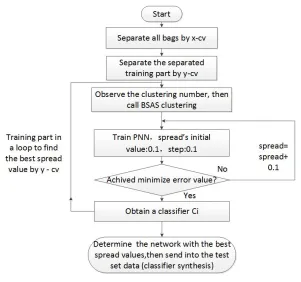
part, which corresponds to a specific classifier. Finally weight/no-weight vote is used to synthesize the results of them[12].
Algorithm Flow Chart
[image:4.612.158.459.132.414.2]The algorithm flow chart is shown in Fig 2:
Figure 2. Algorithm flow chart.
Due to C-PNN can operate an offline training as for PNN, and also for the whole data set’s bags can be transformed into a corresponding numerical value. So compared with the aforementioned algorithms, the whole algorithm can not only reduces the amount of calculation but also decreases the algorithm’s complexity obviously.
Experimental Results The Experimental Data Sets
[image:4.612.88.522.584.645.2]Table 1 shows the classical UCI data sets Musk1 and Musk2’s features. We chose them as experimental data because they are generally used to assess MIL algorithms’ performance.
Table 1. UCI data sets Musk1 and Musk2. The data set
name Feature dimension The total number of instances Number of categories Positive: Negative Each contains the number of instances
Musk1 167 476 2 47:45 2-40
Musk2 167 6598 2 39:63 1-1044
Experimental Method
Results and Analysis
A Example of Clustering Result
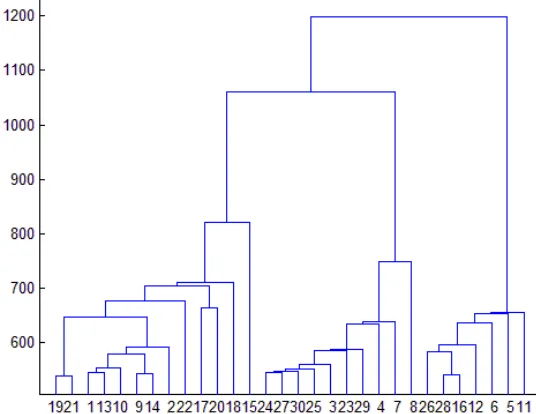
Figure 3. An example of clustering dendrogram pictures for positive bags and negative bags.
It can be seen from the Fig 3 that the best clustering number for positive bags is 3, for negative bags is 2 or 3. We select the 2 in fact, while 3 is also reasonable, but it will affect the subsequent value of the best spread.
[image:5.612.167.435.118.325.2]The Classification Precision and Computation Time
Table 2. Classification Precision and computation time.
Algorithms DD-SVM[3] MILES[8] C-PNN1 C-PNN C-PNN1 C-PNN
Methods 10-CV 10-CV 10-CV 10-CV 5-CV 5-CV Musk1 87.4%,17.6mi
n
84.6%,0.13min 76%,0.11min 80.5%,0.12min 76%,0.07mi n
80.5%,0.08min
Musk2 86.6%,396min 88.3%,4.42min 76%,3.57min 80.5%,3.68min 83%,2.35min 83%,2.58min
The experimental results show that the proposed C-PNN’s classification precision was slightly less than DD-SVM, MILES etc. However, C-PNN’s computation time was better than the other two algorithms because of the PNN’s offline training mainly. Besides, as for C-PNN,5-CV’s computation time are also reasonably slightly less than 10-CV, classification precision was also improved to a certain extent. Moreover, weighted voting(C-PNN) consumed more time than without weighted voting(C-PNN1) because of a more complex synthesis method.
Conclusions and Future Work
Innovation point of this article is to use the method of clustering to seek potential relationship between datas. Compared with DD-SVM,MILES and so on, this method’s amount of calculation is less and it is more simple. Then we take advantage of the probabilistic neural network's excellent performance, combine it with clustering to propose a new algorithm, which can obtain a almost good classification accuracy and also with a reduced complexity. However, the classification accuracy is not good enough, hence the future work should focus on the number of clustering and synthesis of classifiers to improve the resulting accuracy. The former is the premise, it affects the whole follow-up of the algorithm, and the latter directly affects the precision of the classifier. But beyond that, we may also encounter some other subsequent problems at the same time.
References
[1] Dietterich T.G., Lathrop R.H., Lozano-P´erez T. Solving the multiple instance problem with
axis-parallel rectangles [J]. Artificial Intelligence, 1997, 89(1–2): 31-71.
[2] Maron O., Lozano-Pérez T., A framework for multiple-instance learning [J]. Advances in
Neural Information Processing Systems 10, Cambridge, MA: MIT Press, 1998, 570-576.
[3] Chen Y., Wang J.Z. Image categorization by learning and reasoning with regions [J]. Journal
of Machine Learning Research, 2004, 5: 913-939.
[4] Raykar V.C., Krishnapuram B., Bi J., et al. Bayesian multiple instance learning: Automatic
feature selection and inductive transfer [C]Proceedings of the 25th International Conference on Machine Learning. New York, NY, USA: ACM, 2008: 808-815.
[5] Andrews S., Tsochantaridis I., Hofmann T. Support vector machines for multiple-instance
learning [C]. Proc of Advances in Neural Information Processing Systems Vancouver: MIT Press, 2002: 561-568.
[6] Zhou Z.-H., Zhang M.-L. Neural networks for multi-instance learning [R]. Technical Report,
AI Lab, CS Dept., Nanjing Univ., Aug. 2002.
[7] Wang Jun, Zucker Jean-Daniel. Solving the multiple instance problem: A lazy learning approach [C]. Proc of the 17th Int Conf on Machine Learning. San Francisco, 2000: 1119-1125.
[8] Li W.J., Yeung D.Y. MILD: Multiple-instance learning via disambiguation [J]. IEEE
[9] Lisboa P.J Edisbury B. Vellido A. Business applications of neural networks: the state of-the—art of real world applications [M1. World Scientific Publishing Company Incorporated, 2000.
[10] Ali S., Shah M. Human action recognition in videos using kinematic features and multiple instance learning [J]. IEEE Transactions on Pattern Analysis and Machine Intelligence, 2010, 32(2): 288-303.
[11] Amores J. Multiple instance classification: Review, taxonomy and comparative study [J]. Artificial Intelligence, 2013, 201: 81-105.
[12] Sprecht D.F. Probabilistic neutral networks for Classification, Mapping and Associate Memory [C]. IEEE ICNN San Dieg CA, 1988: 525-532.
![Figure 1. Probabilistic neural network model [12].](https://thumb-us.123doks.com/thumbv2/123dok_us/298808.1031073/2.612.117.489.429.681/figure-probabilistic-neural-network-model.webp)