Journal of Chemical and Pharmaceutical Research, 2013, 5(5):119-127
Research Article
ISSN : 0975-7384
CODEN(USA) : JCPRC5
Development of fast dissolving tablets of losartan potassium using
Kollidon CL-SF
Shailaja CJ
1,
Preeti Karwa
2*, Nargund LVG
1and Laxman SV
31
Nargund College of Pharmacy, Bangalore, Karnataka, India
2
Al-Ameen College of Pharmacy, Bangalore, Karnataka, India
3
H. S. K. College of Pharmacy, Bagalkot, Karnataka, India
_____________________________________________________________________________________________
ABSTRACT
The goal of this study was to formulate and evaluate fast dissolving tablets (FDTs) of Losartan potassium so as to overcome swallowing difficulties. The key to develop successful FDT formulations by the direct compression method is to select the right superdisintegrant and compatible excipients depending on FTIR and DSC studies. The FDTs were designed using superdisintegrant such as Kollidon CL-SF in different concentrations by direct compression technique. The FDT formulations were evaluated for physicochemical characteristics including powder flowability, appearance, thickness, uniformity of weight, hardness, friability, in-vitro disintegration time, wetting time, water absorption, content uniformity and in-vitro drug release studies. All the formulations showed satisfactory physicochemical characteristics with disintegration time less than three minutes. The selected formulations were subjected to short term stability studies at 40±2°C and 75±5% RH for a period of 3 months. Thus, this work helped in understanding the effect of formulation processing variables especially different concentrations of super disintegrating agent such as Kollidon CL-SF on the disintegration time.
Keywords: Losartan potassium, Fast Dissolving Tablets, Kollidon CL-SF and Direct compression.
_____________________________________________________________________________________________
INTRODUCTION
of property in dosage form can be added by inclusion of right superdisintegrant and excipients which play a key role in formulation of fast dissolving tablets. Hence, there is a need to have excipients with multiple characteristics built into them such as better flow, low/no moisture sensitivity, superior compressibility and rapid disintegration ability. Excipients with improved functionality can be obtained by developing new chemical excipients, new grade of existing materials and new combination of existing materials. One such approach for improving the functionality of excipients is, inclusion of Kollidon CL-SF (new grade of existing materials) as a superdisintegrant [3].
Addition of disintegrants in fast dissolving tablets, leads to quick disintegration of tablets after putting on tongue, thereby release the drug in saliva. Thus, type, concentration and efficiency of superdisintegrants to a large extent affect the disintegrant properties [4].
Fast onset of action is a major concern in the treatment of hypertension. As the patients with sudden increased blood pressure, have markedly reduced function ability and extremely restless, in such cases rapid onset of action is of prime importance. So the patients would be benefited from acute treatment by using proposed FDT drug delivery system. FDTs can offer advantages over older formulations in terms of convenience, side effect profile, efficacy and fast onset of action [5].
Losartan potassium is an antihypertensive drug belongs to the category of Angiotensin II-receptor antagonist and is chemically described as 2-butyl-4-chloro-1-[p-(o-1H-tetrazol-5-ylphenyl)benzyl]imidazole-5-methanol monopotassium salt. Its molecular formula is C22H22ClKN6O with half life of 2 hr and bioavailability of 33% due to extensive first pass hepatic metabolism.
Losartan Potassium
It blocks vasoconstriction and aldosterone-secreting effects of angiotensin II by selectively blocking the binding of angiotensin II to the angiotensin II receptor (AT1 receptor) in vascular smooth muscle and adrenal gland [6]. Losartan potassium has been demonstrated to be superior to previous peptide receptor antagonists and angiotensin converting enzyme (ACE) inhibitors because of its enhanced specificity, selectivity and tolerability [7].
Thus, main objective of the present study was to formulate and evaluate fast dissolving tablets of Losartan potassium by simple and cost effective direct compression methods.
EXPERIMENTAL SECTION
MATERIALS
Losartan potassium (IP) and Kollidon CL-SF were gift samples provided by Karnataka Antibiotics and Pharmaceuticals Ltd, Bangalore. Microcrystalline cellulose (Avicel 102 PH) was procured from S.D Fine Chem. Ltd, Mumbai and Lactose, Aerosil & Magnesium stearate were procured from Loba Chemie Pvt Ltd, Mumbai. Neotame and Vanilla were gift samples obtained from Karnataka Antibiotics and Pharmaceuticals Ltd, Bangalore. All other chemicals used were of pharmaceutical grade.
METHODS
1)Preformulation Studies of Losartan potassium:
2)Drug-excipient Compatibility:
FTIR: Pure drug and physical mixture of drug & super disintegrant (1:1) were subjected for FTIR analysis using
Fourier Transformer Infra Red Spectrophotometer (8300, Shimadzu, Japan).The samples were prepared on KBr-press and scanned over wave number range of 4000 to 400 cm-1 and the obtained spectra were analyzed for functional groups of drug and interactions with super disintegrant.
Differential Scanning Calorimetry: This study was done to evaluate the compatibility of Losartan potassium with
super disintegrant. Differential Scanning Calorimetry was used for screening. The specified samples were hermetically sealed in a flat bottomed aluminum pans and heated in the differential scanning calorimeter (Perkin-Elmer Thermal Analysis) in an atmosphere of nitrogen and the rate of flow was 25 ml/min. A temperature range of 0°C to 250°C was used and the heating rate was 10°C/min.
3)Formulation of Fast Dissolving Tablets of Losartan potassium:
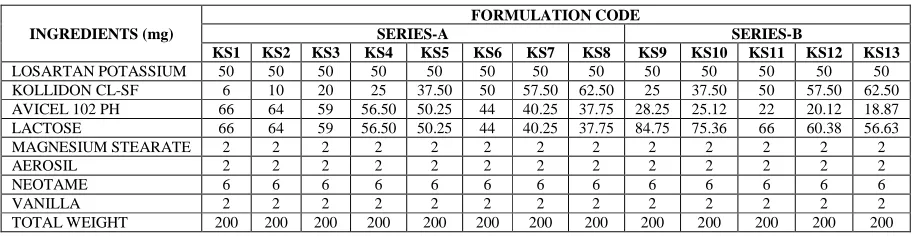
[image:3.595.70.528.343.461.2]Fast dissolving tablets (FDTs) of Losartan potassium were prepared by direct compression method using different concentration of super disintegrant as shown in Table No-1. The drug and super disintegrant selected were passed through 60-mesh sieve and mixed in a mortar with a pestle to obtain uniform mixing. The blend obtained was then lubricated by adding required quantity of magnesium stearate. The tablets were compressed using 8 mm diameter punches to an average weight of 200 mg in “Tablet punching machine (Rimek mini press-1) (10 station) Karnavati Engineering Ltd, Mehsana, Gujarat.
Table No-1: Formulation Design of Fast Dissolving Tablets of Losartan potassium
INGREDIENTS (mg)
FORMULATION CODE
SERIES-A SERIES-B
KS1 KS2 KS3 KS4 KS5 KS6 KS7 KS8 KS9 KS10 KS11 KS12 KS13
LOSARTAN POTASSIUM 50 50 50 50 50 50 50 50 50 50 50 50 50 KOLLIDON CL-SF 6 10 20 25 37.50 50 57.50 62.50 25 37.50 50 57.50 62.50 AVICEL 102 PH 66 64 59 56.50 50.25 44 40.25 37.75 28.25 25.12 22 20.12 18.87 LACTOSE 66 64 59 56.50 50.25 44 40.25 37.75 84.75 75.36 66 60.38 56.63
MAGNESIUM STEARATE 2 2 2 2 2 2 2 2 2 2 2 2 2
AEROSIL 2 2 2 2 2 2 2 2 2 2 2 2 2
NEOTAME 6 6 6 6 6 6 6 6 6 6 6 6 6
VANILLA 2 2 2 2 2 2 2 2 2 2 2 2 2
TOTAL WEIGHT 200 200 200 200 200 200 200 200 200 200 200 200 200
4)Physicochemical Characteristics of Losartan Potassium FDT Formulations:
The physicochemical characteristics of different Losartan potassium FDT formulations including powder flowability, appearance, thickness, uniformity of weight, hardness and friability were investigated. All these physicochemical characteristics were conducted in the standard way. The in-vitro disintegration time, wetting time and water absorption ratio were investigated in the following way-
In-vitro disintegration time:
Disintegration was evaluated to ensure that the drug substance is fully available for dissolution and absorption from the gastrointestinal tract [10]. An FDT formulation should disintegrate or dissolve in water quickly. Hence for the purpose conducting the disintegrated time test, 3 tablets from each formulation were chosen randomly and each individually dropped into a beaker containing 100 ml of pH 6.8 phosphate buffer. Then, the duration of time required for disintegration of tablets were recorded [11].
Wetting time:
A piece of tissue paper folded double was placed in a petri plate (internal diameter is 6.5 cm) containing 6 ml of water. The tablet was placed on the paper and the time for complete wetting of the tablet was measured in seconds [12].
Water absorption ratio:
R= 100 (Wa - Wb)/ Wb
Where Wa and Wb are the weight after and before water absorption, respectively.
Content uniformity:
At random 20 tablets were weighed and powdered. The powder equivalent to 50 mg was weighed accurately and dissolved in 100 ml of phosphate buffer of pH 6.8. The solution was shaken thoroughly. The undissolved matter was removed by filtration through Whatman No.1 filter paper. Then the serial dilutions were carried out. The absorbance of the diluted solutions was measured at 206.5 nm. The concentration of the drug was computed from the standard curve of the Losartan potassium in phosphate buffer of pH 6.8.
In-vitro dissolution testing:
In-vitro dissolution study of Losartan potassium was carried using Electrolab TDL-08L dissolution test apparatus
(Mumbai). The dissolution test was performed using 900 ml of phosphate buffer (pH 6.8) as the dissolution media at 50 rpm and 37°C ±5°C. 5 ml of aliquots were periodically withdrawn and the sample volume was replaced with an equal volume of fresh dissolution medium. The samples were determined spectrophotometrically at 206.5 nm for drug dissolved at that time.
5)Stability studies:
The optimized formulations were tested for Hardness, Disintegration time and Content uniformity at temperature of 40±2°C and 75 ±5% RH for a period of 3 months by storing the samples in a stability chamber (Lab care). (Table
No-4) [13 & 14].
RESULTS AND DISCUSSION
The present study was undertaken with an aim to formulate and evaluate Fast Dissolving Tablets of Losartan Potassium using direct compression method with the addition of super disintegrant such as Kollidon CL-SF in different concentrations and physicochemical parameters such as in-vitro disintegration time, wetting time, water absorption and in-vitro drug release were determined. This formulation strategy could be cost-beneficial and can be easily adopted by the pharmaceutical companies.
Preformulation studies:
Drug was characterized for flow properties, bulk density, tapped density, angle of repose, % compressibility and Hausner’s ratio. Results obtained from the standardization of the drug were found within the specification as per official standards [9]. The result of powder purity was 102.0%, showing compliance with the acceptable range of NLT 98.0% & NMT 102.0% mentioned in the literature [9].
Drug-excipient Compatibility:
Fig-1: Compatibility of Losartan Potassium with Kollidon CL-SF by FTIR
In the present study, it was observed that, there was no appearance of new peaks and no disappearance or no major shifts in characteristics peaks in the mixture shows that there was no interaction between drug and superdisintegrant
(Fig-1).
Fig-2: Compatibility of Losartan Potassium with Kollidon CL-SF by DSC studies
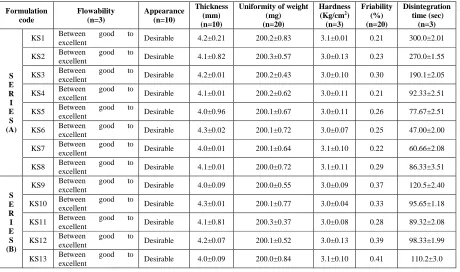
Table No-2: The results of physicochemical tests conducted on series A and B Losartan Potassium FDT formulations
(results are presented as mean ± standard deviation)
Formulation code Flowability (n=3) Appearance (n=10) Thickness (mm) (n=10)
Uniformity of weight (mg) (n=20)
Hardness (Kg/cm2)
(n=3) Friability (%) (n=20) Disintegration time (sec) (n=3) S E R I E S (A)
KS1 Between good to
excellent Desirable 4.2±0.21 200.2±0.83 3.1±0.01 0.21 300.0±2.01 KS2 Between good to
excellent Desirable 4.1±0.82 200.3±0.57 3.0±0.13 0.23 270.0±1.55 KS3 Between good to
excellent Desirable 4.2±0.01 200.2±0.43 3.0±0.10 0.30 190.1±2.05 KS4 Between excellent good to Desirable 4.1±0.01 200.2±0.62 3.0±0.11 0.21 92.33±2.51
KS5 Between good to
excellent Desirable 4.0±0.96 200.1±0.67 3.0±0.11 0.26 77.67±2.51 KS6 Between excellent good to Desirable 4.3±0.02 200.1±0.72 3.0±0.07 0.25 47.00±2.00
KS7 Between good to
excellent Desirable 4.0±0.01 200.1±0.64 3.1±0.10 0.22 60.66±2.08 KS8 Between good to
excellent Desirable 4.1±0.01 200.0±0.72 3.1±0.11 0.29 86.33±3.51
S E R I E S (B)
KS9 Between good to
excellent Desirable 4.0±0.09 200.0±0.55 3.0±0.09 0.37 120.5±2.40 KS10 Between good to
excellent Desirable 4.3±0.01 200.1±0.77 3.0±0.04 0.33 95.65±1.18 KS11 Between good to
excellent Desirable 4.1±0.81 200.3±0.37 3.0±0.08 0.28 89.32±2.08 KS12 Between good to
excellent Desirable 4.2±0.07 200.1±0.52 3.0±0.13 0.39 98.33±1.99 KS13 Between good to
excellent Desirable 4.0±0.09 200.0±0.84 3.1±0.10 0.41 110.2±3.0
Physicochemical parameters:
Various formulations were prepared using Avicel PH 102 and lactose as diluents in different proportions in two series i.e. 1:1 in series A (KS1 to KS8 with 3 to 31.25% of Kollidon CL-SF) and 1:3 in series B (KS9 to KS13 with 12.5 to 31.25% of Kollidon CL-SF). The physicochemical properties of each series including flowability, appearance, thickness, uniformity of weight, hardness, friability and in-vitro disintegration time were investigated. The results have been shown in Table No-2.
[image:6.595.70.530.280.552.2]All formulations, except formulations KS1 to KS3 were disintegrated within 3 minute, fulfilling the official requirement of USP. The delay in disintegration time of first three formulations was due to less concentration of super disintegrant i.e., 3%, 5%, 10% respectively. Disintegration mechanism of formulation KS6 is shown in Fig-3.
5 Sec 25 Sec 47 Sec
Fig-3: Disintegration of Formulation KS6
It was observed that formulations (KS7, KS8, KS12 & KS13) containing more than 25% of Kollidon CL-SF shown increase in disintegration time with further increase in concentration of super disintegrant. This delay in disintegration time might have occurred due to probable blockade of capillary pores in tablet mass as a result of formation of viscous plug by Kollidon CL-SF, which subsequently, prevents free access of fluid into tablets [7].
Series-B formulations (KS9 to KS13) exhibited decrease in disintegration time with increase in concentration of super disintegrant but comparatively disintegration time was more than series-A formulations (KS4 to KS8). This could be due to more proportion of lactose and its higher water activity coefficient which hinders swelling mechanism of super disintegrant [15].
Thus, only series-A formulations (KS4 to KS8) were selected for further post-compression studies based on their faster disintegration time (Fig-4). The probable reason for fast disintegration of Kollidon CL-SF is due to its rapid swelling without gelling [12 & 4]. These particles are found to be granular and highly porous which facilitates wicking of liquid into the tablet particles to generate rapid disintegration.
DISINTEGRATION TIME OF KOLLIDON CL-SF FORMULATIONS
92.33
77.67
47
60.66
86.33
0 20 40 60 80 100
KS4 KS5 KS6 KS7 KS8
FORMULATION CODE
D
IS
IN
T
E
G
R
A
T
IO
N
T
IM
E
(
s
e
c
)
KS4
KS5
KS6
KS7
KS8
Fig-4: Disintegration time of selected formulations of series–A
Wetting time was used as a parameter to correlate with disintegration time in oral cavity. Wetting is related to the
method will duplicate the in vivo disintegration, as the tablet is motionless on the tounge [16]. The formulation KS6 containing 25% of Kollidon CL-SF have the shortest wetting time of 18.66±1.52 seconds, (Table No-3) which may due to strong wicking action of super disintegrant.
Table No-3: Post-compression parameters of selected formulations of series–A
Formulation Code Wetting Time (sec)* (n=3) Water Absorption Ratio* (n=3)
Content Uniformity (%)* (n=10)
KS4 38.00±2.00 48.00±2.51 95.36±0.95 KS5 26.00±2.00 52.66±2.51 93.37±0.62 KS6 18.66±1.52 58.33±1.52 97.53±0.85 KS7 32.66±2.51 62.00±3.00 96.58±0.59 KS8 48.33±3.51 70.66±3.05 97.36±0.50
(* - results are presented as mean ± standard deviation)
Water absorption ratio
Water absorption ratio, which is important criteria for understanding the capacity of disintegrants to swell in presence of little amount of water, was calculated (17). Water absorption ratio, ‘R’ increased with an increase in super disintegrant concentrations from 12.5 to 25%. The increase in ‘R’ was most likely due to increased water uptake capacity of the super disintegrant at higher concentrations. The percentage of drug content for the formulations (KS4 to KS8) complied with official specifications, indicating uniformity of the drug content in the prepared tablets (Table No-3).
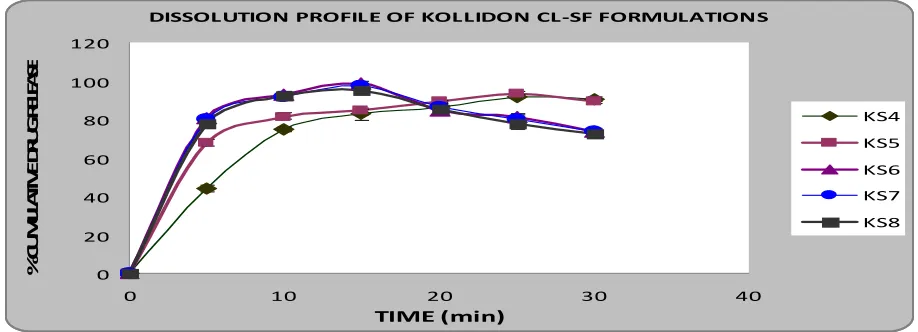
The in-vitro dissolution process of a tablet depends on the wetting followed by disintegration of the tablet. The influence of concentration of super disintegrant on the dissolution of Losartan Potassium from the FDTs is shown in
Fig-5.The figure depicts that, there is an increase in cumulative % drug release with optimum concentration of
superdisintegrant.
DISSOLUTION PROFILE OF KOLLIDON CL-SF FORMULATIONS
0 20 40 60 80 100 120
0 10 20 30 40
TIME (min) % C U M U LA T IV E D R U G R E LE A S E KS4 KS5 KS6 KS7 KS8
Fig-5: In-vitro dissolution profile of selected formulations of series–A
[image:8.595.72.531.403.569.2]The results obtained from the physicochemical tests (Disintegration time - 47 seconds, Drug release of 99.49% within 15 minutes) conducted on formulation KS6 were desirable and acceptable in terms of all the tests conducted and as a result this formulation was chosen as the optimized formulation.
[image:9.595.103.492.209.272.2]The accelerated stability studies (40±2° C and 75±5% RH) performed for a period of three months indicated that there was no significant change in physical and chemical parameters (hardness, disintegration time and drug content) of the tablets, hence the formulation was found to be stable. Results have been shown in Table No-4.
Table No-4: Stability Studies
Time in months Hardness (Kg/cm2) (n=3) Disintegration time (sec) (n=3) Content uniformity (%) (n=3)
KS6 FORMULA
Before 3.00 ± 0.07 47.00 ± 2.00 97.53 ± 0.85 After 1 month 3.05 ±0.02 46.55 ± 1.08 96.75 ± 0.46 After 2 month 3.03 ±0.04 46.16 ± 1.52 96.34 ± 0.76 After 3 month 3.00 ±0.05 45.98 ± 1.68 96.12 ± 0.68
(* - results are presented as mean ± standard deviation)
CONCLUSION
The present study reveals that the prepared Losartan Potassium Fast Dissolving Tablets containing Kollidon CL-SF as a superdisintegrant disintegrate within few seconds without need of water so as to overcome swallowing difficulties. Therefore, in the years to come, their modification aimed at the development of better material for drug delivery systems.
Acknowledgments
We are very thankful to Dr. L.V.G Nargund, Nargund College of Pharmacy, Bangalore for providing the necessary facilities to carry out this work. We are also thankful to Karnataka Antibiotics & Pharmaceuticals Ltd for providing gift samples required for the study.
REFERENCES
[1]K Upendra; NG Raghavendra; RC Hariprasanna; G Rabbani; SP Basawaraj, J. of Applied Pharm., 2011, 2(3), 179-190.
[2]Fu Yourong; Y Shicheng; HG Seong; K Susumu; P Kinam, Critical Reviews in Therapeutic Drug Carrier Systems, 2004, 21(6), 433-75.
[3] NG Raghavendra Rao ; K Ravi Kumar, J. of Chem. and Pharm. Res., 2010, 2(4): 671-679. [4]P Rakesh; G Nisha, Int J of Pharm. Sci. & Res., 2011, 2(11), 2767-80.
[5]A Shankar; KR Anup; KR Shashidhar; R Thout; R Ugendar, Int. J of Drug Dev. & Res., 2011, 3(1). [6]Losartan Potassium. Drugs.com 2010 Oct 1.
[7]MK Suhas; S Vinodh et.al. Int. J. Res. Pharm. Sci. 2010, 1(3), 290-5.
[8]ME Aulton, Pharmaceutics, The science of dosage form design. 2nd ed. 133-134.
[9]Indian Pharmacopeia (IP), The Indian Pharmacopoeia Commission, Ghaziabad Vol-II-2007.
[10] AK Tiwari; H Shah; A Rajpoot; Manmohan Singhal, J. of Chem. and Pharm. Res., 2011, 3(4):333-341. [11]S Shailesh. New Pharmainfo.net 2008, 6(1).
[12] B Debjit; B Chiranjib; Krishnakanth; Pankaj; CR Margret. J. of Chem. & Pharm. Res., 2009, 1(1), 163-177. [13] Alfred Martin, Physical Pharmacy-physiochemical principles in the pharmaceutical sciences, 4th Edition, B.I Waverly Pvt. Ltd; New Delhi: 1996, 313-316.
[14] C Vijaya Raghavan, Practical Hand Book of Physical Pharmaceutics, 1st Edition, New Century Book House (P) Ltd, Madras, 1995, 30-34.
[15] P Jayesh; R Manish, Pharma Times, 2009, 41(4).
[16] SC Gupta; R Gurjar; H Khambete; CK Sudhakar; S Jain , J. of Chem. & Pharm. Res., 2011, 3(4):55-61
[17] V Ramesh; CH Kamaeswara Rao; Shreedhar Nampalli;Y Ganesh Kumar; PC Krishna; MS Shiva Prasad, J. of
Chem. & Pharm. Res., 2011, 3(4):882-892