(
In this report: Basic Internet Suite
Services ... 2 Advanced Internet Suite Services ... 4 Internet
Suite Network
Management ... 8
DATAPRO
Data NetworKing 2775Standards
1
Internet Suite
Application Protocols
Datapro Summary
The Internet suite of protocols is robust and rich with application services. Most users view the Internet protocols in tenns of these application services, which usuaUy run over TCP/IP middle layer protocols. Based on the client/server model, Internet services span the basic functions of virtual terminal support, electronic mail, file transfers, and name service. Ad-vanced services include a distributed windowing system, a network file system, and a net-work management protocol. The demand for these services is fueling the demand for TCPI
IF-based enterprise Internets.
The Internet protocol suite continues in great de-mand in the standards-based networking market-place. This demand should accelerate into the late 1990s. Once the protocol suite of choice for the U.S. military and a handful of universities, Transmission Control Protocol/Internet Protocol
(TCP/IP) is now gaining popularity within the business community. Many businesses have be-come disillusioned with the excruciatingly slow pace of OSI deployment. Consequently, busi-nesses are turning to TCP/IP to form the building blocks for their enterprise internetworks.
As more organizations embrace TCP/IP, the timetable for OSI Ubiquity becomes correspond-ingly shifted to the right. It is unlikely that an organization building a TCPIIP-based enterprise network today would migrate to OSI before the turn of the century.
Introduction to TCP/IP
TCP, itself, is a transport layer protocol (ISO layer 4) providing a connection-oriented service between host processors. It provides a reliable end-to-end service with provisions for flow con-trol and multiplexing of connections. TCP also provides mechanisms for detecting duplicate, lost, or out-of-sequence packets.
The Internet suite also specifies an optional connectionless-mode transport protocol, User Datagram Protocol (UDP). UDP is used for
-By L. Michael Sabo
U S West Advanced Communications Services
transaction-based applications where efficiency and low overhead are more important than reli-ability.
TCP and UDP use the network services of IP (ISO layer 3) as a datagram service. IP is a con-nectionless-mode network layer service. It is used to route messages between networks and performs any message segmentation and reas-sembly required. Segmentation and reasreas-sembly may be needed if a message must be routed through a network with different packet size re-strictions than the source and/or destination net-work.
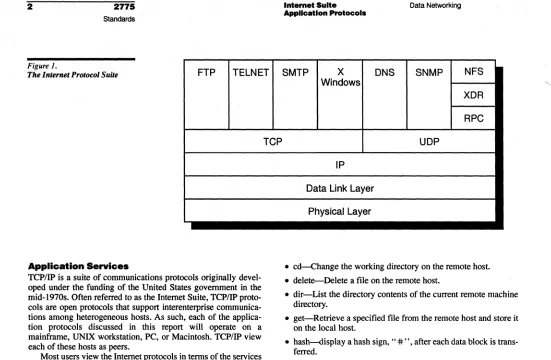
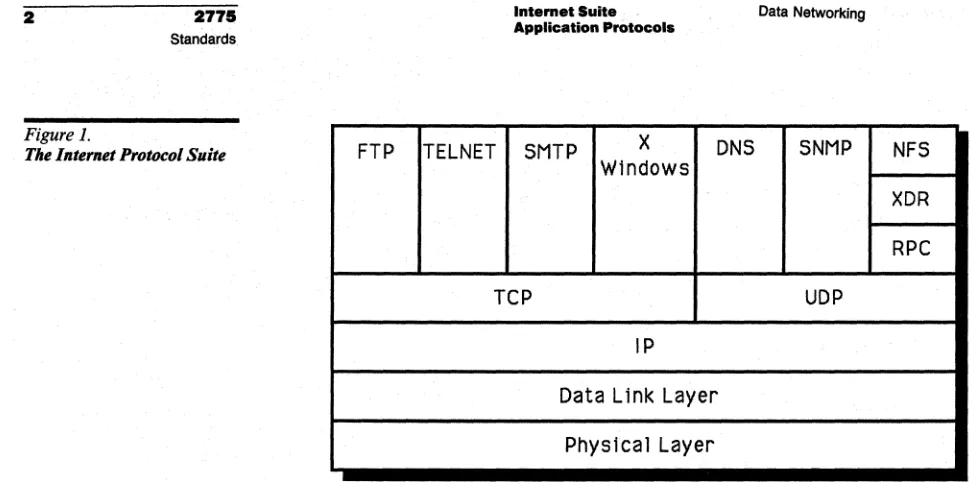
Application protocols are built upon the ser-vices of TCP/IP and UDP/IP (see Figure I). These application protocols form a client!server network computing environment.
Cllent!Server Computing
Each application layer protocol discussed in this report follows the client!server computing model. This model is very simple. In the client! server model, a client application requests ser-vices of a remote service application over a net-work. Correspondingly, the server performs the requested service of the client and responds with the results according to a well-defined protocol. The client typically executes on the local puter, and the server executes on a remote com-puter. Except for network delays, a user may be unaware of the interactions between client and server processes in such a distributed computing environment.
ill) 1993 McGraw-Hili, Incorporated. Reproduction Prohibited. Datapro Information Services Group. Delran NJ 08075 USA
2
2775Standards
[image:2.612.31.582.17.377.2]FTP TELNET
Figure 1:
The Internet Protocol Suite
Application Service.
TCP/IP is a suite of communications protocols originally
devel-oped under the funding of the United States government in the mid-1970s. Often referred to as the Internet Suite, TCP/IP proto-cols are open protoproto-cols that support interenterprise communica-tions among heterogeneous hosts. As such, each of the applica-tion protocols discussed in this report will operate on a mainframe, UNIX workstation, PC, or Macintosh. TCP/IP view each of these hosts as peers.
Most users view the Internet protocols in terms of the services they provide at the application layer. The Internet protocol suite's services are responsible for propelling TCP/IP to its status in en-terprise internetworking.
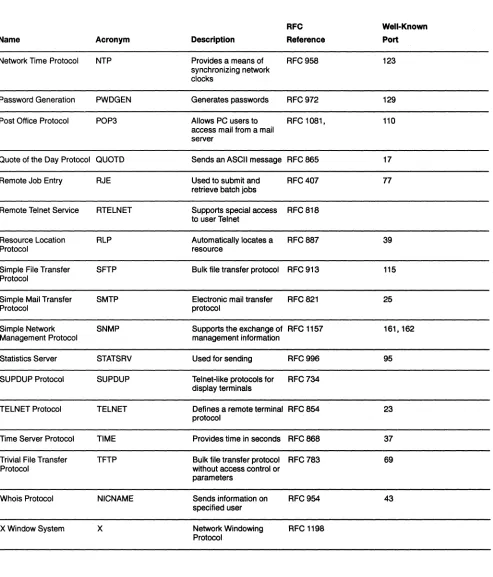
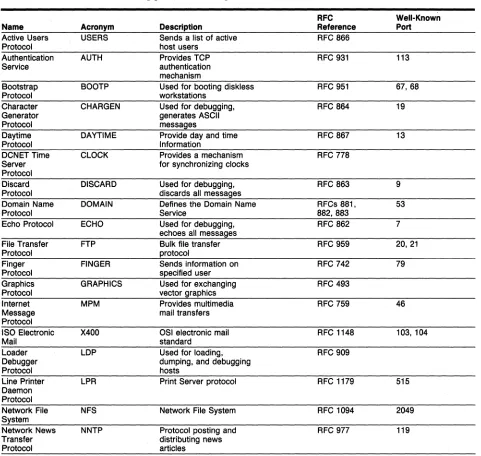
The Internet protocol suite is rich with application services (see Table 1). These services span the basic functions of virtual terminal support, electronic mail, file transfers, and name service. The Internet suite also includes advanced services, such as a dis-tributed windowing system, a network file system, and a network management protocol. This report examines each of these ser-vices and describes how a user interacts with them.
Basic Internet Suite Services
The basic Internet suite services are the File Transfer Protocol
(FfP), the virtual terminal protocol (Telnet), the Simple Mail Transfer Protocol (SMTP), and the Domain Name Service (DNS). Hosts supporting TCP/IP usually provide at least these basic services.
File Trans'er Protocol (FTP)
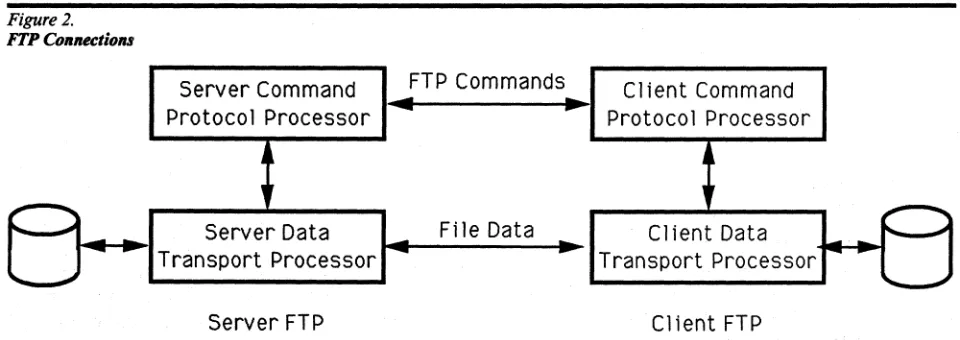
FfP is a protocol used for the bulk transfer of data between host processors over a TCPdatastream. FfP provides a file utility for performing remote file operations such as bidirectional file trans-fers, deleting files, renaming files, and displaying file directories. Users perform these operations during interactive sessions. To support this on-line interaction between a user and a remote host, FfP provides two connections, as shown in Figure 2. FTP com-mands and status information exchanges use the control connec-tion. File transfers use a second connecconnec-tion. Common FfP com-mands and their purpose are listed as follows; for a comprehensive list, refer to your hosts' user manuals:
• ascii-Data will be transferred in ASCII format. This is the default.
• binary-Data will be .transferred as binary data.
• bye-Terminate the FfPsession with the remote seJ:Ver and
exit ftp. .
SEPTEMBER 1993
TCP
Internet Suite application Protocols
SMTP X Windows
IP
Data Link Layer
Physical Layer
Data Networking
DNS SNMP NFS
XDR
RPC
UDP
• cd-Change the working directory on the remote host. • delete-Delete a file on the remote host.
• dir-Ust the directory contents of the current remote machine directory.
• get-Retrieve a specified file from the remote host and store it on the local host.
• hash-display a hash sign, .. ,*,", after each data block is trans-ferred.
• put-Store a specified file from the local host to the remote host.
As does every Internet suite application protocol, FTP follows the client/server model. An FTP client sends commands and interacts with a user or a user program, and the FI'P server portion receives and responds to commands. 1Ypically, a host will provide imple-mentations for both an FTP client and an FI'P server.
FTP is non-host specific. FI'P implementations exist for UNIX systems, mainframes, Macintoshes, and PCs. Thus, FI'P
allows a user to exchange files between dissimilar hosts, such as a Macintosh and a UNIX workstation, without regard to the par-ticulars of the hosts' file systems. Any system supporting TCP/IP
is likely to support FfP. FTP relies on TCP at the transport layer to provide a reliable data path between peer hosts. Thus, users are ensured that files transferred over a network will arrive at their destination error free.
Virtual Terminal Protocol (TELNET)
TELNET is an interactive remote access terminal protocol. It al-lows a user to log in to a remote computer system, over a network, as though the terminal was attached directly to the remote host. TELNET is based on the client/server model, but DOS-based PCs, Macintoshes, and terminal servers typically support only client TELNET. Thus, users on those devices can initiate an inter-active terminal session to a server TELNET but cannot accept a session request from a TELNET client. UNIX hosts and most other multitasking operating systems generally support both cli-ent and server TELNET.
TELNET uses a TCP connection to transmit data and TEL-NET control information. TELTEL-NET is based on the concept of a Network Virtual Terminal (NVT) and negotiated options to ex-tend the basic capabilities of NVT.
@ 1993 McGraw-HiII, Incorporated. Reproduction Prohib~ed.
Datapro Information Services Group. Delran NJ 08075 USA
"--Data Networking Internet Suite Appl_tlon Protocols
Network Virtual Thrminal (NVT)
When a TELNET connection is initiated, both ends of the con-nection begin with an NVT profile. NVT is a least common denominator terminal profile used throughout the network, eliminating the need for every host to support the entire range of terminal possibilities (see Figure 3). The NVT is essentially a bidirectional communications facility that uses the seven-bit ASCII character set but encodes them into eight-bit bytes. Principle of Negotiated Options
TELNET allows services to be supported beyond those defined for the NVT. There are many terminal options not specifically defined within the TELNET Protocol but which can be sup-ported by TELNET. TELNET uses a do/do not, will/will not negotiation process. This scheme allows a client and server to use different conventions for the TELNET session. Specifically, a sender will respond that it will or will not perform some op-tion. Optionally, a sender may request that its peer initiate or not initiate an option. This interaction permits an option request to be refused without knowledge about the requested option. Ac-cepted options take effect immediately. Rejected options require the parameter to remain as defined for an NVT.
Simple Mail Transport Protocol (SMTP)
SMTP is the Internet standard for electronic mail distribution. It
is a text-oriented protocol that uses TCP's underlying services to reliably transfer or relay electronic mail. SMTP supports ef-ficientmessage delivery: if a message has multiple recipients at a particular destination host, SMTP will only send one message to the host listing each recipient. The receiving SMTP will pro-vide each recipient with a copy of the message.
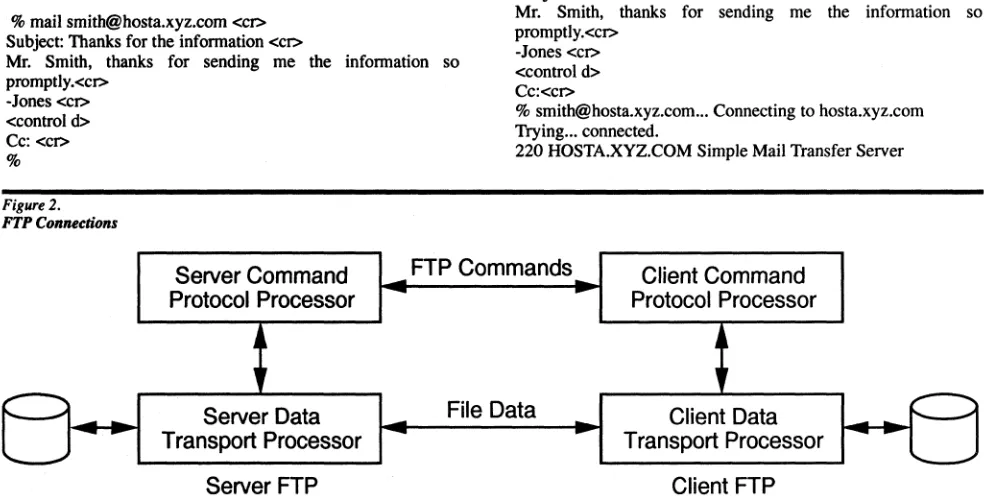
Each mail message contains a header and a body. The header contains elements such as Date, Subject, To, Cc, and From. The client SMTP routine prompts the user for each of these param-eters. The body of the message is typically free-form ASCII text. For example, to send a message to user smith at host hos-ta.xyz.com, a UNIX user Jones on host myhost.xyz.com would perform the following:
% mail [email protected] <er> Subject: Thanks for the information <CD
Mr. Smith, thanks for sending me the information so promptly.<cD
-Jones <CI>
[image:3.612.66.558.469.718.2]<controld> Cc: <cr> % Figure 2.
FTP Conneetions
2775 Standards
3
Obtaining RFCs on the
Internet
RFCs are available through FTP from Internet host NIC.DDN.MIL. Log in using username "anonymous" and password "guest". Once logged on, type in "get RFC:RFCnnnn.txt", where nnnn is the RFC num-ber. RFCs can also be ob-tained through electronic mail. Send a message to
[email protected] place the RFC number in the subject field.
To obtain a current index of all RFCs, type "FTP to
NIC.DDN.MIL" with anony-mous, guest login. Once the seSSion is established, type "dir RFC:RFC-INDEX." A document name will be re-turned, such as "RFC-INDEX.TXT.nnnn" to fetch the index for review on your local host. To log out of the FTP seSSion, type "quit".
On UNIX systems, a control d or a period on a line by itself is used to indicate the message is complete. Notice the user did not copy-"Cc"-any other recipients. If the user had placed other mailboxes in the "Cc" field, each recipient would have also re-ceived the message. To view the actual SMTP protocol interac-tion, Jones could have used the -v-verbose--mail command op-tion. An example follows:
% mail -v [email protected] <CD Subject: Thanks for the information<cD
Mr. Smith, thanks for sending me the information so promptly.<cr>
-Jones <CI>
<controld> CC:<CD
% [email protected] ... Connecting to hosta.xyz.com Trying ... connected.
220 HOSTA.XYZ.COM Simple Mail Transfer Server
Server Command
.. FTP Commands ..
Client Command
Protocol Processor
Protocol Processor
j~ j
r
1-1-
Server Data
..
File Data
Client Data
- -
Transport Processor
-
-
Transport Processor
-
Server FTP
Client FTP
FTP uses two connections, one for commands and replies, and another to support bulk file transfer.
@ 1993 McGraw-HIli. Incorporated. ReproductiOn Prohibited. Oatapro Information Services Group. Delran NJ 08075 USA
-
t--- t--- I
4
Figure 3.
Nvr
for Telnet2775 Standards
Telnet's use of network virtual terminal (NVT) reduces the prob-lem of supporting every possible terminal tyPe to only converting between a specific terminal type
andNVT.
ready
»> HELO myhost.xyz.com 250 OK
»> MAIL From:<[email protected]> 250 OK
»> RCPT To:<[email protected]> 250 OK
»>DATA
354 Input »>. 250 OK
»>QUIT
221 HOSTA.xYZ.COM Simple Mail Transfer server tenninated.
In the above example, lines beginning with »> are generated by the sender, and lines beginning with a number are responses from the message recipient. The actual message is sent after the 354
Input response.
Domain Name Service (DNS)
Domain Name Service is the naming protocol used in the Internet suite. DNS provides domain name-to-IP address translation. Names, rather than IP addresses, are much easier for individuals to remember.
DNS allows the administration of domain names to be decen-tralized. Through DNS, hosts are no longer required to maintain host name-to-IP address configuration tables for every host on the network. Partitioning the domain name into mUltiple name fields allows the decentralization of name administration. The DDN Network Infonnation Center (NIC) administers the top-level por-tions of the domain name. A user organization is free to append names in front of the top-level name to define subdomains or specific hosts within the organization. As an example, company
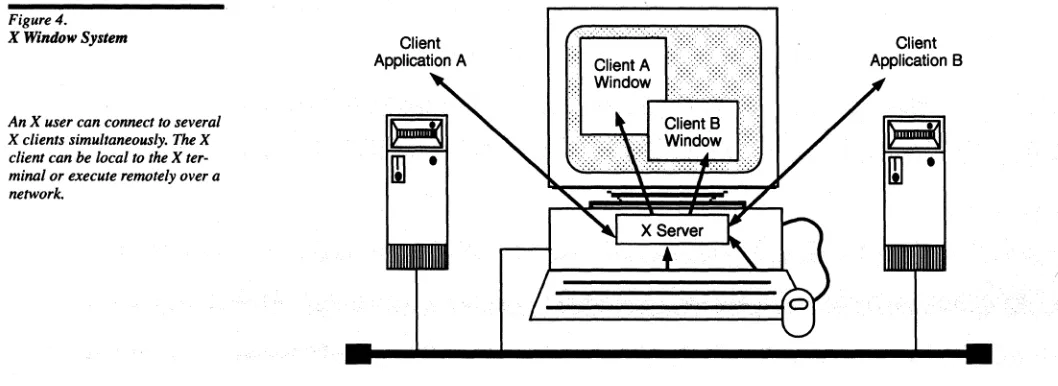
Figure 4.
X Window System
An X user can connect to several
X clients simultaneously. The X
client can be local to the X ter-minalor execute remotely over a network.
SEPTEMBER 1993
Internet Suite Application Protocols
Data Networking
XYZ has registered the domain name xyz.com with the NIC. "XYZ" is the organization's name, and "COM" signifies the organization is a commercial venture. Company XYZ may then assign and locally administer the name hosta.xyz.com for one of its hosts.
Currently, the NIC has specified six top-level domain names. They are the following:
• COM~ommercial Organizations • EDU-Educational Organizations
• GOV-Government Agencies • MIL-MILNET Hosts
• NET-Networking Organizations • ORO-Not for Profit Organizations
DNS tenns the client portion of the protocol implementation the
resolver, and the server is called the name server. The resolver
queries the name server to translate domain names to IP ad-dresses. Resolvers typically cache the results of previous name queries, reducing network traffic and name server interaction.
Advanced Internet Suite Service.
The Advanced Internet suite services include the X Window Sys-tem (X) and the Network File SysSys-tem (NFS). These application protocols are typically implemented on high-perfonnance work-stations and used in a LAN environment.X Window System
The X Window System, typically called simply "X," is a plat-fonn-independent, bit-mapped graphical user interface (GUn that
@ 1993 McGraw-Hili. Incorporated. Reproduction Prohibited. Oatapro Infonnation Services Group. Delran NJ 08075 USA '
Data Networking Internet Suite Application Protocols
@ 1993 McGraw-Hm, IncorporlIIed. Reproduction Pmhibilf!d. Datapro Information Services Gmup. Delran NJ 08075 USA
2775
Standards
5
6 2775 Standards
Internet Suite ApplIcation Protocols
[image:6.612.59.552.88.665.2]Data Networking
Table 1. Internet Suite Application Layer Protocols (Continued)
,Name Acronym
Network Time Protocol NTP
Password Generation PWDGEN Post Office Protocol POP3
Quote of the Day Protocol QUOTD Remote Job Entry RJE
Remote Telnet Service RTElNET
Resource location RlP Protocol
Simple File Transfer SFTP Protocol
Simple Mail Transfer SMTP Protocol
Simple Network SNMP Management Protocol
Statistics Server STATSRV SUPDUP Protocol SUPDUP
TElNET Protocol TElNET
Time Server Protocol TIME Trivial File Transfer TFTP Protocol
Whois Protocol NICNAME
X Window System X
SEPTEMBER 1993
RFC Well·Known
Description Reference Port
Provides a means of RFC958 123 synchronizing network
clocks
Generates passwords RFC972 129 Allows PC users to RFC 1081, 110 access mail from a mail
server
Sends an ASCII message RFC865 17 Used to submit and RFC407
n
retrieve batch jobsSupports special access RFC 818 to user Telnet
Automatically locates a RFC887 39 resource
Bulk file transfer protocol RFC913 115
Electronic mail transfer RFC821 25 protocol
Supports the exchange of RFC 1157 161,162 management information
Used for sending RFC996 95 Telnet-like protocols for RFC734
display terminals
Defines a remote terminal RFC854 23 protocol
Provides time in seconds RFC868 37 Bulk file transfer protocol RFC783 69 without access control or
parameters
Sends information on RFC954 43 specified user
Network Windowing RFC 1198 Protocol
C 1993 McGraw-HIII, Incorporated. Reproduction Prohibited.
Datapro Infonnalion Services Group. Delran NJ 08075 USA
'",-
-
/Data Networking
Figure 5.
Network File System
Internet SuIte ApplicatIon Protocols
Application Process
~~
,~
Operating System
II! ::II
]
NFS
Local File
XDR
System
RPC
UDP
IP
Data Link Control
Physical
Client NFS
-2775 Standards
Operating System
NFS
U
XDR
Local File
System
RPC
UDP
IP
Data Link Control
Physical
Server NFS
7
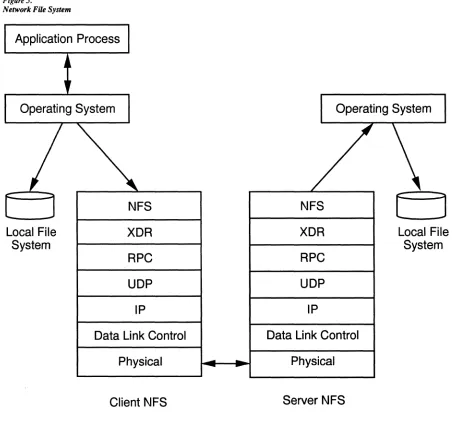
The client Network File System (NFS) provides access to the remote file system over a network connection. The remote file access is transparent to the application process.
runs over TCP. X can run over any reliable network, including OSI, but TCP is the most popular implementation.
An X-based application runs in a client/server environment (see Figure 4). In X, the client and server relationship may appear reversed from the traditional interpretation. The X server typi-cally runs on the local workstation, and the X client runs on the remote host. The X client is responsible for application manage-ment tasks, and the X server is responsible for providing display services on the graphics terminal.
X Servers and X clients can communicate over a network or through an interprocess control (IPC) connection. Because it can operate on a network, X is considered a network-based window-ing system.
The X protocol supports requests and responses between X clients and X servers. It exchanges information necessary to op-erate the graphical windowing system over a network connection.
© 1993 McGraw-Hili, Incorporated. ReprodUCIionProhibijed. Datapro Information Services Group. Delran NJ 08075 USA
X Protocol Internals
Efficiency is an important attribute of the X protocol. It is a nec-essary requirement when running an application such as a distrib-uted windowing system over a network. Efficiencies have been attained in two primary ways. First, not all X client requests re-quire a corresponding reply from the X server; second, the X Protocol Data Units (PDUs) each have a length that is multiples of four octets. The latter allows the X PDUs to be quickly pro-cessed on host processors based on 16- or 32-bit architectures because no alignment is necessary.
The X protocol specifies four PDU types: requests, replies, events, and errors. An X client sends requests to the X server. The X server sends replies, events, and errors to the X client.
8
X Request PJ)U
2775
Standards
An X request PDU instructs an X server to perfonn a specific action and mayor may not require a reply on behalf of the X server. An X client may, for example, request the X server to create a window, allocate a color, draw a graphic, etc. An X re-quest PDU length must be a multiple of four octets.
X RepiyPDU
As mentioned, not all X requests require replies. When the X client requests infonnation, the X server will generate an X reply PDU. An X reply PDU would be sent in response to the "allocate color" request, for example. An X reply PDU's length must be a multiple of four bytes and be a minimum of 32 octets.
X EventPDU
An X event PDU contains infonnation about either a device ac-tion or a side effect of a prior request. X clients receive most of their infonnation through X event PDUs. An X server sends an X event expose PDU when a window display action has completed. An X event PDU's length must be a multiple of four bytes and be a minimum of 32 octets.
X ErrorPDU
An X error PDU is very similar to an X event PDU, with the exception of how the X client handles the PDU. Upon receipt, the X client transfers the error to a special error-handling routine. This facilitates a quick response to error conditions. An X error PDU's length must be a multiple offour bytes and be a minimum of 32 octets.
X appears to have a great future in network computing. Users are demanding windows-based applications because of their ease of use and short learning curves. Software developers find the platfonn independence of X very appealing. MIS managers real-ize they can preserve their investment in hardware, such as main-frames, by migrating many applications to the X environment. Each of these forces is fonning the foundation for a very large market for X applications.
Network File System (NFS)
[image:8.612.223.553.596.720.2]NFS provides the services of what is typically called a "network operating system." NFS is a protocol allowing multiple hosts to access each other's file systems as though they were local (see Figure 5). NFS insulates users and applications from the fact that infonnation is being accessed on another over a network connec-tion. Using NFS, a PC can store infonnation on a UNIX host, for example, as easily as storing infonnation to a local hard drive. Additionally, the PC can actually run a program from software stored on the UNIX host.
Figure 6.
SNMP Management StotWn
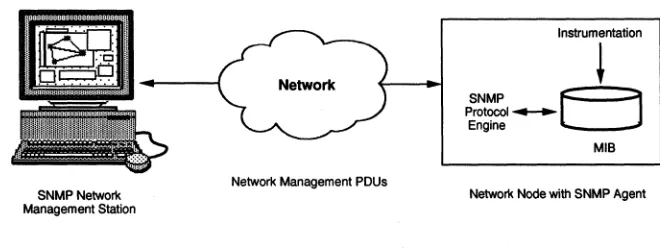
An SNMP Management Station obtains management information from an SNMP agent. The SNMP agent obtains management irifor-mation through its instrumenta-tion. The MIB is a logical data-base of management information.
SEPTEMBER 1993
SNMP Network
Management Stetlon
Internet Suite Application Protocols
Data Networking
NFS is host processor and operating system independent. A Remote Procedure Call (RPC) facility accomplishes this. An ap-plication can execute RPC functions and receive the results to a local data structure just as if a local procedure had been called. The application is unaware that it is processing in a distributed environment. RPC uses eXternal Data Representation (XDR) as a presentation layer service. XDR is responsible for placing infor-mation exchanged between systems in a machine-independent fonn so that any type of CPU can run NFS.
The demand for NFS is accelerating as network administrators discover the benefits of providing users with a standards-based approach to network operating system capabilities. Client NFS is available on a wide variety of hosts including PCs and Mac-intoshes, which should spur the demand for this protocol.
Internet Suite Network Management
Managing a TCP/W-based Internet can be a complex undertak-ing. A TCP/W network typically contains multivendor equipment implemented over multiple network media in a network comput-ing environment. The Internet community struggled for many years without protocols and tools to adequately manage these networks. In response to network administrators' demands, a working group was fonned to develop a network management protocol for managing TCP/IP-based Internets. The result of this effort was the Simple Network Management Protocol (SNMP).
SNMP follows a manager/agent model, similar to the client! server model (see Figure 6). An agent operates on a network de-vice, such as a router, bridge, tenninal server, or even host pro-cessor. The agent responds to queries directed to it from an SNMP manager. SNMP agent software is responsible for providing the instrumentation required to gather management data. The man-agement data is then stored into a logical database called the Management Infonnation Base (MIB).
The SNMP manager software runs on a network manager sta-tion and can perfonn three operasta-tions concerning agent interac-tion. The SNMP manager can get, get-next, or set specific vari-ables in the agent's MIB. Correspondingly, an agent will provide a response to the manager requests. Additionally, an agent can, on certain events, issue an unsolicited trap message to the SNMP manager.
SNMP's authors designed the protocol with three specific goals. Briefly, SNMP was to be developed such that an agent could be deployed with minimal code, have highly extensible monitoring capabilities, and not depend on the underlying trans-port protocol. Each of these goals was met: many SNMP agents are under lOKB; the MIB provides private enterprise space for user extensions; and SNMP implementations exist over many transport mechanisms, including raw Ethernet.
Network Management PDUs
Instrumentation
+
SNMP
U
Protoool ___
Engine
MIB Network Node with SNMP Agent
© 1993 McGraw-Hili, Incorporated. Reproduction Prohibited. Datapro Infonnation Services GroUp. Delran NJOB075 USA
Data Networking Internet Suite AppllClitIon Protocols
Once the SNMP specification was complete, the standard was quickly embraced by vendors. Virtually every TCP/IP networking device manufactured today supports SNMP management.
L. Michael Sabo is a Data Applications Consult-ant with U S West Advanced Communications Services in Denver, CO. Mr. Sabo designs LAN internetworking solutions for clients using frame-relay, SMDS, high-speed private line, and Trans-portation LAN Service (L TS) technologies. This includes porting TCP/IP to the emerging ANSI High-Performance Parallel Interface (HIPPI) Gi-gabit/sec. LAN standard and developing object-oriented and SNMP-based network management architectures. Mr. Sabo has written many techni-cal articles and is a member of Datapro's Board of Technical Advisors for Broadband Communi-cations Services. He participates as a member of the Internet Society, and has been very active in the Internet for eight years. In addition. he is a member of the ATM Forum, Frame Relay Forum, and the SMDS Interest Group.
Mr. Sabo holds a master's degree in Computer Information Management from the University of Denver and a bachelors of science degree in Computer Science from Wright State University.
IC 1993 McGraw-HII~ Incorporated. Reproduction Prohibited. Datapro Information Services Group. Delran NJ 08075 USA
Conclusion
2775
Standards
9
The Internet suite of protocols is robust and rich with application services. Most users view the Internet protocols in terms of these application services. The demand for these services is fueling the demand for TCP/IP-based enterprise Internets, which is likely to continue well into the mid1990s.
-SEPTEMBER 1993
In this report:
Basic Internet Suite Services ... 2
Advanced Internet Suite Services ... 7
Internet Suite Network
Management ... 9
DATAPRO
Data Networking 2775Standards
1
Internet Suite
Application Protocols
Datapro Summary
The Internet suite of protocols is robust and rich with application services.
Most users view the Internet protocols in terms of these application services,
which usually run over
TCP/IPmiddle layer protocols. Based on the clientl
server model, Internet services span the basic functions of virtual terminal
support, electronic mail, file transfers, and name service. Advanced services
include a distributed windowing system, a network file system, and a network
management protocol. The demand for these services is fueling the demand
for TCP/IP-based enterprise internets, which is likely to continue into the
mid-1990s.
The Internet protocol suite continues
in great demand in the
standards-based networking marketplace. This
demand should accelerate into the
mid-1990s. Once the protocol suite
of choice for the U.S. military and a
handful of universities,
Transmis-sion Control Protocol/Internet
Pro-tocol
(TCP/IP)is now gaining
popularity within the business
com-munity. Many businesses have
be-come disillusioned with the
excruciatingly slow pace of OSI
de-ployment. Consequently, businesses
are turning to
TCP/IPto form the
building blocks for their enterprise
internetworks.
As more organizations embrace
TCP/IP,
the timetable for OSI
ubiq-uity becomes correspondingly shifted
-By L. Michael Sabo Communications Architect SSDS,Inc.
to the right.
It
is unlikely that an
or-ganization building a TCP/IP-based
enterprise network today would
mi-grate to OSI before the turn of the
century.
Introduction to TCP/IP
TCP is a transport layer protocol
(ISO layer 4) providing a
connection-oriented service between host
proces-sors.
It
provides a reliable end-to-end
service with provisions for flow
con-trol and multiplexing of connections.
TCP also provides mechanisms for
detecting duplicate, lost, or
out-of-sequence packets.
The Internet suite also specifies
an optional connectionless-mode
transport protocol, User Datagram
Protocol (UDP). UDP is used for
transaction-based applications where
efficiency and low overhead are
more important than reliability.
@ 1992 McGraw·HIII, Incorporated. Reproduction Prohibited. Detapro Information Services Group. Delran NJ 08075 USA
2
Figure 1.
277S
Standards
The Internet Protocol Suite
FTP
TELNET
Intemet Suite Application Protocols
SMTP
X
Windows
Data NetwOrking
DNS
SNMP
NFS
XDR
RPC
TCP
UDP
TCP and UDP use the network services ofIP
(ISO layer 3) as a datagram service. IP is a
connectionless-mode network layer service.
It
is
used to route messages between networks and
per-forms any message segmentation and reassembly
required. Segmentation and reassembly may be
needed if a message must be routed through a
net-work with different packet size restrictions than
the source and/or destination network.
Application protocols are built upon the
ser-vices of TCP/IP and UDP/IP (see Figure 1). These
application protocols form a client/server network
computing environment.
Client/Server Computing
Each application layer protocol discussed in this
report follows the client/server computing model,
which is very simple. In the client/server model, a
client application requests services of a remote
ser-vice application over a network. Correspondingly,
the server performs the requested service of the
client and responds with the results according to a
well-defined protocol. The client typically executes
on the local computer, and the server executes on a
remote computer. Except for network delays, a
user is unaware of the interactions between client
and server processes in such a distributed com put;.
ing environment.
Application Services
Once a TCP/IP-based communications
infrastruc-ture was in place, research turned quickly toward
implementing distributed applications using the
reliable services of TCP. Most users view the
Inter-net protocols in terms of the services they provide
at the application layer. The Internet protocol
IP
Data L1nk Layer
Physical Layer
suite's services are responsible for propelling
TCP/IP to its status in enterprise internetworking.
The Internet protocol suite is rich with
appli-cation services (see Table 1). These services span
the basic functions of virtual terminal support,
electronic mail, file transfers, and name service.
The Internet suite also includes advanced services,
such as a distributed windowing system, a network
file system, and a network management protocol.
This report examines each of these services and
describes how a user interacts with them.
Basic Internet Suite Services
The basic Internet suite services are the File
Trans-fer Protocol (FTP), the virtual terminal protocol
(Telnet), the Simple Mail Transfer Protocol
(SMTP), and the Domain Name Service (DNS).
Hosts supporting TCP/IP are very likely to provide
at least these basic services.
File Transfer Protocol (FTP)
FTP is a protocol used for the bulk transfer of data
between host processors over a TCP datastream.
FTP provides aCile utility for performing remote
file operations such as bidirectional file transfers,
deleting files, renaming files, and displaying file
directories. Users perform these operations during
interactive sessions. To support this on-line
inter-action between a user and a remote host, FTP
pro-vides two connections,as shown in Figure 2.FTP
. commands and status information exchanges use
the control connection. File transferS use a second
connection. Common FTP commands and their
purpose are listed as follows; for a comprehensive
list, refer to your hosts' user manuals:
c-Data Networking Int.met Suite Application Protocols
• ascii-Data will be transferred in ASCII
for-mat.
• binary-Data will be transferred as binary data.
• bye-Terminate the FTP session with the
re-mote server and exit ftp.
• cd-Change the working directory on the
re-mote host.
• delete-Delete a file on the remote host.
• dir-List the directory contents of the current
remote machine directory.
• get-Retrieve a specified file from the remote
host and store it on the local host.
• hash-display a hash sign,
"#",
after each data
block is transferred.
• put-Store a specified file from the local host to
the remote host.
As does every Internet suite application protocol,
FTP follows the client/server model. An FTP client
sends commands and interacts with a user or a user
program, and the FTP server portion receives and
responds to commands. Typically, a host will
pro-vide implementations for both an FTP client and
an FTP server.
[image:13.612.72.552.559.729.2]FTP is non-host specific. FTP
implementa-tions exist for UNIX systems, mainframes,
Mac-intoshes, and PCs. Any system supporting TCP/IP
is likely to support FTP. FTP relies on TCP at the
transport layer to provide a reliable data path
be-tween peer hosts. Thus, users are assured that files
transferred over a network will arrive at their
desti-nation error free.
Figure 2.
fl'p COIIMCtio",
2775
Standards
3
Obtaining RFCs on the
Internet
RFCs are available through FTP from Internet host NIC.DDN.MIL.
Log in using username "anonymous" and pass-word "guest." Once logged on, type in "get RFC:RFCnnnn.txt" , where nnnn Is the RFC number. RFCs can also
be obtained thorugh elec-tronic mail. Send a mes-sage to
and place the RFC num-ber in the subject field.
To obtain a current index of all RFCs, FTP to NIC.DDN.MIL with anony-mous, guest login. Once the session is estab-lished, type "dir
RFC:RFC-INDEX." A doc-ument name will be re-turned, such as RFC-INDEX.TXT.nnnn" to fetch the index for review on your local host. To log out of the FTP seSSion, type "quit."
Virtual Terminal Protocol (TELNET)
TELNET is an interactive remote access terminal
protocol. It allows a user to log in to a remote
com-puter system, over a network, as though the
termi-nal was attached directly to the remote host.
TELNET is based on the client/server model, but
DOS-based PCs, Macintoshs, and terminal servers
typically support only client TELNET. Thus, users
on those devices can initiate an interactive
termi-nal session with a server TELNET but cannot
ac-cept a session request from a TELNET client.
Server Command
FTP Commands
CI ient Command
Protocol Processor
..
~Protocol Processor
Server Data
-
File Data
-
Client Data
Transport Processor
Transport Processor
Server FTP
Client FTP
FrP uses two connections, one for commands and replies, and another to support bulk file transfer.
C\ 1992 McGraw-HIU. Incorporated. Reproduction Prohibited. Datapro Information ServIces Group. Delran NJ 08075 USA
-~
-2775
Standards
Internet Suite
[image:14.612.66.547.77.533.2]Application Protocols Data Networking
Table 1. Internet Suite Application Layer Protocols
Name Acronym
Active Users USERS Protocol
Authentication AUTH Service
Description
Sends a list of active host users
Provides TCP authentication mechanism
RFC Reference RFC 866 RFC 931
Well· Known Port
113
Bootstrap BOOTP Used for booting diskless RFC 951 67,68
Protocol workstations
Character CHARGEN Used for debugging, RFC 864 19
Generator generates ASCII
Protocol messages
Daytime DAYTIME Provide day and time RFC 867 13
Protocol Information
DCNETTime CLOCK Provides a mechanism RFC 778
Server for synchronizing clocks
Protocol
Discard DISCARD Used for debugging, RFC 863 9
Protocol discards all messages
Domain Name DOMAIN Defines the Domain Name RFCs 881, 53
Protocol Service 882, 883
Echo Protocol ECHO Used for debugging, RFC 862 7
echoes all messages
File Transfer FTP Bulk file transfer RFC 959 20, 21
Protocol protocol
Finger FINGER Sends information on RFC 742 79
Protocol specified user
Graphics GRAPHICS Used for exchanging RFC 493
Protocol vector graphics
Internet MPM Provides multimedia RFC 759 46
Message mail transfers
Protocol
I SO Electronic X400 OSI electronic mail RFC 1148 103, 104
Mail standard
Loader LDP Used for loading, RFC 909
Debugger dumping, and debugging
Protocol hosts
Line Printer LPR Print Server protocol Daemon
Protocol
Network File NFS Network File System System
Network News NNTP Protocol posting and
Transfer distributing news
Protocol articles
UNIX hosts and most other multitasking operating
systems generally support both client and server
TELNET.
TELNET uses a TCP connection to transmit
data and TELNET control information. TELNET
is based on the concept of a Network Virtual
Ter-minal (NVT) and negotiated options to extend the
basic capabilities of NVT.
Network Virtual Terminal (NVT)
When a TELNET connection is initiated, both
ends of the connection begin with an NVT profile.
NVT is a least common denominator terminal
pro-file used throughout the network, eliminating the
need for every host to support the entire range of
terminal possibilities (see Figure 3). The NVT is
RFC 1179 515
RFC 1094 2049 RFC 977 119
essentially a bidirectional communications facility
that uses the sevbit ASCII character set but
en-codes them into eight-bit bytes.
Principle of Negotiated Options
TELNET allows services to be supported beyond
those defined for the NVT. There are many
termi-nal options not specifically defined within the
TELNET Protocol but which can be supported by
TELNET. TELNET uses a do/don't, will/won't
negotiation process. This scheme allows a client
and server to use different conventions for the
TELNET session. Specifically, a sender will
re-spond that it will or will not perform some option.
~-(1
"~I
:i
(
Data Networking Intemet Suite
Application Protocols
2775
[image:15.612.78.550.94.548.2]Standards
•
Table 1. Internet Suite Application Layer Protocols (Continued)
RFC Well-Known
Name Acronym Description Reference Port
Network Time NTP Provides a means of RFC 958 123
Protocol synchronizing network
clocks
Password PWDGEN Generates passwords RFC 972 129
Generation
Post Office POP3 Allows PC users to RFC 1081, 110
Protocol access mail from a mail 1082
server
Quote of the QUOTE Sends an ASCII message RFC 865 Day Protocol
Remote Job RJE Used to submit and RFC 407
Entry retrieve batch jobs
Remote Telnet RTELNET Supports special access RFC 818
Service to user Telnet
Resource RLP Automatically locates a RFC 887 39
Location resource
Protocol
Simple File SFTP Bulk file transfer RFC 913 115
Transfer protocol
Protocol
Simple Mail SMTP Electronic mail transfer RFC 821 25
Transfer protocol
Protocol
Simple SNMP Supports the exchange of RFC 1157 161,162
Network management information
Management Protocol
Statistics STATSRV Used for sending RFC 996 95
Server gateway statistics
SUPDUP SUPDUP Telnet-like protocols for RFC 734
Protocol display terminals
Telnet TELNET Defines a remote RFC 854 23
Protocol terminal protocol
Time Server TIME Provides time in seconds RFC 868 37 Protocol
Trivial File TFTP Bulk file transfer RFC 783 69
Transfer protocol without access
Protocol control or parameters
Whois Protocol NICNAME Sends information on specified user
X Window X Network Windowing
System Protocol
Optionally, a sender may request that its peer
ini-tiate or not iniini-tiate an option. This interaction
per-mits an option request to be refused without
knowledge about the requested option. Accepted
options take effect immediately. Rejected options
require the parameter to remain as defined for an
NVT.
Simple Mail Transport Protocol (SMTP)
SMTP is the Internet standard for electronic mail
distribution.
It
is a text-oriented protocol that uses
TCP's underlying services to reliably transfer or
relay electronic mail. SMTP supports efficient
@ 1992 McGraw-Hili, Incorporated. Reproduction Prohibited. Datepro Information Services Group. Delran NJ 08075 USA
RFC 954 43
RFC 1198
message delivery: if a message has multiple
recipi-ents at a particular destination host, SMTP will
only send one message to the host listing each
cipient. The receiving SMTP will provide each
re-cipient with a copy of the message.
Each mail message contains a header and a
body. The header contains elements such as Date,
Subject, To, Cc, and From. The client SMTP
rou-tine prompts the user for each of these parameters.
The body of the message is typically free-form
ASCII text. For example, to send a message to user
smith at host hosta.xyz.com, a UNIX user Jones on
host myhost.xyz.com would perform the following:
•
Figure 3. NIT for Tel1U!t
2775
Standards
Intemet Suite Application Protocols
Data Networking
Telnet's use of network virtual terminal (NVT) reduces the problem of supporting every possible terminal type to only converting between a specific terminal type and NVT.
%
mail [email protected] <cr>
Subject: Thanks for the information <cr>
Mr. Smith, thanks for sending me the information
so promptly. <cr> -Jones <cr> <control d>
Cc: <cr>
%On UNIX systems, a control d is used to indicate
the message is complete. Notice the user did not
copy-"Cc"-any other recipients. If the user had
placed other mailboxes in the "Cc" field, each
re-cipient would have also received the message. To
view the actual SMTP protocol interaction, Jones
could have used the -v-verbose-mail command
option. An example follows:
%
mail -v [email protected] <cr>
Subject: Thanks for the information <cr>
Mr. Smith, thanks for sending me the information
so promptly. <cr> -Jones <cr> <control d>
Cc: <cr>
%[email protected] ... Connecting
to hosta.xyz.com
Trying ... connected.
220 HOSTA.XYZ.COM Simple Mail Transfer
Server ready> > > HELO myhost.xyz.com
2500K»> MAIL
From: <[email protected]>
2500K»> RCPT
To: <[email protected]>
2500K»> DATA
354 Input » > .
2500K»> QUIT
221 HOSTA.XYZ.COM Simple Mail Transfer
server terminated.
%JUN~1992 ,
In the preceding example, lines beginning with
» > are generated by the sender, and lines
be-ginning with a number are responses from the
message recipient. The actual message is sent after
the 354 Input response.
Domain Name Service
The Domain Name Service (DNS) is the naming
protocol used in the Internet suite. DNS provides
domain name-to-IP address translation. Names,
rather than IP addresses, are much easier for
indi-viduals to remember.
DNS allows the administration of domain
names to be decentralized. Through DNS, hosts
are no longer required to maintain host name-to-IP
address configuration tables for every host on the
network. Partitioning the domain name into
multi-ple name fields allows the decentralization of name
administration. The DDN Network Information
Center (NIC) administers the top-level portions of
the domain name. A user organization is free to
append names in front of the top-level name to
define subdomains or specific hosts within the
or-ganization. As an example, company XYZ has
reg-istered the domain name xyz.com with the NIC.
"XYZ" is the organization's name, and "COM"
signifies the organization is a commercial venture.
Company XYZ may then assign and locally
admin-ister the name hosta.xyz.com for one of its hosts.
Currently, the NIC has specified six top-level
domain names. They are the following:
• COM-Commercial Organizations
• EDU-EducationalOrganizations
• GOY-Government Agencies
Data Networking
If Figure 4 .
.. ~ X Window System
Client
Internet Suite
Application Protocol. 2775
Standards
Client
Application B
An X user can connect to several X clients simultaneously. The X client can be local to the X terminal or execute remotely over a network.
(
• MIL-MILNET Hosts
• NET-Networking Organizations
• ORG-Not for Profit Organizations
DNS terms the client portion of the protocol
im-plementation the
resolver,
and the server is called
the
name server.
The resolver queries the name
server to translate domain names to IP addresses.
Resolvers typically cache the results of previous
name queries, reducing network traffic and name
server interaction.
Advanced Internet Suite Services
The Advanced Internet suite services include the X
Window System (X) and the Network File System
(NFS). These application protocols are typically
implemented on high-performance workstations
and used in a LAN environment.
X Window System
The X Window System, typically called simply
"X," is a platform-independent, bit-mapped
graph-ical user interface (GUI) that runs over TCP. X
can run over any reliable network, including OSI,
but TCP is the most popular implementation.
An X application runs in a client/server
envi-ronment (see Figure 4). In X, the client and server
relationship may appear reversed from the
tradi-tional interpretation. The X server typically runs
on the local workstation, and the X client runs on
the remote host. The X client is responsible for
ap-plication management tasks, and the X server is
responsible for providing display services on the
graphics terminal.
X Servers and X clients can communicate
over a network or through an interprocess control
(IPC) connection. Because it can operate on a
net-work, X is considered a network-based windowing
system.
The X protocol supports requests and
re-sponses between X clients and X servers.
It
ex-changes information necessary to operate the
graphical windowing system over a network
con-nection.
X Protocol Internals
Efficiency is an important attribute of the X
proto-col.
It
is a necessary requirement when running an
application such as a distributed windowing
sys-tem over a network. Efficiencies have been
at-tained in two primary ways. First, not all X client
requests require a corresponding reply from the X
server; second, the X Protocol Data Units (PDUs)
each have a length that is multiples of four octets.
The latter allows the X PDUs to be quickly
pro-cessed on host processors based on 16- or 32-bit
architectures because no alignment is necessary.
7
CIlI1992 McGraw-Hili, Incorporated. Reproduction Prohibited. Detepro Information Services Group. Delran NJ 08075 USA
[image:17.612.79.526.96.319.2]•
277. [image:18.612.60.531.56.335.2]Standards
Figure 5.
Network File System
The client Network File
Sys-tem (NFS) provides access to
the remote file system over a
network connection. The
remote file access is
trans-parent to the application
process.
Local File System
Intemet Suite
Application Protocols
RPC UDP IP
Data Networking
NFS XDR
Local File RPC System UDP
IP
Data Link Control nata Link Control Physical Physical
ClientNFS ServerNFS
The X protocol specifies four POU types:
re-quests, replies, events, and errors. An
X
client
sends requests to the
X
server. The
X
server sends
replies, events, and errors to the
X
client.
X
Request
PDU
An X request POU instructs an X server to
per-form a specific action and mayor may not require
a reply on behalf ofthe X server. An X client may,
for example, request the X server to create a
win-dow, allocate a color, draw a graphic, etc. An X
request POU length must be a multiple of four
oc-tets.
X Reply
PDU
As mentioned, not all X requests require replies.
When the X client requests information, the X
server will generate an X reply POU. An X reply
POU would be sent in response to the "allocate
color" request, for example. An X reply POU's
length must be a mUltiple
of
four bytes and be a
minimum of 32 octets.
X Event
PDU
An X event POU contains information about
ei-ther a device action or a side effect of a prior
re-quest. X clients receive most of their information
through X event POUs. An X server sends an X
event expose POU when a window display action
JUNE 1992 ."
has completed. An
X
event POU's length must be
a multiple of four bytes and be a minimum of 32
octets.
X
Error
PDU
An
X
error POU is very similar to an
X
event
POU, with the exception of how the X client
han-dles the POU. Upon receipt, the X client transfers
the error to a special error-handling routine. This
facilitates a quick response to error conditions. An
X error POU's length must be a multiple of four
bytes and be a minimum of 32 octets.
X appears to have a great future in network
computing. Users are demanding windows-based
applications because of their ease of use and short
learning curves. Software developers find the
plat-form independence of X very appealing. MIS
man-agers realize they can preserve their investment in
hardware, such as mainframes, by migrating many
applications to the X environment. Each of these
forces is forming the foundation for a very large
market for X applications.
Network File System (NFS)
NFS provides the services of what is typically
called a "network operating system." NFS is a
protocol allowing multiple hosts to access each
other's file systems as though they were local (see
Figure 5). NFS insulates users and applications
from the fact that information is being accessed
(
[image:19.612.75.544.96.255.2]Data Networking
Figure 6.
SNMP Management Station
Internet Suite Application Protocols
SNMP
2775 Standards
Instrumentation
t
Protocol ...
EJ
9
Network Management PDUs
Engine
MIB
5NMP Network
Management Station
Network Node with 5NMP Agent
An SNMP Management Station obtains management information from an SNMP agent. The SNMP agent ob-tains management information through its instrumentation. The MIB is a logical database of management in-formation.
on another system over a network connection.
Us-ing NFS, a PC can store information on a UNIX
host, for example, as easily as storing information
to a local hard drive. Additionally, the PC can
ac-tually run a program from software stored on the
UNIX host.
NFS is host processor and operating system
independent. A Remote Procedure Call (RPC)
fa-cility accomplishes this. An application can
exe-cute RPC functions and receive the results to a
local data structure just as if a local procedure
had been called. The application is unaware that
it is processing in a distributed environment. RPC
uses eXternal Data Representation (XDR) as a
presentation layer service. XDR is responsible for
placing information exchanged between systems
in a machine-independent form so that any type
of CPU can run NFS.
The demand for NFS is accelerating as
net-work administrators discover the benefits of
pro-viding users with a standards-based approach to
network operating system capabilities. Client NFS
has been implemented on PCs and Macintoshes,
which should spur the demand for this protocol.
Internet Suite Network Management
Managing a TCPIIP-based internet can be a
com-plex undertaking. A TCPIIP network typically
con-tains multivendor equipment implemented over
multiple network media in a network computing
environment. The Internet communities struggled
@) 1992 McGraw·HiII, Incorporated. Reproduction Prohibited. Datapro Information Services Group. Delran NJ 08075 USA
for many years without protocols and tools to
ade-quately manage these networks. In response to
net-work administrators' demands, a net-working group
was formed to develop a network management
pro-tocol for managing TCP/IP-based internets.
The SNMP follows a manager/agent model,
similar to the client/server model (see Figure 6).
An agent operates on a network device, such as a
router, bridge, terminal server, or even host
proces-sor. The agent responds to queries directed to it
from an SNMP manager. SNMP agent software is
responsible for providing the instrumentation
re-quired to gather management data. The
manage-ment data is then stored into a logical database
called the Management Information Base (MIB).
The SNMP manager software runs on a
net-work manager station and can perform three
oper-ations concerning agent interaction. The SNMP
manager can get, get-next, or set specific variables
in the agent's MIB. Correspondingly, an agent will
provide a response to the manager requests.
Addi-tionally, an agent can, on certain events, issue an
unsolicited trap message to the SNMP manager.
to
2775Standards
The standard MIB is fairly small, about 100
objects. Even at that, an agent need not support the
entire MIB if it does not support a specific
proto-col. As an example, a host that does not support
ICMP need not support the ICMP object group.
The Internet community is in the midst of
signifi-cantly expanding the MIB to include many new
objects.
Once the SNMP specification was complete,
the standard was quickly embraced by vendors.
Virtually every
TCP/IP
networking device by all
manufacturers is sold with SNMP support.
L. Michael Sabo is a communications archi-tect with SSDS, Inc., Littleton, CO, and is currently consulting on various networking projects. Previously, Mr. Sabo participated in porting TCP/IP to the emerging ANSI High-Performance Parallel Interface (HIPPI) Giga-bit/sec LAN standard. Mr. Sabo has been active in integrated network management. He participated in developing an object-orI-ented and SNMP-based network manage-ment architecture for Lockheed Integration Services. This effort included defining nu-merous private enterprise management infor-mation base (MIB) objects to support system management functions.
Mr. Sabo is a member of the SNMP working group and has been active in the Internet for six years. He is a member of the board of advisors for Datapro Network Management.
He holds a master's degree in data process-ing management from the University of Den-ver and a bachelor's degree in Computer Science from Wright State University.
Internet Suite AppUcatlon Protocols
Summary
Data Networking
The Internet suite of protocols is robust and rich
with application services. Most users view the
In-ternet protocols in terms of these application
ser-vices. The demand for these services is fueling the
demand for TCP/IP-based enterprise internets,
which is likely to continue into the mid-1990s . •
C) 1992 McGraw-Hili. Incorporated. ReproductlO!" proh~ ..