ISSN: 1992-8645 www.jatit.org E-ISSN: 1817-3195
PLAYABILITY AND SOCIAL EXPERIENCES: AN
ACCEPTANCE STUDY OF INTERACTIVE VIDEO PUZZLE
TECHNOLOGY IN PRESCHOOL SETTING
1LIEW TZE HUI, 1LAU SIONG HOE, 1HISHAMUDDIN ISMAIL, 1AFIZAN AZMAN, 2TEOH
KUNG KEAT
1
Faculty of Information Science & Technology, Multimedia University,
Jalan Ayer Keroh Lama,75450,Melaka, Malaysia
2
Student Learning Centre, Flinders University, Adelaide 5001, South Australia
E-mail: 1{thliew; lau.siong.hoe; hisham; afizan.azman}@mmu.edu.my, [email protected]
ABSTRACT
Interactive Video Puzzle Based Learning solution is designed to better utilize children's strengths and creativity to solve “unstructured” problems in an entertaining ways. Any interactive learning technology will not be a success without acceptance and usage by the target population. The interactive video puzzle prototype was tested using interactive playability and social usability attributes. Interactive playability explain the capability of video puzzle game to provide enjoyment for children player, while social usability is used to explain the predictors that will improve the ease of children-computer-children interactions.
In this paper, we employed interactive playability and social usability attributes in explaining interactive video puzzle learning technology acceptance in preschool setting. Interactive Video Puzzle Acceptance Model had been employed to evaluate the acceptance of video puzzle technology. Results indicated that interactive playability and social usability does matter to children. The feedbacks from the study highlighted that the fact children’s preference is for fun in video puzzle learning activities, which is no surprise. Furthermore, the children perceived that their teacher would choose the interactive video puzzle learning solution on how good it was for their learning. In particular, this paper is aimed to introduce an initial attempt to test the interactive playability and social usability attributes to predict children’s acceptance of interactive video puzzle in preschool setting.
Keywords: Video Puzzle, Interactive Playability, Social Usability, Video Puzzle Based Learning, Problem Solving Kit
1. INTRODUCTION
Video puzzle based learning is a new learning model to attract, motivate and maintain children’s engagement and social interaction, and at the same time to stimulate and develop their problem-solving skills [1]. The objective of video puzzle is to encourage children to think differently, to frame and solve “unstructured” problems. Children will have to discuss different types of video puzzles and their strategies among themselves to solve the problem, which promote peer interaction and social skills among children [2]. Furthermore, a challenging video puzzle game may helps children to train their passionate skills and stimulate their spatial problem solving skills, which extremely needed in today’s preschool education [3].
Video puzzles are educational and it shows useful problem-solving rules in a very entertaining way. Besides, it is absorbing and thought-provoking [1]. Video puzzle games encourage children to think about how they frame and solve problems in real world situation but not those encountered on the textbook chapter. The objectives is to lay a foundation for children to become an effective problem solver in real world uncertain situation. At the highest level, problem solving in real world can be classified into three categories of skills. For examples, children can deal with the vagaries of uncertain and changing environment,
utilize the domain-specific knowledge and
strategies, and stimulate the critical thinking to apply problem-solving strategies [4].
ISSN: 1992-8645 www.jatit.org E-ISSN: 1817-3195
of useful individual spatial problem solving skills; secondly, by transferring these skills to other situations where children can solve new problems. Problem solving skill has become an important learning outcome for children from as young as a toddler. Problem solving skills are important to enable children to deal effectively with social, scientific, and practical problems. Merely having knowledge or information is not enough [5]. To be effective in the workplace and in their personal lives, children must be able to solve problems to make effective decisions; they must be able to frame problems from multiple angle and alternative.
[image:2.612.90.298.324.601.2]In order for the interactive video puzzle learning technology to be successfully installed in preschool setting, this study employed interactive playability and social usability attributes to explain the children’s initial perception and acceptance towards this new learning technology.
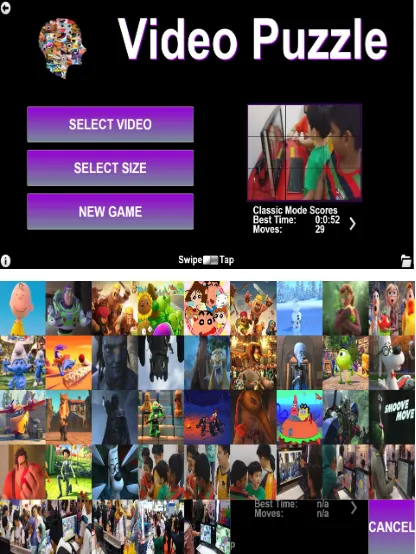
Figure 1: Interactive Video Puzzle Prototype
2. INTERACTIVE VIDEO PUZZLE AND PUZZLE BASED LEARNING
Nowadays, children are busy for their life and always have serious difficulties in independent thinking regardless of the nature of a problem. The most obvious challenges with our curriculum is, from preschool all the way through to university
education, we are relying on coursework as the main component and tools to instill problem-solving skills in young generation. Most of the children never have chances to think and learn on how to solve a problem freely. Throughout our education, we were told to solve the end of chapter question and must refer and applied the materials provided in each chapter to get the correct answer. Following this type of aids to “problem solving,” it is an “expectation” that children are sickening of framing and addressing unstructured real-world challenges. Most importantly, problem solving skill is one of the most critical drivers for high impact productivity and human capital development [6].
For example, players must be provided with rules and concepts that help to analyze and identify the problems, focusing on the inter-related nature of problems and providing problem solving practice in a non-threatening environment. Video puzzle completion time and number of errors made before and after correctly completion of the video puzzle represent the level of the complexity [5]. This is necessary in developing children as effective problem-solvers, rather than limited their thinking to the problems.
On the other hand, the puzzle-solver needs to spend much time to learn all the aspects of the problem before attempting to solve the problem. The more the time spend on identify or analyze the problem, the time taken to find the solution decrease. Processes of understanding problem-solving principles will stimulate critical thinking skills. This is because without understanding of the problem, efforts and time taken to find a solution to complete the video puzzle will be much longer [2]. Of course, patience is also an important skills for an effective problem solving. This skill is closely related to critical thinking, which been described as the ability to ask and answer critical questions that are related to what we have read or learn.
ISSN: 1992-8645 www.jatit.org E-ISSN: 1817-3195
3. INTERACTIVE VIDEO PUZZLE,
SOCIAL INTERACTION AND SOCIAL USABILITY
There are many benefits of social interaction in children especially in preschool setting, namely, sense of belonging, acceptance and confidence. Social activities could assist children to make friends, feel good about themselves and complete a major project in a team.
Interactive gaming experiences were found to both be fun, social belonging, networking and interactions with friends in the social life [7] [8]. It also highlighting the effect of variations in social processes and gaming contexts on the dynamics of the activity. It was enjoyable playing the game together [9].
Social interaction is where children are around with their peers and starting to socialize with others. There are certain interaction protocol to establish fun and rewarding social experiences. For example, during any social interaction, children are thought to take turns, share, patient, respect, listen, talk positive about others and be friendly. Interactive video puzzle based learning could excellently offer an interactive platform for children to play around and offer rewarding social experience.
Social usability is a quality attribute. It assesses how easy social interactions are to make between each other. However, the term “social usability” also refers to the methods for improving the ease of human-computer-human interactions during the design process. Social usability is defined by four characteristic (RICE) [10]:
(i) Relations
(ii) Identity
(iii) Communication
(iv) Emergence of Groups
Social usability is part of a methodology. A rewarding social experience through video puzzle interaction offer children a spectrum of meaningful experience of social connectedness and social interactions.
4. INTERACTIVE PLAYABILITY
Learning through play is one of the most important concept in preschool education especially in engaging children in their learning process. Learning through playing is supported by video
puzzles especially. Few studies focus on analyzing the degree of the playability in interactive technology acceptance had established a definition of playability for both design and evaluation as “a collection of criteria with which to evaluate a product’s game play or interaction” [11].
Good playability of a game should be a prerequisite for evaluating social experience and user acceptance. This could be interpreted to support that playability is related to a game’s capability to provide enjoyment for a player over an extended period of time [12].
Playability is a term used in the design and analysis of video puzzle that describes the quality of a video based game in terms of its rules, mechanics, goals and design. It refers to all the experiences that a child may feel when interacting with video puzzle game. Buts sometimes, the experience is related with the different ways of interaction among children [13]
In this study, the term interactive playability was used to illustrate the interactive game interface, control system, menus and dialogs are attractive and enjoyable for the children. Besides, it also describe the learning and memorization of video puzzle in a pleasant, enjoyable and entertaining way for the children.
5. HOW CAN THE SOCIAL USABILITY INFLUENCE THE CHILDREN USER’S EXPERIENCES?
From the literature, it was also found that enjoyable experiences were associated with gaming tasks which required coordination, cooperation and interdependence. Overall, this suggests that flow can be experienced during cooperative social gaming in which players work together in an additional way, and have collective competency to finish the gaming tasks [9].
ISSN: 1992-8645 www.jatit.org E-ISSN: 1817-3195
Educational game proved to be able to activate children’ mental capacity, and raise their positive attitude towards learning, which enhance the understanding of the topics learned, moreover transfer the effect of learning to other topics. Thus, it is believed that if educational games are well planned, organized and supervised, can play an active role in building positive attitudes toward learning [3].
6. METHODOLOGY
[image:4.612.310.526.90.656.2]In particular, this paper is aimed to introduce an initial attempt to explain the interactive playability and social usability attributes to predict children’s acceptance of interactive video puzzle in preschool setting.
Figure 2: Interactive Video Puzzle Acceptance Model
The test started by approaching some children. We were given permission from the children’s teacher and parent to allow their children to participate in our testing process. Our focus group of the testing is children aged ranging from three (3) years old to six (6) years old and the children were selected randomly.
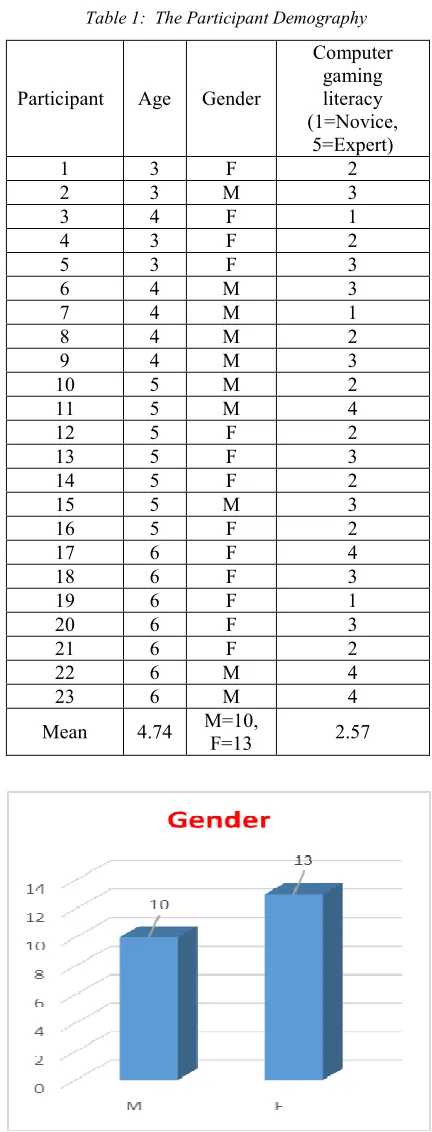
The sample of participants in this study was comprised of 23 children. There were a total 23 participants, 10 were boys and 13 girls. All of the children participated in the experiment were volunteers. The field study took place in a preschool in Melaka. They played the game during the given period, after which they completed the respective survey.
Table 1: The Participant Demography
Participant Age Gender
Computer gaming literacy (1=Novice,
5=Expert)
1 3 F 2
2 3 M 3
3 4 F 1
4 3 F 2
5 3 F 3
6 4 M 3
7 4 M 1
8 4 M 2
9 4 M 3
10 5 M 2
11 5 M 4
12 5 F 2
13 5 F 3
14 5 F 2
15 5 M 3
16 5 F 2
17 6 F 4
18 6 F 3
19 6 F 1
20 6 F 3
21 6 F 2
22 6 M 4
23 6 M 4
Mean 4.74 M=10,
F=13 2.57
Figure 3: Children Demography by Gender
A total number of 23 children were invited to participate in the user testing, and all 23 were actually participated. The children performed the test one at a time, and each test took about 30 minutes. The tests consisted of three parts:
Interactive
Playability
Social
Usability
Video
Puzzle
Acceptance
[image:4.612.90.295.310.493.2]ISSN: 1992-8645 www.jatit.org E-ISSN: 1817-3195
[1] 10 minutes of free surf,
[2] 10 minutes of Walkthrough, performed
by the children, and
[3] 10 minutes of post-interaction interview.
Field studies was carefully planned and prepared in order to ensure that the collected data is accurate, valid and collected efficiently. We had gathered seven researchers in conducting the study. Each of the researcher had been assigned a specific responsibility, for example, some to take photos and videos; some teach the children on how to play the video puzzle game; some observe and written down the children’s emotional reaction; and some recorded down the time taken by the children interacting with the video puzzle game for first time and the second time.
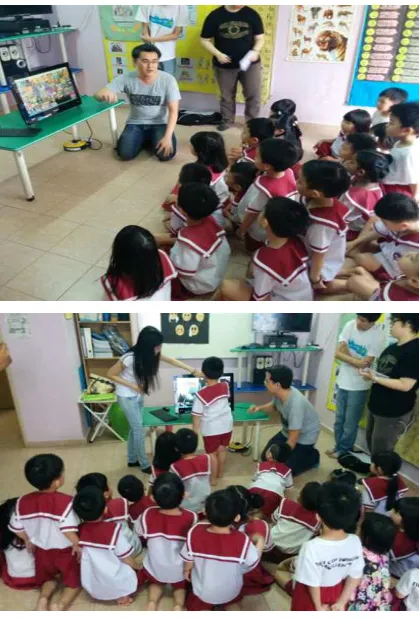
Firstly, to start the session, we introduced video puzzle learning to the children, and followed video puzzle game demo. After a 5 minutes demo, next, we invite volunteer children to try the puzzle and ask for their first impression.
[image:5.612.314.524.143.453.2]Prior of the testing session, children were divided into 3 group for better interaction with the video puzzle. Demo of the video puzzle was conducted in each group and children were given chances to have first feel of video puzzle, and they were asked to indicate on a smileyometer (Figure-4) on how good they thought the video puzzle is going to be. The rationale for this was that this gave a measure of expectation that could indicate whether or not the child was subsequently let down by the activity, or pleasantly surprised.
Figure 4: Smileyometer
The first part of the session required the children to play video puzzle without any specific task. The
[image:5.612.91.299.499.665.2]post-interaction interview gave the children an opportunity to give comments and thoughts on general aspects of the game, the interaction and the performed test procedure.
Figure 5: Initial Demo Of Video Puzzle Game
After the initial demo, the children were divided into 3 groups based on their ages, which are 3 to 4 years old, 5 years old and 6 years old.
[image:5.612.314.524.528.684.2]ISSN: 1992-8645 www.jatit.org E-ISSN: 1817-3195
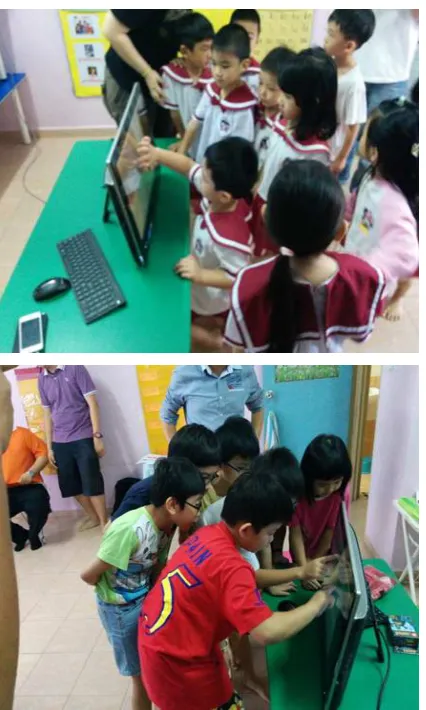
Each group has two researchers and one touch screen device that allows children to play the video puzzle game. Next, the children in each group start to have first experience with the game and play the video puzzle game individually. During the study, each child was observed by two researcher, one concentrated on noting social usability issues, and
one noting indicators of enjoyment and
[image:6.612.312.525.221.387.2]engagement, such as comments, smiles, laughter, or positive body language, and also signs of lack of enjoyment and frustration, including, for example, sighs, and looking around the room.
Figure 7: Testing In Progress
After 20 minutes, we start to asking children based on their experiences, usability, feeling when playing the video puzzle game to get their impressions and feedbacks. In order for the children to understand the questions, we actually further explain and elaborate each question in a simple way or in other word “children slang”. Next, we placed the smiley rating on the white board and let the children choose based on their
respond. Based on the children response, we will than recorded down all the data, and transfer these data into the questionnaire form.
Each child was given approximately 10 minutes to interactive video puzzle game, after which a post-test was administered to establish any learning effect. The children were then asked to rate the video puzzle using the smileyometer rating as shown in figure-4, to give a rating for their ‘actual’ experience.
Figure 8: Gathering Feedbacks With Children
Once all the required information were gathered, the data than be classified and scaled. We employed a five point’s Likert scale for this purpose. Strongly Disagree, Disagree, Neutral, Agree, and Strongly Agree.
[image:6.612.91.304.233.588.2]The data had been converted and arranged into below table:
Table 2: The Results
Children/Age
Moderator Interactive Playability/Social Experience
Gender
Computer Game literacy
Learn with Friend
Play With Friend
Fun With Friend
Teacher Encoura-gement
3 F 2 3 4 3 4
3 M 3 2 3 2 3
4 F 1 4 4 4 5
3 F 2 3 4 5 4
3 F 3 3 3 4 4
4 M 3 4 3 4 4
4 M 1 5 4 5 5
4 M 2 4 4 4 5
4 M 3 4 3 4 4
[image:6.612.305.528.519.739.2]ISSN: 1992-8645 www.jatit.org E-ISSN: 1817-3195
5 M 4 3 4 4 4
5 F 2 4 4 4 4
5 F 3 4 4 5 4
5 F 2 4 3 4 4
5 M 3 3 3 3 4
5 F 2 2 4 3 4
6 F 4 3 5 4 4
6 F 3 3 5 4 3
6 F 1 3 4 4 3
6 F 3 4 5 4 4
6 F 2 4 4 4 5
6 M 4 5 3 4 4
6 M 4 3 4 4 5
7. RESULTS DISCUSSION
[image:7.612.81.533.35.717.2]Figure 9: Computer Gaming Literacy For Children Aged 3 - 4 Years Old
[image:7.612.86.518.78.344.2]Figure 10: Computer Gaming Literacy For Children Aged 5 Years Old
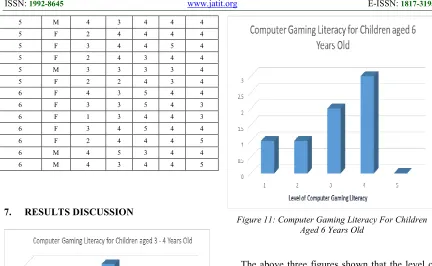
Figure 11: Computer Gaming Literacy For Children Aged 6 Years Old
The above three figures shown that the level of
computer gaming literacy was significantly
correlated with age. Higher score of computer gaming literacy found in senior preschooler. For children group 6 years old, 42% of children had given a rating of 4 for their computer gaming literacy. Comparatively, 0% of children in group age 3- 4 had given a rating of 4 or 5 for their computer gaming literacy.
Figure 12: The Mean Score For Interactive Playability And Social Usability
[image:7.612.301.523.458.658.2]ISSN: 1992-8645 www.jatit.org E-ISSN: 1817-3195
combined attributes had more influence, or which type of the elements were more valued by the children. We perform a simple data analysis that represent four combined measures for interactive playability and social usability.
[image:8.612.90.302.424.611.2]As shown in figure-12, learn with Friend attribute had a mean score of 3.44, which can be interpreted as children had a neutral feedback on its influence towards interactive playability and social usability. Attributes Play with Friend and Fun with Friend had scored 3.74 and 3.83 respectively, which indicated that the children agreed that fun and play with friends were important in their learning process. Finally, as shown in figure-12, Teacher Encouragement had a highest score of 4.05. This finding shown that, teacher plays an important role in preschool setting for learning technology acceptance and usage. Overall, the rating of 3.76 indicated that the children tend to agree and accept the use of video puzzle game in their learning process. Thus, it is believed that educational video puzzle games can play an active role in building positive attitudes toward learning in preschool setting [3]. In conclusion, the children had expressed their intention to accept video puzzle in their daily activities and shown a great interest to play the game again with their friends in future.
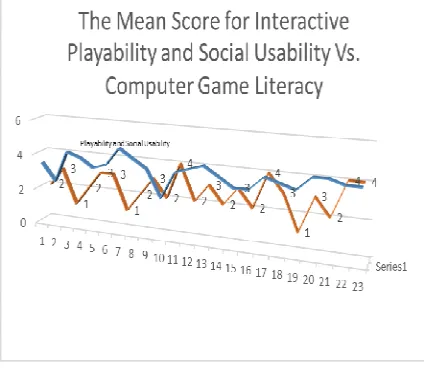
Figure 13: The Mean Score For Interactive Playability And Social Usability Vs. Computer Game Literacy
Figure-13 above indicated the mean score for interactive playability and social usability versus computer game literacy. The purpose of this analysis is to find out if there is any correlation between the two measures. The results depicted that computer game literacy measure does not contribute to the score of interactive playability and social
usability. For example, children no. 3, 7 and 19 had a score of 1 for computer game literacy, but their score for interactive playability and social usability were 4.25, 4.75 and 3.5 respectively. From the results, we can concluded that other measures especially friends and teacher had influenced their perceived acceptance towards video puzzle game. Moreover, it also indicated that children learn better through play with their peers.
8. CONCLUSION
A tentative conclusion is that interactive playability and social usability does matter to children. The feedbacks from the study highlighted the fact that the children’s preference is for fun in video puzzle, which is no surprise. The children perceived that their teacher would choose the video puzzle solution based on how good it was for learning. It is evidenced that the smileyometer is one of the best alternatives for evaluating edutainment with young children, which not really understand the complicated questionnaires. The observation found children tend to synthesis, evaluate and solve the unstructured puzzle at their own efforts, and this practice lay a foundation for children to become an effective problem solver in real world uncertain situation. Lastly, this study investigated the practices of Human Computer Interaction design to understand the difficulties of children computer interaction and provide support towards good usability and better user experience in dealing with children.
REFRENCES:
[1] M. Zbigniew, and F. Nickolas, “Puzzle-Based
Learning: An Introduction to Critical Thinking and Problem Solving”. DSI instructional innovation award competition finalist, 2011.
[2] F. Nickolas, S. Raja, and M. Zbigniew,
“Teaching Puzzle-based Learning:
Development of Basic Concepts Puzzle-Based Learning for Engineering and Computer Science”, Computer, Vol. 43(4), 2012, pp. 20-28.
[3] R. Karl, and P. Dexter, “Learning to learn”,
Retrieved
from:http://www.macalester.edu/geology/wirth/ CourseMaterials.html, 2008.
[4] A. Ibrahim, J. L. Gutiérrez, S. González, and N.
PadillaZea, “Playability Design Pattern in Educational Video Game”, The 5th European
Conference on Games Based Learning
ISSN: 1992-8645 www.jatit.org E-ISSN: 1817-3195
[5] T. Selen, and A. Sonam, “What do players
(think they) learn in games?” Procedia - Social and Behavioral Sciences, Vol. 46, 2012, pp. 3345–3349.
[6] G. Xiaoqing, Z. Yuankun, and G. Xiaofeng,
“Meeting the “Digital Natives”: Understanding the Acceptance of Technology in Classrooms”, Journal of Educational Technology & Society, Vol. 16 (1), 2013, pp. 392–402.
[7] H. Cole, and M. D. Griffiths, “Social
interactions in Massively Multiplayer Online Role-playing gamers”, Cyber Psychology & Behavior, Vol. 10(4), 2007, pp. 575–583.
[8] C. Klimmt, H. Schmid, and J. Orthmann,
“Exploring the enjoyment of playing browser games”, Cyber Psychology & Behavior, Vo. 12,
2009, pp. 231–234.
[9] K. K. Linda, and B. Jo, “Putting The “Fun
Factor” Into Gaming: The Influence of Social
Contexts on Experiences of Playing
Videogames”, International Journal of Internet Science, Vol. 9(1), 2012, pp. 23–36.
[10]G. Gianandrea, and C. Davide, “Social Usability
Checklist”, Retrieved from
http://intenseminimalism.com/2010/social-usability-checklist/, 2010.
[11]A. Jarvinen, S. Helio, and F. Mayra,
“Communication and Community in Digital Entertainment Services”, Pre-study Research Report, Hypermedia Laboratory, University
Tampere, Retrieved from
http://www.hass.rpi.edu/public_html/ruiz/EGDF all09/readings/Creating%20communityUniv.of %20Tampere.pdf, 2002.
[12]H. Korhonen, and E.M.I. Koivisto, “Playability
heuristics for mobile games”, Proceedings of the 8th conference on Human-computer interaction with mobile devices and services, ACM, 2006, pp. 9-16.
[13]A. Voida, and S. Greenberg, “Console gaming
across generations: exploring intergenerational interactions in collocated console gaming”, Universal Access in the Information Society,
Vol. 11 (1), 2011, pp. 1–12. Doi: