Terminals
IBM 3174
Establishment Controller
and InfoWindow
Display Family
Product Enhancement
Analysis
The IBM 3174 ISDN Basic Rate
In-terface Adapter, a new option for the
3174 Establishment Controller,
scheduled for availability in
Septem-ber 1991, will provide downstream
communications at a speed of 64K
bps for ISDN-attached PS/2s
equipped with the IBM ISDN
Co-Processor/2 Model 2 Adapter and
ISDN Co-Processor Support
Pro-gram Version 1.1. The 3174 ISDN
BRI Adapter will provide four ports,
supporting up to eight remote PS/2
ISDN workstations with no
conten-tion.
A new release of 3174 operating
code, Configuration Support-C, will
support the 3174 BRI Adapter while
maintaining compatibility with all
functions provided by Configuration
Support-B. An upgrade is available
to customers currently using
Config-uration Support-B.
By exploiting ISDN's dial-up
capa-bilities, usage-based pricing
struc-ture, and higher throughput, this new
attachment offers users more
config-uration flexibility and cost savings,
along with faster communications
speeds than are possible with analog
facilities.
-By
Martin Dintzis
Assistant Editor
@ 1991 McGraw-Hili, Incorporated. Reproduction Prohibited. Oatapro Research Group. Delran NJ 0/l0751,J$A
The 3174 ISDN BRI Adapter costs
$4,800; the supporting software
li-cense fee ranges from $60 to $1,295,
depending on the 3174 model and
the level of microcode installed.
Advanced Peer-to-Peer
Networking
IBM has also announced the future
availability of the IBM 3174
Estab-lishment Controller Advanced
Peer-to-Peer Networking (APPN)
Licensed Internal Code (LIC)
Fea-ture. This program adds APPN
sup-port to the communications
capabilities of Configuration
Support-Co
APPN is an extension to IBM's
Sys-tems Network Architecture (SNA)
and Systems Application
Architec-ture (SAA) that supports distributed
networking, allowing network nodes
to communicate on a peer-to-peer
basis. APPN extends the reach of
SNA by providing:
• A dynamic network topology,
with a database for recording
net-work changes and a distributed
network directory for tracking
network resources;
• Dynamic route calculation; and
• Network congestion control. •
IBM 3174
Establishment Controller
and InfoWindow
Display Family
Product Enhancement
Analysis
The IBM 3174 ISDN Basic Rate
In-terface Adapter, a new option for
the 3174 Establishment Controller
scheduled for availability in Septem·
ber 1991, will provide downstream
communications at a speed of 64K
bps for ISDN-attached
PSl2s
equipped with the IBM ISDN
Co-Processor/2 Model 2 Adapter and
ISDN Co-Processor Support
Pro-gram Version 1.1.
The 3174 ISDN BRI Adapter will
provide four ports, supporting up to
eight remote PS/2 ISDN
worksta-tions with no contention.
A new release of 3174 operating
code, Configuration Support-C, will
support the 3174 BRI Adapter while
maintaining compatibility with all
-By
Martin Dintzis
Assistant Editor
tl) 1991 McGraw·Hm, Incorporated. Reproduction Prohibited. Datapro Research Group. Delran NJ 08075 USA
functions provided by Configuration
Support-B. An upgrade is available
to customers currently using
Config-uration Support-B.
Advantages
By exploiting ISDN's dial-up
capa-bilities, usage-based pricing
struc-ture, and higher throughput, this new
attachment offers users more
config-uration flexibility and costs savings,
along with faster communications
speeds than are possible with analog
facilities.
Price
The 3174 ISDN BRI Adapter costs
$4,800; the supporting software
li-cense fee ranges from $60 to $1,295,
depending on the 3174 model and
the level of microcode installed . •
IBM 31 74 Establishment
Controller and
InfoWindow
Dis la Famil
In this report:
Product Summary
Analysis ... -102
Editor's Note
IBM is the predominant force in the
Characteristics ... -105synchronous display system market,
a market created in 1972 when IBM
PriCing ... -111introduced the first generation of
3270 products. IBM has lost about
50 percent of this market to
competi-tors over the years, however, and
recently took steps to bolster its
com-petitive position.
Description
IBM's 3270 product line includes
nine upgraded models of the 3174
Controller, the new 3471 and 3472
InfoWindow display families, and a
complete line of printers. Together,
these products support
communica-tions with applicacommunica-tions running on
IBM hosts.
Strengths
The InfoWindow displays offer
higher resolution and improved
ergo-nomics at a more attractive price.
IBM's 3174 controller now supports
up to three synchronous host
connec-tions and is equipped with a faster
microprocessor. IBM's reputation for
quality products and excellent
cus-tomer service also contribute to the
computer manufacturer's
competi-tive position.
© 1990 McGraw-Hili, Incorporated. Reproduction Prohibited. Datapro Research. Delran NJ 08075 USA
Limitations
Memorex Telex, AT&T, and Lee
Data offer communication
control-lers that support up to four
synchro-nous host connections, and access to
multiple synchronous and
asynchro-nous sessions from the same display.
Competition
IBM's chief competitor is Memorex
Telex, which has about 28 percent of
the market to IBM's 50 percent.
AT&T, IDEA Courier, and Lee Data
control about 8, 5, and 2 percent of
the market, respectively.
Vendor
International Business Machines
Corp. (IBM)
Old Orchard Road
Armonk, NY 10504
Contact your local IBM
representa-tive.
Price
See pricing section.
C25-491-102 Terminals
Analysis
Product Strategy
It is no secret that IBM very much wants the
mil-lions of 3270 terminals installed over the past 20
years to be traded for new PS/2 computers. Yet,
IBM recognizes that many people hesitate to scrap
hardware that is serving them well. Not only that,
many of the 3270 software programs on company
mainframes have not been changed in years
be-cause they do what they are supposed to do.
Mak-ing the commitment to new machines, a new
operating system, and new applications may be
more of a leap than companies are willing to make.
Further, there is still a healthy demand for 3270
terminals.
After letting competitors chip away at its
sig-nificant 3270 market share, in 1989 IBM
concen-trated on fortifying itself against further market
losses. Leading the new IBM charge was a new line
of 3174 controllers and terminals. Its line
ofIn-foWindow terminals are more compact, offer
im-proved resolution and ergonomics, and are more
competitively priced-pricing that IBM's
competi-tors will be hard pressed to match.
Perhaps IBM recognized that 3270 terminals
were close to becoming commodity items (as
per-sonal computers had become). In the PC market,
IBM let competitors steal market share from it
with cheaper "clone" products. In the case of 3270
terminals, IBM was not willing to let competitors,
once again, outperform it in the marketplace.
As one analyst commented after the
an-nouncement, "IBM's competitors can match it
fea-ture for feafea-ture, but they may not be able to match
it for price." The fallout has already begun.
Par-tially as a result of IBM's moves, competitor Lee
Data reorganized in 1989, cutting its workforce by
nearly 200, as it tried to weather a large loss.
IBM also enhanced its 3174 controller, which
now includes a faster microprocessor that
im-proves throughput for token-ring communications.
MAY 1990
IBM 3174 Establishment Controller and
InfoWindow Display Family
Datapro Reports on Data Communications
The new 3174 also supports up to three
synchro-nous host connections, access to up to eight IBM
hosts via a token-ring network, and network
man-agement functions. The nine new 3174 controller
models, however, are about the same price as
pre-vious models. IBM has renamed the 3174 product
the Establishment Controller, a reflection of the
fact that the 3174 now offers connectivity beyond
end-user terminals. That is, IBM is portraying the
product as offering establishment control and
con-nectivity, not just display control.
Competitive Position
IBM's competitors in the 3270 market include
Memorex Telex, AT&T, Lee Data, and IDEA
Cou-rier. Its major competitor is Memorex Telex. The
leading manufacturer of 3270-compatible displays,
Memorex Telex's market share is growing. It boasts
strong product support and a complete product
line.
Memorex Telex and IDEA Courier have
ex-celled primarily by offering IBM
plug-compatibility at a lower price. AT&T and Lee Data
were the first to offer controllers and displays that
support enhanced functionality, such as access to
multiple synchronous hosts and multiple
concur-rent asynchronous and synchronous terminal
ses-sions with windowing. One of Memorex Telex's
network controllers, however, also offers this level
offunctionality. Today, Memorex Telex's 1174
Network Controller, AT&T's 6544 Multifunction
Communication Controller, and Lee Data's
~
The Graphics-5
3472Model
GCis a
seven-color display that supports multiple windows,
allowing the user to access up to five
alphanu-meric sessions and one graphics session
simul-taneously. Notepads support data transfer
between sessions.
Display Family
Company Profile
IBM Corporation
Corporate Headquarters Old Orchard Road Armonk, NY 10504 InCanada IBM Canada Ltd., Markham
3500 Steeles Avenue
E.
Markham, ON L3R 2Z1 (416) 474-2111Offices located in other cities throughout Canada. Officers
Chairman/CEO: John Ak-ers
Vice Chairman: Jack D. Kuehler
Sr. VP/Gen. Mgr.: Terry Lautenbach
Company Background
Year Founded: 1914
No. Employees: 400,000
worldwide
IBM is one of the oldest manufacturers of comput-ing equipment in the world. It started out in Poughkeepsie, NY as a small company manufac-turing clocks for industrial use and later introduced punched card equipment for business accounting functions. According to
Business Week and For-tune, IBM is among the top five industrial corpo-rations by sales volume. It has dominated the main-frame market for over 30 years and has a strong hold on other industry sectors.
Business Overview IBM designs, manufac-tures, markets, and ser-vices mainframe computer systems and associated peripherals; minicomputer systems and peripherals,
microcomputer/personal computer systems; com-puter system software; data communication con-trollers and terminals; other communication products such as mo-dems, voice response systems, and voice mes-saging systems; local area network communica-tion products; and office typewriters. In addition, IBM provides specialized products and services such as communications carrier and limited time-sharing services; the IBM Information Network, a communications facility with remote storage and computing services; OEM manufacturing of termi-nals, disk drives, and other products; mainte-nance service and system supplies; and financial services through its IBM Credit Corp. subsidiary. Since it introduced its PC line of microcomputers, IBM has had several earning periods where the growth of the company was much less than antic-ipated. This reflects the competitive nature of this
@ 1990 McGraw-Hili, Incorporated. Reproduction Prohibited. Datapro Research. Delran NJ 08075 USA.
(in billions)
$65
Financial Results 1984-1989
Total Revenues $60 $55 $50 $45 $40 $35 $30 $25 $20 $15 $10 $5
o
~
1984~
50.8roo--1985 1986
small system market. To compete more effectively in this market, IBM has greatly expanded its soft-ware, as well as hard-ware, efforts and has entered into agreements with several independent software suppliers to pro-vide tools for its entire line of computer products. For the second time in its history, IBM last year con-firmed a reduction in its work force. Approxi-mately 10,000 people are either to take early retire-ment or accept termina-tion incentives. IBM took a fourth-quarter write-off of $2.3 billion as a re-structuring charge. Financial Profile Operations results for 1989 showed that net profits fell 35 percent to $3.76 billion, or $6.47 per share. Revenues, how-ever, increased 5.1 per-cent to $62.7 billion over 1988. Fourth-quarter earnings fell 75 percent to $591 million, or $1.04 per
627 59.7
r----=--~
1987 1988 1989
share, due to the $2.3 bil-lion restructuring charge. Management
Statement
Moving more resources close to customers is a cornerstone of IBM's transformation in the computer industry. To that end, in 1988 IBM un-dertook the most signifi-cant restructuring of its business in more than 30 years, establishing seven lines of business and a new organization-IBM United States. This re-structuring continued through 1989 and will continue to be dynamic in order to consistently meet the needs of its custom-ers.
IBM notes that it is man-aging for the long term and, with the steps it has taken and continues to take, it remains confident about the future of its business.
C25-491-104
Terminals
IBM 3174 Establishment Controller and
InfoWindow Display Family
Datapro Reports on Data Communications
Table 1. The Evolution of the IBM 3270 Family'
1972 IBM delivered the first generation of 3270 devices: the 3270 Control Unit; the 3272 Control Unit; the 3275 Stand-alone Display Station; the 3277 Cluster Display Station; the 3284 Matrix Printer; the 3286 Matrix Printer; and the 3288 Belt Printer.
1977 IBM introduced a new generation of components offering increased capabilities at much lower prices, including the 3274 Control Unit, the 3276 Control Unit Display Station, and the 3278 Cluster Display Station.
1979 IBM added the first color products: the 3279 Color Display Station and color versions of the 3278 Printer. 1983 March: IBM announced several additions to the 3270 product line, including the 3178 Display Station (a smaller
and less expensive version of the popular 3278 Model 2 Display); the 3290 Information Panel, a gas plasma dis-play; four new 3274 Control Unit models (41A, 41C, 41D, and 61 C); the 3299 Terminal Multiplexer, a coaxial cable eliminator; and an option permitting the attachment of the IBM PC to the 3278 Display Station.
October: IBM introduced the 3270 Personal Computer, a version of IBM's PC capable of supporting up to seven concurrent sessions: four 3270 sessions, one DOS seSSion, and two notepad sessions. IBM also introduced the 3279 Personal Computer Attachment.
1984 IBM unveiled the 3180 Display Station and 3179 Color Display Station.
1985 IBM unveiled two graphics versions of the 3179 Color Display Station, Models G1 and G2, supporting selectable screen formats and all-points-addressable graphics.
1986 IBM realigned the 3270 family to highlight the 3174 Subsystem Control Unit, the first processor to support a to-ken-ring connection and communications with asynchronous hosts. IBM released 3174 controller Models 1 L, 1 R, 2R, 51R, and 52R that year. The vendor also announced the 3191,3192,3193, and 3194 Display Station series. 1987 IBM released 3174 controller Models 3R and 53R and announced Models 81R and 82R.
1989 IBM introduced the 3174 Establishment Controller Models 11L, 11R, 12R, 13R, 61R, 62R, 63R, 91R, and 92R. These models provide greater speed and memory capacity and more connectivity options than the older 3174 units. IBM also introduced the InfoWindow 3471 and 3472 families of displays.
~
(Analysis continued)
Datastar 5000 System all support up to four
syn-chronous host connections and access to five
con-current synchronous andlor ASCII sessions, in any
combination.
IBM's enhancements to the 3174 controller
have plugged the performance gap between IBM's
3270 Display System and the multifunction
sys-tems of IBM's competitors. In deference to what its
customers were demanding, in 1989 IBM also
re-duced prices on its older 3270 display
terminals-something that its competitors had feared was
coming. This move shook up an already fiercely
competitive market, leading some to predict that
only three players will remain-AT&T, Memorex
Telex, and IBM.
Decision Points
The reliability of IBM's equipment and the
de-pendability and consistency of its maintenance
ser-vice have always presented a problem to vendors
MAY 1990
of IBM-compatible equipment. Now, functional
improvements and more competitive prices have
given IBM an even stronger position in the 3270
market.
The new features of the 3174 Controller have
made the controller much more competitive with
the multifunction-type systems offered by
Memo-rex Telex, AT&T, and Lee Data. These features
include support for up to three host connections, a
faster microprocessor that improves throughput in
token-ring configurations, twice the base internal
memory (2M bytes) and up to 6M bytes of
maxi-mum storage, network management capability, and
up to five concurrent sessions for attached ASCII
displays.
Compared to previous IBM terminals, the
InfoWindow displays have more compact designs
and include smaller, more comfortable keyboard
arrangements. They also provide higher resolution
while using less power. The InfoWindow
Graphics-53472 Model GC display offers up to 70 percent
faster screen painting than its predecessor, the
3192-G. Once again, competing vendors will be
hard pressed to keep in step with IBM.
System/370
IntoWlndow Display Family
System1370 .
3174-11L
System/370
~
II
3174-X3R
Characteristics
Models
The tables provide information about the announcement and release dates of the IBM communication control-lers, displays, printers, and software products covered in this report.
3174 Establishment Controller
Models
11L, 11R, 12R, 13R, 61R, 62R, 63R, 91 R, and 92R
Date Announced May 1989
Date Released May 1989
@ 1990 McGraw-Hili, Incorporated. Reproduction Prohibited. Datapro Research. Delran NJ 08075 USA
Displays
Model(s)
InfoWindow 3471 Mono-chrome Display, Models EA and EG
InfoWindow 3472 Mono-chrome Display, Models FA, FC, FD, and FG
InfoWindow Graphics-5 3472 Model GC Display
3193 Display Station 3194 Display Station
Printers
Model(s) Proprinter II Proprinter II XL Proprinter III and III XL Proprinter X24E and XL24E Quietwriter III
Quickwriter
[image:9.612.66.555.70.756.2]3812 Model 2 Page Printer 3816 Model D Page Printer
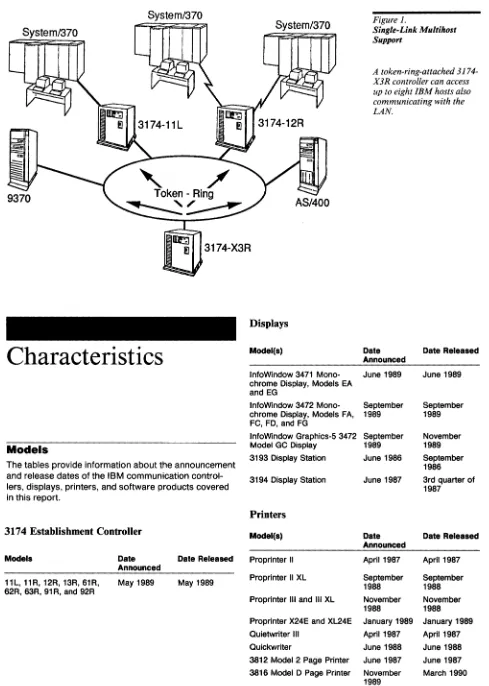
Figure 1.
Single-Link Multihost Support
A token-ring-attached
3174-X3R controller can access
up to eight IBM hosts also
communicating with the
LAN.Date Date Released
Announced
June 1989 June 1989
September September
1989 1989
September November
1989 1989
June 1986 September 1986
June 1987 3rd quarter of 1987
Date Date Released
Announced
April 1987 April 1987 September September
1988 1988
November November
1988 1988
January 1989 January 1989 April 1987 April 1987 June 1988 June 1988 June 1987 June 1987 November March 1990 1989
C25-491-106
Terminals
Model(s)
3816 Model S Page Printer 4019 LaserPrinter
4224 Printer, Models 201,
Date Announced April 1989 October 1989 November 202, 2C2, 2E2, 2E3, 301, 302, 1988 or earlier and 3E3
4234 Model 11 Dot Band February 1989 Printer
6262 Model 012 Impact Line February 1988 Printer
6262 Model 014 Impact Line February 1988 Printer
6262 Model 022 Impact Line October 1989 Printer
Software
Product Date
Announced Configuration Support A Re- May 1989 lease 5 microcode
Configuration Support S Re- May 1989 lease 5 microcode
Configuration Support B Re- September
lease 2 microcode 1989
PC/Host File Transfer and July 1989 Terminal Emulator (FTTERM)
Release 2.1
Transmission Specifications
Date Released
April 1989 November 1989
Information not available March 1989 March 1988 July 1988 November 1989
Date Released May 1989 May 1989 March 1990 July 1989
The 3174 controller family supports local, remote, and tOken-ring gateway communications using BSC, SNA/ SOLC, and X.25 protocols. Model 11 L, the local control-ler, provides single-tag interlocked and two-tag high-speed transfer channel operation modes, with rates up to 1.25M bps. The 3174 remote models 11R, 12R, 13R, 61 R, 62R, 63R, 91 R, and 92R provide the following sup-port as is applicable to the model selected:
• EIA RS-232-C/CCITT V.24/V.28 operation up to a maximum speed of 19.2K bps for BSC and 64K bps for SNA/SOLC;
• CCITT V.35 and X.21 operation up to a maximum speed of 64K bps for SNA/SOLC; and
• X.25 operation up to a maximum speed of 64K bps. Models 11R, 12R, 61R, 62R, 91R, and 92R operate in half-duplex, point-to-point or multipoint modes on du-plex or half-dudu-plex facilities. Switched, X.21, and X.25 network operations are supported only through SNA/ SOLC. Models 13R and 63R transmit and receive at 4M or 16M bps using media access protocols conforming with IEEE 802.5 and ECMA 89 standards, and logical link protocols conforming with the IEEE 802.2 standard, over the baseband IBM Token-Ring Network. Devices can be connected to these controllers using coax, the
MAY 1990
IBM 3174 Establishment Controller and
InfoWlndow Display Family
Datapro Reports on Data Communications
IBM Cabling System (for token-ring network attach-ment), or twisted pair wire.
Host Computer Software Support
The 3270 subsystem is supported for local and remote operation by IBM System/370, 43XX, 303X, 308X, 3090, 8100, System/1, System/3X, System/88, and AS/400 computer systems. Remote terminals are supported by BTAM (Basic Telecommunications Access Method), TCAM (Telecommunications Access Method), and VTAM (Virtual Telecommunications Access Method).
Components
3174 Establishment Controller
The nine new 3174 models-11L, 11R, 12R, 13R, 61R, 62R, 63R, 91 R, and 92R-support several features and capabilities not provided by older models, including the following:
• Support for up to three synchronous host connec-tions, depending upon the model, using the new Concurrent Communication Adapter.
• An increase from one to eight in the number of gate-ways that can be accessed by a tOken-ring-attached 3174.
• A faster microprocessor providing a cycle time 62 percent shorter than that of previous models, which greatly improves throughput in channel-attached, token-ring gateway configurations.
• Greater controller memory capacity-2M bytes base storage and up to 6M bytes maximum (depending on the model).
• Coexistance of the Asynchronous Emulation Adapter, which supports connections with asynchro-nous hosts and devices, and the token-ring gateway function.
• Support for up to five concurrent sessions on ASCII workstations.
• Customization of protocol conversion for ASCII workstations through user-controlled definition ta-bles.
• Improved centralized control ofthe 3174 by IBM's Central Site Control Facility.
Configuration Support B Microcode combines the capa-bilities previously provided by two separate controller. software products, Configuration Support A and Config-uration Support S, While driving the new communica-tions features.
Models 11L, 11R, and 12R are floor-standing units for large clusters. They come with 4 synchronous ports, and are expandable to 32 synchronous and 24 ASCII ports. All three models support up to three syn-chronous host connections via the Concurrent Commu-nication Adapter. Model 11 L is a local controller that provides a System/370-architecture channel interface
InfoWindow Display Family
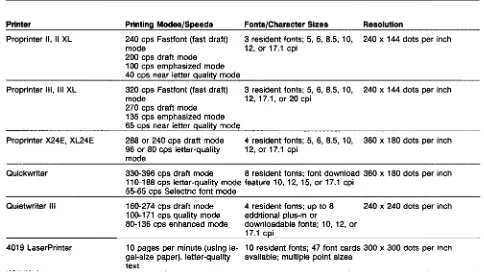
Table 2. Display-Attachable Printers
Printer Printing Modes/Speeds Fonts/Character Sizes Resolution
Proprinter II, II XL 240 cps Fastfont (fast draft) 3 resident fonts; 5, 6, 8.5, 10, 240 x 144 dots per inch
mode 12, or 17.1 cpi
200 cps draft mode 100 cps emphasized mode 40 cps near letter quality mode
Proprinter III, III XL 320 cps Fastfont (fast draft) 3 resident fonts; 5, 6, 8.5, 10, 240 x 144 dots per inch
mode 12,17.1, or 20 cpi
270 cps draft mode 135 cps emphasized mode 65 cps near letter quality mode
Proprinter X24E, XL24E 288 or 240 cps draft mode 4 resident fonts; 5, 6, 8.5, 10, 360 x 180 dots per inch 96 or 80 cps letter-quality 12, or 17.1 cpi
mode
Quickwriter 330-396 cps draft mode 8 resident fonts; font download 360 x 180 dots per inch 110-188 cps letter-quality mode feature 10,12,15, or 17.1 cpi
Quietwriter III
55-65 cps Selectric font mode 160-274 cps draft mode 100-171 cps quality mode 80-136 cps enhanced mode
4 resident fonts; up to 8 additional plus-in or
downloadable fonts; 10, 12, or 17.1 cpi
240 x 240 dots per inch
4019 LaserPrinter 10 pages per minute (using le- 10 resident fonts; 47 font cards 300 x 300 dots per inch gal-size paper), letter-quality available; multiple point sizes
text
for SNA and non-SNA attachment. Model 11 R provides EIA RS-232-C/CCITT V.24/V.28 and CCITT V.35 inter-faces for SNA/SDLC, BSC, or X.25 remote link attach-ment. Model 12R provides a CCITT X.21 interface for SNA/SDLC or X.25 remote link attachment. Each con-troller includes 2M bytes of memory, expandable to 6M bytes, and a 1.2M or 2.4M byte diskette drive. A second diskette drive and a 20M byte hard drive are optionally available. The 3174-11 L, -11 R, and -12R are compatible with the older 3174-1 L, -1 R, and -2R controllers.
Model13R is a floor-standing model that provides host attachment via the IBM Token-Ring Network. It can communicate with a System/370 host via an IBM 37XX Communication Controller with the NCP/Token-Ring Interconnection Facility of ACF/NCP, or via a channel-attached 3174 Model 1 L or 11 L using the Token-Ring Network 3270 Gateway optional feature. This feature consists of the following:
• The Type 3A Dual Speed (16/4M bps) Token-Ring Communication Adapter.
• Configuration Support B microcode or utility and control diskettes for Configuration Support S micro-code.
• A token-ring adapter cable.
Equipped with the Type 3A Dual Speed (16/4M bps) Token-Ring Communication Adapter, model13R sup-ports token-ring communications. It uses media access protocols conforming with IEEE 802.5 and ECMA 89
© 1990 McGraw-Hili. Incorporated. Reproduction Prohibited. Datapro Research. Delran NJ 08075 USA
standards, and logical link protocols conforming with the IEEE 802.2 standard, over the baseband IBM Token-Ring Network.
The 3174-13R optionally supports up to two direct host connections using the Concurrent Communication Adapter. It comes with four synchronous ports, and is expandable to 32 synchronous and 24 ASCII ports. The 3174-13R includes 2M bytes of memory, expandable to 6M bytes, and a 1.2M or 2.4M byte diskette drive. A second diskette drive and a 20M byte hard drive are op-tionally available. The 3174-13R is compatible with the older 3174-3R controller.
Models 61R and 62R are tabletop units for medium-sized clusters. They come with 9 standard syn-chronous ports, and are expandable to 16 synsyn-chronous and 8 ASCII ports. They both support up to three syn-chronous host connections using the Concurrent Com-munication Adapter. Model 61 R provides EIA RS-232-C/ CCITT V.24/V.28 and CCITT V.35 interfaces for SNA/ SDLC, BSC, or X.25 remote link attachment. Model 62R provides a CCITT X.21 interface for SNA/SDLC or X.25 remote link attachment. Each controller includes 2M bytes of memory, expandable to 4M bytes, and a 1.2M or 2.4M byte diskette drive. A second diskette drive is optionally available. 3174-61 Rand -62R are compatible with the older 3174-51 Rand -52R controllers.
Model 63R is a tabletop unit which, like model 13R, supports token-ring communications and host at-tachment via an IBM 37XX Communication Controller or a channel-attached 3174 Model 1 L or 11 L equipped with the Token-Ring Network 3270 Gateway optional
C25-491-108 Terminals
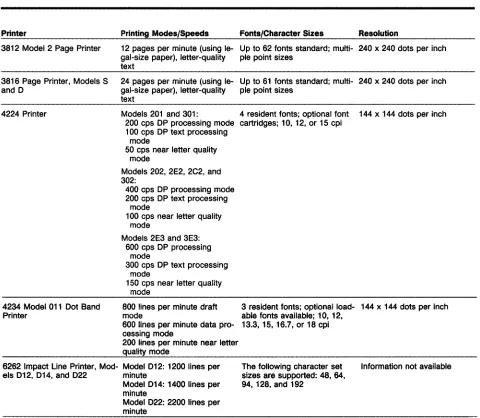
Table 3. Controller·Attachable Printers
Printer Printing Modes/Speeds
IBM 3174 Establishment Controller and
InfoWindow Display Family
Fonts/Character Sizes
Datapro Reports on Data Communications
Resolution
3812 Model 2 Page Printer 12 pages per minute (using le- Up to 62 fonts standard; multi- 240 x 240 dots per inch gal-size paper), letter-quality pie point sizes
text
3816 Page Printer, Models S 24 pages per minute (using le- Up to 61 fonts standard; multi- 240 x 240 dots per inch and 0 gal-size paper), letter-quality pie point sizes
text
4224 Printer
4234 Model 011 Dot Band Printer
Models 201 and 301:
200 cps OP processing mode
100 cps OP text processing mode
50 cps near letter quality mode
Models 202, 2E2, 2C2, and
302:
400 cps OP processing mode
200 cps OP text processing mode
100 cps near letter quality mode
Models 2E3 and 3E3: 600 cps OP processing
mode
300 cps OP text processing mode
150 cps near letter quality mode
800 lines per minute draft mode
600 lines per minute data pro-cessing mode
200 lines per minute near letter quality mode
6262 Impact Line Printer, Mod- Model 012: 1200 lines per els 012, 014, and 022 minute
Model 014: 1400 lines per minute
Model 022: 2200 lines per minute
feature. The 3174-63R comes with 9 standard synchro-nous ports, is expandable to 16 synchrosynchro-nous and 8 ASCII ports, and optionally supports one direct host connection using the Concurrent Communication Adapter. Model63R includes 2M bytes of memory, ex-pandable to 4M bytes, and a 1.2M or 2.4M byte diskette drive. A second diskette drive and a 20M byte hard drive are optionally available. The 3174-63R is compatible with the older 3174-53R controller.
Models 91 Rand 92R are small tabletop units that
support small clusters of IBM 3270 displays and print-ers for remote attachment to IBM host processors via telecommunications links. Both models come with four synchronous ports and are expandable to eight syn-chronous ports. Use of the Concurrent Communication Adapter, for communications with more than one IBM host, is not supported on these models. Model 91 R pro-vides EIA RS-232-C/CCITT V.24jV.28 and CCITT V.35
MAY 1990
4 resident fonts; optional font cartridges; 10, 12, or 15 cpi
144 x 144 dots per inch
3 resident fonts; optional load- 144 x 144 dots per inch able fonts available; 10, 12,
13.3, 15, 16.7, or 18 cpi
The following character set Information not available sizes are supported: 48, 64,
94, 128, and 192
interfaces for SNA/SDLC, BSC, or X.25 remote link at-tachment. Model 92R provides a CCITT X.21 interface for SNAjSDLC or X.25 remote link attachment. Both models come with 2M bytes of memory (not expand-able), and a 2.4M byte diskette drive. The 3174-91 Rand 92R are compatible with the older 3174-81 Rand -82R controllers.
Controller Microcode
Configuration Support A, which supports ASCII protocol conversion, and Configuration Support S, which sup-ports tOken-ring gateway operation, were upgraded from Release 4 to Release 5 to provide base functional-ity for the 3174 Establishment Controller. They include improvements over the old code, such as 64K bps oper-ation for X.25 packet switching (previously limited to 19.2K bps), Graphic Data Display Manager (GDDM) PC-link support, support for both 2.4M byte and 1.2M byte diskette drives, compatibility with the Type 3A Dual
InfoWindow Display Family
Speed (16/4M bps) Token-Ring Communication Adapter, and improved channel-attached token-ring gateway performance. These are the last planned en-hancements to Configuration Support A and S. Future growth and improvement will be provided through Con-figuration Support B, which merges the functions of both Release 5 microcode products into a single config-uration.
Release 2 of Configuration Support B, made avail-able in March 1990, includes the following enhance-ments over Release 1 of the same microcode:
• Local format storage, which allows CICS screen for-mat panels to be stored on the 3174.
• Improvements in asynchronous emulation capability, including support for a wider range of ASCII and 3270 displays.
• Type-ahead, the ability to enter keystrokes for the next screen before the display has fully made the transition to that screen.
Multiple Synchronous Host Connections
The new 3174 models support multiple connections to IBM hosts in two ways: through the Concurrent Com-munication Adapter, and through the Single-Link Multi-Host Support provided for token-ring networks. Both methods require Configuration Support B microcode. The Concurrent Communication Adapter (CCA) enables a 3174 controller to access an additional IBM host. Up to two CCAs, depending upon the model, can be installed for a maximum of three concurrent synchro-nous host connections. Two versions of this adapter are available: one supporting RS-232-C (CCITT V.24./V.28) and CCITT V.35 interfaces, the other supporting attach-ment via the CCITT X.21 interface.
Equipped with a microprocessor, control storage, and a teleprocessing interface, each CCA appears to the host as an additional 3174 controller, communicat-ing at speeds up to 64K bps for SDLC or X.25 protocols, and up to 19.2K bps for BSC protocols. Users of CUT-mode displays can switch between hosts by using the Change Screen key, while users working on DFT mode displays operating in an SNA network can do the same with the Jump Screen key. Use of the Concurrent Com-munication Adapter is not supported on 3174 models 52R, 53R, 81 R, 82R, 91 R, and 92R, or on non-SNA DFT-mode displays.
Single-Link Multi-Host Support enables any 3174-X3R controller connected to a token-ring network to ac-cess up to eight IBM hosts in communication with the LAN. As shown in Figure 1, Concurrent Communication Adapters can be used to increase the number of acces-sible hosts. Up to five concurrent sessions are posacces-sible for workstations on the LAN.
Terminal Multiplexers
The 3174 Establishment Controller can be configured to connect terminals either directly, via 3299 Terminal Mul-tiplexers, via optional Terminal Multiplexer Adapters, or by a combination of these three options. Each control
© 1990 McGraw-Hili, Incorporated. Reproduction Prohibited. Datapro Research. Delran NJ 08075 USA
unit contains an integrated four-port terminal adapter that permits up to four devices to be directly attached; a maximum of 32, 16, or 8 devices, depending upon the model, can be attached by using up to four 3299 Termi-nal Multiplexers, up to four TermiTermi-nal Multiplexer Adapt-ers, or any combination (up to four total) of these two options.
Token-Ring Network Access
The Type 3A Dual Speed (16/4M bps) Communication Adapter provides access to an IBM Token-Ring network at selectable speeds of either 16M bps or 4M bps. This adapter is a base feature on models 13R and 63R (as well as the older 317 4-3R and -53R). The adapter is op-tional for 3174 controller models 1 L, 1 R, 2R, 11 L, 11 R, 12R, 51 R, and 52R.
Terminal Emulation Capability
The Asynchronous Emulation Adapter is an optional feature that allows 3270 display stations operating in control unit mode to emulate an ASCII (IBM 3151 or Dig-ital VT1 00/220) display terminal. Using the adapter, a display can exchange information over a direct or switched RS-232-C circuit with ASCII applications and public data networks, while maintaining communica-tions, when required, with IBM applications. Attached 3270 printers can also emulate ASCII printers. PS/2 workstations emulating any of the supported ASCII dis-plays can also communicate with 3270 applications. Each adapter provides eight ASCII ports. The large con-trol units can support up to three adapters, or 24 ASCII devices. Intermediate 3174 controllers can support up to eight ASCII devices. With a 3299 multiplexer, the smaller 3174 models can support eight synchronous devices emulating ASCII peripherals.
The IBM PC/Host File Transfer and Terminal Em-ulator Program (FTTERM) provides 3270 and ASCII (IBM 3101 or Digital VT1 00/220) terminal emulation, au-tomatic host dial-up, and user-initiated or unattended batch file transfer capabilities for IBM-compatible PCs and PS/2s running under DOS Version 3.3 or later. For 3270 terminal emulation, FTTERM requires the support of a protocol converter, such as an IBM 3174 controller equipped with the Asynchronous Emulation Adapter, an IBM 3708 Network Conversion Unit, an IBM 7171 ASCII Device Attachment Control Unit, or an IBM ES/9370 ASCII Subsystem Controller.
FTIERM supports up to four concurrent synchro-nous sessions, LAN connectivity, and, when attached to the IBM ES/9370 ASCII Subsystem Controller-II, seven-color presentation. In 3270 mode, up to 20 files can be transferred simultaneously; in ASCII mode, any number of concurrent file transfer operations are possible. An optional High-Level Language Application Program In-terface simplifies program development and communi-cations with the host.
Network Management Support
With Configuration Support B microcode, it is possible to distribute or customize microcode residing on differ-ent 3174 controllers from a cdiffer-entral site using IBM's
C25-491-110 Terminals
Central Site Customizing Utility (CSCU). This capability, called Central Site Change Management, makes manual updating unnecessary. Other capabilities supported by the new microcode include the running of online diag-nostic tests from a NetView console and network asset management-the tracking of the location, status, and utilization of each display and controller.
Displays
The InfoWindow 3471 Monochrome Display comes in an amber monochrome version (model EA) and a green monochrome version (model EG). Providing entry-level 3270 functionality, the 3471 includes a flat 14-inch dis-play mounted on a tilt and swivel pedestal, and a low-profile 102-key PS/2-style, 104-key data entry-style, or 122-key typewriter-style keyboard. The 3471 provides a screen arrangement of 24 lines by 80 characters and a resolution of 720 by 402 pixels. Users can switch be-tween five concurrent full-screen alphanumeric ses-sions with a hot key. The screen includes an operator information area for system messages. With the Vital Product Data feature, the 3471 can transmit user-modifiable identification parameters to the host-based NetView network management system. Other features of the 3471 include an adjustable audible alarm, auto dim, a security keylock, a set of 12 or 24 program func-tion keys, a keyboard layout definifunc-tion utility for custom-ized keyboard layouts, a screen setup mode, and support for a display-attached printer.
The InfoWindow 3472 Display includes four mod-els: FA, FC, FD, and FG. Each display is mounted on a tilt and swivel pedestal, and comes with a 102-key IBM Enhanced-style, 1 04-key typewriter-style, or 122-key typewriter-style keyboard. Models FA and FG are flat 14-inch amber (FA) and green (FG) monochrome dis-plays supporting a maximum screen resolution of 1,199 by 508 pixels. Model FD includes a 15-inch green mono-chrome display supporting a maximum screen resolu-tion of 1,200 by 532 pixels. Model FC is a seven-color, 14-inch display supporting a maximum screen resolu-tion of 1,188 by 508 pixels. All models support four se-lectable screen formats: 24 rows by 80 columns, 32 rows by 80 columns, 27 rows by 132 columns, and 43 rows by 80 columns.
The 3472 supports access to up to five concurrent (full-screen) alphanumeric sessions via a hot key. A Vital Product Data feature enables the display to transmit user-modifiable identification parameters to NetView for device tracking purposes. The 3472 features an adjust-able audible alarm, auto dim, a security keylock, 24 pro-gram function keys, record/play/pause capability, a keyboard layout definition utility for customized key-board layouts, a screen setup mode, and support for a display-attached printer and a bar code reader.
The InfoWindow Graphics-5 3472 Model GC Dis-play, also referred to as the 3472-G, is the most ad-vanced member of the InfoWindow family, providing seven-color graphics capability and multiple-sessions with windowing on a 14-inch screen. The 3472-G comes with a tiit and swivel pedestal and a choice of a 104- or
MAY 1990
IBM 3174 Establishment
Controller and InfoWindow Display Family
Datapro Reports on Data Communications
122-key, typewriter-style or IBM enhanced-style key-board. It provides four selectable screen formats: 24 lines by 80 columns, 32 lines by 80 columns, 43 lines by 80 columns, and 27 lines by 132 columns. Maximum resolution for this display is 1,188 by 508 pixels. Draw times for the 3472-G are up to 70 percent faster than its predecessor, the IBM 3192-G. Multisession support permits up to five alphanumeric sessions plus one graphics session simultaneously in overlapping win-dows. The 3472-G features self-contained help screens, a comprehensive setup mode, record/play/pause capa-bility, session-to-session copy capability (not supported on an ASCII session), a notepad, a keyboard definition utility, and support for a mouse, a display-attached printer or plotter, a tablet device, and a bar code reader.
IBM's Older Displays
IBM continues to market the older 3193 and 3194 dis-play stations along with the InfoWindow families. IBM reduced prices on these older workstations to make them just as price-competitive.
The 3193 Display Station includes a 15-inch monochrome monitor mounted on a tilt and swivel ped-estal, a logic unit, and a low-profile 102- or 122-key typewriter-style keyboard. Screen arrangements of 24 lines by 80 columns, 32 lines by 80 columns, and 48 lines by 80 columns are supported. The screen provides for both alphanumeric and image presentations with a resolution of 1,200 by 880 pixels, and supports all-points-addressable capability. The 3193 displays up to two logical terminals and up to eight partitions. Logical terminal capability allows the operator to view alphanu-meric only, image only, or a combination of the two types of presentations. Image presentations are en-abled through the use of the IBM 3117 Scanner (with the IBM 3117 Extension Unit) or the IBM 3118 Scanner. Data and images are displayed in white on black, or black on white in reverse video. Features of the 3193 include an audible alarm, auto dim, record/pause/play capability, a screen setup mode, a security keylock, a set of 12 or 24 program function keys, and support for a display-attached printer.
The 3194 Display Station comes in three varia-tions: a 12-inch color display (model C), a 14-inch color display (model H), and a 15-inch monochrome display (model D). The 3194 is modularly constructed, consist-ing of a monitor with a tilt and swivel pedestal; logic, which includes a 3.5-inch diskette drive with a 720K-byte memory capacity; and a low-profile 102-, 104-, or 122-key typewriter-style keyboard. All three models support screen arrangements of 24 lines by 80 columns and 32 lines by 80 columns. Additionally, models D and H support screen arrangements of 43 lines by 80 col-umns and 27 lines by 132 colcol-umns. Model C and H color displays support seven colors and resolutions of 720 by 400 and 1,188 by 725 pixels, respectively. The mono-chrome version supports up to 1,188 by 544 pixel reso-lution.
The 3194 displays up to two notepad sessions and from one to four host sessions in windows, whose sizes and positions on the screen can be changed. Data
InfoWindow Display Family
can be copied from session to session. Other features of the 3194 include an audible alarm, auto dim, a secu-rity key lock, a set of 24 program function keys, record/ play/pause capability, a screen setup mode, and support for a display-attached printer.
Display-Attachable Printers
The following printers connect directly to an IBM 3270 display. More information about each printer is provided in Table 2.
The Proprinter is a desktop dot-matrix printer that comes in six models. The Proprinter II and Proprinter II XL are nine-wire printers that provide Fastfont (fast draft), draft, emphasized, and near-letter-quality printing modes at speeds of 240, 200, 100, and 40 characters per second, respectively. The Proprinter III and Pro-printer III XL are nine-wire Pro-printers that provide Fastfont, draft, emphasized, and near-letter-quality printing modes at speeds of 320,270,135, and 65 characters per second, respectively. The Proprinter X24E and XL24E are 24-pin printers offering higher resolution and faster speeds. Draft printing at 240 to 288 cps and letter-quality printing at 80 to 96 cps are supported on these models. All XL models accommodate paper up to 16.5 inches wide; models II, III, and X24E accommodate paper up to 11 inches wide.
The Quickwriter is a high-speed 24-wire dot ma-trix printer that supports draft mode printing at 330 to 396 cps, letter-quality printing at 110 to 188 cps, and a Selectric font mode producing IBM Selectric typewriter-quality characters at 55 to 65 cps. The Quickwriter ac-commodates paper up to 16.5 inches wide.
The Quietwriter III is a near-silent, nonimpact printer that employs IBM's Resistive Ribbon Thermal Transfer Technology. The Quietwriter III prints 160 to 274 cps in draft mode, 100-171 cps in letter-quality mode, and 80 to 136 cps in enhanced mode. It accom-modates paper up to 16.5 inches wide.
The 4019 LaserPrinter is a compact, nonimpact
page printer capable of producing letter-quality text and graphics at up to 10 pages per minute. The 4019 in-cludes a standard 200-sheet auto feeder, supports a variety of fonts, and optionally accommodates a 500-sheet second feeder and auto envelope feeders. Controller-Attachable Printers
The following printers connect directly to a 3174 Estab-lishment Controller using coaxial cable. More informa-tion about each printer is provided in Table 3.
@ 1990 McGraw-Hili, Incorporated. Reproduction Prohibited. Datapro Research. Delran NJ 08075 USA
The 3812 Model 2 Page Printer is a tabletop, cut-sheet printer, producing letter-quality text and all-points-addressable graphics at up to 12 pages per minute. The 3812 comes with up to 62 fonts, and optionally supports a scanner for bar coding and photograph reproductions.
The 3816 Page Printer models Sand D are
table-top, nonimpact multifunction printers that produce letter-quality text and graphics at up to 24 pages per minute. Model S produces one-sided copies, while model D prints single or double-sided pages.
The 4224 Printer models 201, 202, 2C2, 2E2, 2E3, 301 , 302, and 3E3 are heavy-duty dot matrix printers that provide print speeds ranging from 200 to 600 cps in DP processing mode, 100 to 300 cps in DP text pro-cessing mode, and 50 to 150 cps in near-letter-quality mode. Models 201 and 301 include 9-wire heads; the other models are 18-wire printers. Model 2C2 offers four- and eight-color printing capability.
The 4234 Model 011 Dot Band Printer is a floor-standing, matrix impact line printer with a changeable print band, allowing different dot sizes to be selected for varied printer applications. This model supports printing speeds of 800 lines per minute (LPM) in draft mode, 600 LPM in data processing (DP) mode, and 200 LPM in near-letter-quality mode.
The 6262 Impact Line Printer models D12, D14, and D22 are floor-standing models providing printing speeds of 1,200, 1,400, and 2,200 lines per minute, re-spectively, with up to 132 characters per line. The 6262 offers a selection of five character sizes.
Technical Support
In 1989, IBM announced that it had consolidated all Maintenance Services, IBM Information Network Ser-vices, IBM Professional SerSer-vices, and account services under a new structure: the IBM ServicePlan. The IBM Maintenance Agreement provides nationwide support 24 hours a day, seven days a week. Customers in the United States can reach the IBM Service Center by call-ing (800) IBM-SERV. This center routes the call to the appropriate customer engineer via a digital radio dis-patch system, usually within two minutes.
Pricing
The following section lists information about prices and annual onsite service charges for the IBM products cov-ered in this report.
C25-491-112
Terminals
Equipment Prices
3174 Establishment Controller
1012 1014 1056 3020 3030 3041 3103 Displays Printers 4001 7000 8077 MAY 1990 3174-11L 3174-11R 3174-12R 3174-13R 3174-61R 3174-62R 3174-63R 3174-91R 3174-92R
1 M Byte Storage Expansion 2M Byte Storage Expansion 20M Byte Hard Disk Drive Asynchronous Emulation Adapter
IBM 3174 Establishment Conttollet and
InfoWlndow Display Family
Type 3A Dual Speed (16/4M bps) Token-Ring Communication Adapter
Datapro Reports on Data Communications
Purcha . . PI'Ice IS) 14,680 11,280 11,280 12,610 6,695 6,695 8,395 3,970 3,970 2,610 3,890 2,120 2,545 3,605 Type 1 (EIA RS-232-C/CCITT V.24/V.28) Concurrent Communication Adapter
Type 2 (X.21) Concurrent Communication Adapter
1,130 1,130 Terminal Multiplexer Adapter
InfoWindow 3471 Model EA1 (14-inch, amber monochrome monitor) InfoWindow 3471 Model EG1 (14-inch, green monochrome monitor)
InfoWindow 3472 Model FA1 (14-inch, amber monochrome monitor) InfoWindow 3472 Model FC1 (14-lnch, color monitor)
InfoWindow 3472 Model FD1 (15-inch, green monochrome monitor) InfoWindow 3472 Model FG1 (14-inch, green monochrome monitor)
InfoWindow Graphlcs-5 3472 Model GC
3193 Model 10 (with 122-key keyboard) 3193 Model 20 (with 102-key keyboard)
3194 Model C10 (12-lnch, color monitor with 122-key keyboard) 3194 Model C20 (12-inch, color monitor with 102-key keyboard) 3194 Model C30 (12-inch, color monitor with 104-key keyboard) 3194 Model 010 (15-lnch, monochrome monitor with 122-key keyboard) 3194 Model 020 (15-lnch, monochrome monitor with 102-key keyboard) 3194 Model D30 (15-inch, monochrome monitor with 104-key keyboard) 3194 Model H10 (14-inch, color monitor with 122-key keyboard) 3194 Model H20 (14-lnch, color monitor with 102-key keyboard) 3194 Model H30 (14-inch, color monitor with 104-key keyboard)
Proprinter II
Proprinter II XL Proprinter III Proprinter III XL
Proprinter X24E Proprinter XL24E
Optional Font Set
Quickwriter
Single Bin Sheet Feeder Dual Drawer Sheet Feeder Font Download Option
567 1,020 1,020 1,330 1,665 1,535 1,330 2,460 3,495 3,495 2,820 2,820 2,820 2,475 2,475 2,475 3,275 3,275 3,275 449 579 599 799 859 1,099 114 1,765 362 882 182 Annual Maint. IS) 290 264 264 330 225 225 290 185 185 82 135 148 148 87 20 65 65 65 80 65 65 90 79 79 141 141 141 141 141 141 141 141 141 43 111 43 111 82 97 345
7000 8077 8659
4001
7846
4001
Software
9010 9007 5010 5060 5090
32F8221
InfoWindow Display Family
Quietwriter III
Single Bin Sheet Feeder Dual Drawer Sheet Feeder Font Download Option 3812 Model 2 Page Printer
Optional Font Set
3816 Model D Page Printer (produces double-sided pages) 3816 Model S Page Printer (produces single-sided pages)
Optional Font Set 4019 LaserPrinter
Optional Envelope Feeder Optional 5OD-Sheet Second Drawer
4224 Printer, Models 201 and 301 (200 cps printing) 4224 Printer, Models 202 and 302 (400 cps printing) 4224 Printer Model 2C2 (400 cps printing; color capability) 4224 Printer Model 2E2 (400 cps printing)
4224 Printer Model 2E3 (600 cps printing) 4224 Printer Model 3E3 (600 cps printing)
Continuous Forms Device 4234 Model 11 Dot Band Printer 6262 Model D12 Impact Line Printer 6262 Model D14 Impact Line Printer 6262 Model D22 Impact Line Printer
Configuration Support A Microcode Release 5 Configuration Support S Microcode Release 5
Configuration Support B Microcode Release 2 (for 3174 controller models 01L, 01R, 02R, 03R, 11L, 11R, 12R, and 13R)
Configuration Support B Microcode Release 2 (for 3174 controller models 51R, 53R, 61 R, 62R, and 63R)
Configuration Support B Microcode Release 2 (for 3174 controller models 91R and 92R
PC/Host File Transfer and Terminal Emulator Program Version 2.1
@ 1990 McGraw-Hili, Incorporated. Reproduction Prohibited. Datapro Research. Delran NJ 08075 USA
Purcha . . Price
I')
1,815 349 349 186 10,380 324 22,570 17,320 325 2,395 329 399 4,850 6,920 7,505 7,505 8,265 8,265 258 14,330 25,650 30,080 42,640
o
o
1,130 566 257
175
Annual Malnt. 1$)
212
1,584
2,160 1,848
310
360 504 624 564 696 696
1,476 2,340 2,988 3,900
o
o
o
o
o
•
IBM 3270 Information Display System
MANAGEMENT SUMMARY
UPDATE: This updated version of the 3270 Information
Display System report includes information on the
long-awaited new controller, the
3174 Subsystem Control Unit.
In addition to the
3174, IBM also announced three new
display stations: the
3191,3193, and 3194. This report also
includes information on the new
3179 Color Display Station
Models
Gl
and G2, which feature graphics capabilities. In
addition, IBM has reduced the purchase prices of various
3270 components.
IBM's 3270 Information Display System is the single most
important family of products in the display terminal
mar-ket. This market supports not only IBM, but a significant
number of independent manufacturers of 3270-type
termi-nals. Initially, these vendors parlayed lower prices and
shorter delivery lead times to capture a share of this
market. More recently, enhanced capabilities were added
to 3270-compatible systems to make them more attractive
to prospective users. Companies like AT&T and Lee Data
have added value to their 3270 offerings by providing
multi functionality, including access to both asynchronous
and synchronous hosts, and windowing capabilities on
their display stations. Others, like Telex and Memorex,
have based their product lines on plug-compatibility with
the corresponding IBM components. Another major
com-petitor, ITT Courier, has done some of both.
IBM's latest response to these challenges came on June 16,
1986. The company announced several new 3270 family
products, the most significant of which is the 3174
Subsys-tem Control Unit. Also unveiled was a new family of
display stations, including the 3191,3193, and 3194, and a
new model of the 3299 Terminal Multiplexer.
The market had waited for IBM to announce a new version
of its 3274 control unit for some time. The 3174 Subsystem
J:>
The 3270 Information Display System is the most successful and most significant prod-uctfamily in the terminal industry. The 3270 family has spawned a huge market for emu-lation products. Family members include controllers. display stations (color. mono-chrome. and plasma). and printers. for use in standalone and cluster configurations in both local and remote environments. IBM has also added personal computing capabili-ties to the family.
MODELS: 3174 Subsystem Control Unit; 3274 Control Unit; 3276 Control Unit Dis-play Station; 3178. 3180. 3191. 3193. and 3278 Display Stations; 3179. 3194. and 3279 Color Display Stations; 3290 Informa-tion Panel; 3262. 3268. 3287. 4250. and 5210 Printers; and 3270 Personal Computer.
DISPLAY: A variety of screen sizes and dis-play formats are available; color and mono-chrome screens are also available.
KEYBOARD: A variety of keyboard layouts and styles is available; all keyboard models are detachable.
COMPETITION: Telex. ITT Courier. Lee Data. Memorex. AT&T. and several others. PRICE: Controller purchase prices range from $4.885 to $18.230. Display station prices range from $1.295 to $7.100. Lease and rental agreements are available for some components.
~---~~
The IBM
3179Color Display
Sta-tion Models
G1and
G2combine
the eight-color display features of
the original
3179with APA
(aI/-points-addressable) graphics
capa-bilities. The
3179 Gmodels contain
a J4-inch (diagonal) screen with a
selectable 1,920- or 2,460-character
display capacity. When equipped
with the
3979Expansion Unit, the
3179 Gmodels can be equipped
with a graphics mouse, color
print-er, and color plotter.
C25-491-102 Terminals
IBM 3270 Information Display System
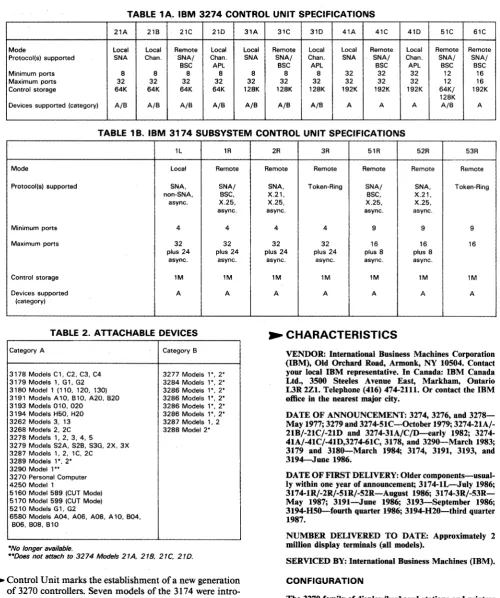
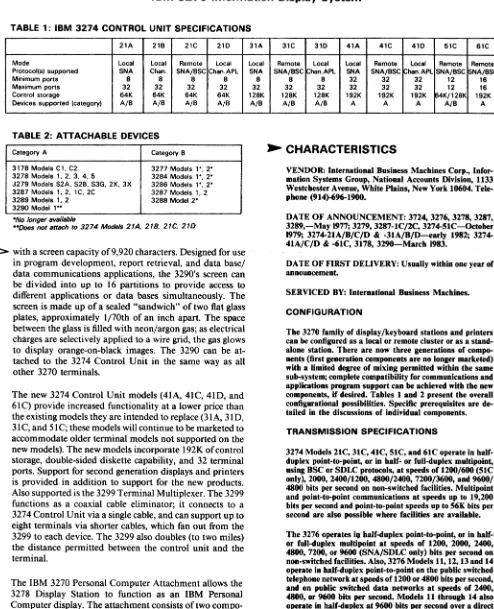
TABLE 1A. IBM 3274 CONTROL UNIT SPECIFICATIONS
21A 21B 21C 21D 31A 31C 310 41A 41C 410 51C 61C
Mode Local Local Remote Local Local Remote Local Local Remote Local Remote Remote
Protocol(s) supported SNA Chan. SNAj Chan. SNA SNAj Chan. SNA SNA/ Chan. SNA/ SNA/
BSe APL BSC APL BSC APL BSC BSC
Minimum ports B 8 8 8 8 8 8 32 32 32 12 16
Maximum ports 32 32 32 32 32 32 32 32 32 32 12 16
Control storage 64K 64K 64K 64K 128K 128K 128K 192K 192K 192K 64Kj 192K
128K
Devices supported (category) A/8 A/B A/B A/B A/B A/B A/B A A A A/B A
TABLE 1B. IBM 3174 SUBSYSTEM CONTROL UNIT SPECIFICATIONS
lL lR
Mode Local Remote
Protocol(s) supported SNA, SNA/
non-SNA, BSC,
async. X.25,
async.
Minimum ports 4 4
Maximum ports 32 32
plus 24 plus 24 async. async.
Control storage 1M 1M
Devices supported A A
(category)
TABLE 2. ATTACHABLE DEVICES
Category A Category B
3178 Models Cl, C2, C3, C4 3277 Models 1", 2" 3179 Models 1, Gl, G2 3284 Models 1", 2" 3180 Model 1 (110, 120, 130) 3286 Models 1", 2" 3191 Models Al0, Bl0, A20, 820 3286 Models 1", 2" 3193 Models 010, 020 3286 Models 1", 2' 3194 Models H50, H2O 3286 Models 1', 2"
3262 Models 3, 13 3287 Models 1, 2
3268 Models 2, 2C 3288 Model 2"
3278 Models 1, 2, 3, 4, 5
3279 Models S2A, S2B, S3G, 2X, 3X 3287 Models 1, 2, 1 C, 2C
3289 Models 1", 2" 3290 Model 1"" 3270 Personal, Computer 4250 Model 1
5160 Model 589 (CUT Mode) 5170 Model 599 (CUT Mode) 5210 Models Gl, G2
6580 Models A04, A06, A08, A 10, 804, B06, B08, Bl0
*No longer available,
**Ooes not attach to 3274 Models 21A 218, 21C, 210.
I> Control Unit marks the establishment of a new generation
of 3270 controllers. Seven models of the 3174 were
intro-duced; Models IL, IR, 2R, and 3R provide for the
attach-ment of up to 32 devices, while Models 51R, 52R, and 53R
allow for the attachment of up to 16 devices. The various
members ofthe 3174 family provide for the attachment of
various 3270 display stations, printers, and workstations to
IBM host processors via a local channel, remote link, IBM
Token-Ring Network 3270 Gateway feature, or IBM
To-ken-Ring Network. In addition, an optional feature pro-I>
2R 3R 51R 52R 53R
Remote Remote Remote Remote Remote
SNA, Token-Ring SNA/ SNA, Token-Ring
X.21, BSC, X.21,
X.25, X.25, X.25,
async. async. async.
4 4 9 9 9
32 32 16 16 16
plus 24 plus 24 plus 8 plus 8
async. async. async. async.
1M 1M 1M 1M 1M
A A A A A
~
CHARACTERISTICS
VENDOR: International Business Machines Corporation (IBM), Old Orchard Road, Armonk, NY 10504. Contact your local IBM representative. In Canada: IBM Canada Ud., 3500 Steeles Avenue East, Markham, Ontario I,3R 2Z1. Telephone (416) 474-2111. Or contact the IBM office in the nearest major city.
DATE OF ANNOUNCEMENT: 3274, 3276, and 3278-May 1977; 3279 and 3274-51C-October 1979; 21A/-21B/-21C/-2ID and 31A/C/D-early 1982; 3274-41A/-41C/-41D,3274-61C, 3178, and 3290-March 1983; 3179 and 3180-March 1984; 3174, 3191, 3193, and 3194-June 1986.
DATE OF FIRST DELIVERY: Older components-usual-ly within one year of announcement; 3174-1L-Jucomponents-usual-ly 1986; 3174-1R/-2R/-51R/-52R-August 1986; 3174-3R/-53R-May 1987; 3191-June 1986; 3193-September 1986; 3194-H50-fourth quarter 1986; 3194-H20-third quarter 1987.
NUMBER DELIVERED TO DATE: Approximately 2 million display terminals (all models).
SERVICED BY: International Business Machines (IBM).
CONFIGURATION
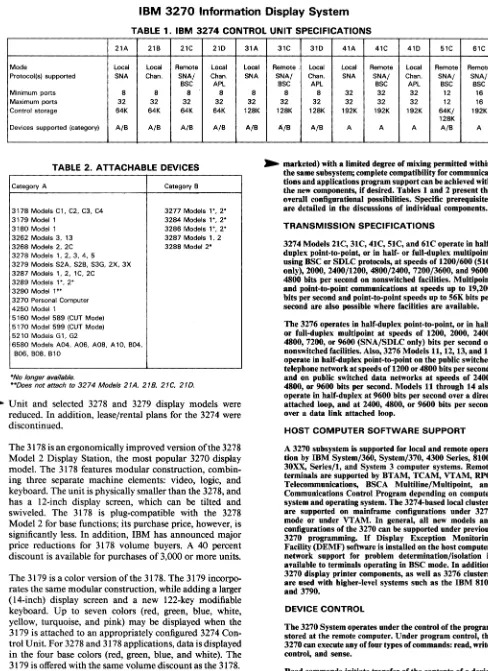
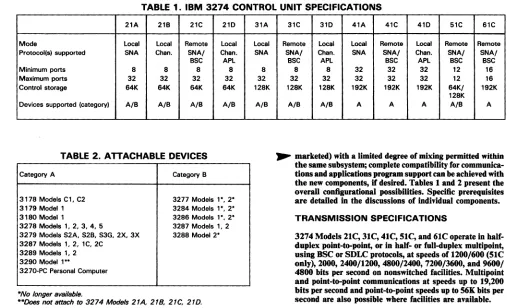
The 3270 family of display/keyboard stations and printers can be configured as a local or remote cluster or as a standalone station. There are now three generations of components (first-generation components are no longer mar-keted) with a limited degree of mixing permitted within the same subsystem; complete compatibility for communica-tions and applicacommunica-tions program support can be achieved with the new components, if desired. Tables 1 and 2 present the overall configurational possibilities. Specific prerequisites are detailed in the discussions of individual components. ....
© 1986 OAT APRO RESEARCH CORPORATION, DELRAN, NJ 08075 USA REPRODUCTION PROHIBITED
[image:20.616.54.555.69.668.2]IBM 3270 Information Display System
t>
vides for the attachment of ASCII terminals to the 3174,
and 3174 attachment to asynchronous host computers via
telecommunications links. The 3174 control unit models
are functionally equivalent to the IBM 3274 Control Unit
Models 41A, 41C, 41D, and 61C.
The 3191 Display Station is a low-priced, entry-level
dis-play. At $1,295, it carries the lowest price tag ever for an
IBM 3270 display. The 3191 is available in four models,
providing a choice of keyboards and character phosphor
(green or amber-gold). Standard features include a 12-inch
screen, 1,920-character display capacity, tilt/swivel
moni-tor, and detachable keyboard.
The 3193 Display Station is a multifunctional,
mono-chrome display terminal. The 3193 offers multiple logical
terminal capability (up to two logical terminals), as well as
multiple partition capability (up to eight partitions). The
3193 combines alphanumeric capabilities with imaging
capabilities, when used in conjunction with the new 3117
and 3118 Scanners. Image documents of up to letter or A4
size may be displayed on the 3193's screen, which provides
al1-points-addressable (APA) screen capability. The 3193
contains a 15-inch monochrome display with 80-character
by 48-column screen support.
The 3194 is a seven-color (plus black) display station with
advanced functions. A resident set of utility functions
makes use of a 3.5-inch diskette drive located in the logic
element. Multiple sessions (up to two notepads and one to
four host sessions, with windowing) and a keystroke
re-cord/play function are supported. The 3194 includes a
14-inch display with a 1,920-character capacity, and a choice
of keyboard.
The first generation of 3270 components was introduced by
IBM in 1972, and consisted of the 3271 Control Unit; 3272
Control Unit; 3275 Standalone Display Station; 3277
Cluster Display Station; 3284 Matrix Printer; 3286 Matrix
Printer; and 3288 Belt Printer. In an announcement that
became effective November 16, 1982, IBM has withdrawn
the first generation of 3270 products from marketing. The
above-mentioned models are no longer marketed by IBM,
although it will continue to support existing units.
The second generation of 3270 components was unveiled
in 1977, and included the 3274 Control Unit; 3276 Control
Unit Display Station; 3278 Cluster Display Station; 3287
Matrix Printer; and the 3289 Belt Printer. IBM has now
replaced the original 3274 Control Unit models with
Models 3274-21 and -31. These control units contain an
improved storage technology, and support extended color,
extended highlighting, and presentation graphics functions.
In October 1979, IBM made another major addition to the
3270 family with the introduction of the 3279 Color
Dis-play Station. Although the 3279 was not the first color
display on the market, it was seen by many industry
observers as IBM's acknowledgement that color displays
were a legitimate part of a general-purpose system, and not
just an unnecessary extravagance. Along with the 3279,
t>
The 3178 Display Station is the replacement for the venerable 3278 display. The 3178 contains an improved ergonomic de-sign, taking up less space than its predecessor. The terminal's modular construction contributes to its ease of use, with a tilt/ swivel display and low-profile keyboard.
~ TRANSMISSION SPECIFICATIONS
The 3174 remote models (1R, 2R, 3R, 51R, 52R, and 53R) provide the following support as is applicable to the model selected:
• EIA RS-232-C CCITT V.24/28 operation up to a maxi-mum speed of 9600 bps for BSC and 19,200 bps for SNA/ SDLC;
• CCITT V.35 and X.21 operation up to a maximum speed of 64K bps for SNA/SDLC;
• X.25 operation up to a maximum speed of 19,200 bps.
The 3174 local model (IL) provides single-tag interlocked and two-tag high-speed transfer channel operation modes, with rates up to 1.25M bps.
3174 Models lR, 2R, 51R, and 52R operate in half-duplex point-to-point or multipoint modes, on duplex or half-duplex nonswitched facilities, and in half-duplex point-to-point mode on switched facilities. Switched, X.21, and X.25 net-work operations are supported only through SNA/SDLC. 3174 Models 3R and 53R transmit and receive at 4M bps using media access protocols conforming with IEEE 802.5 and ECMA 89 standards, and logical link protocols con-forming with the IEEE 802.2 standard, over the baseband IBM Token-Ring Network. (For more in/orllUltion on the IBM Token-Ring Network, see Report Cll-491-501.)
3274 Models 21C, 31C, 41C, 51C, and 61C operate in half-duplex point-to-point, or in half- or full-half-duplex multipoint, using BSC or SDLC protocols, at speeds of 1200/600 (51C oniYh 2000, 2400/1200, 4800/2400, 7200/3600,and9600/ 4800 bits per second on nonswitched facilities. Multipoint and point-to-point communications at speeds up to 19,200 bits per second and point-to-point speeds up to 56K bits per second are also possible where facilities are available.
The 3276 operates in duplex point-to-point, orin half-or full-duplex multipoint at speeds of 1200, 2000, 2400, ~