ISSN: 1992-8645 www.jatit.org E-ISSN: 1817-3195
BSFD: BACKGROUND SUBTRACTION FRAME
DIFFERENCE ALGORITHM FOR MOVING OBJECT
DETECTION AND EXTRACTION
1D STALIN ALEX, 2Dr. AMITABH WAHI
1Research Scholer, Department of Computer Science and Engineering,Anna Univeristy
2Professor,Department of Information Technology,Bannari Amman Institute of Technology
E-mail: [email protected], [email protected]
ABSTRACT
Advantages and drawbacks of two common algorithms often employed in the moving target detection, background subtraction technique and frame distinction methodology are analyzed and compared during this paper. Then supported the background subtraction methodology, a BFSD target detection rule is projected. The background image used to process the next frame image is generated through superposition of the current frame image and therefore the current background image with certain chance. This algorithm makes the objects that keep long-standing, however not be detected as a part of the background. The experimental results show that this algorithm can detect moving objects a lot of effectively and precisely.
Keywords: Background Subtraction –Frame Difference –Moving Object Detection –Dynamic Background
1. INTRODUCTION
Separating foreground from background plays an important role in many computer vision systems, including action recognition, motion capture , video compressing, teleconferencing and surveillance tracing. [1]
Most major challenges to background subtraction methods include sudden illumination changes, shadows, camera shakes, and various changes in the background example waving trees flickering screens and shadows [2], [3]. The temporal differencing method utilizes two or more consecutive frames to extract moving regions. This method is vulnerable and prone to false detection if the temporal changes area unit generated by noise or illumination change due to weather conditions [4].
To overcome these challenges, various methods have been presented in the literature. However background from foreground separation still remains a challenge to the computer vision community. In this paper, firstly, it's a short introduction of pretreatment of the video pictures. It reduces the error within the image process once. second the paper focuses on the analysis and also the frame difference. in conclusion this paper selects supported the background subtraction technique to enhance it and present a BSFD
algorithm based on the background subtraction and the frame difference method.
2. IMAGE PREPROCESSING
Image preprocessing is the main task in moving object detection. The small changes in the pixel lead to false detection. Noise can be added due to various reasons. Due to the noise the pixel values might be changed. So image preprocessing is very essential.
A. Noise Removing
Noise is any entity which is not of benefit to the purpose of image processing. The influence of noises on the image signal amplitude and phase is complexity. So how to smooth out noise and keep the details of image are the major tasks of the image filtering.
B. Noise Filter
We use the median filter in this paper. Median filter is a nonlinear method for removing noise. Its basic idea is to use the median of the neighborhood pixel gray value instead of the gray value of pixel point. For the odd elements, the median refers to the size of the middle value after sorting [5], [6].
ISSN: 1992-8645 www.jatit.org E-ISSN: 1817-3195 remove impulse noise, salt and pepper noise at the
same time retain the image edge details. In general the use of a median filters contain odd numbered points of the sliding window. Specific methods are determined first add numbered pixel window W [7], [8]. Each pixels in window line with the size of the gray value and use the location of the gray value between the image f (x, y) gray value as a substitute for enhanced images g (x, y) as follows.
g(x,y)=Med{f(x-k,y-l), (k,l)∈W
W is the window which is selected
3. IMAGE SEGMENTATION
In the images research and application, images are often only interested in certain parts. These parts are often referred to as goals or foreground (as other parts of the background). In order to identify and analyze the target in the image, we need to isolate them from the image. The image segmentation refers to the image is divided into regions, each with characteristics and to extract the target of interest in the process [9].
The image segmentation used in this paper is threshold segmentation. To put it simply, the threshold of the gray scale image segmentation is to identify a range in the image of the compared with the threshold and according to the results to the corresponding pixel is divided into two categories, The foreground and background. The simplest case the image after the single-threshold segmentation can be defined as
1
( , )
( , )
0
( , )
f x y
T
g x y
f x y
T
>
=
≤
Threshold segmentation has two main steps: 1) Determine the threshold T
2) Pixel value will be compared with the threshold value T
In the above steps to determine the threshold value is the most critical step in partition. In the threshold selection, there is a best threshold based on different goals of image segmentation. If we can determine an appropriate threshold, we can correct the image for segmentation.
4. ANALAYZE AND COMPARISION OF THE TWO TYPES OF MOTION DETECTION ALGORITHM
Intelligent visual surveillance-system can be used many different methods for detection of moving targets, a typical method such as background subtraction method, frame difference method. These methods have advantages and disadvantages, the following will be introduced.
A. Background Subtraction Method
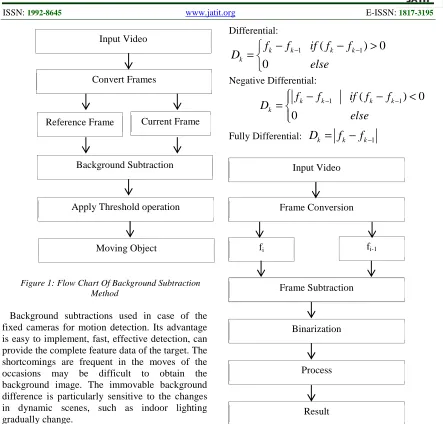
Background subtraction method is a technique using the difference between the current image and background image to detect moving targets. Process flow chart is shown as Fig 1.
The basic idea is the first frame image stored as a background image. Then the current image fk with the pre stored background image B subtraction, and if the pel difference is larger than the bound threshold, then it determines that the pixel to pixel on the moving target, or as the background pixel. The choice of threshold of the background subtraction to achieve the success of motion detection is very important. The success of motion detection is very important. The threshold value is too small will produce a lot of false change points, the threshold choice is too large will reduce the scope of changes in movement [10].
The appropriate threshold request adapts with the impact which be had by scenes and camera on the wavelength of the color, the changes of light conditions, so the choice of the dynamic threshold should be selected. The method formula is shown as
R x y
k( , )
=
f x y
k( , )
−
B x y
( , )
1
( , )
( , )
0 arg
( , )
k k
k
background R x y
T
D x y
t
et R x y
T
>
=
≤
ISSN: 1992-8645 www.jatit.org E-ISSN: 1817-3195
Figure 1: Flow Chart Of Background Subtraction
Method
Background subtractions used in case of the fixed cameras for motion detection. Its advantage is easy to implement, fast, effective detection, can provide the complete feature data of the target. The shortcomings are frequent in the moves of the occasions may be difficult to obtain the background image. The immovable background difference is particularly sensitive to the changes in dynamic scenes, such as indoor lighting gradually change.
B. Frame Difference Method
Frame difference method, is also known as the adjacent frame difference method, the image sequence difference method etc.it refers to a very small time intervals ∆t of the two images before and after the pixel based on the time difference, and then thresholding to extract the image region of the movement, according to which changes in the difference of the specific flow chart as shown in Fig.2
The specific method of calculation of difference image Dk between the kth frame images fk with the k-1 the frame image fk-1 is differential, the negative differential and fully differential, the corresponding formula is as follows.
Differential:
1
(
1)
0
0
k k k k
k
f
f
if f
f
D
else
− −
−
−
>
=
Negative Differential:
1
(
1)
0
0
k k k k
k
f
f
if f
f
D
else
− −
−
−
<
=
Fully Differential:
D
k=
f
k−
f
k−1Figure 2: Flow Chart Of Frame Difference Method
The binarization for the differential image can get a collection of pixel movement.
5. BSFD ALGORITHM BASED ON THE DYNAMIC BACKGROUND
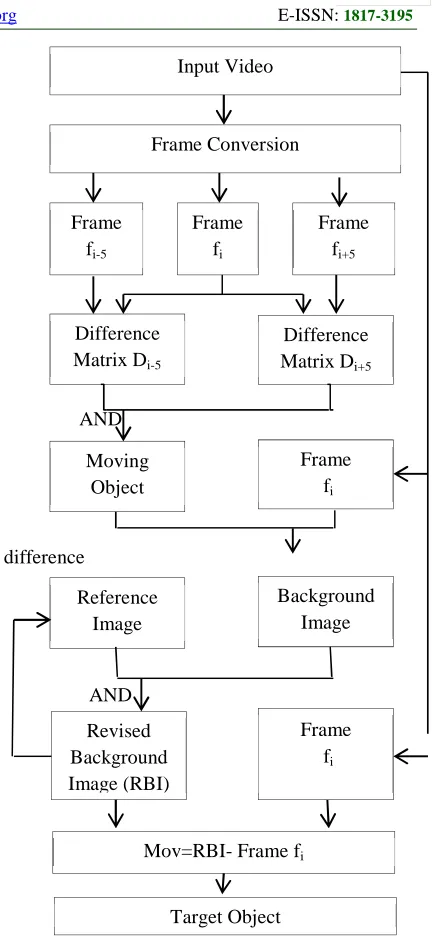
Through the comparison of two moving target detection algorithms in the above section, in this paper it presents BFSD algorithms based on the dynamic background. Dynamic background can be achieved through the frame difference method. To overcome the disadvantages of difference method fi, fi-5 and fi+5 frames can be chosen, so that slowly moving object can be identified.
After updating the background image that is referenced image, the background subtraction method performs for getting the moving object. Input Video
Convert Frames
Reference Frame Current Frame
Background Subtraction
Apply Threshold operation
Moving Object
Input Video
Frame Subtraction
fi fi-1
Frame Conversion
Binarization
Process
[image:3.612.88.531.69.493.2]ISSN: 1992-8645 www.jatit.org E-ISSN: 1817-3195 A. The dynamic updating of the background
In the background subtraction method, we can consider that the whole scene from two parts, the background, the foreground. The background is a static scene and which can be seen, foreground is the moving objects which are interested in the video surveillance, such as vehicles, pedestrians etc. however due to the scene of the monitor changes over time, the foreground stagnation in the picture for a long time could be treated as part of the background, so updating of the reference image periodically is essential for moving object detection. Updating of reference image can be achieved through the frame difference method.
Three frames fi, fi-5 and fi+5 Can be taken and Di-5 and Di+5 calculated. Then perform AND operation, it gives the moving object M. Subtract M from fi it gives the background image B. Now apply logical OR on background image B and the Reference image. It produces the dynamic background image DB now the Reference image can be replaced by DB, this will be the new reference image. Finally subtraction can be made between DB and fi , then suitable threshold value should be applied to detect the moving object. The flow chart is shown in Fig 3.
AND
difference
AND
[image:4.612.315.531.74.543.2]
Figure 3: Flow Chart of BSFD Algorithm
The formula of the moving target detection algorithms based on the dynamic background as follows
5 5
i i i
D
−= −
f
f
−5 5
i i i
D
+= −
f
f
+( , )
( , )
i( , )
MOV x y
=
RBI x y
−
f x y
1
arg
( , )
( , )
0
( , )
t
et
MOV x y
T
D x y
background MOV x y
T
>
=
≤
Input Video
Frame Conversion
Frame fi-5
Frame fi
Frame fi+5
Difference Matrix Di-5
Difference Matrix Di+5
Moving Object
Frame fi
Reference Image
Background Image
Revised Background Image (RBI)
Frame fi
Mov=RBI- Frame fi
ISSN: 1992-8645 www.jatit.org E-ISSN: 1817-3195
6. RESULTS AND DISCUSSION
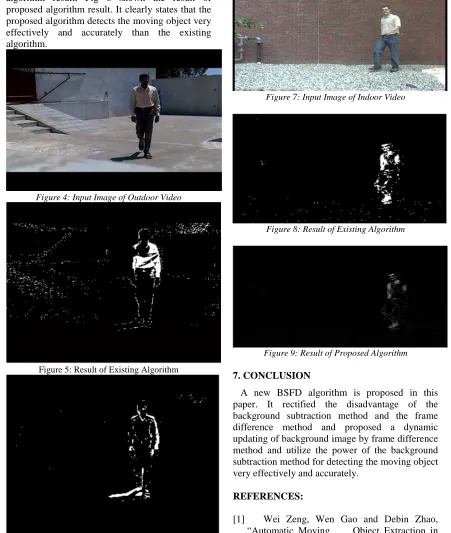
[image:5.612.317.532.140.253.2]The experiment is conducted on outdoor and indoor video. Fig 4. Is the input image of outdoor video, existing algorithm and proposed algorithm are applied to the input image, Fig 5 is the existing algorithm result, Fig 6 shown the result of proposed algorithm result. It clearly states that the proposed algorithm detects the moving object very effectively and accurately than the existing algorithm.
Figure 4: Input Image of Outdoor Video
Figure 5: Result of Existing Algorithm
Figure 6: Result of Proposed Algorithm
Fig 7 is the input image of indoor video, Fig 8 shows the result of existing algorithms and Fig 9 shows the result of the proposed algorithm.
Figure 7: Input Image of Indoor Video
[image:5.612.84.535.165.698.2]Figure 8: Result of Existing Algorithm
Figure 9: Result of Proposed Algorithm
7. CONCLUSION
A new BSFD algorithm is proposed in this paper. It rectified the disadvantage of the background subtraction method and the frame difference method and proposed a dynamic updating of background image by frame difference method and utilize the power of the background subtraction method for detecting the moving object very effectively and accurately.
REFERENCES:
[image:5.612.88.307.193.695.2]ISSN: 1992-8645 www.jatit.org E-ISSN: 1817-3195 [2] D. Gutchess, M. Trajkovie, E. Cohen-Solal, D.
Lyons, and A. K. Jain, “A background model initialization algorithm for video surveillance”. In in proc.IEEE ICCV 2001,Pt 1, pages 733-740,2001.
[3] Mahbub Murshed, Adin Ramirez and Oksam Chae,”Statistical Background Modeling: An Edge Segment based Moving Object Detection Approach”, IEEE International Conference on Advanced Video and Signal Based Surveillance, pages 300-306,2010.
[4] A. Lipton, H. Fujiyoshi, and R. Patil,”Moving target classification and tracking from real-time video. Pages 8-14, Oct 1998
[5] Wang Ying-Li, Dai Jing-min, “Moving Targets Detection and Tracking Based on Nonlinear Adaptive Filtering”, 2007 International Conference on Computational Intelligence and Security Workshops (CSIW 2007), pages 691-694, December 2007
[6] Intan Kartika and Shahrizat Shaik Mohamed, “Frame Differencing with Post Processing Techniques for Moving Object Detection in Outdoor Environment.”, IEEE 7th International Colloquium on Signal Processing and its Applications, pages 172-176, 2011. [7] Sen-Ching, S. Cheung and Chandrika
Kamath,”Robust techniques for background subtraction in urban traffic video”, EURASIP Journal on Applied Signal Processing, Vol. 2005, pages 2330-2340, Jan 2009.
[8] Jared Willems, Glen Debard, Beri Bonroy, Bart
Vanrumste and Toom
Goedeme.(2009)[Online].Available:
https://lirias.kuleuven.be/bitstream/12345789/2 21829/1/jared_poca09.pdf
[9] Yang Shu-Ying, Zhang Cheng, Zhang We-Yu, He Pi-Lian, “Unknown Moving Target Detecting and tracking Based on Computer vision, fourth International Conference on Image and Graphics (ICIG 2007), pages 490-495, august 2007.
[10] Sivabalakrishnan. M and Dr. D. Manjula,”Adaptive background subtraction in Dynamic Environments Using fuzzy Logic”, International Journal of Video and Image Processing and Nework Security, IJVIPNS-IJENS Vol 10 no. 01. pages 18-20.