Munich Personal RePEc Archive
Externally-oriented Small and Medium
Enterprises: Predicament and
Possibilities
Das, Keshab and Pradhan, Jaya Prakash
Gujarat Institute of Development Research, Sardar Patel Institute of
Economic Social Research
17 March 2009
Externally-oriented Small and
Medium Enterprises:
Predicament and Possibilities
Keshab Das
Professor
Gujarat Institute of Development Research, Gota,
Ahmedabad 380 060 Email: [email protected]
Mobile: (0) 94275 27884
Jaya Prakash Pradhan
Associate Professor
Sardar Patel Institute of Economic and Social Research,
Thaltej Tekra, Ahmedabad 380 054
Email: [email protected]
Externally-oriented Small and Medium Enterprises:
Predicament and Possibilities
Abstract
This paper addresses emerging issues concerning externally-oriented SMEs in
India and the nature of important business risks faced by them during the period of
global financial crisis. The unimpressive export performance of SMEs during the
period of reforms is also a reflection of the limitations of the institutional support
as also weak forms of production organization. The state needs to play a
proactive role in contributing to enhancing SME competitiveness. Whereas
financially well protected Indian SMEs are likely to be more competitive and
efficient, a greater recognition of the potential of domestic market and provision
of business-facilitating infrastructure holds the key for success of SMEs across
Introduction
It is not for nothing that the emerging global crisis of confidence in the
functioning of the well-oiled capitalistic enterprises, notoriously in the financial
sector, has sent, inter alia, a chill through the spine of the manufacturing sector across most of the globe. Being intrinsically a manifestation of a systemic failure,
infuse of some money per se by the state – the ‘bail-out’ back-ups – would achieve little in addressing the collapse in money markets that is beyond the
control of it. “Some obvious consequences of the financial crisis due to the
massive uncertainty that it has created are: Slowing down of investment,
emergence of spare capacity in industry, economic entities going liquid, difficulty
for businesses in obtaining credit for production, possibility of deep recession or
depression, rise in unemployment and possibility of protectionist measures by
nations to prevent their economies from declining further” (Kumar, 2009: 19).
Even the World Bank, in its latest assessment of the shape of things to come, has
admitted that due to shrinkage of the world economy, not only trade would fall to
its all-time low in 80 years, access to finance, especially, by the poor and
developing nations would be tougher than ever (Business Standard, 2009: 2). That is news bad enough particularly for the externally-oriented small and
medium enterprises (SMEs) in the developing countries including India; the
promise of the hyped internationalization has come under scrutiny. Whereas the
large enterprises have been wilting under the stress of falling demand and growing
costs of maintaining physical stock as well as paying for huge wage and loan bills,
which have severely dented their profitability, the SMEs, especially those
appended to the large, have been desperate to survive and grow in these difficult
times.
This paper presents an exploratory analysis of the emerging challenges faced by
the Indian SMEs engaged in the process of internationalization during the difficult
times of global financial crisis. While it highlights the significance of the sector
in terms of its contribution to a vibrant industrial economy, the lacklustre
performance of SMEs in the export sphere indicates persistence of limitations of
including linking to the much-hailed global value chains. Potential business risks
and possible ways to manage them have been dealt with in the penultimate section
of this paper. The last section is more a reflection on issues rather than a set of
conclusions on the problem.
In the Indian context, the adverse repercussion of the global financial crisis on
SMEs1 would have deep impact on a sizeable proportion of the overall economy as this sector continues to be a vital mechanism for generating jobs (across levels
of skill, education and age) by, often, using local resources and catering to the
varied layers of markets, including the global. As the country has eternally
grappled with issues of structural nature, often unsuccessfully, in addressing
improving levels of living across space, this sector has contributed immensely
towards efforts at reducing regional and rural-urban disparities in growth. As may
be surmised from Table 1, there has been a steady rise in the number units which
have almost doubled between 1991-92 and 2006-07. Almost similar is the
situation for job generation in the sector, which has grown from 16.6 million to 31
million during the same period. Even in terms the value of output of this sector,
there has been a four-fold rise.
Table 1: Growth of Small Enterprises in India, 1991–2007 Year
Total SSI Units (in Million)
Employment (in Million)
Production
(Rs. Million at Constant 1993-94 Prices)
1991–92 7.06 16.60 0.79
1996–97 8.62 20.59 1.35
2001–02 10.52 24.93 1.96
2002–03 10.95 26.02 2.11
2003–04 11.34 27.14 2.31
2004–05 11.86 28.26 2.56
2005–06 12.34 29.49 2.88
2006–07 12.84 31.25 3.24
Source: Das (2008a: 121).
It needs to be noted, nevertheless, that the official data on small firms have serious
limitations insofar as the quality and reliability are concerned. As observed in Das
1 It be noted that in India, the ‘medium’ category was formally introduced only recently, in
(2006: 113) “scholars have expressed reservations about these figures…. It may
be pointed out that the figures for total SSI units have been shown to increase at a
specified rate (4.07 per cent per annum); it is not only an unlikely phenomenon,
but presents ‘grossly inflated’ data. Similarly, the production figures of SSIs
provided by SIDO, when contrasted with (those) by the National Accounts
Statistics (NAS), show gross overstatement in the former source”. Limitations of
official data have been a serious issue as it camouflages the infirmities of the
sector.
Additionally, raising the persistence of the constraint of availability and
repayment of credit that has plagued the Indian SMEs for long, it is important to
mention at the outset that, irrespective of the global financial crisis, the proportion
of net bank credit flows to the small scale sector has been falling in recent years
(from 16 per cent in early 1990s to 8 per cent in 2006–2007) (Das, 2008a).
Further, the institutional credit sources to SMEs have continued to be marked by
the problem of inadequate credit limit sanction, delay in disbursement of long
term loans, conservative attitude of the bankers in providing fresh working capital
and collateral guarantee, to mention some of the important ones (Morris et al., 2001: 269-271). Inadequate access to timely finance has been one of the
important factors responsible for the existence of a considerable magnitude of
sickness and failures in the SME sector.
Imperatives of Globalization and Outward Orientation of Indian SMEs
With economic reforms initiated in 1991, the strong currents of globalization
impacted the relatively bigger of the small scale sector (the SMEs, in a sense),
which had been raring to move from the long-standing regime of import
substitution to a phase of export orientation. In the policy spheres, there was a
growing emphasis upon enhancing global business linkage to enhance
competitiveness, market share and factor productivity. A section of the Indian
SMEs was overwhelmed by the hyped charm of neolocalism that underscored
success in business as the local interfaced with the global. The policy
instruments, as largely spelt through the MSMED Act, reaffirmed this obsession
loan-finance, infrastructure and technology support that crippled majority of the small
firms.
As it eventually happened, Indian small enterprises posted a lackadaisical
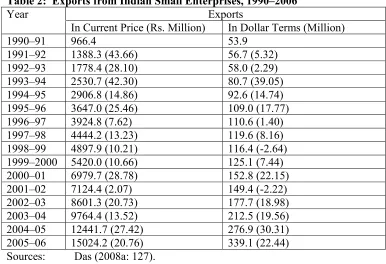
performance in the exports sphere, during the post-reforms period. Even as Table
2 indicates a rise in the value of exports from the small enterprise sector, both in
current prices and dollar terms, over the period 1990–2006, the trend of annual
growth rates of the values (drawn separately in rupee value and corresponding
dollar value) for the period reveals a disturbing scenario (Figure 1). Not only that
the values have vacillated wildly but also, in certain years, the dollar values have
fallen far below those in rupee terms; twice during 1998-99 and 2002-02 the
growth rates in dollar values have actually been negative. The unpredictability of
[image:7.612.104.490.366.630.2]the exports belies the growth rates when estimated based on rupee values only.
Table 2: Exports from Indian Small Enterprises, 1990–2006 Exports
Year
In Current Price (Rs. Million) In Dollar Terms (Million)
1990–91 966.4 53.9
1991–92 1388.3 (43.66) 56.7 (5.32)
1992–93 1778.4 (28.10) 58.0 (2.29)
1993–94 2530.7 (42.30) 80.7 (39.05)
1994–95 2906.8 (14.86) 92.6 (14.74)
1995–96 3647.0 (25.46) 109.0 (17.77)
1996–97 3924.8 (7.62) 110.6 (1.40)
1997–98 4444.2 (13.23) 119.6 (8.16)
1998–99 4897.9 (10.21) 116.4 (-2.64)
1999–2000 5420.0 (10.66) 125.1 (7.44)
2000–01 6979.7 (28.78) 152.8 (22.15)
2001–02 7124.4 (2.07) 149.4 (-2.22)
2002–03 8601.3 (20.73) 177.7 (18.98)
2003–04 9764.4 (13.52) 212.5 (19.56)
2004–05 12441.7 (27.42) 276.9 (30.31)
2005–06 15024.2 (20.76) 339.1 (22.44)
Sources: Das (2008a: 127).
Source: Das (2008a: 128).
Apart from the unimpressive growth rates, even there has hardly been any notable
diversification in the product profile, indicating India’s poor record in this
important sphere of globalization. Indian exports from the small enterprise sector,
at least since the late 1980s, continues to be dominated by just eight product
groups, (namely, Readymade garments, Engineering goods, Electronic and
computer software, Chemicals and allied products, Basic chemicals,
pharmaceuticals and cosmetics, Processed foods, Finished leather and leather
products, Plastic products) accounting for over 90 per cent of total value of
exports. Even in these selected SME sectors, like the pharmaceuticals, for
instance, the export share has consistently fallen during the recent years (Pradhan
and Sahu, 2008: 45-46). Instead of acknowledging this sobering scenario, often
claims made in the official websites project a too-vibrant SME sector without
adequate substantiation.
Eventually, the direct impact of economic slowdown in major developed and
developing countries are likely to be transmitted to Indian SMEs via international
trade. Global credit crunch, falling consumer confidence and spending in foreign
[image:8.612.120.432.75.314.2]countries may result in problems of cancellation/decrease in the number and size
Figure 1: Exports from Indian Small Enterprises, 1991-2006
-5 5 15 25 35 45 55
1991-92 1993-94 1995-96 1997-98 1999-2000 2001-02 2003-04 2005-06
Year
Pe
rc
e
n
ta
g
e
s
of overseas purchase orders and payment defaults. Therefore, export-oriented
Indian SMEs who derive significant proportion of their sales from foreign
countries are the first to be impacted from imminent global slowdown. This
impact seems to be sectorally comprehensive as exporting SMEs in India are
dominated in a range of industrial segments like readymade garments and textiles,
leather goods, food products, chemicals, pharmaceuticals, engineering goods, and
information technologies (IT).
Early signs of contraction in Indian exports are visible in their recent trends. For
the first time in the last five years, India’s monthly exports have declined by over
12 per cent in October 2008 (US $12822 million) as compared to October 2007
(US $14588 million)2. A sharp contraction in exports of readymade garments, cotton clothes and synthetic fibre garments from India has been reported during
the same period3. Indian gems and jewelry exports have fallen by 34.25 per cent to US $987 million in November 2008 as against US $1501 million recorded in
the same month last year4. Reports on sharp drop in export orders have been forthcoming in the case of Indian leather products, pharmaceuticals, auto parts and
light engineering products. The recent dramatic fall in automobile sales in the US
and Europe are clearly forcing global vehicle manufacturers to cut production and
reduce sourcing of auto parts from India5. Majority of pharmaceutical units in Gujarat—the second important host state to Indian pharmaceutical firms after
Maharashtra—are reported to be running below their full capacity due to lack of
export orders6.
With a decline in their foreign sales caused by the slowdown in overseas
consumer spending, export-oriented Indian SMEs shall, perfunctorily, attempt to
2 http://commerce.nic.in/tradestats/indiatrade_press.asp
3 Apparel Export Promotion Council (2008) ‘Apparel export slips 9.62% in October’, December
08.
4Hindu Business Line (2008) ‘Jewellery exports down 34% in November’, December 17.
5Hindu Business Line (2008) ‘Auto parts makers see sharp drop in orders from US, Europe’,
October 12.
6Hindu Business Line (2008) ‘Lack of export orders worries Gujarat pharma sector’, December
offset that revenue loss by focusing aggressively on the domestic market. This
will result in an increasing pressure on the purely domestic market-oriented Indian
SMEs and may, in all likelihood, lead to crowding out as exporting SMEs are
relatively efficient and technologically more dynamic than other SMEs just
operating in local markets. With substantial growth loss caused by the global
economic meltdown, exporting SMEs and large firms are cutting down production
and lowering sourcing of products and services from domestic SMEs.
Non-exporting SMEs may also be affected as Non-exporting and non-Non-exporting national
firms are delaying payment to suppliers of inputs and raw materials.
It is in this broad context of an obsession with external orientation that one needs
to bring into focus the growing phenomenon of participation of Indian SMEs in
the global value chains (GVCs). In the absence of a reliable information base
showing the nature and extent of such contractual arrangements as between
multinational enterprises and local firms, it is important to enquire if a substantial
proportion of such ‘outsourcing’ does not amount to what is termed as ‘rent-poor’
activities. So long as such participation (notwithstanding the miniscule quantum
of SMEs joining) in the GVCs has been incapable of building up technological
capabilities amongst the in-contracting SMEs, there are reasons to rethink, rather
than rejoice, such unhelpful collaboration. Especially at a time of revelations of
global financial crisis, the implications for SMEs mostly or wholly tied to ‘leading
firms’ abroad could be serious.
While very little substantive enquiry into the issues of SME participation in the
global production systems has been undertaken so far, the MSMED Act, 2006 has
made an all-out effort at devising instruments that would help enhancing the
competitiveness of Indian SMEs in the global market. The various schemes under
the National Manufacturing Competitiveness Council have, in fact, included all
possible areas of intervention as, for instance, technology upgradation, quality
testing facilities, bar-coding, encouraging participation in global trade fairs and
promoting and rewarding entrepreneurial skills (Das, 2008b: 80-84). However,
again missing out an opportunity to broad-base access to these advantages by a
large number of product groups as also in all regions, whether rural, semi-urban or
urban. As noted in Das (2009: 8), “External orientation and a global outlook for
the SME sector must first address persisting basic constraints facing the sector. In
the excitement to globalise, including getting networked to the global production
networks or value chains, the policy has been heavily biased towards certain
limited areas and ‘achieving’ entrepreneurs and has made inadequate export
guarantee provisions. In the absence of a strategy to broad-base business services
and infrastructure to tide over domestic market constraints, faced especially by
those based in rural areas and small and medium towns, a global meltdown can
easily upset the apple cart.”
Business Risks and Managing Them
Another important factor that is causing large scale failures in the SME sector is
the inability on the part of the firms to go in for an adequate business protection
plan to cover a variety of business risks that could be minimized or managed.
This factor, which assumes significance during the prolonged phase of the global
financial crisis, has been largely under scrutinized in India at both the policy and
academic levels while discussing the issues of economic failures in the SME
sector. Given that SMEs, specifically smaller firms, operate with a limited
resource base, most often just one or two negative shocks are enough to bring
sickness (Debroy and Bhandari, 2005: 7-8) and eventual failure to an otherwise
well-functioning enterprises. Therefore, it is very important to identify possible
negative shocks or business risks that are most predominant among small firms
and take appropriate measures to minimize those risks by suitable business
protection plans.
Following is a discussion on managing a number of identifiable business risks that
can affect revenue and growth of SMEs in India.
Concentrated Demand and Supply: SMEs with excessive dependence on single major buyer or supplier of their key raw materials have the high risk of significant
The loss of main buyer or supplier could deal a fatal blow to them. The obvious
way to deal with the risks of buyer and supplier concentration is to reduce
over-dependence on a single party by diversifying client base and having multiple
suppliers. This is purely a firm-specific strategy and SME entrepreneurs should
find ways to do that.
Delayed Payment: SMEs often suffer from the problem of late payments for their supply. This is likely to have terrible impact on them as they are perennially
suffering from inadequate size of the working capital (Morris et al., 2001: 275-280). Recently, there has been a significant attempt at the policy level to protect
SMEs from risks of delayed payment. Under Chapter V of the MSMED Act,
2006, SME suppliers should be paid outstanding dues within 45 days from the
date of acceptance of goods and services. Otherwise buyers are liable to pay
compound interest on a monthly basis to the SME supplier on the outstanding
amount from the appointed day and at three times the bank rate notified by the
Reserve Bank of India. However, its functioning on a wider scale is still awaited.
Wide Fluctuations in Prices: A sudden upward or downward movement of input prices can have potentially negative impact on the working of SMEs. Rapid
escalation in input prices tends to force SMEs to absorb larger part of the rise as
they typically fear losing the customer in a competitive market scenario and
refrain from factoring in adequate price escalation clause in their supply contracts.
Contrarily, a sudden downward trend in input prices can hard-hit SMEs having
inventory of high cost raw materials. Particularly, import-dependent and
export-oriented SMEs are likely to suffer from increased volatility in currency prices as
well. To some extent, SMEs can mitigate risks from the sharp rise in prices of
inputs by including mutually agreed safeguard clauses in their business contracts
with input suppliers and buyers. Exporting SMEs deriving significant share of
their revenues in foreign exchange cash flows are required to adopt selective or
complete hedging for foreign exchange risk. A simple way to address this risk is
to accept export order in more than one single currency like the US dollar or to
enter into forward agreements to convert a given sum of foreign currency into
exporting SME has the right but not the obligation to sell currencies at a
predetermined date and rate.
Single Promoter and Ignorance about Intellectual Property Rights (IPRs), Environment and Emerging Regulatory Issues: Majority of Indian SMEs have limited number of managerial staff and are mostly run by individual promoters
often supported by family members in all aspects of their functioning. This single
key individual remains responsible for the financial liability of the enterprise as
well as directing its day to day production activities. Clearly, the risk is that the
future of the enterprise is wholly dependent upon the well-being of this key
business owner.
Further, in a globalized business environment, ignorance of SME
managers/entrepreneurs about IPRs, environment-friendly practices and changing
legal issues at home and abroad could result in considerable risks and costs to
their business. Even unintentional violations of patent rights may entail heavy
expenditure associated with legal action which SMEs may not be able to meet.
The recent growing incidents of product seizures in the European Union, for
instance, of Indian generic drugs consigmments in-transit on suspicious of patent
infringement clrealy demonstrate the urgency with which outward-oriented SMEs
are required to be aware about patent implications of their business activities7 .
With growing consumer consciousness on product quality, safety, best
manufacturing practices and corporate social responsibility on a global scale,
SMEs run the risk of losing markets unless they adopt a proactive environmental
and manufacturing strategy. Studies have shown that SMEs pursuing weak
environmental strategy generally have lower export success than those with green
business strategies (Martin-Tapia et al., 2008).
The survival risk of SMEs can be minimized by investing in the financial
protection for their main promoters essentially for safeguarding business debts,
putting in place clear succession plans and employing managers to look after the
daily business activities. SMEs also need to keep themselves aware of the IPR
7
issues so as to not violate those rights of other firms and adopt best manufacturing
practices as per the evolving regulatory regime on health and environmental
grounds.
Other Risks: Albeit not specific to SMEs, the productive assets and abilities of these enterprises can also receive impact from risks emanating from natural
calamities like cyclone, flood, earthquake and fire. Their business risks can also
be caused due to machine breakdown, damage in transportation, maltreating
labour, fraud by employees, theft and similar human-made misdemeanours.
SMEs also need to get insured for other business risks arising from natural and
human-made factors. A comprehensive industrial insurance coverage for all such
risks is essential for the overall growth and sustenance of the SME sector in India.
Over the last decade, Indian banks and insurance companies have come up to
provide different financial protection plans to industrial firms. However, resource
constrained SMEs in many cases are either unaware about the possible business
risks, or wherever they are aware, have limited financial capability to have a
hedged exposure to such risks. Although statistics on the proportion of Indian
SMEs going for industrial insurance is not readily available, it can be safe to infer
that the SME sector is significantly under-insured as compared to their large
counterparts. In this case, policy intervention is clearly warranted to provide
cheap insurance provision for risks (as, for instance, relatively lower rate of
premium) faced by SMEs and encouraging small firms to be part of a protected
financial regime.
In Lieu of a Conclusion
This rather short paper has focused on issues relating to external orientation of
SMEs and a few important business risks faced by them during the recent years.
These aspects have emerged doubly relevant during the times of global financial
crisis that has begun taking its toll on the business dynamism of enterprises,
especially the so-called networked ones. The Indian SMEs have been under undue duress due to a variety of imperfections in the policy attention towards
hopefully, more by default than by design, due to a certain non-metro location as
well as for having been engaged in producing goods not suitable for the global
market. Whereas financially well protected Indian SMEs are likely to be more
competitive and efficient, a greater recognition of the potential of domestic market
and provision of business-facilitating infrastructure holds the key for success of
SMEs across board. That could, perchance, be an important strategy to beat the
References
Business Standard (2009). “Global Economy to Shrink: World Bank”, March 10, p. 2.
Das, Keshab (2009). “Double Whammy for a Beaten Sector”, FE Insight: SMEs,
The Financial Express, January 23, New Delhi, p. 8.
Das, Keshab (2008a). “Micro, Small and Medium Enterprises: Unfair Fare”, in Alternative Survey Group (ed.), Alternative Economic Survey, India 2007–2008: Decline of the Developmental State, Delhi: Daanish Books: 119–135.
Das, Keshab (2008b). “SMEs in India: Issues and Possibilities in Times of Globalisation”, in Hank Lim (ed.), Asian SMEs and Globalization, ERIA Research Project Report 2007 No. 5, Bangkok: Economic Research Institute for ASEAN and East Asia: Bangkok, pp. 69-97.
Das, Keshab (2006). “Micro and Small Enterprises”, in Alternative Survey Group,
Alternative Economic Survey, India 2005-2006: Disempowering Masses, Delhi: Daanish Books: 111-120.
Debroy, Bibek and Laveesh Bhandari (eds.) (2005). Small-scale Industry in India: Large Scale Exit Problems, New Delhi: Academic Foundation.
Kumar, Arun (2009). “Global Financial Crisis and Government Intervention: Surplus Generation, Gearing Ratio, Asymmetry of Financial Multiplier and Other Considerations”, Accountancy Business and the Public Interest, 8 (1).
Martin-Tapia, Inmaculada, Juan Alberto Aragon-Correa and Maria Eugenia Senise-Barrio (2008). “Being Green and Export Intensity of SMEs: The Moderating Influence of Perceived Uncertainty”, Ecological Economics, 68 (1-2): 56-67.
Morris, Sebastian, Rakesh Basant, Keshab Das, K. Ramachandran and Abraham Koshy (2001). The Growth and Transformation of Small Firms in India, New Delhi: Oxford University Press.