© 2016, IRJET | Impact Factor value: 4.45 | ISO 9001:2008 Certified Journal | Page 380
Multi Objective based Economic Load Dispatch using Game Theory
Vinod Kumar
1, Jyoti Saraswat
21M.Tech (EE), Baddi University of Emerging Sciences & Technology, India 2A.P. (EE), Baddi University of Emerging Sciences & Technology, India
---***---
Abstract -
Economic operation of power systems orframeworks is met by meeting the load demand through
optimal scheduling of force era. Minimization of fuel cost is the
primary type of optimal power flow issues. Real power
generators of various generators are the control variables in
ELD issue. Optimal real power scheduling will ensure
economic advantages to the power framework administrators
and reduce the release of polluting gasses. Previously, various
conventional optimization calculations are misused for taking
care of the optimal power flow issues. A major objective of
thermal power generation is to reduce fuel consumption by
allocating optimum power generation to every unit i.e.
economic dispatch and to take care of emissions at intervals
the environmental license limits i.e. emission dispatch subject
to equality and difference constraints. Owing to conflicting
nature of emission and economy objectives downside becomes
multi-objective in nature. Power grid stability has been
recognized as a very important downside for its secure
operation. Owing to increase in power demand, trendy power
grid networks area unit being operated below extremely
stressed conditions. During this thesis we are going to make
out the simplest worth when convergence of minimum
iteration. After that, we are going to optimize the economic
dispatch and emission dispatch victimization game theory
algorithmic rule.
Keywords—Economic Load Dispatch (ELD), ELD
Formulation, Game Theory, Mat lab Simulator.
1. INTRODUCTION
Today electrical power plays an exceedingly important role in all walks of life of an individual as well as the community. The development of various sectors such as transportation,
industrial, agricultural, entertainment, information and communication sectors etc depend on electrical energy. In fact, the modem economy is totally dependent on the electricity as a basic input. This is turn has led to the increase in the number of power generating stations and their capacities and the consequent increase in power transmission lines which connect the generating stations to the load centres. Interconnections between generating systems are also equally important for reliable and supply quantity of power system which also provide flexibility in system operation. Among different issues in power system operation, economic load dispatch (ELD) and optimal power flow (OPF) problem constitute a major part.
2. ECONOMIC LOAD DISPATCH
Scarcity of energy resources, increasing power generation costs and ever growing demand for energy necessitate optimal economic dispatch in modern power systems. The main objective of economic dispatch is to reduce the total power generation cost while satisfying various equality and inequality constraints. Traditionally, in economic dispatch problems, the cost function for generating units has been approximated as a quadratic function.
A wide variety of optimization techniques have been applied to solving Economic Load Dispatch (ELD). Some of these techniques are based on classical optimization methods, such as linear programming or quadratic programming to solve ELD problems.
© 2016, IRJET | Impact Factor value: 4.45 | ISO 9001:2008 Certified Journal | Page 381 losses at any instant is met by the total generation. The
operating cost of thermal plants is mainly the cost of fuel. It is given as a function of generation .This cost function is defined as a nonlinear function of plant generation’s. Normally graph is given between the heat value of fuel and power generation and knowing the cost of fuel. We can definitely determine the fuel cost as a function of generations for each thermal plant.
3. FORMULATION OF ECONOMIC LOAD DISPATCH
The ELD problem is considered as a general minimization problem with constraints and can be written in the following form:
(i) (ii) (iii)
f(x) is the objective function, g(x) and h(x) are respectively the set of equality and inequality constraints, x is the vector of control and state variables. The control variables are generator active and reactive power outputs, bus voltages, shunt capacitors/rectors and transformers tap setting. The state variables are classic economic load dispatch problem. The objective of the ELD problem is to minimize the total fuel cost at thermal plants
Subject to the constraint of equality in real power balance
The inequality constraints of real power limits of the generation outputs are
where
is the individual generation production in terms of its real power generation
is the output generation for unit i
n is the number of generators in the system is the total current system load demand, is the total system transmission losses
4. OBJECTIVE FUNCTION
The objective function for the ELD reflects the costs associated with generating power in the system. The quadratic cost model is used. The objective function for the entire power system can then be written as the sum of the quadratic cost model for each generator:
where
ng is the number of thermal units,
Pgi is the active power generation at unit I
And ai, bi, ci are the cost coefficients of the ith generator.
5. EQUALITY CONSTRAINTS
The equality constraints g(x) of the ELD problem is represented by the power balance constraint, where the total power generation must cover the total power demand and the power loss. This implies solving the load flow problem which has equality constraints on active and reactive power at each bus as follows:
where
i = 1, 2, 3… N and θ_ij=θ_i-θ_j
injected active and reactive power at bus I. active and reactive power demand at the bus I. Vi, θ bus voltage magnitude and angle at bus I.
© 2016, IRJET | Impact Factor value: 4.45 | ISO 9001:2008 Certified Journal | Page 382 6. INEQUALITY CONSTRAINTS
The inequality constraints h(x) reflect the limits on physical devices in power system as well as the limits created to ensure security. Upper and lower bounds on the active and reactive generations:
Upper and lower bounds on the tap ratio (t) and phase (α) of variable transformers:
Upper limit on the active power flow (Pij) of line ij:
where
Upper and lower bounds on bus voltage magnitude
It can be seen that the generalized objective function F is a non linear, the number of the equality and inequality constraints increase with the size of power distribution systems. Applications of a conventional optimization technique such as the gradient based algorithms to a large power distribution system with a very non linear objective functions and great number of constraints are not good enough to solve this problem. Because it depend on the well computing of these derivatives in large search space.
7. LITERATURE REVIEW
Economic operation of power systems is met by meeting the load demand through optimal scheduling of power generation. Minimization of fuel cost is the main form of optimal power flow (OPF) problems [1]-[2]. Real power
generations of different generators are the control variables in economic load dispatch problem. Optimal real power scheduling will ensure economic benefits to the power system operators and reduce the release of polluting gases. Economic Load Dispatch primarily aims at optimal scheduling of real power generation from committed units in such a way that it meets the total demand and losses while satisfying the constraints [3]. Achieving minimum cost while satisfying the constraints makes the Economic Load Dispatch problem a large-scale highly non-linear constrained optimization problem. The non linearity of the problem is due to non linearity and valve point effects of input–output characteristics of generating units. The objective of cost minimization may have multiple local optima. There is always a demand for an efficient optimization technique for these kinds of highly non linear objective function [4]. Further, the algorithm is expected to produce accurate results for the Economic Load Dispatch problem. In the past, numerous conventional optimization algorithms are exploited for solving the optimal power flow problems [5].
© 2016, IRJET | Impact Factor value: 4.45 | ISO 9001:2008 Certified Journal | Page 383 develop still efficient algorithms by copying the behaviour
of nature/species. Flower pollination algorithm or pollinator based algorithm is one such nature inspired algorithm developed by Xin Yang for engineering tasks. The efficiency of nature/bio inspired algorithms is proved to be outperforming even the evolutionary based algorithms. It introduced pollinator based algorithm [12] for achieving improved results in the ELD problem. This algorithm is with less number of operators and hence can be easily coded in any programming language. To prove the strength of this algorithm its performance is compared with other algorithms.
8. ECONOMIC DISPATCH PROBLEM USING GAME
THEORY
Game theory is a discipline which helps to find out optimum choice. It is used firstly in economics to analyze different strategies. Today, game theory is applied to other branches of science. The fundamental insight of game theory was to apply the logic of games to events in real life. A game-theoretic model is an environment where actions of each decision maker interact with other decision makers. Game theory uses economic and mathematical tools to solve decision making problems. A game is a description of strategic interaction that includes the constraints on the actions that the players can take and the players’ interests, but does not specify the actions that the players take. A solution is a systematic description of the outcomes that may emerge in a family of games. Game theory suggests reasonable solutions for classes of games and examines their properties. Nash equilibrium is one of the most basic concepts in the game theory and the widespread method of predicting the outcome of strategic decisions. Equilibrium is defined as a stable outcome based on the payoffs received by players at the end of the game. Also, all players choose strategies which are best for them according to given their opponents choices at this equilibrium point [8]. In Nash equilibrium, each player responds to the others with best decision. A game includes
three key ingredients: players, actions, and payoffs. The description of these three elements and their functions will be explained in the following example:
1) A set of players N=({1,2,…,n})is a finite set of n, indexed by i.
2) A set of actions (pure strategies) available to each player determines their possible moves or strategies.
3) A payoff functions represent each player’s preferences and shows what players receive at the end of the game.
Best response in a game is defined as if
is a pure strategy Nash equilibrium if
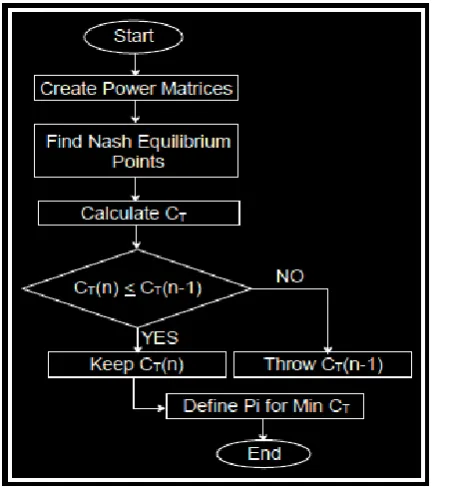
Before the system analyze, game theory elements of the system should be clarified. In this paper, game theory elements with their power generation system equivalents are defined at Table 1 and flow chart of the proposed algorithm is given at Figure 1.
Table 1: An Example of Two Player Game
Game Theory Elements Power System
Equivalent
Players Generation Plants
Strategies Produced Power
Payoffs 1/0 According to Demand
© 2016, IRJET | Impact Factor value: 4.45 | ISO 9001:2008 Certified Journal | Page 384 Figure 1: Flow Chart of Proposed Algorithm.
Table 2: NASH Equilibrium Points of Two Generation Plant.
GP1\GP2 100MW 200MW
100MW (0,0) (1,1)
200MW (1,1) (0,0)
[image:5.595.42.267.98.342.2]If the system total demand is equal to 300 MW, Nash equilibrium points, which supply the total demand, are 100 MW, 200 MW and 200 MW, 100 MW. Nash equilibrium points are signed in Table 3.
Table 3: An Example of Two Generation Plant.
GP1\GP2 100MW 200MW
100MW (0,0) (1,1)
200MW (1,1) (0,0)
After the loop of the presented algorithm, detected Nash equilibrium points are used to calculate total cost of the system. Minimum of calculated costs gives the system minimum total cost, in other words this point shows optimum operating strategy.
9. SIMULATED RESULTS
The main objective is to solve this system using game theory Nash equilibrium. To solve economic dispatch
problem using game theory Nash equilibrium has been presented.
Table 4: Comparison of Power and Cost using various Optimization Techniques w.r.t 6 Generator.
S/N 1 2 3 4
METHO
D GAME PBO MODE PDE
POWER DEMAN
D (MW)
1200 1200 1200 1200
P1(MW) 120.121 114.895
1
108.628 4
107.396 5
P2(MW) 109.2140 110.0341 115.9456 122.1418
P3(MW) 234.3018 218.9038 206.7969 206.7536
P4(MW) 224.5618 213.5678 210.0000 203.7047
P5(MW) 390.120 310.987 301.8884 308.1045
P6(MW) 360.912 306.9100 308.4127 303.3797
Fuel Cost (Rs)
60121 63499 64843 64920
Table 5: Determination of Power Dispatch and Fuel Cost w.r.t 6 Generator.
GENERATOR GENERATOR OUTPUT
P1(MW) 120.121
P2(MW) 109.2140
P3(MW) 234.3018
P4(MW) 224.5618
P5(MW) 390.120
P6(MW) 360.912
Total Power
Generation 109.2140
Fuel Cost (Rs) 60121
[image:5.595.305.563.156.436.2]© 2016, IRJET | Impact Factor value: 4.45 | ISO 9001:2008 Certified Journal | Page 385 show that game theory helps to find better results for solving
economic dispatch problem.
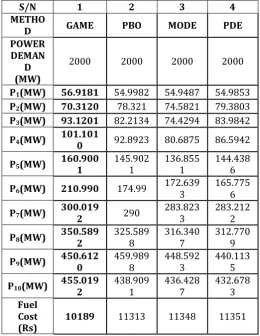
Table 6: Comparison of Power and Cost using various
Optimization Techniques w.r.t 10 Generator.
S/N 1 2 3 4
METHO
D GAME PBO MODE PDE
POWER DEMAN
D (MW)
2000 2000 2000 2000
P1(MW) 56.9181 54.9982 54.9487 54.9853
P2(MW) 70.3120 78.321 74.5821 79.3803
P3(MW) 93.1201 82.2134 74.4294 83.9842
P4(MW) 101.1010 92.8923 80.6875 86.5942
P5(MW) 160.9001 145.9021 136.8551 144.4386
P6(MW) 210.990 174.99 172.6393 165.7756
P7(MW) 300.0192 290 283.8233 283.2122
P8(MW) 350.5892 325.5898 316.3407 312.7709
P9(MW) 450.612
0
459.989 8
448.592 3
440.113 5
P10(MW) 455.019
2
438.909 1
436.428 7
432.678 3 Fuel
Cost (Rs)
[image:6.595.31.292.158.495.2]10189 11313 11348 11351
Table 7: Determination of Power Dispatch and Fuel Cost
w.r.t 10 Generator.
GENERATOR GENERATOR OUTPUT
P1(MW) 56.9181
P2(MW) 70.3120
P3(MW) 93.1201
P4(MW) 101.1010
P5(MW) 160.9001
P6(MW) 210.990
P7(MW) 300.0192
P8(MW) 350.5892
P9(MW) 450.6120
P10(MW) 455.0192
Total Power
Generation 56.9181
Fuel Cost (Rs) 10189
To solve economic dispatch problem using game theory Nash equilibrium has been presented. In the case study, the proposed method has been applied to 39 bus, 10 thermal
generators of power system. The presented algorithm results show that the proposed game theory method gives the minimum total cost of the system with minimum error instead of Lagrange functions results and different algorithm results. Furthermore, if the computation is revised to find minimum total cost without error, total cost decrease. Finally, the results of this study show that game theory helps to find better results for solving economic dispatch problem. The table above shows the comparison of power dispatch and fuel cost of 14 and 39 bus systems using various optimization techniques. The results show that the value of power output and fuel cost obtained by game theory based optimization technique is better than other optimization techniques. Furthermore, if the computation is revised to find minimum total cost without error, total cost decrease. Finally, the results of this study show that game theory helps to find better results for solving economic dispatch problem.
10. CONCLUSION
According to previous approaches another nature propelled calculation is actualized for various
economic load dispatch issues. The numerical comes
about plainly demonstrate that the proposed
calculation gives better results. The game theory
based algorithm based advancement beats the other
as of late created calculations. The calculation is
simple to actualize and can be coded in any computer
language. Power framework operation optimizing
issues can be attacked with the assistance of this
calculation. Power framework administrators can
likewise utilize this calculation for different
enhancement issues. The proposed algorithm is to
find minimum total cost without error, total cost
decrease. Finally, the results of this study show that
game theory helps to find better results for solving
© 2016, IRJET | Impact Factor value: 4.45 | ISO 9001:2008 Certified Journal | Page 386
theory algorithm can be combined with other simple
optimization techniques to improve their
performance when applied to ELD problems and obtain better results.
REFERENCES
1) Chetan Varma, K.S. Linga Murthy, K.SriChandan “Gaussian Particle Swarm Optimization for Combined Economic Emission Dispatch” Published in Energy Efficient Technologies for Sustainability (ICEETS), 2013 International Conference on 10-12 April 2013, pp 1336-1340.
2) Mugdha Udgir, Hari Mohan Dubey, Manjaree Pandit “Gravitational Search Algorithm: A Novel Optimization Approach for Economic Load Dispatch” Published in Emerging Research Areas and 2013 International Conference on Microelectronics, Communications and Renewable Energy (AICERA/ICMiCR), 2013 Annual International Conference on 4-6 June 2013, pp 1-6.
3) D. P. Kothari, Yadwinder Singh Brar, Harinder Pal Singh “Multiobjective Load Dispatch using Particle Swarm Optimization” published in 2013 IEEE 8th Conference on Industrial Electronics and Applications (ICIEA) on 19-21 June 2013, pp 272-277.
4) Sai H. Ling, Herbert H. C. Iu, Kit Y. Chan and Shu K. Ki “Economic Load Dispatch: A New Hybrid Particle Swarm Optimization Approach” published in Power Engineering Conference, 2007. AUPEC 2007. Australasian Universities on 9-12 Dec. 2007, pp 1-8. 5) N. A. Rahmat, and I. Musirin “Differential Evolution Ant Colony Optimization (DEACO) Technique in Solving Economic Load Dispatch Problem” published in Power Engineering and Optimization Conference (PEDCO) Melaka, Malaysia, 2012 IEEE International on 6-7 June 2012, pp 263-268.
6) Sunny Orike , David W. Corne “Improved Evolutionary Algorithms for Economic Load Dispatch Optimization Problems” published in 2012 12th UK
Workshop on Computational Intelligence (UKCI) on 5-7 Sept. 2012, pp 1-8.
7) Gaurav Prasad Dixit, Hari Mohan Dubey, Manjaree Pandit, B. K. Panigrahi “Artificial Bee Colony Optimization for Combined Economic Load and Emission Dispatch” published in Sustainable Energy and Intelligent Systems (SEISCON 2011), International Conference on 20-22 July 2011, pp 340-345.
8) G. Suganya K. Balamurugan Dr. V. Dharmalingam “Multi-Objective Evolutionary Programming Technique for Economic/Emission Load Dispatch” published in IEEE- International Conference on Advances in Engineering, Science and Management (ICAESM -2012) on March 30-31, 2012.
9) Farhan and M. E. El-Hawary “Multi-Objective Economic-Emission Optimal Load Dispatch Using Bacterial Foraging Algorithm” published in 2012 25th IEEE Canadian Conference on Electrical and Computer Engineering (CCECE) on April 29 2012-May 2 2012, pp 1-5.
10) Luis Bayón, José M. Grau , María M. Ruiz , and Pedro M. Suárez “The Exact Solution of the Environmental/Economic Dispatch Problem” published in IEEE Transactions On Power Systems, Volume 27, Issue 2, May 2012.
11) Mahor in the paper “Economic dispatch using particle swarm optimization: A Review” published in IEEE Transactions on Power Systems, Volume 27, Issue 2, June 2009.