© 2016, IRJET ISO 9001:2008 Certified Journal Page 122
Survey on Computational Intelligence Based Routing Protocols in WSN
Hemant Munot
1, P.H. Kulkarni
21
PG Student, Dept. of Electronics and Telecommunications, D.Y.P.I.E.T, Pimpri, Pune, M.S., India
2Professor, Dept. of Electronics and Telecommunications, D.Y.P.I.E.T, Pimpri, Pune, M.S., India
---***---Abstract -
Major concerns while designing any wireless routing protocols are network lifetime and throughput. This is due to the limitations of power source to sensor nodes. Also, sensor energy is consumed in various operations like data acquisition, data aggregation and communication between sensor nodes and from source to destination. Hence, to improve the lifetime of a sensor network, the energy of sensor node must be utilized in an optimized way. Due to advancements in computational intelligence (CI) techniques, various routing protocols have been put forth by many researchers. With a view to prolonging network lifetime, it discusses the routing protocols based on such intelligent algorithms as reinforcement learning (RL), ant colony optimization (ACO), fuzzy logic (FL), genetic algorithm (GA), and neural networks (NNs). Intelligent algorithms provide adaptive mechanisms that exhibit intelligent behavior in complex and dynamic environments like WSNs. Inspired by such an idea, some intelligent routing protocols have recently been designed for WSNs. The prime objective of this paper is to review various representative routing protocols which contribute to the optimization of network lifetime in WSNs, together with offering a guide for the collaboration between WSNs and computational intelligence (CI).Key Words: WSNs, combinatorial intelligence, fuzzy
logic, neural networks, genetic algorithm, reinforcement learning, ant colony optimization
1.
INTRODUCTION
Wireless Sensor Network (WSN) is a wireless communication system based on embedded system and sensor system, which equipped with lots of low-cost micro low-power sensor nodes [1]. These days, WSN has been widely applied in many fields for their advantages, such as smart home, environmental monitoring, military surveillance, disaster relief operations, medical care etc. Sensor nodes in WSN often have many constraints, such as energy, computation, and memory constraints. Among these constraints, energy constraint is usually a very important factor when designing a WSN protocol, because these cheap sensor nodes are not equipped with replaceable or replaceable batteries in the most cases. Hence, efficient use of the energy is always a very important issue that has been being considered in most protocols and algorithms for WSN. In order to work out this problem, scientists and researchers
have proposed many communication protocols to prolong the network lifetime. [2].
Many routing protocols have been specifically designed for WSNs which are classified as data centric, hierarchical and location-based. In recent years, with the development of computational intelligence (CI), routing protocols based on intelligent algorithms such as reinforcement learning, ant colony optimization, fuzzy logic, genetic algorithm, and neural networks have been proposed to improve the performance of WSNs. Intelligent algorithms provide adaptive mechanisms that enable or facilitate intelligent behavior in complex and changing environments, which can be brought to design all-in-one distributed real-time algorithms. Such algorithms have proved to work well under WSN-specific requirements like communication failures, changing topologies and mobility. Thus, some researchers make use of intelligent algorithms to address routing issue in WSNs. However, these intelligent algorithms have different properties, and they should be used depending on the specific application scenario as follows.
GA and NN share very high processing demands and are usually centralized solutions. They are slightly better suited for clustering when the clustering schemes can be pre-deployed.
FL is suitable for implementing routing and clustering heuristics like link or cluster head quality classification. However, it generates non-optimal solutions and fuzzy rules need to be re-learnt upon topology changes. ACO is very flexible, but generates a lot of additional
traffic because of the forward and backward ants. RL has been proved to work very well for routing and can
be implemented at nearly no additional costs. It should be the first choice when looking for a flexible and low-cost routing approach. [3]
© 2016, IRJET ISO 9001:2008 Certified Journal Page 123
1.1 Classification of routing protocols based on
intelligent algorithm
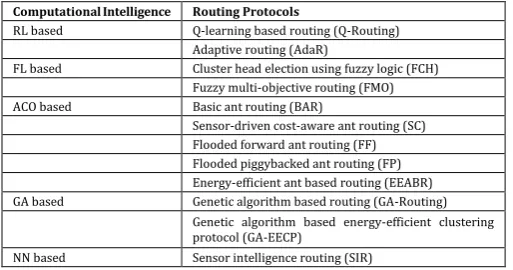
On the basis of the intelligent algorithms used in routing protocols, these intelligences based routing protocols in WSNs can be classified into five categories: RL based routing protocols, ACO based routing protocols, FL based routing protocols, GA based routing protocols, and NNs based routing protocols. Just as shown in Table1, in each category, some representative routing protocols are listed for us to discuss and analyze.
[image:2.595.35.292.355.490.2]The rest of the paper is organized as follows. Sections 2 discuss about the intelligent techniques, Section 3 discuss some of the representative routing protocols based on various intelligent algorithms like RL, ACO, FL, GA and NNs. Section 4 shows the results and analysis of routing protocols. Finally, Section 5 concludes the paper and further points out the open research problems.
Table -1: Classification of Intelligent Routing Protocols
Computational Intelligence Routing Protocols
RL based Q-learning based routing (Q-Routing)
Adaptive routing (AdaR)
FL based Cluster head election using fuzzy logic (FCH)
Fuzzy multi-objective routing (FMO)
ACO based Basic ant routing (BAR)
Sensor-driven cost-aware ant routing (SC)
Flooded forward ant routing (FF)
Flooded piggybacked ant routing (FP)
Energy-efficient ant based routing (EEABR)
GA based Genetic algorithm based routing (GA-Routing)
Genetic algorithm based energy-efficient clustering protocol (GA-EECP)
NN based Sensor intelligence routing (SIR)
2. Computational Intelligent algorithms
2.1 Reinforcement Learning
Reinforcement Learning (RL) [4-5], is a sub-area in machine learning field which uses computer programs to generate patterns or rules from large data sets, deals with how an agent should take actions in an environment to maximize the long-term reward. Agent acquires knowledge by actively exploring its environment and then determines the next action. The agent after trying many different actions, learns from experience as it does not know the best action beforehand. RL algorithm can be used to optimize the network performance. It has medium requirements for memory and computation at each node. It is easy to implement, and highly flexible to topology changes. It can achieve optimal results at no cost by using distributed learning. Hence, RL is well suited to deal with distributed problems as routing in WSNs. Complexity of learning increase exponentially with increase in number of agents. Also, one limitation is the trade-off between exploration (grope for new knowledge) and exploitation (to adopt the experienced state–
action pairs which have gained good reward). Exploration brings long-term improvement, which helps in converging to the optimization and exploitation is able to enhance the performance in a short time, but may lead to non-optimal solution.
2.2 Fuzzy Logic
Fuzzy logic is a mathematical discipline invented to express approximate human reasoning. Different from the classical set theory which allows elements to be either included in a set or not, fuzzy logic can establish intermediate values based on linguistic variables and inference rules. That is to say, in a fuzzy set, a certain element is allowed to have partial membership which is in the range [0, 1]. A linguistic variable is a variable whose values are words or sentences in natural or artificial language, and inference rules are used to govern the approximate reasoning. By using hedges like ‘more’, ‘many’, ‘few’, and connectors like ‘AND’, ‘OR’, ‘NOT’ with linguistic variables, an expert can form inference rules [6]. Fuzzy membership function is defined to compute the membership corresponding to a given value of a linguistic variable. Fuzzy logic has been applied successfully in various fields like pattern recognition, DIP, power and control systems, home appliances, etc. Also, it suits to clustering heuristics and routing optimization to simultaneously achieve multiple objectives. However, this algorithm generates non-optimal solution, and fuzzy rules need to be re-learnt upon topology changes.
2.3 Ant Colony Optimization
© 2016, IRJET ISO 9001:2008 Certified Journal Page 124 optimization problems such as asymmetric traveling
salesman, vehicle routing, WSNs routing, and so on. In WSNs, ACO is popular to handle the routing problem. However, these challenges of ACO should be concerned. Firstly, there is a contradiction between accelerating the speed of convergence and preventing prematurity and stagnancy. On the one hand, some researchers exploit the learning mechanism to optimize the pheromone feedback to speed up converging. But it brings on prematurity and stagnancy. On the other hand, the change of pheromone is restricted to a fixed range. In this condition, prematurity and stagnancy can be effectively prevented, but the speed of convergence is slowed. Secondly, all the links have the same pheromone at first. The ants walk randomly with no hint. This selection may be incorrect, and the latter selection will be misguided. Thirdly, in the process of ACO, any mistake in the selection of path or the updating of pheromone will affect the final optimization.
2.4 Genetic Algorithm
Genetic algorithm modeling the natural evolution performs fitness tests on new structures to select the best population. A population is composed by a group of chromosomes. In the application of GA, a chromosome represents a complete solution to a defined problem, and fitness reveals the quality of a chromosome on the basis of concrete needs. Initially, the population is randomly generated as a set of chromosomes. Then, the fitness of each chromosome is evaluated according to the defined fitness function. For a particular chromosome, the better the fitness value, the higher the chance of being selected to create new chromosomes by crossover and mutation. The procedures presented above are repeated generation after generation until either a fit enough solution is found or a given limit is reached. The GA algorithm is able to explore the search space efficiently through parallel evaluation of fitness and mixing of partial solutions through crossover. It maintains a search frontier to seek global optima, and solve multi-criterion optimization problems. In addition, a more specific advantage of GA is its ability to represent rule-based, permutation-based, and constructive solutions to many pattern recognition and machine learning problems. [11] In WSNs, GA is suited for clustering when the clustering schemes can be pre-deployed. But it requires very high processing and is usually a centralized solution. Also, it is very challenging to define the good fitness measure in a genetic approach.
2.5 Neural Networks
Neural networks [12] are the models of the biological neural systems. The human brain contains a large number of neurons. Each neuron connected to a great many other neurons receives signals through synapses. These synaptic connections play an important role in the behavior of the brain. Such a structure is similar to a dense network. A NN consists of a network of neurons organized in input, hidden
and output layers. NNs learn the patterns and determine their inter-relationships, in which the weights of a NN are updated to discover patterns in the input data. After learning phase completes, then performance of model is validated using an independent testing set.
3. CI Based Representative Routing Protocols
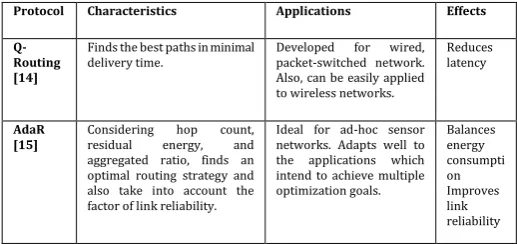
[image:3.595.304.563.364.486.2]Below tables depicts some of the routing protocols based on various computationally intelligent algorithms. Here, we have accomplished the collaborative study between characteristics of various CI techniques, their application in WSN for energy efficiency and throughput improvements and effects. Table 2 shows some of the RL based protocols, Table 3 shows FL based protocols, Table 4 shows ACO based protocols, Table 5 depicts GA based protocols and at last Table 6 shows NN based routing protocols along with their characteristics, results and analysis, applications and effects.
Table-2: Study of Reinforcement Learning Based Intelligent Routing protocols
Protocol Characteristics Applications Effects
Q-Routing [14]
Finds the best paths in minimal delivery time.
Developed for wired,
packet-switched network. Also, can be easily applied to wireless networks.
Reduces latency
AdaR [15]
Considering hop count,
residual energy, and
aggregated ratio, finds an optimal routing strategy and also take into account the factor of link reliability.
Ideal for ad-hoc sensor networks. Adapts well to the applications which intend to achieve multiple optimization goals.
Balances energy consumpti on Improves link reliability
Table-3: Study of Fuzzy Logic Based Intelligent Routing Protocols
Protocol Characteristics Applications Effects
FCH [19] Considers energy,
concentration and centrality as three linguistic variables to determine the chance of becoming cluster-head.
It is only suitable for a small-scale WSN.
Postpones the time of first-node death
FMO [6] Makes use of FL to
simultaneously optimize
multiple objectives, which uses fuzzy membership functions and rules in the design of cost functions.
It can be applied to simultaneously achieve
multiple routing
objectives for WSNs.
© 2016, IRJET ISO 9001:2008 Certified Journal Page 125 Table-4: Study of Some Ant Colony Optimization Based
Intelligent Routing protocols
Protocol Characteristics Applications Effects
BAR [20] Chooses routing path according to the
probability distribution. It is suitable for applications in which the sink node is the focus and ordinary nodes must keep good connectivity to the sink.
Builds multiple paths
SC–FF–
FP [21] SC-FF-FP:settings in ACO to lead to a good start-up. Address the initial pheromone
SC: Stores the energy-correlative cost to the destination from each neighbor, good links are chosen with a much higher probability.
FF: At the start, it floods forward ants to the destination. Once the forward ants arrive at the destination, creates backward ants to traverse back to the source. Once, a shorter path is traversed, the rate of releasing flooding ants is decreased.
FP: Adopts the flooding mechanism to release ants, and combines forward ants with data ants. Data ants not only pass the data to the destination, but also remember the traversed paths, by which the backward ants update the correlative pheromone trail.
On the basis of different requirements of applications, these three protocols can be independently used to build a good system start-up.
SC:
Provides better energy efficiency
FF-FP:
Reduce Latency and Increases packet delivery
EEABR [20]
It uses lightweight ants to find routing paths between the sensor nodes and the sink nodes, which are optimized in terms of distance and energy levels.
Takes the energy levels of sensor nodes and the lengths of routed paths into account to update the pheromone trail.
For different WSNs scenarios, this protocol can lead to a good result.
Decreases energy consumpti on
Table-5: Study of Some Genetic Algorithm Based Intelligent Routing Protocols
Protocol Characteristics Applications Effects
GA-Routing [16]
Uses GA technique to generate an aggregation tree which spans all the sensor nodes.
It can be applied for a homogeneous network.
Suited for small-scale networks.
Postpones the time of first-node death.
Improves energy efficiency
GA-EECP
[17] Uses GA technique to create energy efficient clusters. Considers cluster distance, direct distance to the base station,
transfer energy, standard
deviation of cluster distance, and number of transmissions as factors of influence.
It is suitable for large
scale WSN
applications, such as security, health-care, industry automation, agriculture,
environment and
habitat monitoring.
Provides better energy efficiency
Table-6: Study of Some Neural Networks Based Intelligent Routing Protocols
Protocol Characteristics Applications Effects
SIR [18] Introduces a NN in each node to manage the routing. As it is a QoS driven routing algorithm, it considers latency, error rate, duty cycle and throughput to determine the quality of link.
It is well suited for the real-time application of WSNs.
Provides better energy efficiency, Reduces latency, Increases packet delivery
4. RESULTS AND ANALYSIS
Following section describes results and analysis of the routing protocols discussed in above section.
RL Based Routing Protocols:
Q-Routing: Simulations results prove that Q-Routing is highly efficient under high network loads, performs well under changing network topology, and learns the best paths to increase the rate of packet delivery. Thus, it can indirectly optimize the network lifetime.
AdaR: Take multiple routing metrics into account to determine the routing path, which can achieve goals to maximize network lifetime. It is both data efficient and insensitive against initial setting. Hard to implement and maintain in real scenario. It is hardly scalable. Lot of extra cost is expended to broadcast the new Q-values. It is not a distributed protocol in which packets are delivered from sensors to a centralized base station to calculate the optimal policy offline.
Fuzzy Logic Based Routing Protocols:
FCH: Compared to the LEACH protocol, FCH gains a substantial increase in network lifetime. Simulation results shows that the number of rounds before first-node-death in case of the proposed method is on average about 1.8 times greater than in LEACH, which optimizes the network lifetime in terms of the first definition.
FMO: Simulation results show that this approach is superior to a number of other well-known online routing heuristics in the performance of network lifetime.
Ant Colony Optimization Based Routing Protocols:
© 2016, IRJET ISO 9001:2008 Certified Journal Page 126 performance and while updating pheromone trail, the
energy level of path is not taken into account, which is a significant aspect in WSNs.
SC-FF-FP:
SC: As initial probability distribution differs more, the good links are chosen with a much higher probability rather than the same probability in BAR. However, it is still not quite effective in latency.
FF: Compared to BAR and SC, it has shorter delays, which indirectly optimize the network lifetime. However, success depends on appropriate frequency of flooding ants since there is collision problem in FF. Significant amount of traffic is created due to which the data ants and the backward ants interfere.
FP: It provides higher success rates of data delivery, i.e. it further contributes to the enhancement of network lifetime, whereas it consumes more energy than SC and FF.
EEABR: Simulation results show that in different WSNs scenarios, EEABR minimizes the communication load and maximizes the energy saving, which emphasizes the enhancement of network lifetime.
Genetic Algorithm Based Routing Protocols:
GA-Routing: Simulation results show that it prolongs the network lifetime as compared to the single best tree algorithm. As it is a centralized protocol; it is not suited for large-scale network. Also, extra cost is involved to disseminate the optimal routing paths to sensor nodes.
GA-EECP: Simulation results indicate that it performs better than the traditional cluster based protocols. However, there is an additional cost caused by the base station gathering information about the whole network to determine the clusters.
Neural Network Based Routing Protocols:
SIR: SIR has been evaluated for two cases: One is all the nodes are effective, and the other is 20% nodes are dead. Simulation results show that SIR achieves superior performance in terms of average latency and energy consumption over others. Thus, compared to others SIR further optimizes network lifetime. Especially when the percentage of dead nodes is high, SIR has much greater superiority. SIR has expensive cost.
5. CONCLUSIONS
Lifetime optimization has been a hot issue in WSNs. In recent years, several routing protocols based on such intelligent algorithms as RL, ACO, FL, GA, and NNs have been proposed for WSNs to achieve this goal. This paper first defines network lifetime in three aspects. Then, under each category of intelligent algorithms, it picks out some representative routing protocols which contribute to the optimization of
network lifetime to discuss. Table 5 summarizes these intelligent routing protocols covered in this survey, and indicates which aspects of network lifetime have been optimized. These intelligent algorithms do not have the same fitness for routing in WSNs. RL is the best option to deal with routing issue for WSNs. This algorithm is flexible, fully distributed, and robust against node failures. Moreover, its communication requirements are nearly zero, and it can maintain data delivery even in case of topology changes. Then, ACO is also popular to address routing for WSNs. However, it requires high communication overhead by sending ants separately to manage the routes and sending ants back to the source. Thus, it is better to change the ACO model to accommodate the requirements of WSNs, but this has not been done so far. In addition, FL is suited for implementing clustering heuristics and routing optimization to simultaneously achieve multiple objectives. However, this algorithm generates non-optimal solution, and fuzzy rules need to be re-learnt upon topology changes. Finally, GA and NNs can also be made use of to improve performance of WSNs. But they have very high processing demands and are usually centralized solutions. These two approaches are slightly better suited for clustering when the clustering schemes can be pre-deployed. On the basis of diverse demands, one or multiple intelligent algorithms can be utilized to optimize the performance. Routing protocols based on intelligent algorithms look promising since they have superiority under uncertain environments and severe limitations. However, many of them lack explicit comparison to traditional or to other intelligent algorithms. In addition, only a few algorithms have been validated under real WSNs environments like test-bed or deployments. Oppositely, most of them are evaluated in the simulation environment. Therefore, this paper intends to provide new ideas and incentives for addressing routing issue in WSNs, and there are still many challenges needing to be solved. Furthermore, since the current definition of network lifetime is limited to the time until the first dead node appears, this paper brings forward a comprehensive evaluation indicator for network lifetime. In future, this paper intends to evaluate and compare these routing protocols for WSNs following the above opinion.
REFERENCES
[1] I.F. Akyildiz, W.Su, Y.Sankarasubramaniam, et al, “A
survey on sensor networks,” IEEE Communications Magazine, vol. 40, no. 8, pp. 102-114, 2002.
[2] Feng Zhang, Qi-Ye Zhang, Ze-Ming Sun; ICT2TSK: An
Improved Clustering Algorithm for WSN Using a Type-2 Takagi-Sugeno-Kang Fuzzy Logic System, 2013 IEEE Symposium on Wireless Technology and Applications (ISWTA), September 22-25, 2013, Kuching, Malaysia.
[3] Wenjing Guo, Wei Zhang; A survey on intelligent routing
© 2016, IRJET ISO 9001:2008 Certified Journal Page 127
[4] Kaelbling LP, Littman ML, Moore AP. Reinforcement
learning: a survey. Journal of Artificial Intelligence Research 1996;4:237–85.
[5] Sutton RS, Barto AG. Reinforcement learning: an
introduction. The MIT Press; 1998. Villalba LJG, Orozco ALS, Cabrera AT, Abbas CJB. Routing protocols in wireless sensor networks. Sensors 2009;9:8399–421.
[6] Minhas Mahmood R, Gopalakrishnan Sathish, Leung Victor
CM. Fuzzy algorithms for maximum lifetime routing in wireless sensor networks. Global telecommu-nications conference; 2008. p. 1–6.
[7] Wei G. Study on immunized ant colony optimization. In:
Proceedings of the third international conference on natural computation (ICNC 2007); 2007.
[8] Ellabib Issmail, Calamai Paul, Basir Otman. Exchange
strategies for multiple ant colony system. Information Science 2007;177(5):1248–64.
[9] Ye F, et al. A scalable solution to minimum cost forwarding
in large scale sensor networks. In: Proceedings of international conference on computer commu-nications and networks (ICCCN), Dallas, TX; October 2001.
[10] Subramanian L, Katz RH. An architecture for building self
configurable systems. In: Proceedings of IEEE/ACM workshop on mobile ad hoc networking and computing, Boston, MA; August 2000.
[11] Hsu William H. Genetic algorithms. Department of
Computing and Information Sciences, Kansas State University; 2008.
[12] Haykin S. Neural networks: a comprehensive foundation.
Prentice Hall; 1994.
[13] Kulkarni Raghavendra V, Förster Anna, Kumar
Venayagamoorthy Ganesh. Compu-tational intelligence in wireless sensor networks: a survey. IEEE Communica-tions Surveys & Tutorials 2011;13(1).
[14] Boyan JA, Littman ML. Packet routing in dynamically
changing networks: a reinforcement learning approach.
Advances Neural Information Processing Systems,
vol. 6; 1994.
[15] Wang P, Wang T. Adaptive routing for sensor networks
using reinforcement learning. In: Proceedings of the 6th IEEE international conference on computer and information technology (CIT). Washington, DC, USA. IEEE Computer Society; 2006.
[16] Islam O, Hussain S. An intelligent multi-hop routing for
wireless sensor networks. In: Proceedings of WI-IAT Workshops Web Intelligence and Intelligent Agent Technology Workshops; 2006. p. 239–242.
[17] Hussain Sajid, Matin Abdul Wasey, Islam Obidul. Genetic
algorithm for hierarchical wireless sensor networks. Journal of Networks 2007;2(5).
[18] Barbancho J, León C, Molina J, Barbancho A. Giving
neurons to sensors: QoS management in wireless sensors networks. In: Leon C, editor. Proceedings of the IEEE conference on emerging technologies and factory automation ETFA; 2006. p. 594–597.
[19] Gupta I, Riordan D, Sampalli S. Cluster-head election using
fuzzy logic for wireless sensor networks. In: Riordan, D, editor. Proceedings of the 3rd Annual Communications Networks and Services Research Conference; 2005. p. 255– 260.
[20] Camilo Tiago, Carreto Carlos, Sá Silva Jorge, Boavida
Fernando. An energy-efficient ant-based routing algorithm
for wireless sensor networks. Ant Colony Optimization and Swarm Intelligence; 2006. p. 49–59.
[21] Zhang Y, Kuhn L, Fromherz M. Improvements on ant