4173
A STUDY ON BIG DATA APPLICATIONS FOR THE
KOREAN DRANA INDUSTRY AT EACH STAGE OF THE
VALUE CHAIN
1Jun-Ho LEE, 2Seung-Hyeok BAEK
1 First Author, Dept. Of Business Administration, Hoseo University
2 Corresponding Author, Global Business Support Division, Contents Assessment Center,
Korea Creative Content Agency
E-mail: 1[email protected], 2[email protected]
ABSTRACT
This paper aimed to explore the use of Big Data in the Korean drama industry. The paper examined the strategy of using big data for the development of the Korean drama industry. The purpose of this study was to examine exemplary cases of advanced countries in which big data is being used actively and draw conclusions on the applicability in Korea. Compared with the growth and development of Big Data, its utilization in the Korean contents industry was insufficient, and its application in the drama industry has been limited in particular. While Big Data has been hailed for its wide applicability, there have been few studies on the utilization of big data to promote the culture industry (Yoon, 2013). In foreign countries, there have already been many successful cases of using Big Data in the field of video industry, and although a few Korean cases existed, there was not a comprehensive and systematic linkage and utilization as a whole. Therefore, this paper proposed an integrated model of using big data in the contents industry by presenting integrated method of using big data centered on value chain of Korean drama industry, and proposed future development direction of Korean drama industry with big data .
Keywords: Big Data, Drama Industry, Value Chain
1. INTRODUCTION
Google's Eric Schmidt said at the 2010 Techonomy conference that since the dawn of human civilization until 2003, five exabytes of data have been created, but now, the same amount of data is created every two days. This well encapsulates the big data world that has already been realized. Interest in big data is continuously spreading across industries, as well as in the public sphere. Big Data is used to analyze user patterns to make credit cards issued by banks more widely available (Lee, Y. J., Lee, S. H., & Lee, J. S., 2014). Big data is also used to cope with natural and other disasters (Kim, Ko, Kim, & Park, 2016). Recently, Big Data has also begun to play a role in the political arena.
Various types of voter database have been used to develop election strategies tailored to appeal to voters and to satisfy their needs. During the 2008 election campaign, then Presidential candidate Barack Obama used Big Data. Actually, the Obama camp went beyond a mere use of Big Data and went
4174 input to and output from the system. In other words, new interpretations from a myriad of different data sources can yield entirely different results in the same industry (Woo, 2017).
Such interest and progress in big data technology are no exception in the content industry. Big data use in the content industry has progressed to the stage where it is translating into tangible results. Following the huge success of “House of Cards,” a Netflix original series that was produced based on big data analysis, big data has gone from a mere matter of interest in the content industry to an essential tool for survival. Netflix, buoyed by the success of “House of Cards” and the like, gradually increased the proportion of in-house production from the initial 5 percent, and aimed to produce 450 minutes of original content in 2015.
The company is also trying to make forays into foreign markets such as France, U.K., Norway, Japan, and South Korea. It is attempting to use local content providers as well as big data to identify a locally optimized business model and the needs of local users not yet fulfilled (Song, 2015). But the use of big data in the content industry is still limited in Korea. One main reason for this is that media content as a cultural product in Korea is viewed as an artistic creation rather than a product or service, and as such, the need for big data use in the content industry has been largely dismissed as an unvalidated and overly optimistic claim of technology determinists. Despite a well-established infrastructure and strong online culture with tech-savvy users, only a fraction of the enormous amounts of data generated on the internet through computers and mobile devices is being utilized(Woo, 2017). In this context, this paper aims to examine the applications of big data and the current status of Big Data for the Korean content industry, especially the TV drama industry, which is at the center of hallyu (the Korean Wave). To this end, it will look at how media content industries in other countries are using big data, and consider the possibility of applying this to the Korean drama industry.
2. THE BIG DATA MARKET AND BIG
DATA APPLICATIONS IN KOREA
In the report, “Korea Big Data Technology and Services Forecast” (2015), the market research firm IDC Korea predicted the domestic big data technology and services market to grow at a
[image:2.612.308.516.243.367.2]compound annual growth rate of 26.4% until 2018. The report estimated that the size of the Korean big data technology and services market would grow to 3117 thousand million dollars by 2018 (Figure 1). However, this estimate only includes the total infrastructure, software and services related to big data analytics, and does not include the ripple effects of the growth and expansion of the big data market on other industries, which means that the potential of big data technology and services is probably even greater.
Figure 1. Korea Big Data Technology and Services Forecast, 2014-2018. (Unit: 1000 million
dollars)
*Note: Total infrastructure, software and services related to big data analytics
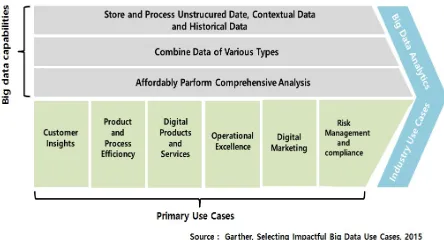
There have been many discussions as to the applications of big data across various industries. In
“The Big Data Value Model” (2015), Gartner identified the six main uses of big data analytics as shown in Figure 2.
Figure 2. The Big Data Value Model
[image:2.612.310.532.531.651.2]4175 have developed and are operating big data analysis platforms; social media analytics companies like Daumsoft, Traum and Medicom are providing big data services for the general public as well as businesses. But in terms of the six big data use cases presented by Gartner, the diversity of applications is limited and few successful cases have been reported. According to the report “Research on the Application Methods of Big Data within the Cultural Industry” (2013) by Yoon H.K., big data in the Korean content industry is being used primarily in the areas of image analysis (brand analysis), trend analysis, crisis management, and as a storytelling tool and for marketing purposes. Here we introduce a couple examples of big data use in different areas of the Korean content industry. Melon is the leading online music store in Korea owned by LOEN Entertainment that possesses 24 million user accounts and offers 3.2 million songs. To put to use the vast amounts of data accumulated from its large-scale services, it has been analyzing and utilizing big data. With an average of more than 70 million songs streamed per day, a monthly average of more than 12 million visitors, and the number of content used per annum amounting to over 1 billion (3.2 million daily), it had reached the limit of its capacity to manage the enormous volume of data generated (NIA, 2015). As a result, Melon developed a big data solution based on the accumulated user data, and has been using this to measure artist popularity and provide music recommendation services based on user interests. Its services range from a mere music playback to the curation service, which classifies and recommends music according to users’ preferences, to a user-customized service, which stores sound source locations, allowing users to receive the same service over multiple devices (Kwon, Kang, & Kim, 2013). Big data analytics and use in the Korean media content industry have been led mostly by cable television companies rather than terrestrial broadcasters. The entertainment and media contents company CJ E&M developed the Contents Power Index (CPI) together with Nielsen Korea, an index considered to be a more realistic measure than the traditional viewer rating, which was previously the only existing audience measurement index in the industry. CPI measures TV shows’ content power based on consumer behavior that includes popularity, viewer interest / involvement, engagement rankings, as well as program-related news subscription, portal direct search and social media buzz rankings. The general trend in the industry is shifting towards using CPI, which is considered a more meaningful index than
viewer ratings in determining the unit price of advertisements, a major source of revenue for television networks. The “Reply” series produced by CJ E&M did not fare as well in terms of viewer ratings compared to terrestrial TV programs, but with a much higher content power rating, they were able to charge higher prices for advertisements. But big data use in the Korean content industry is still limited to a few businesses and just some stages of the value chain.
Big data is mainly used to evaluate contents that have been completed. So data are biased towards results, such as what are viewers’ needs? who is a popular actor or writer? and what’s the reason for a failure? Even if the results are reflected in the production of the next program, the company fails to act in a proactive manner by already putting together a selection of cast and crew, such as actors, directors and writers taking into account dominant viewing trends and the characteristics of the work. Song (2015) said the success of Netflix was attributable to vast amounts of data it has accumulated.
The company analyzed aggregate data by taking into account the number of contents and feedback that are popular among the members, rather than simply analyzing the audience of one or two works. The analysis found that those who use Netflix’s services also have preferences for BBC’s mystery dramas in the 1990s. In other words, big data cover various aspects in a comprehensive manner.
3. WAYS TO USE BIG DATA IN THE
KOREAN DRAMA INDUSTRY
3.1Current Status of the Korean Drama
Industry
4176 industries. In particular, given that exports of Korean dramas to China are growing, dramas will likely exert greater influence on the Korean broadcasting industry. Meanwhile, the market for production of television dramas is estimated to be worth over KRW400 billion to KRW600 billion (Ki-woom Securities, 2015). And starting 2011, more and more dramas have been aired on general programming channels with at least 80 and 30 dramas broadcast annually on terrestrial channels, and cable and general programming channels, respectively.
Kim(2011) selected the trends in industrialization of Korean TV dramas as a key area of interest, and described the industry’s development in three stages. Stage 1 is the period in which Korean TV dramas emerged in the broadcasting landscape. It was from the early 1960s, which was when major television stations were built and started broadcasting, through 1990, covering a period in which the broadcasting history started and culminated. During the period, dramas evolved as an independent form. At Stage 2 - period from 1991 through 2001 – outsourced production system was introduced and thrived. During the period, a key issue related to industrial development was the adoption and revitalization of outsourced production. Stage 3 (2002 ~ present) was the period during which Korean dramas made foray into Asian markets and were firmly established. A key issue that attracted attention during the period was the spread of Korean dramas across Asia, which is referred to as the “Korean wave.” Overseas markets emerged as a new area. Besides, as more and more people are watching videos online via desktops and mobile devices and recommending videos using social media, a new discontinuous pattern of behavior is emerging. Big data is the hallmark of
[image:4.612.89.299.562.688.2]the period.
Figure 3. Trends in Korea Broadcasting Industry Exports and Sales
3.2Strategies to Use Big Data at Each Value
Chain of the Korean Drama Industry
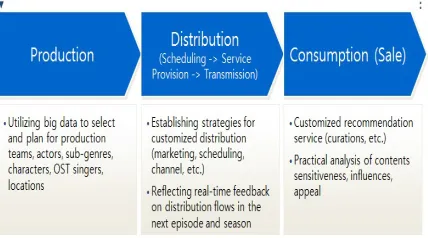
Kim & Lee (2016) said that the entertainment industry uses big data in three ways: to make discoveries and to optimize customer experience; to predict chances of success and so on, and determine the direction of production and launch a marketing campaign based on such forecasts ; and in the production process. Such discussion can also be applied to the value chain of the Korean drama industry. As the video industry, the distribution value chain of dramas can be divided into production, distribution, and consumption or sale (Korea Information Society Development Institute, 2009). Among them, big data in Korea has actually been used in the consumption phase. In other words, it has been used to recommend contents tailored to individual tastes and preferences or, as in the case of CJ E&M’s CPI, to analyze how content is consumed and to identify its influence. Yet, the analysis of such consumption can also be applied to the production phase, and to the distribution phase so that disparate distribution strategies can be employed based on the characteristics of dramas. In short, a comprehensive and systematic strategy is needed to use big data based on the value chain of the drama industry.
3.2.1Production
4177 It will be possible to use big data accumulated so far to select production crew and actors most likely to make the drama not only a commercial success but also an artistic success, and to go even further, to determine other stuff like sub-genre, characters, artists who will be featured in original sound tracks, and filming locations. In fact, historical characters like Admiral Yi Sun-shin clearly illustrate that public preferences identified using big data can lead to the success of actual works (most of the films as well as dramas featuring Yi Sun-shin generated buzz and became hugely popular). Kim (2015) conducted the research titled “TV program viewing trends in 2015 that can be identified by text big data, in which the author collected and analyzed text big data over social media networks regarding major television programs that had been aired during the ten months of 2015. The data contained herein included texts and comments found on over 300 channels, such as online news, blogs, online communities, Internet bulletin boards, and YouTube, and the number of views the relevant content garnered on YouTube. Through them, the study found that in the case of Korean dramas, cast and crew (names of actors and their characters and nicknames, etc.) and subsequently influential property group keywords (fashion, makeup, onesies, bags, clothes, albums, sound sources, hairstyles, shoes, sold-out, and buzzwords, etc) helped generate buzz (47.8% and 16.6%, respectively).
3.2.2 Distribution
It should be noted that Epagogix, Fizziology, Reel Pulse provide services that predict the possibilities of success by analyzing the scripts of movies and TV programs. Based on the accumulated big data analysis, differentiated distribution strategies such as marketing and channel strategies are possible. It is also possible to implement segmented marketing strategies for pre-targeted consumers and to utilize the optimized scheduling and channels for the target consumers. Reel Pulse, a film market research firm, provides professional tracking service for the box office; it provides performance forecasts eight weeks before new movie releases, helping Hollywood studios to implement more effective marketing strategies in advance. This is related to an increase in the proportion of US adults between ages 35 and 54 who use social media for information acquisition from 33% in 2009 to 51% today. The big data generated in this process is used to reliably predict box office performance based on real social networks.
Especially, it is possible to utilize big data even at the stage of actual distribution, not at the distribution planning stage. Drama distribution can be divided into three stages: scheduling, service delivery and transmission. The third stage, transmission, is the point at which the calculation and accumulation of data to be consumed (sold) begins. Such big data can be utilized as a continuous input for the next episode and season due to the nature of drama. The Indian TV documentary program 'Satyamev Jayate' deals with sensitive issues and has high viewer ratings, which causes the viewer feedbacks every time they air. Thus, the production team adds big data analysis techniques to the feedback of viewers and reflects the results in program production. The team collaborated with the Indian IT consulting firm 'Persistent Systems' to announce the issues that are planned to be covered 36 hours before airing an episode, to organize the relevant terms about the issue. After the episode is aired, through the analysis system, feedbacks are classified by scoring based on interest level and emotions. Afterwards, the highly rated feedback is posted on the website after being verified by experts of the credibility of the contents and privacy invasion.
Such big data use in the distribution process is significant in that we can modify and respond to the distribution strategy for consumption after the drama is transmitted to consumers and consumption occurs along with consumer-customized distribution strategy for Korean dramas.
3.2.3Consumption (sales)
4178 media data collected from Twitter, Facebook, etc. Netflix also offered $ 1 million in prize money for those who develop algorithms that could increase the accuracy of this recommendation system by 10 percent. The method employed by Belkor's Pragmatic Chaos, who won the prize in 2009, was a recommendation algorithm for analyzing as many of the user's indicators as possible, which was highly complicated. Netflix recently introduced the Deep Learning method to its recommendation system.
[image:6.612.87.301.554.673.2]This kind of curation service serves to ease the burden of consumers' decision-making, while providing the consumers with the contents they want, so that it can function in a way that improves the rational content consumption for the consumer and the performance of the content sale for the supplier. Such brokerage business, which links production and distribution content to consumers with information overload, is likely to be highlighted in the future (Steven Rosenbaum, 2011). In recent years, Celebtide, founded by big data experts from Korean and foreign companies in Korea, attract public attention as a big data-based content curation platform that reprocesses various data and provides informative contents. Especially, it is interesting that it can be used as information providing service at the stage of reproduction along with curation at the consumption stage through utilization of big data (for example, when searching for a keyword with physical attractiveness such as "cute, pretty" or "lovely, emotional", the female drama characters are recommended in order). Moreover, the CPI of CJ E & M is also analyzed and constructed based on the big data on drama consumption, and it is likely to smooth out the drama production process, etc..
Figure 4. A Plan for Big Data Use at Each Value-Chain of the Korean Drama Industry
4.CONCLUSION
Compared to Big Data's influences and potential, it seems that its utilization in the Korean drama industry is insufficient in scope and systematicity. There have been changes in the Korean drama industry through outsourcing production to tackle terrestrial broadcasters’ monopoly on the production of dramas. There were also changes due to the production, scheduling and transmission of drama by cable television companies and general programming channels. As such, most of Korean dramas depend on external production companies rather than platform operators such as broadcasters (Baek, Byun, & Kim (2015). It is also a result of promoting the outsourcing policy of the Korean broadcasting industry based on the belief that nurturing various outsourcing companies, instead of relying on a limited number of platform providers, fuels creative ideas and contents
The percentage of production outsourced to external production companies subject to quotas has topped 40 percent, including 42.1 percent for MBC and 40.9 percent for SBS, except for KBS, the public broadcasting channel, which started at 3 percent and is now in the 30 percent range (MSIP & KCC, 2016).
In the case of dramas, the proportion of outsourced production is higher than that of in-house production. Yet, all outsourced companies except a few of them such as SAMHWA Networks, Pan Entertainment and iHQ Entertainment & Media Group are small businesses that are struggling financially. In Korea where pre-production process is not yet established, broadcasting stations cover at least 50 percent of production costs.
4179 million annually in its own studio called Amazon Studios, since 2010.
In particular, online video viewing through desktop computers and mobile phones has weakened the status of traditional TVs, and social networking services that accompany video viewing through desktop computers, mobile phones, and Connected TVs (Smart TVs) are rapidly expanding the utility of big data. Korean consumers who are accustomed to this new environment are evolving into active consumers or prosumers, at a speed the existing Korean broadcasting companies or producers can’t catch up with.
In other words, the consumer, not the producer, is becoming a content creator in a real sense. Rather than simply consuming content that the publisher presents unilaterally, consumer needs inspire content creation. How such needs can be datafield, analyzed and reflected is a measure of success. As described above, given the unique nature of the Korean broadcasting industry, it may be difficult to have an infrastructure that enables all production companies to construct, analyze, and reflect Big Data in their production. If you cannot avoid something, you have to face it and find a way to deal with it. In the private sector, it is possible to build a big data system between operators that can be used jointly by operators. In the public sector, the K-ICT Big Data Center built by the government (Ministry of Science, ICT and Future Planning) can expand its coverage to include data related to the cultural industry to serve the private sector. What is clear is that, as we have already seen in previous studies, the areas of application such as manufacturing, banking and agriculture is rapidly expanding.
Ultimately, if we remember the simple but clear lesson that the subjects, which form and destroy the industry and the market, are consumers, building the value chain of production, distribution, and consumption (sales) based on consumer demand is fundamentally essential to the survival and development of Korean dramas. Big Data shows that possibility. So far, this paper examines the use of the value chain in the Korean drama industry based on a review of Big Data use in the video industry.
REFRENCES:
[1] Baek, S. H., Byun, S. K., & Kim, G. J.(2015), “Broadcasting Contents Market and Profit Distribution Model”, Korean Journal of Broadcasting and Telecommunication Studies, 29(1): 63-92.
[2] Cho, Y.S.(2014), “Big Data of Netflix, Contact with Humanistic Imagination”, ICT-Humanities & Social Science, 14-25.
[3] Gartner(2015), Selecting Impactful Big Data Use Cases
[4] Kwon, j. K., Kang, N. R., & Kim, S. I.(2013), “Evaluation of the Usability of Local Application Mobile Music Services: Focused on Naver Music and Melon Music”, Journal of Digital Design, 13(1): 193-202.
[5] Kim, H.(2011), “Korean TV Drama Industry Profit Structure and Current Issues”, Hanwool Academy.
[6] Kim, D.W.(2013), “Big Data Cases of the Sector”, Dong-a University Management Review, 34: 39-52.
[7] Kim, H.W., & Lee, M.(2016), “Big Data and Entertainment Content: Case Studies and Prospects”, Journal of Internet Computing and Services, 17(2): 109-118.
[8] Kim, J.S.(2015), “2015 Broadcasting Program
Viewing Trends by Text Big Data ” ,
Broadcasting Trends & Insights, 4: 13-22. [9] Kim, j. H., Ko, Y. S., Kim, J. K, & Park, J.
I.(2016), “Disaster Preparedness Using Mobile Big Data”, KRIHS POLISH BRIEF, 563: 1-6. [10] KISDI(2009), “ Study on Statistical
Classification in the Broadcasting and Telecommunication Sector”, Policy Research,
09-71.
[11] Lee, Y. J., Lee, S. H., Lee, J. S.(2014), “KB Koomin Card’s Marketing Activities and Use of Big Data”, Korea Business Review, 18(1): 145-176.
[12] MSIP & KCC(2016), Broadcasting Industry Fact Finding Reports for 2016.
[13] NIA(2015), 2015 Big Data Global Cases. [14] Park, H.A.(2014), “Big Data Market Status
and Its Implications for Contents Industry”,
KOCCA FOCUS, 77.
[15] Rosenbaum, S.(2011), “Curation Nation:
How to Win in a World Where Consumers are Creators”, McGraw-Hill.
[16] Song, M. J.(2016), “A Study on business model optimization of video streaming, Netflix: Based on the business model innovation”,
Journal of Broadcasting and
4180 [17] Woo, J. Y.(2017), “The 4 Industrial
Revolution: Preparing for Data Economy”, The Korea Contents Association Review, 15(1): 14-20.
[18] Yoon, H.K.(2013), “ Research on the
Application Methods of Big Data within the Cultural Industry”, Global Cultural Contents,
10: 157-179.