3475
AN ENHANCED EXTRACTIVE TEXT SUMMARIZATION
METHOD FOR MULTIPLE DOCUMENTS
1ADIBA MAHJABIN NITU, 2MD. PALASH UDDIN, 3PRIYANKA BASAK TUMPA, 4SABINA YEASMIN, 5MASUD IBN AFJAL
1Associate Professor, Hajee Mohammad Danesh Science and Technology University (HSTU), Department ofComputer Science and Engineering, Dinajpur, Bangladesh
2&5 Assistant Professor, Hajee Mohammad Danesh Science and Technology University (HSTU), Department ofComputer Science and Engineering, Dinajpur, Bangladesh
3&4 B. Sc. Student (Session 2013), Hajee Mohammad Danesh Science and Technology University (HSTU), Dinajpur, Bangladesh
E-mail: 1[email protected], 2[email protected],3[email protected], 4[email protected],5[email protected]
ABSTRACT
Nowadays, text summarization has become an important issue to extract the required information within short time. Several techniques on extractive text summarization have been developed for summarizing English text(s). However, there is a few works done for the summarization of Bengali text(s). In this paper, an improved extractive Bengali text summarization technique has been proposed with enhancing the word scoring process, position value heuristics and summary generation procedure of our previously presented summarizer. In the word scoring procedure, each word is preprocessed using noise removal, tokenization, stop word removal and stemming operation. Then, a heuristics is applied to calculate the word score through checking it in all the input document(s). Moreover, a modified heuristic is proposed for the sentence scoring in which it has given the priority highest to the middle sentence and then the upper and lower sentences from the middle sentence will be less prioritized. Finally, top k-sentences are extracted from each of the clusters of sentences made by K-means clustering algorithm and then the extracted sentences are sorted as their actual appearances in the original document(s). Thus, the final summary is synchronized with the original document(s). In comparison to the existing method, the experimental result shows that the proposed improved technique produces better summarization to satisfy the end-users.
Keywords: Text Summarization, Extractive Summarization, Bengali Text Summarization, Heuristics, Synchronized Summary
1. INTRODUCTION
The desired amount of information is collected from the massive sources such as news portals, social media, Internet transactions and so on for numerous purposes. It is often difficult to find the relevant information from the big amount of collected data [1]. Presently, the huge amount of textual data is available in many different natural languages in the era of big data which has the potentiality to be mined for extracting the exact information. Search engines such as Google, AltaVista, Yahoo etc. have been developed to retrieve the specific information from this immense amount of data. However, the outcome of a search engine is not able to provide the predicted summarized result where summary is a text that is produced from one or more texts concisely that is
able to convey the important information of the original text(s). The most important benefit of using a summary is that it can reduce the studying time and monotonicity of a user. For this reason, text summarization, an application of data mining and natural language processing (NLP), is one of the most popular research areas that can allow the reader to get a quick overview of the entire document(s) [2].
3476 techniques attempt to improve the coherence among sentences by eliminating redundancies and clarifying the contest of the sentences while extractive techniques perform summarization by choosing the most meaningful sentences of the
document(s) according to some standard
measurements on the sentences. Both techniques are used for summarizing text either for single document or multiple documents. Abstractive summarization usually needs information fusion, sentence compression and reformulation which make the abstractive summarization schemes complex because it requires deeper evaluation of source documents and concept-to-text generation as well [11]. On the other hand, extractive summarization techniques find out the most relevant sentences in the document(s) [12]. These techniques also remove the redundancy of the input text(s). Therefore, extractive summarization is less complicated than abstractive summarization to bring out the summary. However, extractive summarization involves assigning saliency measure to some units (e.g. sentences, paragraphs etc.) of the document(s) and extracting those with maximum scores to prepare the summary. The mostly used methods for extractive summarization are TF/IDF (Term Frequence/Inverse Document Frequency) sentence scoring approach, graph theoretic approach, cluster based method, machine learning based approach, query based extractive approach, regression for estimating feature weights, multilingual, topic-driven summarization, centroid-based summarization, LSA (Latent Semantic Analysis) method, networks based approach, fuzzy logic based approach etc. In this paper, an extractive summarization technique is proposed based on the TF/IDF sentence scoring approach and cluster based method for multiple Bengali documents.
Recently, there are several works done for English, Hindi and Chinese text summarization while a very few attempts have been made for Bengali text summarization. For instance, the authors of the paper described in [13] proposed a cue-based hub-authority approach for multi-document Chinese text summarization. It is a graph based summarization approach that extracts the feature words (or phrase) of various sub-topics using TF/IDF. Then, the sentence with the most ranking score within each topic is chosen as the
summary. An integrated multi-document
summarization approach based on hierarchical representation is presented in [14] for Chinese text. In this work, query relevancy and topic specificity are used for filtering purposes. The authors also
calculated Point-wise Mutual Information (PMI) for identifying the subsumption between words and high PMI regarded as related. The authors of the paper described in [15] proposed an automatic summarization technique for Chinese text based on sub-topic partition and sentence features. In this process, the sentence weight is calculated by LexRank algorithm combining with the score of its own features such as its length, position, cue words and structure. The paper in [16] focused multi-view sentence ranking for query biased summarization of Chinese language. The authors proposed an approach that first constructs two base rankers to rank all the sentences in a document set from two independent but complementary views and then aggregates them into a consensus one. They selected the most significant content from the document set with high biased information. The paper in [17] described a sentence clustering based summarization for multi-documents text in which sentences are clustered using a similarity histogram based sentence clustering algorithm to identify multiple sub-topics (themes) from the input set of related documents and the representative sentences from the appropriate clusters are selected to form the summary. The authors of the
paper in [18] presented multi-document
3477 summarization technique for Bengali document(s) through the usage of k-means clustering algorithm, where they have calculated the word scores considering only the current document and given more emphasize on the first sentence for calculating the sentence score. They used TF/IFD method for calculating the scores. After that, K-means clustering algorithm is used to generate two clusters of the sentences for Bengali text summarization. However, the summary of the document(s) is not synchronized with the original documents. In this paper, an improved Bengali text(s) summarization is presented that uses a modified heuristics for calculating the word and sentence scores through TF/IDF method for the paper described in [24]. In addition, a proposal for the synchronization of the summary is also introduced in this paper.
The rest of this paper is formulated into the following sections. In Section 2, we describe the proposed extractive summarization technique for Bengali documents with detail explanation of the constituent steps and updated heuristics for calculating word and sentence scores. Section 3 focuses on the experimental setup and improved result analysis of different variants of the proposed summarization technique whereas Section 4 summarizes the observations and concludes the paper.
2. PROPOSED TECHNIQUE
As mentioned in the previous section, the authors of the paper described in [24] presented a technique for summarizing Bengali document(s) using K-means clustering algorithm [24] that lacks of synchronization specialy with a less efficient
word and sentence scoring procedures.
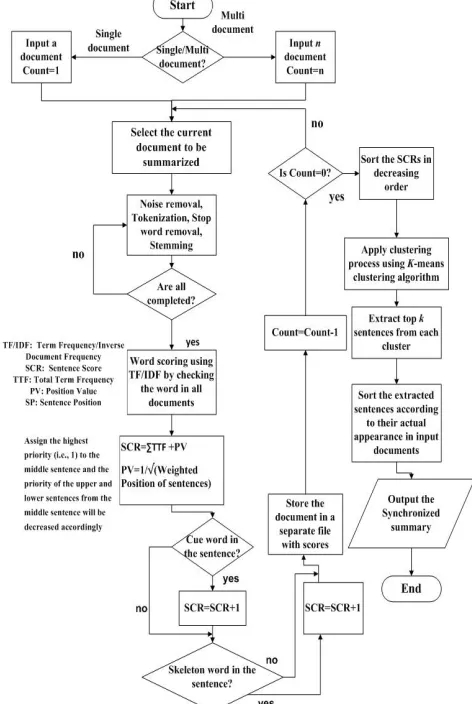
Consequently, an improvement of that Bengali summarization technique has been presented in this paper. In this proposed scheme, some heuristics for word and sentence scoring procedures along with a synchronizing technique to generate the final summary are presented. The same preprocessing steps such as noise removal, tokenization, stop word removal and stemming [24], [25] are used in this proposed approach as well. For calculating TF, each word is checked in all input documents to find its frequency. Then TF/IDF [15] is used finally to calculate the score of the word. On the other hand, the middle sentence has been given the highest priority for the sentence scoring phase and the upper and lower sentences from the middle sentence will be less prioritized. The middle sentence has been given the highest priority based
[image:3.612.324.560.184.536.2]on the heuristics that it can often be the most important sentence in the input document. Then, the score of each sentence is calculated by the total sum of the words’ scores [23]. Moreover, if the sentence contains any cue or skeleton word, then its score is increased by 1 [23]. After that, the document is stored in a separate file with the sentences’ scores.
Figure 1: Flowchart of improved extractive Bengali document(s) summarization technique
3478 get the summary. Here, k sentences can be measured as 10-40% of total sentences of the original document(s). Finally, the sentences in the generated summary are sorted as their actual appearances in the original document(s) to offer the
synchronization with the original input
document(s). The discussed working steps of the proposed improved summarization technique are illustrated in the following flowchart of Fig. 1.
The proposed extractive text
summarization technique is further discussed here in step-by-step:
2.1 Preprocessing
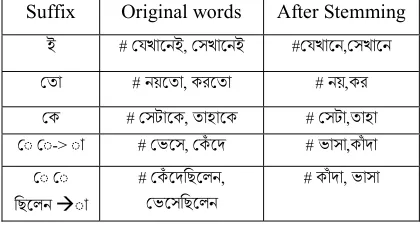
The operations performed in this step are noise removal, tokenization, stemming and stop word removal. Noise removal is involved with removing header, footer, etc., from the document. Tokenization separates each word into lexical form. Words are separated with the aid of কমা, দাঁিড় etc. A word can be found in different forms in the same document. Stemming means the Bengali words need to be converted to their original form for simplicity. The stemming algorithm is used to transform words to their canonical forms, like
অনু ানেক, অনু ােনর, অনু ােনও, অনু ােন etc. should be
converted to their original form অনু ান. The rules for stemming any word are discussed in [24], [25] in detail. In the proposed technique, the following rules for stemming any Bengali word are used:
i. X # When X appears at the end of a word, remove it. ii. Y Z # When Y appears at the end of a word,
replace it with Z
[image:4.612.89.299.570.686.2]iii. Y.Z A.B # When Y, followed by some character a, followed by Z or # appears at the end of a word, replace with AaB
Table 1: Examples of Bengali word stemming.
Suffix Original words After Stemming
ই # যখােনই, সখােনই # যখােন, সখােন
তা # নয়েতা, করেতা # নয়,কর
ক # সটােক, তাহােক # সটা,তাহা
◌ ◌-> ◌া # ভেস, েদ # ভাসা,কাঁদা
◌ ◌
িছেলন ◌া
# েদিছেলন, ভেসিছেলন
# কাঁদা, ভাসা
Let’s see an example: সািজদকাজকরেছ. After stemming, it will beসািজদকাজকর. Some examples ar eshown in Table 1. Consider the words #েযখােনই,
সখােনই since ই, ক, তা appear at the end of any word,
they are removed from the original word (according to the rule#01). For #েমেত, যেচ since ◌, ◌ appear at the end of a word, they are replaced with ◌া
(according to the rule#02). Again for #ে েদিছেলন,
ভেসিছেলন since ◌, ◌ িছেলন appear at the end of a
word, they are replaced with and will be #কাঁদা, ভাসা (according to the rule#03).
2.2 Scoring Procedure
For word score calculation, TF/IDF approach is used. If there are more unique words in a given sentence, then the sentence is relatively more important [23]. In this technique, the number of times that each word occurs in all documents is considered for the calculation of its score. The TF/IDF to calculate the word score is defined as follows:
TF= tfwi,s∗idfwi (1)
idfwi =log ( +1) (2)
Where, TF=Term Frequency, tfwi,s
=Number of occurrences of the word i in the sentence S, idfwi =Inverse document frequency,
N=Total number of the sentences in the text and ni =Number of sentences of all documents in which word wi occurs. Now, the sentence score (SC) is found as:
SCCHK=∑TF + PV (3)
PV =
√ (4) Here, 𝑆𝑝 = Position of the sentences and
PV =Position value. In this case of PV, we have updated the existing assignment mechanism. In the proposed technique, we have assigned the highest priority (i. e., 1) to the middle sentence and the priority of the upper and lower sentences from the middle sentence will be decreased accordingly. 2.3 Generation of Synchronized Summary
3479 values, the average values of each cluster are calculated and assigned them as new centroids. This process is repeated until two consecutive iterations produce the same result. Then, top k
sentences are extracted from each cluster to generate the summary. Moreover, extracted k -sentences from each cluster are sorted according to their actual appearance in the original documents.
In t his way, the generated summary is
synchronized with the original document(s).
3. EXPERIMENT AND RESULT ANALYSIS
For experimental result analysis, let us consider two speech documents to be summarized. Among which the first document can be found at [27] while the second document can be found at [27] which are also place below.
1st Document:
মাননীয় অধ মেহাদয়, ে য় িশ কম লী, অিভভাবকবৃ
এবং ীিতভাজন নবাগত ও সতীথ িশ াথ ভাইেবানসবার িত রইল —
আমার সালাম ও েভ া।আমােদর এ ঐিতহ বাহী িশ া িত ান আজ নতুন ােণর েশ ি ত ও আন িহে ােল মুখিরত। নবাগত িশ াথ ভাই ও বােনরা, ু েলর গি পিরেয় তামরা এেসছ আমােদর কেলেজর আিঙনায়, ছা গি পিরেয় মু ােনর আেলায়, উ তর িশ া অজেনর
াথিমক ে । তামােদর সবার িত রইল আমার আ িরক উ
অিভন ন ও েভ া।নবাগত ভাই ও বােনরা, তামরা জেন খুিশ হেব য এই অ েলর মেধ আমােদর এ িত ান নানা িদক থেক গৗরেবা ল ঐিতেহ র অিধকারী। এক মহান ত ধারণ কের আেছ এ পিব িবদ া ণ। যার
াগান হে িশ াই শি । িশ ার জন এেসা ‘—, সবার জন বিরেয়
যাও।আজ থেক তামােদর জন এটাই হাক জীবেনর মূলম । ’
আেলািকত জীবেন
র জন তামােদর স অিভযা া ভ হাক , সু র
হাক।ব ু রা, তামরা জেন খু◌ুিশ হেব য আমােদর এ কেলজ থেকই অতীেত পড়ােলখা কের ানী ণী পি ত িহেসেব দেশ ও আ জািতক ে সুনাম অজন কেরেছন অেনেক। ডা ার, েকৗশলী, রাজনীিতক, সািহিত ক, সাংবািদক িহেসেব এ িত ােনর অেনক িশ াথ ই পরবত জীবেন িত া লাভ কেরেছন সমােজ। তামরাও তােদর মেতাই দশ ও জািতর মুখ উ ল করেব।নবীন ব ু রা,আমােদর এ িশ ালেয়র দীঘিদেনর এক সুমহান ঐিতহ ও খ ািত রেয়েছ দশব াপী। এখানকার িশ াশৃ লা ,
-ছা িশ ক সুস ক , পরী ায় ঈষণীয় ফলাফল সারােদেশ আেলাড়ন সৃি
-কের িতবছরই। আজ তামরা যারা নতুন াণশি ও অিমত স াবনা িনেয় এখােন এেসছ, তামােদর সাদের বরণ কের িনেয় তামােদরেকও ঐিতহ র ার সুমহান দািয়ে অংশীদার করিছ। আশা কির, এ িত ােনর গৗরব বৃি েত তামরাও াণপণ চ া করেব।ব ু রা,এ িত ােন তামােদর
িশ াজীবন সফলসাথক ও গৗরবময় হাক। এখানকার িশ া িনেয় তামরা
-দশ -জািত ও িব মানবতার কল ােণ িনেয়ািজত হও। যৗবেনর আেলায়
আেলািকত হাক তামােদর ভুবনএই ত াশায় শষ করিছ । সবাইেক —
ধন বাদ, সবার জন ভকামনা।
2nd Document:
মাননীয় সভাপিত ও বেরণ অিতিথবৃ । আজেকর এই মহতী ও পূণ
আেলাচনা সভায় আমােক ধান অিতিথ িহেসেব স ািনত করার জন আিম আেয়াজকেদর জানাই কৃত তা।সুিধবৃ , য জািত িশি ত নয়, সই জািত উ িতর িশখের আেরাহণ করেত বাধা হয়। আজেকর িশ আগামী িদেনর ভিবষ । তারা যিদ অন সর থােক তাহেল জািত তার গিত হািরেয় ফলেব। তাই জািতেক উ িতর চরম িশখের আেরাহণ করেত হেল সই জািতর েত ক ব ি েক িশ ার আেলায় আেলািকত এবং িশি ত হেত হেব।ি য় িশ া অনুরাগী,আেলািকত মানুষ দশে ম, ধম য় মূল েবাধ, শৃ লা, িশ াচার, েমর মযাদা এবং বকারে র অিভশাপ থেক দশেক মু কের দশেক উ িতর পথ দখােত পাের।আেলািকত মানুষ গড়ার কাজ খুব সহজ নয়। ক এ মুহূেত একবার ভেব দখুন আেলািকত মানুেষর অভােব আমরা আজ কত িনেচ আিছ। ধু ািত ািনক িশ াই যথাথ িশ া নয়। এর সােথ িশ ায় জনগণেক িশি ত হেত হেব। আর আজেকর এই েচ া ধু একজনেক করেল অথবা এই অনু ােনর মাধ েম শষ হেয় গেল চলেব না, এর জন সরকার ও জনগণ সবাইেক এিগেয় আসেত হেব। সবাইেক এক
সােথ উ ারণ করেত হেব“— চেলা যাই পড়েত যাই, আেলািকত মানুষ
চাই ।”সবার সু , সু র জীবন কামনা কের, সবাইেক ধন বাদ জািনেয় আিম আমার ব ব শষ করিছ। ধন বাদ।
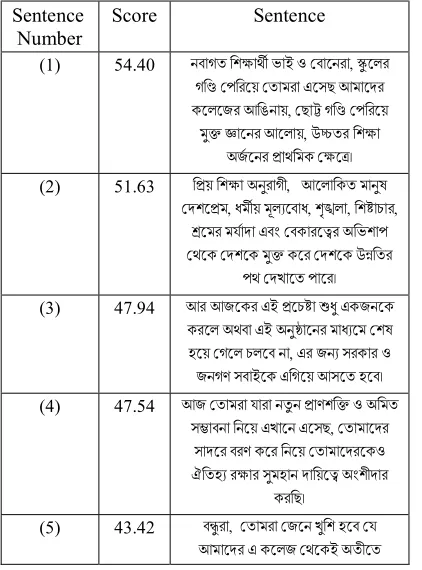
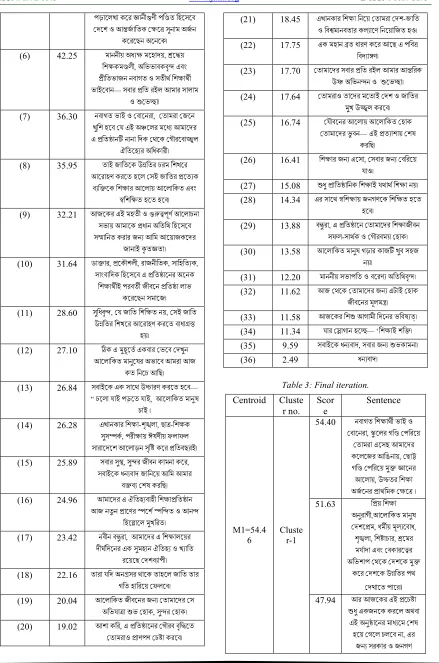
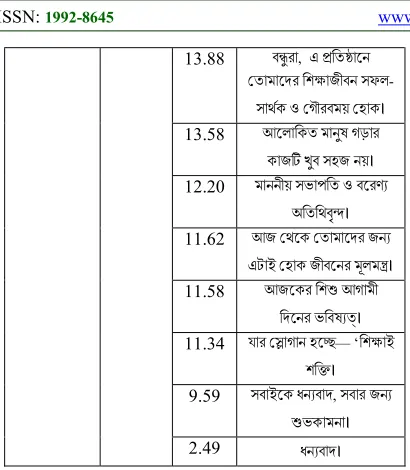
[image:5.612.315.526.452.737.2]Getting the sentences’ score of all documents using the improved scoring process, the scores with sentences have been stored in a merged file which is shown in Table 2. Then, K-means clustering algorithm has been applied with initial centroids as M1=54.40 and M2=2.49. As discussed earlier, the final iteration of the clustering algorithm is shown in Table 3.
Table 2: Merged file with sentence scores. Sentence
Number Score Sentence
(1) 54.40 নবাগত িশ াথ ভাই ও বােনরা, ু েলর গি পিরেয় তামরা এেসছ আমােদর কেলেজর আিঙনায়, ছা গি পিরেয়
মু ােনর আেলায়, উ তর িশ া অজেনর াথিমক ে । (2) 51.63 ি য় িশ া অনুরাগী, আেলািকত মানুষ
দশে ম, ধম য় মূল েবাধ, শৃ লা, িশ াচার, েমর মযাদা এবং বকারে র অিভশাপ থেক দশেক মু কের দশেক উ িতর
পথ দখােত পাের। (3) 47.94 আর আজেকর এই েচ া ধু একজনেক
করেল অথবা এই অনু ােনর মাধ েম শষ হেয় গেল চলেব না, এর জন সরকার ও জনগণ সবাইেক এিগেয় আসেত হেব। (4) 47.54 আজ তামরা যারা নতুন াণশি ও অিমত
স াবনা িনেয় এখােন এেসছ, তামােদর সাদের বরণ কের িনেয় তামােদরেকও ঐিতহ র ার সুমহান দািয়ে অংশীদার
করিছ।
3480 পড়ােলখা কের ানী ণী পি ত িহেসেব
দেশ ও আ জািতক ে সুনাম অজন কেরেছন অেনেক। (6) 42.25 মাননীয় অধ মেহাদয়, ে য়
িশ কম লী, অিভভাবকবৃ এবং ীিতভাজন নবাগত ও সতীথ িশ াথ ভাইেবান— সবার িত রইল আমার সালাম
ও েভ া।
(7) 36.30 নবাগত ভাই ও বােনরা, তামরা জেন খুিশ হেব য এই অ েলর মেধ আমােদর এ িত ান নানা িদক থেক গৗরেবা ল
ঐিতেহ র অিধকারী। (8) 35.95 তাই জািতেক উ িতর চরম িশখের
আেরাহণ করেত হেল সই জািতর েত ক ব ি েক িশ ার আেলায় আেলািকত এবং
িশি ত হেত হেব। (9) 32.21 আজেকর এই মহতী ও পূণ আেলাচনা
সভায় আমােক ধান অিতিথ িহেসেব স ািনত করার জন আিম আেয়াজকেদর
জানাই কৃত তা। (10) 31.64 ডা ার, েকৗশলী, রাজনীিতক, সািহিত ক,
সাংবািদক িহেসেব এ িত ােনর অেনক িশ াথ ই পরবত জীবেন িত া লাভ
কেরেছন সমােজ। (11) 28.60 সুিধবৃ , য জািত িশি ত নয়, সই জািত
উ িতর িশখের আেরাহণ করেত বাধা হয়।
(12) 27.10 ক এ মুহূেত একবার ভেব দখুন আেলািকত মানুেষর অভােব আমরা আজ
কত িনেচ আিছ। (13) 26.84 সবাইেক এক সােথ উ ারণ করেত হেব—
“ চেলা যাই পড়েত যাই, আেলািকত মানুষ চাই ।
(14) 26.28 এখানকার িশ া-শৃ লা, ছা -িশ ক সুস ক, পরী ায় ঈষণীয় ফলাফল সারােদেশ আেলাড়ন সৃি কের িতবছরই। (15) 25.89 সবার সু , সু র জীবন কামনা কের,
সবাইেক ধন বাদ জািনেয় আিম আমার ব ব শষ করিছ। (16) 24.96 আমােদর এ ঐিতহ বাহী িশ া িত ান
আজ নতুন ােণর েশ ি ত ও আন িহে ােল মুখিরত। (17) 23.42 নবীন ব ু রা, আমােদর এ িশ ালেয়র
দীঘিদেনর এক সুমহান ঐিতহ ও খ ািত রেয়েছ দশব াপী। (18) 22.16 তারা যিদ অন সর থােক তাহেল জািত তার
গিত হািরেয় ফলেব। (19) 20.04 আেলািকত জীবেনর জন তামােদর স
অিভযা া ভ হাক, সু র হাক। (20) 19.02 আশা কির, এ িত ােনর গৗরব বৃি েত
তামরাও াণপণ চ া করেব।
(21) 18.45 এখানকার িশ া িনেয় তামরা দশ-জািত ও িব মানবতার কল ােণ িনেয়ািজত হও। (22) 17.75 এক মহান ত ধারণ কের আেছ এ পিব
িবদ া ণ।
(23) 17.70 তামােদর সবার িত রইল আমার আ িরক উ অিভন ন ও েভ া। (24) 17.64 তামরাও তােদর মেতাই দশ ও জািতর
মুখ উ ল করেব। (25) 16.74 যৗবেনর আেলায় আেলািকত হাক
তামােদর ভুবন— এই ত াশায় শষ করিছ।
(26) 16.41 িশ ার জন এেসা, সবার জন বিরেয় যাও।
(27) 15.08 ধু ািত ািনক িশ াই যথাথ িশ া নয়। (28) 14.34 এর সােথ িশ ায় জনগণেক িশি ত হেত
হেব।
(29) 13.88 ব ু রা, এ িত ােন তামােদর িশ াজীবন সফল-সাথক ও গৗরবময় হাক। (30) 13.58 আেলািকত মানুষ গড়ার কাজ খুব সহজ
নয়।
(31) 12.20 মাননীয় সভাপিত ও বেরণ অিতিথবৃ । (32) 11.62 আজ থেক তামােদর জন এটাই হাক
জীবেনর মূলম । (33) 11.58 আজেকর িশ আগামী িদেনর ভিবষ । (34) 11.34 যার াগান হে — ‘িশ াই শি । (35) 9.59 সবাইেক ধন বাদ, সবার জন ভকামনা।
[image:6.612.92.531.81.744.2](36) 2.49 ধন বাদ।
Table 3: Final iteration. Centroid Cluste
r no. Scor
e
Sentence
M1=54.4
6 Cluster-1
54.40 নবাগত িশ াথ ভাই ও বােনরা, ু েলর গি পিরেয়
তামরা এেসছ আমােদর কেলেজর আিঙনায়, ছা গি পিরেয় মু ােনর আেলায়, উ তর িশ া অজেনর াথিমক ে । 51.63 ি য় িশ া
অনুরাগী,আেলািকত মানুষ দশে ম, ধম য় মূল েবাধ, শৃ লা, িশ াচার, েমর মযাদা এবং বকারে র অিভশাপ থেক দশেক মু
কের দশেক উ িতর পথ
দখােত পাের।
47.94 আর আজেকর এই েচ া ধু একজনেক করেল অথবা এই অনু ােনর মাধ েম শষ হেয় গেল চলেব না, এর
3481 সবাইেক এিগেয় আসেত
হেব।
47.54 আজ তামরা যারা নতুন াণশি ও অিমত স াবনা
িনেয় এখােন এেসছ, তামােদর সাদের বরণ কের িনেয় তামােদরেকও ঐিতহ র ার সুমহান দািয়ে
অংশীদার করিছ।
43.42 ব ু রা, তামরা জেন খু◌ুিশ হেব য আমােদর এ কেলজ থেকই অতীেত পড়ােলখা
কের ানী ণী পি ত িহেসেব দেশ ও আ জািতক ে সুনাম
অজন কেরেছন অেনেক।
42.25 মাননীয় অধ মেহাদয়, ে য় িশ কম লী, অিভভাবকবৃ এবং ীিতভাজন নবাগত ও সতীথ িশ াথ ভাইেবান— সবার
িত রইল আমার সালাম ও েভ া। 36.30 নবাগত ভাই ও বােনরা,
তামরা জেন খুিশ হেব য এই অ েলর মেধ আমােদর এ
িত ান নানা িদক থেক গৗরেবা ল ঐিতেহ র
অিধকারী।
35.95 তাই জািতেক উ িতর চরম িশখের আেরাহণ করেত হেল
সই জািতর েত ক ব ি েক িশ ার আেলায় আেলািকত
এবং িশি ত হেত হেব।
32.22 আজেকর এই মহতী ও পূণ আেলাচনা সভায় আমােক ধান অিতিথ িহেসেব স ািনত করার জন আিম আেয়াজকেদর জানাই
কৃত তা।
31.64 ডা ার, েকৗশলী, রাজনীিতক, সািহিত ক,
সাংবািদক িহেসেব এ িত ােনর অেনক িশ াথ ই পরবত জীবেন িত া লাভ
কেরেছন সমােজ।
28.60 সুিধবৃ , য জািত িশি ত নয়, সই জািত উ িতর িশখের আেরাহণ করেত
বাধা হয়। 27.19 ক এ মুহূেত একবার ভেব
দখুন আেলািকত মানুেষর অভােব আমরা আজ কত
িনেচ আিছ।
26.84 সবাইেক এক সােথ উ ারণ করেত হেব—“ চেলা যাই
পড়েত যাই, আেলািকত
মানুষ চাই ।
26.28 এখানকার িশ া-শৃ লা, ছা -িশ ক সুস ক, পরী ায় ঈষণীয় ফলাফল সারােদেশ আেলাড়ন সৃি
কের িতবছরই।
25.89 ” সবার সু , সু র জীবন কামনা কের, সবাইেক ধন বাদ জািনেয় আিম আমার
ব ব শষ করিছ।
24.96 আমােদর এ ঐিতহ বাহী িশ া িত ান আজ নতুন
ােণর েশ ি ত ও
আন িহে ােল মুখিরত।
23.42 নবীন ব ু রা, আমােদর এ িশ ালেয়র দীঘিদেনর এক
সুমহান ঐিতহ ও খ ািত
রেয়েছ দশব াপী।
22.16 তারা যিদ অন সর থােক তাহেল জািত তার গিত
হািরেয় ফলেব।
20.04 আেলািকত জীবেনর জন তামােদর স অিভযা া ভ
হাক, সু র হাক।
19.02 আশা কির, এ িত ােনর গৗরব বৃি েত তামরাও াণপণ চ া করেব।
18.45 এখানকার িশ া িনেয় তামরা দশ-জািত ও িব মানবতার কল ােণ িনেয়ািজত হও।
17.75 এক মহান ত ধারণ কের
আেছ এ পিব িবদ া ণ।
17.70 তামােদর সবার িত রইল আমার আ িরক উ
অিভন ন ও েভ া।
M2=27.4 3
Cluste r-2
17.64 তামরাও তােদর মেতাই দশ ও জািতর মুখ উ ল
করেব।
16.74 যৗবেনর আেলায় আেলািকত হাক তামােদর ভুবন— এই
ত াশায় শষ করিছ।
16.41 িশ ার জন এেসা, সবার
জন বিরেয় যাও।
15.08 ধু ািত ািনক িশ াই
যথাথ িশ া নয়।
14.34 এর সােথ িশ ায় জনগণেক
3482
13.88 ব ু রা, এ িত ােন তামােদর িশ াজীবন
সফল-সাথক ও গৗরবময় হাক।
13.58 আেলািকত মানুষ গড়ার
কাজ খুব সহজ নয়।
12.20 মাননীয় সভাপিত ও বেরণ
অিতিথবৃ ।
11.62 আজ থেক তামােদর জন
এটাই হাক জীবেনর মূলম ।
11.58 আজেকর িশ আগামী
িদেনর ভিবষ ।
11.34 যার াগান হে — ‘িশ াই
শি ।
9.59 সবাইেক ধন বাদ, সবার জন
ভকামনা।
2.49 ধন বাদ।
To this end, after extracting top 5 (k) sentences from each cluster, the sentences are sorted according to their actual appearance in the original input documents. The finally synchronized summary generated using the IDE for Java application, “Netbeans IDE 8.0”, running on a 2.50 GHz Intel® core™ i5 CPU having 4GB RAM with Windows 7 ultimate operating system, which contains 10 sentences, is shown below:
নবাগত িশ াথ ভাই ও বােনরা, ু েলর গি পিরেয়
তামরা এেসছ আমােদর কেলেজর আিঙনায়, ছা গি পিরেয়
মু ােনর আেলায়, উ তর িশ া অজেনর াথিমক ে । ি য়
িশ া অনুরাগী, আেলািকত মানুষ দশে ম, ধম য় মূল েবাধ,
শৃ লা, িশ াচার, েমর মযাদা এবং বকারে র অিভশাপ থেক
দশেক মু কের দশেক উ িতর পথ দখােত পাের । ব ু রা,
তামরা জেন খুিশ হেব য আমােদর এ কেলজ থেকই অতীেত
পড়ােলখা কের ানী ণী পি ত িহেসেব দেশ ও আ জািতক
ে সুনাম অজন কেরেছন অেনেক । আর আজেকর এই েচ া
ধু একজনেক করেল অথবা এই অনু ােনর মাধ েম শষ হেয় গেল
চলেব না, এর জন সরকার ও জনগণ সবাইেক এিগেয় আসেত হেব ।
আজ তামরা যারা নতুন াণশি ও অিমত স াবনা িনেয় এখােন
এেসছ, তামােদর সাদের বরণ কের িনেয় তামােদরেকও ঐিতহ
র ার সুমহান দািয়ে অংশীদার করিছ । সুিধবৃ , য জািত িশি ত
নয়, সই জািত উ িতর িশখের আেরাহণ করেত বাধা হয় । ক
এ মুহূেত একবার ভেব দখুন আেলািকত মানুেষর অভােব আমরা
আজ কত িনেচ আিছ । সবাইেক এক সােথ উ ারণ করেত হেব—“
চেলা যাই পড়েত যাই, আেলািকত মানুষ চাই ।” সবার সু , সু র
জীবন কামনা কের, সবাইেক ধন বাদ জািনেয় আিম আমার ব ব
শষ করিছ । এখানকার িশ া-শৃ লা, ছা -িশ ক সুস ক, পরী ায়
ঈষণীয় ফলাফল সারােদেশ আেলাড়ন সৃি কের িতবছরই ।
However, the summary of the two documents using the existing summarization technique can be found at [24]. It is clearly seen that the summary of the same two documents produced by the improved summarization technique can satisfy the end-users more than the summary produced by the existing technique. Thus, the summary produce by the proposed technique can carry more meanings than that of the existing technique.
3.1 Comparative Discussion
[image:8.612.92.297.70.305.2]The presented extractive Bengali text summarization is implemented in several ways through varying the proposed parameters for word and sentence scoring on its preceding technique to measure the effectiveness. In the variants of the proposed method, the newly added aforementioned two heuristics (one is called position value heuristics and the other is for word scoring heuristics) and the synchronization scheme are taken or not for the different combinations as shown in Table 4. As an instance for variant 6, the position value heuristics for sentence scoring and the synchronization strategy have been updated in comparson to its preceeding existing method while the word scoring heuristics is remained unchanged.
Table 4: Variants of the proposed technique.
Position value Heuristics
Word Score Heuristics
Synchro nization scheme
Variation of Proposed
Method (PM)
No (unchanged)
No No Original
Yes (changed)
No No Variant 1
No Yes No Variant 2
No No Yes Variant 3
Yes Yes No Variant 4
No Yes Yes Variant 5
Yes No Yes Variant 6
Yes Yes Yes Variant 7
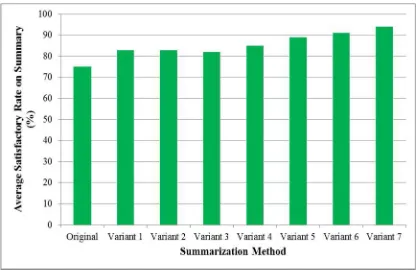
3483 original method and the different variants of the proposed technique. From the produced results of the summarization technique, the variants of the proposed technique can strikingly produce different summary than the original method. Morever, the summary produced by the variant 7 can carry more meanings than that of the others variants satisfying the users rigorously. However, a questionnaire has been conducted among different 100 Bengali native people to get the feedback on the different summaries produced by the variants of the presented method. For validation of the proposed method, the feedback (average satisfactory rate on the summary) on the 8 different summaries for the considered input documents is shown in the following graph:
Fig. 2. End-user feedback (average satisfactory rate on the summaries)) by the existing and proposed methods
In this way, from the above graph it can also be observed that the summary variant 7 can satisfy the user more (94% in average) than the others. In another words, it has been established that the proposed two heuristics for calculating word and sentence scores and synchronized
summary make-up procedure for Bengali
documents can successfully be employed for real-life summary generation.
4. CONCLUSION
In this paper, an improved extraction based Bengali text summarization technique is presented for both single and multiple documents. The proposed extractive text summarization provides the summary where some more significant sentences are extracted from the original document(s). The effectiveness of the proposed technique is improved in comparison to the existing solutions because of using two heuristics for the word and sentence scoring processes along with a new technique for generating synchronized
summary. In particular, K-means algorithm is used for making groups of related sentences. Then, from the group of sentences, the top-most meaningful sentences are selected and they are sorted as their actual appearance in the original document(s). In this way, the final summary is synchronized with the original document(s). The result is compared with existing technique and obtained the better users’ satisfaction on the generated summary. According to the result of the proposed technique, it can be concluded that it reduces the redundancy and provides better summarization of Bengali text document(s).
REFRENCES:
[1] E. Turban, J. E. Aronson, T.-P. Liang and R. Sharda, Decision Support and Business Intelligence Systems. 8th Edition, Prentice-Hall, Inc., USA 2006.
[2] S. A. Babar, “Text Summarization: An Overview”, Technical Notes, M.Tech-CSE, RIT.
[3] H. Dave and S. Jaswal, “Multiple Text Document Summarization System using Hybrid Summarization Technique”, 1st
International Conference on Next Generation Computing Technologies, pp. 804-808, September 2015, India.
[4] A. Khan and N. Salim, “A Review on
Abstractive Summarization Methods”,
Journal of Theoretical and Applied Information Technology, Vol. 59, No.1, pp. 64-72, 2014.
[5] S. Patil and R. Joshi, “Enrich Framework for Multi-Document Summarization Using Text Features and Fuzzy Logic”, Journal of Theoretical and Applied Information Technology, Vol.88. No.3, pp. 431-437, 2016. [6] A. Elrefaiy, A. R. Abas and I. Elhenawy, “Review of Recent Techniques for Extractive Text Summarization”, Journal of Theoretical and Applied Information Technology, Vol. 96. No. 23, pp. 7739-7759, 2018.
[7] S. Jusoh, “A Study on NLP Applications and Ambiguity Problems”, Journal of Theoretical and Applied Information Technology, Vol. 96. No. 6, pp. 1486-1499, 2018.
[8] P. B. Tumpa, S. Yeasmin, A. M. Nitu, M. P. Uddin, M. I. Afjal and M. A. A. Mamun, “An
Improved Extractive Summarization
3484
Electronic Engineering (IC4ME2), 8-9 February 2018, Bangladesh.
[9] S. Yeasmin, P. B. Tumpa, A. M. Nitu, M. P. Uddin, E. Ali and M. I. Afjal, “Study of Abstractive Text Summarization Techniques”,
American Journal of Engineering Research (AJER), Vol. 06, Issue. 8, pp. 253-260, 2017. [10] A. S. Asa, S. Akter, M. P. Uddin, M. D.
Hossain, S. K. Roy and M. I. Afjal, “A Comprehensive Survey on Extractive Text
Summarization Techniques”, American
Journal of Engineering Research (AJER), Vol. 06, Issue. 1, pp. 200-205, 2017.
[11] N. R. Kasture, N. Yargal, N. Singh, N. Kulkarni and V. Mathur, “A Survey on Methods of Abstractive Text Summarization”,
International Journal for Research in Emerging Science and Technology, Vol. 1, Issue. 6, 2014.
[12] V. Gupta and G. S. Lehal, “A Survey of Text
Summarization Extractive Techniques”,
Journal of Emerging Technologies in Web Intelligence, Vol. 2, No. 3, pp. 258-268, 2010. [13] J. Zhang, L. Sun and Q. Zhou, “Cue-based Hub-Authority approach for Multi- document
Text Summarization”, International
Conference on Natural Language Processing and Knowledge Engineering, pp. 642 – 645, 2005, Beijing.
[14] Y. Ouyang, W. Li and Q. Lu , “An Integrated Multi-document Summarization Approach based on Word Hierarchical Representation” ,
ACLShort '09 Proceedings of the ACL-IJCNLP 2009 Conference Short Papers, pp. 113-116, 2009, China.
[15] X. Li, J. Zhang and M. Xing, “Automatic Summarization for Chinese text based on Sub Topic Partition and Sentence Features”, IEEE 2nd International Symposium on Intelligence
Information Processing and Trusted Computing, 22-23 October 2011, China. [16] P. Hu, T. He and H. Wang, “Multi-View
Sentence Ranking for Query-Biased
Summarization”, International Conference on Computational Intelligence and Software Engineering (CiSE), 2010, China.
[17] K. Sarkar, “Sentence Clustering-based Summarization of Multiple Text Documents”
TECHNIA–International Journal of Computing Science and Communication Technologies, Vol. 2, No. 1, pp. 325-335, 2009.
[18] A. Kogilavani, and P. Balasubramani, “Clustering and Feature specific sentence
extraction based summarization of
multidocuments”, International Journal of Computer Science & Information Technology,
Vol.2, No.4, pp. 99-111, 2010.
[19] T. J. Siddiqui and V. K. Gupta, “Multi-document Summarization using Sentence Clustering”, IEEE Proceedings of 4th International Conference on Intelligent Human Computer Interaction, 27-29 December 2012, India.
[20] A. R. Deshpande and L. M. R. J. Lobo, “Text Summarization using Clustering Technique”,
International Journal of Engineering Trends and Technology,Vol. 4, Issue. 8, pp. 3348-3351, 2013.
[21] A. Agrawal and U. Gupta, “Extraction based approach for text summarization using k-means clustering”, International Journal of Scientific and Research Publications, Vol. 4, Issue. 11, pp. 1-4, 2014.
[22] M. A. Uddin, K. Z. Sultana and M. A. Alom, “A Multi-Document Text Summarization for Bengali Text”, IEEE International Forum on Strategic Technology (IFOST), 2014, Bangladesh.
[23] M. I. A. Efat, M. Ibrahim and H. Kayesh, “Automated Bangla Text Summarization by
Sentence Scoring and Ranking”, IEEE
International Conference on Informatics, Electronics & Vision (ICIEV), 2013, Bangladesh.
[24] S. Akter, A. S. Asa, M. P. Uddin, M. D. Hossain, S. K. Roy and M. I. Afjal, "An Extractive Text Summarization Technique for
Bengali Document(s) Using K-Means
Clustering Algorithm", IEEE International Conference on imaging, vision & pattern recognition (icVPR), 2017, Bangladesh. [25] R. Kamal, “Bangla-Stemmer”, [Online].
Available:
https://github.com/rafi-kamal/Bangla-Stemmer, 14 Nov 2018. [26] A. Mhatre, “Implementation of K-Means
Algorithm in C++”, [Online]. Available: http://ankurm.com/implementation-of-k-means-algorithm-in-c/, 15 May 2018.
[27] . , “নবাগত ছা ছা ীেদর
উে েশ এক ভাষণ”, [Online]. Available:
https://archive1.ittefaq.com.bd/print-edition/aunoshilon/2015/05/17/49193_print.ht ml, 17 May 2018.
[28] আহনাফ রাতুল, “ হেয়েছ দেশর সবচাইেত বড় আইিস
ইেভ - িডিজটাল ওয়া ২০১৬”, [Online].
3485 [29] Anandabazar Patrika, "বাংলােদশর সেবেচয় বড় যুি
মলা ‘িডিজটাল ওয়া -২০১৬’”, [Online]. Available: