IJPSR (2014), Vol. 5, Issue 4 (Research Article)
Received on 28 October, 2013; received in revised form, 22 January, 2014; accepted, 24 March, 2014; published 01 April, 2014
ANALYTICAL METHOD DEVELOPMENT AND VALIDATION FOR SIMULTANEOUS ESTIMATION OF HYDRALAZINE, ISOSORBIDE DINITRATE IN BULK AND TABLET FORMULATION BY RP-HPLC
K. Neelima*1 and Y. Rajendra Prasad 2
Department of Chemistry, Sarojini Naidu Vanitha Pharmacy Mahavidyalaya 1, Hyderabad-500001, Andhra Pradesh, India
Department of Pharmaceutical Chemistry, Andhra University College of Pharmaceutical Sciences 2, Peda Waltair, Visakhapatnam- 530003, Andhra Pradesh, India
ABSTRACT: A simple, sensitive, linear, precise and accurate
RP-HPLC method for simultaneous estimation of Hydralazine, Isosorbide dinitrate in bulk and tablet formulation was developed and validated. The chromatographic separation of the three drugs was achieved on Zodiac C18 (250 mm 4.6 mm) 5µ column in an isocratic mode. The mobile phase consisting of 0.01M 0.01 M Ammonium acetate : Acetonitrile : Methanol in the ratio of 50:30:20 v/v and pH adjusted to 3 using ortho phosphoric acid was delivered at a flow rate of 1ml/ min and effluents were monitored at 270 nm. The retention time of Hydralazine, Isosorbide Dinitrate was found to be 2.337 and 3.413 min, respectively. Calibration curves were linear with a correlation coefficient of 0.994 for HYD , and 0.997 for ISD over the concentration range of 45-105µg/ml for HYD, and 24-56 µg/ml for ISD and precise with (%RSD<2). The method was validated as per the ICH guidelines and can be employed for routine quality control analysis.
INTRODUCTION: Chemically, Isosorbide
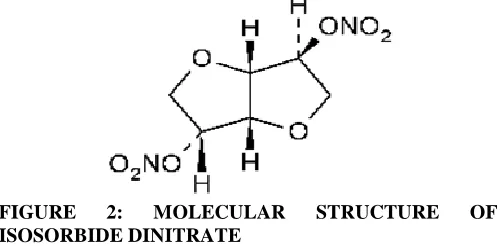
dinitrate is known as 1,4:3,6-dianhydro-2,5-di-O-nitro-D-glucitol or (3R,3aS,6S,6aS)-6-(nitrooxy)-hexahydrofuro[3,2-b]furan-3-yl nitrate 1 (Figure 1). Isosorbide Dinitrate is a moderate to long acting oral organic nitrate which acts as a vasodilator profoundly used in the treatment of angina pectoris, a condition which occurs when the oxygen supply to the myocardium is insufficient for its needs.
QUICK RESPONSE CODE
DOI:
10.13040/IJPSR.0975-8232.5(4).1290-94
Article can be accessed online on: www.ijpsr.com
DOI link: http://dx.doi.org/10.13040/IJPSR.0975-8232.5(4).1290-94
The vasodilating action of Isosorbide dinitrate is through the relaxing action in blood vessels of nitrates, particularly nitric oxide. This will decrease the oxygen demand of the heart and preventing chest pain 2.
Hydralazine, 1-hydrazinylphthalazine (Figure 2) is a direct-acting smooth muscle relaxant. It is used as
an antihypertensive agent in cases like
preeclampsia (a condition in pregnancy
characterized by high blood pressure). Hydralazine
acts by increasing cyclic guanosine
mono-phosphate (cGMP) levels which causes an increase in the activity of protein kinase G (PKG). Active PKG adds an inhibitory phosphate to myosin light-chain kinase which is a protein involved in the activation of cross-bridge cycling (i.e. contraction)
Keywords:
Hydralazine, Isosorbide dinitrate, RP-HPLC, Validation
Correspondence to Author:
Mrs. Neelima Kudumula
Department of Chemistry, Sarojini Naidu Vanitha Pharmacy
Mahavidyalaya, Exhibiton grounds, Nampally, Hyderabad-500001, Andhra Pradesh, India
E-mail:
in smooth muscle. This results in blood vessel relaxation and causes dilation of arteries and arterioles. It also functions as an antioxidant. It inhibits membrane-bound enzymes that form reactive oxygen species, such as superoxides. Excessive superoxide counteracts nitric oxide-induced vasodilation 3, 4.
Isosorbide dinitrate and Hydralazine in
combination are used with other medications to treat heart failure. As both the drugs are
vasodilators they work by relaxing and
widening blood vessels so blood can flow more easily to the heart.
Literature survey reveals that few analytical methods were reported for determination of Isosorbide dinitrate and Hydralazine individually. Gas chromatography 5 and HPLC 6 methods were
reported for Isosorbide dinitrate and
spectrophotometric methods 7-9, electrochemical determination 10 and HPLC 11 methods were reported for Hydralazine alone in pharmaceutical products.
However, no method is reported for simultaneous estimation of these two drugs by reverse phase HPLC in combined dosage form.
MATERIALS AND METHODS:
Chemicals and reagents: The reference samples
of HYD, ISD were provided by Dr. Reddy labs,
Hyderabad. Tablet used for analysis was
ISOLAZINE (Label claim: HYD 75mg, ISD 40
mg) is procured from the local market. Acetonitrile, methanol, and water used were of HPLC grade.
[image:2.612.315.565.46.169.2]Potassium dihydrogen phosphate used is of Analytical grade.
FIGURE 1: MOLECULAR STRUCTURE OF
HYDRALAZINE
FIGURE 2: MOLECULAR STRUCTURE OF
ISOSORBIDE DINITRATE
Instrument and Chromatographic conditions:
The liquid chromatographic system consisted of Shimadzu, Pump (LC-10AT), fitted with UV-Visible detector (SPD-20A) with manual injector. The chromatogram was recorded using Spinchrome software. HPLC separations were carried out on Zodiac C18 (250 mm 4.6 mm i.d.) packed with 5 µ diameter particles. The mobile phase was a mixture of 0.01 M Ammonium acetate, Acetonitrile and Methanol in the ratio of 50:30:20 v/v and pH adjusted to 3 using ortho phosphoric acid. The aqueous phase consisted of 0.01 M Ammonium acetate buffer, pH of the aqueous phase was adjusted to 3 with orthophosphoric acid and filtered through 0.45μm membrane filter and degassed before use. The flow rate was 1 ml/ min. The detection wavelength was set at 270 nm. The injection volume was 20 µl.
Preparation of Buffer for mobile phase:
Weighed 3.85gm of Ammonium acetate into a 1000 ml beaker added 2 ml of triethylamine, dissolved and diluted to 1000 ml with HPLC water. The pH was adjusted to 3 with orthophosphoric acid and filtered through 0.45μm membrane filter and degassed.
Preparation of Mobile Phase: Mixed a mixture of
0.01 M Ammonium acetate buffer 500 ml (50%) and 300 ml of Acetonitrile (30%) and 200 ml methanol (20%) of HPLC grade, and degassed in ultrasonic water bath for 15 minutes, filtered through 0.45μm membrane filter.
Diluent Preparation: Mobile phase is used as
diluents.
Preparation of Standard Solution: Stock
About 70 ml of the mobile phase was added and sonicated to dissolve the drugs completely. The volume was made upto 100 ml with the mobile phase and filtered through 0.45 µm membrane filter. From the above prepared standard stock solution, 5 ml was taken to 50 ml volumetric flask and the volume was made up with the mobile phase to obtain a concentration of 75 µg/ml and 40 µg/ml for HYD and ISD respectively.
Preparation of Sample Solution: Twenty tablets
of Isolazinewere weighed and powdered. Powder weight equivalent to 75 mg of HYD and 40 mg of ISD was weighed and transferred into a 100 ml clean dry volumetric flask. About 70 ml of the mobile phase was added and sonicated to dissolve the drugs completely. The volume was made upto 100 ml with the mobile phase and filtered through 0.45 µm membrane filter. From the above prepared standard stock solution, 5 ml was taken to 50 ml volumetric flask and the volume was made up with the mobile phase to obtain a concentration of 75 µg/ml and 40 µg/ml for HYD and ISD respectively
Method Validation: The proposed method was
validated in compliance with ICH guidelines for
linearity, accuracy, precision, selectivity, sensitivity, robustness, and system suitability parameters by the following procedures.
Linearity: Linearity of developed HPLC method
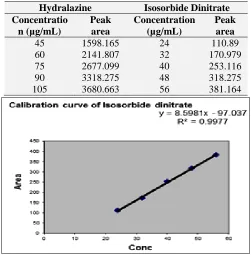
was studied by obtaining calibration curves of HYD, ISD at six different concentration levels in triplicate ranging from 45-105 µg/ml for HYD, and 24-56 µg/ml for ISD. Table 1 shows the linearity data of HYD and ISD. The linearity regression co-efficient (R2) values were found to be 0.999 and 0.999 for HYD, ISD each. Linearity equation obtained for HYD, ISD were y = 35.61x+12.47, and y = 8.598x-97.03 respectively. Figure 3 and 4
shows calibration curves for HYD, ISD
respectively. High level of correlation coefficient indicates good linearity.
TABLE 1: LINEARITY DATA OF HYDRALAZINE, ISOSORBIDE DINITRATE
Hydralazine Isosorbide Dinitrate Concentratio
n (µg/mL)
Peak area
Concentration (µg/mL)
Peak area
45 1598.165 24 110.89 60 2141.807 32 170.979 75 2677.099 40 253.116 90 3318.275 48 318.275 105 3680.663 56 381.164
FIGURE 3: CALIBRATION CURVE OF HYDRALAZINE FIGURE 4: CALIBRATION CURVE OF ISOSORBIDE
DINITRATE
Accuracy: The accuracy of the developed method
was evaluated in triplicates by recovery studies at three different concentration levels of 80%, 100 %, and 120% for HYD, ISD respectively. Known amounts of standard drug concentrations were
added to the sample and peak area was determined. The mean percentage recovery values are shown in
Table 2. The mean recovery of the drugs was
[image:3.612.313.564.305.560.2]found to be in the range of 99- 101% indicating a high degree of accuracy for the developed method.
TABLE 2: ACCURACY RESULTS
Drugs Conc. Amount Present Amount Spiked Conc. after spiking % recovery Mean
HYD
80 % 60 μg/ml 15 μg/ml 75 μg/ml 100.49
100.02 100% 75 μg/ml 15 μg/ml 90 μg/ml 100.83
120% 90 μg/ml 15 μg/ml 105 μg/ml 98.75
ISD
80 % 32 μg/ml 8 μg/ml 40 μg/ml 99.29
99.67 100% 40 μg/ml 8 μg/ml 48 μg/ml 100.72
[image:3.612.48.295.413.560.2] [image:3.612.54.560.673.762.2]Precision: The precision at 100 % concentration of the assay method was evaluated by six replicate injections and measurement of peak areas by determining the % RSD of Hydralazine, ISD. The calculated values of % RSD for HYD and ISD are mentioned in Table 3. The results indicated a high degree of repeatability.
TABLE 3: RESULTS FOR PRECISION
Injection Hydralazine
Isosorbide Dinitrate
RT Area RT Area
1 2.337 2767.579 3.413 222.354
2 2.273 2728.926 3.323 222.081
3 2.26 2710.928 3.303 221.739
4 2.273 2728.926 3.323 222.081
5 2.24 2700.010 3.270 210.357
6 2.233 2689.708 3.260 218.775
Average 2.2693 2721.013 3.315 219.565
STD 0.0371 27.628 0.055 4.703
%RSD 0.93 1.02 0.98 1.45
Selectivity: Selectivity test determines the effect of
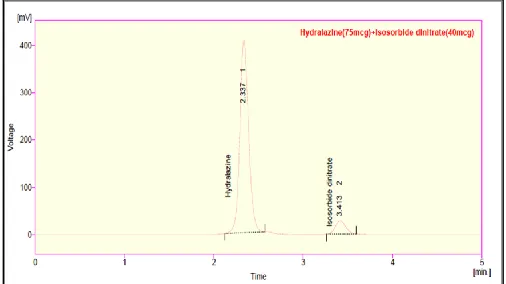
excipients on the assay result. To determine the selectivity of the method, standard sample of HYD, and ISD were injected first. Then commercial product, blank solutions were run in the instrument one after another. The results of the tests proved that the components other than the drug did not produce a detectable signal at the retention time of HYD, and ISD as shown in Figure 5 and 6.
FIGURE 5: CHROMATOGRAM OF PLACEBO TABLET
FIGURE 6: CHROMATOGRAM SHOWING PEAKS OF HYDRALAZINE AND ISOSORBIDE DINITRATE
LOD and LOQ: LOD and LOQ for HYD, ISD by
this method were evaluated on the basis of signal-to-noise ratio method described in ICH guidelines. A signal-to-noise ratio between 3 or 2:1 is generally considered acceptable for estimating the detection limit. A typical signal-to-noise ratio required for LOQ is 10:1.Using the proposed HPLC method, the LOD and LOQ values were calculated and are given in Table 4.
TABLE 4: LOD AND LOQ VALUES OF HYD AND ISD
HYD ISD
LOD(μg/mL) 2.20 μg/ml 4.89 μg/ml
LOQ(μg/mL) 6.66 μg/ml 14.83 μg/ml
Robustness: To evaluate the robustness of the
developed RP-HPLC method, small deliberate variations in the optimized parameters were made in chromatographic conditions like of flow rate and wavelength.
The effect of change in flow rate and wavelength of detection on retention time and tailing factor were examined. The values obtained are mentioned in
Table 5. The method was found to be unaffected
by the small changes like ± 0.2 ml/min in flow-rate of mobile phase and ± 2 nm in detection wavelength.
TABLE 5: RESULTS OF ROBUSTNESS BY VARIATIONS IN FLOW RATE AND WAVELENGTH
Parameters Value HYD ISD
RT TF RT TF
Flow-rate 0.8 ml/min 2.800 1.281 4.107 1.324
1.0 ml/min 2.337 1.259 3.413 1.219 1.2 ml/ min 1.873 1.167 2.743 1.241
Wavelength
[image:4.612.47.300.163.315.2]System suitability: Six replicate of sample containing HYD, ISD were given to evaluate equipment, electronics, analytical operations and samples suitability. Parameters calculated for
system suitability were %RSD of retention time and area, number of theoretical plates and Resolution. The results are given in Table 6.
TABLE 6: SYSTEM SUITABILITY RESULTS FOR ISD AND HYD.
S. No. Parameters Hydralazine Isosorbide Dinitrate
1 Theoretical plates 2659 3819
2 Tailing factor 1.259 1.219
3 Resolution -- 5.345
4 Relative retention time (minutes) 2.337 3.413
RESULTS AND DISCUSSION:
Optimized chromatographic conditions:
Chromatographic conditions were screened for
mobile phase composition, mobile phase
proportion, pH and flow rate Finally, mobile phase of 0.01M 0.01 M Ammonium acetate buffer (pH 3): Acetonitrile: Methanol in the ratio of 50:30:20 v/v was optimized to give symmetric peak with short runtime at UV detection wavelength of 270 nm and flow rate at 1ml/min was found to be appropriate with adequate separation between the two drugs. Chromatogram of HYD, ISD at
optimized chromatographic condition was
recorded, the runtime was 5 min and the retention times of HYD, ISD were found to be 2.337 and 3.413 min as shown in Figure 6.
Assay: The proposed method was applied for the
analysis of tablet sample of Isolazine and the results of the assay were obtained within the specification limit. From the peak area obtained for HYD, ISD, the amount of the drug in the sample was calculated and was found to be 99.64% for HYD, and 99.01% for ISD.
CONCLUSION: The proposed HPLC method was
found to be economical, simple, sensitive, accurate, precise, specific and robust and can be used for the routine quality control analysis of HYD, ISD in bulk as well as in tablet formulation.
ACKNOWLEDGEMENT: The Authors are
thankful to Reddy’s Laboratories, Hyderabad, for providing gift samples of HYD and ISD.
REFERENCES:
1. Available from: http://www.drugbank.ca/drugs/DB00883 Isosorbide Dinitrate
2. Available from: http://en.wikipedia.org/wiki/Isosorbide _dinitrate
3. Available from: http://www.drugbank.ca/drugs/DB01275 Hydralazine
4. Available from: http://en.wikipedia.org/wiki/Hydralazine 5. Massoud Mahmoudian, Hamidreza Falahatpishe, Babak
Gholamine and Ladan Tayebi: Determination of Isosorbide Dinitrate in serum by Gas Chromatography with new generation of electron capture detector and its application in pharmacokinetic study. Iranian Journal of Pharmaceutical Research 2009; 8 (4): 251-255.
6. Carlson M, Thompson RD and Snell RP: Determination of Isosorbide dinitrate in pharmaceutical products by HPLC. J Chromatogr Sci. 1988; 26(11):574-578.
7. M Srinivasa Rao, J V Shanmukha Kumar and D. Ramachandran: Spectrophotometric estimation of Hydralazine hydrochloride in pharmaceutical formulations. Journal of Pharmaceutical Biology, 2012; 2(1): 16-19.
8. O.A. Adegoke and C.E. Nwoke: Spectrophotometric Determination of Hydralazine Using p-Dimethylaminobenzaldehyde. Journal of THE Iranian Chemical Society 2008; 5(2):316-323.
9. K. Siddappa, Mallikarjun Metre, Tukaram Reddy, Mahesh Tambe and Mallikarjun Gavanna: Sensitive spectrophotometric methods for quantitative determination of Hydralazine Hydrochloride in pure and pharmaceutical formulation. World Journal of Chemistry 2009; 4(1):15-20.
10. Srikanth Cheemalapati, Selvakumar Palanisamy and Shen-Ming Chen: Electrochemical determination of Hydralazine Hydrochloride by preanodised screen printed carbon electrode. International Journal of Electrochemical Science 2012; 7:11488 – 11496.
11. Joseph K. Wong, Thomas H. Joyce III and Dean H. Morrow: Determination of Hydralazine in human plasma by high-performance liquid chromatography with electrochemical detection. Journal of Chromatography A 1987; 385: 261–265.
All © 2013 are reserved by International Journal of Pharmaceutical Sciences and Research. This Journal licensed under a Creative Commons Attribution-NonCommercial-ShareAlike 3.0 Unported License. This article can be downloaded to ANDROID OS based mobile. Scan QR Code using Code/Bar Scanner from your mobile. (Scanners are available on Google Playstore)
How to cite this article: