University of New Hampshire
University of New Hampshire Scholars' Repository
Physics Scholarship
Physics
3-2014
Application and testing of the L neural network
with the self-consistent magnetic field model of
RAM-SCB
Yiqun Yu
Los Alamos National Laboratory
Josef Koller
Los Alamos National Laboratory
Vania K. Jordanova
Los Alamos National Laboratory
Sorin G. Zaharia
Los Alamos National Laboratory
R. Friedel
Los Alamos National Laboratory
See next page for additional authors
Follow this and additional works at:
https://scholars.unh.edu/physics_facpub
Part of the
Physics Commons
This Article is brought to you for free and open access by the Physics at University of New Hampshire Scholars' Repository. It has been accepted for inclusion in Physics Scholarship by an authorized administrator of University of New Hampshire Scholars' Repository. For more information, please [email protected].
Recommended Citation
Geoffrey Reeves, and Harlan E. Spence
Journal of Geophysical Research: Space Physics
RESEARCH ARTICLE
10.1002/2013JA019350
Key Points:
• L* neural network based on RAM-SCB model is developed
• L* calculation accuracy is estimated by PSD matching using RBSP data • L* uncertainty causes a radial
shift in the electron phase space density profile
Correspondence to:
Y. Yu, [email protected]
Citation:
Yu, Y., J. Koller, V. K. Jordanova, S. G. Zaharia, R. W. Friedel, S. K. Morley, Y. Chen, D. Baker, G. D. Reeves, and H. E. Spence (2014), Application and testing of theL∗neural network
with the self-consistent magnetic field model of RAM-SCB,J. Geophys. Res. Space Physics,119, 1683–1692, doi:10.1002/2013JA019350.
Received 19 AUG 2013 Accepted 11 FEB 2014
Accepted article online 14 FEB 2014 Published online 6 MAR 2014
Application and testing of the
L
∗
neural network
with the self-consistent magnetic field model
of RAM-SCB
Yiqun Yu1, Josef Koller1, Vania K. Jordanova1, Sorin G. Zaharia1, Reinhard W. Friedel1, Steven K. Morley1, Yue Chen1, Daniel Baker2, Geoffrey D. Reeves1, and Harlan E. Spence3
1Los Alamos National Laboratory, Los Alamos, New Mexico, USA,2Laboratory for Atmospheric and Space Physics,
University of Colorado Boulder, Boulder, Colorado, USA,3Space Plasma Physics, University of New Hampshire, Durham, New Hampshire, USA
Abstract
We expanded our previous work onL∗neural networks that used empirical magnetic field models as the underlying models by applying and extending our technique to drift shells calculated from a physics-based magnetic field model. While empirical magnetic field models represent an average, statistical magnetospheric state, the RAM-SCB model, a first-principles magnetically self-consistent code, computes magnetic fields based on fundamental equations of plasma physics. Unlike the previousL∗neural networks that include McIlwainLand mirror point magnetic field as part of the inputs, the newL∗neural network only requires solar wind conditions and theDstindex, allowing for an easier preparation of input parameters. This new neural network is compared against those previously trained networks and validated by the tracing method in the International Radiation Belt Environment Modeling (IRBEM) library. The accuracy of allL∗neural networks with different underlying magnetic field models is evaluated by applying the electron phase space density (PSD)-matching technique derived from the Liouville’s theorem to the Van Allen Probes observations. Results indicate that the uncertainty in the predictedL∗is statistically (75%) below 0.7 with a median value mostly below 0.2 and the median absolute deviation around 0.15, regardless of the underlying magnetic field model. We found that such an uncertainty in the calculatedL∗value can shift the peak location of electron phase space density (PSD) profile by 0.2REradially but with its shape nearly preserved.1. Introduction
The dimensionlessL∗parameter [Roederer, 1970] describes the guiding drift shell for a trapped charged par-ticle that undergoes the cyclotron, bounce, and drift motions with appropriate adiabatic invariants inside the magnetosphere.L∗is inversely proportional to the third adiabatic invariant, i.e., the magnetic fluxΦ encompassed within the drift shellL∗=2πM∕|Φ|R
E, whereMis the Earth’s dipole magnetic moment andRE is the Earth’s radius. In a dipolar magnetosphere, the value ofL∗is equal to the equatorial crossing distance of the magnetic field line normalized toRE. In radiation belt studies, using phase space density (PSD) in adi-abatic coordinates (𝜇,K,L∗) allows one to examine nonadiabatic effects on the energetic electron dynamics [e.g.,Selesnick and Blake, 1998;Green and Kivelson, 2004;Koller et al., 2007;Gannon et al., 2012;Turner et al., 2012;Reeves et al., 2013], and hence help identify the responsible loss/source mechanisms for radiation belt dynamics. As one of the three adiabatic coordinates,L∗is of great importance to radiation belt studies.
invariant. In contrast, the UBK method is capable of quickly, accurately determining the drift shell but only after a computationally expensive preparatory step for each time step to be calculated.
The third method takes inputs including the solar wind and geomagnetic conditions, the McIlwain L param-eter [Roederer, 1970], and the magnetic field at the mirror points, and uses a neural network to efficiently predictL∗with reasonable accuracy within microseconds. This study aims to expand thisL∗neural network capability from empirical to physics-based magnetic field models. In this work, the inner magnetosphere model RAM-SCB (section 2) is used for generating theL∗neural network. For the previous neural networks, the preparation of some inputs, such as the McIlwain L parameter and the magnetic field at the mirror point has a computational cost, since McIlwain L requires field line tracing numerically. This study will however discard these two input requirements but increase the complexity of the network structure to preserve accuracy. The above methods (2) and (3) have been validated against the first method and both are found to be as consistent [Min et al., 2013a;Yu et al., 2012]. However, owing to the fact that there exist no direct measurements ofL∗in reality, the accuracy ofL∗obtained from our new method is still unclear. This study will therefore employ the PSD-matching technique developed inChen et al.[2007] to estimate the error of L∗computed from different artificial neural networks.
2. Physics-Based RAM-SCB Model
The magnetically self-consistent inner magnetosphere model RAM-SCB couples the kinetic ring
current-atmosphere interactions model (RAM) [Jordanova et al., 1994, 2006, 2010] with the 3-D equilibrium magnetic field code [Zaharia et al., 2004, 2006;Zaharia, 2008]. The domain of the RAM code is confined within geosynchronous orbit with its plasma boundary specified by energetic particle flux measurements from Los Alamos National Laboratory (LANL) geosynchronous satellites, after interpolating the data over the gaps in magnetic local times. The transport of the particles is mainly governed by gradient-curvature drift and convective drift, which are controlled by the dynamic electric and magnetic fields. The convective elec-tric field can be specified by empirical models such as the Weimer elecelec-tric potential model [Weimer, 2001] or the Volland-Stern electric field model [Volland, 1973;Stern, 1975].
The 3-D magnetic field code solves a plasma force-balanced equation𝐉×𝐁 = ∇⋅𝐏in flux coordinates (Euler potentials) where𝐏is the pressure tensor, and𝐉is the current density. The magnetic field bound-ary condition at the geosynchronous orbit can be specified by an empirical magnetic field model [e.g., Tsyganenko, 1989;Tsyganenko and Sitnov, 2005]. The plasma anisotropic pressure produced from the moments of the ring current particle distribution function in RAM is passed to the 3-D magnetic field code, which in turn provides the magnetic field information to the ring current model.
We ran the RAM-SCB model from 1 January 2001 to 1 January 2007 with 5 min cadence using LANL flux observations and T89 magnetic fields for the plasma and magnetic field boundaries, respectively, and the Weimer electric potential model to provide necessary electric field. The simulated global magnetic field configuration was saved at each time step for the field line tracing andL∗calculation, through the IRBEM library.
3. Feed-Forward Neural Network Multilayer Perceptron
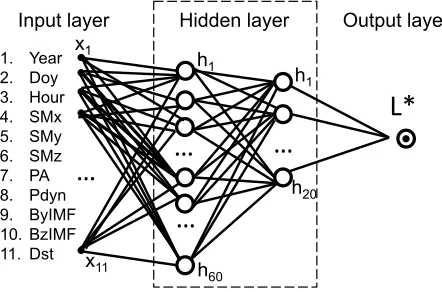
The application of an artificial neural network allows one to unfold the complicated causal relationship between a driver and a response inside a nonlinear system like the terrestrial magnetosphere. Various neu-ral network architectures can be chosen to establish the driver-response (input-output) relationship. This study uses a feed-forward multilayer neural network that consists of several computational units with inter-connections in a feed-forward way, as illustrated in Figure 1. The first layer, composed of input parametersXi, which are listed in the next paragraph, for the determinative yield of output layer, is connected to a hidden layer through weightswij, biasesbj, and an activation functionf:
hj=f (N−1
∑
i=0
Xiwij+bj )
, (1)
Journal of Geophysical Research: Space Physics
10.1002/2013JA019350
Figure 1.The architecture of a multilayer feed-forward neural net-work. (left) The input layer, containing the solar wind condition and theDstindex; (middle) hidden layer is composed of two sublayers, each with 60 and 20 neurons, respectively; (right) the output layer, i.e.,L∗.
sizes of the hidden layer and chose the one with the smallest generalization error (i.e., running the trained network on a test data set that is not used in the network train-ing or validation and determintrain-ing the error between the network result and the target in the test data set).
While the output layer consists of one single neuron representingL∗, the input layer con-tains 11 parameters, including time (year, day of year, hour), location (in SM Cartesian coordinates), solar wind dynamic pressure, ByIMF,BzIMF, theDstindex, and pitch angle. These solar wind parameters and theDst index are chosen as the neural network input because they are required inputs for the RAM-SCB model. Unlike the previous study fromYu et al.[2012] that included the McIlwain L and the mirror point magnetic field in the input layer, this feed-forward neural network only takes into account external solar wind driving and theDstindex as the responsible driving (input) to achieve the subsequentL∗value, for the purpose of better representing the relationship between the solar wind drivers and the internal response as well as for an easier preparation of the inputs. Consequently, the whole process, including the preparation of the input and the calculation ofL∗, is much easier than the previous net-works because the above two input parameters would take appreciable time to be calculated through the IRBEM library.
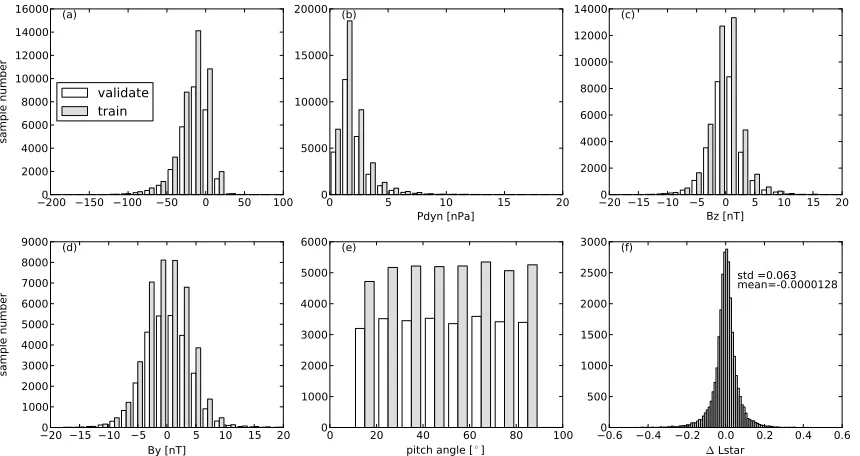
The generation of anL∗neural network follows two steps: (1) sampling adequate input-target patterns and (2) training/learning the relationship between the input and target, i.e., creating the neural network. We produce 67,000 input-target sampling patterns from the IRBEM library. The location of the input parame-ters is randomly sampled inside the magnetospheric domain between 2.5 and 6.5REspherically, each also corresponding to a random time between 1 January 2001 and 1 January 2007 and a random pitch angle between 10◦and 90◦. The input solar wind condition andDstindex at the selected time are taken from the 1 h resolved OMNI database. With these inputs we compute theL∗target using the IRBEM library (from http://sourceforge.net/projects/irbem/, revision number 307, with latitudinal and longitudinal resolutions being 0.05◦and 2.8◦, respectively, i.e., the third and fourth elements in the input array “options” are both 4) based on the global magnetospheric configuration from the RAM-SCB model. From these 67,000 sampling patterns, 40,000 patterns are randomly chosen for the training of the neural network. These training sam-ples cover a wide range of input conditions (Figure 2, grey bars), withDstmostly distributed above−100nT, the solar wind dynamic pressure below 10 nPa,|Bz|and|By|below 10 nT, and the pitch angle nearly evenly distributed among 10 and 90◦.
The learning of the relationship between the input and the targetL∗begins with an initial guess of the weights associated with each connection in the network. The learning process evolves with iterative adjust-ment of the weights until the mean-squared error between theL∗output and the prescribedL∗target approaches a given tolerance of 10−8. Such a process is called supervised learning. The obtained weights
and bias on each neuron define the final structure of a neural network.
4. Validation
To examine the applicability of the above neural network, two types of validation are carried out: (1) out-of-sample validation and (2) comparison with otherL∗neural networks.
Figure 2.The histogram of training data samples (grey) and validating data samples (white) as a function of (a)Dst, (b) solar wind dynamic pressure, (c) interplan-etary magnetic field (IMF)Bz, (d) IMFBy, and (e) pitch angle. The last plot shows the histogram of difference between the neural network calculatedL∗and that obtained through the IRBEM library in the validating data set. Also shown are the standard deviation and mean difference between the two methods.
input conditions in the 27,000 samples. This distribution demonstrates a standard deviation as small as 0.06 and a mean difference near zero (∼10−5), indicating that the neural network is quite reliable in reproducing
theL∗value from IRBEM to reasonable accuracy.
We evaluate the geomagnetic activity dependence of thisL∗neural network using the root-mean-square error (RMSE) as a function of solar wind dynamic pressure,Dst, andBz(Table 1). The RMSE measures the difference between the artificial neural network (ANN) generatedL∗
ANNand IRBEM’s numerical tracing-based
L∗
IRBEMin response to the same input:
RMSE=
√ √ √ √1
N N ∑
i=1 (L∗
ANN−L
∗
IRBEM)2 (2)
Except for extreme conditions such asDst<−150nT, Pdyn>15nPa, and|Bz|>10nT, the RMSE is mostly below 0.1, suggesting that for relatively quiet times or moderate storm periods, this neural network can reproduceL∗with a fidelity comparable to the IRBEM-tracing method. However, caution may be needed when using the neural network for highly disturbed times because the neural network is trained from samples that have poor statistics under those highly disturbed conditions.
Table 1.The Root-Mean-Square Error (RMSE) BetweenL∗Calculated From the Neural Network Trained With the RAM-SCB Magnetic Field Configurations andL∗Calculated From the IRBEM Library as a Function ofDstIndex, Solar Wind Dynamic Pressure, and the Interplanetary Magnetic FieldBzComponent
Values
Dst(nT) (>0) (−50,0) (−100,−50) (−150,−100)
samples 5488 20413 1357 70 Overall
RMSE 0.055 0.062 0.101 0.147
Pdyn (nPa) (0, 5) (5, 10) (10, 15) (15, 20) (20, 25)
samples 26372 944 92 22 13
RMSE 0.060 0.088 0.120 0.178 0.311 RMSE = 0.064
Bz(nT) (>20) (10, 20) (0, 10) (−10,0) (−20,−10)
samples 9 91 13641 13571 91
Journal of Geophysical Research: Space Physics
10.1002/2013JA019350
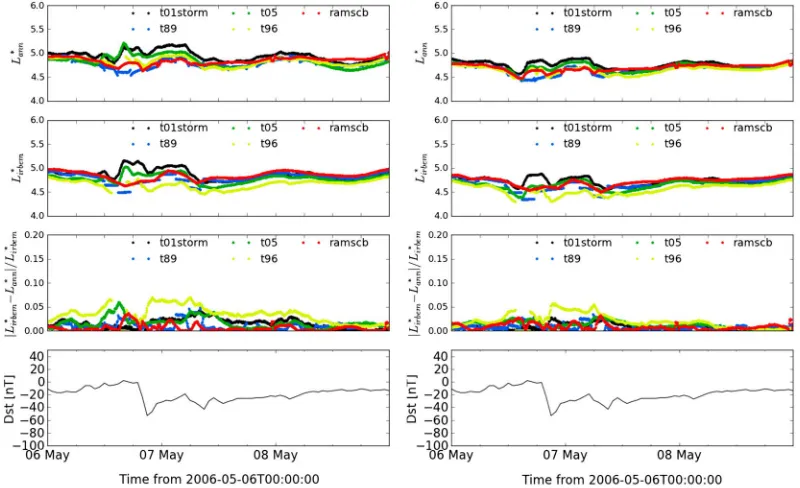
Figure 3.(top to bottom)L∗computed from different artificial neural networks,L∗computed from the IRBEM library, the relative difference between the above two methods, and theDstindex. TheL∗is calculated with different underlying magnetic field models including RAM-SCB, T89, T96, T01Storm, and T05. It is computed at a midnight location (−5.5, 0.0, 0.0)REin SM coordinates with equatorial pitch angle of (left) 90◦and (right) 50◦.
We further compare this newly trained neural network with those previously trained from empirical mag-netic field models, to discern any dependence of theL∗outcome on the underlying magnetic field model. The neural network computedL∗is also compared to that created by the IRBEM method. Figure 3 (left column) shows (a)L∗
ANN, from five neural networks with different underlying magnetic field models, for
a particle with 90◦pitch angle starting at a midnight position (−5.5, 0, 0)REduring a small storm event. These neural networks provide similarL∗values with disagreement mostly less than 0.7 between each other, implying that the neural network is not very sensitive to its underlying magnetic field model during small storm events and/or that the field models are not significantly different at these times. Also shown are (b)L∗computed from the IRBEM method and (c) the relative difference between the two methods. The IRBEM-calculatedL∗values display similar results among different magnetic field models and the relative difference between the two methods is below 7%. While T96 model shows larger discrepancy in the storm main phase, the others have smaller differences (mostly below 3%) between the two methods. This again indicates the reliability of the neural network in reproducing IRBEM results in quiet or moderately disturbed time. Figure 3 (right column) shows the same parameters during the same event but for a pitch angle of 50◦. Similarly, theL∗difference either between different neural networks or between the two methods is small.
However, this is not such a case in highly disturbed time (not shown) Because of the limitation of the neural network in representing extreme conditions, the uncertainty in theL∗is significantly increased whenDstis below−150nT. This suggests that for the above circumstances, theL∗neural network is not as reliable as during less disturbed time. However, all of the underlying statistical magnetic field models themselves are least reliable during very active times. In this sense, a physics-based model could probably provide a better representation of the magnetospheric configuration for a specific storm event.
5. Estimating the Error of
L
∗Calculation
Figure 4.(top) The PSD observed by Van Allen Probes sorted inL∗space during quiet time 3–4 January 2013 with𝜇= 2760MeV∕GandK =0.13
G1∕2R
E. (bottom) Black dots represent the matching ratio of two PSDs at conjunction points with the same adiabatic coordinates (𝜇,K,L∗), and red triangles represent theL∗error,|𝛿L∗|, computed by equation (3). The neural network trained with T05 model is used for theL∗calculation.
inevitable. The computedL∗that carries the information of global mag-netic fields thus accumulates these uncertainties, which is likely to influ-ence the interpretation of the physics of the radiation belt [Green and Kivelson, 2004;Chen et al., 2007; Huang et al., 2008;McCollough et al., 2008;Yu et al., 2012].Green and Kivelson[2004] discussed thatL∗ uncertainties could result in a shift in the phase space density (PSD) radial profile, without changing its shape. This implies that the accuracy ofL∗ could influence the determination of the PSD peak location or the location where the energization/acceleration of energetic electrons occurs in the inner magnetosphere.
Chen et al.[2007] developed a method for determining the accuracy ofL∗calculation by means of PSD-matching technique. Following equation (6) inChen et al.[2007], theL∗error can be quantified by
∣𝛿L∗∣= R−1 R+1
(
∣ 𝜕f
𝜕L∗∕2f̄∣ )−1
(3)
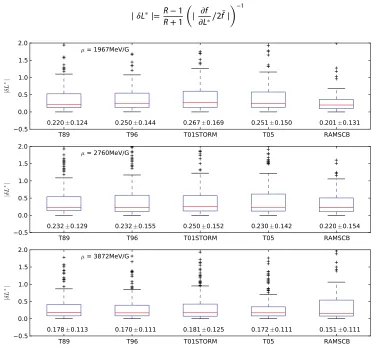
Figure 5.Box-whisker plots of drift shell error𝛿L∗calculated from different neural networks at different𝜇values with
Journal of Geophysical Research: Space Physics
10.1002/2013JA019350
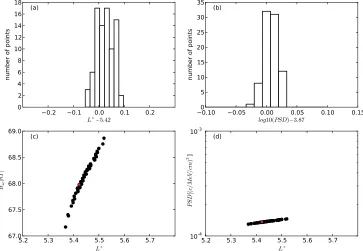
Figure 6.(a) The distribution ofL∗, (b) the distribution of the phase space density (PSD), (c) local magnetic field mag-nitude at (−6.5, 0.0, 0.0)RE, and (d) PSD as a function ofL∗with𝜇= 523MeV∕GandK =0.11G1∕2R
E, obtained from 100 magnetosphere configurations created by small random perturbations on the solar wind speed and density. The red dot represents the nominal value from the initial magnetosphere that experienced random disturbances. The T96 neural network is used forL∗calculation.
wherefrepresents the PSD value,R =f2∕f1is the matching ratio between two PSD data under the same adiabatic coordinates, with the larger one always on the numerator, andf̄= (f1+f2)∕2is the mean of the two PSD values. In order to use this technique, we should be aware of several sources causing theL∗error. The reason for the two PSDs with the same adiabatic coordinates deviating from each other (i.e., the match-ing ratioRis not equal to one) can result from various error sources, including (1) inaccurate PSD conversion from flux observations especially in the fitting process (i.e., the fitting error source, as mentioned inGreen and Kivelson[2004]), (2) inadequate satellite intercalibration, (3) large substorm injection that can violate the Liouville’s theorem based on which equation (3) is derived, (4) errors in theKparameter due to the imperfec-tion of the magnetic field model, and (5) errors in theL∗calculation due to the magnetic field model as well as the training process of the neural network. The error resulting from (1) can be much improved by using a cubic spline interpolation method in fitting an energy spectrum as reported inYu et al.[2014]. To avoid, to a large extent, the potential contribution from error sources (2) and (3), only quiet time periods with smallAL index are chosen for theL∗error estimation, because the intersatellite “fine-tuned” calibration can produce trustworthy correction without large influence from substorm injection [Chen et al., 2005]. Finally, with the assumption that the uncertainty residing in theKparameter is much smaller than inL∗, equation (3) is then used to evaluate the error ofL∗calculation originating from the neural network technique together with its corresponding underlying magnetic field model.
Figure 4 demonstrates one example of the PSD atK≃0.13G1∕2R
Figure 7.The PSD profile as a function ofL∗withK =0.1G1∕2R
eat different𝜇values. The five scattered clusters of data points (gray dots) correspond to PSD(L∗) distributions at five midnight equatorial posi-tions (i.e.,−6.0,−6.5,−7.0,−7.5, and−8.0RE). The blue dash line aligns the minimumL∗from each data cluster, and the green dash line con-nects the maximum values. The red dot represents the nominal value from the initial magnetosphere that experienced random disturbances. The T96 neural network is used forL∗calculation.
values. The box-whisker plot helps depict the degree of dispersion of the data: the bottom and the top of the box indicate the 25th and 75th percentile, respectively, with the range between the two being called the interquar-tile range (IQR). Figure 5 (middle red line) stands for the median value of the data, and the whiskers extend to the most extreme points within the range of 1.5 IQR outside the lower and upper quartile, respectively. The data above the top whisker are those on the tail of the distribution, larger than the 1.5 IQR plus the 75th percentile. When𝜇is larger the spread of the data set appears smaller (box is narrower), except in the RAM-SCB model, and the median value suggests a smaller𝛿L∗. Across differ-ent neural networks,𝛿L∗is similar. The median values are approximately around 0.2 with the median absolute devia-tion (MAD) within 0.11 and 0.17, and 75% (the top of the box) of the error distribution is mostly below 0.7. These results indicate that during relatively quiet time theL∗computed from the neural network is reasonably accurate and little discrepancy exists between different neural networks. However,L∗ accuracy during highly disturbed time cannot be estimated using the above PSD-matching technique, because the Liouville’s theorem can be violated with sudden loss that usually occurs in storms.
6.
L
∗Uncertainty Effect on PSD Profile
Journal of Geophysical Research: Space Physics
10.1002/2013JA019350
is converted from nominal energy differential electron flux, which is obtained from theAE-8 radiation belt model with different energy and pitch angle for solar minimum conditions, following the conversion pro-cedure described inYu et al.[2014]. As an example, at location of (−6.5, 0, 0)REL∗and PSD both display a pseudo-normal distribution (Figures 6a and 6b); the local magnetic field and PSD generally increase mono-tonically withL∗(Figures 6c and 6d). A change of 3% in the magnetic field results in a change of 3% inL∗ value and a change of 12% in the PSD at this selected location. It should be noted that the degree of change in the PSD depends on the PSD radial gradient at the position of interest.
Figure 7 collects the PSD(L∗) results computed at different locations on the midnight equator based on the above 100 magnetospheric configurations. At each location, a scatter of PSD(L∗) distributes around the nom-inal result (Figure 7, red dot), representing the associated uncertainty. The uncertainties in the PSD andL∗ therefore envelope a radial span in the PSD profile, with the blue line aligning the minimumL∗values and the green one aligning the maximum values from each scattered cluster. Between these two extrema, the shape of the PSD profile seems to persist, but the peak location is shifted approximately by 0.2 inL∗. This finding is quantitatively consistent with the conclusion inGreen and Kivelson[2004]. The PSD radial profile at different𝜇values suggests that the PSD radial gradient is energy dependent. This feature is also preserved even with the uncertainty inL∗. While the above ensemble of magnetosphere configurations can mostly be considered as quiet systems and the variability in both theL∗and PSD is not significant, a storm-time magnetosphere would result in a larger uncertainty inL∗and hence a stronger shift in the PSD radial pro-file would be expected. Nevertheless, the above experiment may shed some light on the potential impact on the interpretation of the underlying physics in the radiation belt, such as the responsible energization mechanism for creating the localized PSD peak.
7. Summary
As a continuing effort on increasing the computational capability of efficiently, accurately obtainingL∗, this study trains theL∗neural network based on the first-principles magnetic field configuration from RAM-SCB model, with simple inputs including solar wind conditions and theDstindex, which allows for a much easier preparation of inputs than the previousL∗networks that require the McIlwain L and the magnetic field at the mirror point as part of the inputs. The newly trained neural network is compared against the previously trained neural networks from empirical magnetic field models as well as the tracing method in the IRBEM library and is found to reasonably agree with otherL∗values during moderate storm events and quiet times. But the difference in theL∗is substantially increased across all these neural networks during large storms. This is probably attributed to insufficient statistics for the extreme cases to result in a reliabler neural network.
The accuracy ofL∗neural networks with different underlying magnetic field models (both empirical and physics based) is estimated with the PSD-matching technique using Van Allen Probes observations. The median value of the drift shell error is approximately around 0.2 with median absolute deviation (MAD) around 0.15 during relatively quiet time for all the neural networks. The uncertainty in the calculatedL∗ value is found to affect the PSD profile by shifting it radially without changing its shape, which implies its influence on the interpretation of radiation belt physics such as localized energization.
References
Baker, D., et al. (2013), The relativistic electron-proton telescope (REPT) instrument on board the radiation belt storm probes (RBSP) spacecraft: Characterization of Earth’s radiation belt high-energy particle populations,Space Sci. Rev.,179, 337–381, doi:10.1007/s11214-012-9950-9.
Chen, Y., R. H. W. Friedel, G. D. Reeves, T. G. Onsager, and M. F. Thomsen (2005), Multisatellite determination of the relativistic electron phase space density at geosynchronous orbit: Methodology and results during geomagnetically quiet times,J. Geophys. Res.,110, A10210, doi:10.1029/2004JA010895.
Chen, Y., R. H. W. Friedel, G. D. Reeves, T. E. Cayton, and R. Christensen (2007), Multisatellite determination of the relativistic electron phase space density at geosynchronous orbit: An integrated investigation during geomagnetic storm times,J. Geophys. Res.,112, A11214, doi:10.1029/2007JA012314.
Gannon, J. L., S. R. Elkington, and T. G. Onsager (2012), Uncovering the nonadiabatic response of geosynchronous electrons to geomagnetic disturbance,J. Geophys. Res.,117, A10215, doi:10.1029/2012JA017543.
Green, J. C., and M. G. Kivelson (2004), Relativistic electrons in the outer radiation belt: Differentiating between acceleration mechanisms, J. Geophys. Res.,109, A03213, doi:10.1029/2003JA010153.
Henderson, M. G., S. K. Morley, and B. A. Larsen (2011), LANLGeoMag, version 1.5.13,Tech. Rep. LA-CC-11-104, Los Alamos National Laboratory, Los Alamos, N. M.
Acknowledgments
We gratefully acknowledge the sup-port of the U.S. Department of Energy through the Los Alamos National Lab-oratory (LANL)/LabLab-oratory Directed Research and Development (LDRD) program, as well as the support of NASA through NNH10APOGI and NNG13PJ05I and NSF through IA1203460.
Huang, C.-L., H. E. Spence, H. J. Singer, and N. A. Tsyganenko (2008), A quantitative assessment of empirical magnetic field models at geosynchronous orbit during magnetic storms,J. Geophys. Res.,113, A04208, doi:10.1029/2007JA012623.
Jordanova, V. K., J. U. Kozyra, G. V. Khazanov, A. F. Nagy, C. E. Rasmussen, and M.-C. Fok (1994), A bounce-averaged kinetic model of the ring current ion population,Geophys. Res. Lett.,21, 2785–2788, doi:10.1029/94GL02695.
Jordanova, V. K., Y. S. Miyoshi, S. Zaharia, M. F. Thomsen, G. D. Reeves, D. S. Evans, C. G. Mouikis, and J. F. Fennell (2006), Kinetic sim-ulations of ring current evolution during the Geospace Environment Modeling challenge events,J. Geophys. Res.,111, A11S10, doi:10.1029/2006JA011644.
Jordanova, V. K., S. Zaharia, and D. T. Welling (2010), Comparative study of ring current development using empirical, dipolar, and self-consistent magnetic field simulations,J. Geophys. Res.,115, A00J11, doi:10.1029/2010JA015671.
Koller, J., and S. Zaharia (2011), LANL* V2.0: Global modeling and validation,Geosci. Model Dev.,4(1), 669–675, doi:10.5194/gmd-4-669-2011.
Koller, J., Y. Chen, G. D. Reeves, R. H. W. Friedel, T. E. Cayton, and J. A. Vrugt (2007), Identifying the radiation belt source region by data assimilation,J. Geophys. Res.,112, A06244, doi:10.1029/2006JA012196.
Koller, J., G. D. Reeves, and R. H. W. Friedel (2009), LANL* V1.0: A radiation belt drift shell model suitable for real-time and reanalysis applications,Geosci. Model Dev.,2, 113–122.
McCollough, J. P., J. L. Gannon, D. N. Baker, and M. Gehmeyr (2008), A statistical comparison of commonly used external magnetic field models,Space Weather,6, S10001, doi:10.1029/2008SW000391.
Min, K., J. Bortnik, and J. Lee (2013a), A novel technique for rapidL∗calculation using UBK coordinates,J. Geophys. Res. Space Physics,
118, 192–197, doi:10.1029/2012JA018177.
Min, K., J. Bortnik, and J. Lee (2013b), A novel technique for rapidL∗calculation: Algorithm and implementation,J. Geophys. Res. Space
Physics,118, 1912–1921, doi:10.1002/jgra.50250.
Morley, S. K., M. G. Henderson, G. D. Reeves, R. H. W. Friedel, and D. N. Baker (2013), Phase space density matching of relativistic electrons using the Van Allen Probes: REPT results,Geophys. Res. Lett.,40, 4798–4802, doi:10.1002/grl.50909.
Reeves, G. D., et al. (2013), Electron acceleration in the heart of the Van Allen radiation belts,Science,341, 991–994, doi:10.1126/science.1237743.
Roederer, J. G. (1970),Dynamics of Geomagnetically Trapped Radiation, Physics and Chemistry in Space, Springer, Berlin.
Selesnick, R. S., and J. B. Blake (1998), Radiation belt electron observations following the January 1997 magnetic cloud event,Geophys. Res. Lett.,25(14), 2553–2556, doi:10.1029/98GL00665.
Spence, H., et al. (2013), Science goals and overview of the radiation belt storm probes (RBSP) energetic particle, composition, and thermal plasma (ECT) suite on NASA’s Van Allen Probes mission,Space Sci. Rev.,179(1–4), 311–336, doi:10.1007/s11214-013-0007-5. Stern, D. P. (1975), The motion of a proton in the equatorial magnetosphere,J. Geophys. Res.,80, 595–599, doi:10.1029/JA080i004p00595. Tsyganenko, N. A. (1989), A magnetospheric magnetic field model with a warped tail current sheet,Planet. Space Sci.,37, 5–20,
doi:10.1016/0032-0633(89)90066-4.
Tsyganenko, N. A., and M. I. Sitnov (2005), Modeling the dynamics of the inner magnetosphere during strong geomagnetic storms,J. Geophys. Res.,110, A03208, doi:10.1029/2004JA010798.
Turner, D. L., Y. Shprits, M. Hartinger, and V. Angelopoulos (2012), Explaining sudden losses of outer radiation belt electrons during geomagnetic storms,Nat. Phys.,8, 208–212, doi:10.1038/nphys2185.
Volland, H. (1973), A semiempirical model of large-scale magnetospheric electric fields,J. Geophys. Res.,78, 171–180, doi:10.1029/JA078i001p00171.
Weimer, D. R. (2001), An improved model of ionospheric electric potentials including substorm perturbations and application to the Geospace Environment Modeling November 24, 1996, event,J. Geophys. Res.,106, 407–416, doi:10.1029/2000JA000604.
Yu, Y., J. Koller, S. Zaharia, and V. Jordanova (2012),L∗neural networks from different magnetic field models and their applicability,Space
Weather,10, S02014, doi:10.1029/2011SW000743.
Yu, Y., J. Koller, V. Jordanova, S. Zaharia, and H. Godinez (2014), Radiation belt data assimilation of a moderate storm event using the physics-based magnetic field configuration from RAM-SCB,Ann. Geophys., doi:10.5194/angeo-2013-264-2014, in press.
Zaharia, S. (2008), Improved Euler potential method for three-dimensional magnetospheric equilibrium,J. Geophys. Res.,113, A08221, doi:10.1029/2008JA013325.
Zaharia, S., C. Cheng, and K. Maezawa (2004), 3-D force-balanced magnetospheric configurations,Ann. Geophys.,22, 251–265, doi:10.5194/angeo-22-251-2004.