Efficient Clustering using ECATCH
Algorithm to Extend Network Lifetime in
Wireless Sensor Networks
Mr.R. Sathish Kumar#1, R.Logeswari#2, N.Anitha Devi#3,,S.DivyaBharathy #4
Assistant Professor, Department of Computer Science and Engineering#1
B. Tech, Department of Computer Science and Engineering#2,3,4Manakula Vinayagar Institute of Technology, Pondicherry.
ABSTRACT-- The sensor nodes in wireless sensor networks normally execute only simple logics and have limited resources. Faulty sensors deployed in wireless sensor networks produce erroneous decisions and inaccurate results. We propose a distributed, general-purpose reasoning engine (D-FLER) for WSN which uses fuzzy logic for fusing individual and neighborhood observations, in order to produce a more accurate and reliable result. Usually ,a cluster formed by group of nodes have one leader node that acts as a cluster head whose responsibility is to gather data from all nodes then transmit it to BS. This paper concentrates on multiple cluster head to extend the network lifetime by maximizing battery efficiency. In this paper, we propose ECATCH algorithm to minimize the workload of cluster head by transaction of data with a secondary cluster head and extend battery lifetime.
Keywords- D-FLER, fuzzy logic, memory over- head, numerical accuracy
I .INTRODUCTION
Wireless sensor network (WSN) is constructed by various amounts of node. Sensor node is able to execute sensing information from its area and communicate with each other nodes in the system. Nodes are usually projected to function based on battery lifetime. It is very complicated to renovate batteries of sensor node in the region, nodes are expensive, and energy is constrained for each and every node in WSN. Creation of cluster depends on user preference. Scalability is one of the essential requirements of a WSN system. When numerous devices are involved in the network to perform the required operation clustering is used. Clustering sensor node is an effective and efficient technique for achieving the entire requirement. To form a number of clusters the required can be selected either by equal or unequal probabilities of selection after dividing the population of nodes into specified clusters. The advantage of cluster is to collect data from neighboring node is operationally more convenient then observing units spread over a region.
To avoid this data redundancy and to make the network most energy efficient, data
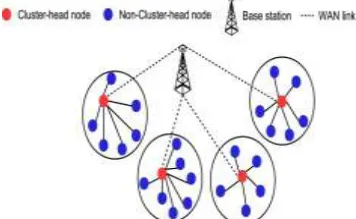
aggregation and sensor fusion have been emphasized in the literature [1]. Many routing protocols with many different ideas have been proposed in the literature to make the network energy efficient [14]. Cluster based routing protocol is one of these efficient ideas, where sensor nodes are divided into number of groups, each group is called as a cluster. One group leader is elected in each cluster known as Cluster Head (CH). Data aggregation is obtained at the leader node. The leader node/CH is only responsible for sending the message to the BS. Figure 1 shows the general system model for clustering based WSN.
LEACH [1, 2] is the first famous hierarchical routing protocol which is proven to be most efficient over traditional routing protocol. In LEACH, the CH is elected in a probabilistic manner and tries to balance the load at each sensor node in a rotation basis. Even though many studies present the efficiency of LEACH protocol, it has certain pitfalls that need to be discussed. As LEACH relies on probabilistic value, it might happen that in each round more than one cluster heads are elected or no cluster head is elected. Further, the cluster head may be elected at the boundary of the network which leads to the improper energy distribution. LEACH also does not consider the distribution of sensor nodes and remaining energy of each node after completion of each round.Figure 1 illustrates the General System Clustering among sensor nodes.
important role in this system. In this paper, our proposal is to reduce the task of cluster head by transaction of data with another cluster head and maximize battery lifetime.
II.RELATED WORKS
To avoid this data redundancy and to make the network most energy efficient, data aggregation and sensor fusion have been emphasized in the literature [1]. Many routing protocols with many different ideas have been proposed in the literature to make the network energy efficient [14]. Cluster based routing protocol is one of these efficient ideas, where sensor nodes are divided into number of groups and each group is called as a cluster. One group leader is elected in each cluster known as Cluster Head (CH). Data aggregation is obtained at the leader node. The leader node/CH is only responsible for sending the message to the BS. Figure 1 shows the general system model for clustering based WSN. LEACH [1, 2] is the first famous hierarchical routing protocol which is proven to be most efficient over traditional routing protocol.As LEACH relies on probabilistic value, it might happen that in each round more than one cluster heads are elected or no cluster head is elected. Further, the cluster head may be elected at the boundary of the network which leads to the improper energy distribution. LEACH also does not consider the distribution of sensor nodes and remaining energy of each node after completion of each round.By doing so, it produces better number of clusters and distributes the CHs evenly among the clusters.
Sensor nodes are typically expected to operate with limited battery power, and it is very difficult to replace the battery when the nodes are dies. When nodes are in operation, there are two methods in the case of battery performance. When nodes sense anything it may consume some sort of energy and when forwarding those sensed data then also it consume more power. While comparing with two of them, second method occupies more battery energy and node may goes down very earlier. For that problem clustering technique is used to increase the lifetime by reducing the energy consumption. The proper cluster-head selection and efficient routing are used to increase the network lifetime of WSN.
III.LITERATURE SURVEY
A. “Energy-efficient Communication Protocol for Wireless Microsensor Networks ”
In this paper, we look at communication protocols, which can have significant impact on the overall energy dissipation of these networks. LEACH uses localized coordination to enable scalability and robustness for dynamic networks, and incorporates data fusion into the routing protocol to reduce the amount of information that must be transmitted to the
base station. Simulations show that LEACH can achieve as much as a factor of 8 reduction in energy dissipation compared with conventional routing protocols. In addition, LEACH is able to distribute energy dissipation evenly throughout the sensors, doubling the useful system lifetime for the networks we simulated.
B. “An application-specific protocol architecture for wireless microsensor networks ”
Networking together hundreds or thousands of cheap microsensor nodes allows users to accurately monitor a remote environment by intelligently combining the data from the individual nodes.We develop and analyze low-energy adaptive clustering hierarchy (LEACH), a protocol architecture for microsensor networks that combines the ideas of energy-efficient cluster-based routing and media access together with application-specific data aggregation to achieve good performance in terms of system lifetime, latency, and application-perceived quality.Our results show that LEACH can improve system lifetime by an order of magnitude compared with general-purpose multihop approaches.
C.“CHEF: Cluster Head Election mechanism using Fuzzy logic in Wireless Sensor Networks”
In this paper we introduce CHEF - cluster head election mechanism using fuzzy logic. By using fuzzy logic, collecting and calculating overheads can be reduced and finally the lifetime of the sensor networks can be prolonged.LEACH is one of the most famous clustering mechanisms. It elects a cluster head based on probability model.To prove efficiency of CHEF, we simulated CHEF compared with LEACH using the matlab. Our simulation results show that CHEF is about 22.7% more efficient than LEACH.
D. “A moving base station strategy using fuzzy logic for life time enhancement in wireless sensor network,”
In this paper, we propose a unique movement strategy for base station to reduce energy consumption. The motion of base station is governed by fuzzy logic inference mechanism. The strategy used in this paper is unique in the sense that the base station is allowed to move only on a predefined path making it practically more feasibleWe further propose that by increasing or decreasing area covered by predefined path we can get desired lifetime intermediate between the above two approaches.
for leader election in PEGASIS based protocol PEGASIS-TC based on two descriptors-residual energy of node and its proximity to Base Station.
Wireless sensor Networks present a new generation of real time embedded systems with limited computation, energy and memory resource that are being used in wide variety of applications where traditional networking infrastructure is practically infeasible. Legitimate leader selection can drastically improve the lifetime of the sensor network. Simulation results show that depending on network configuration, a substantial increase in stability of network lifetime can be accomplished as compared to PEGASIS-TC.
IV. PROPOSED WORK
1. Overview
This paper concentrates on multiple cluster head to maximize battery efficiency and prolong the lifetime of network. To perform the task of node, energy requirement plays an important role in this system. In this paper, our proposal is to reduce the task of cluster head by transaction of data with another cluster head and maximize battery lifetime.
2. Proposed Protocol
The major benefit of using FuzzyLogic is to overcome the overheads of collecting and calculating energy and location information of each node. Most of the FL based clustering algorithms consider the sink node/BS as static. Now there is a trend to investigate sink or BS mobility that can relieve the network traffic, reduces delay and enhances energy efficiency [16]. Finally, through the simulation results it has been shown that the proposed approach performs better than LEACH protocol.
3. Discovery of Route using ECATCH Algorithm
ECATCH algorithm is dynamic selection of cluster-head that are not exist for balancing node energy level based on the parameter defined for it.
4. System Model
The proposed clustering method follows the basic principle of LEACH. The cluster is formed in each round. In every clustering round, each node generates a random number between 0 and 1. If the random number for a particular node is bigger than the threshold value T, the node becomes the CH. In basic LEACH [2], the cluster formation algorithm was defined to ensure that the no. of cluster per round is k, a system parameter. The optimal value of k (k optimal) in LEACH can be determined analytically by computation and communication energy model. For instance, if there are N nodes distributed randomly over M×M region, and k clusters are assumed, then there are N/k nodes per cluster (one CH and (N/k)-1)
Non Cluster head nodes. Each CH dissipates energy by receiving the signal,aggregates it and sends the average signal to BS.
V.IMPLEMENTATION AND RESULTS
1.Node Deployment
Property Value
Number of nodes deployed 23
Total execution time 3.0 ms
The node is designed to move in all the direction. Thus the node is continually adjusted as the node moves.Here the super cluster head is elected & deliver a message to a mobile station.
Fig.4 Node Deployment
Fig.5 Cluster Head Selection
2. Efficient Data Transmission
When sensor nodes are densely deployed to monitor & detect, analyse the physical phenomenon & consume energy while transmitting the information.ECATCH algorithm dynamically selects the cluster nodes and equally distributed the data to improve the network lifetime and consume energy.
Fig.7.Efficient Data Transmission
3. Node creation and routing
To maximize battery efficiency and prolong the lifetime of network multiple cluster head is created.
Fig.8.Node creation and routing
VI.PERFORMANCE EVALUATION
In this section, we present the results of experimental simulations to evaluate our proposed approach. Moreover, we compare our proposed clustering algorithm.ECATCH algorithm with three different algorithms, namely LEACH [8], LEACH- Centralized [8], and CHEF [10]. Simulation results have shown that our approach reveals better performances compared with others.
1.Network stability
In this, Fig.9 shows the network stability of ECATCH algorithm.we compare our proposed clustering algorithm E-CATCH algorithm other fuzzy algorithms. Simulation results have shown that our approach reveals better performances compared with others.
Fig.9.Network stability
2.Performance of energy consumption reduced by cluster
In this section, we present the experimental results obtained from the simulations to evaluate the proposed algorithm. Fig.10. shows the performance of energy consumption reduced by cluster. The time duration between the death of first node and half of the nodes mostly indicates the stability period of the network. This metric is very useful when the sensor nodes are densely deployed. It is seen from Fig. 10 that half of the nodes die first in LEACH and survives for longer period of time in the proposed protocol.
Fig.10.Performance of energy consumption reduced by cluster
3.Performance of End to End Delay
In this section,Fig.9.proofs that the proposed protocol is more stable than the ECATCH protocol. Fig.11presents about end to end delay. End to end delay is defined as the maximum time taken by the packets to travel from source to BS. It is evident from Fig. 12 that end to end delay is reduced by 62% in the proposed protocol compared to LEACH.
Fig.11.End to End Delay
4.Network life time
Fig.12.Network life time
VII.CONCLUSION
In this paper, the clustering algorithm with multiple cluster heads is determined within the cluster of sensor nodes to improve lifetime of WSN. Simulations results show that our algorithm has extended lifetime for the network using clusters. Using each cluster, multiple cluster heads are selected to accumulate the battery of cluster head by swapping head node based on the ECATCH algorithm. When one cluster-head fails due to energy depletion, then another cluster-head works routine without affecting the rest of the node in the cluster. ECATCH algorithm is dynamic selection of cluster-head that are not exist for balancing node energy level based on the parameter defined for it. This proposal becomes more reliable for making network lifetime extended when comparing with rest of the algorithm in WSN. This method helps to maximize the network lifetime in WSN.
VIII.REFERENCES
[1]. W. R. Heinzelman, A. Chandrakasan, and H. Balakrishnan, Energy-efficient Communication Protocol for Wireless Microsensor Networks., in IEEE Computer Society Proceedings of the Thirty Third Hawaii International Conference on System Sciences (HICSS '00), Washington, DC: IEEE, 2000, pp. 1-10.
[2]. W. R. Heinzelman, A. Chandrakasan and H. Balakrishnan,“An application-specific protocol architecture for wireless microsensor networks,” in IEEE Transactions on Wireless Communications, 1(4), pp. 660 – 670, Oct. 2002.
[3]. I. Gupta, D. Riordan and S. Sampalli, "Cluster -head Election using Fuzzy Logic for Wireless Sensor Networks", Communication Networks and Services Research Conference, pp. 255-260, May 2005.
[4]. Jong-Myoung Kim, Seon-Ho Park, Young-Ju Han, TaiMyoung Chung, “CHEF: Cluster Head Election mechanism using Fuzzy logic in Wireless Sensor Networks” ICACT, PP. 654-659, Feb. 2008.
[5]. Abhijeet Alkesh, Ashutosh Kumar Singh, N.Purohit, “A moving base station strategy using fuzzy logic for life time enhancement in wireless sensor network”, in proc. of International
Conference on Communication Systems and Network
Technologies, 2011, pp 198-202.
[6]. Hoda Taheri et.al. “An energy-aware distributed clustering protocol in wireless sensor networks using fuzzy logic”, Ad hoc Networks 10 (2012), pp. 1469-1481.
[7]. Tripti Sharma, Brijesh Kumar, “F-MCHEL: Fuzzy Based Master Cluster Head Election Leach Protocol in Wireless Sensor Network”, International Journal of Computer Science and Telecommunications, Volume 3, Issue 10, October 2012, pp. 8-13. [8]. Z.W.Siew, C.F.Liau, A.Kiring, M.S. Arifianto, K.T.K. Teo, “Fuzzy Logic Based Cluster Head Election for Wireless Sensor Network”, in Proc. of 3rd CUTSE International Conference, Malaysia, 2011, pp. 301-306.
[9]. Vibha Nehra, Raju Pal, Ajay K Sharma, “Fuzzy-based Leader Selection for Topology Controlled PEGASIS Protocol for Lifetime Enhancement in Wireless Sensor Network”, International Journal of Computers & Technology, Volume 4, No. 3, March-April, 2013, pp.755-764.
[10]. Ge Ran, Huazhong Zhang, Shulan Gong, “Improving on LEACH Protocol of Wireless Sensor Networks Using Fuzzy Logic”, Journal of Information & Computational Science 7, (3) (2010), pp. 767–775.
[11]. Hironori Ando, Leonard Barolli, Arjan Durresi, Fatos Xhafa, and Akio Koyama, "An Intelligent Fuzzy-based Cluster Head Selection System for WSNs and Its Performance Evaluation for D3N Parameter", 2010 International Conference on Broadband, Wireless Computing, Communication and Applications, 2010, pp. 648-653.
[12]. Zohre Arabi, "HERF: A Hybrid Energy Efficient Routing using a Fuzzy Method in Wireless Sensor Networks", International Conference on Intelligent and Advanced Systems (ICIAS), 2010, pp.1-6.
[13]. E.H. Mamdani, S. Assilian, “An experiment in linguistic synthesis with a fuzzy logic controller”, International Journal of Man–Machine Studies 7 (1) (1975), pp. 1–13.
[14]. Kemal Akkaya, Mohamed Younis, “A survey on routing protocols for wireless sensor networks”, Ad Hoc Networks 3 (2005), pp. 325–349.
[15]. Padmalaya Nayak, D. Anurag, V.V.N.A Bhargavi, “ Fuzzy based method Super Cluster Head election for Wireless Sensor Network with Mobile Base Station (FM-SCHM)”, in Proc. of 2nd International Conference on Advanced Computing Methodologies”, GRIET, Hyderabad, 2013, pp. 422-427.
[16]. Y.Wang, F. Wu, and Y. Tseng, “Mobility Management Algorithms and Applications for Mobile Sensor Networks,” Wireless Comm. Mobile Computing, Vol. 12, 2012, pp. 7-21.
[17]. M.J. Handy, M. Haase, and D. Timmermann, “Low energy adaptive clustering hierarchy with deterministic cluster-head selection,” in Proc. of Int. Workshop Mobile Wireless Commun. Netw., 2002, pp. 368–372.
[18]. J. Kacprzyk. Group decision making with a fuzzy linguistic majority. Fuzzy Sets and Systems, 18(2):105–118, 1986.
[19]. P. Levis and D. Culler. Mat´e: a tiny virtual machine for sensor networks. In International Conference on Architectural Support for Programming Languages and Operating Systems, pages 85–95, 2002.
[20]. M. Marin-Perianu, T.J. Hofmeijer, and P. J. M.Havinga. Implementing business rules on sensor nodes. In 11th IEEE International Conference on Emerging Technologies and Factory Automation (ETFA), pages 292–299, 2006.
[21]. J. M. Mendel. Fuzzy logic systems for engineering: a tutorial. Proceedings of the IEEE, 83:345–377, 1995.
[23]. M. Strohbach, H. W. Gellersen, G. Kortuem, and C. Kray. Cooperative artefacts: Assessing real world situations with embedded technology. In Ubicomp, pages 250–267, 2004.
[24]. K. Tanaka. An Introduction to Fuzzy Logic for Practical Applications. Springer-Verlag, 1996.
[25]. L. A. Zadeh. A computational approach to fuzzy quantifiers in natural languages. Computers and Mathematics, 9:149–184, 1983.
[26]. Sathish Kumar. R and Pariselvam .S , ―Formative Impact of Gauss Markov Mobility Model on Data Availability in MANET, Asian Journal of Information Technology 11(3):108-116 ,2012.
[27]. Sathish Kumar.R, Aktharunissa.A. Koperundevi.S, S. Suganthi"Enhanced Trust Based Architecture in MANET using AODV Protocol to Eliminate Packet Dropping Attacks", International Journal of Engineering Trends and Technology (IJETT), V34(1),21-27 April 2016. ISSN:2231-538.