Evaluation in science – Index Copernicus case study
of multi-parametric evaluation system
Bartłomiej Jan Barczyński
ABCDE
, Mirosław Rek
DE
Index Copernicus International S.A., Warsaw, Poland
Source of support:
Departmental sources
Received:
10 June 2011;
Accepted:
19 June 2011;
Published online:
21 June 2011
Abstract
The essential part of rational administration of science is the evaluation of academic and scientific institutions ac-tivity, subsidized by public funds, which should be conducted in the form of assessment of researchers and aca-demic institutes as well as the appraisal of programs and research projects along with currently conducted academ-ic polacadem-icy and innovative strategies. It should be performed on every administrative level in a systematacadem-ic, reliable and objective way in order to estimate the value of public intervention in relation to previously determined aims and criteria.
In this context, Index Copernicus provides an interactive system that combines different information areas useful to academic level researchers, administration units, information providers, librarians, journal editors, scientific in-stitutions, universities, government agencies and industry. An information-based scientific system that utilizes a web-based communication platform to provide lifelong documentation of scientific and profession achievements of the scientific communities world-wide, promote exchange of information and collaboration between the scien-tists, and provides a qualitative evaluation of the scientific performance.
Key words: evaluation • Grant Management Kit • Index Copernicus • Institutions Index Copernicus • Journals Master List • patent • Publishers Panel • ranking • Scientists Index Copernicus • scientometrics • Virtual Research Groups
Author’s address: Bartłomiej Barczyński, Index Copernicus International S.A.,Al. Jerozolimskie 146 C, 02-305 Warsaw, Poland; e-mail: [email protected]
B
ackgroundThe essential part of rational administration of science is the evaluation of academic and scientific institu-tions activity, subsidized by public funds, which should be conducted in the form of assessment of researchers and academic institutes as well as the appraisal of pro-grams and research projects along with currently con-ducted academic policy and innovative strategies [1]. It should be performed on every administrative level in a systematic, reliable and objective way in order to esti-mate the value of public intervention in relation to pre-viously determined aims and criteria.
Modern administration of science quality enables both realizations of important assignments executed by the academic units and meeting significant socioeconomic
obligations. The realization and evaluation of research projects, institutions that apply for statutory financ-ing, scientists and research teams, grant applications, programs, but also measurement of achievements and products of science etc. are the complex and complicat-ed tasks that require relatively complete, comprehensive and reliable data, correctly chosen scientometrics mod-els, techniques, instruments, formulas and indicators [2].
The technology development has made information and knowledge extremely useful and powerful resourc-es. Progress, taking place in many disciplines of science, has an impact on the economy and society. Availability of web-based solutions allow both for the dissemination of scientific achievements and facility of acquiring in-formation but also building relations between the sci-ence and the business, what require quite often legal, Authors’ Contribution:
A Study Design
B Data Collection
C Statistical Analysis
D Manuscript Preparation
economic or technical changes. Also expectations, result-ing from the financresult-ing science as well as the higher edu-cation, are changing. In the knowledge society, the need for an effective exchange of information between scien-tists worldwide is increasing rapidly, i.e. in the European Union (EU), where the European Commission requires bringing the results from EU funded research closer to the public [3]. Scientists are under pressure to demonstrate up-to-date results in rapidly developing global science.
Most of the existing scientific information systems provide information that is bibliographic in nature. Bibliographic databases provide quantitative informa-tion on scientific achievements or publicainforma-tions pro-duced by individual scientists and institutions, but do not provide information on any other scientific activi-ties going on at various scientific institutions, for exam-ple, research programs, clinical trials, technology trans-fer, intellectual property development etc. Furthermore, even the limited information available on published pa-pers does not provide information on the quality of the published papers and often the quality of the paper is judged by the address of the authors and the popular-ity of the journal, rather than on qualpopular-ity of the con-tent [4]. It is not surprising that so much emphasis is placed on publishing as the criterion of academic excel-lence since the evaluation of these data is probably the only ground of equal opportunities. Evaluation of re-search projects, patents and its implementation is still far worse criterion due to the huge diversity in the ex-penditure on the research and development in different countries and support innovation policy.
In this context, Index Copernicus provides an interactive system that combines different information areas use-ful to academic level researchers, administration units, information providers, librarians, journal editors, sci-entific institutions, universities, government agencies and industry. An information-based scientific system that utilizes a web-based communication platform to provide lifelong documentation of scientific and profes-sion achievements of the scientific communities world-wide, promote exchange of information and collabora-tion between the scientists, and provides a qualitative evaluation of the scientific performance.
H
istoryThe company Index Copernicus International Plc. (for-merly: Medical Science International Ltd.) founded on 17th November 1995 in Warsaw, Poland as a
publish-ing house for scientific journals.
Based on acquired knowledge, editorial standards and administration of scientific journals, in 1999 the com-pany under the leadership of Dr. Marek Graczyński1
started cooperation with State Committee for Scientific Research in Poland to conduct an objective ranking of Polish scientific journals for the grants allocation called Index Copernicus (later named Index Copernicus Journal Master List). In 2001 it developed the rules of multipa-rametric evaluation of scientific journals.
Evaluation of scientific journals was the basis for the development of separate methodology of scientists’ and scientific institutions evaluation from range of Science, Medicine & Technology (SMT), where a significant in-put had Dr. B. Stefano2 (especially in research activity).
Experience in obtaining funding from the public and private sources (from the National Science Foundation, National Institute on Drug Abuse, National Institute on Mental Health, and National Institute of Health Fogarty International Center), patenting various findings, pub-lishing peer-reviewed reports, serving as editor of various journals as well as organizing both national and inter-national meetings was essential in building methodol-ogy of scientists’ and scientific institutions evaluation.
Broadening the scientists’ evaluation with two compo-nents (teaching and administrative activity) took place after making the “The Charter of academic teacher’s achievements the Józef Piłsudski University of Physical Education in Warsaw (AWF)” together with method-ology accessible by Professor Roman Maciej Kalina3,
who was acting as the AWF Vice-Rector for Science and International Cooperation. Similarly as in many coun-tries, the evaluation of university teachers in Poland is based on three indicators, namely research, teaching, ad-ministration one [5]. From 2002 to 2005 this Charter constituted the fundamental tool for complex annual evaluation of academic teachers, whereas the indicators turned out to be very useful in optimizing two statu-tory regulations concerning the remuneration of AWF employees [6].
In October 2005 during International Conference of Scientific Editors (Beijing, China), the system Scientists Index Copernicus (SIC) has been officially launched, presenting methodology for the multi-parametric eval-uation of scientific achievement integrated with the web-based platform, that provides a set of tools, which enhance productivity. A month later the company sub-mitted the patent application to the United States Patent and Trademark Office for “Scientific information sys-tems and methods for global networking opportunities”.
Institutions Index Copernicus (INSTITUTIONS) system was launched a year later. Also in 2006 Virtual Research Groups (VRG) was launched. It is a web-based scientist’s collaboration platform, which consists of online tools, which enable researchers to work on one project from distant locations (especially used in medical research) and Publishers Panel (PP) – a complete solution for the editorial and publishing needs of the scientific journals.
In the same year the company submitted the patent appli-cation to the United States Patent and Trademark Office for “Computer system and method for evaluating scien-tific institutions, professional staff and work products”.
On 8th April 2008 the company was taken public with
an initial public offering on the Warsaw Stock Exchange NewConnect alternative trading system for innovative enterprises.
In September 2008 Index Copernicus International Inc. signed a significant contract with Google Inc. for digi-talisation of scientific journals.
In September 2009 Index Copernicus created the Partner Search Facilitator (PSF) for Institute of Fundamental Technological Research, Polish Academy of Sciences as a part of The European Network for the Research Potential programme (Specific Programme “Capacities”, FP7) [7]. Partner Search Facilitator is a tool to promote potential of the research entities in the convergence/
outermost regions and to supports transnational coop-eration among research entities in Europe.
In November 2010 Index Copernicus has been cho-sen by the Ministry of Science and Higher Education for the systemic project “Development of system of in-formation on higher education” within frames of sub-measure 4.1.3 “Strengthening system instruments for higher education management” of the Human Capital Operational Programme, as one of three partners to cre-ate an information system for higher education, cover-ing analysis of scientific and technological publications and evaluation of scientific achievements.
c
ompreHensives
cientifics
ystemIndex Copernicus™ generally speaking is an integra-tive, multiparametric, interoperable, scalable, scientific information system based on the methodology devel-oped by the company, with the use of algorithms and analytic solutions, which provides dedicated essential tools for scientists, scholarly publishers/editors, admin-istration, government agencies and industry (Figure 1). All of this is all done as a web-stop-shop, making the process quick and simple.
Index Copernicus integrates all kinds and types of science information i.e. scientific achievements, literature, grants, patents, jobs and positions, individual scientists, research institutions, research projects, conferences, industry etc.
The information, collected and stored by an interactive semi-automated system Index Copernicus, are gathered automatically or provided by members i.e. individual sci-entists, editors/publishers, industry, lawyers, and other professional users.
An important element of the Index Copernicus™ scientific system is Scientists Index Copernicus (SIC), the global platform for scientific cooperation in the form of an infor-mational-social portal based on Web 2.0 standard, which allows users to interact and integrate more easily. SIC en-ables the possibility to personalise the system as well as provides tools provided by the creators of the system which aims at supporting the work of scientists and research ad-ministrators by facilitating the exchange of information and expertise, or setting up a research team. This module uses the data entered by respective users to automatically prepare and provide them with personalised information on potential collaborators for scientific research, informa-tion on new publicainforma-tions in a given specialized branch of science as well as information on available grants and sci-entific meetings and conferences. Additionally, this mod-ule enables users to localise available research equipment necessary to conduct certain types of research.
Furthermore Index Copernicus™ system is addressed to scientific institutions, foundations, and public adminis-tration offices managing funds spent on science. When implemented, the Institutions module is able to as-sess the chances of an individual researcher or research team to achieve assumed research goal under given re-quirements of the financing subject. Thanks to this, Institutions is a useful tool in the decision making pro-cess while awarding scientific grants. Automatic analy-sis of the potential (research, teaching, administrative one) of a scientist is made based on indexes illustrating a wide spectrum of scientific and professional activity such as experience, innovative potential, research skills, or publications; the analysis includes, among others, guidelines of the European Qualification Framework. Whereas cumulative evaluation scores of individual sci-entists are the basis for evaluation of the whole research team, science and research units such as laboratories, faculties, research and development units, and univer-sities, institutions module is a tool supporting efficient administration of scientific/research institution thanks to providing online access to information on on-going projects, including access to up to date analytical, sta-tistical and financial data. An implemented function in the Institutions module allows for the generation of detailed periodic reports on activity of institutions if needed by controlling or grants awarding institutions.
The Index Copernicus™ scientific system evaluates every year scientific journals from all over the world,
sharing the results on the Index Copernicus Journals Master List (JML) platform. The core of JML is the evaluation of journals based on over 100 evaluation criteria, which takes into account international edito-rial standards, the result is journals rating. JML mod-ule evaluates journals according to parameters divided into five categories: scientific quality, editorial quali-ty, international availabiliquali-ty, frequency-regularity-sta-bility and technical quality. The purpose of rating pre-pared by the Index Copernicus™ system is to prepare journals for evaluation in the Index Medicus/Medline, Scopus and Thomson Reuters. Criteria of journal eval-uation, provides the opportunity to include many lo-cal journals in international circulation more efficiently. At first the rating was designed for evaluation of Polish journals and included around 150 journals. Since 2000 the system has gradually been adding new journals, es-pecially international ones.
Index Copernicus Journal Master List platform is com-plemented with the Publishers Panel module, which is a comprehensive and complete web-based editorial of-fice management system, designed and developed for editors and publishers of small-to-medium-sized aca-demically based scholarly journals with limited techni-cal resources and financial revenues. Publishers Panel is a tool which guarantees high standards and quality of the published journals (with relatively low financial input) which makes it possible to build prestige and a stronger position on the specialized scientific journal’s market. Publishers Panel allows editors to manage the editorial process more efficiently, thanks to easier acqui-sition and selection of articles and materials for journals. Publishers, on the other hand, are able to take advan-tage of online publishing and facilitation of the journal’s development strategy. Furthermore, the module enables journal website management as well as subscribers/au-thors/reviewers database management. As a part of the Index Copernicus™ scientific system, Publishers Panel module provides an opportunity for the journals to be promoted among system users globally.
Another important element of the Index Copernicus™ system is the Conferences module which allows the ad-dition of information about planned and participated conferences, which enable users to establish relations. Through archiving of speeches and workshops this mod-ule assures popularisation of scientific achievements as well as it teaches and improves the level of speeches and workshops and moreover, it facilitates the organisation of local conferences.
Key solution delivered within Index Copernicus™ sys-tem is platform for scientists’ networking and conduct-ing joint research projects – Virtual Research Groups Index Copernicus – an
integrative multiparametric, interoperable, scalable, scientific information system based on the methodology developed by the company, with the use of algorithms and analytic solutions, which provides dedicated essential tools for scientists, scholarly publishers/editors, administration, government agencies and industry.
Institutions Index Copernicus – a part of Index Copernicus system for research institutions’ administration allows easy management of research projects in real time as well as online access to up to date information, statistics and analytical data. This service improves institutional performance and the efficiency of research spending through evidence-based decisions.
Journals Master List (JML) – a part of Index Copernicus system for a journal indexing, ranking and abstracting. The core of JML is the evaluation of journals based on over 100 evaluation criteria, which takes into account international editorial standards. JML module evaluates journals according to parameters divided into five categories: scientific quality, editorial quality, international availability, frequency-regularity-stability and technical quality.
(VRG). This module is a complex, web-based research environment with access to a wide range of analytical tools. Its purpose is the facilitation of international sci-entific cooperation through the elimination of the barri-er of geographical distance in the process of information flow between research centres around the world. VRG allows remote cooperation of scientists from different centres working on the joint projects at the same time.
The VRG platform is designed in a way, in which individ-ual users are assigned a certain authorization level. That is why, apart from scientists, monitoring staff, sponsors, and auditors have constant access to the projects. The in-frastructure of the system is designed to give every sub-ject associated with the research prosub-ject individual ser-vice with profiled information, solutions, mechanisms and tools concerning a particular project. An important advan-tage of the VRG platform is the elimination of incompat-ibility of systems and software used as well as a high lev-el of data transfer security via an encrypted connection.
In the recent years the company has implemented the Index Copernicus™ system around the world, e.g. in China, Egypt, Iran, Lithuania, Poland and United States. Part of the process was developing local versions of the system (Index Copernicus Local System) using the same methodology and tools, which will enable the ad-ministration of science and the scientific career of uni-versities and research units employees.
The unique value of the Index Copernicus™ system, which distinguishes it from standard administrative sys-tems and makes it a useful tool for universities and re-search units, is own original solutions concerning the evaluation of scientific institutions and staff based on a dedicated methodology using Index Copernicus Journal Master List, Scientists Index Copernicus, Institutions. Thanks to that decision-makers can take advantage of scientific staff competences and work on the develop-ment of their institution more efficiently.
Being adapted to individual requirements of the insti-tution andlocal regulations, local versions of the Index Copernicus system enable the addition of various func-tional modules (i.e. e-workbench, e-learning, e-commu-nication, local scientific evaluation and reporting, dig-ital repository, intellectual property management etc.). They can be easily integrated with the Index Copernicus global system that evaluates scientists and scientific staff from all over the world.
i
nnovativea
pproacHtos
cienceGrowing importance of the evaluation is an effect of economic and social changes taking place. There are
increased expenditures on research, development and implementation. Innovation is one of the important elements of policy-making and strategy planning of many countries developing knowledge based economy.
Index Copernicus International Plc. has developed two related scientific information systems and methods for global networking and evaluating scientific institutions, professional staff and work products. In 2005 and 2006 when both inventions were submitted to the United States Patent and Trademark Office, there was no such an advanced, working tool. Most of the leaders in sci-ence information had only concepts. This situation re-quired to take an action, to protect intellectual proper-ty of the Index Copernicus.
Scientific information systems and methods for global networking opportunities
On 15th November 2005 the company submitted the
first patent application to the United States Patent and Trademark Office for “Scientific information systems and methods for global networking opportunities”.
The invention relates to systems and methods for net-working and providing a web-based communication plat-form (Scientists Index Copernicus) of essential tools to encourage free and effective exchange of scientific in-formation between scientists located in different coun-tries. The invention provides improved capabilities for scientific information, knowledge and other content in an electronic use operating environment such as a com-puter network containing a registration server, a plu-rality of content servers or databases connected to the registration server, and a plurality of member work-sta-tions connected to the content servers. Databases pro-vide system security through use of passwords issued at time of registration.
In the first aspect of the invention, a web-based system and method is provided to include databases containing information on Scientists, Journals, Case Reports Register, Patents, Grants, Research Programs, Scientific Institutions, Drug Register, Clinical Trial Register, Therapeutics Directory, Employment Register among others.
The customized design of web pages provides a multi-tude of discipline specific knowledge scientific commu-nities. Each of the discipline specific knowledge of sci-entific communities comprises a plurality of web pages of specific interest to members of the knowledge scien-tific community in targeted disciplines.
The system and method of the invention are adapted to improve the accuracy and efficacy of the networking
Evaluation – a process of examining parameters applied to methodology [10].
Grant Management Kit – a part of Index Copernicus system, which provides tools for a grant application, evaluation process and monitoring.
Patent – formal procedure and legal protection of intellectual property and invention.
Ranking – a classification of performance arranged in descending order [10].
Scientists Index Copernicus (SIC) – a part of Index Copernicus system for scientists provides easy access to global networking and collaboration. It helps to find collaborators with desirable research skills and access to key equipment for research. Moreover, it performs global searches for scientists in desirable area of expertise and monitors literature, case reports, conferences, patents and available grant opportunities.
Scientometrics – the science of measuring and analysing science [11].
process on a real-time or near real-time basis and to en-able tailoring the needs and requirements of individual scientific institutions in different countries and/or mul-ticultural environments.
The key objects of the invention are to provide: • an effective system to enable accessing different
da-tabases and networking services offered by the sci-entific system Index Copernicus. The scisci-entific data-bases offered include, but are not limited to: journals, scientists, on-going research articles, clinical trials, case reports, patents, grants, funding opportunities, business organizations, job postings, medical consul-tants, therapeutics directories, professional or career development,
• an effective system for registering users such as scien-tific institutions, universities, industry, publishers, li-braries, students or administrators, collecting evalua-tion data, evaluating and processing data and storing the processed data for reporting,
• a system for evaluating data collected, using an eval-uation system established to improve the accuracy and efficacy of the evaluation process on a real-time or near real-time basis,
• an evaluation of methodology and data structure de-signed to apply standardized scoring on a uniform, global basis for all scientific institutions, universities, industry, publishers, libraries, students or adminis-trators, their personnel and their work products in-cluding, but not limited to, scientific publications, re-search programs, grants, courses offered, and others, • an evaluation of methodology and data structure de-signedto enable customising the Index Copernicus evaluation system to an individual institution, • an evaluation of methodology and data structure
de-signed to apply standardized scoring on a country ba-sis for all scientific institutions, universities, industry, publishers, libraries, students or administrators, their personnel and their work products including, but not limited to scientific publications, research programs, grants, courses offered, and others,
• an evaluation of methodology and data structure de-signed to enable member institutions to customize the scoring system for internal use, according to needs, culture and traditions by selecting specific parame-ters to generate individual category and cumulative scores for internal monitoring and evaluation, • a system that produces timely performance reports that
are capable of delivering evaluation scores for overall per-formance as well as for particular areas of perper-formance.
The more specific knowledge of the invention might be deepen after reading patent application, which contains detailed description of the concept and embodiments in conjunction with the drawings [8].
Computer system and method for evaluating scientific institutions, professional staff and work products
On 10th July 2006 the company submitted the second
patent application to the United States Patent and Trademark Office for: “Computer system and method for evaluating scientific institutions, professional staff and work products”.
The invention provides a computer-based system and method for evaluating the productivity of scientific in-stitutions, performance of their personnel and quality of their work products using electronic evaluation forms and global or customized scoring systems (Journals Master List,Scientists Index Copernicus, Institutions). More specifically, the computer system evaluates:
• the quality articles through scoring the journals and assigning a Journal Index Copernicus value (JICV) and depending on the type of an article assign a score, • the quality of institutions is based on the sum of all
individual scientists’ multi-parametric career evalua-tion for scientists who work for the instituevalua-tion through calculating the “intellectual potential factor”. Thus an increasing “intellectual potential factor” will yield an Index Copernicus™ (IC) value that is favourable to the reputation and value of an institution, its sci-entists, its authors and the journals they publish in. Conversely, a low IC value for the intellectual poten-tial factor will alert the journal or institution, for a need to improve and take remediation measures, • the “research potential factor” of scientists by
cal-culating a score of:
– the sum of original publications of a scientist in any or selected journals + number and size of grants awarded to the scientist + the number of research projects being conducted by the scientist, as a function of the Index Copernicus Value (ICV), and optionally;
– the “scientist’s impact factor” (pIF) calculated as a number of citations of articles published by a scientist in the current year for articles published in previous two years, divided by the number of ar-ticles published by the scientist in those two years in all journals or in a selected category of journals. • the “innovation potential factor” of a scientist-based
on a cumulative score of the total number of patents issued (and/or pending) to the scientist + correspond-ing foreign patents + number of patents that result in technology development and commercialization, • the “teaching potential factor” of a scientist based on
The key tasks of the invention are:
• to provide an effective system for registering users such as scientific institutions, universities, industry, publishers, libraries, students or administrators, col-lecting evaluation data, evaluating and processing data and storing the processed data for reporting, • to provide a system for evaluating data collected,
us-ing an evaluation system established to improve the accuracy and efficacy of the evaluation process on a real-time or near real-time basis. Data collected for evaluation comprises data in different scientific fields, • to provide an evaluation methodology and data struc-ture designed to apply standardized scoring on a form, global basis for all scientific institutions, uni-versities, industry, publishers, libraries, students or administrators, among others, their personnel and their work products,
• to provide an evaluation of methodology and data structure designed to apply to enable customising the Index Copernicus evaluation system to an indi-vidual institution,
• to provide an evaluation of methodology and data structure designed to apply standardized scoring on a country basis for all scientific institutions, univer-sities, industry, publishers, libraries, students or ad-ministrators, their personnel and work products, • to provide an evaluation of methodology and data
structure designed to enable member institutions to customize the scoring system for internal use, ac-cording to needs, culture and traditions by selecting specific parameters to generate individual category and cumulative scores for internal monitoring and evaluation,
• to provide a system that produces timely performance reports that are capable of delivering evaluation scores for overall performance as well as for particular areas of performance,
• to record the number of downloads that an article registers electronically to indicate the quality of the article, the value of the journal and the “intellectu-al potenti“intellectu-al” for the journ“intellectu-al by c“intellectu-alculating an IC v“intellectu-al- val-ue or score. To prevent counts of false downloads or cheating, the system counts users who download ar-ticles, since downloads can be done only through us-ers who have an Index Copernicus account, • to record the number of downloads a scientist or the
scientist’s institution receives through downloads of journal articles, by calculating the IC value or score for the “intellectual potential factor”. To prevent counts of false downloads or cheating, the system counts users who download articles, since downloads can be done only through users who have an Index Copernicus account,
• to estimate the “research potential factor” of scientists,
• to estimate the “innovation potential factor” of a scientist,
• to estimate the “teaching potential factor” of a scientist.
Both inventions create a computer-based system provid-ed for evaluating performance of scientific institutions, universities, industry, publishers, libraries, students or administrators, among others, their personnel and their work products including, but not limited to scientific publications, research programs, grants, courses offered, and others. The system and method include the steps of registering a member, making available to the mem-ber user a first set of electronic forms consisting of spe-cific questions for collecting in depth and standardized data for evaluation, in putting the first set of data into electronic form into Index Copernicus’s evaluation data base, evaluating the first set of data to generate results in the form of scores for specific categories of informa-tion and storing scores generated in Index Copernicus’s reports data base.
The more specific knowledge of the invention might be deepen after reading patent application, which contains detailed description of the concept and embodiments in conjunction with the drawings [9].
e
valuationm
etHodologyoftHei
ndexc
opernicusIndex Copernicus Journals Master List Evaluation Methodology
The following description provides a brief overview con-cerning multiparametric evaluation process used by Index Copernicus to analyse scientific journals.
Stage 1. Detailed Parametrical analysis
The following groups of parameters are evaluated:
• Scientific quality: 580 base points (58.0%)
The following parameters are evaluated:
1. International indexation. Three levels of indexation have been defined:
a. Basic level – indexation in international bibliograph-ic databases EXCEPT Index Medbibliograph-icus/MEDLINE and Current Contents.
b. MEDLINE level (indexation at Index Medicus/ MEDLINE). The score can be lowered if a journal does not or is late with its delivery of XML files according to Medline requirements.
List (based on impact factor). IF is used in the cal-culation algorithm of Index Copernicus Value. 2. Annual percent of original research papers. An
origi-nal research paper is one, which presents the results of empiric investigation (clinical or laboratorial) di-vided into the following sections: background, ma-terial and methods, results, discussion, conclusions, references. The percentage of the original work pub-lished in a journal reflects its character (scientific or educational) and indicates the potential interest of researchers in publishing there.
3. The number of papers published annually from cen-tres outside the journal’s country of origin indirectly indicates a degree of the journal’s acceptance on the international market. The more international publi-cations – the higher the score.
4. Number of all papers published on annual basis. Reflects potential authorship and acceptance for the journal. Only papers published in regular issues are considered. Papers published in special issues or sup-plements are not counted as they are not considered to undergo the regular peer-review process. It is also assessed if the papers published in a journal come from a source associated with the publisher or edito-rial board only, lowering the IC score.
5. The International Editorial Board adds to the score, for it creates a chance to support the journal’s development.
• Editorial quality: 200 base points (20.0%)
1. Cover page (all the following items should appear clearly: title, ISSN, frequency, volume/issue/part num-ber, month/year).
2. The leading element of editorial quality is the uni-form composition of presented manuscripts and ad-herence to a journal’s instruction for its authors. The following parameters are evaluated:
a. The summary should count 200–250 words and have a structured form, i.e. reflect structure of an article (background, material and methods, results, conclu-sion). Non-structural summaries consisting of less than 200 words will receive a penalty.
b. Key words should not repeat the title of the manu-script. Ideally, authors should use key words selected from the MeSH catalogue.
c. Uniform presentation of original manuscripts. Research papers should be divided into background, material and methods, results, discussion, conclu-sions, references.
d. References should be presented in consecutive or-der (as they are cited in the text). The first six au-thors should be presented. Journal title abbreviations should be in Medline standard. Citations in the text should be marked by Arabic numerals in brackets.Each
citation item should be placed in a separate paragraph. Alphabetical order, “en block” presentation or incor-rect abbreviation of journal titles lowers the score. 3. Information for authors should be included in each
journal issue and should contain the general rules of the manuscript evaluation process, disclosing conflicts of interest between the referee and author, the referee and research sponsor, the author and research spon-sor, the patient’s privacy rights and ethical issues in animal and clinical research (Editorial Policy). 4. Detailed editorial and technical information
regard-ing manuscript preparation (Instruction for Authors). 5. Editorial information should include a list of Editorial
Board members, editorial correspondence addresses, the name and address of the publisher, ISSN and fre-quency of issuance (monthly, quarterly).
6. Advertisements should be placed on editorial pages (at the beginning and/or end of a journal).Advertisement within scientific content, i.e. before, inside and directly after an article is undesirable and lowers the IC score.
• International availability: 135 base points (13.5%)
International availability is important for the proper de-velopment of a scientific journal. Two factors are taken into consideration:
1. The language of publication: English is preferable, since this is the universal language of science. Journals published in other languages should have full size (200–250 words) structural summaries in English and a bilingual article title as well as table/figure subtitles. 2. Internet availability: The internet is an important me-dium for scientific publications and for the exchange of professional information,due to its global avail-ability, speed and low cost of publication in compar-ison with printed journals. Internet availability en-hances a journal’s chance of broadening circulation and accelerating development. Access to editorial in-formation, the table of contents, summaries, full text articles and search tools are evaluated. The preferred language of a website is English.
• Frequency-Regularity-Stability: 50 base points (5.0%)
This group of parameters assesses the editor’s publish-ing/managing efficiency.
1. Regularity of issuance, which is an important factor for a journal’s stability and one of the key evaluation parameter at other international indexing databases such as Medline and Current Contents. Journals of an irregular issuance, those which are late, or those which publish joint issues receive a lower score. 2. We add score to journals on their continued presence
• Technical quality: 35 base points (3.5%)
Technical quality assesses proper presentation of the scien-tific content. The quality of the preprint process, especially desktop publishing (DTP), the ability to print in colour, and the quality of paper (acid free is preferred) are evaluated. The preferred format of a journal is A4 (210×297 mm).
Total: 1000 base points (100.0%)
Stage 2. Negative score analysis
Negative score is given for:
a. Irregular or late issuance [late by up to one publish-ing period (–30), joint issues (–50), late more than one publishing period (–60)],
b. Unethical advertisement placement [within article (–60), directly before/after article (–40).
Stage 3. Expert peer-review
Expert peer-review of evaluated journals changes the to-tal score by ±60 points (12.0%)
a. Scientific significance of the published material [±20], b. Up-to-date content [±20],
c. Educational value [±20].
Stage 4. Calculation of the Index Copernicus Value (ICV)
At first, Base Points (BP) are converted into 10 points Total Basic Score (TBS), then:
a. For journals indexed in Current Contents Index Copernicus Value (ICV) calculations are based on the following formula:
9+[(TBS)×(IF)], where IF = impact factor value
This formula ensures that the journals indexed at Current Contents a have minimum ICV of =10 points.
b. For the rest of the journals which are not indexed in Current Contents TBS=ICV.
The more specific knowledge of the journals evaluation might be deepen after reading patent application, which contains detailed description of the concept and embodi-ments in conjunction with the drawings [9].
Scientist Evaluation Methodology
Single-Parameter Evaluation
Until recently, the most popular way of evaluating scientists has been citation-based. First of all, it is a
single-parameter based evaluation which does not take into account other (equally important) areas of profes-sional activity. One of the commonly acknowledged de-ficiencies of the single-parameter system is a negative citation, which represents a lack of value. Inadequate publications may therefore receive high numbers of crit-ical citations or self-citations by authors, similarly so for scientifically important papers. Secondly, the use of Impact Factor for positioning scientists represents a mis-use of this numerical parameter, considering that it was created to evaluate journals, not scientists.
Multiple-Parameter Evaluation
The Index Copernicus™ takes into account 16 profes-sional areas of activities:
1. Personal Identification and Contact Information. 2. Current Position and Employment History. 3. Education, Specialties (Board eligible / Board
certi-fied), Titles and Scientific Degrees. 4. Membership in Scientific Societies. 5. Journals Editorial Boards Membership. 6. Peer-Reviewer of Scientific Journals.
7. Peer-Reviewer of Scientific Dissertations, Grants and other Scientific Works.
8. Mentor of Scientific Dissertations.
9. Positions and Functions at Scientific Institutions and Universities.
10. Grants. 11. Patents. 12. Scientific Prizes.
13. Other Medals, Diplomas and Honors.
14. Participation at Scientific Conferences and Meetings. 15. Publications in Scientific Journals and Books. 16. Key words or search terms which describe
profes-sional research interests and expertise.
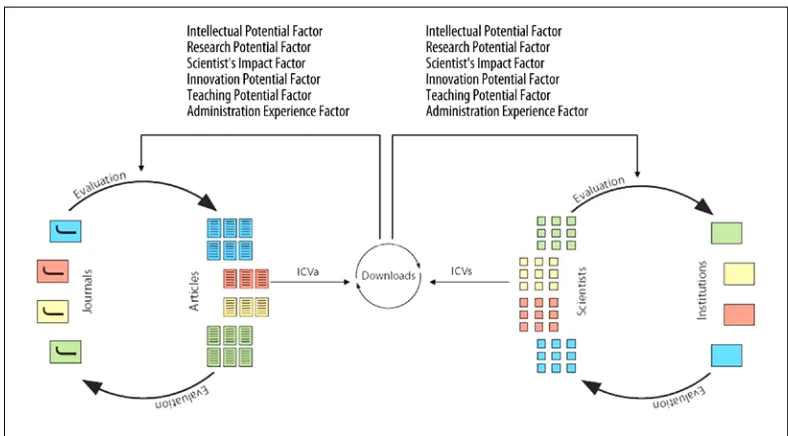
Each of these represents the calculated weight of math-ematical parameters summed up in the Total Index Copernicus Value (ICV). This cumulative parameter describes the overall value of professional career de-velopment with a more precise assessment. “Scientists Index Copernicus” provides uniform methodology for finding personal information and documenting profes-sional achievements. This tool is useful for university administrations in their attempt to keep track of the ac-complishments of their scientists. It provides summa-ries and the dossiers of individual scientists, with their permission, along with a uniform and multi-parameter scoring system that, evaluates:
Therefore, for example if an Article is downloaded by 200 scientists with an average of SICV of 5, its APF will be 200×5/1000=1. Therefore, if the article with the SICV of 5 is downloaded by 100 scientists, its prestige value is higher than an article download-ed by 200 scientists with an average SICV of 2.
• “Research Potential Factor” (RPF) of scientists by calculating a score of:
– the sum of original publications of a scientist in any or selected journals + number and size of grants awarded to the scientist + the number of research projects being conducted by the scientist, as a function of the Index Copernicus Value (ICV), and optionally;
– the “Scientist’s Impact Factor” (pIF) calculated as a number of citations of articles published by a scientist in the current year for articles published in previous two years, divided by the number of ar-ticles published by the scientist in those two years in all journals or in a selected category of journals.
• “Innovation Potential Factor” (IPF) of a scien-tist, based on a cumulative score of the total num-ber of patents issued (and/or pending) to the scien-tist + corresponding foreign patents + number of patents that result in technology development and commercialization.
• “Teaching Potential Factor” (TPF) of a scientist, based on scores for number of publications such as review articles and books + role as advisor or mentor to graduate and postgraduate candidates + partici-pation as faculty for continuing education programs, divided by ICV.
• “Administration Experience Factor” (AEF) of a sci-entist by calculating a score of organizational experi-ence in projects + positions and functions at scientific
institutions, scientific societies and conferences + journals editorial boards membership (Figure 2).
Such multi-parameter evaluation can be useful for making decisions for a scientific degree promotion purposes; search-ing for the best candidates for the position of lead scien-tist in a research group, etc. It also helps to identify and locate researchers with similar scientific interests and ex-perience within a university, country or world community.
The more specific knowledge of the journals evaluation might be deepen after reading patent application, which contains detailed description of the concept and embodi-ments in conjunction with the drawings [9].
c
onclusionsOver decade experience of journals’ multi-parametrical evaluation and 5-years experience in scientist multi-para-metric evaluation Index Copernicus International Plc. cre-ated a unique system, accumulcre-ated huge resources of infor-mation and gathered a unique know-how. After years the company is still open to new challenges, putting on coop-eration with the world of science, far later on profitabili-ty. Index Copernicus still focuses on the development, in-vesting in new ideas, working on a more perfect solution, creating new algorithms of evaluations as well as develop-ing innovative methodologies for the evaluation of scien-tists and institutions. Most of our ideas is still waiting for broaden implementation, what is caused by a strong lobby of systems providing information bibliographic in nature.
However, we are convinced that a single parameter, may not, in the long run, be the primary criterion for assess-ing the value of a scientists, institutions or journals.
It may be justified by the argumentation quoted in this paper that proves the high usefulness of the complex (multiparametric) evaluation of scientists working in large institution, as well as the references to publica-tions providing two important empirical facts.
First of all, a specific character of scientific and didactic activity is easy to lose, due to the transfer of academic teachers’ interests (not connected and often distant from education direction) to the necessity of supervising and ad-ministering the bachelor’s and master’s dissertations [2].
Secondly, creating the rating of universities on the ba-sis of the number and sort of scientific papers published in the journals with specific evaluation indicators i.e. Impact Factor, Hirsch, Index Copernicus Value, minis-terial lists of a particular countries etc. enables almost everyone to systematically compare not only the institu-tions, but also individual scientists and research groups
[10,11]. The benefits are experienced by creative sci-entists as well as each active member of the Knowledge Society, applicants that have to choose the university and the direction of their education, employers, poten-tial sponsor of the science etc.
Hence, basing on the empirical knowledge, solid eval-uation of experience and awareness of unquestionable role of researches and science nowadays and in the fu-ture, in our opinion it is a matter of change in think-ing since the progress made in the last quarter-centu-ry gives a real chance of executing our ideas associated with a very detailed evaluation of science.
Acknowledgement
The article was prepared based on Index Copernicus doc-uments and with the consent of the Index Copernicus International Plc.
1. Kozłowski J: Ewaluacja instytucjonalna w Polsce w świetle porównań międzynarodowych i uwag jednostek naukowych. Departament Strategii Ministerstwa Nauki i Szkolnictwa Wyższego. Warszawa 2010: 4 [in Polish]
2. Barczyński BJ, Bąk R, Czarny W et al.: Preferred by Polish students of physical education subject matter and type of bachelor theses in 2008–2010. Arch Budo, 2011; 7(1): OA41–47
3. European Commission (EU). Science, technol-ogy and innovation in Europe. Luxembourg: Publications Office of the European Union; 2010
4. Barczyński BJ, Graczyński M, Kalina RM: Barriers Restricting the Free Dissemination of Scientific Achievements: Own Experiences in Crossing Walls and Bridges. Jour Hum Kinetics, 2009; (22): 7–14 5. Ustawa z dnia 27 lipca 2005 r. Prawo o szkolnictwie
wyższym (Dz. U. Nr 164, poz. 1365 [in Polish] 6. Ustawa z dnia 18 marca 2011 r. o zmianie ustawy –
Prawo o szkolnictwie wyższym, ustawy o stopniach naukowych i tytule naukowym oraz o stopniach i tytule w zakresie sztuki oraz o zmianie niektórych innych ustaw http://www.bip.nauka.gov.pl/bipmein/redir. jsp?place=galleryStats&id=13930 [in Polish] 7. http://www.respotnet.eu/index.html
8. http://static.patsnap.com/patent/download/pdf/ US20070112778
9. http://static.patsnap.com/patent/download/pdf/ US20080288324
10. Barczyński BJ: Ranking of Polish higher schools based on articles published in Polish sports sci-ence journals indexed by the Polish Ministry of Science and Higher Education. Arch Budo, 2009; 5: OA155–64
11. Barczyński BJ: Preferences of the employees of the Polish Academies of Physical Education concern-ing articles published in Polish journals on sports science and sports medicine, included in the min-isterial list – contribution to scientometric analy-ses from the perspective of the educational aim and of the process of creation of the knowledge society. Arch Budo, 2010; 6(2): OA101–10