
Multiobjective Optimisation Strategy for
Seismic Response Control of Buildings using
Genetic Algorithm
Ravindra S. Desai*1, Shrirang N. Tande2,*1 Assistant Professor, 2 Professor
Applied Mechanics Dept., Walchand College of Engineering Sangli, India.
Abstract Multiobjective optimisation by evolutionary
algorithms is becoming attractive strategy in several disciplines of engineering. This study employs supplemental damping to improve seismic performance of buildings and exploits the power of genetic algorithm, to strategically place the viscous fluid devices throughout the height of building, and optimise the damping provided by them. Interstorey drift and base shear, which serves as important seismic control parameters, are used as two significant objectives for their simultaneous minimisation. Strong ground motions which have shown excessive damage to buildings in the past are used to analyse their effect on set of five and ten storey buildings and subsequent response control by providing damping devices. Comparison of results shows that genetic algorithms are best suited for multiobjective optimisation in seismic response control.
Keywords Multiobjective optimisation, seismic response control, strong motion, energy dissipation devices, genetic algorithm, interstorey drift.
I. INTRODUCTION
An Earthquake energy management in short duration of real time has been a critical challenge to mankind for its uncertainty and devastating effects. It received serious attention of researchers in last three decades owing to substantial life and infrastructural loss all over the globe. Seismic response control is emerging active field of research, wherein, resilient design of buildings is achieved by absorption or dissipation of earthquake input energy. Technological advancement today has allowed practitioners to implement base isolation and supplemental damping solutions, covering large spectrum of devices and control systems, to protect the buildings from undesired response in seismic event of high magnitude. These measures have permitted structural designers to follow a strategy of achieving desired performance objectives in structures without pushing them into collapse state.
The objective of utilizing energy dissipation devices (EDD) is to reduce critical responses of structure and to mitigate damage or collapse of structures from severe earthquakes by participating in energy dissipation. As a successful application, installation of EDD in a building structure, enables control of the story drift within the required limitation and maintains its desired functions during an earthquake event. Since the first application of EDD in structural engineering took place in 1960s, abundant research work has been conducted to study their material characteristics, mechanism and the behaviour of externally damped structures. With the invention of different types of damping devices and systems, improvement of modelling techniques and development of new computational methodologies, use of these devices has become a mature technology in designing of new structures and retrofitting of existing facilities.
Prevailing technology of EDD systems requires economical utilization due to its expensive manufacturing costs and simultaneously achieve expected high-quality performance and reliability. As a result, structural control with optimization of these systems should become an integrated design approach.
II. PASSIVE CONTROL AND OPTIMISATION
STUDIES
The passive energy dissipation systems, such as fluid viscous devices and visco-elastic devices, act as energy sinks and absorb some of the input vibration energy so that less is available to cause deformation of structural elements. Importance of this approach is highlighted and emphasized in several studies ([1],[2],[3],[4]).
were optimized based on controllability index. The guiding principle underlying the method is that a device/controller is optimally placed when it is located at a position where the relative controllability index defined in terms of weighed modal inter-storey drifts is minimum. Though it was done in the context of active control, the concept was very much applicable for addressing the optimal positioning issues in passive control. Zhang and Soong [6] used an intuitive idea of inserting devices one by one at that location where maximum of inter-storey drifts is found at latest cycle, for renewed properties of structure. This was pioneering extension to the controllability index method to address the issue of locating passive dampers. This procedure was called the Sequential Search Algorithm (SSA), which determined the optimal location index by evaluating the random seismic response of a structure using the transfer matrix method. The mean square values of the inter-story drifts were used as optimal location indices. This approach was further extended by Garcia [7] as simplified sequential search algorithm (SSSA) to optimize the computational efforts.
A new approach of passive damper placement with a algorithms in frequency domain solution pioneered by Takewaki [8],[9] was to minimize the sum of the amplitudes of the transfer functions evaluated at the undamped fundamental natural frequency of the structural system. This work was based on the concepts of inverse problem and optimal criteria based design approaches. However, it still lacks the required convincing in its direct use in practical implementation, owing to the fact that neither the current standards nor the practicing structural engineers are tuned to the frequency domain techniques.
Goldberg and Samtani [10] appear to have first suggested the use of genetic algorithms (GA) for structural optimization. They considered the use of a GA to optimize a 10-bar plane truss. Hajela and Lin [11] analysed the potential of GA as function optimizers in the context of structural optimization. He discussed encoding, optimal population size, selection, crossover and mutation over binary alphabets, making an important distinction between random search and genetic search. Rajeev and Khrisnamoorthy [12] used the GA for discrete optimization of generalized trusses.
Lavan et al. [13] and Lavan and Dargush [14] provided a framework for multiobjective optimization methodology in evolutionary computing by GA, to optimize performance of building to given seismic excitation by means of energy dissipation devices. Optimization of interstorey drifts and floor accelerations was demonstrated with Pareto front concept using novel fitness index. Three building were used to demonstrate the methodology and its effectiveness. A 10-storey building with elastic behaviour,
five-story regular yielding shear frame that considers strength reduction and added viscous damping as an additional retrofitting approach are considered. Though this work was able to set certain direction to multiobjective optimization with passive devices, it also admitted the shortfalls in the study. Important to mention is, missing comprehensive characterization of the seismic environment which can take into consideration distribution of devices appropriate to meet specific performance objectives for specific seismic hazard level. Secondly, the methodology focuses more on topology optimization which does not address the exact amount of supplemental damping essential for certain objective.
In this study, problems identified in scientific literature discussed above are addressed sufficiently accurately by using elitism strategy. The strong stochastic characteristics of genetic algorithm (GA) allows global optimization and simultaneously handle multiple objectives of competing nature.
III. GENETIC ALGORITHM PROCEDURE
In order to find optimal designs, the GA processes populations of fittest chromosomes, successively replacing one such population with another. The procedures required to achieve this goal and organize the task in systematic but stochastic way are termed as operators in GA. The simplest form of genetic algorithm involves three types of operators: selection, crossover and mutation.
A. Selection (Reproduction)
The Selection or reproduction is usually the first operation which is exerted on population. In this step, a set of chromosomes are selected from the population as parents. Based on the survival of the fittest, to create the better generation, the best and fittest chromosomes must be selected. Selecting the most prospective chromosomes from the current generation, creating several copies of them and finally putting them into the mating pool is the main goal of several selection methods. At the end of the above step, the mating pool is full. A new population is generated from the parent population of the mating pool. A probabilistic based roulette wheel selection strategy is depicted in figure 1.
B. Crossover (Recombination)
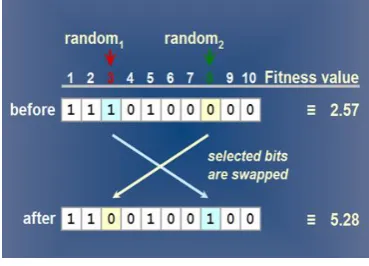
binary coded chromosomes. A crossover rate is percentage of recombination from total number of parent population in mating pool. The crossover probability of 80 % to 99 % is used in general.
C. Mutation
This operator randomly flips bits, 0 to 1 and vice versa, in a chromosome. By this operation few individuals of new population are modified (mutated) to mimic the diversification of population in nature. This operation is performed according to a certain mutation rate or probability on a bit by bit basis. The bits of any individual are mutated independently and randomly. It means that the mutation of an individual bit doesn't affect the mutation probability of other bits. In general, 1% to 2% mutation rate is accepted. The mutation operation is explained in figure 3.
D. Computation in GA
This A simple GA works as follows
1. Start with a randomly generated population of even number of chromosomes (candidate solutions to a problem).
2. Calculate the fitness of each candidate chromosome x in the population.
3. Repeat the following steps until same no. of offspring have been created:
dia. Select a pair of parent chromosomes from the current population, the probability of selection being an increasing function of fitness. Selection is generally done "with replacement," meaning that the same chromosome can be selected more than once to become a parent.
b. With chosen probability of crossover called “crossover probability" or "crossover rate", cross over the pair at a randomly chosen section to form two offspring. There are also "multi−point crossover" versions of the GA in which the crossover rate for a pair of parents is the number of points at which a crossover takes place.
c. Mutate the two offspring at each locus with the mutation probability or mutation rate, and place the resulting chromosomes in the new population. If population size is odd, one member from new population can be discarded at random.
4.Replace the current population with the new population.
Each iteration of this process is called a generation. A GA is typically iterated for anywhere from 50 to 500 or more generations. The entire set of generations is called a run. At the end of a run there are often one or more highly fit chromosomes in the population.
Fig. 1 A Roulette wheel selection strategy
(http//www.edc.ncl.ac.ukhighlight-rhjanuary-2007g02.php)
Fig. 2 Crossover operation
(http//www.edc.ncl.ac.ukhighlight-rhjanuary-2007g02.php)
Fig. 3 Mutation operation
(http//www.edc.ncl.ac.ukhighlight-rhjanuary-2007g02.php)
IV. MULTIOBJECTIVE OPTIMISATION
PROBLEM AND SEISMIC ANALYSIS
the limits prescribed by code. Hence, these two quantities are used as simultaneous performance objectives to be handled by GA for multiobjective optimization. The goal of GA chosen in this study is to select the optimized amount of damping and device placement which results in minimizing both base shear and interstorey drifts simultaneously.
Set of 5 storeys and 10 storey buildings are considered for investigation with and without dampers installed. The structural properties of these buildings are chosen in such a way that they provide sufficient range of periods to obtain meaningful results of optimization analysis. In order to compare the performance of optimal solution, a uniform device placement strategy is also followed which minimizes interstorey drifts and base shear both.
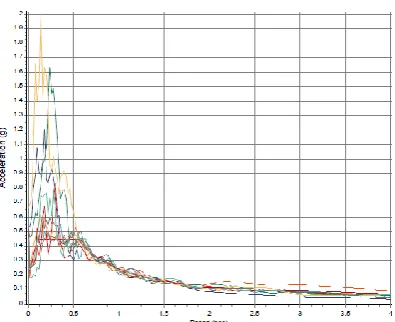
Fig. 4 DBE spectrum matched ground motion time histories (Ref. Table I)
The ground motion chosen for the analysis are as shown in Table I. These motions are selected with magnitude and peak ground acceleration such that they represent sufficient damage in the past. These ground motion are scaled, as shown in figure 4, by the SEISMOMATCH [15] code, which follows a procedure given by Al-Atik and Abramson [16]. The spectral matching is carried out in such a way that, they are period matched for each building under consideration, for design basis earthquake (DBE) response spectrum indicated in IS1893-2002 [17].
In order to quantify results and demonstrate the usefulness of multiobjective optimization the viscous fluid dampers (FVD) are used as EDD.
V. STRUCTURE AND DEVICE MODELING
A. Viscous fluid dampers (FVD)
The generalized characteristic relation of FVD is stated as
(1)
Where x with dot over head is relative velocity across ends of device. cd is a generalized damping
coefficient and α may take values in the range of about 0.25 to 2. That is, the damper may exhibit nonlinear viscous behaviour (the case a α= 1 is that of a linear device and appropriate for earthquake analysis). The force-displacement hysteresis relation indicating energy dissipation characteristics of such devices is as shown in figure 5.
B. Buildings modelling
Two set of reinforced concrete (RCC) buildings are considered in this study to determine the efficacy of optimization algorithm. First set of building models consists of six number of 5 storey buildings and the other set consists of six number of 10 storey buildings. These buildings are designed sing ETAB® software as per IS1893-2002 and IS456-2000 [18]. An imposed load of 3kN/m2 and normal brickwork masonry in the walls is used with height of each storey 3.2m. One of principal direction (Y) is deliberately designed to violate drift criteria for the purpose of evaluating amount of damping and subsequent optimization. The plan layout of each set is as shown in figure 6.
TABLE I
Ground motions used for analysis.
Ground motion
Station or Site
Magnitude (Richter)
PGA (g)
Elcentro Earthquake,
1940
Elcentro
Array #9 6.9 0.348
West Washington Earthquake, 1965
Olympia
6.7 0.279
Koyana Dam, Earthquake,
1967
Koyana 1A
Gallery 6.5 0.487
Uttarkashi Earthquake,
1991
Bhatwari
6.8 0.246
North Ridge Earthquake,
1994
San
Bernardino 6.7 0.582
Park Field Earthquake,
1982
San Luis
Obisbo 6.2 0.354
Imperial Valley Earthquake,
1940
Imperial Valley Irrigation district, California
Table II
Seismic response results of multiobjective analysis and saving in damping [5 storey]
Bui ld ing . G round m ot ion Bui ld ing s ta tus Inter-storey drift ratio [Actual on Limiting] (Unsafe if >1) Base shear as fraction of seismic weight of building . Total damp. value (kN/m/s) % Saving in dampi-ng A1 W . W a shi ng ton
I 1.086 0.398 NA
II 1.000 0.367 1833
III 0.957 0.353 1223 36.71
IV 0.946 0.348 1454 24.75
A2 E lc e n tro
I 1.128 0.340 NA II 1.000 0.306 5718
III 0.950 0.304 3971 35.10 IV 0.960 0.297 4465 27.01
A3 U tt a rk a shi
I 1.129 0.295 NA II 1.000 0.269 7868
III 0.903 0.262 5352 31.97 IV 0.900 0.258 6779 13.84
A4 U tt a rk a shi
I 1.265 0.281 NA II 1.000 0.230 10624
III 0.898 0.221 7643 34.25 IV 0.881 0.219 8363 28.06
A5 P a rk F ie
ld I 1.330 0.258 NA II 1.000 0.198 9041
III 0.938 0.186 6412 36.14 IV 0.927 0.184 6703 33.24
A6 U tt a rk a shi
I 1.404 0.255 NA II 1.000 0.191 15721
III 0.914 0.182 10275 42.02 IV 0.848 0.166 14991 15.40
I-Bare Frame II-Uniform Damping III-Optimal plan-1 IV-Optimal plan 2
VI. MULTIOBJECTIVE OPTIMISATION
RESULTS AND DISCUSSION
As discussed earlier, genetic algorithm implementing elitism procedure is developed in this study and implemented to verify the effect of objective priorities on drift and shear control of
Fig. 5 Fluid viscous damper (FVD) ideal hysteresis loop
X
Y
4 4 4 4 4 4 4
X
Y
4 4 4 4
4 4 4
4 4
Fig. 6 Plan of 5 storey(left) and 10 storey (right) buildings
buildings. Two different strategies are investigated. In the first strategy (optimal plan-1) the priority was set for shear rather than drift, accordingly weightage of shear control was set to 80% and drift control to 20%. In second strategy (optimal plan-2) the priority was reversed i.e. drift at 80% and shear at 20%. With these considerations, in this study, results are discussed for multiobjective optimization.
The 5 and 10 storey buildings were subjected to one of these excitations which could match the level of shaking due to DBE response spectrum at fundamental time period of building under consideration.
Table II shows results for 5 storey buildings and Table III shows results for 10 storey buildings with and without FVD.
Table III
Seismic response results of multiobjective analysis and saving in damping [10 storey]
Bui ld ing . G round m ot ion Bui ld ing s ta tus Inter-storey drift ratio [Actual on Limiting] (Unsafe if >1) Base shear as fraction of seismic weight of building . Total damp. value (kN/m/s) % Saving in dampi-ng B1 Im pe ri al V a ll e
y I 1.084 0.221 NA
II 1.000 0.211 16758
III 0.973 0.208 10345 38.27
IV 0.963 0.207 11264 32.78
B2
K
oya
na
I 1.166 0.203 NA II 1.000 0.183 28817
III 0.936 0.169 19471 32.43 IV 0.933 0.169 21168 26.55
B3 Im pe ri al V a ll e
y I 1.119 0.158 NA II 1.000 0.144 34915
III 0.956 0.144 20783 40.48
IV 0.975 0.139 24322 30.34
B4
K
oya
na
I 1.366 0.1641 NA II 1.000 0.1465 54701
III 1.000 0.1296 34842 36.31 IV 1.000 0.1294 37813 30.87
B5 Im pe ri al V a ll e
y I 1.291 0.1338 NA
II 1.000 0.1084 67120
III 0.964 0.1064 45660 31.97
IV 0.970 0.1024 50004 25.50
B6
N
ort
hr
idge
I 1.552 0.1466 NA II 1.018 0.1283 97632
III 1.003 0.1143 58918 39.65 IV 1.000 0.1170 59532 39.02
I-Bare Frame II-Uniform Damping III-Optimal plan-1 IV-Optimal plan 2
VII. CONCLUDING REMARKS
This study has developed multiobjective genetic algorithm to study the mutual effect of drift control and shear control which serves as competing objectives and results of all analyses are examined in
detail. The objective of achieving seismic response control in desired manner is verified through important criteria of maximum interstorey drifts and maximum base shear. Analysis results of 5 and 10 storey buildings with and without providing supplemental damping by FVD are compared. To verify the efficacy of optimal control genetic algorithm developed in this study, responses and damping distribution are compared with that of uniform damping.
Comparison of results shows that genetic algorithms are best suited for multiobjective optimisation in seismic response control. The multiobjective strategies provide clear scenario and more power in decision making process, so that designer can set and achieve goals as per his priorities.
REFERENCES
[1] Hahn G.D. and Sathiavageeswaran K.R., “Effects of added-damper distribution on the seismic response of buildings,” Computers &Structures, vol. 43(5), pp. 941– 950, 1992.
[2] Chang K.C., Soong T.T., Oh S.T., and Lai M.L., “Seismic behavior of steel frame with added viscoelastic dampers,” Journal of Structural Engineering, ASCE, 121(10), 1995. [3] Soong T.T. and Spencer B.F., “Supplemental Energy
Dissipation: State-of-the-Art and State of-the Practice,” Engineering Structures, vol. 24, pp.243-259, 2002. [4] Adachi F, Fujita K, Tsuji M. and Takewaki I.,
“Importance of interstorey velocity on optimal along height allocation of viscous oil dampers in super high-rise buildings,” Engineering Structures, vol. 56, pp. 489–500, 2013.
[5] Cheng F. Y. and Pantelides C. P., “Optimal placement of actuators for structural control,” Technical Report NCEER-88-0037, State University of New York, Buffalo, New York., 1998.
[6] Zhang R.H. and Soong T.T., “Seismic design of viscoelastic dampers for structural applications,” Journal of Structural Engineering, vol. 118 (5), pp.1375–1392, 1992.
[7] Garcia Lopez D., “A simple method for the design of optimal damper configurations in MDOF structures,” Earthquake Spectra, vol. 17 (3), pp.387–398, 2001. [8] Goldberg D.E. and Samtani M.P., “Engineering
optimization via genetic algorithm,” in: Ninth Conference on Electronic Computation. New York, ASCE, pp.471-482. 1986.
[9] Takewaki I., “Optimal damper placements for minimum transfer functions,” Earthquake Engineering & Structural Dynamics, vol. 26(11), pp.1113–1124, 1997.
[10] Takewaki I., “Optimal damper placement for planar building frames using transfer functions,” Structural and Multidisciplinary Optimization, vol.20(4), 280–287, 2000. [11] Hajela P. and Lin C.Y., “Genetic search strategies in multi-criterion optimal design,” Structural Optimization, vol. 4, pp. 99-107, 1992.
[12] Rajeev S and Khrisnamoorthy C.S., “ Discrete Optimization of Structures using Genetic Algorithms,” Journal of Structural Engineering, ASCE, vol. 118(5), 1233-1250, 1992.
[14] Lavan O. and Dargush G.F., “ Multi objective evolutionary seismic design with passive energy dissipation systems,”, Journal of Earthquake Engineering, ASCE, vol. 13, pp. 758–790, 2009.
[15] (2016) The seismosoft.com website. [Online]. Available: http://www.seismosoft.com/SeismoMatch-2016-Release-1 [16] Al-Atik L. and Abrahamson N.A., "An improved method
for nonstationary spectral matching," Earthquake Spectra, Vol. 26, No. 6, pp. 601-617, 2010.
[17] IS1893 (Part 1)-2002, “Criteria for Earthquake Resistant Design of Structures, Part 1,” General Provisions and Buildings (Fifth Revision), Bureau of Indian Standards (BIS), 2002.
Table II
Seismic response resultsof multiobjective analysisand saving in damping [5 storey]
Bldg. Ground motion Building status with damping
category.
Interstorey drift ratio [Actual on Limiting] (Unsafe if
>1)
Base shear as fraction of seismic
weight of building.
Total damping
value (kN/m/s)
% Saving in damping
A1 West Washington
Bare frame 1.086 0.398 NA
Uniform damping 1.000 0.367 1833
Optimal plan-1 0.957 0.353 1223 36.71
Optimal plan-2 0.946 0.348 1454 24.75
A2 Elcentro
Bare frame 1.128 0.340 NA
Uniform damping 1.000 0.306 5718
Optimal plan-1 0.950 0.304 3971 35.10
Optimal plan-2 0.960 0.297 4465 27.01
A3 Uttar-Kashi
Bare frame 1.129 0.295 NA
Uniform damping 1.000 0.269 7868
Optimal plan-1 0.903 0.262 5352 31.97
Optimal plan-2 0.900 0.258 6779 13.84
A4 Uttar-Kashi
Bare frame 1.265 0.281 NA
Uniform damping 1.000 0.230 10624
Optimal plan-1 0.898 0.221 7643 34.25
Optimal plan-2 0.881 0.219 8363 28.06
A5 Park Field
Bare frame 1.330 0.258 NA
Uniform damping 1.000 0.198 9041
Optimal plan-1 0.938 0.186 6412 36.14
Optimal plan-2 0.927 0.184 6703 33.24
A6 Uttar-Kashi
Bare frame 1.404 0.255 NA
Uniform damping 1.000 0.191 15721
Optimal plan-1 0.914 0.182 10275 42.02
Table III
Seismic response results of multiobjective analysisand saving in damping [10 storey]
Bldg. Ground motion Category Interstorey drift ratio [Actual on Limiting ] (Unsafe if >1)
Base shear as fraction of seismic weight
Total damping
value (kN/m/s)
% Saving in damping
B1 Imperial Valley
Bare frame 1.084 0.221 NA
Uniform damping 1.000 0.211 16758
Optimal plan-1 0.973 0.208 10345 38.27 Optimal plan-2 0.963 0.207 11264 32.78
B2 Koyana
Bare frame 1.166 0.203 NA
Uniform damping 1.000 0.183 28817
Optimal plan-1 0.936 0.169 19471 32.43 Optimal plan-2 0.933 0.169 21168 26.55
B3 Imperial Valley
Bare frame 1.119 0.158 NA
Uniform damping 1.000 0.144 34915
Optimal plan-1 0.956 0.144 20783 40.48 Optimal plan-2 0.975 0.139 24322 30.34
B4 Koyana
Bare frame 1.366 0.1641 NA
Uniform damping 1.000 0.1465 54701
Optimal plan-1 1.000 0.1296 34842 36.31 Optimal plan-2 1.000 0.1294 37813 30.87
B5 Imperial Valley
Bare frame 1.291 0.1338 NA
Uniform damping 1.000 0.1084 67120
Optimal plan-1 0.964 0.1064 45660 31.97 Optimal plan-2 0.970 0.1024 50004 25.50
B6 North Ridge
Bare frame 1.552 0.1466 NA
Uniform damping 1.018 0.1283 97632

![Table II Seismic response resultsof multiobjective analysisand saving in damping [5 storey]](https://thumb-us.123doks.com/thumbv2/123dok_us/8585779.1719867/8.595.80.518.106.541/table-seismic-response-resultsof-multiobjective-analysisand-saving-damping.webp)
![Table III Seismic response results of multiobjective analysisand saving in damping [10 storey]](https://thumb-us.123doks.com/thumbv2/123dok_us/8585779.1719867/9.595.81.519.128.556/table-seismic-response-results-multiobjective-analysisand-saving-damping.webp)
