Nat. Hazards Earth Syst. Sci., 14, 1819–1833, 2014 www.nat-hazards-earth-syst-sci.net/14/1819/2014/ doi:10.5194/nhess-14-1819-2014
© Author(s) 2014. CC Attribution 3.0 License.
Estimation of synthetic flood design hydrographs using a distributed
rainfall–runoff model coupled with a copula-based single storm
rainfall generator
A. Candela1, G. Brigandì2, and G. T. Aronica2
1University of Palermo, Dipartimento di Ingegneria Civile, Ambientale, Aerospaziale e dei Materiali, Palermo, Italy 2University of Messina, Ingegneria Civile, Informatica, Edile, Ambientale e Matematica Applicata, Messina, Italy Correspondence to: A. Candela ([email protected])
Received: 5 November 2013 – Published in Nat. Hazards Earth Syst. Sci. Discuss.: 2 January 2014 Revised: 20 May 2014 – Accepted: 2 June 2014 – Published: 24 July 2014
Abstract. In this paper a procedure to derive synthetic flood design hydrographs (SFDH) using a bivariate representation of rainfall forcing (rainfall duration and intensity) via copu-las, which describes and models the correlation between two variables independently of the marginal laws involved, cou-pled with a distributed rainfall–runoff model, is presented. Rainfall–runoff modelling (R–R modelling) for estimating the hydrological response at the outlet of a catchment was performed by using a conceptual fully distributed procedure based on the Soil Conservation Service – Curve Number method as an excess rainfall model and on a distributed unit hydrograph with climatic dependencies for the flow routing. Travel time computation, based on the distributed unit hy-drograph definition, was performed by implementing a pro-cedure based on flow paths, determined from a digital eleva-tion model (DEM) and roughness parameters obtained from distributed geographical information. In order to estimate the primary return period of the SFDH, which provides the prob-ability of occurrence of a hydrograph flood, peaks and flow volumes obtained through R–R modelling were treated sta-tistically using copulas. Finally, the shapes of hydrographs have been generated on the basis of historically significant flood events, via cluster analysis.
An application of the procedure described above has been carried out and results presented for the case study of the Imera catchment in Sicily, Italy.
1 Introduction
Floods are a global problem and are considered the most frequent natural disaster worldwide. They may have serious socio-economic impacts in a community, causing victims, population displacement and damages to the environment, ecology, landscape and services.
Flood risk analysis and assessment are required to provide information on current or future flood hazard and risks in order to accomplish flood risk mitigation, to propose, eval-uate and select measures to reduce risk. Thus, the European Parliament has adopted the new Directive 2007/60/EC (Eu-ropean Union, 2007) that requires member states to assess if coastal areas and water courses are at risk from flood-ing, to produce flood risk maps and take measures to miti-gate the consequent risk. The objective of this directive is to establish a framework for the assessment and management of flood risk in Europe, emphasising both the frequency and magnitude of a flood as well as its consequences.
Reliable estimates of the likely magnitude of the extreme floods are essential in order to reduce future flood damages. Despite the occurrence of extreme floods, a problem across Europe, physical mechanisms responsible for the generation of floods will vary between countries and regions. As a re-sult, no standardised European approach to flood frequency estimation exists. Where methods exist, they are often sim-ple and their ability to predict accurately the effect of envi-ronmental change (e.g. urbanisation, land-use change, river training and climate change) is unknown.
Moreover, Mediterranean water courses have specific features compared to other river systems. Mediterranean
1820 A. Candela et al.: Estimation of synthetic flood design hydrographs
catchments are, in fact, generally small, with extents of a few hundred km2, highly torrential and may generate flash floods (Brigandì and Aronica, 2008; Koutroulis and Tsanis, 2010; Aronica et al., 2012a; Camarasa-Belmonte and Sori-ano, 2012). Runoff generation in those areas is the final re-sult of numerous spatial and temporal complex processes that take place at the hillslope and on catchment scale. The com-plexity of the processes involved derives from the great het-erogeneity of rainfall inputs, surface and subsurface charac-teristics, and a strong nonlinear dependency on antecedent wetness which controls the infiltration capacity of the soil surface and the connectivity of surface and subsurface runoff pathways (Nicolau et al., 1996; Candela et al., 2005).
The flood frequency analysis (FFA) estimates how often a specified event will occur and aims to evaluate the flood event in terms of a maximum discharge value corresponding to a given return period and/or relative volume. The proba-bility of future events can be predicted by fitting the past ob-servations to selected probability distributions. Flood event estimation (hydrograph design) requires the use of different methods depending on whether it is enough to know the max-imum discharge value or whether it is necessary to know the full hydrograph. In both cases, the problem can be solved directly, starting from flow measurements available for the catchment, or indirectly using rainfall data recorded as input for a rainfall–runoff model. This latter approach is the basis of the derived distributed approach methods (DDA methods) that allow one to derive flood hydrographs using rainfall– runoff models. Analytical difficulties associated with this ap-proach are, often, overcome by adopting numerical Monte Carlo methods. In these cases, a stochastic rainfall genera-tor is used in order to generate rainfall data for a single event or continuously (Blöschl and Sivapalan, 1997; Loukas, 2002; Rahman et al., 2002; Aronica and Candela, 2007).
FFC analysis is, usually, based on the derivation of FFC to define the maximum discharge value corresponding to a given return period only. However, for flooding management, it is not enough to know information about flood peaks only, but it is also useful to evaluate flood volume and hydrograph duration statistically. Since flood peaks and corresponding flood volumes are variables of the same phenomenon, they should be correlated and, consequently, bivariate statistical analyses should be applied (Serinaldi and Grimaldi, 2011; Aronica et al., 2012b).
In general, bivariate (multivariate) probability models were limited by mathematical difficulties due to the genera-tion of consistent joint laws with ad hoc marginals. Actually, copulas have overcame many of these problems (Salvadori et al., 2007), as they are able to model the dependence structure independently of the marginal distributions.
Several authors have presented hydrological applications with copula implementation as complex hydrological phe-nomena such as floods, storms, and droughts. For all these phenomena it is fundamental to be able to link to each other the marginal distributions of different variables (De Michele
and Salvadori, 2003; Favre et al., 2004; Salvadori and De Michele, 2004, 2010; Grimaldi and Serinaldi, 2006; Dupuis, 2007; Zhang and Singh, 2007; Kao and Govindaraju, 2010; Klein et al., 2010; Vandenberghe et al., 2010; Aronica et al., 2012b; Serinaldi, 2013; Sraj et al., 2014g). Particularly, De Michele et al. (2005), Requena et al. (2013) and Gräler et al. (2013) used copulas for modelling statistical depen-dence between flood peaks and volume for hydraulic design purposes.
The aim of the paper is to propose an indirect procedure for the estimation of synthetic flood design hydrographs us-ing a bivariate representation (via copulas) of rainfall (rain-fall duration and intensity), used as forcing input to a dis-tributed rainfall–runoff model for assessing the hydrological response of a catchment. Specifically, the proposed proce-dure is based on a single-event approach and not on a contin-uous simulation.
In fact, despite several authors showing how “continuous simulation” schemes that consist of generating long synthetic rainfall time series and transforming them through a contin-uous rainfall–runoff model could be preferable with respect to “event-based” schemes for the SFDH definition (Verhoest et al., 2010; Grimaldi et al., 2012b), this requires complex rainfall–runoff models to simulate hydrological response and the availability of long continuous and reliable time series of hydrological variables such as rainfall and discharge. When, as in many real-world cases, available data are not sufficient to allow the calibration of a continuous (and often with a complex structure) rainfall–runoff model, an event-based ap-proach could be preferable, because it is easily applicable and affected by fewer errors and total uncertainties (Wagener et al., 2004).
An important aspect to be considered in the estimation of the SFDH is the choice of an appropriate return period. Sev-eral authors found (see for instance Salvadori et al., 2011; Gräler et al., 2013; Requena et al., 2013; Volpi and Fiori, 2014) how different return periods estimated by fitted copu-las could be considered. Between them, the primary return period, which provides the probability of occurrence of a flood hydrograph, was selected in this study. In order to esti-mate it, peaks and flow volumes obtained through R–R mod-elling were treated statistically via copulas. Finally, the shape of the hydrograph was generated on the basis of a modelled flood event, via cluster analysis.
2 Case study
A. Candela et al.: Estimation of synthetic flood design hydrographs 1821
3 Figure 1
1 2
Riesi Canicattì
Caltanissetta
Delia
Mazzarino Enna Petralia Sott.
Polizzi
Drasi
100 200 300 400 500 600 700 800 900 1000 1100 1200 1300 1400 1500 1600 1700 1800
0 km 10 km 20 km 3
4 Figure 1. Imera catchment layout.
hot dry summers and a rainy winter season from October to April and the hydrological response is greatly dependent on the soil water initial state, which is highly variable because of the large range of weather conditions. The measurement network (Fig. 1) consists of eight raingauges (Canicattì, Cal-tanissetta, Delia, Mazzarino, Enna, Riesi, Petralia Sottana, Polizzi Generosa) located within the catchment and charac-terised by a temporal resolution of 10 min, and of one flow-gauge (Drasi). Historical series of rainfall are available from 1960 up to date on an hourly basis and from 2001 up to date on a 10 min basis, while discharges are available only on an hourly basis. Unfortunately the hourly series (rainfall and discharges) shows many gaps, especially in the periods of high flows. A digital elevation model characterised by a resolution of 200 m with a grid of 278×399 pixels is also available for this catchment.
3 Methodology
This section describes in detail the proposed procedure to derive SFDH whose layout can be summarised as fol-lows: (1) stochastic generation of rainfall to derive single synthetic rainfall events by a bivariate analysis based on cop-ulas; (2) rainfall–runoff modelling for the estimation of the hydrological response at the outlet of the catchment using a conceptual fully distributed model; (3) derivation of
syn-thetic hydrographs (for a given design return period) by bi-variate analysis of rainfall–runoff outputs.
3.1 Stochastic generation of rainfall
The hydrological input was derived by using a stochastic model to derive single synthetic sub-hourly rainfall events (Brigandì, 2009; Brigandì and Aronica, 2013). Generated rainfall events are totally stochastic but with characteristics in terms of shape, duration and average intensity that have to satisfy the parameters derived by statistical analyses of the available historic records.
Stochastic generation of rainfall was based on the imple-mentation of the two following modules:
– Intensity–duration (statistical description and genera-tion of storm characteristics using a bivariate model). – Temporal pattern (generation of within-storm temporal
characteristics as time step intensity variations, using simple statistical descriptors).
3.1.1 Intensity–duration module
Since storm duration, average intensity or rainfall volumes are variables of the same phenomenon, they should be correlated. Consequently, these variables have to be anal-ysed jointly through bivariate models and, particularly, those based on the theory of copulas.
In a two-dimensional context, copulaCis a function which represents the joint distribution function of two dependent random variables uniformly distributed between 0 and 1:
C(u1, u2)=Pr{U1≤u1, U2≤u2}, (1) whereu1andu2 denote realisations. Let two random vari-ables beXandY, with their marginal distribution functions
Fx(x)andFy(y). Through a change of variables
Fx(x)=U1; Fy(y)=U2 (2) it is possible to obtain the bivariate cumulative distribution function, as expressed by the theorem of Sklar (1959): Pr(X≤x;Y≤y)=FX,Y(x, y)=C(Fx(x), Fy(y)). (3)
The advantage of the copula method is that no assumption is needed for the variables to be independent or have the same type of marginal distribution. More information and appli-cations about copulas can be found in Nelsen (2006) and Genest and Favre (2007).
A particular subclass of copulas, called Archimedean, is widely used for hydrological applications, given many use-ful properties and particularly given their easy construction. More in particular, because storm duration and average rain-fall intensity are variables negatively correlated with each other, the Frank copula was considered for this application because of its ability to model both positive and negative
1822 A. Candela et al.: Estimation of synthetic flood design hydrographs
correlations (Favre et al., 2004; Zhang and Singh, 2007). De Michele and Salvadori (2003) found, in fact, how the Frank copula is the best candidate for modelling the dependence be-tween average rainfall intensity and storm duration in com-parison with other families of copulas, and also for reproduc-ing the asymptotic statistical distribution of the storm depth. In the present study, Frank’s family class of 2-copulas were considered:
C(u1, u2)= − 1 θln
1+(exp(−θ u1)−1) (exp(−θ u2)−1) exp(−θ )−1
(4) with generation function
ϕ(t )=ln
exp(θ t )−1
exp(θ )−1
and t=u1 or u2, (5)
whereθ is the parameter of a copula function that is related to the Kendall coefficient of correlationτ betweenXandY
through the expression
τ =1−411(−θ )−1
θ , (6)
where11is the first-order Debye function.
The first step in determining a copula is to obtain its generating function from bivariate observations. The proce-dure to calculate the generating function and the resulting copula followed in this study was described by Genest and Rivest (1993). It assumes that for a random sample of bi-variate observations (x1, y1), (x2, y2), . . . , (xN, yN)the
un-derlying distribution function HX,Y(x, y)has an associated
Archimedean copula C(u1, u2)which can also be regarded as an alternative expression of the joint cumulative distribu-tion funcdistribu-tion (CDF). The procedure involves the following steps, all implemented through the use of Matlab©routines:
1. Determine Kendall’sτ from observations.
2. Determine the copula parameterθfrom the above value ofτ using Eqs. (5) and (6). For the Frank copula fam-ilies introduced above, theθparameter needs to be de-termined numerically, since there are no closed-form re-lations betweenτ andθ.
3. Obtain the copula having calculated the copula param-eter θ. One can also obtain the generating function of each copula, since the generating function is expressed in terms of the copula parameter.
Moreover, the use of copulas requires the determination of marginal distributions based on univariate data. Therefore, fitting of several extreme value distributions was considered, i.e. exponential, Gamma, Weibull and two-parameter lognor-mal distribution functions:
F (x)=1−exa (7a)
F (x)= 1
ba0(a) x Z
0
ta−1e−btdt (7b)
F (x)=1−e−(xa) b
(7c)
F (x)= 1
b
√
2π
x Z
0
e−
[ln(t )−a]2 2b2
t dt (7d)
These are one or two parameter distributions, allowing for various degrees of model complexity. Three parameter dis-tributions were not considered for this application, given the reduced size of the samples.
3.1.2 Rainfall temporal pattern submodel
In order to define the temporal patterns of rainfall for each event, the mass curves concept, as similarly implemented by other various authors (Huff, 1967; Garcia-Guzman and Aranda-Oliver, 1993; Chow et al., 1988), was considered here. Following this kind of approach the variability of pre-cipitation within a rainy period is represented by a dimen-sionless hyetographH (d), defined as follows:
H (d)= 1
I·D
t Z
0
h(t )dt , (8)
which identifies the fraction of rainfall accumulated over the time interval [0, d]. In Eq. (8), t (0≤t≤D) is a fraction of the total durationDof the considered event and, conse-quently,d=t /D(0≤d≤1)is the corresponding dimension-less duration,h(t )is the rainfall depth at timet (0≤h≤V ),
V =I·Dis the total storm volume andDthe storm duration for the event.
The normalised events obtained are the input for selecting an appropriate probability function for the hyetograph shape. Although any continuous density function could be appro-priate to represents the shape for every analysed time step between 0 and 1, here the choice was orientated towards the Beta distribution because it is a very simple model that fits reasonably well this kind of rainfall data.
The Beta cumulative distribution function for a given value
xand a given pair of parametersaandbis
F (x)= 1
B(a, b)·
x Z
0
ta−1(1−t )b−1dt, (9)
whereB(a, b)is the Beta function
B(a, b)=
1
Z
0
ta−1(1−t )b−1dt=0(a)·0(b)
0(a+b) (10)
A. Candela et al.: Estimation of synthetic flood design hydrographs 1823
Table 1. Information and statistics of the rainfall data for 80 events
registered from 2010 to 2011.
Intensity Volume Duration (mm h−1) (mm) (min)
Max 26.02 156.2 2060.0
Min 1.62 18.0 170.0
Mean 5.04 66.9 975.0
Standard deviation 3.76 27.6 453.0
3.2 Rainfall–runoff modelling
In Mediterranean areas, intense weather phenomena, respon-sible for the flood events, are often characterised by high spatial variability. For this reason, in this study a conceptual fully distributed model with climatic dependencies for the flow routing, derived starting from a semi-distributed model presented by Di Lorenzo (1993), was proposed and imple-mented.
This model is characterised by a parsimonious structure (Jakeman and Hornberger, 1993) which was preferred over more complex models because of its simplicity and ability to approximate catchment runoff behaviour characterised by a fast hydrological response, small areas and inadequate hy-drological data.
The proposed model is based on the representation in the form of a linear kinematic mechanism of transfer of the full outflows coming from different contributing areas of the catchment through the definition of a distributed hydrologi-cal response array with climatic characteristics.
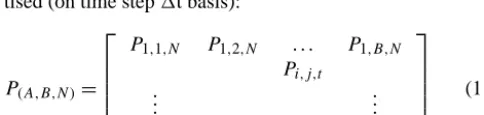
Rainfall inputs are, hence, distributed in space and varying in time. They are represented by a three-dimensional matrix P of order (A,B,N ), whereAandBare the number of cells into which the catchment was divided in the directionxand
y, andN represents the number of intervals into which the rainfall event of duration (withN=/1t) was discre-tised (on time step1t basis):
P(A,B,N )=
P1,1,N P1,2,N . . . P1,B,N
Pi,j,t
..
. ...
PA,1,N PA,2,N · · · PA,B,N
(11)
In Eq. (11) the generic termPi,j,t represents the rainfall,
ex-pressed in mm, falling on the cell of coordinatesi,jat timet. To transform the gross rainfall into effective rainfall, the SCS–CN method, adopted by the USDA Soil Conservation Service (1986), was used here. This method allows one to incorporate information on land-use change, as the CN is a function of soil type, land use, soil cover conditions and de-gree of saturation of the soil before the start of the storm.
Since a precipitation variable in time was considered, the runoff volume, Pe,i,j,t, was calculated in a dynamic form
(Chow et al., 1988; Montaldo et al., 2007; Grimaldi et al.,
4 Figure 2 1 2 0 0.2 0.4 0.6 0.8 1
0 0.2 0.4 0.6 0.8 1
Theo reti ca l co pul a Empirical copula 0.00 0.20 0.40 0.60 0.80 1.00
0.00 0.50 1.00
K(z), K N (z) z Empirical Theoretical 3 4
Figure 2. Comparison between empirical joint distribution and best
fitted copula. Goodness test for Frank’s copula.
5 Figure 3 1 0 0.2 0.4 0.6 0.8 1
0 10 20 30
P I (mm/h) Empirical Theoretical (LogNormal) 0 0.2 0.4 0.6 0.8 1
0 1000 2000 3000
P D (min) Empirical Theoretical (Weibull) 2 3
Figure 3. Plotting position: average intensity and duration.
2012a) as a function of the storm depthPi,j,t, given initial
abstraction,Ia,i,j =cSi,j, and the infiltrated volume,Fi,j,t,
according to the following expression:
Pe,i,j,t=
0 Pi,j,t< c·Si,j
Pi,j,t−c·Si,j−Fi,j,t Pi,j,t> c·Si,j (12)
withFi,j,t calculated with the following expression:
Fi,j,t=
Si,j· Pi,j,t−c·Sa,i,j
Pi,j,t−c·Sa,i,j+Si,j
(13) and
Si,j=254·
100
CNi,j
−1
. (14)
The CNi,j parameter was also defined in a distributed form
starting from a map of its spatial distribution obtained on the basis of the knowledge of soil types, land use and hydrologic soil types. Using Eqs. (12)–(14), the matrix of effective rain-falls Pe was obtained with the same structure of the matrix (Eq. 11).
The matrixHof order (2, A, B) describes the hydrologi-cal response of the catchment and represents the space–time distribution of contributing areas (isochrone areas). It can be derived starting from the knowledge of the concentration time for each cell within the catchment:
H(2,A,B)=
H1,1,1 H1,1,2 . . . H1,1,B
Hn,i,j
..
. ...
H2,A,1 H2,A,2 · · · H2,A,B
(15)
1824 A. Candela et al.: Estimation of synthetic flood design hydrographs
Table 2. Marginal distribution parameters and goodness of fit
re-sults for average intensity (I).
a b AIC RRMSE A-D∗
Exponential 5.03644 – 420.672 13.890 10.557
Gamma 3.31078 1.52123 376.565 7.91708 3.099
Weibull 5.67845 1.57408 394.866 10.3672 4.928
Lognormal 1.45814 0.51516 357.209 5.84947 1.411
* Critical value for 95% significance level=2.492.
Table 3. Marginal distribution parameters and goodness of fit
re-sults for duration (D).
a b AIC RRMSE A-D∗
Exponential 16.2542 – 608.136 56.130 9.588
Gamma 3.84882 4.22315 554.563 10.590 0.808
Weibull 18.3596 2.32434 549.195 6.842 0.451
Lognormal 2.65285 0.56908 564.288 18.451 1.522
* Critical value for 95% significance level=2.492.
whereH2,i,jrepresents the cell surface of theiandj
coordi-nates and concentration timeϑn(withϑn=ϑcatch/n·1t, and
n=1,2, . . ., 2) and2is the number of intervals in which catchment concentration timeϑcatchis discretised.
In particular, in order to derive the concentration time at cell scale, the Wooding formula (1965) was used here:
ϑi,j =
L3i,j/5→out ki,j→3/5 out·si,j→3/10out·ri,j2/5
, (16)
whereLi,j→out[m] is the hydraulic path length between the centroid of the cell of coordinatesi, j and the outlet section of the catchment,ki,j→out[m1/3s−1] is the Strickler rough-ness for the same path,si,j→out[m m−1] is its slope, andri,j
[m s−1] is the average rainfall intensity for the rainfall event over the cell of coordinatesi, j.
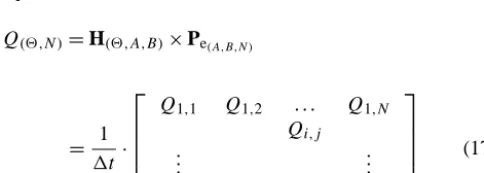
The matrix of runoffQis obtained by multiplying the hy-drological response matrix H by the effective rainfall matrix, Pe:
Q(2,N )=H(2,A,B)×Pe(A,B,N )
= 1
1t ·
Q1,1 Q1,2 . . . Q1,N
Qi,j
..
. ...
Q2,1 Q2,2 · · · Q2,N
(17)
in which Qi,j represents the available runoff for the ϑ
isochrone zone at timet.
In this application, the path lengths and their average slopes to be included in Eq. (16) were extracted from a DEM (Noto and La Loggia, 2007).
6 Figure 4
1
0 0.2 0.4 0.6 0.8 1
0 0.2 0.4 0.6 0.8 1
h
/H
t/T 2
3
Figure 4. Historical normalised mass curves derived for all the
events selected.
7 Figure 5
1
0.1 1 10 100
10 100 1000 10000
I
(m
m
/h
)
D (min)
generated observed
(a)
0 0.2 0.4 0.6 0.8 1
0 0.5 1
H
d
observed generated P = 0.9
P = 0.1 P = 0.5
2 3
Figure 5. Duration–intensity correlation (left) and adimensional
shapes (right).
3.3 Synthetic hydrograph derivation
The final step of the methodology consists in the deriva-tion of flood design hydrographs (FDH) via synthetic gen-eration by using the output from the rainfall–runoff model. The derivation of FDH was carried out following these steps: (a) modelling of the statistical correlation between flood peak and volume pairs generated by the R–R model via copulas; (b) definition of the normalised hydrograph shape in probabilistic form; (c) final derivation of the FDH by rescal-ing the selected shape (i.e. for a given joint return period) given the synthetic flood peak and volume values. The core of step (c) is the choice of a joint (bivariate) return period (JRP).
A. Candela et al.: Estimation of synthetic flood design hydrographs 1825
Table 4. Parameter estimation of the Beta distribution.
d 0.1 0.2 0.3 0.4 0.5 0.6 0.7 0.8 0.9
α 1.070 1.369 1.706 2.029 2.029 3.629 4.643 5.600 9.558 β 8.127 4.727 3.456 2.790 2.790 2.543 2.151 1.649 1.198
Table 5. Engmann modified table reported Strickler’s coefficient values related to Imera catchment land use.
Land Bare Arable Clear
use Urban rocks land Untilled vineyard forest
Strickler
coefficient 100.0 50.0 22.0 20.0 7.69 6.67
8 Figure 6
1
0 km 10 km 20 km
25 30 35 40 45 50 55 60 65 70 75 80 85 90 95 CN II distribution
2 3
Figure 6. Spatial distribution of CNIIfor the Imera catchment.
return period, where the thresholdsxandyare exceeded by the respective random variables X andY, and (3) the sec-ondary return period, or Kendall return period, that is associ-ated with the primary return period and is defined as the mean inter-arrival time of events (called super-critical or dangerous events) more critical than design events.
Although all these three return periods can be obtained us-ing copulas thanks to their formulation, in this application, the primary return period was used because it is an intuitive extension of the definition of a univariate return period. Fur-thermore, as this paper mainly proposes a method for the generation of a design ensemble, the choice of the return pe-riod was considered only as a mere example. The primary return period can be easily calculated by means of a bivariate
9 Figure 7
1
0 km 10 km 20 km
5 10 15 20 25 30 35 40 45 50 55 60 65 70 75 80 85 90 95 100 Strickler coefficient
2
3 Figure 7. Spatial distribution of roughness coefficientk.
copulaC(u1, u2)as
T = 1
1−C (u1, u2)
= 1
1−C Fx(x), Fy(y)
. (18)
All couples (u1, u2) that are on the same contour (corre-sponding to an isolinep)of the copulaCwill have the same bivariate return period.
Hence, for a given design return period T, the corre-sponding level p=C(u1, u2) can be calculated easily us-ing Eq. (18) and all the pairs(u1, u2)on the isolinephave the same return period. In order to select the single de-sign point u1,T, u2,T
, Salvadori et al. (2011) and Graler et al. (2013) suggest the selection of the point with the largest
1826 A. Candela et al.: Estimation of synthetic flood design hydrographs
10 Figure 8
1
0
1
2
3
4
5
6
7
8 0
200 400 600 800 1000 1200
1 5 9 13 17 21 25 29 33 37 41 45
Rai
n
fal
l
in
te
n
si
ty
(m
m
/h
r)
D
is
c
h
ar
ge
(m
3/s
)
time from 21/12/1976 14:00 (hours)
Rainfall Runoff
2 3
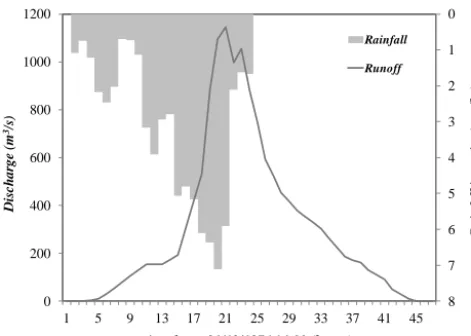
Figure 8. Event of 21 December 1976 registered at the Drasi
flow-gauge.
joint probability:
u1,T, u2,T
= arg max
C(u1,u2)=p
fXY
FX−1, FY−1. (19)
Finally, the corresponding design valuesQmax,T andVT can
be calculated easily by inverting the marginal CDF:
Qmax,T =FQ−max1 (u1,T)VT =FV−1(u2,T). (20)
4 Application of the proposed methodology 4.1 Calibration of rainfall model
Synthetic sub-hourly rainfall events were derived starting from a sample of annual maximum rainfall events, extracted from the series of 10 min rainfall data recorded at the rain-gauges mentioned above. Following De Michele and Sal-vadori (2003), two events were considered independent if they were separated by a dry period of at least 7 h. As a con-sequence an inter-event time equal to 7 h was adopted here to derive single rainfall events from the available rainfall series, for which average intensity and duration were derived.
Kao and Govindaraju (2007) stated how the definition of annual maximum events for multivariate problems is some-what ambiguous. As matter of fact, extreme rainfall events could be defined as those storms that have both high vol-ume and peak intensity. Therefore, the definition of extreme rainfall based on events with annual maximum joint cumu-lative probability was considered in this study, where the joint cumulative probabilities of samples can be estimated directly via the empirical copulaCnas introduced by Yue et
al. (1999).
Moreover, as all raingauges are in a hydrologically homo-geneous area (Cannarozzo et al., 1995), all subsequent sta-tistical analyses were performed by aggregating all selected
Table 6. Ranges of parameters considered for the calibration.
Lower Upper Max eff Parameter limit limit value
c 0 1 0.68
CN 70 90 87
k 50 100 75.8
Table 7. Goodness of fit results for copula (Qmax, V ).
Copula family θ LL AIC
Gumbel 14.792 9581.66 19163.32 Frank 57.476 10354.17 20708.35 Clayton 27.585 10140.84 20281.68
events obtaining a final sample of 80 rainfall events whose characteristics are reported in Table 1.
The procedure described in Sect. 3.1.1 was applied in or-der to or-derive theθ parameter for the Frank copula and the generating function. The copula so obtained was charac-terised by a parameterθequal to−3.7573, calculated using Eq. (6) where the Kendall coefficient of correlationτ was equal to−0.381.
In order to evaluate the goodness of fit of the chosen cop-ula, the empiricalCnand best fitted copula joint distribution
were reported in aQ–Qplot (Fig. 2, left). Furthermore, to confirm the goodness of fit, the parametric and nonparamet-ric values of the function K(z), as defined by Genest and Rivest (1993), were calculated and shown in Fig. 2 (right). These comparisons confirmed that the Frank 2-copula is well suited to describing the dependence structure between the available intensity–duration data.
The parameters of the marginal distributions considered were estimated by applying the maximum likelihood method and the best fitted distribution was selected using various criteria. More in particular, the Akaike information criterion (AIC), the relative root mean square error (RRMSE), and the Anderson–Darling test (Kottegoda and Rosso, 2008) were applied to verify the goodness of the fitting. The results, as shown in Tables 2 and 3, returned lognormal probability dis-tribution as the best marginal disdis-tribution for average storm intensity, and Weibull distribution as the best marginal distri-bution for storm duration. Furthermore, Fig. 3 shows the two marginal distributions defined respectively by Eq. (7c–d) and the empirical exceedance probabilities computed using the Gringorten formula of the observed data.
A. Candela et al.: Estimation of synthetic flood design hydrographs 1827
11 Figure 9
1
0 0.2 0.4 0.6 0.8 1
0 0.2 0.4 0.6 0.8 1
L
c
0 0.2 0.4 0.6 0.8 1
70 75 80 85 90
L
CN
0 0.2 0.4 0.6 0.8 1
50 60 70 80 90 100
L
k 2
3
Figure 9. Scatter plots illustrating the distribution of likelihood weighted hydrological parameter values distribution.
12 Figure 10
1
0 200 400 600 800 1000 1200
21/12/76 12.00 22/12/76 0.00 22/12/76 12.00 23/12/76 0.00 23/12/76 12.00
D
is
c
h
ar
ge
(m
3/s
)
time (hours)
Observed
Modelled
2 3
Figure 10. Comparison between observed and modelled
hydro-graphs for the event of 21 December 1976.
Table 8. Marginal distribution parameters and goodness of fit
re-sults for flood peaks (Qmax).
a b c AIC A-D∗
Exponential 985.84 – – 7.895 1.110
Gamma 1.04 944.78 – 7.895 1.089
Weibull 982.33 0.99 – 7.895 1.130
Lognormal 6.34 1.16 – 7.913 2.819
GEV 425.29 438.01 0.51 7.916 1.204
* The critical value for the Anderson–Darling test is 2.492.
In order to test the model’s ability to reproduce rainfall event characteristics, 1000 events were generated using the Monte Carlo procedure. As can be seen in Fig. 5, generated events show an excellent reproducibility of historical events characteristics both in terms of duration–intensity correlation and in terms of dimensionless hyetographs.
Table 9. Marginal distribution parameters and goodness of fit
re-sults for flood volumes (V ).
a b c AIC A-D∗
Exponential 39.66 – – 4.6816 3.745
Gamma 1.27 31.18 – 4.6649 0.680
Weibull 41.41 1.12 – 4.6716 1.199
Lognormal 3.24 1.03 – 4.6856 2.804
GEV 17.8733 20.327 0.39014 4.6824 0.944
* The critical value for the Anderson–Darling test is 2.492.
13 Figure 11
1
0 40 80 120 160 200
0 1000 2000 3000
V
(M
m
3)
Qmax(m3/s) Generated
Observed
2 3
Figure 11. Comparison between scatter plot of the observed and
generated pairs (Qmax,V).
4.2 Calibration of the rainfall–runoff model
Regarding the rainfall–runoff model, calibration is only re-quired for three parameters:c and CNi,j, for the effective
rainfall module (Eqs. 12–14), and the hydraulic roughness
ki,j→outfor the transfer module (Eq. 15). The latter two pa-rameters are spatially distributed and their calibration should
1828 A. Candela et al.: Estimation of synthetic flood design hydrographs 14 Figure 12 1 0 0.2 0.4 0.6 0.8 1
0 0.2 0.4 0.6 0.8 1
K (z ), K n (z ) z Empirical Gumbel 0 0.2 0.4 0.6 0.8 1
0 0.2 0.4 0.6 0.8 1
K (z ), K n (z ) z Empirical Frank 0 0.2 0.4 0.6 0.8 1
0 0.2 0.4 0.6 0.8 1
K (z ), K n (z ) z Empirical Clayton 2 3
Figure 12. K plot for the copula models. The “empirical” points represent the pairs coming from the R–R model.
Figure 13. Normalised scatter plot for the different copula models considered. The “empirical” points represent the pairs coming from the
R–R model. 16 Figure 14 1 0 0.2 0.4 0.6 0.8 1
1 10 100 1000 10000
P
Qmax(m3/s)
Empirical Theoretical (Gamma)
0 0.2 0.4 0.6 0.8 1
0.1 1 10 100 1000
P
V (Mm3)
Empirical Theoretical (Gamma)
2 3
Figure 14. Plotting position: flood peak and volume.
17 Figure 15 1 0 50 100 150
0 1000 2000 3000 4000
V
(M
m
3)
Qmax(m3/s)
Modelled Generated 0 .1 0 .1
0.1 0.1 0.1
0
.2
0
.2
0.2 0.2 0.2
0 .3 0 .3 0.3 0.3 0 .4 0 .4 0.4 0.4 0 .5 0.5 0.5 0 .6 0.6 0 .7 0.7 0 .8 0 .9 u 1 u2
0 0.1 0.2 0.3 0.4 0.5 0.6 0.7 0.8 0.9 1
0 0.1 0.2 0.3 0.4 0.5 0.6 0.7 0.8 0.9 1 2 3
Figure 15. Comparison between a sample generated from the
Gum-bel copula and the observed data (left) with the copula contours (right). Figure 16 1 0 0.2 0.4 0.6 0.8 1
0 1 2 3 4
N or m al is e d di sc h ar ge ( -)
Normalised time (-)
Shape 1 Shape 2
Shape 3
2
3 Figure 16. Non-dimensional clustered hydrographs.
be carried out by considering both values to be their spatial correlation. Other authors recently presented interesting re-sults on the application of CN for hydrological modelling in Sicily (D’Asaro et al., 2014) in lumped form. In order to avoid a “lumped” estimation of CN and to overcome the
A. Candela et al.: Estimation of synthetic flood design hydrographs 1829
19 Figure 17
1
0.9895 0.99 0.9905 0.991 0.9915 0.992 0.9925
0.985 0.99 0.995 1
u2
u1
p = 0.99
2 3
Figure 17. p level of the copulaC(u1, u2) corresponding to a JRP=100 years, with indication of the single design point (white dot).
difficulties arising from considering spatial correlation for the calibration, a simple and efficient procedure proposed by Candela et al. (2005) was implemented here.
To include its spatial distribution, the CN map was rescaled according to some weightswCNi,j allowing for CN
spatial variability in the catchment, with regards to a refer-ence value CN which coincides with the spatially averaged value of CNi,j:
CNi,j =wCNi,j·CN. (21)
In this way, it is not necessary to calibrate each single value of CN, but only the reference value. Hence, the new CN spa-tial distribution can be obtained easily from Eq. (18) given the spatial distribution ofwCNi,j.
The values of the weight coefficients have been obtained from the CN map for AMC condition II available for the Imera catchment at 100 m grid resolution (Fig. 6) by us-ing Eq. (21) given the CN reference value. This map was extracted from the CNII map for the whole of Sicily pro-duced using the information coming from the Corine Land Cover 2000 project (Regione Siciliana, 2004). The uncali-brated value of the reference CN obtained from this map is equal to 82.
Similarly, the Strickler roughness coefficients (Fig. 7) were rescaled according to some weights, wki,j→out, allow-ing for roughness variability in the catchment, with regard to a reference roughness value k which coincides with the spatially averaged value ofki,j→out.
ki,j→out=wki,j→out·k (22) The spatially averaged value of ki,j→out was easily calcu-lated starting from its effective spatial distribution in relation
20 Figure 18
1
0 1000 2000 3000 4000 5000
0 20 40 60
D
is
c
h
ar
ge
(m
3/s
)
time (hours)
2 3
4 FigureJRP=100 years.18. Flood design hydrograph corresponding to a
to soil type and land use by the modified Engmann table (En-gmann, 1986; Candela et al., 2005) (Table 5). Its value was derived equal to 20.5 m−1/3s1−. As for CN, the weight co-efficients have been obtained from the roughness coco-efficients map using Eq. (22).
The calibration of the three model parameters was carried out by comparing observed and predicted variables in terms of discharges for the event of 21 December 1976, recorded at the Imera at the Drasi flowgauge station (Fig. 8). The men-tioned event was chosen for the calibration because it was a very significant event in terms of duration, flood volume and peak discharge.
In calibration it is not difficult to get optimal fittings to the observations by adjusting parameter values, but rather that there are many sets of parameter values that will give ac-ceptable fits to the data (Beven, 1993). Often there are no techniques available for estimating or measuring the values of effective parameters required at the grid element or catch-ment scale. These values will therefore be subject to some uncertainty, especially in semiarid areas for which data are not always adequate and there is an extreme variability in space and time of all factors controlling the runoff processes (Yair and Lavee, 1982).
In this study parameter calibration was performed by using the Generalised Likelihood Uncertainty Estimation (GLUE) procedure proposed by Beven and Binley (1992). GLUE is a Monte Carlo technique that transforms the problem of searching for an optimum parameter set into a search for the sets of parameter values, which would give reliable simula-tions for a wide range of model inputs. Following this ap-proach there is no requirement to minimise or maximise any objective function, but the performances of individual param-eter sets are characterised by a likelihood weight, computed
1830 A. Candela et al.: Estimation of synthetic flood design hydrographs
by comparing predicted to observed responses using some kind of likelihood measure. The GLUE places emphasis on the study of the range of parameter values, which have given rise to all of the feasible simulations (Freer et al., 1996).
Table 6 lists parameters required for the model and the ranges assigned to each for the Monte Carlo simulations; in particular, each interval was chosen as wide as possible in order to explore a feasible parameter space.
This analysis was carried out by generating 5000 uniform random sets of parameters and using these sets to perform model simulations. The results presented in this study use the sum of squared errors as a basic likelihood measure, in the form of the Nash and Sutcliffe (1970) efficiency criterion:
L(2i/Y )=(1−σi2/σobs2 ) σi2< σobs2 (23) whereL(2i/Y )is the likelihood measure for theith model
simulation for parameter vector 2i conditioned on a set of
observationsY,σi2is the associated error variance for theith model andσobs2 is the observed variance for the event under consideration.
Figure 9 shows scatter plots for the likelihood measure based on Eq. (23) for each of the three parameters to be cali-brated. Each dot represents one run of the model with differ-ent randomly chosen parameter values within the ranges of Table 6. These plots are projections of the surface of the like-lihood measure within a three-dimensional parameter space into single parameter axes. Scatter plots for the three param-eters are very similar to each other, in terms of form of like-lihood surface and level of performance.
It is readily seen from these plots that, consistent with the concepts that underlie the GLUE approach, there is consid-erable overlap in performance between simulations and that there are many different parameter sets that give acceptable simulations.
Moreover, a best fit parameter set was fixed corresponding to maximum efficiency values, and a comparison between observed and simulated hydrographs was reported in Fig. 10.
5 Results
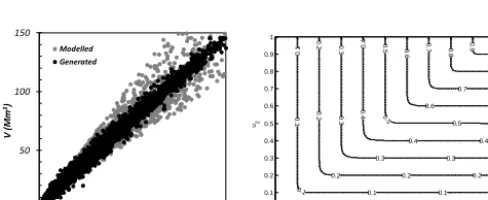
The capability of the proposed procedure in reproducing the joint statistics of both peak discharges and corresponding volumes was tested through the generation of 5000 synthetic hydrographs starting from 5000 synthetic rainfall events of an assigned shape, average intensity and duration. Figure 11 shows the scatter plot of the pairs (Qmax, V )derived from synthetic hydrographs generated. Comparison with pairs of observed (Qmax, V )values at the Drasi station (Aronica et al., 2012b) shows a good ability of the procedure to repro-duce both observed values and their correlative structure for all ranges of values.
The first step of the methodology (as outlined in Sect. 3.3) involved the choice of the best copula for the bivariate
anal-ysis of the output data from the R–R model. In this study, three copula families (namely Gumbel-Hougard, Frank and Clayton) were adapted to the 5000 generated pairs of flood peak discharges and volumes. These two series are charac-terised by a Kendall correlation coefficient equal to 0.932. The parameter of the studied copulas was estimated using the inversion of Kendall’s Tau method (Table 7).
In order to select the copula that best represents the de-pendence structure of observed variables, graphical tools and statistical tests were used here. In Fig. 12 the K plot, as de-fined by Genest and Rivest (1993), is shown for the three copula families considered. For a best detection of modelling the correlation structure, the normalised scatter plot of the empirical and theoretical 5000 pairs is reported in Fig. 13. In addition, more rigorous tests based on statistical analysis were performed. Specifically, the AIC criterion and the log-likelihood test were applied to verify the goodness of the fit-ting. The graphical tools and the statistical test returned the Gumbel-Hougard copula family as the best choice for de-scribing the dependence structure between the flood peaks and volumes.
The parameters of the marginal distributions used here (ex-ponential, Gamma, Weibull, lognormal, and GEV) were es-timated by applying the maximum likelihood method, and the best fitted distribution was selected using various criteria. Again, the AIC and the Anderson–Darling test (Kottegoda and Rosso, 2008) were applied to verify the goodness of the fitting (Tables 8 and 9). The goodness of fit criteria returned Gamma distribution as the best marginal distribution for both univariate variables. Figure 14 shows the marginal distri-bution defined by Eq. (7b) compared with the exceedance probabilities computed using the Gringorten formula of the empirical data.
A comparison between a sample generated from the Gumbel-Hougard copula and the empirical (Qmax−V )pairs is plotted in Fig. 15 (left). Also, contours of the fitted copula that represent the events with the same probability of occur-rence are shown (Fig. 15, right).
A. Candela et al.: Estimation of synthetic flood design hydrographs 1831
The final step of the procedure allows one to obtain the SFDH for any return time by merging the non-dimensional hydrographs (for a given probability) and the generated peak-volume pairs from copulas.
In this application, as an example, the SFDH with a de-sign return period of T =100 years was calculated. For
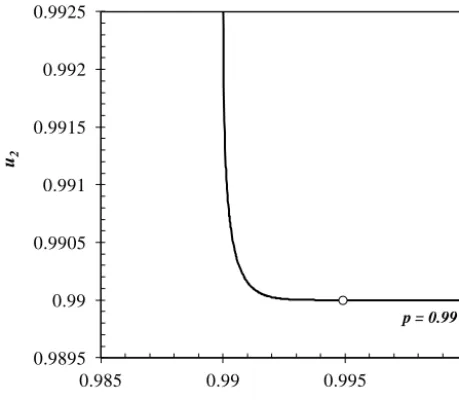
T =100 years, the copula levelp is equal to 0.99, corre-sponding to a specific isoline (Fig. 17).
Eq. (22) can be solved to find the single design point
u1,T, u2,T
with the largest joint probability, i.e. (0.9912, 0.9901). Using the inverse marginal CDFs the design event pair is obtained: (Qmax,T, VT) = (4564.8 m3s−1,
162.5 Mm3). Finally, the design hydrograph can be obtained using Shape 3 and de-normalising the time and the discharge by multiplying by the values of the pair (Fig. 18).
6 Conclusions
In this study a procedure to derive flood design hydrographs (FDH) using a bivariate representation of rainfall forcing (rainfall duration and intensity) described by copulas coupled with a distributed rainfall–runoff model was presented. In or-der to estimate, the return period of the SFDH which gives the probability of occurrence of hydrograph flood peaks and flow volumes obtained through R–R modelling was treated statistically via copulas. The choice of copulas was moti-vated by its strong capability to describe the statistical cor-relation between variables, which allows one to obtain the return period related to the entire SFDH and not only to a single variable (usually the peak flow) as in the univariate analysis. This circumstance has a significant importance in all those cases where all the hydrological variables (flood volume, flood peaks, etc.) included in a design hydrograph play an important role (i.e. hazard and risk mapping, design of flood control systems as reservoirs or storage areas, etc.).
In addition, a statistical label (in terms of probability of oc-currence) was also given to the hydrograph shape through the cluster analysis of the R–R model-generated hydrographs. This completes the statistical definition of the FDH, which can be identified with a specific return period (joint return period, JRP).
The procedure described above applied to the case study of Imera catchment i, and shows how this approach allows a reliable estimation of the design flood hydrograph in a way which can also be implemented easily in practical situations. These results, hence, underline the necessity of consider-ing JRP estimation methods in the definition of design events for all practical purposes.
Further research efforts will be devoted to move from single-design-event methods to ensemble-design-event methods by considering uncertainty via a complete applica-tion of the GLUE procedure.
Acknowledgements. This research was developed in the framework of COST Action ESF0901 “European Procedures for Flood Frequency Estimation” (FloodFreq) activities. The authors wish to thank the Sistema Informativo Agrometorologico Siciliano, and particularly Dr. Luigi Pasotti, for supplying the rainfall data and the Osservatorio delle Acque for supplying the discharge data.
Edited by: A. Loukas
Reviewed by: S. Grimaldi, F. Serinaldi, and three anonymous referees
References
Apel, H., Thieken, A. H., Merz, B., and Blöschl, G.: Flood risk assessment and associated uncertainty, Nat. Hazards Earth Syst. Sci., 4, 295–308, doi:10.5194/nhess-4-295-2004, 2004. Apel, H., Thieken, A. H., Merz, B., and Blöschl, G.: A probabilistic
modelling system for assessing flood risks, Nat. Hazards, 38, 79– 100, 2006.
Aronica, G. T. and Candela, A.: Derivation of flood frequency curves in poorly gauged Mediterranean catchments using a sim-ple stochastic hydrological rainfall-runoff model, J. Hydrol., 347, 132–142, 2007.
Aronica, G. T., Brigandì, G., and Morey, N.: Flash floods and de-bris flow in the city area of Messina, north-east part of Sicily, Italy in October 2009: the case of the Giampilieri catchment, Nat. Hazards Earth Syst. Sci., 12, 1295–1309, doi:10.5194/nhess-12-1295-2012, 2012a.
Aronica, G. T., Candela, A., Fabio, P., and Santoro, M.: Estima-tion of flood inundaEstima-tion probabilities using global hazard indexes based on hydrodynamic variables, Phys. Chem. Earth, 42–44, 119–129, 2012b.
Beven, K. J.: Prophecy, reality and uncertainty in distributed mod-eling, Adv. Wat. Resour., 16, 41–51, 1993.
Beven, K. J. and Binley, A. M.: The future of distributed models – model calibration and uncertainty prediction, Hydrol. Proc., 6, 279–298, 1992.
Blöschl, G. and Sivapalan, M.: Process control on flood frequency. Runoff generation, storm properties and return, Centre for Water Research Environmental Dynamics Report, ED 1159 MS, De-partment of Civil Engineering, The University of Western Aus-tralia, 1997.
Brigandì, G.: Il preavviso delle piene in bacini non strumentati at-traverso l’uso di precursori idro-pluviometrici, Ph.D. disserta-tion, University of Palermo, 2009 (in Italian).
Brigandì, G. and Aronica, G. T.: Operational flash flood forecasting chain using hydrological and pluviometric precursors, in: Pro-ceedings of FLOODrisk 2008, Oxford, UK, 30 September–2 Oc-tober 2008, 1321–1331, 2008.
Brigandì, G. and Aronica, G. T.: A stochastic point rainfall model of design storms based on 2-copula and dimensionless hyeto-graph, EGU General Assembly, Vienna, Austria, 7–12 April 2013, EGU2013-5912, 2013.
Camarasa-Belmonte, A. M. and Soriano-Garcia, J.: Flood risk as-sessment and mapping in peri-urban Mediterranean environ-ments using hydrogeomorphology. Application to ephemeral streams in the Valencia region (eastern Spain), Landscape Urban Plan, 104, 189–200, 2012.
1832 A. Candela et al.: Estimation of synthetic flood design hydrographs
Candela, A., Noto, L. V., and Aronica, G. T.: Influence of surface roughness in hydrological response of semiarid catchments, J. Hydrol., 313, 119–131, 2005.
Cannarozzo, M., D’Asaro, F., and Ferro, V.: Regional rainfall and flood frequency analysis for Sicily using the two component ex-treme value distribution, J. Hydrol. Sci., 40, 19–42, 1995. Chow, V. T., Maidment, D. R., and Mays, L. W.: Applied
Hydrol-ogy, McGraw-Hill International Ed., 1988.
D’Asaro, F., Grillone, G., and Hawkins, R.: “Curve Number: em-pirical evaluation and comparison with Curve Number handbook tables in Sicily”, J. Hydrol. Eng., doi:10.1061/(ASCE)HE.1943-5584.0000997, in press, 2014.
De Michele, C. and Salvadori, G.: A generalized Pareto intensity-duration model of storm rainfall exploiting 2-Copulas, J. Geo-phys. Res., 108, 4067, 2003.
De Michele, C., Salvadori, G., Canossi, M., Petaccia, A., and Rosso, R.: Bivariate statistical approach to check adequacy of dam spill-way, J. Hydrol. Eng., 10, 50–57, 2005.
Di Lorenzo, M.: Modello Afflussi-deflussi per lo studio delle piene del fiume salso a Drasi, M.Sc. thesis, University of Palermo, 1993 (in Italian).
Dupuis, D. J.: Using copulas in hydrology; benefits, cautions and issues, J. Hydrol. Eng., 12, 381–393, 2007.
Engman, E. T.: Roughness coefficients for routing surface runoff, J. Irrig. Drain. Eng. ASCE, 112, 39–54, 1986.
E.U.: Directive 2007/60/EU of the European Parliament and of the Council of 23 October 2007 on the assessment and management of flood risks, Official Journal of the European Union, 2007. Favre, A. C., El Adlouni, S., Perreault, L., Thiemonge,
N., and Bobee, B.: Multivariate hydrological frequency analysis using copulas, Wat. Resour. Res., 40, W01101, doi:10.1029/2003WR002456, 2004.
Freer, J., Beven, K. J., and Ambroise, B.: Bayesian estimation of uncertainty in runoff prediction and the value of data: an applica-tion of the GLUE approach, Water Resour. Res., 32, 2161–2173, 1996.
Garcia-Guzman, A. and Aranda-Oliver, E.: A stochastic model of dimensionless hyetograph, Wat Resour Res, 29, 2363–2370, 1993.
Genest, C. and Favre, A. C.: Everything you always wanted to know about copula modeling but were afraid to ask, J. Hydrol. Eng., ASCE, 12, 347–368, 2007.
Genest, C. and Rivest, L.: Statistical inference procedures for bivari-ate Archimedean copulas, J. Am. Stat. Assoc., 88, 1034–1043, 1993.
Gräler, B., van den Berg, M. J., Vandenberghe, S., Petroselli, A., Grimaldi, S., De Baets, B., and Verhoest, N. E. C.: Multi-variate return periods in hydrology: a critical and practical re-view focusing on synthetic design hydrograph estimation, Hy-drol. Earth Syst. Sci., 17, 1281–1296, doi:10.5194/hess-17-1281-2013, 2013.
Grimaldi, S. and Serinaldi, F.: Design hyetograph analysis with 3-copula function, Hydrol. Sci. J., 51, 223–238, 2006.
Grimaldi, S., Petroselli, A., and Nardi, F.: A parsimonious geomor-phological unit hydrograph for rainfall–runoff modelling in small ungauged basins, Hydrol. Sci. J., 57, 73–83, 2012a
Grimaldi, S., Petroselli, A., and Serinaldi, F.: Design hydrograph estimation in small and ungauged watersheds: continuous sim-ulation method versus event-based approach, Hydrol. Process., 26, 3124–3134, doi:10.1002/hyp.8384, 2012b.
Huff, F. A.: Time distribution of rainfall in heavy storms, Water Resour. Res., 3, 1007–1019, 1967.
Jakeman, A. J. and Hornberger, G. M.: How much complexity is warranted in a rainfall-runoff model?, Water Resour. Res, 29, 2637–2649, 1993.
Kao, S. C. and Govindaraju, R. S.: A bivariate frequency analysis of extreme rainfall with implications for design, J. Geophys. Res., 112, D13119, doi:10.1029/2007JD008522, 2007.
Kao, S. and Govindaraju, R.: A copula-based joint deficit index for droughts, J. Hydrol., 380, 121–134, doi:10.1016/j.jhydrol.2009.10.029, 2010.
Klein, B., Pahlow, M., Hundecha, Y., and Schumann, A.: Prob-ability analysis of hydrological loads for the design of flood control systems using copulas, J. Hydrol. Eng., 15, 360–369, doi:10.1061/(ASCE)HE.1943-5584.0000204, 2010.
Kottegoda, N. T. and Rosso, R.: Applied Statistics for Civil and En-vironmental Engineers, Blackwell Publishing Ltd, Oxford, UK, 2008.
Koutroulis, A. G. and Tsanis, I. K.: A method for estimating flash flood peak discharge in a poorly gauged basin: Case study for the 13–14 January 1994 flood, Giofiros basin, Crete, Greece Origi-nal, J. Hydrol., 385, 150–164, 2010.
Loukas, A.: Flood frequency estimation by a derived distribution procedure, J. Hydrol. 255, 69–89, 2002.
Montaldo, N., Ravazzani, G., and Mancini, M.: On the prediction of the Toce alpine basin floods with distributed hydrologic models, Hydrol. Process., 21, 608–621, 2007.
Nash, J. E. and Sutcliffe, J. V.: River flow forecasting through con-ceptual models 1. A discussion of principles, J. Hydrol., 10, 282– 290, 1970.
Nelsen, R. B.: An introduction to copulas, 2nd Edn., Springer-Verlag New York, 2006.
Nicolau, J. M., Solé-Benet, A., Puigdefabregas, J., and Guitiérrez, L.: Effects of soil and vegetation on runoff along a catena in semiarid Spain, Geomorphol., 14, 297–309, 1996.
Noto, L. V. and La Loggia, G.: Derivation of a Distributed Unit Hy-drograph Integrating GIS and Remote Sensing, J. Hydrol. Eng., 12, 639–650, 2007.
Rahman, A., Weinmann, P. E., Hoang, T. M. T., and Laurenson, E. M.: Monte Carlo simulation of flood frequency curves from rainfall, J. Hydrol., 256, 196–210, 2002.
Requena, A. I., Mediero, L., and Garrote, L.: A bivariate return pe-riod based on copulas for hydrologic dam design: accounting for reservoir routing in risk estimation, Hydrol. Earth Syst. Sci., 17, 3023–3038, doi:10.5194/hess-17-3023-2013, 2013.
Regione Siciliana: Piano Stralcio di Bacino per l’Assetto Idrogeo-logico della Regione Sicilia – Relazione Generale, 2004 (in Ital-ian).
Salvadori, G. and De Michele C.: Frequency analysis via copu-las: Theoretical aspects and applications to hydrological events, Water Resour. Res., 40, W12511, doi:10.1029/2004WR003133, 2004.
A. Candela et al.: Estimation of synthetic flood design hydrographs 1833
Salvadori, G., De Michele, C., Kottegoda, N. T., and Rosso, R.: Ex-tremes in Nature. An approach using copulas, Water Sciences and Technology Library Vol. 56, Springer Ed., Dordrecht, the Netherlands, 2007.
Salvadori, G., De Michele, C., and Durante, F.: On the return period and design in a multivariate framework, Hydrol. Earth Syst. Sci., 15, 3293–3305, doi:10.5194/hess-15-3293-2011, 2011. Serinaldi, F.: An uncertain journey around the tails of multivariate
hydrological distributions, Water Resour. Res., 49, 6527–6547, doi:10.1002/wrcr.20531, 2013.
Serinaldi, F. and Grimaldi, S.: Synthetic design hydrograph based on distribution functions with finite support, J. Hydrol. Eng., 16, 434–446, doi:10.1061/(ASCE)HE.1943-5584.0000339, 2011. Sklar, A.: Fonctions de Repartition a’n Dimensions et Leurs
Marges, Publishing Institute of Statistical University of Paris, 8, 229–231, 1959.
Sraj, M., Bezak, N. and Brilly, M.: Bivariate flood frequency anal-ysis using the copula function: a case study of the Litija station on the Sava River, Hydrol. Process., doi:10.1002/hyp.10145, in press, 2014.
US Department of Agricolture, Soil Conservation Service: Na-tional Engineering Handbook, Hydrology, Vol. 4, Washington DC, 1986.
Vandenberghe, S., Verhoest, N., Buyse, E., and De Baets, B.: A stochastic design rainfall generator based on copulas and mass curves, Hydrol. Earth Syst. Sci., 14, 2429–2442, doi:10.5194/hess-14-2429-2010, 2010.
Verhoest, N. E. C., Vandenberghe, S., Cabus, P., Onof C., Meca-Figueras, T., and Jameleddine, S.: Are stochastic point rainfall models able to preserve extreme flood statistics?, Hydrol. Pro-cess., 24, 3439–3445, 2010.
Volpi, E. and Fiori, A.: Hydraulic structures subject to bivariate hydrological loads: Return period, design, and risk assessment, Water Resour. Res., 50, 885–897, doi:10.1002/2013WR014214, 2014.
Wagener, T., Wheater, H. S., and Gupta, H. V.: Rainfall-Runoff Modelling in Gauged and Ungauged Catchments, Imperial Col-lege Press, London, 2004.
Ward, J. E.: Hierarchical grouping to optimize an objective function, J. Am. Stat. Assoc., 58, 236–244, 1963.
Wooding, R. A.: A hydraulic model for the catchment-stream prob-lem: 1. Kinematic wave theory, J. Hydrol., 3, 254–267, 1965. Yair, A. and Lavee, H.: Application of the concept of partial area
contribution to small arid watersheds, in: Rainfall-runoff Rela-tionship, edited by: Singh, P. V., Water Res. Publ., Colorado, 1982.
Yue, S., Ouarda, T. B. M. J., Bobèe, B., Legendre, P., and Bruneau, P.: The Gumbel mixed model for flood frequency analysis, J. Hy-drol., 226, 88–100, 1999.
Zhang, L. and Singh, V. P.: Bivariate rainfall frequency distributions using Archimedean copulas, J. Hydrol., 332, 93–109, 2007.