Development of a prompting method to promote
adolescent mother/infant verbal interactions using
bug-in-the-ear-feedback
Afua Ottie Arhin
Grambling State University, Grambling, LA, USA
Correspondence: Afua Ottie Arhin Grambling State University, 403 Main St, Grambling, Louisiana 71245, USA Tel +1 318 274 2528
Fax +1 318 274 3491 Email [email protected]
Abstract: It has been documented that adolescent mothers are less verbally and emotionally responsive in their interactions with their children compared to adult mothers. These less than optimal adolescent mother/infant interactions have been found to affect the child’s healthy growth and develop-ment. This small study aimed to identify and characterize the frequency of verbal behaviors exhibited in the infant/adolescent mother dyad during feeding sessions during a baseline phase of a study that employed single subject methodology. An individualized bug-in-the-ear feedback and prompting parent training model was instituted in the intervention phase of the study to improve the frequency and quality of infant-mother interaction. Results of the study clearly revealed low frequency of verbal interaction in the baseline phase. After a structured prompting intervention was instituted there were positive effects in the mother’s behaviors which in turn positively impacted infant behavior.
Keywords: adolescent mothers, verbal interactions, single subject design
Introduction
Previous studies have shown that adolescent mothers are less verbal to their infants compared to older mothers. Pomerleau and colleagues (2003) found that teenage mothers vocalized less compared with adult mothers, and they found that their infants obtained lower mental scores at 6 months. Lacroix and colleagues (2002) also found differences in utterance properties in adolescent mothers, with the use of more controlling/directive utterances. Recent research has documented that adolescent mothers are also less likely to show heightened/selective responses to infant cues and tended to show less attentive responses to infants. For example, Giardino and colleagues (2008) found that, unlike adult mothers, adolescent mothers did not show an “alerted” pattern of heart rate or cortisol response to infant cues. Additional studies have established the importance of interactions between a mother and her infant as crucial for optimal child development (Beckwith and Cohen 1984; Olson et al 1992). Maternal behaviors including mother’s gaze, physical interaction and vocalizations have been found to be related with several outcome measures, including cognitive, language and interactive performances (Olson et al 1992). More recent studies, including Pomerleau and colleagues (2003), have found that infants of adolescent mothers who vocalized less obtained lower mental scores at 6 months. Further, Oxford and Spieker (2006) revealed that having a poor language-learning home environ-ment was associated with children’s low language scores. Much research conducted in the last 30 years have documented that children of adolescent mothers do more poorly on cognitive tests and measures of school achievement than children of adult mothers (Oxford and Spieker 2006). The effects have been found to be especially persistent for tests of verbal ability and vocabulary (Oxford and Spieker 2006).
mother to her infant. From a behavior analyst standpoint, verbal activity can be described as the result of environmen-tal contingencies, particularly audience response (Skinner 1957). Thus, it can be postulated that adolescent mothers do not communicate with their infants, at least in part because it is unlikely that they will get a reinforcing response. It is thus imperative that we continue to explore parent training approaches that are most effective in promoting positive interaction between the adolescent mother/infant dyad.
The purpose of this study was to investigate whether a prompting intervention delivered via a bug-in-the-ear feedback (a wireless earphone) using positive reinforcement could improve verbal behaviors in the adolescent mother/ infant dyad during feeding sessions.
Method
Design
Single subject design was employed in this study. The design derived from behavior analysis, is a research design that provides an experimental model for the study of individu-als over time. The design is a clinically viable, controlled experimental approach to the study of a single case or several subjects, and the fl exibility to observe change under ongoing treatment (Portney and Watkins 2000).
Participants and setting
After obtaining approval from the affiliate university Institutional Review Board (IRB) and the local Department of Health IRB, three adolescent mothers and their infants were recruited through referrals from a local public health agency. Inclusion criteria for participating in the study were based on conditions that were optimal for mother/infant interactions and also based on conditions that minimized the risk of the impact of confounding variables such as age, racial and cultural differences on interaction behaviors. Thus, mothers recruited: (1) were 15 years old, (2) African American, (3) and had no previous parenting experience, (4) had a vaginal delivery, and (5) were in good mental and physical health as determined by their health care provider. Inclusion criteria for the infants were (1) thirty six weeks gestation or greater (2) no congenital abnormalities (3) between the ages of six weeks and six months (4) formula-fed and (5) in good general health as determined by their health care provider.
Formula feeding was used as an inclusion criteria to minimize the possible psychological discomfort associated with videotaping in this population, particularly when breast feeding. All sessions were conducted at the participant’s home. Verbal behaviors for this paper included frequency of
mothers’ comments on hunger cues, frequency of mothers’ use of positive statements and the frequency of mothers’ use of multiple words. These behaviors were selected after the review of existing mother/infant attachment literature.
Procedure
A nonconcurrent multiple baseline design across participants was used. The demonstration of experimental control in the multiple baseline design depends upon approximately equal effects of the treatment being observed with each baseline (Bailey and Burch 2002). Therefore, baseline videotaping was done at the 1 pm feeding of the infants of all three 15-year-old mothers. After baseline stability was reached, the intervention phase was instituted but staggered, several days to several weeks apart, across participants due to their different schedules and availability. A modifi ed intervention was instituted for the fi rst two participants after only subtle changes in target behaviors were observed after the fi rst intervention was instituted. The third participant received the modifi ed intervention only (There were a total of nine sessions for Participant 1, eight sessions for Participant 2, and six for Participant 3). At the conclusion of the study all adolescent mothers received a gift certifi cate of $25–$35 (depending on the number of sessions).
After baseline stability was reached, an individualized inter-vention delivered via a bug-in-the-ear feedback was designed and instituted based on the occurrence or nonoccurrence of verbal behaviors that were identifi ed during the baseline phase. The intervention phase was staggered, several days to several weeks apart, across participants due to their different schedules and availability. All sessions were completed within a two-month time frame for each participant (Table 1).
Coding of videotapes
Three independent observers coded target verbal behaviors of the videotaped sessions. The time interval coding method was used for the target behavior. Infant feeding for participants lasted between 6 1/2 minutes and 11 minutes. Thus, 6 minute sessions of each videotaped interaction were coded and frequencies of occurrences of behaviors were recorded every 20 seconds.
Bug-in-the-ear equipment
Bug-in-the-ear prompting and feedback
The fi rst intervention involved the investigator’s randomly interjecting several prompts for desired verbal behaviors and providing reinforcement such as “great,” or “good job” when the desired behaviors were exhibited via the bug-in-the-ear feedback. After several sessions with this intervention with the fi rst two participants, very subtle changes in target verbal behavior were noticed.
During debriefi ng after the fi rst intervention, the participants reported that they had diffi culty formulating positive statements about their infants because they were not clear what that meant. Thus the language used in delivering the prompts to elicit that target behavior was simplifi ed and specifi c examples of the verbal target behavior were also given. For example, the investigator would prompt the mother via the bug-in-the-ear by saying something such as “tell him how cute he is or how good an eater he is.” The intervention was modifi ed to be struc-tured, where prompts, cues and reinforcements were given in sequence, followed by reinforcement for each exhibited target behavior. For example, when the mother began to feed the infant, the investigator would prompt the participant via the bug-in-the-ear device by saying something such as “remember to talk to him (the infant) about how hungry he is acting.” The investigator would further cue the mother by saying, “talk to him some more about how hungry he is and how good the milk tastes.” When the behavior of commenting on infant’s hunger, for example, was exhibited, the investigator provided reinforcement using language such as “great job!”
This modifi ed intervention incorporating participant feedback was instituted with all three participants and found to produce a signifi cant change in target behaviors. As a result of the fi rst two participants’ positive response to the modifi ed intervention, Participant 3 received this modifi ed intervention only, after her baseline stability was achieved.
Results
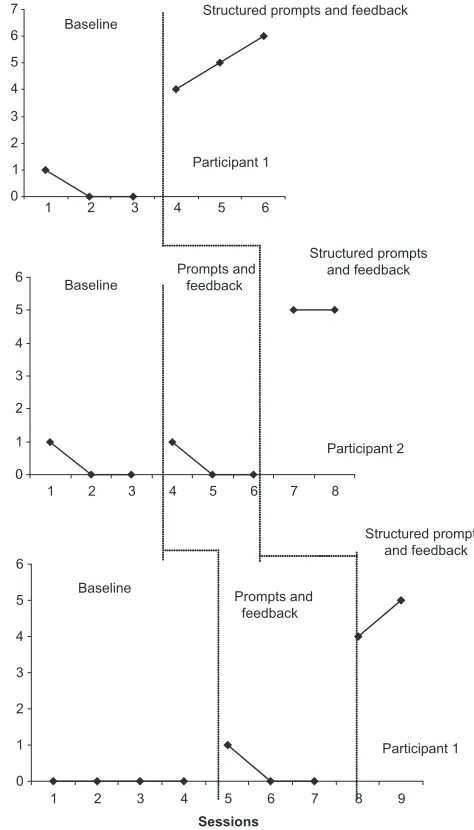
Coding of six minute feeding sessions revealed that in the baseline phase of the study, all three participants exhibited very low frequencies of verbal communication to their infants. Pictorial representation of the prompting interventions for the low frequency communication target behaviors demonstrated
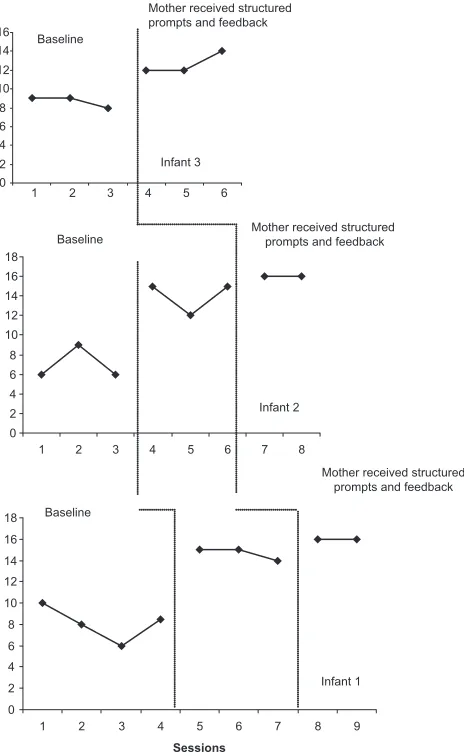
that the behaviors appeared to increase only after the second prompting feedback intervention (Figures 1–3). The change in verbal behavior was immediate in nearly every case. This change had a clear effect on the infants’ interactive behavior with the mother as well (Figure 4).
Discussion
The baseline phase of the study clearly identifi ed the low fre-quency and nonoccurrence of verbal behaviors that required intervention. After the intervention was instituted in the second phase of the study there were positive effects in the mother’s behaviors which in turn positively impacted infant behavior. This was particularly notable in the area of the infant respond-ing to the mother and was clearly demonstrated by the increase in the frequency at which the infant looked in the mothers’ direction in the six minute coded sessions. Although all three infants intermittently looked in the direction of their mother in all feeding sessions in the baseline phase, there was an increase in the frequency of this behavior with the prompting inter-ventions. The fi ndings clearly demonstrate the importance of verbal communication in mother/infant interactions and also suggest that prompting interventions with adolescent moth-ers may need to be structured. Further, the study reveals that reinforcement can increase verbal behaviors in the adolescent mother/infant dyad which can result in an improvement in interaction behaviors between mother and infant.
Findings from this study extend and strengthen previous research in this area that has shown that adolescent mothers are less verbal to their infants (Brooks-Gunn and Chase-Landale 1995; Culp et al 1996; Pomerleau et al 2003). Additional stud-ies have established the importance of interactions between a mother and her infant as crucial for optimal child development (Sroufe 1985; Olson et al 1992; Oxford and Spieker 2006). Infants exposed to greater verbal stimulation have been found to be more likely to have better verbal comprehension later in life (Olson et al 1992; Lacroix et al 2002). The fi ndings of this study support the importance of interventions such as parent training to improve the quality and frequency of verbal behav-iors, particularly as they relate to adolescent mother and her infant. Improvement in these mother/infant behaviors ultimately can have a positive impact on the child’s development.
Table 1 Videotaping schedule of participants
Baseline sessions Intervention 1 Intervention 2
Participant 1 X X X X X X X X X
Participant 2 X X X X X X X X
Implications
The fi ndings of this study demonstrate that a prompting intervention using a bug-in-the-ear feedback can increase the frequency of verbal behaviors in the adolescent mother/infant dyad which according to the literature can ultimately have a positive impact on the infant’s development. Although the intervention was successful in this study, it is important to indicate that the bug-in-the-ear-feedback intervention was a labor-intensive approach in changing mother/infant interaction behaviors. Yet it can not be assumed that the intervention implemented in the intervention phases was comprehensive enough to maintain long term optimal mother/ infant interaction behaviors.
Thus, further research is warranted on exploring the best approaches in changing these rather complex and difficult behaviors. Since adolescents respond well to
technology, further research can explore how technological approaches such as tele-health or computerized prompting can be used as a large scale intervention approach to improve interaction behaviors between the adolescent mother and her infant.
Limitations of the study
and recommendations
Several limitations of the study that suggest avenues for future research warrant comment. These limitations are presented below, including recommendations for future research.
• Only three adolescent mother/infant dyads participated in this study. It would be worthwhile to replicate this work with a larger sample.
0 1 2 3 4 5 6
1 2 3 4 5 6
0 1 2 3 4 5 6 7
1 2 3 4 5 6 7 8
0 1 2 3 4 5 6
1 2 3 4 5 6 7 8 9
Sessions
Baseline Structured prompts and feedback
Participant 3
Baseline
Prompts and feedback
Structured prompts and feedback
Participant 2
Baseline Prompts and feedback
Structured prompts and feedback
Participant 1
Figure 1 Frequency of mothers’ comments on infant’s hunger during baseline and intervention phases.
0 1 2 3 4 5 6 7
1 2 3 4 5 6
0 1 2 3 4 5 6
1 2 3 4 5 6 7 8
0 1 2 3 4 5 6
1 2 3 4 5 6 7 8 9
Sessions Baseline Prompts and
feedback
Structured prompts and feedback
Participant 1 Participant 2 Baseline Prompts andfeedback
Structured prompts and feedback Participant 1
Baseline Structured prompts and feedback
• The three adolescent mother/infant dyads in this study were all African American and of similar sociocultural backgrounds. It would be benefi cial if future research was conducted on participants from different racial and sociocultural backgrounds. Comparisons could provide valuable information on whether race and culture infl uence adolescent mother/infant interaction behaviors.
• The Investigator videotaped mother/infant interaction in the family’s home during each home visit. Although the Investigator waited in another room while the videotaping occurred, there is no information regarding what effect if any, the Investigator’s presence in the home may have had on the participants’ behavior.
• Although all sessions were completed within two months, there still is the possibility of the change in mother/infant interaction being infl uenced by normal development and experience. It would be benefi cial to replicate this study using infants of the same age.
• As a result of the risk of attrition, phases of this study were not prolonged. However, it cannot be assumed that the intervention implemented in the intervention phases was comprehensive enough to maintain long-term optimal
mother/infant interaction behaviors. Thus, a solution would be to extend the intervention phases. Additionally, further research is needed to determine the amount of par-ent training that is required to maintain optimal mother/ infant interactions in the adolescent mother/infant dyad.
Disclosure
The authors report no confl icts of interest in this work.
References
Bailey JS, Burch MR. 2002. Research methods in applied behavior analysis. Thousand Oaks, CA: Sage Publications, Inc.
Beckwith L, Cohen S. 1984. Home environment and cognitive competence in preterm children during the fi rst fi ve years. In: Gottfried AW (Ed). Home environment and early cognitive development. New York: Academic Press, pp. 235–73.
Brooks-Gunn J, Chase-Lansdale P. 1995. Adolescent parenthood and parenting: development in context. In: Bornstein MH (Ed). Handbook of parenting. New Jersey: Erlbaum, pp.13–49.
0 1 2 3 4 5 6 7
1 2 3 4 5 6
0 1 2 3 4 5 6 7 8
1 2 3 4 5 6 7 8
0 2 4 6 8 10
1 2 3 4 5 6 7 8 9
Sessions Structured prompts and
feedback Baseline Prompts and feedback Structured prompts and feedback Participant 2 Participant 3 Baseline Prompts andfeedback
Structured prompts and feedback Baseline
Figure 3 Frequency of mothers using multiple words during baseline and intervention phases. 0 2 4 6 8 10 12 14 16
1 2 3 4 5 6
0 2 4 6 8 10 12 14 16 18
1 2 3 4 5 6 7 8
0 2 4 6 8 10 12 14 16 18
1 2 3 4 5 6 7 8 9
Sessions
Infant 3
Infant 2
Infant 1 Baseline
Mother received structured prompts and feedback Baseline
Baseline
Mother received structured prompts and feedback Mother received structured
prompts and feedback
Culp R, Culp A, Osofsky J, et al. 1991. Adolescent and older mothers’ interaction patterns with their six month old infants. J Adolesc, 14:195–200. Giardino J, Gonzalez A, Steiner M, et al. 2008. Effects of motherhood on
physi-ological and subjective responses to infant cries in teenage mothers: a com-parison with non-mothers and adult mothers. Horm Behav, 53:149–58. Lacroix V, Pomerleau A, Malcuit G. 2002. Properties of adult and adolescent
mothers’ speech, children’s verbal performance and cognitive develop-ment in different socioeconomic groups: A longitudinal study. First Language, 22:173–96.
Olson S, Bates J, Kaskie B. 1992. Caregiver infant interaction antecedents of children’s school-age cognitive ability. Merrill Palmer Q, 38:309–30. O’Reilly MF, Renzaglia A, Lee S. 1994. An analysis of acquisition, generaliza-tion, and maintenance of systematic instruction competence by preservice teachers using behavioral supervision techniques. Education and Training in Mental Retardation and Developmental Disabilities, 29:22–33.
Oxford M, Spieker S. 2006. Preschool language development among children of adolescent mothers. J Appl Dev Psychology, 27:165–82. Pomerleau A, Scuccimarri C. 2003. Mother-infant behavioral
interac-tions in teenage and adult mothers during the fi rst six months post-partum: Relations with infant development. Infant Ment Health J, 24:495–509.
Portney L, Watkins M. 2000. Foundations of clinical research: Applications to practice. New Jersey: Prentice-Hall.
Skinner BF. 1957. Verbal behavior. New York: Appleton-Century-Crofts. Sroufe LA. 1985. Attachment classification from the perspective of