https://doi.org/10.26637/MJM0602/0009
Synchronization of dynamical systems of different
orders and different dimensions
Ayub Khan
1, Mridula Budhraja
2and Aysha Ibraheem
3*
Abstract
A method of tracking control is proposed to achieve synchronization between the systems of fractional order and integer order. This article presents two cases of synchronization, in first case synchronization for three dimensional integer order Cai system and a four dimensional fractional order hyperchaotic Gao system is achieved and in second case synchronization for three dimensional fractional order Newton-Leipnik system and four dimensional hyperchaotic Pang-Liu system is achieved by tracking control method. Computational results shows that the controllers designed are useful to synchronize the considered master and slave systems in both the cases. In order to execute numerical results Matlab software is used.
Keywords
Synchronization, fractional order system, integer order system, tracking Control.
AMS Subject Classification 37B25, 37D45, 37N35, 70K99.
1Department of Mathematics, Jamia Millia Islamia, New Delhi, 110025, India. 2Department of Mathematics, Shivaji College, New Delhi, 110027, India. 3Department of Mathematics, University of Delhi, Delhi, 110007, India.
*Corresponding author:1[email protected]; 2[email protected];3[email protected]
Article History: Received17November2017; Accepted19February2018 2018 MJM.c
Contents
1 Introduction. . . 354
2 Fractional order derivatives, stability of fractional or-der system and synchronization scheme. . . 355
2.1 Fractional order derivative [8] . . . 355
2.2 Stability of fractional order system[28] . . . 355
2.3 Synchronization Scheme . . . 355
3 Description of chaotic and hyperchaotic systems356 4 Synchronization of systems of different order and dif-ferent dimension and numerical results. . . 357
5 Conclusion. . . 360
References. . . 361
1. Introduction
Chaotic phenomenon has been present in the nature since a long time but when the Lorenz system [1] was found in 1963, this field arose as a new attraction in non linear sciences. After that pioneer invention of Lorenz a lot of literature is available on chaotic and hyperchaotic systems. Chaos is the property of typical dynamics and highly unpredictable behavior of a
system. Having a 300 years old history fractional calculus has always been a branch of intrinsic interest for researchers. Chaos in fractional order systems have also been the field of new and application based researches. Several chaotic sys-tems with fractional order are discovered and studied by the researchers. Some of the well known fractional order systems are Lorenz, Rossler, Chen, Liu, Volta fractional order systems [2]-[6]. Importance of fractional order can be seen as there are so many systems which can be modeled in a better and more accurate manner as a fractional order system in comparison of integer order. Different methods of solving fractional order systems and stability of these methods have been analyzed by some researchers [7,8]. Several other significant analysis have also been done on fractional differential equations [9 ]-[11].
syn-chronization can be seen with significant developments in the field of secure communication [19,20]. In secure communi-cation, although the information signal is always masked by a chaotic signal but when it comes to the security of trans-mitted message, role of chaos synchronization becomes vital. Synchronization has been an integral part of chaotic lasers [21] due to its applicability in optical secure communication. Several methods have been found for security of transmitted signal in secure communication including chaos masking. But it is found that information signal masked with chaotic signal is not much secure, therefore to enhance the grade of secu-rity of information signal several types of synchronizations were suggested among which projective synchronization was found much effective for secure communication because of its unpredictable multiple factor. Several methods like active control [22], adaptive control [23], feedback control [24], pin-ning control [25], sliding mode control [26], fuzzy control [27] etc have been studied and found effective to obtain the desired synchronization. Some work have also been done on synchronization of fractional order and integer order system [28,29], but still a very few work have been done on different order and different dimensional systems. A very particular case was considered by Ping et. al [28] to achieve complete synchronization which is extended in this paper in a more gen-eralized way to achieve different kinds of synchronizations. This paper is categorized in five sections. Section2presents synchronization scheme, fractional order derivatives and sta-bility of fractional order systems. Section3presents the brief discussion of chaotic and hyperchaotic nature of all four sys-tems considered. In section4construction of controllers and numerical results are presented to justify the theoretical ap-proach and the last section5is conclusion where the main findings of this paper are highlighted.
2. Fractional order derivatives, stability
of fractional order system and
synchronization scheme
2.1 Fractional order derivative [8]
For differentiation and integration, in fractional calculus the operatorbDtβ is defined wherebandt are the limits of the
operator andβ is the non integer order. This operator is defined in the following manner
bDβt =
dβ
dtβ i fβ>0
0 i fβ=0
t
R
b
(dτ)β i fβ<0
(2.1)
Three definitions for fractional integro differential operator are Riemann-Liouville definition, Grunwald Letnikov definition and Caputo’s definition.
The Riemann-Liouville definition is defined by
bDβt f(t) =
1
Γ(n−β)
dn dtn
t
Z
b
(t−τ)n−β−1f(τ)d(τ), (2.2)
forn−1<β <n. The Caputo’s fractional derivative is given
by
bDβt =
1
Γ(n−β)
Z t
b
fn(τ)
(t−τ)β+1−ndτ, :n−1<β<n (2.3)
whereΓ(.)is the Gamma function. The Grunwald Letnikov definition is
bD β
t f(t) =lim h→0
1
hβ
[(t−β) h ]
∑
j=0(−1)j
β
j
f(t−jh) (2.4)
where[.]denotes greatest integer part.
2.2 Stability of fractional order system[28]
Theorem:Suppose a fractional order system is considered as
Dβx=Bx, x(0) =x 0
HereB∈Rp×p, andβ= (β1,β2, ...,βp),(0<βi≤1). The
system is asymptotically stable if and only if |arg(νi)|>
β π/2 is satisfied for all eigenvaluesνiof the matrixB.
Fur-thermore this system is stable if and only if|arg(νi)| ≥β π/2
is satisfied for all eigenvaluesνiof the matrixBand the
crit-ical eigenvalues for which the condition|arg(νi)|=β π/2
have geometric multiplicity one. The geometric multiplicity of an eigenvalue is defined as the dimension of the associated eigenspace, i.e., number of linearly independent eigenvectors with that eigenvalue.
2.3 Synchronization Scheme
A brief discussion is presented in this subsection to achieve synchronization between two different order systems. Sup-pose a p-dimensional system is considered as master system
dηm
dtη =h(m) (2.5)
wherehis a differentiable function fromRptoRp,m∈Rp,
η= (η1,η2, ...,ηp)is the order and 0<ηi≤1 for all i=1,2....p.Suppose the slave system with controller is
dκs
dtκ =l(s) +U (2.6)
wherel is a differentiable function fromRptoRp,s∈Rp,
κ= (κ1,κ2, ...,κp)is the order and 0<ηi≤1 for all i=1,2....p.U is the controller which will be decomposed in two subcontrollersU1,U2asU=U1+U2and
U1=χd
κm
whereχ= (χ1,χ2, ...,χp)is a 1×pvector of scaling
fac-tors by choosing of which different types of synchronization could be achieved andm= (m1,m2, ...,mp)t is ap×1
vec-tor. HereU1is a compensation controller andU2is feedback
controller. If errors are defined as
e=s−χm (2.8)
The goal is to design an effective controller so that error will tend to zero and the desired synchronization could be achieved. As the slave systems considered in this paper is of greater dimension than master system so the last dimension of slave system will be synchronized to zero.
3. Description of chaotic and
hyperchaotic systems
−30 −20 −10 0
10 20 30 40
−40 −20 0 20 40 60
0 20 40 60 80
m11 m21
m
3
1
−30 −20 −10 0 10 20 30 40 −40
−30 −20 −10 0 10 20 30 40 50 60
m11
m
2
1
Figure 1.Chaotic attractor of Cai system in three dimensional space and inm11−m31space
Dynamics of integer order Cai [30] system is given below
m11=λ1(m21−m11)
m21=µ1m11+ρ1m21−m11m31 m31=m211−σ1m31
(3.1)
−40 −20
0 20
40 60
−40 −20 0 20 400 20 40 60 80 100 120
s11 s21
s3
1
−40 −30 −20 −10 0 10 20 30 40 −40
−30 −20 −10 0 10 20
s21 s4
1
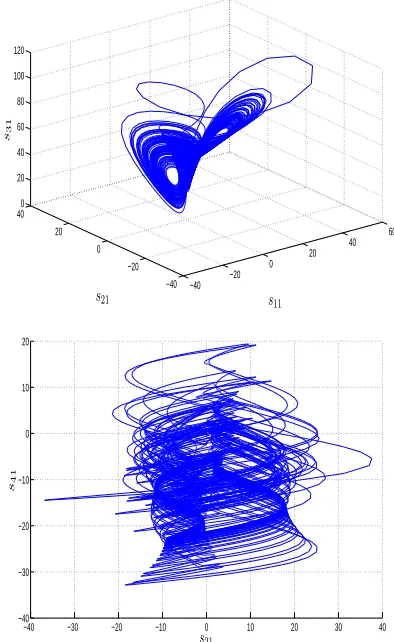
Figure 2.Hyperchaotic attractor of Gao system in three dimensional space and ins11−s41space
which shows chaotic behavior for λ1=20,µ1=14,ρ1=
10.6,σ1=2.8 as shown in Figure (1). Dynamics of fractional
order Gao system [31] is
dκ1s 11
dtκ1 =−λ2s11+µ2s21 dκ2s
21
dtκ2 =ρ2s11−s11s31−s21+s41 dκ3s
31 dtκ3 =s
2
11−σ2(s11+s31) dκ4s
41
dtκ4 =−k2s11
(3.2)
which shows hyperchaotic behavior for parameter valuesλ2=
25,µ2=60,ρ2=40,σ2=4,k2=5 and orderκ1=0.95,κ2=
0.95,κ3=0.95,κ4=0.95. Hyperchaotic attractors of Gao
−40 −30 −20 −10
0 10 20 30
40
0 20 40 60 80 100 120 −40 −30 −20 −10 0 10 20
s21 s31
s4
1
−400 −30 −20 −10 0 10 20 30 40 20
40 60 80 100 120
s21
s3
1
Figure 3.Hyperchaotic attractor of Gao system in three dimensional space and ins21−s31space
which is given by
dκ1m 12
dtκ1 =−λ3m12+m22+10m22m32 dκ2m
22
dtκ2 =−m12−0.4m22+5m12m32 dκ3m
32
dtκ3 =µ3m32−5m12m22
(3.3)
which shows chaotic behavior for parameter values λ3=
0.4,µ3=0.175 and orderκ1=0.95,κ2=0.95,κ3=0.95.
Chaotic attractors of fractional order Newton-Leipnik system are shown in Figure (4).
Integer order hyperchaotic Pang-Liu system [33] is given by
s12=λ4(s22−s12) s22=ρ4s22−s12s32+s42 s32=−µ4s32+s12s22 s42=−h4s12−k4s22
(3.4)
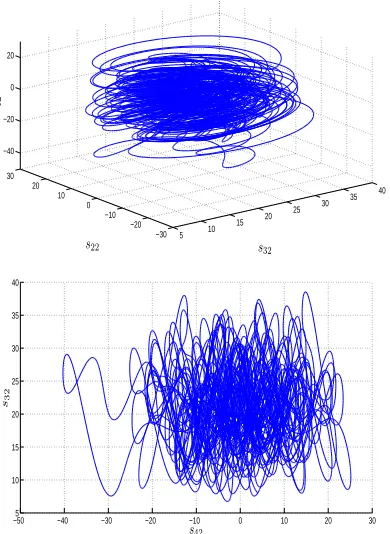
which exhibits hyperchaotic behavior for the parameter values
λ4=36,µ4=3,ρ4=20,h4=2,k4=2.Hyperchaotic
attrac-tors of Pang-Liu system are shown in Figure (5) and Figure (6) .
−0.3 −0.2 −0.1 0
0.1 0.2 0.3 0.4
−0.4 −0.2 0 0.2 0.4 0.6 −0.4 −0.3 −0.2 −0.1 0 0.1
m12 m22
m
3
2
−0.3 −0.2 −0.1 0 0.1 0.2 0.3 0.4 −0.4
−0.3 −0.2 −0.1 0 0.1 0.2 0.3 0.4 0.5 0.6
m12
m
2
2
Figure 4.Chaotic attractor of fractional order Newton Leipnik system in three dimensional space and inm12−m32
space
4. Synchronization of systems of
different order and different dimension
and numerical results
Two cases are considered in this paper. In first case Cai sys-tem is considered as master syssys-tem and fractional order Gao system is considered as slave system and in second case frac-tional order Newton-Leipnik system is considered as master system and integer order Pang Liu system is considered as slave system.
Case 1Suppose scaling vector is taken asχ= (χ1,χ2,χ3,χ4).
Then errors are
e11=s11−χ1m11 e21=s21−χ2m21 e31=s31−χ3m31 e41=s41−χ4m41
(4.1)
To synchronize three dimensional Cai system and the four dimensional fractional order hyperchaotic Gao system via tracking control,s41 has to be synchronized to 0. So the
5 10 15 20 25 30 35 40 −30 −20 −10 0 10 20 30 −40 −20 0 20 s32 s22 s4 2
−505 −40 −30 −20 −10 0 10 20 30 10 15 20 25 30 35 40 s42 s3 2
Figure 5.Hyperchaotic attractor of Pang-Liu system in three dimensional space and ins32−s42space
Theorem 1Hyperchaotic fractional order Gao system (3.2)
will attain synchronization with chaotic Cai system (3.1) for the errors defined by (4.1), if the compensation controllerV1
and feedback controllerV2are
V1=χ
dκ1m 11 dtκ1 dκ2m21
dtκ2
dκ3m 31 dtκ3 dκ4m41
dtκ4
−
−λ2χ1m11+µ2χ2m21
ρ2χ1m11−χ1m11χ3m31−χ2m21+χ4m41
χ12m211−σ2(χ1m11+χ3m31)
−k2χ1m11
(4.2) and
V2=
Qe¯11−G1(m0,e¯11,e¯21) Se¯21−G3(m0,e¯11,e¯21)
(4.3)
where Q,S are suitably chosen matrices, e¯11 =e11,e¯21=
(e21,e31,e41)andm0represents terms containing master
sys-tem’s state variables.
ProofSuppose fractional order Gao system with controller is
dκ1s11 dtκ1
dκ2s21 dtκ2 dκ3s
31 dtκ3
dκ4s 41 dtκ4
=
−λ2s11+µ2s21
ρ2s11−s11s31−s21+s41 s211−σ2(s11+s31)
−k2s11
+V (4.4)
whereVis the controller. SupposeV=V1+V2whereV1is
compensation andV2is the feedback controller. Then by using
equation (4.2) in the previous equation
dκ1s11 dtκ1 dκ2s
21 dtκ2 dκ3s31
dtκ3 dκ4s41
dtκ4
=
−λ2s11+µ2s21
(ρ2−s31)s11−s21+s41
s211−σ2(s11+s31)
−k2s11
+V2+χ
dκ1m11 dtκ1 dκ2m 21 dtκ2 dκ3m31
dtκ3 dκ4m41
dtκ4
−
−λ2χ1m11+µ2χ2m21
(ρ2χ1−χ1χ3m31)m11−χ2m21+χ4m41
χ12m211−σ2(χ1m11+χ3m31)
−k2χ1m11
(4.5)
Then error dynamical system will be
dκ1e 11 dtκ1 dκ2e21
dtκ2
dκ3e 31 dtκ3 dκ4e41
dtκ4
=
−λ2s11+µ2s21
ρ2s11−s11s31−s21+s41 s211−σ2(s11+s31)
−k2s11
+V2−
−λ2χ1m11+µ2χ2m21
ρ2χ1m11−χ1m11χ3m31−χ2m21+χ4m41
χ12m211−σ2(χ1m11+χ3m31)
−k2χ1m11
(4.6) Hence
dκ1e 11 dtκ1 dκ2e21
dtκ2 dκ3e 31 dtκ3
dκ4e41 dtκ4
=V2+
−λ2e11+µ2e21
(ρ2−e31−χ3m31)e11−e31χ1m11−e21+e41
e11(e11+2χ1m11)−σ2(e11+e31)
−k2e11
Our aim is to design controllerV2so that a stable error
dy-namical system can be achieved.
dκ1e¯ 11 dtκ1 dκ2e21¯
dtκ2
!
=
Pe11¯ +G1(m0,e¯11,e¯21)
Re¯21+G2(m0,e¯11,e¯21) +G3(m0,e¯11,e¯21)
+V2
(4.8)
where,P= (−λ2),R=
−1 0 0
0 −σ2 0
0 0 0
, ¯e11=e11,e¯21=
(e21,e31,e41)andm0represents terms containing master
sys-tem’s state variables.
G1(m0,e¯11,e21¯ ) =µ2e21
G2(m0,e¯11,e21¯ ) =
ρ2e11−e11e31−e11χ3m31 e11(e11+2χ1m11)−σ2e11
−k2e11
G3(m0,e¯11,e21¯ ) =
−e31χ1m11+e41
−σ2e31
0
(4.9)
Hence by defining
V2=
Qe11¯ −G1(m0,e¯11,e¯21) Se¯21−G3(m0,e¯11,e¯21)
(4.10)
The error dynamical system will be
dκ1e¯ 11 dtκ1 dκ2e¯21
dtκ2
!
=
(P+Q)e¯11
(R+S)e¯21+G2(m0,e11¯ ,e¯21)
(4.11)
where lime11¯→0G2(m 0,e¯
11,e¯21) =0. By choosing suitable Q,Smatrices condition of eigenvalues of the system can be made suitable so that asymptotical stability condition will be satisfied.
For numerical simulation of first case to achieve anti-synchroni-zation scaling vector is chosen as(χ1,χ2,χ3,χ4) = (−1,−1,
−1,−1). Parameters of master and slave system are cho-sen asλ1=20,µ1=14,ρ1=10.6,σ1=2.8,λ2=36,µ2=
3,ρ2=20,h4=2,k4=2. Fractional order of slave system is
κ1=κ2=κ3=κ4=0.95.Initial values for master system
and slave systems are(−3,−8,−4)and(2,6,9,2). Matrices
QandSare chosen in such a way that eigenvalues ofP+Q
is−1 and eigenvalue ofQ+S are−3,−2,−4. Hence the condition|arg(νi)| ≥β π/2 will be satisfied. Initial
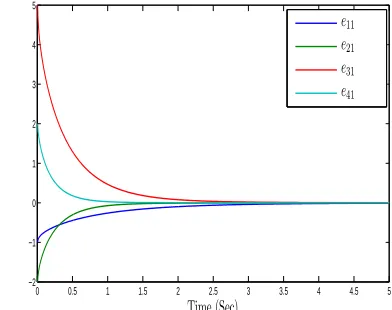
condi-tions for the error systems will be(−1,−2,5,2)and order of error dynamical system isκ1=κ2=κ3=κ4=0.95. Errors
converging to zero are shown in Figure (7).
Case2
In this case fractional order Newton Leipnik system is consid-ered as master system and integer order Pang Liu system is
−25 −20 −15 −10 −5 0
5 10 15 20 25
5 10 15 20 25 30 35 40 −30 −20 −10 0 10 20 30
s22 s32
s1
2
5 10 15 20 25 30 35 40 −30
−20 −10 0 10 20 30
s32 s1
2
Figure 6.Hyperchaotic attractor of Pang-Liu system in three dimensional space and ins12−s32space
0 0.5 1 1.5 2 2.5 3 3.5 4 4.5 5 −2
−1 0 1 2 3 4 5
Time (Sec)
e11 e21 e31 e41
Figure 7.Convergence of anti-synchronization errors to zero for integer order Cai system and fractional order Gao system
considered as slave system. Errors are defined as
e12=s12−χ1m12 e22=s22−χ2m22 e32=s32−χ3m32 e42=s42−χ4m42
Theorem 2Hyperchaotic integer order Pang-Liu system (3.4) will attain synchronization with chaotic fractional order Newton-Leipnik system (3.3) for the errors defined by (4.12), if the compensation controllerV1and feedback controllerV2are
V1=χ
dm12 dt dm22
dt dm32
dt dm42
dt
−
λ4(χ2m22−χ1m12)
ρ4χ2m22−χ1χ3m12m32+χ4m42
−µ4χ3m32+m12χ2m22
−h4χ1m12−k4χ2m22
(4.13)
and
V2=
Q0e¯12−H1(m0,e¯12,e¯22) S0e¯22−H3(m0,e¯12,e¯22)
(4.14)
whereQ0,S0 are suitably chosen matrices, ¯e12=e12,e¯22=
(e22,e32,e42)andm0represents terms containing master
sys-tem’s state variables.
ProofOn applying the same procedure which is described in
previous theorem an error dynamical system will be obtained in the following form
de12 dt de22
dt de32
dt de42
dt
=
λ4(e22−e12)
ρ4e22−e12e32−e12χ3m32−e32χ1m12−e42
−µ4e32+e12e22+e12χ2m22+e22χ1m12
−h4e12−k4e22
+V2
(4.15)
de12¯ dt de22¯
dt
=
P0e¯12+H1(m0,e12¯ ,e¯22)
R0e¯22+H2(m0,e¯12,e¯22) +H3(m0,e¯12,e¯22)
+V2
(4.16)
whereP0= (−λ4),R0=
ρ4 0 0
0 −µ4 0
0 0 0
, ¯e12=e12,e¯22=
(e22,e32,e42)andmrepresents terms containing master
sys-tem’s state variables.
H1(m0,e¯12,e¯22) =λ4e22
H2(m0,e¯12,e¯22) =
−e12e32−e12χ3m32 e12e22+e12χ2e22
−k4e12
H3(m0,e¯12,e¯22) =
−e32χ1m12−e42 e22χ1m12
−k4e22
(4.17)
Hence by defining
V2=
Q0e¯12−H1(m0,e¯12,e¯22) S0e¯22−H3(m0,e¯12,e¯22)
(4.18)
Hence error dynamical system will be
de12¯ dt de22¯
dt
=
(P0+Q0)e¯12
(R0+S0)e¯22+H2(m0,e¯12,e¯22)
(4.19)
where lime¯12→0H2(s,e¯12,e¯22) =0. Similarly, by choosing
suitableQ0,S0an asymptotically stable error dynamical sys-tem can be obtained.
For the second case to achieve hybrid projective synchroniza-tion scaling vector is chosen as(χ1,χ2,χ3,χ4) = (1,−1,1,−1).
Parameters of master and slave system are chosen asλ3=
0.4,µ3=0.175,λ4=36,µ4=3,ρ4=20,h4=2,k4=2.
Frac-tional order of master system isκ1=κ2=κ3=0.95.Initial
values for master system and slave systems are(0.349,0,−0.16) and(6,7,8,4). MatricesQ0andS0are chosen in such a way that eigenvalues ofP+Qis−1 and eigenvalue ofQ+Sare
−1,−2,−3,−4. Initial conditions for error systems will be (5.651,7,8.16,4). Errors converging to zero are shown in Figure (8).
0 1 2 3 4 5 6 7
0 1 2 3 4 5 6 7 8 9
Time(sec)
e12 e22 e32 e42
Figure 8.Convergence of hybrid projective synchronization errors to zero for fractional order Newton Leipnik system and integer order Pang Liu system
5. Conclusion
References
[1] E.N. Lorenz, Deterministic nonperiodic flow.J. Atmos.
Sci.20 (2) (1963), 130-141.
[2] I. Grigorenko, E. Grigorenko, Chaotic dynamics of the
fractional Lorenz system,Phys. Rev. Lett.91(3) (2003), 034101-4.
[3] C. Li, G. Chen, Chaos and hyperchaos in the
fractional-order Rossler equations.Physica A,341 (2004), 55-61.
[4] X.Y. Wang, M.J. Wang, Dynamic analysis of the
fractional-order Liu system and its synchronization.
Chaos, 17(3) (2007), 033106.
[5] C. Li, G. Peng, Chaos in Chen’s system with a fractional
order.Chaos Solitons Fractals22(2) (2004), 443-450. [6] I. Petras, Chaos in the fractional-order Volta’s system:
modeling and simulation.Nonlinear Dyn.57(1-2) (2009), 157-170.
[7] I. Podlubny, Factional differential equations, New York,
Academic Press, (1999).
[8] I. Petras , Fractional-order nonlinear systems, modelling,
analysis and simulation, Spinger (2011).
[9] A. Anguraja, M. Kasthurib, P. Karthikeyan, Existence
results of boundary value problem for implicit impul-sive fractional differential equations. Malaya J. Mat.
5(3)(2017), 550-555
[10] A. Benaissa Cherif, F. Z. Ladranib, Asymptotic behavior
of solution for a fractional Riemann-Liouville differential equations on time scales.Malaya J. Mat.5(3)(2017), 561-568
[11] J.A. Nanwarea, N.B. Jadhav, D.B. Dhaigude, Initial value
problems for fractional differential equations involving Riemann-Liouville derivative.Malaya J. Mat.5(2)(2017), 337-345
[12] I.S. Jesus, J.A. Machado, Fractional control of heat
difu-sion systems.Nonlinear Dyn.54(3)(2008), 263-282. [13] R.L. Magin, Fractional calculus in bioengineering. USA,
Begll House Publishers, (2006).
[14] W.G. Glockle, T. Mattfeld, T.F. Nonnenmacher, E.R.
Weibel, Fractals in biology and medicine. Basel, Birkhauser, (1998).
[15] L.M. Peccora, T.L. Carroll. Synchronization in chaotic
systems.Phy. Rev. Lett.64(8) (1990), 821-824.
[16] S. Wang, Y. Yu, M. Diao, Hybrid projective
synchroniza-tion of chaotic fracsynchroniza-tional order systems with different dimensions,Physica A,389(21) (2010), 4981-4988. [17] H. Taghvafard, G.H. Erjaee, Phase and anti-phase
syn-chronization of fractional order chaotic systems via
ac-tive control. Commun. Nonlinear Sci. Numer. Simul.
16(10)(2011), 4079-4088
[18] P. Zhou, W. Zhu, Function projective synchronization for
fractional-order chaotic systems,Nonlinear Anal. Real World Appl.12(2) (2011), 811-816.
[19] W. Kinzel, A. Englert, I. Kanter, On chaos
synchroniza-tion and secure communicasynchroniza-tion.Philos Trans A Math
Phys Eng Sci, 368 (2010), 379-389.
[20] X. Wu, H. Wang, H. Lu, Modified generalized projective
synchronization of a new fractional-order hyperchaotic system and its application to secure communication. Non-linear Anal.: Real World Appl.13(3)(2012), 1441-1450. [21] R.Roy, K. S. Thornburg, Experimental synchronization of
chaotic lasers,Phys. Rev. Lett.72(13)(1994), 2009-2012. [22] S. Bhalekar, V. Daftardar-Gejji, Synchronization of
differ-ent fractional order chaotic systems using active control,
Commun. Nonlinear Sci. Numer. Simul.15 (11)(2010), 3536-3546.
[23] R. X. Zhang, S. P. Yang, Adaptive synchronization of
fractional-order chaotic systems via a single driving vari-able.Nonlinear Dyn.66(4) (2011), 831-837.
[24] J. H. Park, O.M. Kwon, A novel criterion for delayed
feedback control of time-delay chaotic systems.Chaos Solitons Fractals23(2)(2005), 495-501.
[25] L. Pan, W. Zhou, J. Fang, D. Li, A novel active pinning
control for synchronization and anti-synchronization of new uncertain unified chaotic systems,Nonlinear Dyn.
62 (1-2)(2010), 417-425.
[26] B. Wang, Y. Zhou, J. Xue, D. Zhu, Active sliding mode
for synchronization of a wide class of four-dimensional fractional-order chaotic systems.ISRN Applied Mathe-matics,2014 (2014), Article ID 472371.
[27] D. Chen, W. Zhao, J.C. Sprott, X. Ma, Application of
Takagi-Sugeno fuzzy model to a class of chaotic syn-chronization and anti-synsyn-chronization, Nonlinear Dyn.
73(3)(2013), 1495-1505.
[28] Z. Ping , C.Y. Ming, K. Fei, Synchronization between
fractional-order chaotic systems and integer order chaotic systems,Chin. Phy. B19 (9) (2010), 090503.
[29] D. Y. Chen, R. F. Zhang , X. Y. Ma, J. Wang,
Synchro-nization between a novel class of fractional-order and integer-order chaotic systems via a sliding mode con-troller.Chin. Phy. B,21(12)(2012), 120507.
[30] G. Cai, Z. Tan, Chaos synchronization of a new chaotic
system via nonlinear control.J. Uncertain Systems1 (3) (2007) 235-240.
[31] Y.Gao, C. Liang, Q. Wu, H. Yuan, A new
fractional-order hyperchaotic system and its modified projective synchronization.Chaos Solitons Fractals76, (2015) 190-204.
[32] L.J Sheu ,L.M. Tam, S.K. Lao, Y. Kang, K.T. Lin, J.H.
Chen, H.K. Chen, Parametric analysis and impulsive syn-chronization of fractional order Newton Leipnik systems.
Int. J. Nonlinear Sci. Numer. Simul.(10) (1)(2009), 33-44.
[33] S. Pang, Y. Liu, A new hyperchaotic system from
the Lu system and its control, J. Comput. Appl. Math
235(8)(2011), 2775-2789.
? ? ? ? ? ? ? ? ? ISSN(P):2319−3786
Malaya Journal of Matematik