Platforms for Deploying Applications for Cloud
Computing Environment
Jayalakshmi K1, K M Uma2, Veena A3, Lavanya Santhosh4
1, 2, 3, 4
Assistant Professor, Department of Computer Science and Engineering, Dr.AIT, Bangalore.
Abstract: With advancement in technology trends, facilities are increasing day by day and services are available at our doorstep. Cloud computing is one of the emerging areas that is prevailing in industries at grandiose rate. With the significant advances in Information and Communications Technology (ICT) over the last half century, there is an increasingly perceived vision that computing will one day be the 5th utility (after water, electricity, gas, and telephony). This computing utility, like all other four existing utilities, will provide the basic level of computing service that is considered essential to meet the everyday needs of the general community. To deliver this vision, a number of computing paradigms have been proposed, of which the latest one is known as Cloud computing. Aneka is an Application Platform-as-a-Service (Aneka PaaS) for Cloud Computing. It acts as a framework for building customized applications and deploying them on either public or private Clouds In this paper, we will present Aneka platform and its integration with one of the public Cloud infrastructures, Windows Azure, which enables the usage of Windows Azure Compute Service as a resource provider of Aneka PaaS. The integration of the two platforms will allow users to leverage the power of Windows Azure Platform for Aneka Cloud Computing, employing a large number of compute instances to run their applications in parallel. Aneka is an integrated middleware package which allows you to seamlessly build and manage an interconnected network in addition to accelerating development, deployment and management of distributed applications using Microsoft .NET frameworks on these networks.
Keywords: Cloud computing, Network models, ANEKA, Platform–as-a-Service (PaaS), Windows Azure and Cloud Application Development.
I. INTRODUCTION
[image:1.612.206.410.616.719.2]Current industries have seen Clouds [1,2] as an economic incentive for expanding their IT infrastructure with less total cost of ownership (TCO) and higher return of investment (ROI). By supporting virtualization and dynamic provisioning of resources on demand, Cloud computing paradigm allows any business, from small and medium enterprise (SMEs) to large organizations, to more wisely and securely plan their IT expenditures. They will be able to respond rapidly to variations in the market demand for their Cloud services. IT cost savings are realized by means of the provision of IT "subscription-oriented" infrastructure and services on a pay-as-you-go-basis. There is no more need to invest in redundant and highly fault tolerant hardware or expensive software systems, which will lose their value before they will be paid off by the generated revenue. Cloud computing now allows paying for what the business need at the present time and to release it when these resources are no longer needed. The practice of renting IT infrastructures and services has become so appealing that it is not only leveraged to integrate additional resources and elastically scale existing software systems into hybrid Clouds, but also to redesign the existing IT infrastructure in order to optimize the usage of the internal IT, thus leading to the birth of private Clouds. To effectively and efficiently harness Cloud computing, service providers and application developers need to deal with several challenges, which include: application programming models, resource management and monitoring, cost-aware provisioning, application scheduling, and energy efficient resource utilization. The Aneka Cloud Application platform, together with other virtualization and Cloud computing technologies aims to address these challenges and to simplify the design and deployment of Cloud Computing systems.
Cloud computing is rapidly emerging as a new paradigm for delivering computing as a utility [2]. It allows leasing of IT capabilities whether they are infrastructure, platform, or software
applications as services on subscription oriented services in a pay-as-you-go model. Its foundation is based on various developments in IT during the last thirty to forty years. As fresh ideas and technology advancement have made it all the more striking and appealing during the Internet age, the way consumers consume and technology enablers deliver solutions has evolved. With a trend towards Cloud based model, the power is shifted to consumers. They have access to more compute power and to new applications, at an alluring price, as well as they enjoy the advantages of a self-service and self managed environment.
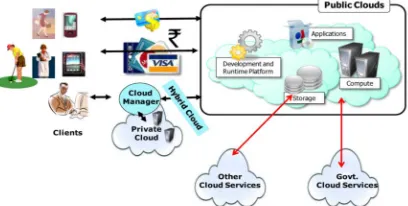
Cloud computing fosters elasticity and seamless scalability of IT resources that are offered to end users as a service through Internet medium. Cloud computing can help enterprises improve the creation and delivery of IT solutions by providing them to access services in a most cost effective and flexible manner. A bird’s eye view of Cloud computing is shown in Figure 1. Although Cloud computing has emerged mainly from the appearance of public computing utilities [4], various deployment models, with variations in physical location and distribution, have been adopted. In this sense, regardless of its service class, Clouds can be classified as public, private, or hybrid depending on the model of deployment. A public Cloud is a Cloud made available in a pay-as-you go manner to the general public. A private Cloud is a data center of an organization, not made available to the general public.A hybrid Cloud is a seamless use of public Cloud along with private Cloud when needed. In a typical public Cloud scenario, a third-party vendor delivers services such as computation, storage, networks, virtualization and applications to various customers. In a private Cloud environment, internal IT resources are used to serve their internal users and customers. Businesses are adopting public Cloud services to save capital expenditure and operational cost by leveraging Cloud’s elastic scalability and market oriented costing features. Nevertheless, public Cloud computing also raises concerns about data security, management, data transfer, performance, and level of control. Cloud Computing started with a risk free concept. let someone else take the ownership of setting up IT infrastructure and let end-users tap into it, paying only for what is been used. From this simple idea, a much more sophisticated, complex (and sometimes complicated) market started to grow. Today, businesses can buy computation resources, infrastructure plus platform or infrastructure plus applications. In the language of this market, the computation resources is frequently referred to as Infrastructure as a Service (IaaS), and the applications as Software as a Service (SaaS). In fact, use of the acronym appears ubiquitously from SaaS to PaaS (Platform as a Service) to XaaS (Anything as a Service).
II. DEVELOPMENT OF CLOUD APPLICATION PLATFORMS
In the Cloud-computing context, applications are generally deployed by Cloud providers to provide highly scalable and elastic services to as many end users as possible. The need for support as many users to access and utilize the same application services, with elastic resources allocation have led to enhancement in development platform technologies and architectures to handle performance, security, resource allocation, application monitoring, billing, and fault tolerance. There are several solutions available in the PaaS market, to mention a few: Google App Engine, Microsoft Windows Azure, Force.Com, and Manjrasoft
Aneka. Google App Engine provides an extensible runtime environment for web based applications developed with Java or Python, which leverage huge Google IT infrastructure. Windows Azure provides a wide array of Windows based services for developing and deploying windows based applications on the Cloud. It makes use of the infrastructure provided by Microsoft to host these services and scale them seamlessly. Aneka provides a more flexible model for developing distributed applications and provides integration with external Clouds such as Amazon EC2 and Go Grid. Aneka offers the possibility to select the most appropriate infrastructure deployment without being tied to any specific vendor–a virtual infrastructure, a private datacenter or a server –thus allowing enterprises to comfortably scale to the Cloud when needed.
A. Windows Azure
Microsoft Azure, formerly known as Windows Azure, is Microsoft's public cloud computing platform. It provides a range of cloud services, including those for compute, analytics, storage and networking. Users can pick and choose from these services to develop and scale new applications, or run existing applications, in the public cloud.
based on usage. However, a single application may use multiple Azure services, so users should review and manage usage to minimize costs.
Microsoft categorizes Azure services into 11 main product types:
1) Compute: These services provide virtual machines, containers, batch processing and remote application access.
2) Web and Mobile: These services support the development and deployment of web and mobile applications, and also offer features for API management, notification and reporting.
3) Data Storage: This category includes Database as a Service offerings for SQL and NoSQL, as well as unstructured and cached cloud storage.
4) Analytics: These services provide distributed analytics and storage, as well as real-time analytics, big data analytics, data lakes, machine learning and data warehousing.
5) Networking: This group includes virtual networks, dedicated connections and gateways, as well as services for traffic management, load balancing and domain name system (DNS) hosting.
6) Media and content delivery network (CDN): These services include on-demand streaming, encoding and media playback and indexing.
7) Hybrid integration: These are services for server backup, site recovery and connecting private and public clouds.
8) Identity and access management (IAM): These offerings ensure only authorized users can employ Azure services, and help protect encryption keys and other confidential information.
9) Internet of Things (IoT): These services help users capture, monitor and analyze IoT data from sensors and other devices. 10) Development: These services help application developers share code, test applications and track potential issues. Azure support
a range of application programming languages, including JavaScript, Python, .NET and Node.js.
11) Management And Security: These products help cloud administrators manage their Azure deployment, schedule and run jobs, and create automation. This product group also includes capabilities for identifying and responding to cloud security threats.
B. Google App Engine
Google App Engine is offered by Google Inc. Its key value is that developers can rapidly build small web based applications on their machine and deploy them on the Cloud. A notable thing is that Google App Engine provides developers with a simulated environment to build and test applications locally with any operating system or any system that runs a suitable version of Python and Java language environments. Google uses the Java Virtual Machine with Jetty Servlet engine and Java Data Objects.
Google App Engine is a platform as a service (PaaS) cloud computing platform for developing and hosting web applications in Google-managed data centers. Applications are sandboxed and run across multiple servers. App Engine offers automatic scaling for web applications as the number of requests increases for an application, App Engine automatically allocates more resources for the web application to handle the additional demand. Google App Engine is free up to a certain level of consumed resources. Fees are charged for additional storage, bandwidth, or instance hours required by the application. It was first released as a preview version in April 2008, and came out of preview in September 2011.
C. Force.com
Force.com is a development and execution environment that is independent for Salesforce.com. Force.com is the best approach for Platform as-a-Service (PaaS) for developing CRM based application and, with regards to the design of its platform and the runtime environment is based on the Java technology. The platform uses a proprietary programming language and
environment called Apex code, which it has a reputation for simplicity in learning and rapid development and execution. The foundation of Force.com is the infrastructure that supports the upper layers of the platform.
D. Redundancy
E. Security Rest Assured
The physical, network, host, data transmission, and database security levels of the Force.com platform are world class. All data centers are SAS 70 Type II, SysTrust, and ISO 27001 certified. Each facility’s security team monitors site perimeters 24/365, and five levels of biometric scanning and other technologies encapsulate internal operations centers to ensure only authorized personnel have system access. To protect data in transit between data centers, the system uses secure point-to-point data replication. Salesforce.com performs both internal and external vulnerability assessments on a regular basis to further ensure system security. Internal assessments help guarantee that software releases are secure and include design, architecture, and code quality reviews by internal staff as well as by third parties. External assessments focus on other types of potential concerns, including exposure to such things as buffer and parameter overflow, SQL injection, cross-site scripting, and much more.
F. Performance and Scalability
Force.com’s infrastructure design can scale both vertically and horizontally due to its unique pod architecture. A pod is a set of industry-standard resources (high-performance database, Web, application, search, email, storage, backup servers, load balancers, etc.) that work together to serve the needs of a limited collection of organizations and applications. To prevent demand overload of any one pod’s resources, salesforce.com provisions a new pod when existing pods are at or nearing predefined capacity thresholds.
G. Monitoring
A collection of systems management tools closely monitor Force.com’s health and performance 24/7 and alert the platform’s team of specialized engineers to potential problems and resolutions. All situations of interest are made public at http://trust.salesforce.com/. To adequately prepare for future growth of Force.com usage, weekly capacity planning reports measure and project the individual demands of each enterprise customer and collective demands placed on each data center.
H. Manjrasoft Aneka
Aneka is a workload distribution and management platform that accelerates applications in Microsoft .NET framework environments. Some of the key advantages of Aneka over other GRID or Cluster based workload distribution solutions include:
1) rapid deployment tools and framework,
2) ability to harness multiple virtual and/or physical machines for accelerating application result 3) provisioning based on QoS/SLA
4) support of multiple programming and application environments 5) simultaneous support of multiple run-time environments 6) built on-top of Microsoft
7) .NET framework, with support for Linux environments through Mono
Aneka [5] is a distributed application platform for developing Cloud applications. Distributed means that Aneka can seam together any number of Windows based physical or virtual desktops or servers into a network of interconnected nodes that act as a single logical “application execution layer.” The middleware is managed and monitored with advanced tools that allow monitoring applications’ performance and the system status in order to meet the Service Level Agreements (SLAs) made with the users. Aneka-based Clouds can be deployed on a variety of hardware and operating systems including several flavors of the Windows and Linux operating system families. This flexibility allows Aneka to virtually harness almost all the different types of infrastructure and runtime environment to serve application execution on demand.
III. ANEKA CLOUD APPLICATION DEVELOPMENT PLATFORM
Current industries have seen Clouds [1,6] as an economic incentive for expanding their IT infrastructure with less total cost of ownership (TCO) and higher return of investment (ROI). By supporting virtualization and dynamic provisioning of resources on demand, Cloud computing paradigm allows any business, from small and medium enterprise (SMEs) to large organizations, to more wisely and securely plan their IT expenditures. They will be able to respond rapidly to variations in the market demand for their Cloud services. IT cost savings are realized by means of the provision of IT "subscription-oriented" infrastructure and services on a pay-as-you-go-basis. There is no more need to invest in redundant and highly fault tolerant hardware or expensive software systems, which will lose their value before they will be paid off by the generated revenue. Cloud computing now allows paying for what the business need at the present time and to release it when these resources are no longer needed. The practice of renting IT infrastructures and services has become so appealing that it is not only leveraged to integrate additional resources and elastically scale existing software systems into hybrid Clouds, but also to redesign the existing IT infrastructure in order to optimize the usage of the internal IT, thus leading to the birth of private Clouds. To effectively and efficiently harness Cloud computing, service providers and application developers need to deal with several challenges, which include: application programming models, resource management and monitoring, cost-aware provisioning, application scheduling, and energy efficient resource utilization. The Aneka Cloud Application platform, together with other virtualization and Cloud computing technologies aims to address these challenges and to simplify the design and deployment of Cloud Computing systems.
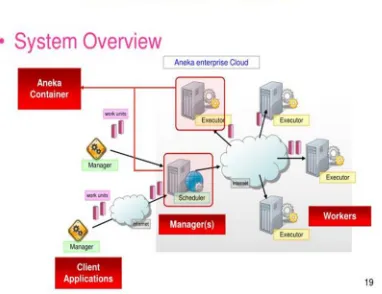
[image:5.612.213.404.557.704.2]Aneka is a .NET-based application development Platform-as–a-Service (PaaS), which offers a runtime environment and a set of APIs that enable developers to build customized applications by using multiple programming models such as Task Programming, Thread Programming and Map Reduce Programming, which can leverage the compute resources on either public or private Clouds [1]. Moreover, Aneka provides a number of services that allow users to control, auto-scale, reserve, monitor and bill users for the resources used by their applications. One of key characteristics of Aneka PaaS is to support provisioning of resources on public Clouds such as Windows Azure, Amazon EC2, and Go Grid, while also harnessing private Cloud resources ranging from desktops and clusters, to virtual datacenters when needed to boost the performance of applications, as shown in Figure2. Aneka has successfully been used in several industry segments and application scenarios to meet their rapidly growing computing demands. In this paper, we will introduce Aneka Cloud Application Platform (Aneka PaaS) and describe its integration with public Cloud platforms particularly focusing on the Windows Azure Platform. We will show in detail, how an adaptable, extensible and flexible Cloud platform can help enhance the performance and efficiency of applications by harnessing resources from private, public or hybrid Clouds with minimal programming effort. The Windows Azure Platform is a Cloud Services Platform offered by Microsoft [7]. Our goal is to integrate the Aneka PaaS with Windows Azure Platform, so that Aneka PaaS can leverage the computing resources offered by Windows Azure Platform. The integration supports two types of deployments. In the first case, our objective is to deploy Aneka Worker Containers as instances of Windows Azure Worker Role, while the Aneka Master Container runs locally on-premises, enabling users of Aneka PaaS to use the computing resources offered by Windows Azure Platform for application execution. And in the second case, the entire Aneka Cloud is deployed on Windows Azure so that Aneka users do not have to build or provision any computing resources to run Aneka PaaS. This chapter reports the design and implementation of the deployment of Aneka containers on Windows Azure Worker Role and the integration of two platforms.
Figure 3 shows the basic architecture of Aneka. The system includes four key components, including Aneka Master, Aneka Worker, Aneka Management Console, and Aneka Client Libraries [8]. The Aneka Master and Aneka Worker are both Aneka Containers which represents the basic deployment unit of Aneka based Clouds. Aneka Containers host different kinds of services depending on their role. For instance, in addition to mandatory services, the Master runs the Scheduling, Accounting, Reporting, Reservation, Provisioning, and Storage services, while the Workers run execution services. For scalability reasons, some of these services can be hosted on separate Containers with different roles. For example, it is ideal to deploy a Storage Container for hosting the Storage service, which is responsible for managing the storage and transfer of files within the Aneka Cloud. The Master Container is responsible for managing the entire Aneka Cloud, coordinating the execution of applications by dispatching the collection of work units to the compute nodes, whilst the Worker Container is in charge of executing the work units, monitoring the execution, and collecting and forwarding the results.
IV. EMERGING CLOUD PLATFORMS
Industry analysts have made bullish projections on how Cloud computing will transform the entire computing industry.According to a recent Merrill Lynch research note [9], Cloud computing is expected to be a ``$160-billion addressable market opportunity, including $95-billion in business and productivity applications, and another $65-billion in online advertising''.
Another research study by Morgan Stanley [10] has also identified Cloud computing as one of the prominent technology trends. As the computing industry shifts toward providing Platform as a Service (PaaS) and Software as a Service (SaaS) for consumers and enterprises to access on demand regardless of time and location, there will be an increase in the number of Cloud platforms available. Recently, several academic and industrial organizations have started investigating and developing technologies and infrastructure for Cloud Computing. Academic efforts include Virtual Workspaces [11], OpenNebula [12], and Reservoir [13]. Amazon Elastic Compute Cloud (EC2) [14] provides a virtual computing environment that enables a user to run Linux-based applications. The user can either create a new Amazon Machine Image (AMI) containing the applications, libraries, data and associated configuration settings, or select from a library of globally available AMIs. The user then needs to upload the created or selected AMIs to Amazon Simple Storage Service (S3), before he can start, stop, and monitor instances of the uploaded AMIs. Amazon EC2 charges the user for the time when the instance is alive, while Amazon S3 [15] charges for any data transfer (both upload and download). Google App Engine [16] allows a user to run web applications written using the Python programming language. Other than supporting the Python standard library, Google App Engine also supports Application Programming Interfaces (APIs) for the data store, Google Accounts, URL fetch, image manipulation, and email services. Google App Engine also provides a web-based Administration Console for the user to easily manage his running web applications. Currently, Google App Engine is free to use with up to 500MB of storage and about 5 million page views per month.
V. CONCLUSION AND FUTURE THOUGHTS
Cloud computing is a new and promising paradigm delivering IT services as computing utilities. As Clouds are designed to provide services to external users, providers need to be compensated for sharing their resources and capabilities.
The Aneka PaaS is built on a solid .NET service oriented architecture allowing seamless integration between public Clouds and mainstream applications. The core capabilities of the framework are expressed through its extensible and flexible architecture as well as its powerful application models featuring support for several distributed and parallel programming paradigms. These features enhance the development experience of software developers allowing them to rapidly prototype elastically scalable applications. Applications ranging from the media and entertainment industry, to engineering, education, health and life sciences and several others have been proven to be appropriate to the Aneka PaaS.
Admittedly, the integration of two platforms would give numerous benefits to not only the users of Aneka PaaS but also the customers of Windows Azure Platform, enabling them to embrace the advantages of Cloud computing in terms of more computing resources, easier programming model, and more efficiency on application execution at lower expense and lower administration overhead.
Finally, we need to address regulatory and legal issues, which go beyond technical issues. Some of these issues are explored in related paradigms such as Grids and service-oriented computing systems. Hence, rather than competing, these past developments need to be leveraged for advancing Cloud computing. Also, Cloud computing and other related paradigms need to converge so as to produce unified and interoperable platforms for delivering IT services as the 5th utility to individuals, organizations, and corporations.
REFERENCES
[1] Rajkumar Buyya, Chee Shin Yeo, Srikumar Venugopal, James Broberg, and Ivona Brandic, Cloud Computing and Emerging IT Platforms: Vision, Hype, and Reality for Delivering Computing as the 5th Utility, Future Generation Computer Systems, 25(6):599-616, Elsevier Science, Amsterdam, The Netherlands, June 2009.
[2] David Chappell, Introducing Windows Azure. David Chappell & Associates, October 2010.
[3] R. Buyya, C. Yeo, S. Venugopal, J. Broberg, and I. Brandic, Cloud Computing and Emerging IT Platforms: Vision, Hype, and Reality for Delivering Computing as the 5th Utility, Future Generation Computer Systems, 25(6):599-616, Elsevier, The Netherlands, June 2009.
[4] R. Buyya, J. Broberg, and A. Goscinski (eds), Cloud Computing: Principles and Paradigms, Wiley Press, USA, Feb. 2011.
[5] C. Vecchiola, X. Chu, and R. Buyya, Aneka: A Software Platform for .NET-based Cloud Computing, High Speed and Large Scale Scientific Computing, 267-295 pp., IOS Press, Amsterdam, Netherlands, 2009
[6] Michael Armbrust, Armando Fox, Rean Griffith, Anthony D. Joseph, Randy Katz, Andy Konwinski, Gunho Lee, David Patterson, Ariel Rabkin, Ion Stoica, Matei Zaharia, A View of Cloud Computing, Communications of the ACM, Vol. 53 No. 4, Pages 50-58, 2010.
[7] Henry Li, Introducing Windows Azure, ISBN: 978-1-4302-2469-3, Apress, 2009.
[8] Christian Vecchiola, Xingchen Chu, and Rajkumar Buyya, Aneka: A Software Platform for .NET-based Cloud Computing, High Speed and Large Scale Scientific Computing, 267-295pp, W. Gentzsch, L. Grandinetti, G. Joubert (Eds.), ISBN: 978 -1-60750-073-5, IOS Press, Amsterdam, Netherlands, 2009. [9] D. Hamilton, `Cloud computing' seen as next wave for technology investors, Financial Post 4 (2008).
http://www.financialpost.com/money/story.html?id=562877 (18.07.08).
[10] Morgan Stanley, Technology trends, 12 June 2008. http://www.morganstanley.com/institutional/techresearch/pdfs/TechTrends062008.pdf 18.07.08).
[11] K. Keahey, I. Foster, T. Freeman, X. Zhang, Virtual workspaces: Achieving quality of service and quality of life in the grid, Scientific Programming 13 (4) (2005) 265_275.
[12] OpenNebula project. http://www.opennebula.org/ (23.07.08). [13] Reservoir project. http://www.reservoir-fp7.eu/ (30.10.08).
[14] Amazon elastic compute cloud (EC2). http://www.amazon.com/ec2/ (18.07.08). [15] Amazon simple storage service (S3). http://www.amazon.com/s3/ (18.07.08). [16] Google app engine. http://appengine.google.com (18.07.08).
[17] Microsoft azure. http://www.microsoft.com/azure/ (30.10.08). [18] Sun network.com (Sun grid). http://www.network.com (18.07.08).
[19] X. Chu, K. Nadiminti, C. Jin, S. Venugopal, R. Buyya, Aneka: Next-generation enterprise grid platform for e-science and e-business applications, in: Proc. 3th IEEE Int. Conference on e-Science and Grid Computing (e-Science 2007), Bangalore, India, Dec. 2007.