Licensed under Creative Common Page 631
http://ijecm.co.uk/
ISSN 2348 0386
THE IMPORTANCE AND DEVELOPMENT OF
RESEARCH PROBLEM: A DIDACTIC DISCUSS
Augustine E. Akhidime
Associate Professor, Department of Accounting, Benson Idahosa University, Benin-City, Nigeria [email protected], [email protected]
Abstract
This paper aims at assisting budding researchers, particularly in the social and management
sciences to have better approach to handling doable research projects. The paper provides a
lucid and practical discussion on the importance and simple strategies involved in the
identification and development of researchable problems; processes that are considered to be
the cornerstone and precursor for a feasible and successful research effort. The paper relies on
extant literature and basic teaching methodology in presenting in very simple form a narrative
of the systematic building blocks of research problem development which begins with the
explanation of the concept of research, research cycle, sources of research problem,
statement of research problem, questions, objectives and hypotheses. The paper concludes
that the importance of research problem lies in the fact that the entire research efforts begin
with the articulation and formulation of researchable problem from the research topic, from
which the research problem is developed further into research questions, objectives, and
hypotheses which are tested to produce results/findings that provide the basis for arriving at a
conclusion on the attainment of the research objectives and from which recommendations are
drawn that may throw up new problems for further research.
Keywords: Researchable problem; Research problem; Research cycle; Knowledge-gap;
Licensed under Creative Common Page 632
INTRODUCTION
The importance and development of research problem can best be articulated from having first, a clear understanding of what research is all about. Research is credited to produce the required spring board for human, societal, technological advancement and development in countries that recognize its value and prioritise its importance. Research has been defined and explained in various forms by various scholars and authorities.
From an informal approach, the simple explanation of research can be deduced from its compound wording-„re‟ and „search‟. The word, „re‟ implies „continuity‟ and the word „search‟
implies among other meanings: inquiry, investigation, examination, „experimentation‟ or effort towards finding out or discovering something hitherto unknown of unfound.
Piecing the two words together, a research therefore represents a continuous search, inquiry, investigation, examination, experimentation of required knowledge or information that could lead to the discovery of appropriate solution to a particular problem. The search becomes continuous as newfound solution to a particular problem over time develops another set of problems that would necessitate further research for new set of solutions. For example, the search for a better lighting led to the discovery of the electric bulb.
Electric bulb over time generated its own sets of problems in the form of high electricity power consumption and generation of intense heat among others. A further search (research) for solution to these new sets of problems from the electric bulb led to the discovery of Fluorescent bulbs. Soon the fluorescent bulb was found to require certain minimum level of electricity voltage without which it begins to dysfunction.
Further search for solution over the new problem from the Fluorescent bulb led to the discovery of variants of better performing energy-saving lightings that are further being improved upon by continuous research. Every research begins with the identification of a problem and ends with solution that eventually creates further problem for yet another research concern.
Research is not a one-off set of activity, but a process that consists of series of systematic and interrelated activities that are aimed at obtaining solution to particular problem (Nachmias, &Nachmias, 1996).
Taken from a formal angle, research can be described as a process that consists of the identification and definition of problem, the formulation and testing of hypothesis through the collection, organisation and evaluation of data, the making deductions and reaching of conclusion from the test results of the hypotheses.
Licensed under Creative Common Page 633 in the form of an unknown phenomenon or knowledge; orin an applied research, about a practical problem whose solution would enhance the quality of human life.
Figure 1. Research Cycle
Problem Knowledge-Gap (e.g, need for better product, process or information/knowledge)
Solution New Knowledge (New/improved product/process)
Problem Knowledge Gap (Limitations in the new product, processor information/knowledge)
CONCEPT AND IMPORTANCE OF RESEARCH PROBLEM
A research problem could present itself as a condition to be improved upon, a difficulty or deficiency to be overcome, or a gap in knowledge that exists in scholarly literature that is to be filled, or theory that requires meaningful understanding. It could also concern a body of knowledge or views held in different clime that requires validation or confirmation for local application.
The formulation of research problem constitutes the starting point and the most important phase of any research process (Jessa, 2010). The importance of research problem cannot be over emphasized as it serves as the foundation of a research effort and upon which the success or failure of the research undertaking well depends on the appropriateness in both the selection and formulation and development of the research problem.
Research problem provides direction and defines the purpose(s) of any particular research, which could be one or combination of the followings:
i. The filling of existing knowledge gap or gap in knowledge
ii. Knowledge of the relationship among different aspects of nature or phenomenon iii. Testing and verification of new or old body of knowledge, theories or beliefs. iv. The need for theory construction
v. Resolution and clarification of contradictory findings or classical problems vi. Informing changes in present practice?
Licensed under Creative Common Page 634 Also researchers seeking for grant from research funding organisations are required to submit a project proposal, which is a statement of carefully articulated research problem and the proposed ways or methods at solving it.
Formulated, feasible and appropriate research problem provides the basis for research questions, objectives and hypotheses development and testing, the result of which constitute the findings on which conclusion on the attainment of the research objectives andits contributions to knowledge.
Formulation and Development of Research Problem
Sources of research problem
Discussion on the formulation of research problem should begin from knowing about some of the sources of finding research problem.
Based on existing practices and literature, research topics that embed research problems can be sourced from the followings:
Collaboration with Research supervisor
Students who are desirous of pursuing research for a degree are generally expected to suggest at least three tentative research topics from which feasible research problems are to be developed. The student research supervisor is expected to review each of the research topics with the student and together select a particular one, and the student is eventually made to develop a research proposal on the chosen topic in order to ascertain the researcheability of the topic.
Students’ independent effort
While students are allowed to produce a number of research topics for the supervisor‟s review and approval, the question that then arises is: “where do the students source for their research topics”? Students‟ common source of research topics for development into research problem is
the internet. There are internet addresses that with a click can roll out research topics from virtually all fields of knowledge. The second source is perhaps the physical or virtual library which stores copies of previous research works of graduated students.
Licensed under Creative Common Page 635
Research literature
One of the outstanding purposes or desired benefits against which the value of a research effort is weighed is its categorical contribution to knowledge. The body of knowledge a research is expected to contribute or add value to consist of previous studies as espoused in the literature. This is why literature review is regarded as a very important phase in the articulation of research problem.
Literature on related previous studies on the researcher‟s area of interest holds great
promises for the articulation of research problems. The nature of research problems that evolve from literature whose findings are considered as contribution to knowledge can be categorized as follows:
a) Knowledge Gap/ Gap in literature: One of the features of a good research problem is that it should evolve from existing literature. No research as previously demonstrated is absolutely conclusive hence the need for researchers to indicate the limitations of their study as well as suggest further areas of study. Gaps in existing literature could manifest in any of the following areas:
i. Need for a larger sample or longer period.
ii. Need to replicate present study using different methodology or examining different participants and different research sites?
iii. Need to replicate the study in a different clime (e,g if previously done in developed countries to be repeated in developing countries)
iv. Need to replicate the research using different industry or setting. v. Need to mitigate or avoid the limitations in the previous study.
b) Contradictory findings: Where literature on previous studies show contradictory findings from studies on the same problem, the need for further researches to confirm or explain the rationale behind the contradiction becomes imperative (Obadan, 2012).
c) Research funding agencies
As a furtherance of the „town and gown‟ connectivity and in the pursuit of research and development or even for the pursuit of humanitarian goals, a good number of research problems are generated and studies on them are funded by corporate bodies, government agencies and non-governmental/civil societies.
d) Other sources
Licensed under Creative Common Page 636 of behavior, some body of untested theories, personal/group brainstorming or personal inclination or area of special interest.
Research problem, Research topic and Research Title
There is a nexus between research problem, research topic and research title. While research topic is the area of study or subject matter of interest on which the problem rests or is derived from, research title provides the operational expression of the research problem in a manner suggestive of the scope, required methodology in terms of the research design, required data, data collection and method of analysis for investigating or solving the research problem (Onyeizugbe, 2013).
Research problem is embedded in a particular chosen area of study (topic) while the research title clarifies what the problem is all and provides the specifications and directions for solving the problem.
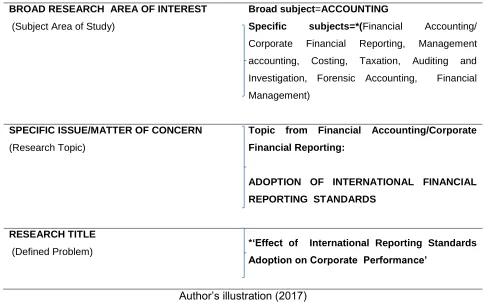
Table 1. Linking Research Problem with Research Topic and Research Title
BROAD RESEARCH AREA OF INTEREST
(Subject Area of Study)
Broad subject=ACCOUNTING
Specific subjects=*(Financial Accounting/ Corporate Financial Reporting, Management accounting, Costing, Taxation, Auditing and Investigation, Forensic Accounting, Financial Management)
SPECIFIC ISSUE/MATTER OF CONCERN
(Research Topic)
Topic from Financial Accounting/Corporate
Financial Reporting:
ADOPTION OF INTERNATIONAL FINANCIAL
REPORTING STANDARDS
RESEARCH TITLE
(Defined Problem) *‘Effect of International Reporting Standards
Adoption on Corporate Performance’
Author‟s illustration (2017)
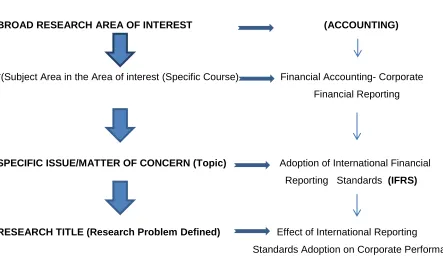
Licensed under Creative Common Page 637 Table 1 above is further illustrated in Fig 2 for clearer understanding.
Figure 2. Research Problem formulation
BROAD RESEARCH AREA OF INTEREST (ACCOUNTING)
*(Subject Area in the Area of interest (Specific Course) Financial Accounting- Corporate Financial Reporting
SPECIFIC ISSUE/MATTER OF CONCERN (Topic) Adoption of International Financial Reporting Standards (IFRS)
RESEARCH TITLE (Research Problem Defined) Effect of International Reporting
Standards Adoption on Corporate Performance
The development and formulation of a research problem begins with the identification of the broad discipline or area of study, followed by the specific course in the broad area of study (Osaze & Izedonmi,2000). From the specific course of study a topic which forms the basis of the problem for research is identified, and thereafter a title which represents an operational expression of the research problem.
From Table 1 and Figure 2 above, the broad subject area of research interest is accounting discipline. The specific accounting course of research interest is Financial Accounting and Corporate Reporting. A topic of interest, „Adoption of International Financial Reporting Standards‟ which envelopes the research problem is articulated, and thereafter, a
title, ‘Effect of International Reporting Standards Adoption on Corporate Performance‟ is formulated as the operational expression of the problem to be researched.
Development of the Research Problem
Licensed under Creative Common Page 638
Statement of the Research Problem
A statement of the research statement could be derived from the very source(s) from where the problem evolved. Often the source of the research problem, such as literature, practical experience or other factors is taken to provide justification for the research problem. Where for example a research problem emanated from a gap in literature, then it becomes imperative to provide sufficient information on the knowledge gap that constituted or provided authenticity to the research problem as object of study (Osaze, 2011)
Research Question
Research questions set out the framework and the specific terms of inquiry needed to address the research problem. Research questions are drawn to reflect the nature of the research problem under study. Quantitative or empirical research problems are closing ended the required research questions are along the following patterns:
i. Probable cause/effect (E.g: Does the adoption of IFRS have significant effect on corporate performance?
ii. Use of theories i.e. why did it happen in view of an explanation or theory? (E.g: „Does
the adoption of IFRS have significant effect on the comparability of corporate financial statement ?‟)
iii. Assess differences and magnitude. (E.g, „Has the adoption of IFRS received significant acceptance among Nigerian banks?‟)
Qualitative research questions are open ended and have the following characteristics:
i. Interpretive: assessment of perception about events. E.g: „Do companies consider the adoption of IFRS important?
ii. Process oriented. E.g: Did the attitude of Companies over the adoption of IFRS improve over time over time?
On the whole Quantitative research and the associated questions attempt to explain or predict the effect of variables on one another (how independent variable influence dependent variable while qualitative research questions tries to explore or understand how external forces shape and are shaped by the dependent variable (King, 2010 & Salawu, 2017).
Licensed under Creative Common Page 639
Research Objectives
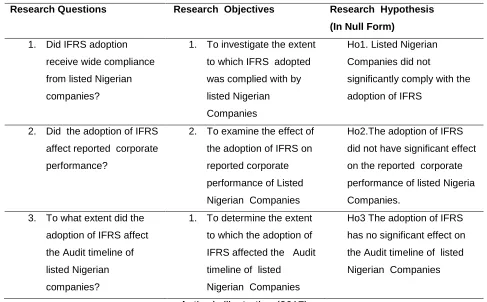
Research Objectives or Purposes of the research are built and made to align with the research questions (as shown on Table 2 below). A research objective opens with a statement of broad objective of the research, a statement such as: “The broad objective of this study is to determine the level of adoption of IFRS by Nigerian banks”; this is followed by specific objectives whose
numbers and subject matter are same with the research questions. The set objectives of the research provide the basis for arriving at informed decision on the conclusion arrived at the end of the study.
Research Hypothesis
Hypotheses frame the terms of inquiry in terms of tentative answers to each of the earlier stated research questions (as shown on Table 2). They are expressed as expected but unconfirmed relationships between two or more variables. Hypotheses are to be stated in such a way as to be amenable to testing. Hypotheses speculate on the form or the direction of the relationship. Like research questions that hypothesis address, it can also be categorized into „master‟ hypothesis and „subsidiary‟ hypothesis. Hypotheses can be stated either in the null or alternative
form.
For example where it is in the null form it is stated in a categorical negative form such as: “The adoption of IFRS does not significantly affect corporate performance” and in the alternative form:“The adoption of IFRS significantly affect corporate performance”. However,
in whatever form hypothesis is stated, it is expected to be expressed in such a way as to be testable (Agbonifo, 1999). Hypotheses frame the variables of the research problem for empirical evaluation.
The results of the evaluation of the hypotheses form the bases of the research findings, and the research findings provide basis for arriving at the conclusion over the attainment of the objectives of the research. From the conclusion is drawn both the recommendations and the extent to which the research contributes to knowledge.
CONCLUSION
Licensed under Creative Common Page 640 Table 2. Example of Alignment amongst Research Questions, Objectives and Hypothesis
Research Questions Research Objectives Research Hypothesis
(In Null Form)
1. Did IFRS adoption receive wide compliance from listed Nigerian companies?
1. To investigate the extent to which IFRS adopted was complied with by listed Nigerian Companies
Ho1. Listed Nigerian Companies did not
significantly comply with the adoption of IFRS
2. Did the adoption of IFRS affect reported corporate performance?
2. To examine the effect of the adoption of IFRS on reported corporate performance of Listed Nigerian Companies
Ho2.The adoption of IFRS did not have significant effect on the reported corporate performance of listed Nigeria Companies.
3. To what extent did the adoption of IFRS affect the Audit timeline of listed Nigerian companies?
1. To determine the extent to which the adoption of IFRS affected the Audit timeline of listed
Nigerian Companies
Ho3 The adoption of IFRS has no significant effect on the Audit timeline of listed Nigerian Companies
Author‟s illustration (2017)
REFERENCES
Agbonifo, B.A & G.O Yomere (1999). Research Methodology. 1st Edition. University Press, University of Benin, Benin-City.
Osaze, B.E & Izedonmi, F.I (2000). Guidelines for Writing Theses and Dissertations For Postgraduate Students in Africa. Revised Ed., Daycon Ltd, Islington, London.
Osaze B.E (2011). Guidelines For Writing Theses and Dissertations For Postgraduate Students. Ambik Press, Benin-City Nigeria.
Salawu (R.O). Selection of suitable and adequate (Research) Methodology. A Paper presented at the 3rd Annual ICAN Academic Conference held 19th-21st April, 2017 at University of Lagos.
Jessa, T (2010). What are the steps of Scientific Method? Available at http://www.universetoday.com/74036/what-are-the-step-of-scientific-method
King, D, (2010), Qualitative and quantitative research design, http://.unisa.Edu.au/footer/brosealoud.asp Kothari, C.R, (2012). Research Methodology: Methods and Techniques.2nd Ed. New Delhi. New Age International Limited Publishers
Nachmias, C. & D. Nachmias (1996). Research Methods in the Social Research Methods in the Social Sciences. 5th ed.
Obadan M.I ( 2012) Research Process, Report Writing & Referencing.1st Edition. Goldmark Press, Garki, Abuja.