Research Article
EVALUATION OF ANTI-INFLAMMATORY ACTIVITY OF
USING ADJUVANT INDUCED RAT PAW VOLUME METHOD
Abhilasha A1, Srinivas Yadav K2, Surekha S Medikeri
1Final year PG Scholar, 2Guide, Assistant Professor,
Department of PG studies in Rasashastra
Hospital, Bengaluru, Karnataka, India
Email: [email protected]
ABSTRACT
The disease Amavata was first mentioned in which is formed due to deranged Agni.
auto immune disorder that primarily affects joints. One of the main problems in RA is joint inflam
affects between 0.5 to 3% of adults in the developed world is most frequent during middle age and women are affected 3 times as frequently as men. There are
among them Amavatari Rasa is one of the herbo mineral & study was to observe the effect of Amavatari Rasa
was used to induce arthritis in rats. Randomly selected 30 Female Albino of 6 rats each. Rats were injected with 0.1 ml of Freund’s C
left hind paw. The paw volume of both the 14th and 21st days of treatment. In Disease C dard (Prednisolone induced) and Amavatari Rasa
significant decrease in the inflammation.
Keywords: Amavata, Rheumatoid arthritis,
INTRODUCTION
Ayurveda, the science of health has its roots from ancient times. This is being evolved in parallel with human race. The supremacy of Ayurveda
Holistic approach towards patient care.
is a branch of Ayurvedic medicine, which deals with metals and minerals to produce the drugs with higher efficacy in lower doses. In today’s scenario,
Amavata is one of the serious problems among all
MEDICAL JOURNAL
ISSN: 2320 5091
INFLAMMATORY ACTIVITY OF
AMAVATARI RASA
USING ADJUVANT INDUCED RAT PAW VOLUME METHOD
, Surekha S Medikeri3
Guide, Assistant Professor, 3Professor & HOD,
Rasashastra and Bhaishajya kalpana, Government Ayurvedic Medical
was first mentioned in Madhava nidana. The main Pathogenic factor in the disease is . Amavata can be compared to Rheumatoid Arthritis; RA is a long lasting auto immune disorder that primarily affects joints. One of the main problems in RA is joint inflam
affects between 0.5 to 3% of adults in the developed world is most frequent during middle age and women are There are many formulations mentioned in Ayurvedic classics for
is one of the herbo mineral & Khalveeya Rasayana. The purpose of the present
Amavatari Rasa on inflammation in RA. Freund’s Complete A
was used to induce arthritis in rats. Randomly selected 30 Female Albino rats were equally divided into 5 groups jected with 0.1 ml of Freund’s Complete Adjuvant (FCA) into the plantar region of the left hind paw. The paw volume of both the hind paws was measured using a Digital Plethysmometer on 1
days of treatment. In Disease Control group, inflammation consistently increased. Where as in Sta
Amavatari Rasa treated (Group IV- TED and Group V- 2 TED) groups showed ammation.
, Rheumatoid arthritis, Amavatari Rasa, Khalveeya Rasayana, FCA
, the science of health has its roots from ancient times. This is being evolved in parallel with
Ayurveda lies in its
Rasa shastra
is a branch of Ayurvedic medicine, which deals with ls and minerals to produce the drugs with higher In today’s scenario, is one of the serious problems among all
joint disorders. A disease resembling clinically Rheumatoid arthritis (RA) is described in Ayurvedic text as Amavata.
Amavata as a separate disease entity was described for the first time in detail by
famous treatise called Madhava Nidan
with the aetiopathogenesis of the diseas
tematic manner with the signs, symptoms, complic
Impact Factor: 4.018
AMAVATARI RASA
BY
, Government Ayurvedic Medical College and
The main Pathogenic factor in the disease is Ama, can be compared to Rheumatoid Arthritis; RA is a long lasting auto immune disorder that primarily affects joints. One of the main problems in RA is joint inflammation. RA affects between 0.5 to 3% of adults in the developed world is most frequent during middle age and women are yurvedic classics for Amavata, The purpose of the present n inflammation in RA. Freund’s Complete Adjuvant (FCA) rats were equally divided into 5 groups omplete Adjuvant (FCA) into the plantar region of the lethysmometer on 1st, 7th, ontrol group, inflammation consistently increased. Where as in
Stan-2 TED) groups showed
joint disorders. A disease resembling clinically Rheumatoid arthritis (RA) is described in Ayurvedic
as a separate disease entity was described for the first time in detail by Madhavakara in his
Madhava Nidana, dealing with the aetiopathogenesis of the disease in a
complica-IAMJ: Volume 6, Issue 6, June, 2018 1265
tions and prognosis. Amavata has been named, tak-ing into account the predominant pathological fac-tors i.e. Ama and Vata, as they have important place in Nidana and Chikitsa of this disease.1
Amavata occurs in all over the world in all races, genders, age and climates and is equated with Rheumatoid Arthritis by the scholars. RA is a long lasting auto immune disorder that primarily affects joints. It typically results in warm, swollen and pain-ful joints. One of the main problems in RA is joint inflammation. In affected joints, the thin synovium grows thicker. The joint swells and the cartilage pro-tecting the ends of the bones in the joints gets dam-aged. This disease is two or three times more preva-lent among females than the males. Shamana and
Shodhana Chikitsa are advised in Amavata whereas Analgesics, NSAID and DMARD are required for the management in modern medicines.2, 3
The principle aim of the Ayurvedic management in
Shamana chikitsa is to improve status of Agni and thus to break the formation of Ama and effective in treating vitiated Vata dosha i.e. the drug which ful-fils Deepana, Pachana and Anulomana properties.4 So the drug selected for this study is Amavatari Rasa
with the reference of Bhaishajya Ratnavali5 which is
the combination of herbo-mineral ingredients. The main aim of the study is to evaluate the anti-inflammatory activity of Amavatari Rasa by using FCA induced rat paw volume method.
OBJECTIVE
To study the anti-inflammatory effect of Amavatari Rasa by FCA induced rat paw volume method.
MATERIALS AND METHODS Source of drug:
All the required drugs were collected from authenti-cated dealers.
Locale of the work:
The preparation of Amavatari Rasa was carried out in Department of PG studies in Rasa Shastra and Bhaishajya Kalpana, Government Ayurvedic Medi-cal College and Hospital, Bengaluru.
The experimental study was carried out in Depart-ment of Pharmacology, Acharya & B.M. Reddy Col-lege of Pharmacy, Bengaluru.
Selection of animals:
The required numbers of healthy female Wistar Al-bino rats weighing 120-200 gms were procured from Acharya & B.M Reddy College of Pharmacy, Ben-galuru.
Housing and feeding condition:
Animals were kept in polypropylene cages with paddy husk bedding. The temperature in the experi-mental room was around 25°C. Lightening was natu-ral sequence being 12 hours dark, 12 hours light. They were provided standard food pellets and water
ad libitum.
All the experiments were performed in the morning according to the guidelines for the care of laboratory animals. The experimental procedures were carried out in accordance with the ethical guidelines for animals proposed by the government of India. The approval of the ethical committee was obtained be-fore performing the experiments. Ethics Committee (IAEC) with reference no: IAEC/ABMRCP/2016-2017/23
Grouping:
Randomly selected 30 Female Albino Rats were equally divided into 5 groups of 6 rats each. In each group the animals were marked with yellow colour to permit individual identification i.e. at the region of head, body, tail, front leg, back leg and no mark. Each group of 6 rats were kept in separate polypro-pylene cages denote the number from 1 to 5 respec-tively, for one week prior to dosing to allow accli-matization of them to laboratory conditions.
Table 1: Showing the Details of Grouping
Group Purpose Drugs No. of animals
Group I Normal control Distilled water 6
IAMJ: Volume 6, Issue 6, June, 2018 1266
Group III Standard group FCA induced+ 1% Gum acacia+ Prednisolone 6
Group IV Trail group I FCA induced + 1% Gum acacia+ Amavatari Rasa (TED) 6
Group V Trail group II FCA induced + 1% Gum acacia+ Amavatari Rasa (2 TED) 6
Drug and Chemicals:
Picric Acid, FCA, Gum Acacia, Prednisolone,
Amavatari Rasa and Distilled Water.
Equipments:
Tuberculin Syringe (1ml Capacity), Gavage Needle, Gloves, Digital Plethysmometer, Mortar and Pestle.
Injection of disease: FCA induced arthritis
Rats were injected with 0.1 ml of Freund’s Complete Adjuvant (FCA) into the plantar region of the left hind paw. A mark was put on the leg at themaleous region of the rat to facilitate the dipping of the leg into the Plethysmometer. The paw volume of both the hind paws was measured using a Digital Plethysmometer and body weight was recorded on the day of adjuvant injection considered as 0th day. Administration of doses:
Animals were kept for 12 hours of fasting. Then as-signed drugs were administered orally using a ga-vage needle in a calculated dose.
Dosing
The initial reading was taken before the injecting FCA. After one day of injection, dosing was started.
Amavatari Rasa in TED (45mg/kg bodyweight) and 2 TED (90 mg/kg bodyweight) dose was adminis-tered orally for Group IV and V respectively. Pred-nisolone (10mg/kg) was used as standard drug. The paw volume was measured on 1st, 7th, 14th and 21st day of treatment. The percentage inhibition of paw volume in drug treated group was compared with the control group.
RESULTS:
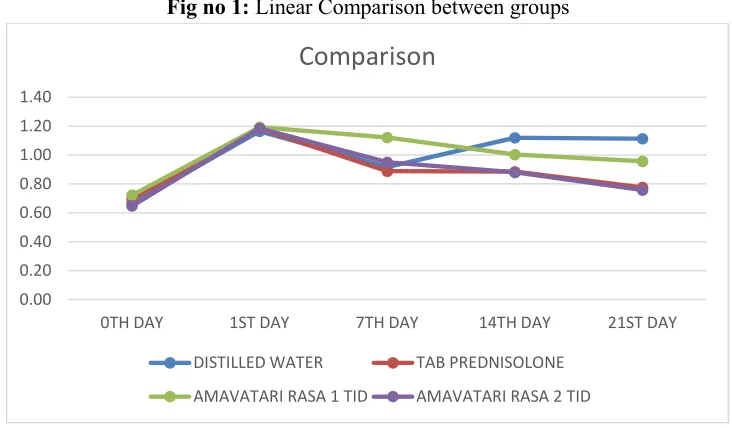
In Standard Group (Group III) though it showed sta-tistically insignificant result at the end of 21st day, experimentally significant result has been found. Statistical insignificancy may be because of higher standard deviation value on 21st day results. In
Amavatari Rasa treated Group IV and V Statistically & Experimentally significant result has been found.
Table 2: Comparison between drugs and days
Group Drugs 0th Day 1st Day 7th Day 14th Day 21st Day
IAMJ: Volume 6, Issue 6, June, 2018 1267
Fig no 1: Linear Comparison between groups
STATISTICAL RESULTS Table 3: Showing statistical results.
0th Day 1st Day 7th Day 14th Day 21st Day Control 0.665±0.102 1.165±0.027 0.917±0.073 1.120±0.068 1.113±0.054
Standard 0.697±0.106 1.183±0.029 0.937±0.175 0.885±0.201 0.777±0.154 % Inhibition 4.545 1.549 2.135 26.554 43.348
Trial I 0.723*±0.073 1.193*±0.035 1.122*±0.075 1.003*±0.063 0.957*±0.071 % Inhibition 8.065 2.374 18.276 11.628 16.376
Trial II 0.648*±0.112 1.185*±0.037 0.950*±0.154 0.880*±0.204 0.758*±0.088 % Inhibition 2.571 1.688 3.509 27.273 46.813 F Value 0.676 0.808 3.283 3.431 17.031
DF 3,20 3,20 3,20 3,20 3,20
P Value 0.577 0.504 <0.05 <0.05 <0.05
DISCUSSION
In the present study an attempt has been made to evaluate the anti-inflammatory activity of Amavatari Rasa by FCA induced rat paw volume method. The FCA induced arthritis model is widely used for evaluating anti-arthritic activity of drugs. It shares a number of clinical and immunological features with human arthritis; therefore FCA model has a high degree of validity.
In the present study randomly selected 30 rats weighing between 120-200gms were equally divided into 5 groups of 6 each. The Group I of Normal Con-trol, Group II of Disease Control was administered 1% Gum acacia in rat dose of 5ml/kg body weight,
In Group III of Standard was Prednisolone in 10mg/kg body weight, in Group IV of Trail drug 1 (Amavatari rasa TED) was treated with 45mg/kg body weight and lastly Group V of Trail drug 2 (Amavatari rasa 2 TED) was treated with 90mg/kg body weight PO.
The study revealed that Amavatari rasa possess sig-nificant anti-inflammatory activity in experimental animals at the dose of 45mg/kg body weight and highly significant at the dose of 90mg/ kg body weight PO.
0.00 0.20 0.40 0.60 0.80 1.00 1.20 1.40
0TH DAY 1ST DAY 7TH DAY 14TH DAY 21ST DAY
Comparison
DISTILLED WATER TAB PREDNISOLONE
IAMJ: Volume 6, Issue 6, June, 2018 1268
CONCLUSION
The reference of the present study was adopted from
Bhaishajya Ratnavali, Amavata rogadhikara. Shod-hana, Bhavana, Mardana, Swedana and Vati nir-mana are the important pharmaceutical procedures involved in the preparation of Amavatari Rasa.
Amavatari Rasa comes under kharaleeya rasayana
and a Vati kalpana, which is one of the easy and widely used dosage forms.
Normal Control Group showed no change in their physiological conditions. Disease Control Group
showed continued inflammation over the period of experiment. Standard drug showed experimentally significant and statistically insignificant results. Experimental study proved that Amavatari Rasa in Group V (2 TED) is more significant when com-pared to Amavatari Rasa in Group IV (TED). With the factual evidence obtained by the above experi-mental data, it has been concluded that the Amava-tari Rasa is having significant anti-inflammatory activity.
Injection of FCA into Inflammation after injection Digital plethysmometer Left plantar
REFERENCES
1. Madhavakara, Madhava Nidana, Madhukosha by Srikanta Datta, Hindi commentary and edited by Yadunandan Acharya, Chaukambha prakashana, Vol 1, 25/1-15, pg no.508-512.
2. Davidson’s Principles and Practice of Medicine, ed-ited by Dewards Christopher Boucher, 16th edition, 1991 Hongkong.
3. Braunwald-Kurt J. Issebacher Wilson, Martin, Kasper, Hauser, Longo, Harrisons Principle of
Inter-nal Medicine, 14th edition, Mc Graw Hill book
Com-pany, New York, 1998.
4. Chakrapani Datta, Chakradatta, Translated by Dr.G. Prabhakar Rao, Chaukambha Orientalia Varanasi, 1st
edition 2014, Chikitsa Sangraha 25/1, pg no.264. 5. Govind Dasa Sena, Bhaishajya Ratnavali, Hindi
Commentary, Prof S N Mishra, Chaukambha Surab-harati Prakashan, 29/ 69-70, pg no.601.
Source of Support: Nil
Conflict Of Interest: None Declared
How to cite this URL: Abhilasha A et al: Evaluation Of Anti-Inflammatory Activity Of Amavatari Rasa By Using Adjuvant Induced Rat Paw Volume Method. International Ayurvedic Medical Journal {online} 2018 {cited June, 2018} Available from: