http://www.ijcmph.com pISSN 2394-6032 | eISSN 2394-6040
Original Research Article
Exploration of contraceptive awareness and decision making among
married women of reproductive age in semi urban area of Tamil Nadu
Sinduja Saravanan
1, Rakesh Maiya
1*, R. M. Waseem Akram
2, Timsi Jain
1INTRODUCTION
India was the first country in the world to have launched a National Programme for Family Planning in 1952, but still there is no control on population growth. Healthy spacing of 3 years improves the chances of survival of infants and also helps in reducing the impact of population momentum on population growth which can be achieved by various methods of contraception.
An unwanted pregnancy may lead to an induced abortion. From the point of view of health, abortion outside the medical setting is one of the most dangerous consequences of unwanted pregnancy. There is also
evidence of higher incidence of mental disturbances among mothers who have had unwanted pregnancies. The health impact of family planning occurs primarily, through the avoidance of unwanted pregnancies, limiting the number of births and proper spacing, and timing the births particularly the first and last, in relation to the age of the mother.1
Contraception includes the preventive methods to help women avoid unwanted pregnancies. There are different methods of contraception as long-acting reversible contraception, such as the implant or intrauterine contraceptive device (IUCD), hormonal contraception such the pill or the barrier methods, such as condoms, emergency contraception, permanent contraception, such
ABSTRACT
Background: India was the first country to have launched a National Program for Family Planning in 1952, but still there is no control on population growth. The objective was to assess the knowledge, attitude and practices of contraceptives among married women in semi urban area of Tamil Nadu.
Methods: A community based cross sectional study was conducted in a semi urban area of Tamil Nadu. Married women of reproductive age (15-49) were included. Purposive sampling technique was used to select the subjects and self-administered questionnaire was used as study tool.
Results: In this study about 91.80% were aware of at least one of the contraceptive methods but only 64.75% women used. The most common reason for using contraception was small family norms (75.89%) and for not using contraception was worried about side effects. The method commonly preferred was sterilisation (63.93%). The process of decision making was done mutually by both husband and wife (76.79%). There is an association existing between the education and awareness.
Conclusions: On overall analysis it was found that only 49% are aware of contraception. Thus by proper motivation, counselling and improving facilities at both government and private sector, the unmet needs of contraception can be achieved.
Keywords: Knowledge, Attitude, Practices, Contraceptives, Married women of reproductive age 1Department of Community Medicine, Saveetha Medical College, Tamil Nadu, India
2Department of Community Medicine, Nimra Medical College, Andhra Pradesh, India
Received: 28 August 2019
Revised: 05 October 2019
Accepted: 07 October 2019
*Correspondence:
Dr. Rakesh Maiya,
E-mail: [email protected]
Copyright: © the author(s), publisher and licensee Medip Academy. This is an open-access article distributed under the terms of the Creative Commons Attribution Non-Commercial License, which permits unrestricted non-commercial use, distribution, and reproduction in any medium, provided the original work is properly cited.
as vasectomy and tubal ligation.2 Promotion of family planning and ensuring access to preferred contraceptive methods for women and couples is essential in securing the well-being and autonomy of women, and supporting the health and development of community.
Women in India are not being fully educated on contraception usage and what they are putting in their bodies and were not informed of all the options and what those options actually do.3 According to the National Family Health Survey(NFHS-4), in Tamil Nadu contraceptive prevalence rate (CPR) among currently married women age 15-49, at 53 percent, shows a sharp decline from 61 percent in NFHS-3.4
Objectives
The objectives of the study were to assess the knowledge, attitude and practices of contraceptives among married women, identify factors that are associated with the non-use of contraceptives and to determine the factors influencing contraceptive decision making of married women.
METHODS
Study design
The study was done as a community based cross sectional study.
Study setting
The study was conducted in Thirumazhisai, semi urban area of Tamil Nadu.
Study population
Married women of reproductive age (15-49) who were willing to participate were included in the study.
Study duration
The study was carried out from January 2019 through June 2019.
Sample size
In the study conducted by Chandhick, an ICMR task force study on contraception, the prevalence of use of contraceptives was found to be 45.6% therefore with a relative error of 20% and confidence level 95% the sample size calculated is 122.
Sample size calculation
Proportion of an event (p) = 45%;
Proportion of an alternate event (q) = 55%;
Sample size (n) = =
Hence the sample size (n): 122
Sampling method
Purposive sampling method was used for selecting the individuals as study subjects. The data was collected by house to house visit in the study area.
Data collection
Self-administered questionnaire was used for collecting the data. Questionnaire included the variables such as the socio-demographic profile and 22 questions in multiple choices regarding the knowledge, attitude and practice of contraception. The subjects are allowed to choose more than one option. Individual scoring done based on the weightage of each question and total score being 50.
Ethical clearance for the study was obtained from the institutional review board and participant information sheet was given to the study subjects and written informed consent was obtained from each participant prior to data collection.
Data analysis
Data analysis was done using Microsoft Excel. Descriptive statistics were calculated for the background characteristics and variables related to knowledge attitude and practice of contraception among married women.
RESULTS
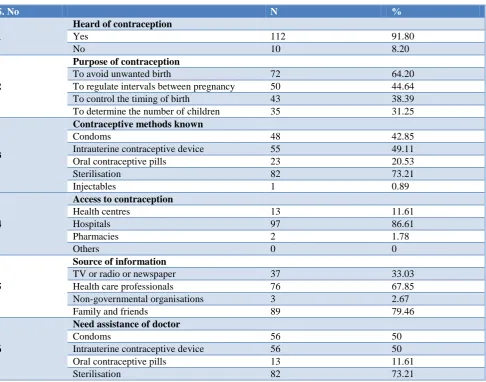
A total of 122 married women of reproductive age group were interviewed, the analysis of the demographic profile revealed that more than half of the women (54.09%) were in the age group of 25-34 years. About 40.16% of the respondents were graduates followed by 43.44% and 16.40% who were educated upto high school and primary school. Majority of the women (80.33%) were homemaker. Almost 97.54% of them were Hindus. The marital age of 64.75% of the women was found to be early and late twenties. 65.57% of the women had 2 living child. 66.39% of the women were belonging to nuclear family (Table1).
that sterilisation requires the assistance of doctor while 50% responded that condoms and intrauterine contraceptive device needs the assistance of doctor. 76.79% of them agreed that decision making regarding contraception must be done by both together. 70.53% responded that husband’s decision is the main
determinant of their contraceptive use (Table 2 and 3).
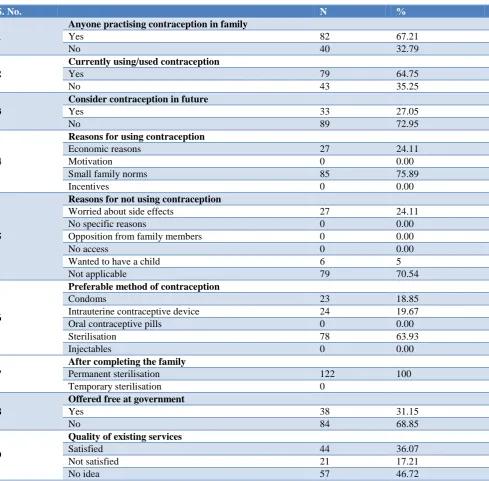
Regarding the practice of contraception, about 64.25% were currently practising contraception and 27.05% would consider using contraception in the future. The most common reason for using contraception was small family norms (75.89%) and for not using contraception was worried about side effects.
Table 1: Socio-demographic characteristics of the interviewed women (n=122).
S. No. Characteristics N %
1
Age (in years)
15-24 1 0.82
25-34 66 54.09
35-44 41 33.61
45-49 14 11.48
2
Educational status
profession 0 0
graduate or post graduate 49 40.16
intermediate or post high-school diploma 0 0
High school certificate 53 43.44
Middle school certificate 0 0
Primary school certificate 20 16.40
Illiterate 0 0
3
Occupational status
Professionals 0 0
Semi professionals 0 0
Skilled worker 5 4.09
Semiskilled worker 4 3.28
Unskilled worker 15 12.30
Unemployed 98 80.33
4
Monthly income (in Rs.)
<5000 2 1.64
6000-10000 49 40.16
11000-20000 45 36.89
21000-30000 21 17.21
31000-40000 3 2.46
>40000 1 0.82
5
Religion
Hindu 119 97.54
Muslim 1 0.82
Christian 2 1.64
Others 0 0
6
Marital age (in years)
≤20 41 33.61
21-25 73 59.84
26-30 6 4.91
>31 2 1.64
7
No of children
1 34 27.87
2 80 65.57
3 7 5.74
4 1 0.82
8
Type of family
Joint 41 33.61
Table 2: Knowledge and awareness regarding contraception (n=122).
S. No N %
1
Heard of contraception
Yes 112 91.80
No 10 8.20
2
Purpose of contraception
To avoid unwanted birth 72 64.20
To regulate intervals between pregnancy 50 44.64
To control the timing of birth 43 38.39
To determine the number of children 35 31.25
3
Contraceptive methods known
Condoms 48 42.85
Intrauterine contraceptive device 55 49.11
Oral contraceptive pills 23 20.53
Sterilisation 82 73.21
Injectables 1 0.89
4
Access to contraception
Health centres 13 11.61
Hospitals 97 86.61
Pharmacies 2 1.78
Others 0 0
5
Source of information
TV or radio or newspaper 37 33.03
Health care professionals 76 67.85
Non-governmental organisations 3 2.67
Family and friends 89 79.46
6
Need assistance of doctor
Condoms 56 50
Intrauterine contraceptive device 56 50
Oral contraceptive pills 13 11.61
Sterilisation 82 73.21
Table 3: Attitude towards contraception (n=122).
S. No. N %
1
Necessary to know about contraception
Yes 122 100.00
No 0 0.00
2
Decision making
Self 17 15.18
Husband 8 7.14
Both together 86 76.79
Parents or in laws 1 0.89
3
Determinants of your contraceptive use
Own decision 24 21.42
Husband’s decision 79 70.53
Doctors recommendation 5 4.46
In laws approval 4 3.75
4
Ideal number of children
1 23 18.85
2 99 81.45
Table 4: Practices of contraception (n=122).
S. No. N %
1
Anyone practising contraception in family
Yes 82 67.21
No 40 32.79
2
Currently using/used contraception
Yes 79 64.75
No 43 35.25
3
Consider contraception in future
Yes 33 27.05
No 89 72.95
4
Reasons for using contraception
Economic reasons 27 24.11
Motivation 0 0.00
Small family norms 85 75.89
Incentives 0 0.00
5
Reasons for not using contraception
Worried about side effects 27 24.11
No specific reasons 0 0.00
Opposition from family members 0 0.00
No access 0 0.00
Wanted to have a child 6 5
Not applicable 79 70.54
6
Preferable method of contraception
Condoms 23 18.85
Intrauterine contraceptive device 24 19.67
Oral contraceptive pills 0 0.00
Sterilisation 78 63.93
Injectables 0 0.00
7
After completing the family
Permanent sterilisation 122 100
Temporary sterilisation 0
8
Offered free at government
Yes 38 31.15
No 84 68.85
9
Quality of existing services
Satisfied 44 36.07
Not satisfied 21 17.21
No idea 57 46.72
*For certain data n=112, since it is not applicable for the rest of the subjects.
Figure 1: Awareness about contraception.
The method commonly preferred was sterilisation (63.93%) and after completing the family 100% preferred permanent sterilisation. Only 36.07% of them were
satisfied about the existing contraceptive services (Table 4).
Description of scores
On scoring each subject individually, the average score was found to be 22.37 and individuals with score above the average were considered to be aware of contraception and those below the average were considered as unaware (Figure 1).
Association between education and awareness
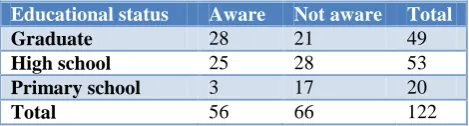
The computed Chi-square statistic is 10.2188. The p-value is 0.00604. The result is significant at p<0.05.Thus
49% 51%
Aware
it was found that the awareness among women regarding contraception depends on the educational status (Table 5).
Table 5: Association between education and awareness.
Educational status Aware Not aware Total
Graduate 28 21 49
High school 25 28 53
Primary school 3 17 20
Total 56 66 122
DISCUSSION
In this study about 91.80% were aware of at least one of the contraceptive methods but only 64.75% women used contraception. The phenomena of high knowledge about contraception and low practice has been observed in multiple studies conducted in various parts of India as reported by Srivastava et al (awareness 71.22%, practice 51.7%), Bhasin et al (awareness 90%, practice 59.8%).5,6 Most of the women preferred female sterilisation (63.93%) which is similar to data obtained from NFHS-2 in which female sterilisation is the prevalent method of contraception (71%). When the respondents who had knowledge about contraception were asked about their source of information, majority indicated social circle as their source. This corresponds with the study by Srivastava et al KAP survey.7
The decision making regarding contraception in our study is taken mutually by both wife and the husband (76.79%) which is similar to the study conducted by Chopra et al (71%).8 In this study there is an association existing between the education and awareness with a significant p value, a similar association is also seen in the study by Srivastava et al.9
CONCLUSION
This study reveals average knowledge and attitude of women towards contraception. There are various reasons for the non-acceptance of contraceptives like worries about side effects, preference for male child, and poor family planning services. Thus by proper motivation, counselling and improving facilities at both government and private sector the unmet needs of contraception can be achieved.
ACKNOWLEDGEMENTS
We thank all women for their active participation in this study.
Funding: No funding sources Conflict of interest: None declared
Ethical approval: The study was approved by the Institutional Ethics Committee
REFERENCES
1. Anjum S, Durgawale PM, Shinde M. Knowledge of contraceptives methods and appraisal of health education among married woman. Int J Sci Res. 2014:3(3):584.
2. Park K. Textbook of Preventive and Social Medicine. 24th ed. Jabalpur: M/s Banarsidas Bhanot; 2017: 528.
3. Jain AK. Information about methods received by contraceptive users in India. J Biosoc Sci. 2017;49(6):798-810.
4. International Institute for Population Sciences (IIPS) and ICF. 2017. National Family Health Survey (NFHS-4), India, 2015-16: Tamil Nadu. Mumbai: IIPS.
5. Tejaswini D, Spandana JC, Sunanda Bai. Knowledge, attitude and practices about contraception among married reproductive women. Int J Reprod Contracep Obstetr Gynecol. 2018;1431-4.
6. Bhasin SK, Pant M, Metha M, Kumar S. Prevalence of usage of different contraceptive methods in east Delhi-a cross sectional study. Indian J Community Med. 2005;30(2).
7. Srivastava R, Srivastava DK, Jina R, Srivastava K, Sharma N, Sana S. Contraceptive knowledge, attitude and practice (KAP Survey). J obstet Gynecol India. 2005;55:546-50.
8. Chopra S, Dhaliwal L. Knowledge, attitude and practices of contraception in urban population of North India. Arch Gynecol Obstet. 2010;281:273-7. 9. Srivastava A, Khan MS. Knowledge, attitude and
practices about contraceptive among married reproductive females. Int J Scientific Study. 2014;1(5):2-4.