ISSN: 2395-3519
www.ijatca.com 45
International Journal of Advanced Trends in
Computer Applications
www.ijatca.com
Design image encryption then compression system
using prediction error clustering with haar wavelet
transform
1
Harkanwal Preet kaur, 2Rupinder kaur 1
Department of cse,Doaba institute of engineering and technology,kharar, India 2
Assistant Professor 2
Department of cse,Doaba institute of engineering and technology,kharar, India
1
[email protected], [email protected]
Abstract: Presently these days there is accelerated advancement in multimedia and network technologies. For
that reason the privacy and security evolves into the preeminent issues because the multimedia is disseminated openly over network. In our proposed work, asymmetric key encryption is used means where encryption key is known to everyone where decryption key is known to receiver side that allow receiver to read the encrypted image. The proposed scheme of encrypting image is operated with prediction error clustering method that is shown to provide high level of security reasonably. After that image compression algorithm is implemented using Haar Wavelet Transform which efficiently compresses the image encrypted. The compression approach applied to encrypted image is proved more efficient in terms of Compression Ratio (CR), Mean Square Error (MSE), Peak Signal to Noise Ratio (PSNR), Entropy and Bit error rate (BER). For the implementation of this proposed work we use image processing toolbox under MATLAB software.Keywords:
ETC, Encryption, Compression, Haar wavelet, mean square error, CR, peak signal to noise ratio, entropy, bit error rate.I. INTRODUCTION
The security of multimedia becomes more important, since multimedia data are transmitted over open networks more frequently. Typically, reliable security is necessary to content protection of digital images and videos. Encryption schemes for multimedia data need to be specifically designed to protect multimedia content and full fill the security requirements for a particular multimedia application. For example, real-time encryption of an image using classical ciphers requires heavy computation due to the large amounts of data involved, but many multimedia applications require security on a much lower level, this can be achieved using selective encryption that leaves some perceptual information after encryption.
A marked progress has been made in the field of image compression and its application in various branches of engineering. Image compression is associated with removing redundant information of image data. It is a solution which associated with storage and data transmission problem of huge amounts of data for digital image. Image transmission application includes broadcast television, remote sensing via satellite and other long distance communication systems. Image storage is required for several purposes like document, medical images, MRI
and radiology, motion pictures etc. All such applications are based on image compression. On the basis of all benefits and requirements of image encryption and image compression I am going to combine both the techniques so that an image can be transmitted over a network with complete security and also taking small storage space.
ISSN: 2395-3519
www.ijatca.com 46 existing ETC solutions induce significant penalty on the
compression efficiency.
Lossless compression technique:
Image compression techniques can be classified in to two categories - lossy or lossless. In proposed work we considered lossless image compression. Lossless compression is preferred for archival purposes and often for medical imaging, technical drawings, clip art, or comics. When using lossless compression, the exact original image can be recovered. The performance can be specified in term of compression efficiency and complexity.
Haar Wavelet Transform:
Haar functions are used since 1910 and were introduced by Hungarian mathematician Alfred Haar [5]. Over the past few years, a variety of powerful and sophisticated wavelet– based schemes for image compression were developed and implemented. Generally, wavelets, with all generalizations and modifications, were intended to adapt this concept to some practical applications. The DWT uses the Haar functions in image coding, edge extraction and binary logic design and is one of the most promising techniques today. The non-sinusoidal Haar transform is the complete unitary transform. It is local, thus can be used for data compression of non–stationary
“spiky” signals. The digital images may be treated as such “spiky” signals. Unfortunately, the Haar Transform has poor energy compaction for image, therefore in practice, basic Haar transform is not used in image compression.
Fourier methods are not always good tools to recapture the signal, particularly if it is highly non–smooth; too much Fourier information is needed to reconstruct the signal locally. In these cases the wavelet analysis is often very effective because it provides a simple approach for dealing with the local aspects of a signal, therefore particular properties of the Haar or wavelet transforms allow analysing the original image on spectral domain effectively.
II. LITERATURE SURVEY
Jiantao Zhou, Xianming Liu, Oscar C. Au and Yaun Yan Tang, “Designing an Efficient Image Encryption Then Compression System via Prediction Error Clustering and Prediction error clustering” [1] they proposed image encryption scheme operated in the prediction error domain able to provide a reasonably high level of security. Arithmetic coding-based approach can be exploited to efficiently compress the encrypted images. Proposed compression approach applied to encrypted images is only slightly worse, in terms of compression efficiency than the state-of-the-art lossless/lossy image coders which take original, unencrypted images as inputs most of the existing ETC solutions induce significant penalty on the compression efficiency.
Lisa M. Marvel and George W. Hartwig, Jr. ,“A Survey of Image Compression Techniques and Their Performance in Noisy Environments”[2] this paper explore the effects of noise on a variety of image compression techniques - namely, fractal, wavelet, DPCM and the most recent compression standard for still imagery methods for minimizing the effects of the noisy channel on algorithm performance are also considered.
Kamrul Hasan Talukder and Koichi Harada, “Haar Wavelet Based Approach for Image Compression and Quality Assessment of Compressed Image” [3] this presented a comprehensive survey on existing etc techniques by categorizing them according to the features used in each stage and compare them in terms of pros, cons, recognition accuracy and processing speed.
Jashanbir Singh Kalka, Reecha Sharma, “Comparative Performance Analysis of Haar, Symlets and Bior wavelets on Image compression using Discrete Wavelet Transform” [4] paper aims at performing wavelet analysis on jpeg images using discrete wavelet transform for implementation in a still image compression system and to highlight the benefit of this transform relating to other techniques (DCT).
Piotr Porwik, Agnieszka Lisowska, “The Haar–Wavelet Transform in Digital Image Processing” [5] paper for the first time presents graphic dependences between parts of Haar and wavelets spectra. Presents a method of image analysis by means of the wavelets–Haar spectrum some properties of the Haar and wavelets spectrum were investigated. The extraction of image features immediately from spectral coefficients distribution was shown. Two dimensional both the Haar and wavelets functions products man be treated as extractors of particular image features.
M. Sifuzzaman, M.R. Islam and M.Z. Ali, “Application of Wavelet Transform and its Advantages Compared to Fourier Transform.” [6] representation of a function is important in all types of signal transmission. The wavelet representation of a function is a new technique where wavelet transform of a function is the improved version of Fourier transform. Fourier transform is a powerful tool for analyzing the components of a stationary signal. Main goal is to find out the advantages of wavelet transform compared to Fourier transform.
ISSN: 2395-3519
www.ijatca.com 47
implementation in a still image compression system and
to highlight the benefit of this transform relating to today‟s methods features of wavelet transform in compression of still images, including the extent to which the quality of image is degraded by the process of wavelet compression and decompression.
Anna Saro Vijendran, Vidhya.B, “A Hybrid Image Compression Technique Using Wavelet
Transformation”, Global Journal of Computer Science and Technology in this paper an interpolation method is proposed for compression technique. The method used is the localizing of spatial and frequency correlation from wavelets. Modified Forward Only Counter Propagation Neural Network (MFOCPN) is used for the classification and functional task. The wavelet based technique decomposes the lower sub band consisting of non significant coefficients and are eliminated.
III.
METHODOLOGY
In this work, a novel approach for image encryption and compression is used in which prediction error clustering method is combined with new Haar Wavelet Transform for calculating more accurate results. The proposed approach is named as ECNHWT (Encryption-Compression using new Haar wavelet transform). The input image has been considered as „I‟, encryption over „I‟ has been implemented using prediction error clustering method. The obtained result after encryption has been considered as „Ie‟, and then a new Haar Wavelet technique has been used for compression. The output after compression has been stored as image „B‟. Then the image „B‟ has been decrypted after decompression. Fig shows the proposed model for Encryption-Compression System.
I Ie Ie
Prediction error clustering New Haar Wavelet
Reconstruction of Real Image
I B
Fig 1: Proposed model for Encryption-Compression System
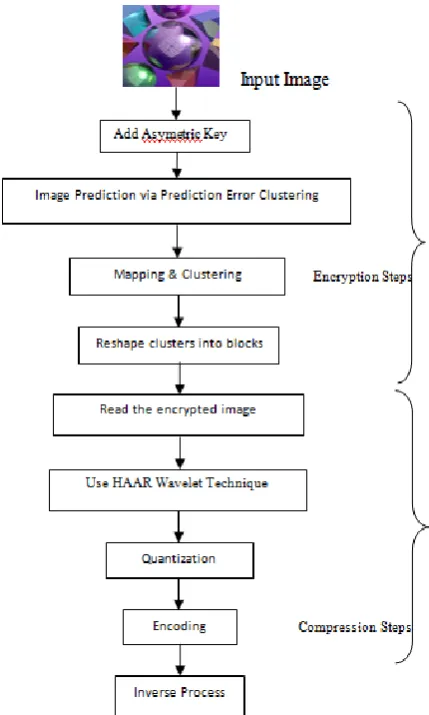
The resultant image is evaluated using various parameters like CR, MSE and PSNR to check the efficiency and to compare it with the result of existing system. We can also represent the proposed schema with the help of flowchart. Figure shown below shows the flowchart that represents the procedure flow of various steps. Half of the flowchart represents the encryption steps and rest represents the compression steps. Then inverse process to retrieve the real image and then calculation steps to check the efficiency.
Fig 2: Flowchart for Image Encryption-Compression Scheme
The algorithmic procedure of performing the image encryption-compression by new Haar wavelet transform (ECNHWT) is given as follows [1] [2]:
Step 1: Implementation of encryption algorithm to the input image I.
I: Compute all the mapped prediction errors i,j of the whole image I using GAP image predictor.
II: Divide all the prediction errors into L clusters Ck, for 0 ≤ k ≤ L − 1, and each Ck is formed by concatenating the mapped prediction errors in a raster-scan order. III: Reshape the prediction errors in each Ck into a 2-D block having four columns and rows, where |Ck| denotes the number of prediction errors in Ck . IV: Perform cyclical shift operations to each resulting prediction error block, and read out the data in raster-scan order to obtain the permuted cluster k.
V: The assembler concatenates all the permuted clusters k, for 0 ≤ k ≤ L− 1, and generates the final encrypted image Ie= 0 1… L-1 in which each prediction error is represented by 8 bits. As the number of prediction errors equals that of the pixels, the file size before and after the encryption preserves.
VI: Pass Ie together with the length of each cluster | k |, for 0≤k≤L− 2.
Encryption
Compression
ISSN: 2395-3519
www.ijatca.com 48 Step 2: Implementation of compression algorithm to the
outcome of above algorithm i.e. Ie.
I. Treat the array as n/2 pairs called (a, b)
II. Calculate (a + b) / sqrt(2) for each pair, these values will be the first half of the output array.
III. Calculate (a - b) / sqrt(2) for each pair, these values will be the second half.
IV. Repeat the process on the first half of the array (the array length should be a power of two).
V. The proposed sparse orthogonal transform matrix can be obtained by appropriately inserting some 0‟s and ½‟s into the HWT.
VI. It is look at the first four entries of as two pairs that it will take their averages. The third and the fourth entries are obtained by subtracting these averages from the first element of each pair.
VII. Average the first two entries and before subtract the answer from the first entry. It can be obtained for multiplying on the right by the matrix.
Step 3: Applying the inverse process for decompression & decryption.
I: Calculate the inverse of all the intermediate matrices and multiply them.
II: Real image will retrieved by the resultant matrix.
Step 4: Calculate the CR, MSE, BER, Entropy & PSNR of the reconstructed image.
In this new image compression algorithm of Haar wavelet transform, the main difference from the old algorithm is that in the previous one each row and column was gone through sum and differencing but in the new one each row and column go through average and differencing.
IV. EXPERIMENTAL RESULTS
Parameters Used:
There are some parameters which were useful in our implementation:
A) Compression ratio
It is defined as the ratio of original size of the image to compressed size of image. It is given as
Compression ratio (CR) = original size/compressed size
The compression ratio is the size of compressed image compared to that of the uncompressed image. Still images are often lossless compressed at 10:1, but the quality loss is more noticeable, especially on closer inspection.
Where, n1 is the size of original image and n2 is the size of compressed image.
B) MSE
Mean Square Error (MSE) is calculated pixel-by pixel by adding up the squared difference of all the pixels and dividing by the total pixel count. MSE of the segmented image can be calculated by using the Equation. The MSE range between [0, 1], the lower is better. The MSE between the signals is given by the following formula:
MSE = (1/N) Σi|x (i) - e (i) |2
Here x is the compressed image and e input image. N is the size of image. Mean square error is substantially a signal fidelity measure. The purpose of a signal fidelity measure is to compare two signals. Consistently, it is pretended that one of the signals is an immaculate original, while other signal is distorted or corrupted by errors. The MSE is given by formula:
Where, MxN is the size of image, f(x,y) is the original image and F(x,y) is the reconstructed image.
C) PSNR
PSNR is most commonly used to measure the quality of for image compression. The signal in this case is the original data, and the noise is the error introduced by compression. When comparing compression, PSNR is a human perception of reconstruction quality. The PSNR is calculated based on color texture based image segmentation. The PSNR range between [0, 1], the higher is better. PSNR calculate by using formula:-
PSNR = 20log10 (PIXEL_VALUE/√MSE)
PSNR is most commonly used to measure the quality of reconstruction. The signal in this case is the original data, and the noise is the error introduced by compression. Although a higher PSNR generally indicates that the reconstruction is of higher quality, in some cases it may not. The PSNR values can be obtained using following formula-
The most commonly used parameters for measuring the quality of reconstruction of lossless compression codecs are MSE and PSNR. The signal in this case is the original data, and the noise is the error introduced by compression.
D) BER
ISSN: 2395-3519
www.ijatca.com 49
bits during a studied time interval. BER is a unit less performance measure, often expressed as a percentage. The bit error probability pe is the expectation value of
the bit error ratio. The bit error ratio can be considered as an approximate estimate of the bit error probability. This estimate is accurate for a long time interval and a high number of bit errors.
BER=1/PSNR
E) Entropy
The entropy is an important factor to estimate whether the digital image is basically the same with the original image. Usually, the higher the resolution is, the more similar the digital image is to the original one.
Let us suppose we have a distribution where image
i occur with probability pi. Suppose we have sampled
it N times and outcome i was, accordingly, seen ni = N pi times. The total amount of information we
have received is
The average amount of information that we receive with every image is therefore
Results Obtained: The main objective of the research was to compress an encrypted image in efficient way. Encryption technique focus on making changes to the original image in a manner that makes it invisible. Compression is used to reduce the size of image. The objective was to provide privacy as well as least possible storage space. The same has been achieved with transformation based compression using encryption but with a new algorithm of Haar wavelet transform. Encrypting the image with prediction error clustering method, results in distortion of image, which is visible to human eye. The research has resulted in a good CR (Compression Ratio), MSE (Mean Square Error) and PSNR (Peak Signal to Noise Ratio).
CR, MSE & PSNR, ENTROPY, BER Calculation for Performance Analysis
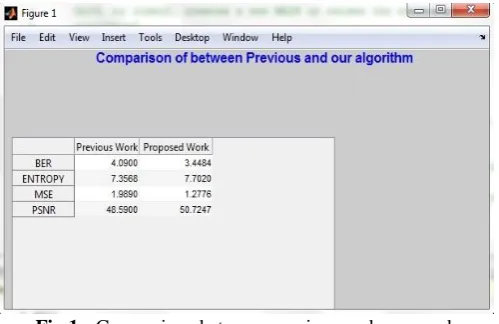
Fig 1 : Comparison between previous and proposed approach
The fig 1 shown above shows the different values of BER, entropy, MSE and PSNR obtained by both previous and proposed approaches. The value of mean square error obtained by proposed approach is 1.2 with is low as compared with the previous technique. Similarly, value of PSNR is high i.e. 50.7 when compared with earlier work.
Fig 2: Graph comparison of all the parameters
Figure 2 shown above represents the graphical comparison of all the parameters such as PSNR, MSE, Entropy and BER among the previous and the proposed algorithm of ETC system. All these obtained results are evident of that the proposed ETC technique is more efficient and competent.
ISSN: 2395-3519
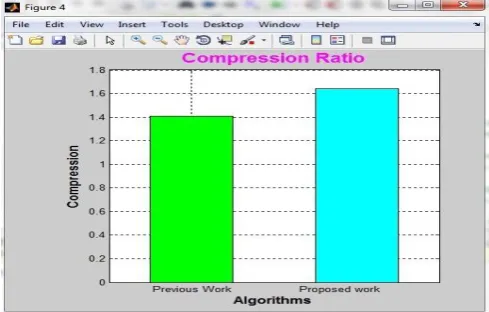
www.ijatca.com 50 Fig 4: Graph Comparison of Compression ratio between
previous and proposed approach
In the above figure 3 shown, the comparison is obtained among previous and proposed approaches on the basis of compression ratio. The compression ratio obtained is 4 which is better than the previous approach. From all the above gathered results it is evident that the proposed approach is more efficient than the previously applied encryption then compression techniques.
V. CONCLUSION AND FUTURE
SCOPE
An efficient image Encryption-Then-Compression system is designed by prediction error clustering with HAAR wavelet transform. Highly efficient compression of encrypted image has been realized by a new image compression algorithm of Haar wavelet transform. Experimental results have shown that reasonably high level of security has been retained. More notably, the coding efficiency of our proposed compression method on encrypted images is very close to that of state-of-art lossy image codecs, which receive original, unencrypted images as input. The PSNR values for resultant images are better than the previous one. Better PSNR indicates that the reconstruction of image is of higher quality. In future the same technique can be extended by applying different transforms to cover image and thus robustness of algorithm can be verified.
ACKNOWLEDGMENT
Thanks to my Guide and family member who always support, help and guide me during my dissertation. Special thanks to my father who always support my innovative ideas.
References
[1] Jiantao Zhou, Xianming Liu, Oscar C. Au and Yuan Yan Tang, “Designing an Efficient Image Encryption-Then-Compression System via Prediction Error Clustering and Prediction error clustering”, IEEE Trans. Inf. Forensics Security, vol. 9, issue 1, January 2014.
[2] Lisa M. Marvel and George W. Hartwig, Jr. ,“A Survey of Image Compression Techniques and Their Performance
in Noisy Environments”, IEEE Transactions on Circuits & Systems for Video Technology, Vol. 23, Issue.2, pp.311-325, IEEE 2013.
[3] Kamrul Hasan Talukder and Koichi Harada, “Haar Wavelet Based Approach for Image Compression and Quality Assessment of Compressed Image”, IAENG International Journal of Applied Mathematics, 36:1, IJAM,Dec 2012.
[4] Jashanbir Singh Kalka, Reecha Sharma(2012), “Comparative Performance Analysis of Haar, Symlets and Bior wavelets on Image compression using Discrete Wavelet Transform”, International Journal of Computers & Distributed System, Volume 1, Issue 2, August, 2012. [5] Piotr Porwik, Agnieszka Lisowsk, “The Haar–Wavelet Transform in Digital Image Processing: Its Status and Achievements”, Machine Graphics and Vision, vol. 13, issue 1/2, 2004.
[6] M. Sifuzzaman1, M.R. Islam and M.Z. Ali, “Application of Wavelet Transform and its Advantages Compared to Fourier Transform” Journal of Physical Sciences, Vol. 13, 2009.
[7] R. Mehala and K. Kuppusamy, “A New Image Compression Algorithm using Haar Wavelet Transformation”, International Journal of Computer Applications(0975-8887), International Conference on Computing and Information Technology, 2013.
[8] X. Zhang, G. Sun, L. Shen, and C. Qin, “Compression of encrypted images with multilayer decomposition”, Multimed. Tools Appl., vol. 78, issue 3, Feb. 2013.
[9] J. Zhou, X. Wu, and L. Zhang, “l2 restoration of l∞-decoded images via soft-decision estimation”, IEEE Trans. Imag. Process., vol. 21, issue 12, Dec. 2012.
[10] D. Klinc, C. Hazay, A. Jagmohan, H. Krawczyk, and T. Rabin, “On compression of data encrypted with block ciphers”, IEEE Trans. Inf. Theory, vol. 58, issue 11, Nov. 2012.
[11] Z. Erkin, T. Veugen, T. Toft, and R. L. Lagendijk, “Generating private recommendations efficiently using homomorphic encryption and data packing”, IEEE Trans. Inf. Forensics Security, vol. 7, issue 3, June 2012.
[12] X. Zhang, G. Feng, Y. Ren, and Z. Qian, “Scalable coding of encrypted images”, IEEE Trans. Imag. Process, vol. 21, issue 6, June 2012.
[13] Nidhi Sethi, Ram Krishna, R. P. Arora, “Image Compression using HAAR Wavelet Transform”, IISTE Comp. Engg. & Intelligent Systems, ISSN 2222-1719, 2011 [14] X. Zhang, Y. L. Ren, G. R. Feng, and Z. X. Qian, “Compressing encrypted image using compressive sensing”, in Proc. IEEE 7th IIH-MSP, Oct. 2011.
[15] M. Barni, P. Failla, R. Lazzeretti, A. R. Sadeghi, and T. Schneider, “Privacy-preserving ECG classification with branching programs and neural networks”, IEEE Trans. Inf. Forensics Security, vol. 6, issue 2, June 2011.
[16] X. Zhang, “Lossy compression and iterative reconstruction for encrypted image”, IEEE Trans. Inf. Forensics Security, vol. 6, issue 1, Mar. 2011.
ISSN: 2395-3519
www.ijatca.com 51 encrypted signals”, IEEE Trans. Inf. Forensics Security, vol.
5, issue 1, Mar. 2010.
[19] V. Ashok, T. Balakumaran, C. Gowrishankar, Dr. ILA.Vennila, Dr.A.Nirmal kumar, “The Fast Haar Wavelet Transform for Signal & Image Processing”, (IJCSIS) International Journal of Computer Science and Information Security, Vol. 7, issue 1, 2010.
[20] Q. M. Yao, W. J. Zeng, and W. Liu, “Multi-resolution based hybrid spatiotemporal compression of encrypted videos,” IEEE in Proc. ICASSP, Apr. 2009, pp. 725–728. [21] T. Bianchi, A. Piva, and M. Barni, “On the implementation of the discrete Fourier transform in the encrypted domain”, IEEE Trans. Inf. Forensics Security, vol. 4, issue 1, Mar. 2009.
[22] A. Kumar and A. Makur, “Lossy compression of encrypted image by compressing sensing technique”, in Proc. IEEE Region 10 Conf. TENCON, Jan. 2009.
[23] T. Bianchi, A. Piva, and M. Barni, “Encrypted domain DCT based on homomorphic cryptosystems”, EURASIP J. Inf. Security, 2009, Article ID 716357.
[24] D. Schonberg, S. C. Draper, C. Yeo, and K. Ramchandran, “Toward compression of encrypted images and video sequences”, IEEE Trans. Inf. Forensics Security, vol. 3, issue 4, Dec. 2008.
[25] R. Lazzeretti and M. Barni, “Lossless compression of encrypted grey-level and color images”, in Proc. 16th Eur. Signal Process. Conf., Aug. 2008.
[26] A. Kumar and A. Makur, “Distributed source coding based encryption and lossless compression of gray scale and color images”, IEEE in Proc. MMSP, 2008.
[27] D. Schonberg, S. C. Draper, and K. Ramchandran, “On compression of encrypted images”, in Proc. IEEE Int. Conf. Image Process., Oct. 2006.
[28] D. Schonberg, S. C. Draper, and K. Ramchandran, “On blind compression of encrypted correlated data approaching the source entropy rate”, in Proc. 43rd Annu. Allerton Conf., 2005.
[29] K. Wahid, V. Dimitrov, G. Jullien ,“Error-free computation of 8×8 2D DCT and IDCT using two-dimensional algebraic integer quantization ”, IEEE Computer Arithmetic, June 2005.
[30] M. Johnson, P. Ishwar, V. M. Prabhakaran, D. Schonberg, and K. Ramchandran, “On compressing encrypted data”, IEEE Trans. Signal Process., vol. 52, issue 10, Oct. 2004.
[31] Bryan Usevitch, “A Tutorial on Modern Lossy Wavelet Image Compression: Foundations of JPEG 2000”, IEEE Signal Processing Magazine, 2001.
[32] Haweel T.I., “A new square wave transform based on the DCT”, Signal Process., 2001.
[33] M. J. Weinberger, G. Seroussi, and G. Sapiro, “The LOCO-I loss-less image compression algorithm: Principles and standardization into JPEG-LS”, IEEE Trans. Imag. Process., vol. 9, issue 8, Aug. 2000.
[34] X. Wu and N. Memon, “Context-based, adaptive, lossless image codec”, IEEE Trans. Commun., vol. 45, issue 4, Apr. 1997.
[35] A. J. Menezes, P. C. Van Oorschot, and S. A. Vanstone, “Handbook of Applied Cryptography”, Cleveland, OH, USA: CRC Press, 1997
[36] Jerome Shapiro, “Embedded Image Coding Using Zerotrees of Wavelet Coefficients”, IEEE Transactions in Signal Processing, 1993.
[37] Gregory Wallace, “The JPEG Still Picture Compression Standard”, IEEE Transactions on Consumer Electronics, 1991.
[38] Ch. Samson, V. U. K. Sastry, “An RGB Image Encryption Supported by Wavelet-based Lossless Compression”, International Journal of Advanced Computer Science and Applications, Vol. 3, Issue 9, 2012.