RFID System and its Perspective Analysis with
KERGM(1,1) Model
Liu Bin
Henan Agricultural University/ Department of Management Science, Zhengzhou, China E-mail: [email protected]
Zhang Rong and Liu Sifeng
Nanjing University of Aeronautics and Astronautics /College of Economics and Management, Nanjing,China 210016 E-mail: [email protected], [email protected]
Abstract—RFID (Radio Frequency Identification) technology will be indispensable to our future life. This paper gives certain insight analysis of RFID system from the view of application perspective. First, this paper introduces some essential implementation principles of RFID system and shows its hot application areas. Then, we analyze the limiting factors of RFID system in advanced development, and present a generalized modeling process from the view of knowledge-embedded data mining. Further, based on the above though of knowledge-embedded data mining, a new forecasting method, KERGM(1,1), is developed to forecast RFID’s potential application prospect. Lastly, several countermeasures and advices for the development of RFID industry are put forward. It is shown that the future RFID industry should be greatly promising, however, some countermeasures should be adopted to support its development, such as reducing the cost of RFID tag with technical innovation, popularizing RFID system in wider fields, and strengthening international cooperation in RFID standard system.
Index Terms—RFID; knowledge-embedded data mining;
KERGM(1,1) model; modeling.
I. INTRODUCTION
In real management practices, kinds of activities or events all will come into being redundant data, and these data derive from humans, materials, purchasing behaviors, selling inventories and so on. Certainly, they are very important for us to make decisions. In present, computer is our main tool to collect data, and with it we can analyze data, and then find interested information or management insights to hold up our decision-makings. So, it is known that collecting data is the basis of whole information process. At the early stage of information system, data are processed by handworks of humans. Certainly, the working strength is great, and the
corresponding error rate of data is high, at the same time, it is most important that handmade operation cannot reflect the real-time well. So, the auto-identified technology was presented, and soon had been one of most important research focus in the intelligent system field.
The auto-identified technology mainly applies some identified equipments to automatically get related information by nearing action between the identified equipment and the observed objective, and provides corresponding information to computers in background, which can complete the follow-up process, such as processing information, and feedbackresults[1]. In present fields of logistics and supply-chain management, the auto-identified technology has already become the basis of logistics information system. For example, salespersons collect the merchandises information of customers with the reader of bar code, and then total their amounts automatically by cash register. Further, the inventory manager can easily get real-time stock information of each product, and then makes right decisions on replenishing and re-pricing. In fact, auto-identified technologies derived from computer technology, communication technology and control science, and have been developed rapidly for recent decades. In the family of auto-identified technologies, some new high-technology are integrated by some technologies, such as the Bar Code technology, the magnetic card technology, the IC card technology, the OCR technology, the acoustics recognition technology, the vision recognition technology and the RF technology, and by some disciplines, such as computer, optical, magnetic, physics, electro-mechanical, communication and cybernetics[2]. Briefly, RFID is one of auto-identified technologies, and it will change human’s life and business activity in several years, at the same time, it also attracts scholars in information sciences. In this paper, we will analyze the perspective of RFID with a quantitative model from the thought of knowledge-embedded data mining, and propose some countermeasures according to present limited factors to develop the RFID industry.
The rest of this paper is organized as following. In The paper is partially supported by National Natural Science
Foundation of China through Grant NO.70473037, by the Post-Doctoral Research Fund of China through Grant NO.20060390280.
Reader
Secret Key K
Elector-Tag
Secret Key K Inquire Passwords
Random Number A
Token 1 Token 2
Figure 1. The basic principle of RFID
section 2, we will introduce RFID technology and its basic principle, and in section 3 some applications in different fields are listed. Then, we analyze the limiting factors to develop RFID system in section 4, and based on the present selling gross of RFID products we establish a model, knowledge-embedded renewal GM(1,1) model, to forecast the potential market chance in section 5, which will reflects the wide prospect of RFID industry. Lastly, we put forward advices or tactics for RFID technology in section 6.
II. RFID AND ITS BASIC PRINCIPLE
The main principle of RFID is electromagnet theories, and its strongpoint is embodied at the line of sight, which can recognize something in more distance than optical system does. The information in RFID tag can be modified, at the same time, the RFID tag can contain vast data, and it is difficult to fabricate and has the intelligent characteristic. In fact, these characteristics determine its application in wider foreground. Alike the bar card technology, RFID is also an identified technology with non-contact mode, so the RFID tag often be tumbled in related products, even some RFID tags can identify something out of several hundreds meters. Furthermore, because the RFID tag can identify objectives well with non-contact, it can automatically realize the operation with non-effect. So, it is very interested the RFID can identify objectives in moving and can distinguish from multiple RFID tags with convenient and fast operation.
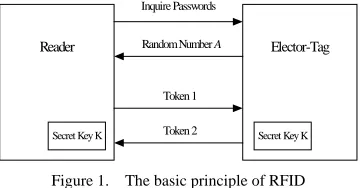
RFID system mainly achieves to identify objectives automatically with the coupling between the radio-frequency signals and the space[3]. Generally, there are two parts to consist of RFID system, the electronic tag and the reader. In application of RFID system, electronic tags often are embedded into the interior or on the surface of objectives, and when objectives with electronic tag are in the active range of the reader, the reader will take away information of objectives automatically with conventional mode. The basic principle of RFID is listed in fig 1.
Retrospect to the origin of RFID technology, the paper “Communication with echo-power” published by Harry Stockman in 1948 established its theory basis. With the research on theories and technologies about six decades, RFID technology started to enter in the business stage during 1980s, and then the standardization problem of RFID attracted more and more scholars in 1990s with its application widely, especially after Wal-Mart announced
that she would apply widely RFID technology to more and more merchandises and actively prompted the research on RFID technology. Concretely, Wal-Mart requires his main suppliers must set RFID tag into their products, which will be transported to his distributed workshops of Wal-Mart after the end of 2004. At present, because the research and application of RFID in China also be in the stage of exploring, the main contribution of this paper is to wake up more and more managers and scholars in China to pay more attentions to RFID technology and RFID products.
However, these are not also the united standard system accepted by countries, which is a restraint factor to baffle the popularization of RFID. At present, there are two groups for technique standard of RFID. One is the auto-IDCenter in MIT, and the other is Ubiquitous ID Center(UID) in Japan. The former is leaded by the EPC globe association of USA, and he developed the EPC code standard for electronic products This association consists of Wal-Mart, more 100 retail- catenation firms in British, et al., and supported by IBM, Microsoft Corp, Philips, Auto-IDLab, et al. in technology. The latter consists of firms of Japan, and he presented UID code system. At present, it is in the incandesced stage for firms who are interested in RFID to scramble for the profits from RFID industry. However, in other words, this wrangle maybe take some chance for the developing countries to joint the standardization of RFID technology, especially for China.
III. APPLICATIONS OF RFID SYSTEM IN CLASSIC FIELDS
RFID technology has developed rapidly in international market, and more and more RFID products have already emerged. Some corporations, such as Motorola, Phillips, EM and iPico and Alien, all yield RFID products. At the same time, RFID technology has been applied into the industry automatics[4], the commerce automatics, the traffic and transportation management, such as the transportation monitor for train, the automatic charge in highway, the MIS for park, the inventory management system and the vehicle guard against theft. Now we briefly introduce some others application fields of RFID as follows.
A. The automatic charge for highway and its traffic management
The automatic charging system for highway is one of the most successful cases of RFID applications[5]. In present, Chinese highways have boosted rapidly, but there are some questions in her charge-sect. On the one hand, traffic jam and waiting for charge, and on the other hand, the country has shot up tremendous expenses as for as possibility due to corruptions of a few toll collectors. Whereas, RFID application can embody fully the advantage in the non-contact characteristic, which can automatically charge when vehicle passes the toll station, and can solve the above two questions.
automation and the legalization of traffic system, which can help to improve present traffic situation.
B. Tolling with RFID tag
International bargaining mostly be completed by kinds of cards, and in China these often depend on cash yet, which consequentially bring to tax evasion. Though some cards, such as IC card, magnetic card, have occupied most market share, RFID starts to race to control the market because there is two characteristics in RFID tag, non-easy wear and care nothing for the static[6]. At the same time, it is very convenience and shortcut to use the RFID tags, and the user completes his paying only by wobbling his bag with RFID tag. With the establishment of Chinese credit system RFID system will be applied more widely. Recently, the public traffic systems of most capital cities in China have adopted the RFID charging mode.
C. Automation in streamline production
To apply RFID system in streamline production can realize automatic control and real-time monitor, which can improve productive efficiency and better the optimal production mode, and then save production costs[7]. For example, BMW automobile company assembles RFID tags into his streamline in order to mass-produce his auto with customized mode. At the same time, several noted integrated circuit manufacturers embedded the auto-identification working procedure controlling system with RFID into their semiconductor streamline. It is known that the semiconductor products should be produced in super-lustration environment, and others auto-identification system ex RFID cannot suitable to carry out its productions.
D. Inventory Management
RFID technology can help to manage relative information between inventories and logistics with applying RFID system into intelligent inventory management[3]. Furthermore, it can advance the operation efficiency of products, and also get full information of products in time. Concretely, we can embed the RFID tag on the door that goods passed, and set the reader and the antenna on the fork truck, at the same time, every good will be attached a barcode, and all information of barcodes all be stored the center computer in inventory system, by which relative information of goods can be queried. Then, when goods are transported into others, the reader will identify it and inform the center computer of the corresponding trailer. In this way, the management center can know how many goods have been yielded and how many goods transported, and these goods have been automatically identified and located precisely.
E. Anti-theft and anti-counterfeit
Anti-theft of automobile with RFID is an traditional application field, and the basis principle of this application is to encapsulate the RFID tag with specific codes into the key to automobile[8]. At the same time, the reader is arranged in the automobile, and when the key inserts into the fire lighter, the reader can identify the
status of the key.
It is very interesting to apply RFID technology into anti-counterfeit, and its principle is to sign the status of goods with the exclusive product-number.
F. Identification of animals
This application of RFID in identification of animals comes of the identification of racehorses, and its basic principle is to encapsulate small glass with RFID tag into the sebum of horse, which can be identified in the game[9]. The identification of animals not only tracks the purity in animal population, and can prevent and cure diseases and epidemic situations, which will help to hold the health and the safety of the mean product. We think this application of RFID should be paid more attentions to.
IV. ANALYSIS ON CONSTRAINED FACTORS OF RFID
As with a technology that has been advanced for a long time, RFID theories were not synchronous with its applications[10]. Because there exist some factor, the applications and development of RFID are hard limited, and these constrained factors are briefly listed as follows.
A. Suppliers and users of RFID products know it rarely.
Sometime, potential users have high expectation on RFID, and wish it to solve all questions, which ignore the factor in application circumstance and constrain the application of RFID technology.
B. The production costs of the tag, the reader and relative system are high.
For the system is needed a good many, their costs are often embedded in the cost of tag. Because the cost is high now, the application of RFID products is very constrained. However, it is optimistic that some experts forecast that to 2010 the cost of RFID will come down to a right price with the development of relative technologies.
C. The Compatibility of RFID technology
Different standards are adopted in different countries, and different countries execute different communication protocols, which all limit the applications of RFID.
D. The privacy of users
A large number of users will suspect to be tailed because of the existence of RFID system, and they think they will loss the right to privacy, which results that many people reject RFID system.
E. The process of standardization is slow
Because there isn’t a united standard in the technologies and the application, RFID technology and its products cannot be popularized well, which limited their rapid development.
V. FORECASTING OF APPLICATION PROSPECT OF RFID
A
Pretreating
B
selecting variable
C
selecting models
D
computing parameter
E valuing
Report of KDD
models
arts and crafts theory
Academic knowledge
experience
Data
Data after pretreating
Data for establishmen
t models
Figure 2. The modeling process of Knowledge-Embedded Data Ming TABLE 1.
THE SELLING AMOUNTS OF RFID PRODUCTS*
Year Variables Selling Amount (Hundred Million Dollars)
1990 0(1)
x 1.01
1993 0(2)
x 1.67
1996 0(3)
x 2.96
1999 0(4)
x 5.54
2002 x0(5)
9.42
2005 0(6)
x 21.85
*: The data are gotten from the literature[1].
establish a mathematics model, Knowledge-Embedded Renewal GM(1,1) model(briefly, KERGM(1,1) model), to forecast future selling amount of our whole market.
A. Modeling process of Knowledge-Embedded Data Ming
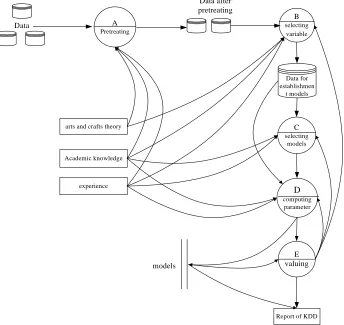
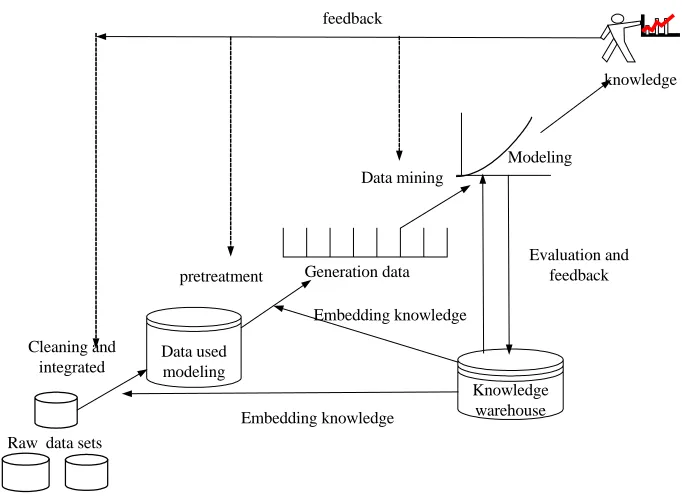
The KERGM(1,1) model is developed based on a knowledge-embedded modeling framework, which is represented by authors of this paper in literature[11], and its basis process is shown as fig 2. The knowledge-embedded modeling techniques embodies the integrated thinks of knowledge discovering technologies, which is different from the traditional modeling method, and it is seemed that the traditional modeling always pays
attentions to the statistical data and methods, such as hypothesis testing method, and the connotative rules in samples so on. Generally, it is not a fault to pay more attention to the statistical data; however, it is undoubtedly a great bug for modeling to neglect of the experiential knowledge of experts. In fact, the information is very important to model, especially when there are many experiences on craftwork processes, and to neglect of these information will be the greatest expense for modeling. So, it is an effective reinforce and improvement for traditional modeling method to embed the knowledge from experiences into the modeling process. Detailed thinks related knowledge-embedded modeling system could be referred by the literature [11].
B. Forecasting method, KERGM(1,1)
the forecasting performance. Certainly, under this interactive system, it is very important that experts have a better understanding of the forecasting objective and its setting, and they can logically judge the future of the objective. Additionally, this integrated forecasting system, as a decision-aided system, can be applied with online mode, and this open-type communication pattern is benefit to eliminate the effect of authority on others experts. It is undoable that this open-type pattern can speed up the convergence of experts’ judges.
C. Detailed Modeling Steps
Further, because the data for modeling is lesser, the classic forecasting method, such as the linear regression, cannot be applied. At the same time, the market of RFID products is uncertainty, so grey-system method will be applied in this forecasting. Grey system is to seek the mathematic relations and movement rule among factors themselves and between factors, based on behavioral data of social, economic, et al. In Grey system theories, it is through the organization of raw data for one to sort out development laws, if any. In other words, this is a path of finding out realistic governing laws from the available data. It is believed that even though objective systems phenomena may be complicated and related data is chaotic, they always represent a whole, hence, implicitly contain some governing laws in theories of Grey system. The key for us to uncover and to make full use of all these laws is how to choose appropriate methods. Other than the GM(1,1) model, which is the most important core of Grey system, the KERGM(1,1) model, the Knowledge-Embedded Renewal GM(1,1) model, is developed in this paper, which bases on the above integrated forecasting system and can depict well the
value of information and experience for the objective system. Detailed steps are listed as follows.
Step 1: Pretreatment of raw data sets, which should integrate the thoughts of qualitative analysis for objective question.
At present, there are often two types of buffer operators to be applied to combine the experiences on forecasting objective, the weakening operators and the strengthen operators. Further, the weakening buffer operator system consists of average weakening buffer operator(AWBO), geometric average weakening buffer operator(GAWBO), weighted average weakening buffer operator(WAWBO), and weighted geometric average weakening buffer operator(WGAWBO) , which all can weaken the effects of non-system factors on the forecasting objective. Correspondingly, the strengthening buffer operator consists of average weakening buffer operator(ASBO), geometric average strengthening buffer operator(GASBO), weighted average strengthening buffer operator(WASBO), and weighted geometric average strengthening buffer operator(WGASBO) , which all can strengthen the effects of non-system factors on the forecasting objective. The readers can refer to the literature[12] to know the operators well. In this paper, we will use the ASWO to pretreat the raw data based on the judge on the development of RFID industry.
Step 2: Applying 1-AGO on X0gives us
1 1 ) 1 (
)
(k d
x X
k
i
∑
= =
))
5
(
),
4
(
),
3
(
),
2
(
),
1
(
(
(1) (1) (1) (1) (1)x
x
x
x
x
=
Step3: Perform a quasi-smoothness check on (0) X .
From
Data used modeling
Raw data sets
knowledge
Knowledge warehouse Cleaning and
integrated
pretreatment
Data mining
Embedding knowledge
Evaluation and feedback feedback
Generation data
Embedding knowledge
Modeling
) 1 ( ) ( )
( (1)
0 − = k x k x k ρ
so, ρ(4)<0.5 and ρ(5)<0.5. That is, for the case of
3 >
k , the condition of being quasi-smooth is satisfied.
Step 4: Check to see whether or not X(1) satisfies the law of quasi-exponentiality from
) 1 ( ) ( )
( (1)
) 1 ( ) 1 ( − = k x k x k σ
Step 5: Apply a consecutive neighbor generation to . ) 1 ( X Let ). 1 ( 5 . 0 ) ( 5 . 0 )
( (1) (1)
) 1 ( = + − k x k x k z
Step 6: Perform a least square estimate for a parametric sequence Y B B B b a
aˆ=[ , ]T =[ T ]−1 T
where ⎥ ⎥ ⎥ ⎥ ⎥ ⎦ ⎤ ⎢ ⎢ ⎢ ⎢ ⎢ ⎣ ⎡ − − − − = 1 ) 5 ( 1 ) 4 ( 1 ) 3 ( 1 ) 2 ( ) 1 ( ) 1 ( ) 1 ( ) 1 ( z z z z B , ⎥ ⎥ ⎥ ⎥ ⎥ ⎦ ⎤ ⎢ ⎢ ⎢ ⎢ ⎢ ⎣ ⎡ = ) 5 ( ) 4 ( ) 3 ( ) 2 ( 0 0 0 0 x x x x Y
Step 7: Determine the model. We have
b ax dt
dx − (1)= )
1 (
and the time response sequence
a b e a b x k
xˆ(1)( +1)=[ 0(1)− ] −a⋅k+
Step 8: Restore to find the simulation value of X0 from . ,..., 2 ), 1 ( ˆ ) ( ˆ ) (
ˆ0 (1) (1)
n k k x k x k
x = − − =
Step 9: Evaluate the error. If the error is less than 5%, then go to step 10, else go to step 1 for further pretreatment
Step 10: Let xˆ0(n+1) be a newest piece of
information. Inserting ˆ0( +1)
n
x into the sequence 0 X ,
and built the KERGM(1,1).
Step 11: End.
D. Forecasting analysis
Here, the series KERGM(1,1) can be modeled as following: 78576 . 18 86576 . 25 ) 1 (
ˆ k+ = ⋅e0.255137⋅k− x
ˆ( +2)=32.683875⋅ 0.25743⋅k −24.393875
e k x 7673 . 32 7073 . 42 ) 3 (
ˆ + = ⋅ 0.255702⋅k − e k
x
where the error of the newest sample datum is 4.30%, 2.48% and 2.03%, respectively. With these models we can get the selling amount of RFID products in 2008,2011 and 2014 is 26.93, 34.78 and 44.69,
respectively.
Though this forecasting model seems a little simple or rough, we can find that with it the higher simulation precision degree is gotten. Furthermore, from the selling amount forecasted by these models we can conclude that RFID technology and its products will continue its favorable development trend in future. The parlance, “without RFID, and without nice life”, maybe is exaggerated in some sort, but it is consensus that RFID will be necessary in future and will improve our life.
VI. COUNTERMEASURES AND CONCLUSION
Briefly, according to present development situation of RFID, some countermeasures are provided as following. Firstly, at present, the production cost of RFID tag is about 0.10 US dollar each piece, and it is not favorable to popularize the RFID in wider fields with this high cost. It is predicted that the demand of RFID tags will increase 200 million USD when the cost of RFID tag descends 0.01 USD per piece, and until the price of RFID tag decreases to less than 0.01USD, the RFID tag will applied widely into wider application fields, such as packaging consumables, drugs, and books. So, scholars will strengthen the innovative on RFID technology and relative materials to reduce the application costs of RFID system as soon as possible.
Secondly, The application fields should be widened further, especially in logistics industry, and at the same time, it is important to publicize far and wide the superiority of RFID and to let more manufacturers and more merchantmen know RFID well. For the present RFID system, it is in the stage of technology driven by demand, and new application fields are persevered to see. With the development of Internet and Intranet, the RFID system is endowed wider scopes. For example, through planting RFID tag with sufferer information, the sufferer can be diagnosed by remote medical treatment with low cost. Additionally, each Olympic has been viewed a development engine to spread a new technology, and I think the Beijing Olympic in 2008 also is without exception. Let us keep expectancy on the Olympic and the Disabled Olympic in Beijing to mainly popularize RFID technology.
Lastly, states all over the world should enhance the international cooperation, and promote the standardization process of RFID technology and its application. There are several kinds RFID products in different frequency, and generally we call them low frequency, high frequency and super-high frequency, respectively. Certainly, they often are adopted by different products, which require different frequency rages with different standard system. This non-standard RFID products system will baffle the global RFID development, and it is a key issue to eliminate this obstacle. Further, it is necessary to carry out the cooperation among governments and core-enterprises.
RFID development are analyzed, and at the same time, according to the present selling amounts of RFID products, the future market amounts are forecasted with a renewal GM(1,1), which can help people to buildup the confident RFID future. Additionally, three countermeasures are advanced.
ACKNOWLEDGMENT
The authors thank the editor and anonymous referees for their helpful comments and suggestions, which have improved the exposition of this paper.
REFERENCES
[1] Z.Q. You, S.J.Su, et al. RFID theories and its applications. Publishing house of Electronic Industry. 2004.10.
[2] Junichi Yagi, Eiji Arai and Tatsuo Arai. “Parts and packets unification radio frequency identification application for construction”. Automation in Construction. Vol 14, No.5, pp477-490, 2005.
[3] Xingxin(Grace) Gao, Zhe(Alex) Xiang, Hao Wang, et al. “An approach to security and privacy of RFID system for supply-chain”. Proceedings of the IEEE International Conference on E-Commerce Technology for Dynamic E-Business (CEC-East’04): 1023-1028.
[4] P.G. Ranky. “Intelligent planning and dynamic scheduling of flexible manufacturing cell and systems”. Proceedings of 1992 Japan–U.S.A. Symposium on Flexible Automation, 1992:415-422.
[5] Dirk Hihnel, Wolfram Burgard, et al. “Mapping and Localization with WID Technology”. Proceedings of 2004 IEEE International Conference on Rob Dtics &Automation. New Orleans. LA April,2004.
[6] H. Yuasa, M. Yuasa. “Global order formation by coordination in autonomous distributed system”.
Measurement and Control. Vol. 32, No. 10, pp929-934, 2003.
[7] Rob Glidden. Cameron Bockorick, Scott Cooper, et al. “Design of Ultra-Low-Cost UHF RFID Tags for Supply Chain Applications”. IEEE Transactions on Communications Magazine. Vol. 34, No.1, pp140-151, 2004.
[8] Sarma, S. et al. “RFID Systems and Security and Privacy Implications”. Workshop on Cryptographic Hardware and Embedded Systems. Lecture Notes in Computer Science, 2002:454-470.
[9] Mans B. Jansen, Wim Eradus. “Future developments on devices for animal radiofrequency identification”. Computers and Electronics in Agriculture. Vol 24, No.1, pp109-117, 2004.
[10] Bruce Potter. “RFID: misunderstood or untrustworthy?”
Network Security. Vol.39, No.1, pp17-18, 2005.
[11] Liu Bin, Zhang Hui, Liu Sifeng, et al. “Data Mining Techniques Based on Grey System Theories for Time Sequence Data”. Computer Science and Information System. Vol.3,No.2, pp74-82,2006.
[12] Dang Yaoguo, Liu Bin and Guan Yeqing. “On the strengthening buffer operators”. Control and Decision. Vol.20, No.12, pp1332-1336, 2005.
Liu Bin was born in 1971, and received his B.S. degree in mathematics from Henan University, China, in 1994, the M.S. degree in Economics Management from Henan Agricultural University, China in 1998, and the PhD degree in management science and engineering from Nanjing University of Aeronautics and Astronautics(NUAA), China, in 2005. Dr. Liu’s dissertation was endowed the excellent dissertation of Jiangsu province in 2006.
At present, he is with the Department of Management Science, Henan Agricultural University, Zhengzhou, China and is also the Associate Professor and Director of this department. At the same time, he is a visiting scholar of Tsinghua University, Beijing, China. His main interested fields include Supply Chain Coordination and its Optimization, Grey System, and Management Information Systems.
Dr. Liu also serves The IEEE SMC society, The Operation Research Society of China, and The System Engineering Society of China. Since 2000, he has published 34 academic papers in some international journals and conferences, such as IEEE Transaction on System, Man and Cybernetics, International Journal of Service Operation and Informatics, Computer Science and Information Systems.
Zhang Rong was born in 1973, and received her B.S. degree in mathematics from Henan University, China, in 1994, the M.S. degree in Management Science and Engineering from Henan Agricultural University, China in 2003.
At present, she is a PhD candidate in management science and engineering at NUAA, China. She is also with the Department of Management Science, Henan Agricultural University, Zhengzhou, China and is also the lector of this department. Her interested fields include Decision Analysis, Grey System, and Management Information Systems.
Dr. Zhang services the System Engineering Society of China. Since 2002, she has published 12 academic papers in some journals and international conferences, such as 2007 International Conference of IEEE on System, Man and Cybernetics, 2007 International Conference of IEEE on Grey System and Intelligent Services.
Liu Sifeng was born in 1955, and received the B.S. degree in mathematics from Henan University, China, in 1981 and the M.S. degree in economics and the Ph.D. degree in systems engineering from Huazhong University of Science and Technology, China, in 1986 and 1998, respectively. He is the Founding President of The Institute for Grey Systems Studies.
At present, he is a Distinguished Professor at the College of Economics and Management in NUAA, China, and the Academic Leader and the Doctor Supervisor in the management science and systems engineering disciplines. His main scientific research activities are in Grey systems theory and econometrics.