Devi Priya P & Alekhya Goud E. / International Journal of Pharmacy & Therapeutics, 10(2), 2019, 46-50.
46 |
P a g e
e- ISSN 0976-0342 Print ISSN 2229-7456
International Journal of Pharmacy & Therapeutics
Journal homepage: www.ijptjournal.com
ANALYZING THE PATIENT’S KNOWLEDGE AND PREVALENCE
OF DIABETES AND ITS COMPLICATIONS IN A TERTIARY CARE
TEACHING HOSPITAL
P.Devi Priya* & E. Alekhya Goud
Department of Pharmacy Practice, Santhiram College of Pharmacy, Nandyal, Andhra Pradesh, India.
ABSTRACT
A study was conducted in Santhiram medical college and general hospital, Nandyal from July 2017 to December 2017, to evaluate the knowledge and prevalence of diabetic complications in diabetic patients of a tertiary care teaching hospital. Patient data was collected by using questionnaire which was prepared by ourselves and was thoroughly evaluated by physicians and healthcare professionals. About 97 diabetic patients were evaluated for the knowledge and prevalence of diabetes and its complications out of which 41 patients have answered correctly to our questionnaire. The mean age of the patients was 54.7 years. Most knowledgeable group was 51-60 years. Out of 41 knowledgeable patients, Males (29) were more knowledgeable regarding complications of diabetes than females(12). In Frequency distribution of the most serious complication of diabetes mellitus, Diabetic foot (34) was found to be major complication when compared to Nephropathy(20), Retinopathy (17) and others include Neuropathy, CVD, Stroke (16). The overall knowledge about diabetes among the diabetic patients was only 42.4% which shows that the knowledge regarding diabetes was less in our study population. Hence, it is necessary to educate the patients regarding diabetes and its complications by conducting Diabetic health care programmes and providing patient counseling by health care professionals in a local language so that they could understand and lead their life in a healthy way.
Key Words:-Retinopathy, Neuropathy, Nephropathy, Prevalence, Diabetic complications.
Access this article online
Home page: http://ijptjournal.com/
DOI:
http://dx.doi.org/10.21276/ijpt.2019.10.2.1
Quick Response code
Received:12.11.18 Revised:12.12.18 Accepted:22.12.18
Corresponding Author P.Devi Priya
Department of Pharmacy Practice, Santhiram College of Pharmacy, Nandyal, Andhra Pradesh, India.
Email:- [email protected]
INTRODUCTION
According to WHO, Diabetes Mellitus is defined as a heterogeneous metabolic disorder characterized by the common feature of chronic hyperglycemia with disturbance of carbohydrate, fat and
protein metabolism (Harsh M). Diabetes mellitus is a leading cause for increased mortality and morbidity throughout the world. More than 170 million people worldwide have diabetes, if this situation continues, the number will become twice by the year 2030 (Wild S et al., 2004). India is the diabetes capital of the world, with 41 million Indians having diabetes, every fifth diabetic in the world is an Indian (Joshi SR, Parikh RM, 2007).
The prevalence of diabetes is gradually rising worldwide at an alarming rate. As per International Diabetes Federation in 2015, a conjectured 415 million people globally were diagnosed with diabetes (http://www.diabetesatlas.org).
In most of the cases, morbidity and mortality is caused by Diabetes mellitus and hence is considered as one of the major public health challenge (Barrett EJ, 2004).
Hyperglycemia produces direct and indirect effects on the human vascular system, that leads to morbidity and mortality in both type 1 and type 2
Devi Priya P & Alekhya Goud E. / International Journal of Pharmacy & Therapeutics, 10(2), 2019, 46-50.
47 |
P a g e
diabetes mellitus which cannot be overemphasized. These effects are classified as macrovascular complications (coronary artery disease, peripheral artery disease and stroke) and microvascular complications (diabetic nephropathy, neuropathy, retinopathy) (Michael JF, 2008).
The oxidative stress generated by the excess production of reactive oxygen species (ROS) and defects in the insulin signal transduction pathway in which ceramide (bioactive sphingolipid) shows inhibitory effect was considered as emerging evidence that manifests the underlying mechanism in the pathogenesis of diabetic complications (Giacco F and Brownlee M, 2010; Hassan RH, 2014).
Diabetic patients are 30-40 times more likely to undergo major amputation, 25 times more prone to blindness, 17 times more prone to kidney diseases, 2-4 times more likely to progress with myocardial infarction and twice more likely to suffer a stroke compared to non-diabetes (Shah SN, Anand MP).
Studies show that, on the first diagnosis upto 25% of all type 2 diabetic patients develop some degree of retinopathy and 60-80% of these patients developed diabetic retinopathy after 15 years from the time they were first diagnosed (Cacallerano J, Coopan R, 2002). Diabetic macular edema and proliferative diabetic retinopathy are the main reasons for loss of vision in diabetic patients (Martin MN and Michael WU, 2015).
The diabetic foot may be defined as a group of syndromes in which neuropathy, ischemia and infection lead to tissue breakdown resulting in morbidity and possible amputation (Markakis K et al., 2016).
About 20-30% of diabetic patients have renal impairment, classified as moderate to severe CKD. The combination of diabetes and Chronic kidney disease are associated with increased morbidity and mortality (Huang ES et al., 2011; Grandfils N et al., 2014).
Many studies suggest that by increasing knowledge of patients on disease and its complications will improve patient compliance with treatment and reduce the diabetic complications (Murugesan N et al., 2007). However, diabetic patients have less awareness about existing interventions for preventing complications (Kazi RN et al., 2017) because of insufficient counseling to diabetic patients by physician due to lack of time for mentioning and discussing patient self care (Shah VN et al., 2009).
Aims and Objectives of the study is to know the knowledge and prevalence of diabetic complications in diabetic patients of a tertiary care teaching hospital. To assess the level of knowledge regarding complications of diabetes mellitus, To assess the knowledge and practice of inpatients living with diabetes mellitus, in regards to diabetes self management, Understanding the present knowledge and practices of patients with diabetes mellitus is a cornerstone to plan well targeted interventions in order to improve and alleviate the burden if diabetes care. The ultimate need of the study is to assess whether the patients have knowledge regarding the disease and its complication.
Methodology
A study was conducted in Santhiram Medical College and General Hospital, Nandyal which was carried out for a period of seven months from July-2017 to January-2018 with a sample size of 97 patients.After the approval of Institutional Human Ethics Committee, at Santhiram Medical College and General Hospital, Nandyal this study was initiated.
Study Criteria
Inclusion criteria: Known cases of DM with other co-morbidities who are receiving anti-diabetic drugs and admitted as in-patients, of both sex and age group of 18years and above were included.
Exclusion criteria: Patients with Gestational diabetes and age group of below 18 years was excluded from the study.
Method of collection of data
The necessary information was collected by interviewing the patients using the following annexure.
Annexure-I (Patients demographic characteristics) Annexure-II (Diabetic health assessment questionnaire) Annexure-III (Patient information leaflets)
RESULTS
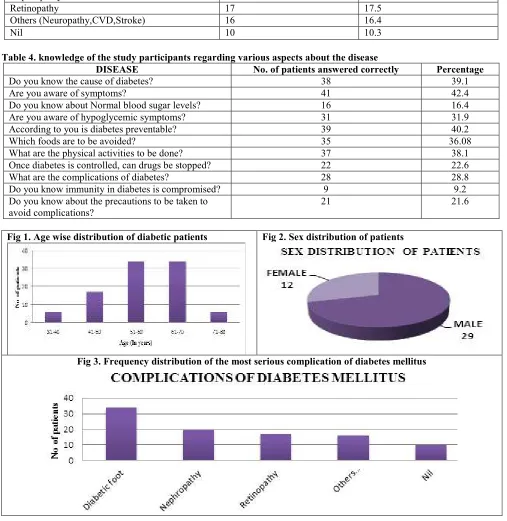
Out of 41 knowledgeable patients, Males(29) were more knowledgeable regarding complications of diabetes than females(12).
In Frequency distribution of the most serious complication of diabetes mellitus, Diabetic foot(34) was found to be major complication when compared to Renal failure(20), Retinopathy (17) and others include Neuropathy, CVD, Stroke (16).
Table 1. Age wise distribution of diabetic patients
Age(In years) Total No. of patietnts % of patients
31-40 6 6.18
41-50 17 17.52
51-60 34 35.05
61-70 34 35.05
71-80 6 6.18
Devi Priya P & Alekhya Goud E. / International Journal of Pharmacy & Therapeutics, 10(2), 2019, 46-50.
48 |
P a g e
Table 2. Sex distribution of patients
Population Yes Percentage No Percentage
MALE 29 49.15 30 50.8
FEMALE 12 31.5 26 68.4
TOTAL 41 42.4 56 57.7
Table 3. Frequency distribution of the most serious complication of diabetes mellitus
Complications Frequency Percentage
Diabetic foot 34 35.05
Nephropathy 20 20.06
Retinopathy 17 17.5
Others (Neuropathy,CVD,Stroke) 16 16.4
Nil 10 10.3
Table 4. knowledge of the study participants regarding various aspects about the disease
DISEASE No. of patients answered correctly Percentage
Do you know the cause of diabetes? 38 39.1
Are you aware of symptoms? 41 42.4
Do you know about Normal blood sugar levels? 16 16.4
Are you aware of hypoglycemic symptoms? 31 31.9
According to you is diabetes preventable? 39 40.2
Which foods are to be avoided? 35 36.08
What are the physical activities to be done? 37 38.1
Once diabetes is controlled, can drugs be stopped? 22 22.6
What are the complications of diabetes? 28 28.8
Do you know immunity in diabetes is compromised? 9 9.2
Do you know about the precautions to be taken to avoid complications?
21 21.6
Fig 1. Age wise distribution of diabetic patients Fig 2. Sex distribution of patients
Devi Priya P & Alekhya Goud E. / International Journal of Pharmacy & Therapeutics, 10(2), 2019, 46-50.
49 |
P a g e
DISCUSSION
The study included 97 diabetic patients attending the general medicine inpatient department of a tertiary care teaching hospital. Our study showed that the knowledge about diabetes was less among diabetic patients. The mean age of patients was found to be 54.7 years, as age is considered as the major risk factor for occurrence of diabetes. Comparing these results with the study conducted in Puducherry, India by Benil.V, Dheepan Nayagam B, Awareness and knowledge of diabetes mellitus among diabetic patients in puducherry, India proved similar results showing that the prevalence of diabetes was more among elders. The knowledge about the complication was observed more in male patients when compared to females, showing similar results with the study conducted in UAE by Fatma Al-Masdari, Mohamed El-Sadig, Juma M.Al-Kaabi et.al, knowledge, Attitude and Practices of diabetic patients in the UAE. Diabetic foot (35.05%) was found to be major complication when compared to Nephropathy(20.06%), Retinopathy (17.5%) and others include Neuropathy, CVD, Stroke (16.4%), which showed different results with study conducted in Mangalore, India by Sharol Asham Menezes, Mohsin Mohammed Bava, Roshan M, A Study on awareness of diabetic complications among type II Diabetic patients.
In this study, 42.2% of diabetic patients out of 97 had enough knowledge about symptoms of diabetes. The knowledge about normal blood sugar levels among patients was found to be 16.4%. A study conducted in Mumbai, India by Rufiat Nasiruddin Kazi, Mangala M.Bote, Kedar J.Riaka, Knowledge, Attitude and Practices about diabetes mellitus and its complications in type II diabetes mellitus patients attending the UHC in Mumbai showed that 62.9% of patients were aware of symptoms and 50.9% had knowledge about normal blood sugar levels which was more compared to our study. Although hypoglycemia is one of the serious complication, only 31.9% of patients were aware of hypoglycemic symptoms, which was sympathized by El-Khawaga G, Abdel-Wahab F, Knowlegde, Attitudes, Practice and Compliance of Diabetic patients in
Dakahlia, Egypt.
Among 97 Diabetic patients, 36.08% could correctly identify food items that need to be avoided in diabetes. This was in the contrast to the study done by Rufiat Nasiruddin Kazi, Mangala M. Bote, Kedar J. Riaka, Knowledge, Attitude and Practices about diabetes mellitus and its complications in type II diabetes mellitus patients attending the UHC in Mumbai , which showed 89.7% of patients identified food items correctly.
Regular physical activity can reduce the overall morbidity in diabetic people, while in this study 38.1% of people answered correctly that physical activity was important in controlling diabetes, which was similar to the study conducted by Zeyana. S. Al Bimani, Shah Alam Khan and Pratap David, Evaluation of type II diabetes mellitus related knowledge and practices of Omani patients, where 38.7% of patients answered correctly.
Patient’s knowledge regarding complications of diabetes was found to be 28.8% which contrasts with RufiatNasiruddinKazi, MangalaM.Bote, KedarJ.Riaka, Knowledge, Attitude and Practices about diabetes mellitus and its complications in type II diabetes mellitus patients attending the UHC in Mumbai, where 52.6% of patients knew about complications. As diabetes develop potentially serious complications, it is necessary to take precautions in order to avoid them, this study show about 25.6% of patients answered correctly about the precautions to be taken to avoid the complications.
CONCLUSION
This study mainly concentrated on knowledge and prevalence of diabetic complications in diabetic patients. From this study, we conclude that the overall knowledge about diabetes among the diabetic patients was only 42.4% which shows that the knowledge regarding diabetes was less in our study population. Hence, it is necessary to educate the patients regarding diabetes and its complications by conducting Diabetic health care programmes and providing patient counseling by health care professionals in a local language so that they could understand and lead their life in a healthy way.
REFERENCES
Barrett EJ. Diabetes epidemic is a world-wide threat. ClinDiab, 22, 2004,47-48.
Cacallerano J, Coopan R. Optometric clinical guidelines. Care of the patient with diabetes mellitus. AOA reference guide for clinicians. Third revision 2002.
Giacco F and Brownlee M. Oxidative stress and diabetic complications. Circulation Research, 107(9), 2010, 1058–1070. Grandfils N, Detournay B, Attali C, Joly D, Simon D, Vergès B, et al. Glucose lowering therapeutic strategies for type 2
diabetic patients with chronic kidney disease in primary care setting in france: a cross-sectional study. Int J Endocrinol, 10, 2013, 640632.
Harsh M. Text book of Pathology, 6th ed., Jaypee brothers medical publishers (P)ltd, 818-824.
Hassan RH. Defect of insulin signal in peripheral tissues: important role of ceramide. World Journal of Diabetes, 5(3), 2014, 244–257.
Devi Priya P & Alekhya Goud E. / International Journal of Pharmacy & Therapeutics, 10(2), 2019, 46-50.
50 |
P a g e
International Diabetes Federation, IDF Diabetes Atlas, International Diabetes Federation, Brussels, Belgium, 7th ed., 2015,
http://www.diabetesatlas.org
Joshi SR, Parikh RM. India- Diabetes Capital of the World: Now Heading Towards Hypertension. J Assoc Physicians India, 55, 2007, 323-4
Kazi RN et al.Int J Community Med Public Health, 4(8), 2017, 2793-2797.
Markakis K, Bowling FL, Boulton AJ. The diabetic foot in 2015: an overview. Diabetes Metab Res Rev, 32(Suppl 1), 2016, 169-78
Martin MN and Michael WU. Diabetic retinopathy - ocular complications of diabetes mellitus.World J Diabetes, 6(3), 2015, 489–499
Michael JF. Clinical Diabetes. Microvascular and Macrovascular Complications of Diabetes. Diabetes Foundation, 26(2), 2008.
Murugesan N, Snehalatha C, Shobhana R, Roglic G, Ramachandran A. Awareness about diabetes and its complications in the general and diabetic population in a city in southern India. Diabetes Res ClinPract, 77(3), 2007, 433–437. Shah SN, Anand MP. API Textbook of Medicine. 8th ed., The Association of Physicians of India Mumbai. Chapter 18.7,
Chronic Complications of Diabetes; 1062-1068.
Shah VN, Kamdar PK, Shah N. Asseissng the knowledge, attitudes and practice of type 2 diabetes among patients of saurashtra region, Gujarath. Int J Diabetes DevCtries, 29(3), 2009, 118-122.
Wild S, Roglic G, Green A, Sicree R, King H. Global prevalence of diabetes: estimates for the year 2000 and projections for 2030. Diabetes Care, 27, 2004, 1047–53.
Cite this article:
Devi Priya P, Alekhya Goud E. Analyzing the patient’s knowledge and prevalence of diabetes and its complications in a tertiary care teaching hospital..International Journal of Pharmacy & Therapeutics, 10(2), 2019, 46-50.
DOI: http://dx.doi.org/10.21276/ijpt.2019.10.2.1