A Survey on Performance Analysis of Different
Routing Protocols in VDTN
Sonal B. Gandhi Vyomal N. Pandya
Department of Electronics & CommunicationEngineering Department of Electronics & CommunicationEngineering L.D. College of Engineering,Ahmedabad, Gujarat,
India.
C. K. Pithawalla College of Engineering & Technology Surat, Gujarat, India
Kinnar G. Vaghela
Department of Electronics & CommunicationEngineering L.D. College of Engineering,Ahmedabad, Gujarat, India.
Abstract
VDTNs are DTNs where mobile nodes (vehicles) are communicate wirelessly to transfer data between nodes irrespective to connectivity issues. In low node density network, the traffic is sparse and direct end-to-end paths between nodes do not always available. Routing in such networks is very challenging due to absence of prior knowledge about network topology and because Contact opportunities between nodes are for limited duration. Routing is the major issue which has effect on overall performance of VDTN in terms of resource usage, data delivery, latency, etc. From last few years, so many routing protocols are proposed and classified for DTN/VDTN till date. In this paper mainly three VDTN routing protocols: Epidemic, Spray And Wait and PROPHET routing are analyzed and compared in terms of Delivery Probability, Overhead ratio and Average Latency. For Performance Analysis of these three protocols, various simulations are done in The ONE Simulator with Version of 1.4.1.
Keywords: DTN, VDTN, ONE
________________________________________________________________________________________________________
I. INTRODUCTION
Delay Tolerant Network is also referred as the Intermittent (fragmented) Mobile Network [1]. It is the wireless network in which at any given time, the probability of an end-to-end path from a source to destination is low. Since most of the nodes in a DTN are mobile, the connectivity of the network is maintained only when they come in to the transmission ranges of each other. If any node is not connected to another node and it has message (packet) to send then it stores the message until an appropriate communication opportunity arises. In DTN communication opportunity means a contact. A contact can be constant i.e. the contact is always available, On-demand i.e. a contact is initiated when needed, or scheduled i.e. the contact and its characteristics is known in advance or opportunistic contacts.
Vehicular Delay-Tolerant Networks (VDTNs) are DTNs where vehicles (mobile nodes) communicate with each other and with fixed (relay) nodes placed along the roads in order to circulate messages [2]. VDTN Scenario is shown in Fig.-1. Some of applications for these networks are the following: notification of traffic jams, road accident warnings, weather condition reports (ice, snow, fog, and wind), advertisements (like, free parking spots, nearby fuel prices, etc.), vehicle collision avoidance, and web access or email access.
Generally, Vehicular Ad hoc Network (VANET) is an extended version of Mobile Ad hoc Network (MANET), where nodes are vehicles [2]. Routing protocols of VANETs are based on the assumption that the network is congested (dense) enough so that it is fully connected i.e. the path is always exists between every node in the network or that end-to-end connectivity link is down for a very short period of time. So, traditional routing protocols for VANETs do not work well for DTN/VDTNs [1]. If there is no path between the sender and the destination nodes, these protocols will not succeed to send any data.
The main difference between VANETs and VDTNs is that VANETs assume that end-to-end connectivity exists between nodes, while VDTNs do not. So, VANETs concepts are more appropriate for dense networks, while VDTNs are more suitable for sparse networks. VDTNs extend VANETs with DTN capabilities to support long delay (disruptions) in network connectivity [2].
To overcome the problem of intermittent connectivity and partitions of network, DTN/VDTN routing protocols use the mobility of the nodes and message buffering, this makes possible for a node to carry a message. It is also known as store-carry-forward (SFC) methodology [1]. When a message is created, it is stored at the source node and when a contact with another node becomes available the message is sent over this contact node. The message gets stored at the new node until the next-hop node in the path is found and so on, until the destination node is found.
(Probabilistic Routing Protocol using History of Encounters and Transitivity) Routing and to analyse the performance of them we have concentrated mainly on three parameters which are Delivery Probability, Overhead ratio and Average Latency.
This paper is organized as follows: First the detailed introduction of VDTN routing protocols (Epidemic, Spray and Wait and PROPHET) are given in section II. In section III, the simulation strategy is discussed. A result analysis of Packet Delivery Probability, Overhead ratio and Average Latency are discussed in section IV. The final conclusion is given in section V.
Fig. 1: VDTN Scenario [1]
II. VDTN ROUTING PROTOCOLS
Direct Delivery:
It is very simple protocol; in which node generates the message (data) packet and carries it until it meets to the final destination. This simple routing strategy uses one single message transmission. It requires direct path between source and destination. Hence if no contact occurs, message is not delivered.
Epidemic Routing:
It is based on flooding technique. It simply replicates messages to all encountered nodes that still do not have them. Thus, the message is spread throughout the network by nodes and eventually all nodes will have the same data. If message storage space and resources like node buffers and communication bandwidth are assumed to be sufficient large, then the epidemic routing protocol minimizes the deliver delay and maximizes the delivery probability ratio. It provides strong redundancy against node failure. The major disadvantage of epidemic routing is wastage of resources like buffer, bandwidth and node power due to multiple copies of same message, which may lead to dropping of messages.
Spray and Wait Routing:
To overcome the disadvantage of epidemic routing protocol, resource consumption must be reduced. Similar to epidemic routing, it simply forwards message copies using flooding technique. The difference between epidemic and spray and wait routing protocol is that it generates only N number of message copies. Where N is depend on number of nodes in the network.
The spray and wait protocol has two phases, spray phase and wait phase. In spray phase the source node spreads N copies of message to the first N encountered nodes, and goes to the wait phase. In wait phase all nodes with message copy wait for direct delivery of data to its destination node.
PROPHET
The PROPHET (Probabilistic Routing Protocol using History of Encounters and Transitivity) protocol transfers message to a node if it has higher probability of being able to deliver the message to its final destination and it is based on past node encounter history. Hence the nodes that made a contact in past are more likely to meet in future.in this protocol probabilistic matric called delivery predictability P(a,b)estimates the probability of node A to be able to deliver message to node Whenever nodes makes a contact with each other, they exchange their summary vectors. These summary vectors contain unique identifier and delivery predictability values. Each node requests for the message which it does not have and updates its internal delivery predictability vector to identify which node has higher delivery predictability to the destination.
Table – 1
Characteristics of VDTN Routing Protocols
Routing Protocols No. of message copy Functions
Epidemic Unlimited-copy Fast propagation of message
SprayAndWait(SnW) n-copy Source can limit the number of message copy Prophet Unlimited-copy Based on Probability i.e. Probabilistic
III. SIMULATION STRATEGY
The ONE Simulator:
The ONE (Opportunistic Network Environment) Simulator (Keranen et al. 2009) with version of 1.4.1 is used for carried out performance analysis of above mentioned routing protocols. The ONE is an agent based discrete event simulation engine, at its core. It is a java based tool. The main functions of the ONE are node movement modeling, intermediate nodes contacts using different interfaces, routing, and message handling. We can see the result of analysis by visualization, reports and post processing tool. Different elements and their interactions are shown in Fig. 2. A detailed description of The ONE simulator is available in [5] and the ONE simulator Project Page [6] where the source code is also available.
Fig. 2: Overview of ONE Simulator Environment [5]
Simulation Setup Information for Scenario-1:
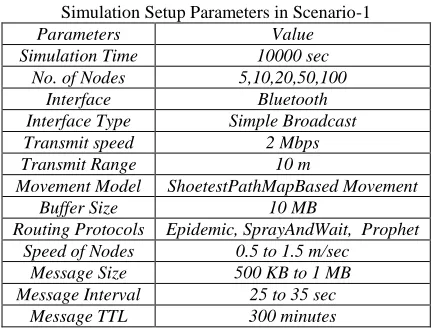
In Scenrio-1 simulation, we have assigned simple broadcast type Blue tooth interface with the transmit speed of 2 Mbps to all the nodes. We have assigned shortest path map based movement model to all the nodes with velocity varies from 0.5 to 1.5 m/sec. To better analyse the performance of all the three routing protocols, we have assigned 10Mb buffer size to each node and also their transmit range is limited to 10 m only. So, during store-carry-forward paradigm each node can carry messages only up to 10Mb and node can forward messages to those nodes only which are in 10m range of it. Message Event Generator generates the messages in every 25 to 35 seconds and every time message size can also be varied from 500 Kb to 1Mb.
Table – 1
Simulation Setup Parameters in Scenario-1
Parameters Value
Simulation Time 10000 sec
No. of Nodes 5,10,20,50,100
Interface Bluetooth
Interface Type Simple Broadcast
Transmit speed 2 Mbps
Transmit Range 10 m
Movement Model ShoetestPathMapBased Movement
Buffer Size 10 MB
Routing Protocols Epidemic, SprayAndWait, Prophet Speed of Nodes 0.5 to 1.5 m/sec
Message Size 500 KB to 1 MB
Message Interval 25 to 35 sec
Message TTL 300 minutes
To analyse the performance of routing protocols we have mainly concentrated on three performance parameters: (i) Packet Delivery Probability: It is the fraction of generated messages that are correctly delivered to the final destination within given time period. (ii) Average Latency: It is the measure of average time between messages generated and when it is received by the destination. (iii) Overhead Ratio: it is the estimate of extra packets needed by the routing protocol for delivery of the packets.
Simulation Setup Information for Scenario-2:
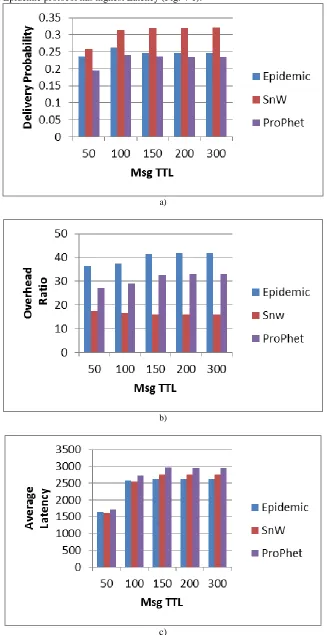
Scenario-2 is same as Scenario-1, the only difference is that here we vary message TTL from 50 to 300 minutes instead of no. of nodes (5 to 100) as in Scenario-1. Here, No. of nodes are kept fixed by 100. All other parameters are same as Scenario-1. The complete simulation setup information is given in Table II.
Table – 2
Simulation Setup Parameters in Scenario-2
Parameters Value
Simulation Time 10000 sec
No. of Nodes 100
Interface Bluetooth
Interface Type Simple Broadcast
Transmit speed 2 Mbps
Transmit Range 10 m
Movement Model ShoetestPathMapBased Movement
Buffer Size 10 MB
Routing Protocols Epidemic, SprayAndWait, Prophet Speed of Nodes 0.5 to 1.5 m/sec
Message Size 500 KB to 1 MB
Message Interval 25 to 35 sec
Message TTL [50;100;150;200;300] minutes
IV. RESULT ANALYSIS
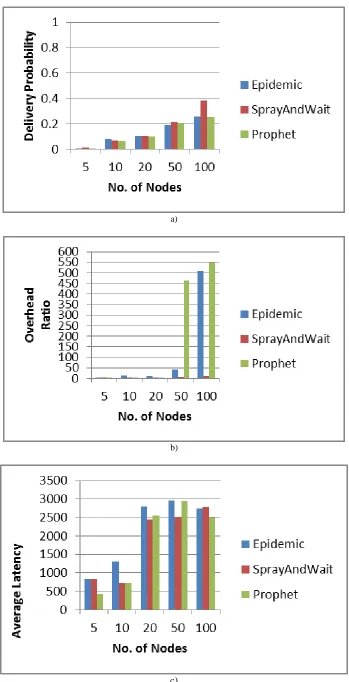
Fig. 3-a, Fig. 3-b, Fig. 3-c, are based on simulation Scenario-1 and Fig. 4-a, Fig 4-b, Fig. 4-c, are based on simulation scenario-2. Fig. 3-a-shows the Comparison graph of Delivery Probability for Epidemic Routing, Spray and Wait Routing and PROPHET Routing. From the chart it can be seen that when 5 nodes are there, three routing protocols give almost equal Delivery Probability. But when total number of nodes is increased by 10, 20, 50 and 100, all three Routing Protocol shows increment in Delivery Probability. But, Spray and Wait routing shows excellent performance in terms of Delivery Probability.
Fig. 3-b, shows the Comparison chart of Overhead Ratio for Epidemic Routing, Spray and Wait Routing and PROPHET Routing protocols. From the graph it can be seen that PROPHET is very good at Overhead Ratio comparing to other protocols.
a)
b)
Fig. 4-a shows that for any Msg TTL time Spray And Wait routing protocol has highest Delivery Probability compare to other. But, it has lowest Overhead Ratio as compare to other routing protocols as shown in Fig. 4-b. Average Latency is less for Spray And Wait protocol. But, Epidemic protocol has highest Latency (Fig. 4-c).
a)
b)
c)
V. CONCLUSION
The Results of both scenarios show that there is no protocol adequate for all cases. Our simulations show that each protocol shows good performance in some metrics but shows different behavior for other metrics.
After Analyzing results of both scenarios for Epidemic routing, Spray and Wait routing and PROPHET routing we can conclude that Epidemic routing has very poor delivery probability than Spray and Wait and PROPHET routing. PROPHET routing has high Average Latency.
Among these three routing protocols, Spray and Wait routing has high Delivery probability and Less Overhead ratio. So, Spray and Wait routing protocol shows the excellent performance than PROPHET routing and Epidemic routing.
REFERENCES
[1] Chintan B. Desai, Mr. Vyomal N. Pandya, and Dr. Prashant M. Dolia, “Comparative Analysis Of Different Routing Protocols In Delay Tolerant Networks”,
, IJCSET ,2013
[2] Paulo Rogerio Pereira, Member, IEEE, et.al “From Delay-Tolerant Networks to Vehicular Delay-Tolerant Networks”, IEEE Communications Surveys &
Tutorials, Vol. 14, No. 4, Fourth Quarter 2012, Page No.-1166-1182
[3] Nabil Benamar, “Are VDTN Routing Protocols Suitable For Data Collection In Smart Cities: A Performance Assessment “, Journal of Theoretical and
Applied Information Technology, 2013
[4] Chintan B. Desai, Vyomal N. Pandya, “A Survey on Knowledge Based Classification of Different Routing Protocols in Delay Tolerant Networks” , IJCSMC,
Vol. 2,pg.83 – 88, March 2013
[5] Ari Keränen, “The ONE Simulator for DTN Protocol Evaluation”, Helsinki University of Technology (TKK), Copyright 2009 ICST ISBN
978-963-9799-45-5.
[6] Tkk/Comnet. Project page of the ONE simulator. [Online]. Available: http://www.netlab.tkk.fi/tutkimus/dtn/theone, 2009.
![Fig. 1: VDTN Scenario [1]](https://thumb-us.123doks.com/thumbv2/123dok_us/7820527.1664825/2.612.145.478.114.408/fig-vdtn-scenario.webp)
![Fig. 2: Overview of ONE Simulator Environment [5]](https://thumb-us.123doks.com/thumbv2/123dok_us/7820527.1664825/3.612.105.501.346.588/fig-overview-simulator-environment.webp)