A List Simulated Annealing Algorithm for Task
Scheduling on Network-on-Chip
Song Chai
School of Communication and Information Engineering,
University of Electronic Science and Technology of China, Chengdu, China Email: [email protected]
Yubai Li, Jian Wang and Chang Wu
School of Communication and Information Engineering,
University of Electronic Science and Technology of China, Chengdu, China Email: {ybli, wangjian3630, changwu}@uestc.edu.cn
Abstract—In this paper, a List Simulated Anneal (LSA)
algorithm is proposed for the DAG tasks scheduling on the Network-on-chip to simultaneously optimize makespan, load balance and average link load. A task list is first creat-ed for the DAG tasks, and the task-to-processor assignment is performed using Best Fit rule. Then the generated sched-ule is further optimized using LSA. In LSA, the task execu-tion order is determined by the task list, and the task map-ping solution is optimized using simulated annealing. By conducting series of simulation, the performance of our proposal is validated. Comparing to the list Best Fit and list random mapping algorithm, our LSA has 9% and 25.4% shorter makespan, 31.1% and 79.4% better load balance and 18% smaller average link load.
Index Terms—DAG, task scheduling, Network-on-Chip, list
schedule, best fit, simulated annealing
I. INTRODUCTION
The task scheduling problem on Multiprocessor has proved to be NP-hard [1]. To solve this complex problem, many heuristics are proposed, such as list scheduling heu-ristics [2] and meta-heuheu-ristics [3]. List scheduling main-tains a task list which is created based on the task priori-ties, and assigns task to processor using certain rules, such as First Fit, Best Fit and Next Fit [4]. In another way, meta-heuristics randomly search the solution space for the optimal schedule, such as Genetic Algorithm [5], Par-ticle Swarm Optimization [6], and Simulated Annealing (SA) [7].
Simulated annealing is a generic probabilistic algo-rithm for global optimization which is inspired from the metallurgic process of heating and cooling down the ma-terial so that the atoms of mama-terial progress to the equilib-rium state. SA simulates this process to explorer the search space.
In this paper, we combine the list schedule heuristics and SA meta-heuristics, and propose a List Simulated Anneal (LSA) algorithm for the DAG tasks scheduling on the Network-on-chip. Our proposal draws advantages
from both heuristics, and performs optimization simulta-neously on makespan, load balance and average link load.
The rest of this paper is organized as follow: Section II summarizes the related work; the problem is formulated in Section III; our proposal is elaborated in Section IV; Section V gives the comparative simulation results; and Section VI concludes the paper.
II.RELATED WORKS
List heuristic and meta-heuristic for task scheduling for multicore system has been widely researched. For list scheduling, [8] proposes a communication-aware list scheduling algorithm for the NoC-based MPNoC. In [9], a contention-aware list scheduling algorithm is proposed for the dynamic reconfigurable NoC system. Reference [10] implements a Best Fit Decreasing heuristic for task scheduling in NoC. List scheduling is popular for its straightforward implementation and relatively low com-putational requirement. However in most situations, the result of list scheduling can be further optimized.
For the meta-heuristics methods, a genetic algorithm is proposed in [5] for the task scheduling in multiprocessor system. Reference [6] proposes a modified particle swarm optimization with load-balance to schedule heter-ogeneous tasks on to heterheter-ogeneous processors. In [7], a simulated annealing task scheduling algorithm is pro-posed for Voltage-Frequency islands applied NoC-based MPSoC. The meta-heuristics can effectively explore the solution space for the optima, however if combined with list schedule, the efficiency of searching as well as the probability of finding a better solution is greatly in-creased.
III.PROBLEM FORMULATION
A. Task Model
In this paper, tasks are modeled using Directed Acyclic Graphs (DAGs). A DAG
G
=
( , )
V E
is an acyclic graph where V is the set of nodes which represent the tasks and E is the set of edges in which an elemente
ij denotes the communication from task i to task j. The edge reflects the precedent relation between two tasks. If there is an edgee
ij between task i and task j, then task i is called a predecessor of task j, and correspondingly, the task j is called a successor of task i. The node with no predecessor is the entry node, and the node with no suc-cessor is the exit node.Each node
v
i and edgee
ij is associated with a weight, denoted asC
i andT
ij respectively. WeightC
i is the computational load required by a Processing Element (PE) to execute task i; andT
ij is the data transmission load between task i and task j. In our work, bothC
i andT
ij are converted to an amount of time (cycles).The Computation-Communication Ratio (CCR) [11] of a DAG is then defined using
C
i andT
ij. CCR is defined as the total computation time of a DAG divided by it total data transmission time, as given in (1).i ij
i ij v V e E
CCR
C
T
∈ ∈
=
∑
∑
(1)In DAG, a path is a sequence of nodes and edges lying in the route. The length of a path is calculated by adding up all the computation time of each node and the trans-mission time of each edge on the path. The top distance of node
v
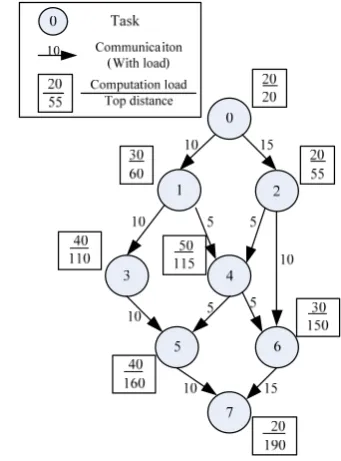
i is the length of the longest path from entry node to it.Figure 1. An example DAG tasks with 8 nodes.
Fig. 1 shows an example of a DAG with 8 tasks, and the top distance of the task is calculated and annotated in the figure.
B. Network-on-Chip Hardware
The target hardware is a 2D mesh NoC-based MPSoC, as illustrated in Fig. 2. Each PE is connected to a router, and routers are interconnected with each other through bi-direction links. Data is transferred through NoC in the form of packets.
PEs are homogenous processor cores with local data cache. If two consequential tasks are scheduled to the same PE, the successor task reads the predecessor’s data directly from the data cache of the PE without routing in NoC.
Figure 2. A 4×4 2D mesh NoC-based MPSoC
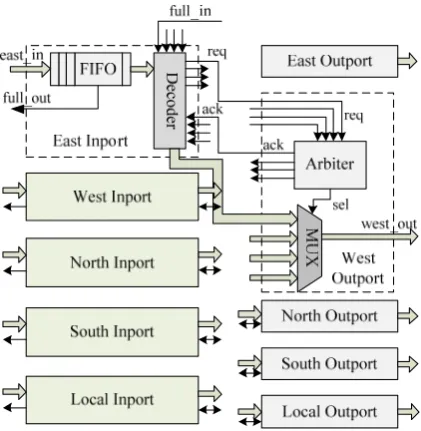
The microstructure of a NoC router is shown in Fig. 3. The router has five Inports and Outports corresponding to five directions of East, West, North, South and Local. The decoder in the Inport scans the first flit of the FIFO for any incoming packet. If decoder detects the head flit of a packet, it performs XY routing algorithm and send re-quest signal to the arbiter of the corresponding Outport. If the arbiter receives multiple request signals, contention are solved using Round-Robin arbitration. The granted Inport then forwards the packet to the downstream router. Wormhole routing is adopted to minimize the buffer re-quirement as well as the packet latency [12]. The back pressure mechanism is also employed to further reduce end-to-end delay [13].
IV.PROPOSED ALGORITHM
Figure 3. Microstructure of NoC node.
A. List schedule
The target DAG is processed by a list schedule algo-rithm to generate an initial schedule solution for the SA. The execution sequence of tasks is defined by a task list which is produced according to the top distance of tasks, and the task-to-processor assignment is performed using BF.
Task list generation: The top distance of each task in the target DAG is calculated using the method mentioned in Section III. Then the tasks are sorted based on their top distance values, and inserted to the task list. The task with the smallest top distance is placed at the head of the list. For the example DAG in Fig. 1, the task list is: task 0, task 2, task 1, task 3, task 4, task 6, task 5, and task 7.
Task list generated by top distance ensures that the precedent condition of tasks is met. For any task i with predecessor task j and successor task k, it is obviously that the top distance of task i is greater than that of task j, and smaller than task k’s top distance. In the generated task list, task j is scheduled prior to the task i, and only when task i finishes, task k is scheduled.
Best Fit scheduling: Tasks read from the list are then allocated to processor using the BF rule. For a to-be-scheduled task i, the BF algorithm calculates the Estimat-ed Finish Time (EFT) of each PE, which is the time that each PE finishes current task running on it, and EFT is regarded as the earliest starting time that each PE can provide for the target task. BF chooses the PE with the best (earliest) EFT, and schedules task i to that PE.
Although BF scheduling is focusing solely on the makespan, its output schedule provides a good start point for the further optimization. The pseudocode of the list scheduling is shown in Fig.4.
B. List Simulated Annealing Scheduling
In this subsection, a list simulated annealing algorithm is proposed to further optimize the schedule generated by list best fit algorithm presented before. Like the algorithm
1.
2. calculate ; 3.
4. sort ;
5.
6. 7.
each task in DAG
the top distance of each task
tasks into task list according to top distance each task in task list
each processor
FOR DO
END FOR
FOR DO
FOR DO
calculate ; 8.
9. schedule ;
10.
EFT
current task to the processor with the smallest EFT
END FOR
END FOR
Figure 4. Pseudo code of list scheduling.
in previous subsection, the execution order of tasks is determined by the task list which guarantees the prece-dent condition of tasks, and SA is used to find optimal task-to-processor allocation solution.
Solution representation: In the SA, schedule solution is represented by the symbol S. For a schedule problem with n_tsk tasks scheduling to n_pe PEs, a symbol is ex-pressed as:
1 2
{ ,
, ... ,
n_pe}
S
=
s s
s
, (2)where an element
s
i=
k
,k
∈
{1, ... , _
n
pe
}
denotes that the i-th task is scheduled to the k-th PE.Evaluation of schedule solution: In our proposal, three metrics are monitored to evaluate the performance of a symbol (schedule), and they are: Makespan (M), Load Balance (B) [14] and Average Link Load (L) [15].
The Makespan, also called the schedule length, is the time span for the NoC to finish all the tasks in a DAG.
The Load Balance metric is defined as follow:
1 2 2 1 _ ( ( _ _ ( ) _ ) ) n_pe n ave load LB
load on pe n ave load
= = −
∑
(3)The Load Balance measures the inverse coefficient of variant of the total workload on each processor. The larg-er B value suggests bettlarg-er balanced schedule.
The last metric, Average Link Load, monitors the traf-fic load on each link, and is defined to be the average value of traffic loads on all links. A better schedule is supposed to minimize the L metric.
(
)
(
)
(
)
ref i i ref
M B
ref ref i ref
L ref
M
M
B
B
E
w
w
M
B
L
L
w
L
−
−
=
+
−
+
(4)( )
( )
(
)
1. Initialize , , , ; 2.
3. Cooling ; 4. 1
5. NeighborMove ; 6. Evaluate , _ ; 7.
best best
new
new new new best
T S E S and E
T T
n L
S S
E S task list
E E = = = = >
WHILE TRUE DO
FOR TO DO
IF THEN DO
(
)
8. Update( , ); 9. Update( , );
Accept_worse , 12. Update( , );
13. 10. 11. 14. best best best new S E S E
E E T
S E − IF THEN ELSE DO ENDIF DO END 15.
16. Terminal_condition() 17.
18. 19.
IF END FOR
IF THEN DO
BREAK;
END IF END WHILE
Figure 5. Psedocode of SA
When evaluation is needed, the SA symbol along with the task list is send to the evaluation process for the as-sessment of the metrics, and then the process returns the evaluation score.
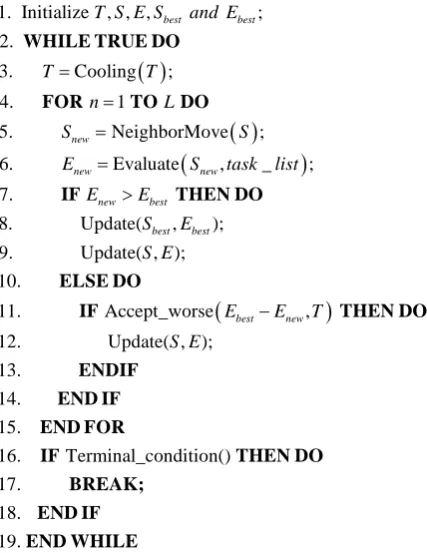
Cooling down process: SA starts with a high tempera-ture level, then gradually cooling down to a lower tem-perature level. At each level, SA repeats certain number of neighbor searches, in which a new symbol is generated by randomly change the value of a random element from the original symbol.
Better moves of the neighbor searching are always ac-cepted, and the original symbol is updated. A worse move is also accepted under a certain probability to prevent algorithm from local optima. The probability of accepting a worse move decreases as the temperature decreases.
The temperature cooling function is given in (5), where
0
T
is the initial temperature, i is the ordinal number ofcurrent iteration,
L
=
n tsk n
_
⋅
( _
pe
−
1)
[17] is the number of iteration per temperature level, and the cooling factor q is a constant. The cooling function forces the temperature to cooling from level to level.
( )
0i L
Cooling T
T q
⎢ ⎥ ⎢ ⎥ ⎣ ⎦
= ⋅
(5) The worse move acceptance function is defined as (6), where function random() returns a random number of interval (0,1), and
E
0 is the performance score of thereference symbol
S
0 .Fig. 5 shows the pseudocode of the SA algorithm, and Line 4 to line 15 in the code shows the L iterations of the neighbor searching in the cooling down process.
0
_ ( , )
1 1, ()
1 ( )
0, .
best new
best new Accept worse E E T
random E E Exp E T others − ⎧ < ⎪ − ⎪ + = ⎨ ⋅ ⎪ ⎪⎩ (6)
V.SIMULATION &RESULTS
A. Simulation Setup
To evaluate the performance of our proposal, we im-plement the list SA (LSA) scheduling algorithm in C++, and simulate the produced schedules under a SystemC based cycle-accurate NoC simulator which is modified from the work in [18]. The list BF (LBF) as well as the list random mapping (LRM) scheduling is also imple-mented and simulated as reference.
The NoC is a 4×4 2D mesh structure with XY routing algorithm. Wormhole switching is adopted, and Round-Robin arbitration is enforced to solve contentions.
For the LSA, the algorithm terminates after 50 temper-ature level, and the cooling factor q=0.95. The weight coefficients in the evaluation are
w
M=
0.7
,0.15
B
w
=
andw
L=
0.15
. B. Task GenerationIn our simulation, both random DAG and the real-world application DAG are used for evaluation the per-formance of our schedule algorithm.
The 20 random DAGs are generated using TGFF 3.1 [19]. The detail information of each DAG is shown in Table I. The task number (n_tsk) varies from 52 to 101 which covers various of DAG sizes. Tasks’ computation time is randomly generated from 40~160 cycles. CCR is set to 3, 2, 1.5 and 1.2 to simulate light, medium, heavy and extreme heavy communication load. The series_w and series_l are the parameters required by the new algo-rithm of TGFF 3.1. The series_w and series_l parameter are given as a tuple (average, multiplier), and set the width/length of series chains.
Two real world applications, solving Laplace Equation (LE) using Gauss-Seidel algorithm in [20] and Molecular Dynamics Code (MDC) in [21] are also simulated in our experiment.
C. Simulation Results
The simulation results of List Simulated Annealing (LSA), List Best Fit (LBF) and List Random Mapping (LRM) scheduling algorithm under our NoC simulator is illustrated in Fig. 6.
DETAILS OF RANDOM GENERATED TASK GRAPHS
(a) Makespan
(b) Load balance
(c) Average link load
Figure 6. Simulation results of LSA, LBF and LRM.
Task Graph tg1 tg2 tg3 tg4 tg5 tg6 tg7 tg8 tg9 tg10
tsk_num 63 58 59 52 75 71 67 71 80 79
CCR 3 2 1.5 1.2 3 2 1.5 1.2 3 2
series_w 4,2 4,2 4,2 4,3 4,2 4,2 4,2 4,2 5,2 5,2
series_l 3,2 3,2 3,2 3,2 3,2 3,2 3,2 3,2 4,2 4,2
Task Graph tg11 tg12 tg13 tg14 tg15 tg16 tg17 tg18 tg19 tg20
tsk_num 77 77 91 91 93 92 101 97 96 97
CCR 1.5 1.2 3 2 1.5 1.2 3 2 1.5 1.2
series_w 5,2 5,2 5,2 5,2 5,2 5,2 6,2 6,2 6,2 6,2
larger than the makespan of tg17, for the critical path of tg1 (1557 cycles) is larger than that of tg17 (1226 cycles). From Fig. 6 (a) we observe that the makespan of LSA is always smaller than the makespan of LBF and LRM. The average makespan of LSA is 91% of LBF and 74.6% of LRM. We also observe that in some situations, the makespan results of LSA is very close to that of LBF, that is because the schedule produced by LBF is already near-optima.
Fig. 6 (b) shows the load balance results, and all the re-sults are normalized to the LSA equivalent. Notice that in some situations, the load balance of LSA is identical to that of LBF. The explanation to this phenomenon is that two or more processors swap all their tasks during the cooling down process of LSA. Besides these situations, LSA still outperforms LBF by 33.1% and LRM by 79.4%. The average link load results are illustrated in Fig. 6 (c). Obviously, LSA remarkably reduces the average link load on NoC. The average link load of LSA is 57.9% and 56.3% smaller than that of LBF and LRM.
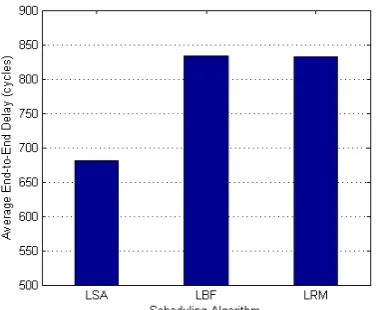
Moreover, we measure the end-to-end routing delay of each packet, and the overall average end-to-end delay of three schedule algorithm is shown in Fig. 7. Although it is not a optimization goal in our proposal, as presented in the figure, the average end-to-end delay of LBF and LRM are of the same level, and the routing delay of LSA is 18% shorter than that of LBF and LRM. This is because both makespan and average link load optimization favors the schedule with shorter routing delay.
Figure 7. Average End-to-End Delay VI.CONCLUSION
A list simulated annealing scheduling algorithm is pro-posed in this paper for the DAG tasks scheduling on the NoC. The proposal combines list schedule and simulated annealing to optimize makespan, load balance and aver-age link load. Through series of simulations, the perfor-mance of our proposal is validated.
ACKNOWLEDGMENT
This work was supported by the National Natural Sci-ence Foundation of China [61201005], the Fundamental Research Funds for the Central Universities [No.ZYGX2011J006] and the National Major Projects [2011ZX03003-003-04].
REFERENCES
[1] M. Bambagini, G. Buttazzo, and S. Hendseth, "Exploiting Uni-Processor Schedulabilty Analysis for Partitioned Task Allocation on Multi-Processors with Precedence Con-straints," RTSOPS 2012, p. 17, 2012.
[2] H. Arabnejad and J. G. Barbosa, "Performance evaluation of list based scheduling on heterogeneous systems," in Eu-ro-Par 2011: Parallel Processing Workshops, 2012, pp. 440-449.
[3] S. Mandloi and H. Gupta, "A Review of Resource Alloca-tion and Task scheduling for ComputaAlloca-tional Grids based on Meta-heuristic Function," IJRCCT, vol. 2, pp. 099-102, 2013.
[4] I. Lupu, P. Courbin, L. George, and J. Goossens, "Multi-criteria evaluation of partitioning schemes for real-time systems," in Emerging Technologies and Factory Automa-tion (ETFA), 2010 IEEE Conference on, 2010, pp. 1-8. [5] S. Gupta, G. Agarwal, and V. Kumar, "Task scheduling in
multiprocessor system using genetic algorithm," in Ma-chine Learning and Computing (ICMLC), 2010 Second In-ternational Conference on, 2010, pp. 267-271.
[6] S. Sivanandam and P. Visalakshi, "Dynamic task schedul-ing with load balancschedul-ing usschedul-ing parallel orthogonal particle swarm optimisation," International Journal of Bio-Inspired Computation, vol. 1, pp. 276-286, 2009.
[7] S. Ninomiya, K. Sakanushi, Y. Takeuchi, and M. Imai, "Task Allocation and Scheduling for Voltage-Frequency Islands Applied NoC-based MPSoC Considering Network Congestion," in Embedded Multicore Socs (MCSoC), 2012 IEEE 6th International Symposium on, 2012, pp. 107-112. [8] H. Yu, Y. Ha, and B. Veeravalli, "Communication-aware
application mapping and scheduling for NoC-based MPSoCs," in Circuits and Systems (ISCAS), Proceedings of 2010 IEEE International Symposium on, 2010, pp. 3232-3235.
[9] M. Tagel, P. Ellervee, T. Hollstein, and G. Jervan, "Con-tention aware scheduling for NoC-based real-time sys-tems," in NORCHIP, 2011, 2011, pp. 1-4.
[10]É. Cota, A. de Morais Amory, and M. S. Lubaszewski, "NoC Reuse for SoC Modular Testing," in Reliability, Availability and Serviceability of Networks-on-Chip, ed: Springer, 2012, pp. 59-83.
[11]A. K. Singh, T. Srikanthan, A. Kumar, and W. Jigang, "Communication-aware heuristics for run-time task map-ping on NoC-based MPSoC platforms," Journal of Systems Architecture, vol. 56, pp. 242-255, 2010.
[12]F. Samman, T. Hollstein, and M. Glesner, "New theory for deadlock-free multicast routing in wormhole-switched vir-tual-channelless networks-on-chip," Parallel and Distrib-uted Systems, IEEE Transactions on, vol. 22, pp. 544-557, 2011.
[13]E. Bolotin, I. Cidon, R. Ginosar, and A. Kolodny, "QNoC: QoS architecture and design process for network on chip,"
Journal of Systems Architecture, vol. 50, pp. 105-128, 2004.
[14]Y. Fang, F. Wang, and J. Ge, "A task scheduling algorithm based on load balancing in cloud computing," in Web In-formation Systems and Mining, ed: Springer, 2010, pp. 271-277.
[16]R. T. Marler and J. S. Arora, "Survey of multi-objective optimization methods for engineering," Structural and multidisciplinary optimization, vol. 26, pp. 369-395, 2004. [17]H. Orsila, E. Salminen, and T. D. Hämäläinen, "Best prac-tices for simulated annealing in multiprocessor task distri-bution problems," Simulated Annealing, pp. 321-342, 2008. [18]S. Chai, C. Wu, Y. Li, and Z. Yang, "A NoC simulation and verification platform based on systemC," in Computer Science and Software Engineering, 2008 International Conference on, 2008, pp. 423-426.
[19]R. P. Dick, D. L. Rhodes, and W. Wolf, "TGFF: task graphs for free," in Proceedings of the 6th international workshop on Hardware/software codesign, 1998, pp. 97-101.
[20]M.-Y. Wu and D. D. Gajski, "Hypertool: A programming aid for message-passing systems," Parallel and Distributed Systems, IEEE Transactions on, vol. 1, pp. 330-343, 1990. [21]S. Kim and J. Browne, "A general approach to mapping of
parallel computation upon multiprocessor architectures," in