Page 594
HOW TO REBUILD LANGUAGE LEARNERS’ CONFIDENCE IN SPEAKING FLUENCY Kun-Huei Wu1, Yin-Shi Wu2
1Department of English, Aletheia University, Taiwan
2English Taught Program in International Business, Shih Chien Univeristy, Taiwan
Abstract
This study intends to investigate English teachers’ perception and attitude toward various aspects of Communicative Language Teaching (CLT) and the difficulties they faced in implementing this teaching approach. Data was collected through an attitude scale and interviews with the participants. Analysis of the data revealed that most of the teachers had favorable attitudes with some reservations toward four domains of CLT: group/pair work, grammar, student/teacher roles, and peer/teacher correction. The results also showed that the difficulties encountered by teachers were teacher-related, student-related, and educational-system related. Teacher-related constraints included teachers’ deficiency in spoken English, strategic and sociolinguistic competence, lack of cultural knowledge, lack of training in CLT, and lack of time to prepare communicative materials. Student-related constraints included students’ low proficiency, and educational-system related limitations consisted of large classes and grammar-based examinations. The findings of this study, which corroborated those of previous studies, suggest that many of the difficulties encountered by Chinese English teachers over the past two decades still persist to this day.
Key words: Communicative Language Teaching (CLT), teacher-related, student-related,
educational-related
INTRODUCTION
The world is becoming more and more inter-culturally inclined. Language communication ability plays an important role in the globe village. Language learners are expected to emulate the communicative skills of native speakers. In the 1950s and 1960s, the grammar-translation and audio-lingual methods of language teaching prevailed; however, the premium put on spoken communicative competence attracted more attention in the 1970s. Communicative Language Teaching (CLT), as a teaching innovation that has widely spread over the past two decades, is arguably today’s most popular teaching method in the field of English language teaching (ELT). Although it is extensively practiced in the English as a second language (ESL) setting, it is not so clear that CLT is also widely applied in the English as a foreign language (EFL) setting. English teachers from countries such as China, Greece, South Korea, and Turkey have made attempts to implement CLT; however, research has shown that English teachers from these countries have faced many constraints that have hindered them from fully adopting CLT (Burnaby and Sun, 1989; Eveyik-Aydin, 2003; Karavas-Doukas, 1996; Li, 1998). Some of the more common constraints include large classes, grammar-based examinations, teachers’ low English proficiency and lack of cultural knowledge, lack of communicative teaching materials, and students’ low English proficiency.
The results from the above studies affirmed the importance of understanding and taking into account teachers’ beliefs and attitudes toward an innovative teaching approach (CLT) when attempting to implement such an approach. That in spite of government reforms to make ELT more communicative, CLT will fail if teachers have an unfavorable attitude toward it and do not believe that this approach will work for them.
Page 595 COMMUNICATIVE LANGUAGE TEACHING
According to Larsen-Freeman (2000), CLT consists of the following characteristics. Its primary goal is to develop communicative competence in language learners, enabling them to communicate using the target language, which requires not only knowledge of linguistic form and meaning but also function. Language learners acquire the ability to differentiate between the various functions that a form may have and to choose the appropriate form that is suitable to the given context. They learn to negotiate meaning in a conversation. In CLT, the role of the teacher is that of a facilitator, advisor, and ‘co-communicator,’ and the role of the students is to communicate by participating in meaning-negotiation activities and to manage their own learning. Students work, not only as a whole group, but also in pairs and small groups.
Activities considered truly communicative are those that include an information gap, choice, and feedback (Morrow, 1981, as cited in Larsen-Freeman, 2000). Information gap refers to the need of one interlocutor to obtain an unknown piece of information from the other. Choice is being able to decide what one will say and how one will say it, and feedback from participants in a conversation ascertains that the communication is purposeful.
CLT focuses on language functions over forms; therefore, a functional syllabus, which is organized according to functions such as introducing oneself, making requests, asking for information, apologizing, and congratulating, is usually used and is accompanied by authentic teaching materials. Language activities take place at the discourse level (e.g., looking at the cohesion and coherence of paragraphs) and seek to integrate the four language skills (reading, writing, listening, and speaking). Language is for the purpose of communication, not just an object of study. Consequently, the target language is used not only for communicative activities but also for instruction, minimizing the usage of the native language.
CLT evaluates both fluency and accuracy. Informal assessment can take place when the teacher is being the advisor and co-communicator. Integrative tests with a real communicative function are used. Errors of form are seen as a natural part of developing communicative competence; hence, they are overlooked when the focus is on fluency.
CLT in China
Up until the mid-1980's, the dominant and unquestioned teaching method in China was based on the audiolingual and grammar-translation approaches to language teaching, which emphasized pronunciation/intonation training and oral practice through pattern drills for the purpose of developing good verbal habits; there was also a strong focus on grammar analysis, use of translation, rote memorization of vocabulary, intensive reading skills, and writing (Hu, 2002). However, as new ELT theories and methods began making their way into China, dissatisfaction with the traditional teaching methods, which were failing to develop communicatively competent language learners, grew. In 1984, an inciting and widely influential article came out in defense of the communicative approach (Li). It argued against the traditional methods and questioned Chinese teachers’ beliefs in regards to the language teaching and learning process.
Page 596
language teaching as imparting knowledge and language learning as receiving knowledge; he maintained that language learning is an active development process where learners need to take initiative and be active in the learning process. Finally, he asserted that effective communication– linguistic accuracy and sociolinguistic appropriateness–should be the criterion for judging performance, not the ability to memorize grammatical rules and a large number of vocabulary words. As a result of such discontentment with the traditional teaching methods, the government was compelled to begin reforming the nation’s ELT. One of the major changes has been the replacement of the structural syllabus by a functional one in 1992, which set communicative competence as its primary aim. This was to be accomplished “by training in listening, speaking, reading and writing, to teach students in order to gain basic knowledge of English and competence to use English for communication” (English Teaching Syllabus, 1992, as quoted in Liao, 2000).
However, despite the reforms, the traditional method has remained predominant in many classrooms, albeit to a lesser extent than two decades ago. Many articles have explored the reasons for this reluctance to adopt CLT (Anderson, 1993; Campbell & Zhao, 1993; Liao, 2000). Anderson (1993) identified the following as obstacles to the implementation of CLT: heavy demands (due to the lack of training, texts, and materials) placed on teachers, students’ lack of readiness, the difficulty of assessing communicative competence, and the need to prepare students for grammar-focused examinations. Campbell and Zhao (1993) observed that this reluctance to change has to do with the highly centralized education system, perceptions of teachers and students, teachers’ limited knowledge of the target culture, and the lack of attention paid to the cultural context. Liao (2000) noted that the difficulties are related to teachers’ lack of language proficiency and familiarity with the new method. Moreover, the influence of Chinese educational traditions has been difficult to overcome.
Teacher Attitudes toward CLT
Of central importance in understanding the feasibility of implementing CLT is teachers’ attitudes toward this innovative approach to language teaching. As Li (1998) puts it, “How teachers as the end users of an innovation perceive its feasibility is a crucial factor in the ultimate success or failure of that innovation” (p. 698).
In their study on the effect of language context on Chinese teachers’ views of CLT, Burnaby and Sun (1989) found that teachers perceived the communicative approach as more suitable for those planning to study or live in an English speaking country (English as a second language (ESL) context), but not for those, especially English majors, who planned to remain in China (English as a foreign language (EFL) context). For the latter, the traditional methods were perceived to be more appropriate, given their specific needs and learning goals. The study also revealed that teachers viewed their non-native English speaking teacher identity as a limitation (e.g., lack of familiarity with authentic texts, lack of knowledge in regards to appropriate cultural contexts, and no target language “intuition”). Furthermore, the pressure to teach to the grammar-focused examinations, the clash of two different teaching philosophies, large classes, lack of resources, and the low status associated with teaching language skills were all seen as constraints on the application of CLT.
Karavas-Doukas (1996) examined Greek secondary school English teachers’ attitudes toward CLT and found that most had mildly favorable to favorable attitudes towards this approach. However, upon observing some of these teachers in the classroom, the researcher found that their teaching practices did not correspond with their attitudes toward CLT. There was an emphasis on form, the classes were teacher-centered, and there were no group activities. In this case, the discrepancy was caused by a lack of understanding of CLT principles. The author made note of the importance of not neglecting teachers’ beliefs and attitudes prior to the introduction of a new teaching method.
Page 597
about the approach, and lack of time and expertise to develop communicative materials. Perceived educational system constraints consisted of large classes, grammar-based examinations, and lack of funding and support. Perceived difficulties caused by CLT itself included an inadequate account of EFL teaching context and the lack of effective and efficient instruments for assessment. Finally, perceived difficulties related to students included low English proficiency, little motivation for communicative competence, and resistance to class participation. This last point is further supported by two studies investigating student’s attitudes toward CLT. Matsuura, Chiba, and Hilderbrandt’s (2000) study of Japanese students revealed that the latter preferred traditional methods–learning isolated skills, focusing on accuracy, and the teacher-centered approach. The Chinese students in Rao’s (2002) study preferred non-communicative activities such as audiolingual drills and workbook type drills over communicative activities.
Showing similar results, Eveyik-Aydin’s (2003) examination of Turkish secondary school English teachers’ attitudes toward CLT indicated that most had a favorable attitude with some reservations. These reservations concerned constraints that were caused by the educational system–large classes and having to stick to the curriculum; teachers’ beliefs and educational values; and the students–low proficiency, fear of making mistakes, and the pressure of having to pass national examinations.
Because of the crucial role teacher’s attitudes and beliefs toward CLT play in the ongoing reforms in ELT in China, this paper will attempt to conduct a small scale, up-to-date investigation of selected Chinese English teacher’s attitudes toward the implementation of this approach. Furthermore, it will explore the difficulties encountered by these teachers in applying the principles of CLT.
THE STUDY
As a replication of Eveyik-Aydin’s (2003) study, the research questions are as follows:
1. What are selected Chinese English teachers’ attitudes towards Communicative Language Teaching?
2. What are the difficulties facing teachers in teaching English communicatively in the Chinese EFL context?
Design
Data were collected through the Communicative Language Teaching Attitude Scale (COLTAS) that was developed by Eveyik-Aydin (2003). This instrument is a five-point Likert type attitude scale consisting of 36 statements developed based on the fundamental characteristics of CLT and categorized into four domains: group/pair work activities, place of grammar, student/teachers roles, and peer/teacher corrections. Of all the statements, half of them have been designated as “negative” because they support the traditional perspective on language teaching, while the other half have been designated as “positive” because they reflect the principles of CLT. Although this instrument was intended for the Turkish EFL context, it is, nevertheless, applicable to the Chinese EFL context because of the similarities in both settings and also because the statements are not so specific as to limit it to one particular setting.
In fall 2014, COLTAS was administered to five Chinese secondary and primary school English teachers through e-mail. To ensure that their responses were not affected by their colleagues or friends’ attitudes, they were asked not to discuss the attitude scale with anyone, and to ensure that participants understood the items in the attitude scale, they were encouraged to ask for clarification through e-mail and chat sessions as needed.
Page 598
open-ended question asking participants to explain any “yes” responses, and a final question asking them to identify other difficulties not already mentioned. As with the administration of COLTAS, to ensure that the participants fully understood the questions, they were also encouraged to ask for clarification through e-mail and chat sessions as needed. In addition, terms with which the participants were less familiar were defined and included in the interview.
Participants
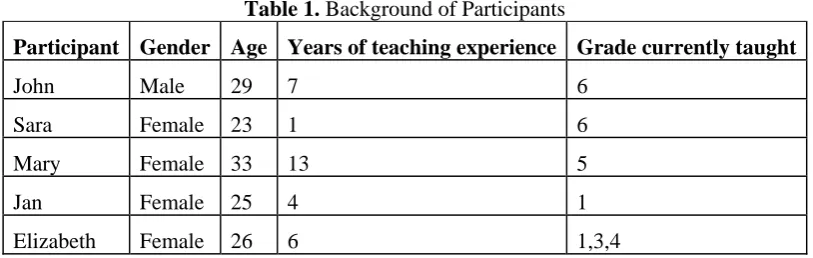
The participants were five Chinese primary (grades one through five) and junior middle (grades six through nine) school English teachers from various school districts in Shanghai, China’s most modern metropolis. Two are junior middle school teachers, one male and one female. The male teacher, 29 years of age, has taught for seven years and currently teaches grade six, while the female teacher, age 23, has only taught for one year and is currently in her second year teaching grade six (see Table 1).1 The three primary teachers are all female teachers. One of them, age 26, has taught for six years and currently teaches first, third, and fourth grade. The second one, age 25, has been an English teacher for four years and presently teaches grade one. The third teacher, age 33, has taught for about 13 years and teaches grade 5 at the present moment. In summary, the age range among the five participants was between 23 and 33, the average age being 27.2, and their years of teaching experience ranged from 1 to 14 with an average of 6.2. It is also important to note that all of them attended a summer in-service training program for English teachers and were exposed to and were taught the basic principles of CLT and ways to implement them.
Table 1. Background of Participants
Participant Gender Age Years of teaching experience Grade currently taught
John Male 29 7 6
Sara Female 23 1 6
Mary Female 33 13 5
Jan Female 25 4 1
Elizabeth Female 26 6 1,3,4
Data Analysis
As in Eveyik-Aydin’s (2003) study, the positive items on the scale, those that reflect the principles of CLT, were assigned a high score of 5 for “strongly agree” down to a low score of 1 for “strongly disagree.” The negative items on the scale, those that reflect a traditional view of language teaching, were assigned a reverse score of 1 for “strongly agree” up to 5 for “strongly disagree.” Thus, the participants who were more in favor of the communicative approach would have selected a larger number of scores between 4 and 5, and those who were more in favor of the traditional approach would have selected a larger number of scores between 1 and 2.
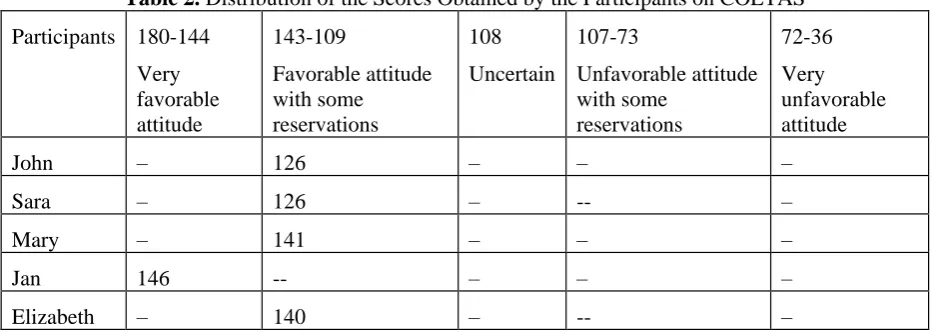
Accordingly, the higher the scores obtained on COLTAS, the more favorable were the participants’ attitudes toward CLT, and the lower the score, the less favorable the participants’ attitudes. Scores for each participant were calculated and placed within the following categories. Scores between 180 and 144 (36x4) revealed a very favorable attitude toward CLT, whereas scores between 36 and 72 (36x2) revealed a very unfavorable attitude. A score of 108 (36x3) revealed a neutral attitude toward CLT. Scores between 109 and 143 showed a favorable attitude with some reservations toward CLT, while scores between 73 and 107 reflected unfavorable attitudes with some reservations. These scores were also tabulated to determine participants’ attitudes toward each of the four domains of the scale–
Page 599
group/pair work, grammar, student/teacher roles, and peer/teacher correction.
Analysis of the interviews was conducted by placing the data within three main categories: teacher-related, student-teacher-related, and educational system-related difficulties in the implementation of CLT. These categories were derived from the questions themselves. Questions one, two, three, ten, eleven, and twelve ask about difficulties related to teachers; four and five inquire into difficulties associated with students; and questions six, seven, and eight solicit information related to the educational system.
RESULTS FROM THE ATTITUDE SCALE
Scores obtained by the five participants ranged from 126 to 146, with a mean of 135.80 (see Table 2 below).
Table 2. Distribution of the Scores Obtained by the Participants on COLTAS Participants 180-144
Very favorable attitude
143-109
Favorable attitude with some
reservations
108 Uncertain
107-73
Unfavorable attitude with some
reservations
72-36 Very unfavorable attitude
John – 126 – – –
Sara – 126 – -- –
Mary – 141 – – –
Jan 146 -- – – –
Elizabeth – 140 – -- –
The results showed that each of the participants had a favorable attitude toward CLT. One had a very favorable attitude, while the other four had favorable attitudes with some reservations. Jan obtained the highest score of 146, revealing a very favorable attitude toward CLT. Mary and Elizabeth had almost the same scores, 141 and 140, respectively, revealing favorable attitudes with some reservations, and both John and Mary had scores of 126, also revealing favorable attitudes with some reservations.
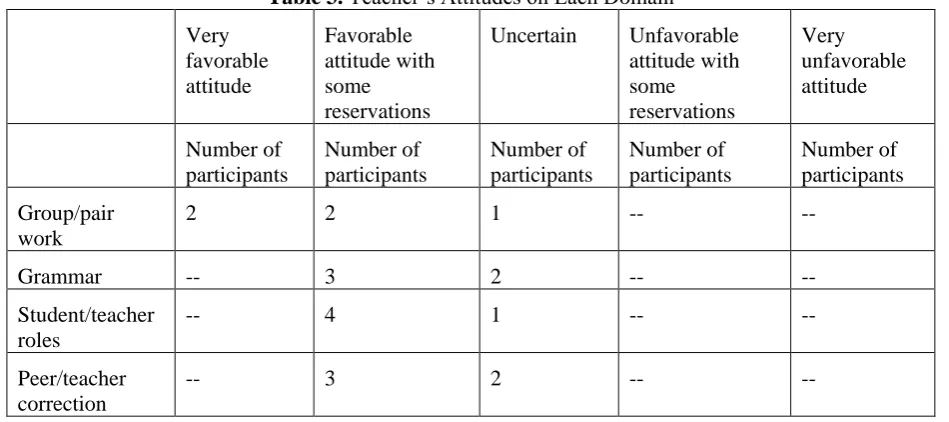
Scores tabulated to determine participants’ attitudes toward each of the four domains revealed that, overall, most of the participants had favorable attitudes with reservations toward all four domains. Two of the participants had very favorable attitudes and two had favorable attitudes with some reservations toward the group/pair work domain, making it the most preferred domain (see Table 3). Four out of the five participants showed favorable attitudes with some reservations toward student/teacher roles, and three of the participants indicated favorable attitudes with some reservations toward grammar and peer/teacher correction domains.
Page 600
activities rather than form-focused activities. Finally, concerning peer/teacher correction, most agreed that teacher correction should be avoided when it interrupts the flow of communication; however, it ought to be provided when required for effective communication. They agreed that feedback should focus on the content of the activities and the appropriateness of student responses rather than on the form of the language. Furthermore, most favored allowing student-student correction to take place in the classroom.
Table 3. Teacher’s Attitudes on Each Domain Very
favorable attitude
Favorable attitude with some reservations
Uncertain Unfavorable attitude with some reservations
Very unfavorable attitude
Number of participants
Number of participants
Number of participants
Number of participants
Number of participants Group/pair
work
2 2 1 -- --
Grammar -- 3 2 -- --
Student/teacher roles
-- 4 1 -- --
Peer/teacher correction
-- 3 2 -- --
Results from the Interview
As previously mentioned, results from the interview were analyzed in light of three major categories of difficulties faced by EFL teachers in implementing CLT: teacher-related, student-related, and educational system-related.
Teacher-related Difficulties
The participants identified several constraints that were directly related to them as teachers. These included teachers’ deficiency in spoken English, deficiency in strategic and sociolinguistic competence, lack of time to prepare communicative materials, lack of training in CLT, and lack of cultural knowledge (see Table 4). Of these, teachers’ deficiency in spoken English and lack of cultural knowledge were selected most often.
Table 4. Reported Difficulties in Implementing CLT
Teacher Number of participants
Deficiency in spoken English 4
Deficiency in strategic and sociolinguist competence 3 Lack of time to prepare communicative materials 3
Lack of training in CLT 3
Page 601
Students Number of participants
Low English proficiency 4
Passive learning style 2 Educational system
Large classes 3
Grammar-based examinations 4
Lack of authentic teaching materials 2
Deficiency in spoken English. Four out of the five participants indicated that teachers’ deficiency in spoken English is a source of difficulty when attempting to implement CLT in the classroom. Reasons given to explain this included teachers’ limited vocabulary, lack of attention to their own spoken English, and uncertainty about speaking the language correctly. The following are comments from Mary, Jan, and Elizabeth.
If we want to teach the students some words of the jobs. We can find a lot of jobs in the dictionary, but now-a-days we have a lot of new jobs, and we cannot get them from the dictionary. What can we do?2(Mary)
So sometimes I feel I have a lot of problems to speak English in the class. Sometimes I can speak it fluently, but I am not sure it is in an appropriate way. (Elizabeth)
We teachers pay less attention to our spoken English. (Jan)
Deficiency in strategic and sociolinguistic competence and lack of cultural knowledge. Because cultural knowledge is part of sociolinguistic competence, these two constraints were combined under one heading. Three of the participants reported that deficiency in strategic and sociolinguistic competence was an impeding factor in their decision to apply CLT, and four of them reported that their lack of cultural knowledge was also a constraint. One of the reasons given was teachers’ lack of training in strategic and sociolinguistic competence.
We didn’t get that training from the training school... I didn’t hear about the strategic and sociolinguistic competence before I went to last summer training. (Elizabeth)
In regards to culture, one student identified limited exposure to the target culture as the reason for his limited use of CLT.
Yes, most of teachers learn this from the book and just a few have chances to go abroad, some only learn it from other teachers and their friends (just like me). (John)
2 Minor grammatical errors were corrected and minor rephrasing was done to make some of the e-mail entries more readable.
Page 602
Lack of time to prepare communicative materials. Three participants reported that having little time to prepare materials for communicative lessons was also an obstacle to the implementation of CLT. This was attributed to a heavy teaching load and having less proficient students in the classroom.
The English teacher cannot manage a class like a Chinese Class teacher. I mean many English teachers have to teach two or three classes, two and three grades. They won’t have much time to prepare the class very well. (Mary)
Yes, most of the top students go to the private schools, so most of the students are not very smart in learning, teachers must use a lot of time to improve the “poor” students for having high scores. (John)
Lack of training in CLT. Three participants indicated that lack of training was also a constraint. Their responses revealed that there was a lack of focus on teaching methodology in their teacher training.
This summer training is the first time to me. (Jan, four years of teaching experience)
Most of our training are focused on spoken language; I didn’t get the training of CLT.
(Elizabeth, six years of teaching experience)
As can be seen, despite having had several years of teaching experience, Jan and Elizabeth have had little training in CLT.
Student-related Difficulties
The second category of difficulties involved students. The participants identified two student-related difficulties in adopting CLT: low English proficiency and a passive learning style. The former was seen by the participants as more of a constraint than the latter (see Table 4).
Low English proficiency. Four of the participants considered students’ low English proficiency a major obstacle in applying CLT. They reported that students were lacking in their ability to understand and express themselves in the target language, despite having a large vocabulary, and that this low communicative proficiency was due to the curriculum’s strong focus on grammar.
…we English teachers are asked to speak English all the class…but most of the time the students can’t understand what I say, then I have to translate it into Chinese, so, half of the lesson I speak Chinese. (Sara)
Though the students have large vocabulary but they cannot express themselves. For instance, in my class when I ask a student “where did you go last week?” and “where will you go for a trip?” He does not know how to answer my question. (John)
Page 603
Passive Learning Style. Two participants reported that students’ passive learning style was a constraint on teachers’ use of CLT. The main reasons expressed for this was the lack of opportunities for students to interact in English and again, the impact of a strong emphasis on grammar. Closely related to this issue of students’ passive learning style is students’ motivation, which the participants also acknowledged as a constraint.
Students do not have a lot of time to contact English in their daily life. They just pick some English at school. And because of the examination system, they have to learn grammar and recite the words. At the very beginning, most of the students like to learn English, but later on, they lose the interest to learn English. (Elizabeth)
And to my students, English is the second language, some students aren’t interested in it, because they must spend much time reciting new words and grammar. (Sara)
Educational System-related Difficulties
The third category of difficulties faced by the teachers in applying the principles of CLT was the educational system. This included large classes, grammar-based examinations, and lack of funds to provide for resources such as authentic teaching materials (see Table 4).
Large classes. Three participants indicated that large classes were a major impediment to teachers’ attempts at implementing CLT. For instance, each of the three classes Jan taught contained more than 50 students. Although this is not unusual, there has been an on-going, slow shift from larger to smaller classes, as exemplified in Elizabeth’s case. Two of her classes were only 21 and 27 in number, and a third one had only 32 students.
Grammar-based examinations. Four of the participants reported that grammar-based examinations presented a major challenge to the implementation of CLT. As noted earlier, English curriculums in China place a strong emphasis on grammar, which is also true of national examinations. Although teachers want to spend time developing students’ oral proficiency in the target language, they find it difficult to do so because of the need to teach to the grammar-based tests that do not allow for oral assessment.
We want to help the student improve their oral level, we encourage them say more, practice more, but if we spend a lot of time on oral practice then we won’t have more time to teach the students Grammar. But our country is Grammar-based examinations. (Mary)
Because of the examination system in China, the students do a lot of paper tests. (Elizabeth)
Lack of authentic teaching materials. Two participants indicated that the lack of authentic teaching materials was also a constraint on their use of CLT. As pointed out by them, this is also an issue of insufficient funds to provide resources for teachers. As a result, teachers have to either pay for materials out of their own pockets or be limited to the textbook. This was well-expressed by Elizabeth:
We have some ways to find the material for the kids. We can find the books in the bookstores. I like the original books, but they are expensive, I can’t afford them, and the school does not want to pay a lot of money for them… I can find the material from the internet, but most of what I find only allows me to see the cover, not what’s in the book. My friend told me he can mail me some second hand books from America, but that can’t be enough. So mostly we use the textbook.
Page 604 DISCUSSION
The results of this study on the attitude of Chinese English teachers toward CLT reflect the results of similar studies on Chinese and other EFL teachers’ perceptions of CLT (Burnaby & Sun, 1989; Eveyik-Aydin, 2003; Doukas, 1996). As in Burnaby and Sun, Eveyik-Aydin, and Karavas-Doukas’ study on Chinese, Turkish, and Greek English teachers’ attitudes, respectively, this study also showed that the participants had favorable attitudes toward CLT, despite the difficulties they encountered in adopting this approach. More specifically, analogous to Eveyik-Aydin’s (2003) findings, this study also revealed that most of the participants had favorable attitudes toward these domains of CLT: group/pair work, the place of grammar, student/teacher role, and peer/teacher correction.
In regards to the difficulties teachers faced in implementing CLT, the findings of this study also reflect many of the same constraints found in other studies (Burnaby & Sun, 1989; Eveyik-Aydin, 2003; Li, 1998). For example, comparable to Li’s (1998) findings in her study on South Korean secondary school English teachers’ perceived difficulties in adopting CLT, this study also showed that selected Chinese English teachers’ perceived difficulties were teacher related—deficiency in spoken English, strategic and sociolinguistic competence, lack of training in CLT, and little time to develop communicative materials; student-related—low English proficiency and a passive learning style; and educational-system related—large classes, grammar-based examinations, and lack of funding. In short, the similarities in the results of this and the aforementioned studies, which were carried out in various EFL settings, including China, South Korea, Greece, and Turkey, support the general notion that EFL teachers face comparable challenges in applying the principles of CLT.
Placed in the context of CLT in China, the findings of this study along with those of previous studies and reports on CLT in China (Anderson, 1993; Burnaby & Sun, 1989; Campbell & Zhao, 1993; Liao, 2000) suggest that many of the difficulties Chinese English teachers encountered during and since the appearance of Li’s (1984) article defending the communicative approach still remain today. Grammar-based examinations, referred to as the “piper that calls the tune” by Li (1984, p. 13), was widely identified by this and all the other reports as a pervasive constraint on the adoption of CLT in China. Limitations associated with lack of resources and large classes identified in Burnaby and Sun’s (1989) study was also found in this study. Teachers’ lack of training and the lack of teaching materials reported in Anderson’s article were corroborated by this study as well. Teachers’ limited knowledge of culture as identified by Campbell and Zhao (1993), and teachers’ lack of language proficiency as reported by Liao (2000) were constraints that most of the teachers in this study faced too.
In view of the persistence of these difficulties, the feasibility of adopting CLT in China is called into question. Is it possible to fully adopt CLT in the Chinese context? Considering that CLT is a western import rooted in the western culture of learning that is in many respects in conflict with the Chinese culture of learning—which values teacher dominance over student-centeredness, mental activeness over verbal activeness, and student receptiveness and conformity over student independence and individuality, etc. (Hu, 2002)—is a full adoption of CLT a pedagogically sound choice? If not, does this mean that CLT ought to be abandoned?
Page 605 CONCLUSION
This study revealed that selected Chinese English teachers had favorable attitudes toward CLT; however, this attitude was not without reservations and even a certain amount of uncertainty. Given the incompatibility of many of CLT’s practices with the Chinese culture of learning, it is not surprising that this should be the case. The results of this study showed that many of the difficulties encountered by the participants in implementing CLT are the same as the ones faced by Chinese English teachers over the last two decades. Constraints related to teachers, students, and the education system have persisted over the years and have been difficult to overcome. This state of affairs implies that there is still an urgent need for more teacher training that will prepare and equip teachers with the necessary language and pedagogical skills needed to apply CLT in the classroom. Moreover, the government needs to continue to modify the grammar-based examinations to make them more communicative.
REFERENCES
Anderson, J. (1993). Is a communicative approach practical for teaching English in China? Pros and cons. System, 21, 471-480.
Burnaby, B., & Sun, Y. (1989). Chinese teachers’ views of Western language teaching: Context informs paradigm. TESOL Quarterly, 23, 219-238.
Campbell, K. & Zhao, Y. (1993). The dilemma of English language instruction in the People’s Republic of China. TESOL Journal, 2(4), 4-6.
Eveyik-Aydin, E. (2003, March). EFL teacher’s voice on communicative language teaching. Paper presented at the Annual Meeting of Teachers of English to Speakers of Other Languages. Baltimore, Maryland.
Hu, G. (2002). Recent important developments in secondary English-language teaching in the People’s Republic of China. Language, Culture, Curriculum, 15, 30-49.
Hu, G. (2002). Potential cultural resistance to pedagogical imports: The case of communicative language teaching in China. Language, Culture, Curriculum, 15, 93-105.
Karavas-Doukas, E. (1996). Using attitude scales to investigate teachers’ attitude to the communicative approach. ELT Journal, 50, 187-198.
Li, D. (1998). “It’s always more difficult than you plan and imagine”: Teachers’ perceived difficulties in introducing the communicative approach in South Korea. TESOL Quarterly, 32, 677-703.
Larsen-Freeman, D. (2000). Communicative language teaching. In Techniques and principles in language teaching (2nd ed.). New York, NY: Oxford University Press.
Li, X. J. (1984). In defense of the communicative approach. ELT Journal, 38, 2-13.
Liao, X. Q. (2000). Communicative language teaching innovation in China: Difficulties and solutions. New Zealand. (Eric Document Reproduction Service No. ED 443 294)
Matsurra, H., Chiba, R., & Hilderbrandt, P. (2001). Beliefs about learning and teaching communicative English in Japan. JALT Journal, 23, 69-89.