www.ocean-sci.net/5/13/2009/
© Author(s) 2009. This work is distributed under the Creative Commons Attribution 3.0 License.
Ocean Science
On the time to tracer equilibrium in the global ocean
F. Primeau1and E. Deleersnijder2
1Department of Earth System Science, University of California at Irvine, Rowland Hall, Irvine, CA 92697, USA 2Universit´e catholique de Louvain, Centre for Systems Engineering and Applied Mechanics (CESAME), 4 Avenue G. Lemaˆıtre, 1348 Louvain-la-Neuve, Belgium
Received: 28 July 2008 – Published in Ocean Sci. Discuss.: 1 September 2008
Revised: 15 December 2008 – Accepted: 6 January 2009 – Published: 3 February 2009
Abstract. An important issue for the interpretation of data from deep-sea cores is the time for tracers to be transported from the sea surface to the deep ocean. Global ocean cir-culation models can help shed light on the timescales over which a tracer comes to equilibrium in different regions of the ocean. In this note, we discuss how the most slowly de-caying eigenmode of a model can be used to obtain a rel-evant timescale for a tracer that enters through the sea sur-face to become well mixed in the ocean interior. We show how this timescale depends critically on the choice between a Neumann surface boundary condition in which the flux of tracer is prescribed, a Robin surface boundary condition in which a combination of the flux and tracer concentration is prescribed or a Dirichlet surface boundary condition in which the concentration is prescribed. Explicit calculations with a 3-box model and a three-dimensional ocean circula-tion model show that the Dirichlet boundary condicircula-tion when applied to only part of the surface ocean greatly overestimate the time needed to reach equilibrium. As a result regional-“injection” calculations which prescribe the surface concen-tration instead of the surface flux are not relevant for inter-preting the regional disequilibrium between the Atlantic and Pacific found in paleo-tracer records from deep-sea cores. For tracers that enter the ocean through air-sea gas exchange a prescribed concentration boundary condition can be used to infer relevant timescales if the air-sea gas exchange rate is sufficiently fast, but the boundary condition must be ap-plied over the entire ocean surface and not only to a patch of limited area. For tracers with a slow air-sea exchange rate such as14C a Robin-type boundary condition is more rele-vant and for tracers such asδ18O that enter the ocean from melt water, a Neumann boundary condition is presumably more relevant. Our three-dimensional model results based
Correspondence to: F. Primeau
on a steady-state modern circulation suggest that the relative disequilibrium between the deep Atlantic and Pacific is on the order of “only” 1200 years or less for a Neumann bound-ary condition and does not depend on the size and location of the patch where the tracer is injected.
1 Introduction
In a recent article Wunsch and Heimbach (2008) (hereinafter referred to as WH08) pose an important question for the in-terpretation of paleoceanographic proxy tracer data: “How long to oceanic tracer and proxy equilibrium?” One spe-cific motivation for posing the question is the large differ-ence in the apparent time for theδ18O of deep Atlantic and Pacific oceans to reach equilibrium subsequent to the input of depletedδ18O water from the melting of ice sheets noted by Skinner and Shackleton (2005). WH08 suggest that a transient tracer disequilibrium can more than account for the 3900 year lag in the Pacific relative to the Atlantic recorded in the sediment. Indeed, simulated transient tracer experi-ments performed by WH08 suggest that in the case where a tracer enters the ocean over a limited-area patch of the high latitude Northern Atlantic or Southern Ocean, the deep Pa-cific can lag the deep Atlantic by as much as 4000–6000 years before it reaches 90% of its equilibrium value. While we agree entirely with the main point of the WH08 article – that a substantial passage of time is needed before a tracer be-comes uniformly mixed throughout the ocean after it enters through the sea surface, and that this transient response can result in significant regional differences in the time to reach uniformity – we wish to bring attention to the importance of the choice of boundary condition on the implied time to reach equilibrium.
0 5 10 15 20 25 30 0
0.2 0.4 0.6 0.8 1.0 1.2 1.4 1.6
C
t
(Kyrs)
Dirichlet b.c.
Neumann b.c.
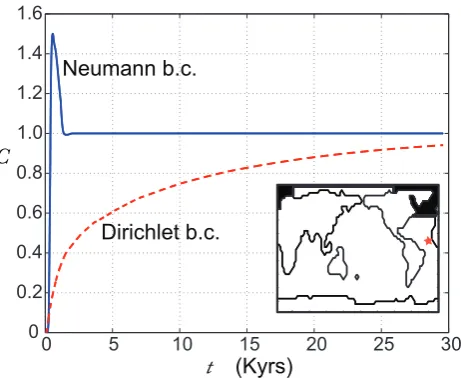
Fig. 1. Time evolution of two tracers at the same location indicated by the red star in the inset map (9◦N, 19◦W, depth=3195 m) in the deep Northern Atlantic showing the very different equilibration time for a Dirichlet (prescribed concentration) versus a Neumann (prescribed flux) boundary condition. The solid curve corresponds to the Neumann boundary condition in which a pulse of tracer is injected at timet=0. The injection is uniformly distributed in a 50 m thick patch with an area 1.4×10⁷km2located in the high lat-itude Northern Atlantic as indicated by black region in the inset map. The dashed curve corresponds to the Dirichlet boundary con-dition in which the tracer concentration is prescribed to unity for
t >0 in the same 50 m thick patch used for the Neumann problem. At timet=0 the concentration of both tracers is zero everywhere in the ocean.
concentration in a patch at the surface of the ocean. If instead
of prescribing the concentration of tracer they had prescribed the flux of tracer, the time to reach equilibrium would have been drastically shorter. This is illustrated in Fig. 1 which shows the time evolution of the concentration in the deep At-lantic ocean at (9◦N, 19◦W, depth=3195 m) of two tracers simulated using a three-dimensional ocean circulation model to be described in Sect. 3. One tracer, denoted by the dashed red curve, was introduced using the same type of boundary condition used by WH08. Its concentration was prescribed to be unity starting att=0 over a 50 m thick patch in the high latitude North Atlantic Ocean. Ast→∞ and all the ocean’s water parcels have cycled through the surface patch, the concentration of this tracer approaches unity everywhere in the ocean. The other tracer, denoted by the solid blue curve, was introduced by prescribing an instantaneous uni-form flux at timet=0 into the same 50 m thick patch. For this second tracer, the amount of tracer flux into the ocean was prescribed to be exactly the amount needed such that once the tracer is mixed uniformly throughout the ocean its concentration is equal to unity everywhere. By construction, both tracers have the same initial condition at timet=0 and the same equilibrium condition ast→∞. Their approach to
equilibrium, however, is dramatically different. After 25 000 years of simulation the tracer with a prescribed concentration boundary condition has barely reached 90% of its final equi-librium concentration but the tracer that is introduced using a prescribed flux boundary condition is already in approximate equilibrium after only 1200 years.
The reason for the vastly different equilibration timescales is easy to understand physically. For the case in which the concentration is prescribed, the tracer is introduced into the ocean only gradually because the flux of tracer through the surface patch depends on the tracer gradient normal to the surface. As the tracer enters the ocean its gradient near the surface, and hence its flux through the surface, decreases rapidly because the tracer naturally spreads first to waters that are near the patch. Further uptake of tracer depends on the rate at which pristine waters can cycle through the patch so as to maintain a concentration gradient normal to the patch. For the case in which the flux of tracer is prescribed, all the tracer is introduced into the ocean instantaneously at timet=0 and the role of the circulation is then to mix the tracer throughout the ocean. Equilibrium is reached when the tracer becomes uniformly mixed everywhere. In case the reader objects that in reality tracers enter the ocean more gradually, we demonstrate in Sect. 3.2.1 that the overshoot seen in Fig. 1 for the case in which the flux is applied impul-sively is greatly diminished if the flux is distributed over a thousand years or more. However, an important point for the interpretation of paleo-proxy records is that time lag for dif-ferent points of the deep ocean to reach equilibrium when the flux is distributed in time is still controlled by the equilibra-tion time of the impulsive response and remains drastically shorter than for the prescribed concentration response.
uniformly throughout the ocean is much shorter than the time needed for 90% of the fluid elements to cycle through the input patch. Consequently, thet90 criterion used by WH08 greatly overestimates the time needed for a pulse of anoma-lousδ18O water to reach equilibrium.
Our goal in the following sections is to further elucidate the dependence of the equilibration time on the choice of boundary condition. However, one of the main conclusions from this article should already be evident – the relevant boundary condition for studying the differences in equilibra-tion time between the Atlantic and Pacific ocean in theδ18O record is not the one used by WH08 in which the concentra-tion is prescribed, but one in which the flux of tracer is pre-scribed. As we will discuss later, a prescribed concentration boundary condition can be used to extract relevant timescales for tracers that enter the ocean through air-sea exchange pro-vided the air-sea gas exchange rate is sufficiently fast, but the prescribed concentration boundary condition must be applied over the entire air-sea interface and not as was done in WH08 over a patch of limited area with no-flux boundary conditions applying over the rest of the ocean.
A natural timescale for characterising the rate at which a system approaches equilibrium is the e-folding decay timescale of the most slowly decaying eigenmode of the sys-tem. Ast→∞, the most slowly decaying eigenmode dom-inates the time evolution of the system because the other eigenmodes eventually decay sufficiently to make a negligi-ble contribution. The spatial pattern associated with the most slowly decaying eigenmode together with the mode’s decay rate provide a concise description of the regional differences in the equilibration time. The plan for this paper is therefore to compute the eigenmodes of a three-dimensional OGCM, and explore the dependence of the characteristic equilibra-tion time on the size of the patch in which the tracer is in-troduced. Before presenting the results for the OGCM, we first illustrate in the simplest possible terms the main dif-ference for the equilibration time of a problem with a pre-scribed flux (Neumann boundary condition) and a prepre-scribed concentration (Dirichlet boundary condition) using a simple 3-box model. The available analytical solution for the simple 3-box model will allow the interested reader to verify quali-tatively the results which we obtain numerically for the full OGCM.
2 A simple 3-box model example
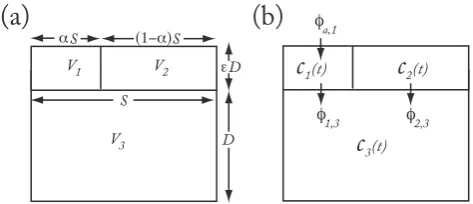
To illustrate in the simplest possible terms how the time to reach equilibrium depends critically on the choice between a Dirichlet and Neumann boundary condition, we now con-sider the evolution of a passive tracer in a simple 3-box model. A detailed formulation of the governing equation for the 3-box model shown in Fig. 2 is presented in Appendix A. Expressed in matrix form, the governing equation is
α (1−α)
V 3 V 1 V 2
S
ε
S S
D D
φ1,3 φ2,3
c
(t)1c
(t)2 φa,1c
(t)3(a)
(b)
Fig. 2. (a) Geometry of the 3-box ocean model whereV1,V2and
V3are the box volumes,αSand(1−α)Swith 0≤α≤1 are the areas of the interfaces separating box 1 from 3 and box 2 from 3 respec-tively, and whereS is the area of the ocean-atmosphere interface. (b) Diagram showing the notation used for the tracer concentrations c1,c2andc3, for the fluxes between the boxesφ1,3=(c1−C3)αvS, andφ2,3=(c2−c3)(1−α)vS, and for the flux from the atmosphere or runoff,φa,1.
dc
dt +Ac=s, (1)
where,
A=
γ 0 −γ
0 γ −γ
−αγ (α−1)γ γ
, (2)
is the model’s flux-divergence operator (also known as the transport operator), where the state vector c=[c1 c2 c3]0 represents the tracer concentration in each box and where s=[φa,1 0 0]0 is a source term. The prime denotes vector transpose. The parameters in A that are not defined in the caption for Fig. 2 are the inverse timescaleγ≡vS/(V1+V2), and the small parameter≡(V1+V2)/V3.
2.1 Neumann boundary condition
We first consider the case in which a pulse of tracer is in-jected instantaneously into box “1” at time t=0 prior to which the tracer concentration was zero everywhere. The total amount of tracer injected is such that ast→∞and the mixing of the tracer is complete, the equilibrium tracer dis-tribution is one in whichc1=c2=c3=1. The total amount of tracer injected at timet=0 must therefore beV1+V2+V3, and the concentration in box 1 at timet=0+ (immediately after tracer injection) is
c1(0+)=
V1+V2+V3 V1
= 1+
α . (3)
c=e−tAco, (4) where co≡c(t=0+)=[(1+)/(α),0,0]0 is the tracer distri-bution immediately after injection when all the tracer is con-centrated in box “1”. Expanding the exponential in terms of the eigenmodes of A, we obtain the solution
c1(t ) c2(t ) c3(t )
= 1 1 1 +
(1+)(1−α) α
−1+
0
e
−γ t+
1 1 −1 e
−(1+)γ t.
(5) The first mode corresponds to a zero eigenvalue and is there-fore independent oft. It captures the equilibrium state of the system which corresponds to a state in which the pulse of tracer is mixed uniformly throughout the three boxes. The last two modes decay exponentially withe-folding time-scales given by the reciprocal of the eigenvalues,
λ+= −γ and λ−= −(1+)γ . (6)
These two decaying modes describe the transient state of the system. The longest lived of the two modes with ane-folding timescale 1/λ+ controls the length of time for the system
to come to equilibrium. The adjustment timescale for the Neumann problem is therefore
τN =γ−1=
V1+V2
vS . (7)
It is important to note that unlike the adjustment timescale τD obtained for the Dirichlet problem to be considered in Sect. 2.2,τN is independent of the relative sizes of the two
surface boxes. As time progresses mixing and diffusion erases the details of the tracer injection so that the size of the initial injection box becomes irrelevant.
2.2 Dirichlet boundary condition
The box model analogue of the Dirichlet boundary condi-tion considered by Wunsch and Heimbach (2008) consists of holding the tracer concentration in box “1” to unity starting att=0. Fort <0 the tracer concentration in each box is pre-scribed to be zero. Becausec1is prescribed, the differential equation corresponding to the first row of A in Eq. (1) can be ignored and we are left with only the last two equations. The resulting governing equation for the Dirichlet boundary condition reduces to
dco
dt =Aooco+Ao1c1, (8)
where co≡[c2(t ), c3(t )]0, and Ao1=
0 αγ
, Aoo=
−
γ γ
(1−α)γ −γ
,
c1=
0, t≤0,
1, t >0. (9)
The solution to this system can be written as the sum, co=cf+ch, of a steady forced solution
cf = −A−oo1Ao1=[ 1 1 ]0, (10)
and a transient homogeneous solution which can be written in terms of the exponential of a matrix
ch= −e−tAoocf, (11)
Note that at timet=0, ch=−cf so that co satisfies the zero
initial condition.
Expanding the matrix exponential into the eigenmodes of Aoo, the time evolution of the tracer subject to the Dirichlet
boundary condition can be expressed as follows
c2(t ) c3(t ) = 1 1 +
−1−+d
2d ,
−1−(1−2α)+d 2d
eλ−t
+
1++d
2d , 1+(1−2α)+d
2d .
eλ+t
(12)
where λ±= −
γ
2 [1+∓d], withd = p
(1+)2−4α. (13) Bothλ+ andλ− are real and negative so that the
homoge-neous solution decays to zero and the equilibrium solution corresponds to the forced solution which is a state in which the tracer concentration is uniform throughout the boxes. The approach to equilibrium for the Dirichlet problem consid-ered here is governed by the eigenmodes of the matrix Aoo. The time to reach equilibrium is given by the mode whose e-folding timescale is longest, i.e.
τD≡ 1 λ+
= 2γ
−1
1+−p(1+)2−4α ∼ γ
−1
α , →0.
(14)
Note thatτD depends onα, the relative size of the surface boxes. This is consistent with the results of WH08 who also noted that the timescale to reach equilibrium increases as the size of the surface patch where the tracer enters the ocean decreases.
2.3 Discussion of the simple box model results If we form the ratio ofτDtoτNwe obtain,
τD
τN
∼ 1
α, →0, (15)
The Dirichlet boundary condition implies a definite time-dependent “air-sea” flux of tracer into box “1”. In-deed, a consideration of the total tracer budget yields φa,1(t )=φ1,3=αvS[1−c3(t )]. From which we see that as c3(t ) approaches its equilibrium value the implied flux of tracer decreases to zero. We see also that the implied flux is proportional toαSthe area of the patch where the tracer is introduced. The smaller the area where the tracer is intro-duced into the ocean the more slowly the tracer is fluxed into the ocean. The slow equilibration timescale for the Dirichlet in comparison to the Neumann problem can be understood in terms of the slow rate at which the tracer is introduced into the ocean in the Dirichlet solution. This slow input rate is not relevant for interpreting theδ18O record because the timing and amplitude of the melt water pulse is causally independent from the concentration ofδ18O-depleted water in the ocean. The melting of the ice prescribes a flux ofδ18O-depleted wa-ter into the ocean and, given the melting rate, does not depend on the circulation as is the case for the Dirichlet boundary condition. The surface concentration ofδ18O-depleted wa-ter on the other hand is dewa-termined by the balance between the prescribed flux and the mixing of surface and interior wa-ters. It is therefore the relatively fast timescale of the Neu-mann problem that is the relevant one for interpreting the δ18O record.
An alternative way of thinking about the slow adjustment timescale of Dirichlet problem is to think of the solution to the Dirichlet problem as the concentration of surface water (e.g. Deleersnijder et al., 2002), i.e. the concentration of wa-ter particles that have touched box-“1” at least once. The smaller we makeα the less likely it is for a water particle to have hit the box-“1” air-sea interface and thus have been transformed into a “surface water particle”. Thet90timescale defined by WH08 as the time at which the tracer concentra-tion at some point r in the interior of the ocean equals 0.9 is precisely the time at which 90% of the water in a parcel at r has been in contact with the patch where the tracer is intro-duced. The solution to the Neumann problem shows clearly that a pulse of tracer becomes well mixed long before 90% of the water particles have made contact with the patch where the tracer is injected.
The box model is sufficient to demonstrate clearly how the Dirichlet versus Neumann boundary conditions lead to highly different adjustment timescales. However, in order to get more quantitative results relevant to the real ocean and to look at the relative disequilibrium between the Atlantic and Pacific Oceans, we now turn to a three-dimensional ocean circulation model.
3 Eigenmode analysis for a 3-D ocean tracer transport model
In order to compare the eigenmodes of a three-dimensional global ocean circulation model with a Neumann
bound-ary condition (prescribed flux) to a model with a Dirichlet boundary condition (prescribed concentration), we use the three-dimensional tracer transport model of Primeau (2005). The advantage of this model is that its advection-diffusion tracer transport operator is available in matrix form making it possible to compute the model’s three-dimensional eigen-modes by solving a matrix eigenvalue problem.
The tracer transport model is driven by the velocity field and eddy diffusion tensor field derived from a dynamical ocean general circulation model (OGCM). The dynamical OCGM is a version of the climate model of the Canadian Center for Climate Modeling and Analysis, based on the NCAR CSM Ocean Model (Pacanowski et al., 1993; NCAR CSM Ocean Model Technical Note, NCAR/TN-423+STR, NCAR Oceanography Section, 1996). The dynamical model uses the KPP (Large et al., 1994) vertical mixing scheme and the GM (Gent and McWilliams, 1990) isopycnal eddy-mixing scheme. Convection is parameterized by using an implicit vertical diffusion scheme with a large diffusivity co-efficient. Second-order centered differences are used on a ∼3.75◦×3.75◦grid with 29 levels ranging in thickness from 50 m near the surface to 300 m near the bottom. The model has a velocity field and transport characteristics typical of OGCMs with similar resolution and produces a maximum Atlantic meridional overturning streamfunction of 18 Sv. It has been used to simulate transient and equilibrium tracers such as14C and CFC’s (Krakauer et al., 2006) and biological tracers such as phosphate, dissolved inorganic carbon, and alkalinity (Kwon and Primeau, 2006; Kwon and Primeau, 2008). The water mass ventilation properties of the annu-ally averaged circulation are described in detail in Primeau (2005), Primeau and Holzer (2006), Holzer and Primeau (2006, 2008).
The tracer transport model uses a state vector c of di-mension 63 090×1 whose elements correspond to the tracer concentration in each ocean grid box to represent a three-dimensional tracer concentration field. The advection-diffusion flux-divergence operator subject to no-flux condi-tions on all boundaries, once discretized, can be expressed as 63090×63090 sparse matrix,A=∇·[u−K·∇], in which u is the fluid velocity and K is the eddy-diffusivity tensor. 3.1 Dirichlet boundary condition: prescribed tracer
con-centration
dco
dt +Aooco= −Aos1s, co=0, att =0,
(16)
in which 1sis a vector of ones of lengthNs, the number of
grid points inside the patch. In writing Eq. (16), we used the partitioning of the state vector and matrix transport operator into
c=
cs
co
, and A=
Ass Aso
AosAoo
, (17)
in whichsindicates the set of indices corresponding to model grid boxes inside the surface patch andoindicates the set of indices corresponds to grid boxes outside the patch.
The eigenmode problem for the discretized model with a Dirichlet boundary condition consists of looking for solu-tions of the form co(t )=ve−λt. Substituting this modal form
into the homogeneous counterpart of Eq. (16) leads to the following matrix eigenvector problem,
Aoovn=λnvn, forn=0,· · · , No, (18)
where No is the number of grid boxes outside the patch.
In the following we will assume that the eigenmodes are ordered in terms of their real part <{λn}≡τn−1 such that
τ0>τ1≥τ2≥ · · · ≥τN.
Note that by eliminating the rows and columns corre-sponding to grid points inside the patch we have made the matrix in Eq. (18) depend on the location and size of the patch. This should be contrasted with the Neumann eigen-mode problem. As we will see in Sect. 3.2, (Eq. 23) the eigenmode problem for the Neumann problem uses the full matrix and is therefore completely independent of the patch size and location. The e-folding decay rate of the most slowly decaying eigenmode for the Dirichlet problem will therefore depend on the size and location of the patch. This is consistent with the results of WH08 who found that the t90 timescale tended to increase as the patch size was made smaller.
3.1.1 Approach to equilibrium for the Dirichlet problem The solution of Eq. (16) can be expressed as the sum of a forced and a homogeneous solution. The forced solution de-scribes the equilibrium state of the system and the homoge-neous solution describes the transient approach to equilib-rium. If we expand the homogeneous solution in terms of the system’s eigenmodes, the full solution can be written as follows
co(t )=1o+b0v0e−t /τ0+ No
X
n=1
bnvne(−1/τn+iωn)t, (19)
where the leading 1ocorresponds to the forced response due
to the prescribed concentration of unity in the patch. We have
separated out the leading eigenfunction, v0e−t /τ0, because its eigenvalue is purely real. To see why this is so, note that in the limit oft→∞the time evolution of any tracer dis-tribution that has an initial projection on v0will eventually become dominated by v0 because all the other eigenmodes decay to zero more quickly. In this asymptotic regime, the tracer concentration would change sign at certain values oft ifω06=0. Because such changes of sign are a physical impos-sibility, ω0 must necessarily vanish. We can also conclude from this argument that the leading eigenvector, v0is neces-sarily sign definite otherwise an initially positive tracer dis-tribution would ultimately produce negative tracer concentra-tions once the other eigenmodes had decayed away. Further-more, any positive tracer distribution must have a projection onto v0because in a connected domain with finite diffusivity all the other eigenmodes, vnforn=1,2,· · · ∞cannot be sign definite, that is they must have both positive and negative re-gions. This fact follows from the bi-orthogonality property of the eigenvectors of A and its adjoint which are both proper advection-diffusion tracer transport operators. The fact that any positive tracer distribution must have a projection onto v0 for the Dirichlet problem means that v0e−t /τ0 is always the relevant eigenmode for describing the asymptotic approach to equilibrium of the Dirichlet problem.
Because the type of boundary condition that is used inside the patch (prescribed concentration) is different from the type of boundary condition that is used outside the patch (no flux) there is no single eigenspectrum relevant to each Dirichlet problem corresponding to a different patch size and location. A separate eigenvalue problem must be solved every time the surface patch is changed. We note also that because differ-ent types of boundary conditions are used inside and outside the patch the principle of superposition does not apply if one wants to add up the concentrations from different patches. This points again to the fact that the regional-“injection” runs of WHO8 cannot be used in a simple way to interpret real tracers for which we expect to be able to add the contribution from different patches to obtain the total tracer concentration. To explore the dependence of the e-folding decay timescale of the most slowly decaying mode on the location and areal extent of the patch where the tracer concentration is prescribed, we randomly chose 20 points at the surface of the ocean and for each point we constructed a set of 6 patches ranging in area from that of a single grid box to that of the full ocean surface. In this way a total of 101 distinct surface patches were constructed. For each of these patches we con-structed a matrix Aooby deleting the rows and columns of A corresponding to grid points inside the patch. We then solved the matrix eigenvalue problem in Eq. (18) for each of the 101 Aoomatrices using the sparse matrix eigenvalue solver
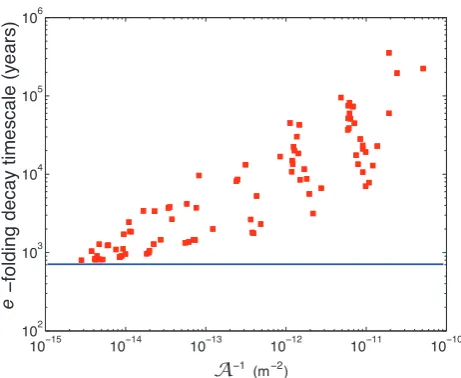
areaAof the surface patch. The figure shows clearly how the equilibration timescale for the Dirichlet problem increases without bound asAapproaches zero. There is also a conspic-uous scattering ofτ0for small area patches indicating a large sensitivity to the precise location of the patch. This sensitiv-ity is expected due to local differences in the vertical velocsensitiv-ity, diffusive mixing and penetration depth of the mixed layer. In contrast, the variability in timescaleτ1 (not shown) associ-ated with the decay rate of the second most slowly decaying eigenmode decreases and approaches the decay rate of the most slowly decaying eigenmode of the Neumann problem asA→0. This behavior ofτ0andτ1is consistent with the fact that asA→0 the eigenspectrum of the Dirichlet prob-lem approaches the one for the Neumann probprob-lem. In other words, asA→0 the number of grid boxes inside the patch decreases until Aoo→A and 1/τ0→0 as is required for the Neumann problem where the no-flux boundary condition en-sures that the total amount of tracer is conserved.
3.2 Neumann boundary condition: prescribed flux
We again present the problem formulation in discrete form. The interested reader can refer to Appendix C for the contin-uous formulation of the eigenvalue problem with Neumann boundary conditions. The tracer transport problem in which a flux of tracer is prescribed through a given surface patch at timet=0 can be written in terms of a matrix system of differential equations of the form
d
dtc+Ac=ρsδ(t ), (20)
subject to the initial condition
c=0, att =0, (21)
where s is a vector with ones in the elements corresponding to grid boxes inside the patch and zeros in the elements cor-responding to grid boxes outside the patch and whereδ(t )is the Dirac-delta function. The dimensionless scalarρensures that enough tracer is injected in the patch at timet=0 so that the asymptotic equilibrium tracer concentration is equal to unity everywhere. The parameterρis therefore equal to the ratio of the total volume of the ocean to the volume inside the patch. Equation (20) can be reduced to a homogeneous ini-tial value problem (i.e. with no source term on the right hand side) by integrating the equation fromt=−tot=and let-ting→0, to obtain
d
dtc+Ac=0, c(t=0)=ρs,
(22)
in which the effect of the pulse of tracer injected into the ocean at timet=0 is encoded in the problem’s initial condi-tion.
10 −15 10 −14 10 −13 10 −12 10 −11 10 −10 10 2
10 3 10 4 10 5 10 6
A−1 (m −2 )
e
−f
o
ld
in
g
d
e
ca
y
ti
me
sca
le
(ye
a
rs)
Fig. 3. Plot ofτ0=1/λ0(red squares) thee-folding decay timescale in units of years of most slowly decaying eigenmode of the Dirichlet-problem versus the reciprocal of the area,A, of the patch. The set of patches used for this calculation is described in the text. AsA→0, the equilibration time-scale given byτ0approaches in-finity. For comparison, the timescale of the most slowly decaying eigenmode of the Neumann problem which does not depend on the patch area is indicated by the thick blue line.
The eigenmode problem for the discretized model with Neumann boundary condition consists of looking for so-lutions of the homogeneous equation that are of the form c(t )=ve−λt. Substituting the modal form into the homo-geneous equation leads to the following matrix eigenvector problem,
Avn=λnvn, forn=0,· · · , N−1, (23) whereN=63 090 is the number of grid boxes in the model. The eigenvectors, vn, capture the spatial pattern of the eigen-modes and the eigenvalues, λn are such that the reciprocal of their real parts give thee-folding decay rate of the cor-responding eigenmodes. In the following we will assume that the eigenmodes are ordered in terms of their real part <{λn}≡τn−1such thatτ0>τ1≥τ2≥ · · · ≥τN.
3.2.1 Approach to equilibrium for the Neumann problem The solution to Eq. (20) is obtained by projecting the initial condition, c=ρs onto the eigenmodes of A,
c(t )=eAt(ρs)=
N−1 X
n=0
anvne−λnt
=1+
N−1 X
n=1
anvne(−1/τn+iωn)t,
(24)
0 60E 120E 180E 120W 60W 90S
60S 30S EQ. 30N 60N 90N
90o
120o
135o
150o
135o
180o
240o
255o
270o
150o
150o
225o
0 0.2 0.4 0.6 0.8 1
0 60E 120E 180E 120W 60W 90S
60S 30S EQ. 30N 60N 90N
75o
90o
105o
120o
90o
120o
135o
135o
120o
270o
285o
105o 255o
(a)
(b)
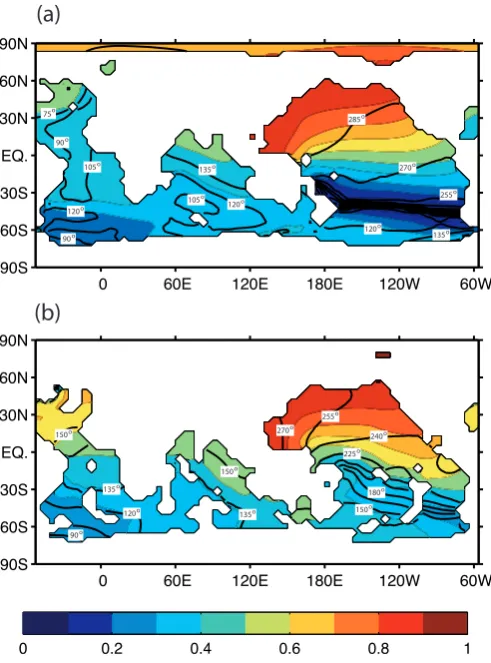
Fig. 4. Amplitude and phase of the most slowly decaying eigen-mode of the transport operator with a Neumann boundary condition. Panel (a) corresponds to a depth of 2105 m and panel (b) corre-sponds to a depth of 3185 m. The mode is over-damped with a an
e-folding decay rate of 628 years and a period of 5190 years.
zero eigenvalue. All the eigenmodes withn≥1 have a pos-itive τn and therefore decay exponentially with time. As
t→∞only the constant eigenmode with a zero eigenvalue survives to produce the asymptotic equilibrium state. In gen-eral, the approach to the asymptotic tracer field ast→∞is dominated by v1, because the other eigenmodes decay more quickly. In the unlikely situation where the initial tracer dis-tribution does not project onto v1, the asymptotic tracer field will be dominated by v2e−λ2t, the second most slowly decay-ing eigenmode and the approach to equilibrium will be even faster.
To compute the slowly decaying part of the eigen-spectrum of A we again used Arpack (Lehoucq and Sorensen, 1996) as implemented in Matlab’s eigs func-tion. As required by tracer conservation, A has a con-stant eigenvector with a zero eigenvalue,λ0=0. The most slowly decaying eigenmode for our model has eigenvalue, λ1≡1/τ1−iω1, which corresponds to an over damped mode with ane-folding decay time ofτ1=629 years and a period
of Tn=2π/ω1=5190 years. The next most slowly decay-ing eigenmode has ane-folding decay timescale ofτ2=365 years. Figure 4 shows a contour plot of the phase and am-plitude of the corresponding eigenfunction, v1 in the deep ocean.
For our OGCM, the approach to the uniform tracer dis-tribution is governed by an over-damped exponentially de-caying mode, v1e(−1/τ1+iω1)t. By factoring oute−t /τ1 in the solution’s eigenmode expansion in Eq. (24), we can rewrite the solution as follows
c(t )=1+e−t /τ1 "
a1v1eiω1t+ N−1
X
n=2
anvne(−1/τn+1/τ1+iωn)t #
,
(25) which shows that the exponentially decaying regime is itself approached with a timescale determined by the relative decay rate of the next most slowly decaying eigenmode through the formulaτr∼τ1τ2/(τ1−τ2). For our model isτr=870 years.
Assuming that the initial projection on v1is not zero, as is the case for our model, the relative disequilibrium between points at two different locations in the deep ocean, in grid boxesiandj say, can be obtained for timestτr from the spatial structure of v1alone. If we consider two points in the ocean at grid boxesiandj then the asymptotic disequilib-rium of these two points is
||1−ci(t )|| ∼ ||a1v1i||e−t /τ1,
||1−cj(t )|| ∼ ||a1v1j||e−t /τ1,
(26)
where v1i and v1j are theith and jth elements of v1. The time lag 1t (i, j ) between the equilibration time of boxes with indicesiandj can be estimated from the requirement that
||v1i||e
−τt
1 = ||v1j||e
−t+1t (i,j )τ
1 , (27)
which leads to the following formula, 1t (i, j )≈ −τ1log
||v1
i||
||v1j||
, (28)
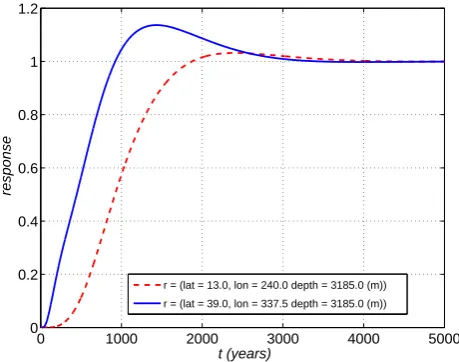
provided neither v1ior v1jvanishes. At the few points where either v1i or v1j vanishes, the next eigenmode in the ex-pansion (which decays even more rapidly) would need to be taken into account. For our model, the lag in the equilibra-tion time between any two points at depths below 3100 m is always less than 1200 years and much less on average. These time lags are much smaller than those obtained from the boundary condition used by WH08, i.e. Dirichlet bound-ary condition on regional patches.
0 1000 2000 3000 4000 5000 0
0.2 0.4 0.6 0.8 1 1.2
t (years)
response
r = (lat = 13.0, lon = 240.0 depth = 3185.0 (m))
r = (lat = 39.0, lon = 337.5 depth = 3185.0 (m))
Fig. 5. Response to a flux into the top layer of the model prescribed as a Dirac-delta function pulse. The solid blue curve is for a point at (39◦N 23.5◦W) in the Atlantic Ocean and the dashed red curve is for a point at (13◦N, 120◦W) in the Pacific Ocean. Both points are taken at a depthz=3185 m.
in equilibrium at about 3000 years. The Pacific lag with re-spect to the Atlantic is generally less than 1000 years. Fig-ure 6 shows the response at the same two points for the case where the injection of tracer is distributed in time according to a Gaussian pulse with a standard deviation of 2000 years. Distributing the tracer flux in time as opposed to injecting it instantaneously using a Dirac-delta function has the effect of reducing the overshoot past the asymptotic equilibrium value and tends to further decrease the lag between the Pacific and Atlantic responses.
3.3 Robin boundary condition: prescribed linear combina-tion of flux and concentracombina-tion
In the case where the tracer enters the ocean through air-sea gas exchange it is often the case that the information we have is for the atmospheric concentration of the tracer. The ap-propriate boundary condition is then one in which the flux of tracer through the air-sea interface is taken to be propor-tional to the difference in the concentration of the tracer be-tween the bulk ocean and the bulk atmosphere (e.g. Krakauer et al., 2006). This implies a surface boundary condition of the form,
F =k·(Cs −Ca), (29)
whereF is the gas flux out of the ocean;Cs is the concen-tration of the gas in surface water;Ca is the surface ocean concentration of the gas in equilibrium with the partial pres-surepof the gas in the air over the ocean surface. The pro-portionality constantk, sometimes referred to as the piston velocity is generally tracer dependent. Note that the Dirich-let boundary condition is obtained asymptotically ask→∞.
0 0.5 1 1.5 2
x 104 −0.2
0 0.2 0.4 0.6 0.8 1 1.2
t (years)
response
r = (lat = 13.0, lon = 240.0 depth = 3185.0 (m))
r = (lat = 39.0, lon = 337.5 depth = 3185.0 (m))
Fig. 6. Response to a flux into the top layer of the model is prescribed to evolve according to a Gaussian function centered at
t=6000 yrs with a standard deviationσ=2000 yrs. For t <0 the surface flux is zero. The solid blue curve is for a point at (39◦N 23.5◦W) in the Atlantic Ocean and the dashed red curve is for a point at (13◦N, 120◦W) in the Pacific Ocean. Both points are taken at a depthz=3185 m.
In other words, when the air-sea gas exchange process is suf-ficiently fast the Robin boundary condition is essentially the same as prescribing the concentration at the sea surface. A mixed boundary condition in which a linear combination of the flux and the surface tracer concentration is prescribed is often referred to as a Robin boundary condition (e.g. Haine, 2006). The interested reader is referred to Appendix D for the continuous formulation of the eigenvalue problem for the case of a Robin boundary condition applied at the sea sur-face. Here we present the discrete problem for the approach to equilibrium subject to a Robin boundary condition. Be-cause air-sea gas exchange occurs over the entire sea surface we will only consider the case in which the Robin boundary condition is applied to the entire surface ocean and will not consider the localized-patch case as we did for the Dirichlet problem.
The discrete tracer transport problem for a Robin bound-ary condition can be written in terms of a restoring timescale τ=1z/ kwhere1zis the thickness of the top most layer of the ocean model. In matrix form we have
d
dtc+ [A+ 1 τ3s]c=
1 τ3s1 c=0, att=0,
(30)
where 1 is a vector of ones and where 3s≡
Iss 0so
0os0oo
, (31)
10−2 100 102 104 102
103 104 105 106
τ (years) τ0
(years)
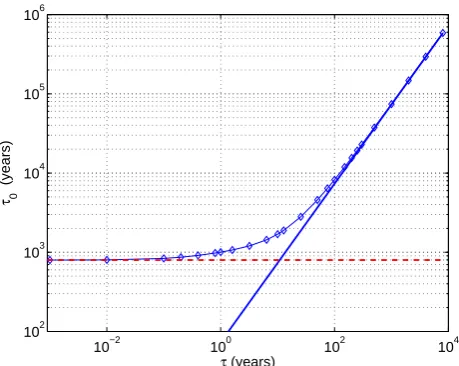
Fig. 7. Plot of τ0=1/λ0 (blue diamonds) the e-folding decay timescale of the most slowy decaying eigenmode of the Robin-problem versusτ the air-sea equilibration timescale for a 50 m thick mixed layer. The red dashed line indicates thee-folding decay timescale of the Dirichlet problem (τD=797 years). The straight blue line indicates the asymptotice-folding decay timescale for the Robin problem obtained form a first-order perturbation expansion of the Neuman problem in terms of the small parameter≡1/τ.
To obtain the discrete eigenmode problem for the Robin boundary condition we substitute the modal form c(t )=ve−λt in the homogeneous counterpart of Eq. (30) to obtain,
[A+1
τ3s]vn=λnvn, forn=0,· · ·, N−1 (32) where, as before,N=63 090, is the number of grid boxes in the ocean model.
3.3.1 Approach to equilibrium for the Robin problem The solution of the Robin problem in Eq. (30) is mathemati-cally similar to the Dirichlet problem considered in Sec. 3.1. If we enlarge our system to include the air-sea tracer ex-change process, the Robin problem can be viewed of as a Dirichlet problem in which the tracer concentration is pre-scribed in the air overlying the sea surface instead of in the water at the sea surface. Not surprisingly, the solution to the Robin problem can be expressed as the sum of a forced plus homogeneous solution as was the case for the Dirichlet prob-lem,
c(t )=1+b0v0e−t /τ0+
N−1 X
n=1
bnvne(−1/τn+iωn)t, (33)
where the leading 1 corresponds to the forced response due to the prescribed concentration of unity in the atmosphere, and where the remaining terms are the eigenmode expansion
of the homogeneous solution. The eigenmodes in Eq. (33) that capture the approach to equilibrium are those of the en-larged system in Eq. (32) that includes the process of air-sea exchange. The eigenmodes are therefore functions of the timescaleτ with which the 50 m thick top layer of the model equilibrates with the atmosphere.
As we have already mentioned the Dirichlet boundary con-dition is a limit case of the Robin boundary concon-dition. We therefore expect that if the air-sea gas exchange time scale is small compared with the residence time of water in the mixed layer, the eigenmodes of the Robin problem will be similar to the eigenmodes of the Dirichlet problem. Figure 7 shows the e-folding decay timescale of the most slowly decaying eigenmode of the Robin problem as a function of the air-sea equilibration timescale for a 50 m thick mixed layer. As be-fore the modes were computed using Matlab’seigs func-tion. Asτ→0, the e-folding timescale of the most slowly decaying eigenmode asymptotes to τD=797 years, the e -folding timescale of the most slowly decaying eigenmode of the Dirichlet problem with the surface patch being the whole sea surface. For values of τ shorter than 3 months, thee -folding timescale of the most slowly decaying mode for the Robin problem is within 10% of the Dirichlet asymptote.
If on the other hand the air-sea equilibration timescale is sufficiently long, the reciprocal of τ is a small parameter, and the eigenvalue problem in Eq. (32) can be thought of as a perturbation to the eigenvalue problem for the Neumann problem discussed in Sect. 3.2. By having introduced the process of air-sea gas exchange, the tracer can escape to the atmosphere and is not conserved in the ocean as it was for the case of the Neumann problem. The process of air-sea tracer exchange therefore perturbs the null eigenmode of the Neumann problem into a decaying mode. A perturbation ex-pansion in powers of 1/τ allows us to examine how the null eigenmode of the Neumann problem is modified by the pro-cess of air-sea gas exchange. Expanding the eigenvector and eigenvalue of the Robin probem in powers of 1/τ,
v=φ0+1
τφ1+ · · · λ=γ0+
1
τγ1+ · · ·,
(34)
substituting into Eq. 32 and equating like powers of 1/τ we recover to zeroth order the Neumann eigenvalue problem,
Aφ0=γ0φ0. (35)
Takingφ0andγ0to be the null mode of the Neumannprob-lem, we haveφ0=1 andγ0=0. At first order we obtain,
Aφ1+3sφ0=γ11. (36)
4000 2000 0
4000 2000 0
4000 2000 0
Pacific Atlantic
100 yrs
τ = τ =1 year
10 yrs
τ =
depth (m)
0 0.1 0.2 0.3 0.4 0.5 0.6 0.7 0.8 0.9 1.0
90S 5S EQ 45N 90N 90S 45S EQ 45N 90N
Fig. 8. Spatial pattern of the most slowly decaying eigenmode for a Robin surface boundary condition for several values of the air-sea equilibration time-scale,τ, for a 50 m thick mixed layer. The left column shows the modal pattern zonally averaged in the Pacific basin and the right column shows the modal pattern zonally aver-aged in the Atlantic basin.
γ1=
10W3s1
10W1 , (37)
where we have used the fact that because of tracer conser-vation volume weighted sum of a column of the transport operator is zero, i.e. 10WA=00. The numerator in Eq. (37) is equal to the volume for the top layer of the ocean model, and the denominator is equal to the total volume of the ocean. The large-τasymptotic behavior of the most slowly decaying eigenmode is therefore
λ0∼ Vsurf
Vtot 1
τ, asτ → ∞ ∼ kA
Vtot ask→0,
(38)
whereAis the surface area of the ocean and k is the air-sea tracer-exchange rate. Equation (38) shows that when the air-sea exchange rate is sufficiently slow the tracer equilibra-tion timescale for the ocean can be obtained simply by di-viding the ocean volume by the rate of tracer input through the air-sea interface. The ocean, subject to a Robin bound-ary condition with a sufficiently slow air-sea tracer exchange rate, behaves essentially as a well-mixed box in terms of its equilibration timescale. The largeτ asymptotic limit is in-dicated in Fig. 7 by the solid blue line. For values of τ greater than approximately 100 years thee-folding timescale of the most slowly decaying eigenmode is within 10% of the asymptotic value given in Eq. (38). Forτ=100 years thee -folding timescale of the most slowly decaying mode is 8225 years. For reference, the time for a 50 m thick mixed layer to come to equilibrium with the overlying air is on the order of a week for oxygen or chlorofluorocarbon and roughly 10 years for radiocarbon (Broecker and Peng, 1982).
0 2000 4000 6000 8000 10000
0 0.1 0.2 0.3 0.4 0.5 0.6 0.7 0.8 0.9 1
t (years)
response
r = (lat = 13.0,lon = 240.0, depth = 3185.0 (m))
r = (lat = 39.0, lon = 337.5 depth = 3185.0 (m))
Fig. 9. Plot of the time evolution of a tracer subject to a Robin boundary condition for which the tracer concentration in the at-mosphere is prescribed to unity fort >0 and for which the air-sea equilibration time-scale for a 50 m thick mixed layer is set toτ=10 years. The solid blue curve is for a point at (30◦N, 23.5◦W) in the Atlantic Ocean and the dashed red curve is for a point at (13◦N, 120◦W) in the Pacific Ocean. Both points are taken at a depth of
z=3185 m.
The long equilibration timescales obtained in the asymp-totic limit of 1/τ→0 have of course more to do with the slow air-sea gas exchange process than with the circulation of the ocean. Figure 8 shows the spatial patterns associated with the most slowly decaying eigenmode for the Robin problem for several values ofτ in the transition region between the small and largeτasymptotic limits. Asτ increases, the spatial gra-dients of the most slowly decaying eigenmode gradually de-crease, first in the deep ocean but eventually throughout the whole ocean. Eventually, forτ >500 years, the modal pat-tern is essentially constant. When the rate at which a tracer is introduced into the ocean is slow compared with the rate at which the ocean circulation can mix a tracer on global scales, the relative tracer disequilibrium between different parts of the ocean is necessarily small.
pattern shown in Fig. 8. The Atlantic-to-Pacific gradients in the deep ocean are already substantially weakened forτ=10 years. The modal pattern forτ=10 years shows that the rel-ative disequilibrium between the surface and deep ocean is expected to be much greater than the Atlantic-to-Pacific dis-equilibrium. Direct time-dependent simulation (not-shown) revealed that the time lag between the surface and deep ocean to reach 10% of their final equilibration value is on the order of 4000 years forτ=10 years, and only on the order of 2500 years forτ=1 month.
It is interesting to point out that the air-sea equilibration time for14C of τ≈10 years lies right in the middle of the transition between Dirichlet and Neumann asymptotic lim-its in Fig. 7. This implies that ignoring the air-sea exchange process (smallτ limit) or treating the ocean as a well mixed box (largeτ limit) will result in significant underestimates in the equilibration time of14C. The importance of includ-ing both ocean circulation and air-sea exchange process for understanding the time evolution of 14C is of course well known by the paleoceanographic community (e.g. Campin et al., 1999).
4 Discussion
The type of surface boundary condition one should apply de-pends on the information available. The Dirichlet bound-ary condition is appropriate when the surface concentration is known. The Neumann boundary condition is appropriate when the flux is known. In the case where the tracer enters the ocean through air-sea gas exchange the information we have is often for the atmospheric concentration of the tracer. In that case a Robin boundary condition in which a linear combination of the flux and surface concentration is speci-fied is appropriate.
Tracer simulations that use a prescribed tracer concentra-tion as a surface boundary condiconcentra-tion allow the tracer flux to be determined as part of the solution. This has the effect of making the flux dependent on the tracer concentration and on the ocean circulation. However, for a tracer such asδ18O, the flux of melt water into the ocean determines the initial surface concentration ofδ18O and not the other way around. The injection of a tracer by a process such as ice melt is consistent with prescribing a flux over a limited region of the surface ocean. Prescribing the concentration as is done by WH08, implies that there is some instantaneous feed-back mechanism that keeps the surfaceδ18O concentration at some prescribed value as deeper waters with little or no tracer signature are mixed into the surface layer. It is difficult to imagine a mechanism that could achieve this. We expect no such feedback from the runoff of ice-melt from rivers and streams and while the atmosphere is a reservoir with a fast mixing timescale it is a rather small reservoir and is there-fore not expected to have the ability to keep theδ18O content
of surface waters constant during the period over which the ocean reaches equilibrium.
For a tracer such as 14C that enters the ocean through air-sea gas exchange a Robin boundary condition is appro-priate. To the extent that the air-sea gas exchange is suffi-ciently rapid, one might argue that a prescribed concentration boundary condition can be used to provide timescales useful for the interpretation of regional differences in tracer concen-trations. However, for the specific case of14C the air-sea dis-equilibrium is sufficiently large that it needs to be taken into account (Campin et al., 1999) by either using a Robin-type boundary condition with an appropriate air-sea exchange rate or by prescribing a flux boundary condition in a well mixed atmospheric box coupled to the ocean.
While the Neumann boundary condition in which the flux of tracer is prescribed is the relevant one for understanding the equilibration time of a tracer such asδ18O, the Dirichlet boundary condition in which the concentration is specified is still extremely useful for understanding the age concept in marine modeling (e.g. Delhez et al., 1999; Holzer and Hall, 2000; Deleersnijder et al., 2001; Deleersnijder et al., 2002; Haine and Hall, 2002). As mentioned in the introduction, for the case of a stationary circulation the solution to the Dirich-let boundary condition can be interpreted as the cumulative distribution of times since the fluid elements in the ocean in-terior were last in contact with the surface patch. The time derivative of the cumulative distribution is often referred to as an age distribution and it gives important information about the distribution of times by which fluid elements are trans-ported from the surface ocean to a point in the interior of the ocean via multiple pathways. However, in order for the age distribution to give specific information about the relative disequilibrium of a given tracer in the interior of the ocean it must be convolved with the time history of the surface con-centration of the given tracer. Unless the concon-centration his-tory of the tracer at the surface is known, the age distribu-tion cannot be used to infer the relative disequilibrium of the tracer. This point is made explicit from the integral equa-tion relating the Green funcequa-tion,G(r, t;)for propagating a pulse of tracer through a surface patchat timet=0 and the Green functionG(r, t;r0, t0)for propagating a prescribed surface concentration at timet0at point r0inside,
G(r, t;)=
Z t
0 dt0
Z
d2r0G(r, t;r0, t0)G(r0, t0;). (39)
at timet. This information is not contained inG, the Green function for the Dirichlet problem.
Holzer and Hall (2000) point out that the mean time since last contact with a patch,0=R
∞
0 τG(r, τ;)dτ, tends to infinity as the size ofshrinks to zero. In other words, asshrinks to zero it takes infinitely long on average for fluid elements to find their way fromto r. It may therefore seem paradoxical that a tracer that is initially concentrated in a small patchcan become well mixed in a finite time even asshrinks to zero. There is no paradox, however. It is the shortτ part of theGdistributions that carries the bulk of the tracer because as the area of the patch shrinks to zero, the initial concentration tends to infinity. In the case of theδ18O tracer for example, the concentration ofδ18O depleted water is expected to have been extremely elevated at the mouth of the melt water rivers and streams relative to the well mixed asymptotic state. Therefore, whenis small, it is the fast transport of waters with initially concentrated tracer values that carry the bulk of theδ18O signal and so bring the ocean to its well mixed state long beforet90or0is reached.
5 Conclusions
In this article we have used the eigenmodes of a simple three box model and of a three-dimensional ocean circula-tion model to characterise the timescale for a tracer to come to equilibrium. We have shown that the timescale to reach equilibrium is longer when one prescribes the concentration of tracer instead of the flux of tracer. The difference in equi-libration time is especially pronounced when the patch over which the tracer is injected is small. For the Dirichlet prob-lem the time to reach equilibrium tends to infinity as the area of the patch shrinks to zero. In contrast, the equilibration time of the Neumann problem becomes insensitive to the de-tails of the injection as the patch size shrinks to zero. This result should not be surprising to anyone who has observed the dispersion of a dye in fluid experiment – the size of the syringe used to inject the dye quickly become irrelevant to the evolution of the dye.
Prescribing the surface concentration to be a constant im-plies that the flux of tracer into the ocean depends on the concentration of this tracer in surface water. Such a bound-ary condition can be used for interpreting the time to unifor-mity of a tracer that enters the ocean through air-sea gas ex-change, provided that the air-sea exchange rate is sufficiently rapid and that the Dirichlet boundary condition is applied to the entire ocean surface. Applying the Dirichlet boundary condition in patches of limited surface area breaks the super-position principle and makes it difficult to apply the resulting time scales for the interpretation of real tracers.
For the case ofδ18O, the melting of ice sheets is causally independent of the concentration ofδ18O in surface waters. The correct boundary condition for interpreting the relative disequilibrium between the deep Atlantic and Pacific oceans
found in the δ18O record is the Neumann boundary condi-tion for which the flux is prescribed. Our three-dimensional model results suggest that the relative disequilibrium be-tween the modern day deep Atlantic and Pacific oceans is on the order of 1200 years or less. This tracer equilibrium timescale depends of course on the accuracy of our model’s velocity field and eddy diffusivity coefficients. Given that the model resolution is very coarse one might wonder how accurately it can simulate the time-mean circulation. Early studies such as Cox, (1989) and England (1993) have shown that coarse-resolution models are capable of representing the global-scale water masses suggesting that at least on the largest scales the model circulation is reasonably accurate. Given that the most slowly decaying eigenmodes are associ-ated with the largest spacial scales we do not expect that our result should be very sensitive to the model resolution. Of course, a realistic simulation of the dispersion of theδ18O signal from the melting of the ice sheets needs to take into account the changes in ocean currents that are expected to oc-cur as a result of the change in density due to the fresh-water pulse. Without taking these effects into account we can still question the “simpler explanation” offered by WH08 that a steady modern-day circulation is sufficient to account for the apparent 3900 year lag between the times for the deep Pacific and Atlantic oceans to reach equilibrium.
Appendix A
Formulation of the governing equations for the 3-box model
The volumes of the boxes are denoted by V1, V2 and V3, and the corresponding tracer concentrations are denoted by c≡[c1 c2 c3]0. As indicated in Fig. 2, the index “3” is as-sociated with the deep ocean box, while the indices “1” and “2” are associated with the two surface ocean boxes. The geometry of the boxes, as shown in Fig. 2a, is such thatS de-notes the area of the interface separating the deep box from the surface boxes as well as the area of the ocean-atmosphere interface. The limited area of the interface separating boxes 1 and 3 is thenαSwith 0≤α≤1, and the area of the interface between boxes 2 and 3 is (1−α)S. To keep the algebraic complexity to a minimum it is useful to consider the case where the thickness of the surface boxes is much less than that of the deep box. We therefore introduce the following small parameter
= V1+V2 V3
1. (A1)
neglect the tracer exchange between the two surface boxes, more precisely, we setφ1,2=0. We parameterize the fluxes between the ocean boxes as the product of (i) the area be-tween the boxes, (ii) a constant velocity scalevand (iii) the difference in tracer concentration between the boxes: φ1,3=(c1−c3)αvS, φ2,3=(c2−c3)(1−α)vS. (A2)
The tracer budget for each of the three boxes yields the following governing equations
V1 dc1
dt = −φ1,3,+φa,1 V2
dc2
dt = −φ2,3, V3
dc3
dt =φ1,3+φ2,3.
(A3)
Combining the flux relations in Eq. (A2) with the differential equations in Eq. (A3) we obtain
dc1
dt = −γ c1+γ c3+ φa,1
V1 ,
dc2
dt = −γ c2+γ c3, dc3
dt =αγ c1+(1−α)γ c2−γ c3,
(A4)
where we have introduced the time-scale γ−1= V1+V2
vS . (A5)
It is convenient to rewrite this system of equations in matrix form
dc
dt +Ac=s, (A6)
where c=
c1 c2 c3
, s=
φa,1/V1
0 0
, and
A=
γ 0 −γ
0 γ −γ
−αγ (α−1)γ γ
. (A7)
Appendix B
Continuous problem for the case of a Dirichlet boundary condition
The mathematical formulation of the tracer initial value prob-lem with concentration prescribed over a fixed patch (i.e. the problem considered by WH08) is given by
∂
∂tC(t,r)= −∇ ·[u−K· ∇]C(t,r), C(0,r)=0,
(B1)
subject to the boundary conditions
bn·(K· ∇C(t,r))=0 for r on the boundary 0∪01\00, C(t,r)=
(
0,fort ≤0
1,fort >0 on r∈00,
(B2) where
bn:is a unit vector normal to the basin boundary, 0:is the bottom and sides of the ocean basin, 00:is a surface patch at the air-sea interface, 01:is the total air-sea interface,
01\00:is the rest of the air-sea interface excluding
the00patch. (B3)
The eigenfunctions, ψn(r), of the Dirichlet problem are the solutions to the following eigenvalue problem
(−1/τn+iωn)ψn(r)= −∇ · [u−K· ∇]ψn(r),
ψn(r)=0 for r on the boundary 00,
bn·(K· ∇ψn(r))=0 for r on the boundary 01\00, (B4)
where the eigenmodes are ordered such that their decay rate increases with increasingn. Note that because of the absorb-ing boundary condition over00and the absence of any tracer source terms, the eigenmodes, eλntψ
n(r), n=1,2,· · · ,∞, must be decaying functions of time, implying thatτn>0 for alln.
Appendix C
Continuous problem for the case of a Neumann boundary condition
∂
∂tC(t,r)= −∇ ·[u−K· ∇]C(t,r),
bn·(K· ∇C(t,r))=
Vtot
A00
δ(t )for r on the boundary00
0for r on the boundary0∪01\00
(C1)
where
bn:is a unit vector normal to the boundary of the domain, 0:is the bottom and sides of the basin boundary, 01:is the total air-sea interface,
00:is a surface patch on the air-sea interface, δ(t ):is the Dirac-delta function,
Vtot:is the total volume of the ocean,
A00 :is the area of the00patch.
The eigenfunctions,ψn(r), of the Neumann problem are the solutions of the following eigenvalue problem
(
(−1/τn+iωn)ψn(r)= −∇ · [u−K· ∇]ψn(r), bn·(K· ∇ψn(r))=0 for r on the boundary0∪01,
(C3) where the eigenvalues,λn=(−1/τn+iωn),n=0,1,· · · ,∞, are ordered such that thee-folding decay timescale,τn, de-creases with increasingn. As already mentioned in Sect. 2.1, the zero eigenvalue is a manifestation of the conservation of tracer. That the eigenfunction corresponding to the zero eigenvalue is constant is consistent with the physical fact that in the absence of source or sinks, a uniform tracer distribu-tion must be in steady state. Also, because diffusion acts to decrease the difference between the domain maximum and minimum tracer concentrations, all the eigenmodes except for the one with the zero eigenvalue must be decaying modes, (i.e.τn>0). Conservation of tracer mass then requires that all eigenfunctions withn≥1 integrate to zero. This last fact im-plies that any initial tracer distribution that does not integrate to zero must necessarily project ontoψ0.
Appendix D
Continuous problem for the case of a Robin boundary condition
∂
∂tC(t,r)= −∇ ·[u−K· ∇]C(t,r), bn·(K· ∇C(t,r))=0 for r on the boundary0. kC(t,r)+
bn·(K· ∇C(t,r))=
(
0,fort ≤0
k,fort >0 on r∈01 (D1) where
bn:is a unit vector normal to the boundary of the domain, 0:is the bottom and sides of the basin boundary, 01:is the total air-sea interface,
k:tracer-transfer or piston velocity with units of m s−1 (D2) The eigenfunctions,ψn(r), of the Robin problem are the solutions of the following eigenvalue problem
(−1/τn+iωn)ψn(r)= −∇ · [u−K· ∇]ψn(r),
kψn(r)+bn·(K· ∇ψn(r))=0 for r on the boundary01, bn·(K· ∇ψn(r))=0 for r on the boundary 0, (D3)
where the eigenvalues,λn=(−1/τn+iωn),n=0,1,· · · ,∞, are ordered such that thee-folding decay timescale,τn, de-creases with increasingn.
Acknowledgements. We wish to acknowledge comments made by C. Wunsch and discussions with Jake Gebbie on an earlier draft of the manuscript which helped us improve the manuscript. ED is a Research associate with the Belgian National Fund for Scientific Research (FNRS). FP wishes to thank the Universit´e catholique de Louvain (Louvain-la-Neuve) for a visiting professorship. This research was also funded in part by the National Science Foundation grant OCE 0726871.
Edited by: E. J. M. Delhez
References
Broecker, W. S. and Peng, T.-H.: Tracers in the sea, Lamont-Doherty Geological Observatory, Palisades, NY., 690 pp., 1982. Campin, J.-M., Fichefet, T., and Duplessy, J.-C.: Problems with using radiocarbon to infer ocean ventilation rates for past and present climates, Earth Planet. Sci. Lett., 165, 17–24, 1999. Cox, M. D.: An Idealized Model of the World Ocean. Part I: The
Global-Scale Water Masses., J. Phys. Oceanogr. 19, 1730–1752, 1989.
Delhez, E. J. M., Campin, J.-M., Hirst, A. C., and Deleersnijder, E.: Toward a general theory of the age in ocean modelling, Ocean Model., 1, 17–27, 1999.
Deleersnijder, E., Campin, J.-M., and Delhez, E. J. M.: The concept of age in marine modelling – I, Theory and preliminary model results, J. Marine Systems, 28, 223–267, 2001.
Deleersnijder, E., Mouchet, A., Delhez, E. J. M., and Beckers, J.-M.: Transient behaviour of water ages in the World Ocean, Math. Comput. Model., 36, 121–127, 2002.
England, M.: Representing the Global-Scale Water Masses in Ocean General Circulation Models, J. Phys. Oceanogr., 23, 1523–1552, 1993.
Haine, T. W. N. On tracer boundary conditions for geophys-ical reservoirs: How to find the boundary concentration from a mized condition, J. Geophys. Res., 111, C05003 doi:10.1029/2005JC003215, 2006.
Haine, T. W. N. and Hall, T. M.: A generalized transport theory: water-mass composition and age, J. Phys. Oceanogr., 32, 1932– 1946, 2002.
Hirsch, M. W. and Smale, S.: Differential Equations, Dynamical systems, and Linear Algebra, Academic Press, 358 pp., 1974. Holzer, M. and Hall, T. M.: Transit-time and tracer-age distributions
in geophysical flows, J. Atmos. Sci., 57, 3539–3558, 2000. Holzer, M. and Primeau, F. W.: The Diffusive Ocean Conveyor,
Geophys. Res. Lett., 33, L14618, doi:10.1029/2006GL026232, 2006.
Holzer, M. and Primeau, F. W.: The path-density distribution of oceanic surface-to-surface transport, J. Geophys. Res., 113, C01018, doi:10.1029/2006JC003976, 2008.
Kwon, E. Y. and Primeau, F.: Sensitivity and Optimization Study of a Biogeochemistry Ocean Model using an Implicit Solver and In-Situ Phosphate Data, Global Biogeochem. Cy., 20, GB4009, doi:10.1029/2005GB002631, 2006.
Kwon E. Y. and Primeau, F.: Optimization and sensitivity of a global biogeochemistry ocean model using combined in-situ DIC, alkalinity and phosphate data, J. Geophys. Res., 113, C08011, doi:10.1029/2007JC004520, 2008.
Lehoucq, R. B. and Sorensen, D. C.: Deflation Techniques for an Implicitly Re-started Arnoldi Iteration, Siam J. Matrix Anal. A., 17, 789–821, 1996.
Liss, P. S. and Merlivat, L.: Air-sea gas exchange rates: introduction and synthesis, in: The Role of Air-sea Exagange in Geochemical Cycling, edited by: Buat-M´enard, P. and Reidel, D., Dordrecht, 113–129, 1986.
NCAR Oceanography Section: The NCAR CSM Ocean Model, NCAR Tech. Note NCAR/TN-423+STR, 70 pp., 1996. Primeau, F.: Characterizing transport between the surface mixed
layer and the ocean interior with a forward and adjoint global ocean transport model, J. Phys. Oceanogr., 35(4), 545–564, doi:10.1175/JPO2699.1, 2005.
Primeau, F. and Holzer, M.: The Ocean’s Memory of the Atmo-sphere: Residence-Time and Ventilation-Rate Distributions of Water Masses, J. Phys. Oceanogr., 36, 1439–1456, 2006. Skinner, L. C. and Shackleton, N. J.: An Atlantic lead over
Pa-cific deep-water change across Termination I: implications for the application of the marine isotope stage stratigraphy, Quater-nary Sci. Rev., 24, 571–580, 2005.