Big
Idea
Cellular Processes:
Energy and Communication
2
INVESTIGATION
4
DIFFUSION AND OSMOSIS
What causes my plants to wilt if I forget to
water them?
■
BACKGROUND
Cells must move materials through membranes and throughout cytoplasm in order to maintain homeostasis. The movement is regulated because cellular membranes, including the plasma and organelle membranes, are selectively permeable. Membranes are phospholipid bilayers containing embedded proteins; the phospholipid fatty acids limit the movement of water because of their hydrophobic characteristics.
The cellular environment is aqueous, meaning that the solvent in which the solutes, such as salts and organic molecules, dissolve is water. Water may pass slowly through the membrane by osmosis or through specialized protein channels called aquaporins. Aquaporins allow the water to move more quickly than it would through osmosis. Most other substances, such as ions, move through protein channels, while larger molecules, including carbohydrates, move through transport proteins.
The simplest form of movement is diffusion, in which solutes move from an area of high concentration to an area of low concentration; diffusion is directly related to molecular kinetic energy. Diffusion does not require energy input by cells. The movement of a solute from an area of low concentration to an area of high concentration requires energy input in the form of ATP and protein carriers called pumps.
Water moves through membranes by diffusion; the movement of water through membranes is called osmosis. Like solutes, water moves down its concentration gradient. Water moves from areas of high potential (high free water concentration) and low solute concentration to areas of low potential (low free water concentration) and high solute concentration. Solutes decrease the concentration of free water, since water molecules surround the solute molecules. The terms hypertonic, hypotonic, and
not only by the solute concentration, but also by the resistance to water movement in the cell by the cell wall. This resistance is called turgor pressure. The presence of a cell wall prevents the cells from bursting as water enters; however, pressure builds up inside the cell and affects the rate of osmosis.
Water movement in plants is important in water transport from the roots into the shoots and leaves. You likely will explore this specialized movement called transpiration in another lab investigation.
■
Understanding Water Potential
Water potential predicts which way water diffuses through plant tissues and is abbreviated by the Greek letter psi (ψ). Water potential is the free energy per mole of water and is calculated from two major components: (1) the solute potential (ψS), which is dependent on solute concentration, and (2) the pressure potential (ψP), which results from the exertion of pressure—either positive or negative (tension) — on a solution. The solute potential is also called the osmotic potential.
ψ = ψP + ψS
Water Potential = Pressure Potential + Solute Potential
Water moves from an area of higher water potential or higher free energy to an area of lower water potential or lower free energy. Water potential measures the tendency of water to diffuse from one compartment to another compartment.
The water potential of pure water in an open beaker is zero (ψ = 0) because both the solute and pressure potentials are zero (ψS = 0; ψP = 0). An increase in positive pressure raises the pressure potential and the water potential. The addition of solute to the water lowers the solute potential and therefore decreases the water potential. This means that a solution at atmospheric pressure has a negative water potential due to the solute.
The solute potential (ψS) = – iCRT, where i is the ionization constant, C is the molar concentration, R is the pressure constant (R = 0.0831 liter bars/mole-K), and T is the temperature in K (273 + °C).
A 0.15 M solution of sucrose at atmospheric pressure (ψP = 0) and 25°C has an osmotic potential of -3.7 bars and a water potential of -3.7 bars. A bar is a metric measure of pressure and is the same as 1 atmosphere at sea level. A 0.15 M NaCl solution contains 2 ions, Na+ and Cl-; therefore i = 2 and the water potential = -7.4 bars.
BIG IDEA 2: CELLULAR PROCESSES: ENERGY AND COMMUNICATION
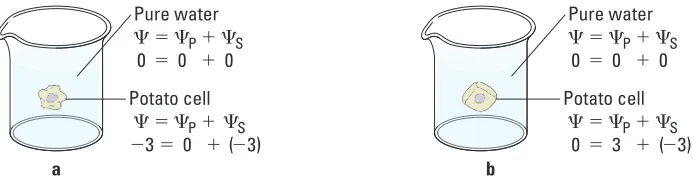
(ψ is negative). It is assumed that the solute is not diffusing (Figure 1a). The movement of water into the cell causes the cell to swell, and the cell membrane pushes against the cell wall to produce an increase in pressure. This pressure, which counteracts the diffusion of water into the cell, is called turgor pressure.
Over time, enough positive turgor pressure builds up to oppose the more negative solute potential of the cell. Eventually, the water potential of the cell equals the water potential of the pure water outside the cell (ψ of cell = ψ of pure water = 0). At this point, a dynamic equilibrium is reached and net water movement ceases (Figure 1b).
a b
Figures 1a-b. Plant cell in pure water. The water potential was calculated at the beginning of the experiment (a) and after water movement reached dynamic equilibrium and the net water movement was zero (b).
If solute is added to the water surrounding the plant cell, the water potential of the solution surrounding the cell decreases. If enough solute is added, the water potential outside the cell is equal to the water potential inside the cell, and there will be no net movement of water. However, the solute concentrations inside and outside the cell are not equal, because the water potential inside the cell results from the combination of both the turgor pressure (ψP) and the solute pressure (ψS). (See Figure 2.)
Figure 2. Plant cell in an aqueous solution. The water potential of the cell equals that of surrounding solution at dynamic equilibrium. The cell’s water potential equals the sum of the turgor pressure potential plus the solute potential. The solute potentials of the solution and of the cell are not equal.
and the cell?
■
Learning Objectives
• To investigate the relationship among surface area, volume, and the rate of diffusion
• To design experiments to measure the rate of osmosis in a model system
• To investigate osmosis in plant cells
• To design an experiment to measure water potential in plant cells
• To analyze the data collected in the experiments and make predictions about molecular movement through cellular membranes
• To work collaboratively to design experiments and analyze results
• To connect the concepts of diffusion and osmosis to the cell structure and function
■
General Safety Precautions
You must wear safety glasses or goggles, aprons, and gloves because you will be working with acids and caustic chemicals. The HCl and NaOH solutions will cause chemical burns, and you should use these solutions in spill-proof trays or pans. Follow your teacher’s instructions carefully. Do not work in the laboratory without your teacher’s supervision. Talk to your teacher if you have any questions or concerns about the experiments.
■
THE INVESTIGATIONS
This investigation consists of three parts. In Procedure 1, you use artificial cells to study the relationship of surface area and volume. In Procedure 2, you create models of living cells to explore osmosis and diffusion. You finish by observing osmosis in living cells (Procedure 3). All three sections of the investigation provide opportunities for you to design and conduct your own experiments.
■
Getting Started
These questions are designed to help you understand kinetic energy, osmosis, and diffusion and to prepare for your investigations.
• What is kinetic energy, and how does it differ from potential energy?
BIG IDEA 2: CELLULAR PROCESSES: ENERGY AND COMMUNICATION
• How do these factors alter diffusion rates?
• Why are gradients important in diffusion and osmosis?
• What is the explanation for the fact that most cells are small and have cell membranes with many convolutions?
• Will water move into or out of a plant cell if the cell has a higher water potential than the surrounding environment?
• What would happen if you applied saltwater to a plant?
• How does a plant cell control its internal (turgor) pressure?
■
Procedure 1: Surface Area and Cell Size
Cell size and shape are important factors in determining the rate of diffusion. Think about cells with specialized functions, such as the epithelial cells that line the small intestine or plant root hairs.
• What is the shape of these cells?
• What size are the cells?
• How do small intestinal epithelial and root hair cells function in nutrient procurement?
Materials
• 2% agar containing NaOH and the pH-indicator dye phenolphthalein
• 1% phenolphthalein solution
• 0.1M HCl
• 0.1 M NaOH
• Squares of hard, thin plastic (from
disposable plates); unserrated knives; or scalpels from dissection kits
• Metric rulers
• Petri dishes and test tubes
• 2% agar with phenolphthalein preparation
Step 1
Place some phenolphthalein in two test tubes. Add 0.1 M HCl to one test tube, swirl to mix the solutions, and observe the color. Using the same procedure, add 0.1 M NaOH to the other test tube. Remember to record your observations as you were instructed.• Which solution is an acid?
• Which solution is a base?
• What color is the dye in the base? In the acid?
• What is the surface area of each of your three cells?
• What is the total volume of each of your cells?
• If you put each of the blocks into a solution, into which block would that solution diffuse throughout the entire block fastest? Slowest? How do you explain the difference?
■
Alternative Method
Mix one packet of unflavored gelatin with 237 mL of water: add 2.5 mL 1%
phenolphthalein and a few drops of 0.1 M NaOH. The solution should be bright pink. Pour the gelatin mixture into shallow pans and refrigerate overnight.
You may use white vinegar in place of the 0.1 M HCl.
■
Designing and Conducting Your Investigation
Using the materials listed earlier, design an experiment to test the predictions you just made regarding the relationship of surface area and volume in the artificial cells to the diffusion rate using the phenolphthalein–NaOH agar and the HCl solution. Once you have finished planning your experiment, have your teacher check your design. When you have an approved design, run your experiment and record your results. Do your experimental results support your predictions?
■
Procedure 2: Modeling Diffusion and Osmosis
You are in the hospital and need intravenous fluids. You read the label on the IV bag, which lists all of the solutes in the water.
• Why is it important for an IV solution to have salts in it?
• What would happen if you were given pure water in an IV?
• How would you determine the best concentration of solutes to give a patient in need of fluids before you introduced the fluids into the patient’s body?
BIG IDEA 2: CELLULAR PROCESSES: ENERGY AND COMMUNICATION
Materials
• Distilled or tap water
• 1 M sucrose
• 1 M NaCl
• 1 M glucose
• 5% ovalbumin (egg white protein)
• 20 cm-long dialysis tubing
• Cups
• Balances
• How can you use weights of the filled cell models to determine the rate and direction of diffusion? What would be an appropriate control for the procedure you just described?
• Suppose you could test other things besides weights of the dialysis tubes. How could you determine the rates and directions of diffusion of water, sucrose, NaCl, glucose, and ovalbumin?
• Will protein diffuse? Will it affect the rate of diffusion of other molecules?
Step 1
Choose up to four pairs of different solutions. One solution from each pair will be in the model cell of dialysis tubing, and the other will be outside the cell in the cup. Your fifth model cell will have water inside and outside; this is your control. Before starting, use your knowledge about solute gradients to predict whether the water will diffuse into or out of the cell. Make sure you label the cups to indicate what solution is inside the cell and inside the cup.Step 2
Make dialysis tubing cells by tying a knot in one end of five pieces of dialysis tubing. Fill each “cell” with 10 mL of the solution you chose for the inside, and knot the other end, leaving enough space for water to diffuse into the cell.Step 3
Weigh each cell, record the initial weight, and then place it into a cup filled with the second solution for that pair. Weigh the cell after 30 minutes and record the final weight.Step 4
Calculate the percent change in weight using the following formula: (final – initial)/initial X 100. Record your results.• Which pair(s) that you tested did not have a change in weight? How can you explain this?
• If you compared 1 M solutions, was a 1 M NaCl solution more or less hypertonic than a 1 M sucrose solution? What is your evidence? What about
1 M NaCl and 1 M glucose and 1 M sucrose?
• Does the protein solution have a high molarity? What is evidence for your conclusion?
• How could you test for the diffusion of glucose?
depth. Think about the questions that came up as you worked through the investigation. What unanswered questions do you still have about osmosis that you could investigate further?
Using the available materials, design an investigation to answer one of your questions. Have your teacher check your design first. Remember to record your results, and be sure to use appropriate controls.
These questions can help jump-start your thinking.
• What factors determine the rate and direction of osmosis?
• What would you predict if you used a starch solution instead of the protein?
• Can you diagram the flow of water based upon the contents of your model cell and the surrounding solution?
• When will the net osmosis rate equal zero in your model cells? Will it ever truly be zero?
• Based upon your observations, can you predict the direction of osmosis in living cells when the cells are placed in various solutions?
• How is the dialysis tubing functionally different from a cellular membrane?
■
Procedure 3: Observing Osmosis in Living Cells
The interactions between selectively permeable membranes, water, and solutes are important in cellular and organismal functions. For example, water and nutrients move from plant roots to the leaves and shoots because of differences in water potentials. Based upon what you know and what you have learned about osmosis, diffusion, and water potential in the course of your investigations, think about these questions.
• What would happen if you applied saltwater to the roots of a plant? Why?
• What are two different ways a plant could control turgor pressure, a name for internal water potential within its cells? Is this a sufficient definition for turgor pressure?
• Will water move into or out of a plant cell if the cell has a higher water potential than its surrounding environment?
Step 1
Start by looking at a single leaf blade from either Elodea (a water plant) or a leaf-like structure from Mniumhornum (a moss) under the light microscope. If you need assistance, your teacher will show you how to place specimens on a slide.BIG IDEA 2: CELLULAR PROCESSES: ENERGY AND COMMUNICATION
Back in Procedure 2 you tested diffusion and osmosis properties of several solutions. Now you are going to determine how they affect plant cell turgor pressure.
• What changes do you expect to see when the cells are exposed to the solutions?
• How will you know if a particular treatment is increasing turgor pressure? If it is reducing turgor pressure?
• How could you determine which solution is isotonic to the cells?
Step 2
Test one of the four solutions from Procedure 2 and find out if what you predicted is what happens. When you are done, ask other students what they saw. Be sure to record all of your procedures, calculations, and observations.■
Designing and Conducting Your Investigation
Materials
• Potatoes, sweet potatoes, or yams
• Cork borers or french fry cutter
• Balances
• Metric rulers
• Cups
• Color-coded sucrose solutions of different, but unlabeled, concentrations prepared by your teacher
Design an experiment to identify the concentrations of the sucrose solutions and use the solutions to determine the water potential of the plant tissues. (You might want to review the information on water potential described in Understanding Water Potential.) Use the following questions to guide your investigation:
• How can you measure the plant pieces to determine the rate of osmosis?
• How would you calculate the water potential in the cells?
• Which solution had a water potential equal to that of the plant cells? How do you know?
• Was the water potential in the different plants the same?
• How does this compare to your previous determinations in the Elodea cells?
• What would your results be if the potato were placed in a dry area for several days before your experiment?
2. What organelles inside the cell have membranes with many convolutions? Why?
3. Do you think osmosis occurs when a cell is in an isotonic solution? Explain your reasoning.