Content-based Image Retrieval using Spatial-color
and Gabor Texture on a Mobile Device
Yong-Hwan Lee1, Bonam Kim2and Sang-Burm Rhee3
1 Department of Applied Computer Engineering, Dankook University
152, Jukjeon-ro, Suji-gu, Yongin-si, Gyeonggi-do, 448-701, Korea [email protected]
2
Division of Electrical and Computer Engineering, Chungnam National University 99, Daehak-ro, Yuseong-gu, Daejon, 305-764, Korea
3 Department of Applied Computer Engineering, Dankook University
152, Jukjeon-ro, Suji-gu, Yongin-si, Gyeonggi-do, 448-701, Korea [email protected]
Abstract. Mobile image retrieval is one of the most exciting and fastest growing research fields in the area of multimedia technology. As the amount of digital contents continues to grow users are experiencing increasing difficulty in finding specific images in their image libraries. This paper pro-poses a new efficient and effective mobile image retrieval method that applies a weighted combination of color and texture utilizing spatial-color and second order statistics. The system for mobile image searches runs in real-time on an iPhone and can easily be used to find a specific image. To evaluate the performance of the new method, we assessed the Xcode simulations performance in terms of average precision and F-score using several image databases and compare the results with those obtained us-ing existus-ing methods such as MPEG-7. Experimental trials revealed that the proposed descriptor exhibited a significant improvement of over 13% in retrieval effectiveness, compared to the best of the other descriptors. Keywords:Mobile Content-Based Image Retrieval, Image Representa-tion and RecogniRepresenta-tion, Image Descriptor, Spatial-Color, Gabor Texture
1.
Introduction
The mobile phones that we use in our everyday life have become popular mul-timedia devices, and it is not uncommon to observe users capturing photos on their mobile phones, instead of using dedicated digital cameras or video cam-eras. This ease of use means that the number of digital images will only con-tinue to rise with the rapid development of mobile devices, and individual users rapidly accumulate very large image repositories including both their personal photo archives and image from wider-access digital libraries. At present, users generally browse their personal multimedia repositories on mobile devices by
??
scrolling through image libraries or by manually creating a series of folders to fit their needs, and browsing through these folders. However, as the amount of digital content continues to increase end-users are beginning to suffer difficul-ties in locating specific images. As a result, research into more effective image retrieval techniques is currently receiving a great deal of attention, and image retrieval is now one of the most exciting and fastest growing areas in the field of multimedia technology [11].
There are two main approaches to image retrieval: text-based retrieval and content-based retrieval [22]. The popular text-based method requires images to be annotated with one or more keywords that can then be easily searched. However, this method involves a vast amount of labor and tends to be colored by personal subjectivity; the resulting lack of clarity often leads to mismatches in the retrieval process. In particular, this approach runs into critical problem concern the possibility of mismatches in a personal photo database. The al-ternative content-based method indexes images in a database by identifying similarities between them based on lower-level visual features such as color, texture, shape and spatial information [22] [23]. Although some systems are designed for a specific domain such as medical image retrieval or personal identification [19], a CBIR (Content-based Image Retrieval) system typically re-quires the construction of an image descriptor, which is characterized by two primary functions [23]. One is an extraction process that encodes the image into feature vectors, and another is a similarity measure that compares two im-ages. The image descriptorD is formulated into 2-tuples as (FD, SD), where
FD : {I} → Rn is an extraction function that extracts a feature vector f from
imageI, andSD:Rn×Rn →Ris a distance measure function that computes
the similarity between two feature vectors corresponding to images.
This paper proposes a new and more efficient mobile image descriptor that utilizes a weighted combination of color and texture features based on spatial-color and second-order statistical texture. This paper is an extension of work first presented in [9], here we provide a more thorough experimental compari-son, and demonstrate much improved performance4.
This paper is organized as follows: Section 2 reviews the related research on image retrieval and mobile image searching. In Section 3, we provide full details of our proposed descriptor. Section 4 presents some experimental results ob-tained using the proposed approach and assesses its performance compared to the methods currently used. Lastly, Section 5 concludes the paper by sum-marizing the study and discussing possible directions for future research.
2.
Related Work
This section summaries recently published research on content-based image retrieval including a consideration of the features commonly used in image searches and the issues involved in feature extraction from a color image.
2.1. Content-based Approaches
Many general-purpose image retrieval systems have been developed and pro-posed by both industrial and academic research laboratories, and it is not prac-ticable to attempt to survey all of these in the limited space available. Hence, we focus on those works that deal specifically with standardization, especially those that feature in SC29/WG1 JPSearch. The standard approach involves two steps [10]:
Algorithm 1:RETRIEVALfinds out the relevant images from database Input: A query image
Output: Relevant images in the database
1 Extracting image f eatures to a distinguishable extent
2 M atching these f eatures to yield a result that is visually similar
3 returnrelevant images
Fig. 1 shows the approaches traditionally used to search digital images. The type of image search and retrieval systems shown schematically on the left hand side of the figure require each image to be associated with one or more keywords entered by a human operator, while those on the use an image as a query and then attempts to retrieve other images which are similar. This rep-resents the current state-of-the-art in CBIR systems described in SC29/WG1 JPSearch, International Standardization [10].
Fig. 1.Naive system view of image search and CBIR [10].
filtering processes prior to image analysis, while we use EXIF data, which gives a better way to find approximate position within image. In [24], they present mo-bile search systems which support image queries and audio queries, covering typical design for mobile visual and audio search. But, their work flow of match-ing core logic is runnmatch-ing on the server, and client-side module is only workmatch-ing as interface for the user.
2.2. Conventional Features Relevant to the Current Research
This subsection explains the conventional features used in the proposed re-trieval method, namelyauto-correlograms for color features andgray-level co-occurrence metricsas texture features.
A histogram is a graphical display of frequencies that represents the total distribution in a digital image [4]. The histogram for colorciof imageIis
formu-lated as follows:
Hci(I) = probabilityp∈I[p∈Ici] (1)
Since the histogram simply corresponds to the probability of there being any pixels of colorciin an image, this feature does not take into account the spatial
distribution of color across different areas of the image. A correlogram charac-terizes not only the color distributions of pixels, but also the spatial correlations of pairs of colors (ci,ck) [20]. This feature describes the probability of finding a
pixel p2 of special colorck at a distancedfor a pixelp1 of given colorci. The
correlogram for a color pair (ci,ck) is formulated as follows:
With all possible combinations of color pairs, the size of the correlogram is in-evitably very large so a formulation, known as an auto-correlogram, is generally used. An auto-correlogram gives the probability of capturing the spatial corre-lation between identical colors only, and this is effectively a simplified subset of the correlogram, signified byΓd
c(I) = Ccdi,ck(I). Thus, the auto-correlogram is
formulated as follows:
Γcd(I) = probabilityp1∈Ic,p2∈I[p2∈Ic||p1−p2|=d] (3)
Gray Level Co-occurrence Matrices (GLCM) contain information about the po-sitions of pixels having similar gray level values [6]. The GLCM is defined by calculating how often a pixel with the intensity valueioccurs in a specific spa-tial relationship to a pixel with the valuej [12]. That is, the GLCM is created by first specifying a displacement vectord= (dx, dy)and then counting all the
pairs of pixels separated bydhaving gray levelsiandj. The GLCMGis there-fore computed over ann×m image, parameterized by an offset(∆x, ∆y)as follows:
Gd[i, j] = n
X
p=1
m
X
q=1
1,ifI(p, q) =iandI(p+∆x, q+∆y) =j
0,otherwise (4)
These spatial relationships can be specified in a number of different ways, but the default is that between a pixel and its immediate neighbor to its right. How-ever, it is possible to specify this relationship with different offsets and angles, as described in Section 3.
3.
Proposed Mobile Image Descriptor
Fig. 2 depicts a block diagram of the proposed retrieval approach. A single feature may lack sufficient discriminatory information to permit the retrieval of relevant images [21], so for this study we opted to use multiple features utilizing a combination of color and texture features that have been extracted separately. In addition, local features have been proved to be effective in image analysis [7]. When a query imageIQis entered into the retrieval system, it must first be
pre-processed by reducing the size of the querying image and by performing color space conversion and color channel separation. Each of the channels is then wavelet decomposed into a wavelet image, after which color features fc and
texture featuresftare extracted from the transformed image. Next, the system
combines two features with appropriate weighting to generate the query vector
Fig. 2.Block Diagram of the Proposed Mobile Image Retrieval Method.
the database. Finally, it returns similar target images from the image database according to their similarity rankings.
Details of how the proposed algorithm extracts the color features using a wavelet spatial-color correlogram and the texture features using second-order statistical data for the texture based on Gabor wavelet transforms are provided in the following subsection.
3.1. Extraction of Spatial-color Based on Main Focus Region
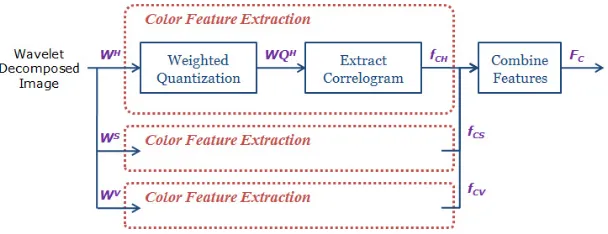
The procedure for extracting the color features from an input image is shown in Fig. 3. Given a RGB query image, the SubjectArea tag of EXIF is first checked for resizing the entered image. The tag indicates the location and area of the main subject in the overall scene [5] [3], enabling the main area of the image to be extracted from the original if the tag is set as the region of interest (ROI). The main area is decided by computing the value of the tag, and by choosing the largest areas of intersection, as shown in Fig. 4. Alternatively the whole image can be reduced using bi-directional down-sampling algorithm such as YCbCr4 : 2 : 0Co-sited of the JPEG standard [5]. Then, the RGB color space of the reduced image is converted into HSV space, presented as Ic, where c ∈ {H, S, V}. When extracting a color feature with a correlogram, HSV color space is known to provide better correspondence with human perceptions of color similarities than other color spaces [20].
Next, each of the three channels is wavelet transformed into two consecu-tive levels using a Haar filter, which is a good compromise between computa-tional time and performance [13], denoted as WC
s,l wheres indicates the four
orientations of the sub-bandss∈ {LL, LH, HL, HH},l is the level of wavelet decomposition, andCrepresents the color channels. Thereafter, wavelet coef-ficients are quantized intoQC
s,lwith different levels for each scale and sub-band.
Fig. 3.Procedure for Weighted Wavelet Spatial Color Extraction.
Fig. 4.Five Types of Main Area of Query Image with SubjectArea Tag (Red point and circle).
time required for the extraction of the feature vectors a quantized color code-book was created for the proposed algorithm that functions as a color lookup table. Next, the horizontal, vertical and both directional correlograms for the quantized coefficients are calculated for the LH, HL and LL sub-bands in each scale. The correlogram of imageI, which comprises the pixelsp(x, y)is then re-formulated from the definition of equation (X):
Γcd(I) = |{p(x, y)|I(x, y) =ci;I(x±d, y±d) =ci}|
|{p(x, y)|I(x, y) =ci}|
(5)
where ci is the distinct value of each color andd is the fixed distance of the
correlation.
Thus, the correlogram of wavelet coefficients for LL is computed as follows:
αdc
i(WLL) =
|{(x, y)|WLL(x, y) =ci;WLL(x±d, y±d) =ci}|
8×d× |{(x, y)|WLL(x, y) =ci}|
(6)
whereWLL is the wavelet decomposed image of LL sub-band,ci is the
quan-tized color, anddis the correlation distance.
is computed as follows:
αdc
i(WLH) =
|{(x, y)|WLH(x, y) =ci;WLH(x, y±d) =ci}|
2×d× |{(x, y)|WLH(x, y) =ci}|
(7)
Similarly, the vertical correlogram of the HL coefficients is computed using only the vertical direction, as described in equation (8):
αdci(WHL) =
|{(x, y)|WHL(x, y) =ci;WHL(x±d, y) =ci}|
2×d× |{(x, y)|WHL(x, y) =ci}|
(8)
Fig. 5 represents the neighboring pixels of pointpwith distanced= 1, used in the proposed approach.
Fig. 5.Neighboring Pixels of Pointpwith Distanced = 1(a) 8-directions for LL, (b) 2-directions for LH, and (c) 2-2-directions for HL.
Next, the wavelet color-spatial feature is combined with different weights for the sub-bands in the wavelet transform for each color channel, as follows:
fc(C) = bωLL×αdLL, ωLH×αdLH, ωHL×αdHLc (9)
where the large C indicates the channel of the color image that satisfies the conditionC∈ {H, S}, andωis the weighted value for LL, LH and HL sub-bands. In this extraction process the results of the feature vectors inherit the multi-scale and multi-resolution properties from the wavelet and the translation invari-ant property from the correlogram.
3.2. Extraction of Texture Feature Using GLCM
The second part of the proposed descriptor consists of the texture feature ex-traction, which is shown in Fig. 6.
Fig. 6.Texture Feature Extraction Procedure in the Gabor Wavelet Domain.
converted to a gray-scale imageIGand a Gabor filter with two scales and four
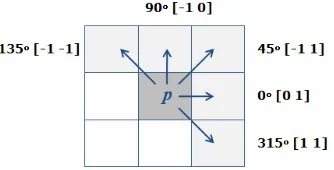
orientations is constructed. Gabor wavelet decomposition of the converted im-age is then performed, after which a GLCM is generated with five displacements (0,45,90,135and315, as shown in Fig. 7) after performing integer quantization.
Fig. 7.Spatial Relationship used for Computing GLCM.
Five common texture features, namely contrast, correlation, energy, entropy and homogeneity are then calculated with the GLCM, as shown below:
Contrast = ΣΣ(i−j)2·P(i, j) Correlation = ΣΣ(i−µi)(j−µj)·P(i,j)
δiδj
Energy = ΣΣP(i, j)2
Entropy = ΣΣP(i, j)·logP(i, j)
Homogeneity = ΣΣ1+|P(i,ji−)j|
(10)
whereP(i, j) is the(i, j)th entry in the co-occurrence matrix P, and δiδj and
µiµj are the mean and standard deviation ofP, respectively.
image and images in the database [25]. However, both these approached re-quire expensive calculations.
In this paper, we propose implementing a simple circular shift on the fea-ture map to solve the rotation variance problem associated with Gabor texfea-ture features. The total energy for each orientation is calculated and then the orien-tation with the highest total energy is deemed to be the dominant orienorien-tation. The feature elements in the dominant element are then shifted to become the first element in the feature vector ft and the other elements are circularly shifted accordingly. For example, if the original feature vector isf = [1, 2,· · ·, n] =
[1,3,2,5,2,3]and ”5” is the dominant orientation, the circularly shifted feature will befCSF = [5,2,3,1,3,2].
3.3. Combination With Both Visual Features
The final step is to combine the two feature vectors. The color and texture fea-tures must first be normalized to reduce the effect of different feature dimen-sions and variances of the feature components. The normalized multiple feature FDis computed as follows:
FD = bωc×
fc
Nc×δcµc
, ωt×
ft
Nt×δtµt
c (11)
whereNc andNt are the dimensions of the color and texture feature vectors,
δcδtandµcµt are the mean and standard deviations for color and texture,
re-spectively, and ωc and ωt indicate the weights of color and texture, over the
ranges0≤ωc, ωt≤1andωc+ωt= 1.
3.4. Similarity Measure
Once the features of the image have been extracted the retrieval results are obtained by measuring the similarity between the features of the query image and the pre-extracted features of the images in the database.
One of the most important parts of the matching process is the similarity function, because this decides how similar two features are. There are two methods commonly used to perform this function: the Minkowski-form metric and the Quadratic-form metric [4]. While the former compares only the cor-responding bins between the histograms, the latter also considers the cross-relationships between the bins.
For the similarity measure, we can compute a distance that consists of the sum of the normalized distances for the visual feature:
SD(FQ, FT) = n−1
X
i=0
|FiQ−FiT|
1 +FiQ+FiT (12)
wheren is the number of feature dimensions, andFQ andFT are the query
4.
Experiments and Results
4.1. Datasets
To evaluate the performance of the proposed descriptor, we selected three datasets of images. Two of the datasets were the Corel photo gallery and the MPEG-7 common color dataset (CCD), both of which are widely used in the field of image retrieval. The third dataset included natural photos obtained from the website www.freeimages.co.uk. Each collection has images with a range of resolutions (e.g.,320×240,384×256,640×420,768×512and1,600×1,200) formatted as JPEGs and various kinds of images, including humans, flowers, vehicles, structures, fruits, materials, and so on. We used a subset of three datasets consisting of 2,200 images belonging to 85 classes of different kinds of images, chosen to estimate the effectiveness of image retrieval. To identify the SubjectArea of the EXIF tag, each of the images was manually generated to highlight a ROI. Fig. 8 shows just sample images from the MPEG-7 CCD, representing 50 image classes.
The ground truth sets (GTS) for evaluation were provided with the class in the experiments, but this was only used to calculate the effectiveness of the proposed approach. Retrieved images were considered to be relevant if they belonged to the same class as the query image.
Fig. 8.Sample Images from MPEG-7 CCD, from 50 Image Classes.
4.2. Experimental Results
denotes the ratio of retrieving an image that is relevant to the query, and recall indicates the ratio of the relevant images being retrieved, calculated as follows:
precision = no.of relevantimagesincollectionno.of relevantimageretrieved = a+ab
recall = no.of relevantimageretrievedno.of imagesretrieved = a+ac (13)
whereais the number of relevant images retrieved,bis the number of irrelevant images retrieved, andcis the number of relevant images that were not retrieved. Since precision and recall are not always the most appropriate measures for evaluating IR, precision and recall scores are often combined into a single measure of performance, known as the F-score [2]. Higher values of the F-score are obtained when both precision and recall are higher. The formula for calculating the F-score is:
F score = 2×precision×recall
precision+recall (14)
The following experimental approach was adopted to evaluate the search results and quantify any improvement in the retrieval performance. Leaveone-out cross validation (LOO-CV) performance was applied to obtain more reliable estimates compared to previous experiments whose results were based on a small number of queries, for example MPEG-7 [25]. Thus, each image in the database was selected in turn as the query image, and queried against the remaining images.
Fig. 9 shows the results for the comparison of retrieval effectiveness over the entire query. The source codes of C++ for other image descriptors [14], [6], [25], [20], [16], [17] are called within Objective-C++, to compare the effective-ness of the retrieval results. The values shown are computed in terms of recall and precision after the top 50 images have been retrieved, denoted as P(50) and R(50), respectively. The other methods included for comparison included a higher proportion of irrelevant images during the search, as indicated by their low precision and high recall. Based on the average from all queries for the F-score, 57.7% of all relevant images were retrieved by the new algorithm, which compares favorably to the best of the comparable methods, which retrieved just 44.7% of the relevant images in the image collection and was much better than the worst case, which retrieved only 13.3%. SCD, which is one of represen-tative descriptor of MPEG-7, achieved 44.3% of relevant images, as shown in experimental results.
Experimentally the proposed method achieved an overall retrieval result score of 57.7%, markedly better than the 47.3% achieved by reducing query image through down sampling without checking main area of the image tag.
Fig. 9.Comparisons of Retrieval Effectiveness using F-Score.
Dimensionality of the feature vector is one of the most important factors affecting not only the amount of storage space needed, but also the retrieval accuracy and computational time [15]. Although the retrieval accuracy gener-ally tends to improve as the dimension increases the amount of stage space and the computation time also increase. Thus, it is very important to choose the optimum dimension of the feature vector that will result in acceptable re-trieval accuracy without incurring an excessive amount of storage space and computation time in CBIR. Since the ways of composing feature vectors in the search methods are quite different, it is necessary to fix all their feature vector dimensions to the same value for a fair comparison. Here, we chose the vector dimensions of image color features to be around 100, close to the dimension of the extracted vector for the proposed descriptor.
We implemented all approaches using Objective-C and C++ (source code for other methods) with Xcode 4.4.1 on a MacBook Pro running OS X 10.7 (Lion). Table 1 shows the computational characteristics of each method in or-der to compare the dimension of the feature vector and computational time required for each. Each of the computational times was calculated by the av-erages through batch processing. The retrieval time for exhaustive search is the sum of two times:Tsim andTsort[8].Tsim is the time to calculate the
sim-ilarity between the query and every image in the database, and Tsort is the
simi-larity, especially on the time of extracting features. At this point, the proposed algorithm requires more computing time than others, enhancement of time is necessary for computing power and this is remained in future work.
Table 1.Computational time and dimensions of feature vectors for descriptors. Column (A) is the average time for extraction of visual features [sec/image], and (B) is the number of dimensions used for the feature vectors.
Method (A)Extraction time (B)Feature vector
Local color histogram 0.081 96
Scalable color descriptor 0.094 64
Color correlogram 0.127 96
Wavelet correlogram 0.131 96
GLCM 0.067 16
Gabor wavelet texture 0.098 48
Proposed Method 0.176 72
Fig. 10 depicts the user interfaces for our prototype system, which were used solely in extraction and retrieval mode for this study. Thus, users of the new system would only use the retrieval interface presented in Fig. 10(a) and 10(b). Fig. 10(c) shows how users can scroll through the retrieved results. However, the system does not yet support the re-query procedure, which remains for future work.
5.
Conclusions
This paper proposes a new, more efficient mobile image descriptor that utilizes a combination of color features based on color-spatial information and texture features that make use of the Gabor texture of an image. In the preprocessing stage, the query image is resized, either by extracting the main area of the im-age or by down sampling to avoid a memory leak, taking into account the EXIF metadata. When using a correlogram for the color features, more computational time is required than for a histogram-based approach. For this reason, we in-corporated a wavelet transform, whose coefficients provide information that is independent of the original image resolution, and appropriately weight the LL, LH and HL sub-bands. Also, the use of a color codebook helps to reduce the computational time needed.
The results of extensive experimental trials revealed that the proposed method produced a significant improvement of around 13% in retrieval effectiveness compared to the best of the other descriptors tested. However, the memory effi-ciency still needs further improvement, since limited memory resources remain a critical problem for mobile devices.
Fig. 10.Screenshots of the Prototype System: (a) User Interface for Selecting Query Image, (b) Query Image Chosen for Mobile search, and (c) Retrieved Images shown as Cover-flow on a iPhone Simulator, which is the Target Device used in Our Work.
second order statistics. As for future work, there are two main avenues for fur-ther development to enable the system to operate on smart phones such as the iPhone and Android. The first is the addition of an automatic procedure to iden-tify the main area of an image, which had to be performed manually for these experiments. For example, automatic face detection and recognition would be particularly helpful. The second is the addition of textual or semantically related information such as geo-location and user events to the existing algorithm to enable users to search for photographs associated with specific features.
Acknowledgments.This research is supported by Ministry of Culture, Sports and Tourism (MCST) and Korea Creative Content Agency (KOCCA) in the Culture Technology (CT) Research and Development Program.
References
2. Baeza-Yates, R., Ribeiro-Neto, B.: Modern Information Retrieval: The Concepts and Technology behind Search. 2nd Editions. ACM Press Books, USA (2011)
3. Camera, Association, I.P.: Exchangeable image file format for dig-ital still cameras: Exif version 2.3 (2010), [Online]. Available http://www.cipa.jp/english/hyoujunka/kikaku/pdf/DC-008-2010E.pdf (current March 2013)
4. Castelli, V., Bergman, L.D.: Image Databases - Search and Retrieval of Digital Im-agery. Wiley Inter-Science (2002)
5. Group, M.W.: Guidelines for handling image metadata ver-sion 2.0. Motorola Labs, Paris (2010), [Online]. Available http://www.metadataworkinggroup.org/pdf/mwg guidance.pdf (current March 2013)
6. Howarth, P., Ruger, S.: Evaluation of texture features for content-based image re-trieval. In: Lecture Notes of Computer Science. pp. 326–334 (2004)
7. Jiang, X., Sun, T., Fu, G.: Multi-scale image semantic recognition with hierarchical visual vocabulary. Computer Science and Information Systems (2011)
8. Krishnamachari, S., Abdel-Mottaleg, M.: Hierarchical clustering algorithm for fast image retrieval. In: Part of the IS&T/SPIE Conference on Storage and Retrieval for Image and Video Databases VII. pp. 427–435 (1999)
9. Lee, Y.H., Kim, B., Rhee, S.B.: Content-based image retrieval using wavelet spatial-color and gabor normalized texture in multi-resolution database. In: International Conference on Innovative Mobile and Internet Services in Ubiquitous Computing. pp. 1–1. IMIS, Australia (2012)
10. Leong, M.K., Chang, W.: Framework and system components. ISO/IEC JTC1/SC29/WG1N3684 pp. 1–1 (2006)
11. Leong, M.K., Chang, W.: Iso/iec pdtr 24800-1: Jpsearch - part 1: Framework and system components. ISO/IEC JTC1/SC29/WG1N4203 pp. 1–1 (2007)
12. M.A., A., Maldague, Z., W.B., L.: A new color-texture approach for industrial products inspection. Journal of Multimedia pp. 44–50 (2006)
13. Makris, C.: Wavelet tress: a survey. Computer Science and Information Systems 9(2) (2012)
14. Malinga, B., Raicu, D., Frust, J.: Local vs. global histogram-based color image clus-tering. Technical Report TR06-010, School of Computer Science, De Paul University (2006)
15. Man, W.K.: Content-based Image Retrieval using MPEG-7 Dominant Color Descrip-tor. Master Thesis, Dept. of Electronic Engineering, City University of HongKong (2004)
16. Manjunath, B., Ma, W.: Texture features for browsing and retrieval of large image data. IEEE Transactions on Pattern Analysis and Machine Intelligence (Special Is-sue on Digital Libraries) 18(8), 837–842 (1996)
17. Moghaddam, H.A., Khajoie, T.T., Rouhi, A.: A new algorithm for image indexing and retrieval using wavelet correlogram. In: Proceedings of International Conference on Image Processing. pp. 497–500 (2003)
18. Nakagawa, A., Kutics, A., Phyu, K.H.: Mosir: Mobile-based segment and image re-trieval. In: International Conference on Wireless Communications, Networking and Mobile Computing. pp. 1–4. WiCOM (2011)
20. Ojala, T., Rautiainen, M., Matinmikko, E., Aittola, M.: Sementic image retrieval with hsv correlograms. In: Proceeding 12th Scandinavian Conference in Image Analysis. pp. 621–627 (2001)
21. Skulsujirapa, P., Aramvith, S., Siddhichai, S.: Development of digital image retrieval technique using autocorrelogram and wavelet based texture. In: IEEE International Midwest Symposium on Circuits and Systems. pp. 273–276 (2004)
22. Smeulders, A.W., Worring, M., Santini, S., Gupta, A., Jain, R.: Content-based image retrieval at the end of the early years. IEEE Transactions on Pattern Analysis and Machine Intelligence 22(12), 1349–1380 (2000)
23. Torres, R.S., Falcao, A.Z.: Content-based image retrieval: Theory and applications. In: Brazilian Symposium on Computer Graphics and Image Processing. pp. 161– 185. SIBGRAPO (2006)
24. Xing Xie, Lie Lu, M.J.H.L.G.S.W.Y.M.: Mobile search with multimodal queries. In: Proceedings of the IEEE. pp. 589–601. WiCOM (2008)
25. Yamada, A., Ocallaghan, R., Kim, S.K.: Mpeg-7 visual part of experimentation model (xm) version 27.0. ISO/IEC JTC1/SC29/WG11/N7808 (2006)
26. Yeh, T., Tollmar, K., Grauman, K., Darrell, T.: A picture is worth a thousand keywords: Image-based object search on a mobile platform. In: Proceeding Conference Hyman Factors in Computing System (2005)
27. Zhang, D., Wong, A., Indrawan, M., Lu, G.: Content-based image retrieval using gabor texture features. IEEE Transactions PAMI pp. 13–15 (2000)
Yong-Hwan Leeis received his Ph.D. degree in Electronics and Computer En-gineering and M.S.degree in Computer Science from Dankook University, Ko-rea, in 2007 and 1995, respectively. He is a research professor in Department of applied computer engineering at Dankook University. His research interests are the area of Image/Video Representation and Retrieval, Face Recognition, Augmented Reality, Mobile Programming and Multimedia Communication.
Bonam Kimis received the Ph.D. degree in Computer Science and Software Engineering from the Auburn University, Alabama, USA in 2006. She is a re-search professor in division of electrical and computer engineering at Chung-nam National University since 2010. She joined the School of Electrical and Computer Engineering, CNU in March 2007. Her current research interests are in the areas of wireless ad hoc and sensor networks, network security and MIPv6.
Sang-Burm Rhee is received the Ph.D. degrees in Electronics Engineering from Yonsei Univ. in 1986. Now he is a professor at Dankook Univ. since 1979. His research interests are the area of Microprocessor, SoC(System-On-Chip), Pattern Recognition, Multimedia Processing. They include topics such as Object-oriented Methods for Audio/Video Watermarking, Pattern Recognition and HDL for SoC..
![Fig. 1. Naive system view of image search and CBIR [10].](https://thumb-us.123doks.com/thumbv2/123dok_us/1178216.1620471/4.612.152.465.116.288/fig-naive-view-image-search-cbir.webp)