V I N N O V A P O L I C Y V P 2 0 0 7 : 0 3
PUBLIC PROCUREMENT
AS A DRIVER
VINNOVA´s publications are published at www.VINNOVA.se
I VINNOVAs publikationsserier redovisar bland andra forskare, utredare och analytiker sina projekt. Publiceringen innebär inte att VINNOVA tar ställning till framförda åsikter, slutsatser och resultat. Undantag är publikationsserien VINNOVA Policy som återger VINNOVAs synpunkter och ställningstaganden.
About VINNOVA
VINNOVA, the Swedish Governmental Agency for Innovation Systems, integrates research and development in technology, transport,
communication and working life.
VINNOVA´s mission is to promote sustainable growth by funding needs-driven research
and developing effective innovation systems.
Through its activities in this field, VINNOVA aims to make a significant contribution to Sweden´s development into a leading centre of economic growth.
The VINNOVA Policy series includes material that reflects on VINNOVA´s position in different issues. For example: strategically important opinions expressed in government referrals, reports from special government commissions, strategic planning, or other documents where VINNOVA makes a policy-statement.
Title: Public procurement as a driver for innovation and change - Report on government commission to Nutek and VINNOVA
Series: VINNOVA Policy VP 2007:03
ISSN: 1651-355X
Published: Decemer 2007
Publisher: VINNOVA - Verket för Innovationssystem/Swedish Governmental Agency for Innovation Systems
Public procurement as a driver for
innovation and change
Report on government commission to Nutek and VINNOVA
VINNOVA journal number: 2006-01487
Foreword
In May 2006, the Swedish government commissioned Nutek and VINNOVA, in consultation with the Nämnden för offentlig upphandling (NOU) (the Swedish National Board for Public Procurement), to:
“examine how public procurement can contribute to developing innovation and creative renewal. The study is to include investigation as to how procurements may be structured in such a way that, to a greater extent, they drive forward technological development and business opportunities.” 1 The study was conducted as a close collaboration between Nutek and VINNOVA. NOU contributed a certain amount of support during the study, but no other consultation took place.
Nutek and VINNOVA concur to a major extent in their view of public procurement in Sweden and on what is important in order to develop it. However, the differing functions of each agency as a public authority, where VINNOVA is responsible for research, development and innovation in growth, led to proposals with differing areas of focus in terms of how innovation and renewal may be promoted via public procurement. This is VINNOVA’s analysis and proposals. The project manager was Göran Marklund. Nina Widmark and Jennie Granat Thorslund also took part in the project. Per Eriksson Director-General, VINNOVA 1
Abstract
The Swedish Government in May 2006 assigned the Swedish Agency for Economic and Regional Growth (NUTEK) and the Swedish Governmental Agency for Innovation Systems (VINNOVA), in collaboration with the National Board for Public Procurement (NOU), to investigate how public procurement can stimulate innovation, including technological develop-ment and business opportunities.
To spur innovation, i.e. the development of innovative products, processes or services through public procurement, VINNOVA recommends the following:
1. Introduce public procurement of innovation, i.e. procurement that includes R&D, as a general procurement form in Sweden. This does not violate the existing regulations for public procurement and R&D. Create supporting structures of expertise with the help of public authorities that have R&D-review as core business. Introduce clear incentives to procuring public authorities (the procuring entity) by stating that one percent of the total volume of procurements should be allocated to innovation procurements. In addition, highlight successful procurements and reward them. In this manner, public innovation procurement can become a strategic issue for Swedish public authorities.
2. Strengthen the organisation and simplify the process for public procurement to enable coordination of demand. Thus, critical mass regarding methodological expertise can be achieved. This should be done in consideration of how to utilize the innovation potential and increased efficiency of small and medium enterprises (SME).
3. Create reliable information for follow-up and statistics on public procurement. Evaluate the scope of public procurement and distribution as well as its effects on public organisations regarding organisational renewal and increased efficiency. Also, evaluate its effects on innovation in the private sector.
Innovation is always preceded by development and at times even by research, in other words R&D. Thus, public procurement processes that endeavour innovative solutions encompass R&D. Such public procurement should be denoted as procurement of innovation, as the focus is on novel
solutions, i.e. innovation. Historically, Sweden boasts numerous successful procurer-producer examples that occurred before the deregulation of different state monopolies. Well-known cases are the collaboration between Televerket (the Swedish Agency for Telecommunications) and Ericsson, which led to the AXE switching system and NMT, Nordic Mobile Telephony. Also, the collaboration between Swedish energy company Vattenfall and electrical engineering company ABB led to advanced power generators. Public innovation procurement can also be applied to promote innovation processes in smaller scales, for instance, procurement to boost software development, energy conservation techniques, and new telephony solutions in the public sector.
Public authorities dealing with R&D-funding as a core activity should be in a position to review the quality of R&D in public innovation procurements. Such authorities include VINNOVA, Swedish Research Council (VR), Swedish Research Council for Environment, Agricultural Sciences and Spatial Planning (FORMAS), Swedish Council for Working Life and Social Research (FAS), Swedish Energy Agency and others. Procuring authorities should make such R&D reviews a part of the final assessment of tenders received. If necessary, R&D-funding authorities can assist in preparing the R&D content in the invitations to tender documents.
Innovation procurement should be an integral part of an authority’s long-term organisational development and therefore every public authority must have both incentives to pursue innovation procurement as well as ownership of innovation procurement contents and processes. It is thus essential that there are clear incentives to promote innovative public purchases for all public authorities. As the encouragement to conduct such procurements are currently quite weak, it is suggested that special
incentives be created. It is therefore put forward as a suggestion that the Swedish Government set up a target of at least one percent of the total procurement volume of public authorities be innovation procurement. To stimulate innovation procurement as a general form of public procure-ment, development of methods and structures to coordinate processes dealing with such procurements should be devised, so that:
• Critical mass regarding demand and methodological expertise and requirements for innovation procurement is attained, and
• Small and medium enterprises’ potential for innovation and job creation are considered and encouraged.
Coordination of demand and expertise are critical for the quality in the requests for proposals and for the evaluation of submitted bids. Special
venues should be developed to coordinate between public authorities and organisations with similar functional requirements and procurement procedures. Critical mass can be attained through such venues of collabora-tion, regarding function oriented demand and methodological skills. The suggestion above should encompass all public authorities and thereby all the sectors these authorities represent. Each public authority should decide on its own if any adjustment of its organisation, as well as its role within its specific sector, is necessary. Municipalities and county councils should also be able to use the principle of the suggestion, as part of their strategies for innovation and renewal. If so, public authorities must be given assignments to methodologically support the municipalities and county councils and thereby serve as necessary coordinators. In the latter case, financial support from EU’s structural funds may be applicable. It is not evident whether the directives for procurement require public authorities to focus on the development of their organisations for improved quality and efficiency. Given this ambiguity, it is suggested, that a general review of Sweden’s national policy for procurement be conducted. The purpose should be to develop the principles and structures of a national procurement policy so that the organisational developments of public authorities are strengthened and positive socio-economic outcomes are promoted. Three central functions should be part of an updated national procurement policy:
• Fundamental objectives and principles for prioritisation in public procurements
• Clarification of the responsibilities of central/national public authorities and their public relations so that the policy can have a high impact
• Resources for further development of principles and methodologies as well as measures for follow-up of public procurements should be secured
For a goal-oriented, innovation friendly and efficient public procurement it is essential that there are strong stimulants and responsibility for a
continual development of policy, methodologies and performance metrics. This must be steered politically and be based upon a clear leadership from the Government’s side. To support the political objectives, the functions and roles of assisting public authorities must be clarified and distributed among the authorities. This requires a detailed review of the strengths among public authority roles, as well as the collaboration between them that exist today.
At the moment it is difficult to get a picture of the total volume of public procurement, its size in different markets and its content regarding general procurement as compared to innovation procurement. The level of
ambition to follow-up, collect data and analyse public procurement to spur innovation, increase efficiency and structures should be raised. If the requirements for audit and follow-up on public procurement increase, in regard to both the general impact on efficiency as well as promoting innovation, it will have positive bearings on the incentives for efficient and innovation friendly procurement.
Contents
1 Introduction ________________________________________ 1
Purpose and objective ________________________________ 2 Scope of the study ___________________________________ 2 Methodology ________________________________________ 3 External assignments ______________________________ 3 Interviews and seminars____________________________ 4 Terms and definitions _________________________________ 5
2 Background to public procurement in Sweden ___________ 6
Public procurement and the system of regulation____________ 6 What is public procurement? ________________________ 6 Principles of EU law must be observed ________________ 7 Public procurements must be advertised _______________ 7 Exemption from LOU in the field of innovation ___________ 9 The procurement process _____________________________ 10 Procurement in Sweden ______________________________ 12 Lack of statistics on public procurements______________ 12 Estimated 20,000 advertisements annually ____________ 13
3 Public procurement as a driver of innovation ___________ 17
Innovation – a driver of growth and new jobs ______________ 17 Innovation and R&D _________________________________ 19 Time horizon and degree of renewal _________________ 20 Private- and public procurement_____________________ 22 International and historical background __________________ 24 Incentives for procurement of innovation _________________ 27
4 Challenges for greater innovation and renewal via public
procurement _________________________________________ 31
Incentives and strategic focus__________________________ 32 Need for political visions and a co-ordinated national policy34 Importance of commitment from business sector________ 34 Methodological development and rationalisation ___________ 36 Procurement by function and performance ____________ 36 Coordination for critical mass in demand and expertise___ 38 Structure of responsibilities in procurement sector_______ 41
Clarification of rules ______________________________ 41 Bringing out the potential of SMEs ___________________ 42 Follow-up and evaluation _____________________________ 43
5 Methods to stimulate innovation in public procurement __ 44
Methods for procurement of innovations__________________ 44 Pre-commercial procurement _______________________ 45 Technology procurement and technology competition ____ 47 Demonstration installations ________________________ 48 Methods for innovation-promoting procurement_________ 49
6 International examples ______________________________ 51
New lighting system in Hamburg (Germany) ______________ 51 Electronic file management system (Austria) ______________ 53 Motorway signalling system (UK) _______________________ 54 Energy conserving procurement (Italy) ___________________ 55 Electronic identification system (Netherlands) _____________ 56 Advanced Tactical Fighter (USA) _______________________ 57
7 Conclusions ______________________________________ 59
Objectives and principles _____________________________ 59 Incentives to public authorities for procurement of innovations 61 Efficiency and development of procurement methods _______ 64 Interaction for higher quality and efficiency in demand ___ 65 Organisation of methodology support functions _________ 66 Development of methods and tools __________________ 68 Participation by small enterprises in procurement of
innovations________________________________ 69 Follow-up and statistics on public procurement ____________ 70
8 Proposals_________________________________________ 72
Procurement of innovations ___________________________ 72 Strengthen the organisation for public procurement _________ 74 Simplify and strengthen policy on public procurement ____ 76 Develop reliable information and statistics ________________ 77
References ___________________________________________ 79 Contacts _____________________________________________ 82
Interviews _________________________________________ 82 Seminars __________________________________________ 82
1 Introduction
In May 2006, the Swedish government commissioned Nutek and VINNOVA, in consultation with the Nämnden för offentlig upphandling (NOU, the Swedish National Board for Public Procurement):
“to examine how public procurement can contribute to developing innovation and creative renewal. The study is to include investigation as to how
procurements may be structured in such a way that, to a greater extent, they drive forward technological development and business opportunities.” 2 The commission included assessing:
y which methods are the most appropriate to an innovation-promoting procurement process
y the sectors in which the need is most urgent for establishing conditions to enable public procurement to become a driver of innovation and renewal; and
y the extent to which the development of public procurement may have an important role to play in implementing the strategic programmes formulated for key sectors in Sweden.
The report from the agencies was to be structured in such a way that it could serve as the basis of a policy including guidelines for public procure-ment as a driver of innovation and renewal.
In motivation of its decision, the government states that:
“the government’s objective is, in line with its innovation strategy, that procurements shall become more stimulating of innovation. This implies inter alia a need to structure procurements such that they can promote creative renewal and innovation, while at the same time the requirements for cost efficiency must not be compromised
Sweden’s innovation strategy “Innovativa Sverige – en strategi för tillväxt
genom förnyelse (Ds 2004:36) (“Innovative Sweden – a strategy for growth through renewal”) is the government’s platform for its efforts to
strengthen the country’s competitiveness. One aspect of the strategy concerns innovative public investment. There it is emphasised that, for
2
example, public organisations must in their role as procurement agencies be more active in driving forward technological development and
exploiting business opportunities, while at the same time fulfilling the needs of the community at large.
Purpose and objective
VINNOVA has interpreted that the primary purpose of the commission is to establish facts and produce proposals that may form the basis of
principles of a national policy on how public procurement may be used as a driver of innovation and renewal.
The objective of a national policy to this effect should be to contribute towards greater use of innovation-promoting public procurement processes, that is, procurement processes that lead to:
• development of new and more functional – i.e. organisationally better – solutions to the needs of public organisations; and
• development of new, more internationally competitive products (goods and services) and processes for the Swedish business sector.
Scope of the study
The focus of this work has been on identifying principles for a greater use of public procurement as a driver of innovation. Further initiatives are needed in connection with the development of a national policy, to narrow down how the principles proposed should be applied.
The study did not in any depth look at general problems relating to the participation by small enterprises in public procurement, since this issue was addressed in detail in a recently completed report.3 Neither did it analyse the importance of standardisation and the use of e-services during procurement, since these issues are being considered within the scope of other studies currently in progress.
3
See Nutek report, Småföretag och offentlig upphandling. Hinder och möjligheter för små företag att delta i offentliga upphandlingar (Small enterprises and public procurement. Obstacles to and opportunities for participation by small enterprises in public procurements), Nutek R 2005:21.
Methodology
The commission was conducted during May-October 2006. The report comprises three sections; documentary studies in the form of a review of Swedish and international analysis reports and proposals, facts and information provided to the investigation on the basis of assignments to external experts and a large number of interviews with public procurement officials and procurement experts.
The process began with a collection and review of current reports, national and international, on the theme of innovation-promoting public
procurement. This showed clearly that this is a major, complex subject of topical relevance that is currently undergoing a wide-ranging study at EU level. (See the attached list of references.)
External assignments
Because the time allowed for completion was short, use was made of the possibility to contract assignments to four external suppliers. Parts of the material assembled are used in this report.
Opic AB was contracted to survey all public procurements advertised in Sweden during 2005. The survey drew from material in Opic’s own database, which brings together essentially all information on
procurements that are published in generally available databases. The material was used to provide breakdowns of Swedish procurements by product sector, geographically, the procedure used and how procurements are apportioned among different procuring entities.
The commission also included a reasonably detailed review of a number of invitations to tender documents to assess what proportion of the
procurements contained scope for innovation. The survey initially comprised advertising in three product sectors: medical equipment, IT services and telecommunication services. In the report, the latter two categories were merged into one, IT and telecommunication services. The company Faugert & Co. was contracted to compile international experiences of implementing public procurement as a driver of innovation and renewal. This part of the project was conducted as a literature study, supplemented by the experiences of personnel from the Technopolis Group and Swedish researchers.
Torbjörn Stenbeck, of KTH (the Royal Institute of Technology), was requested to undertake an in-depth analysis of innovation-promoting aspect of public procurement in the infrastructure sector. This analysis is
based on case studies and reviews of the construction sector that Torbjörn Stenbeck performed within the scope of his completed licentiate degree thesis and within the scope of his current doctoral thesis.
Göran T. Andersson was requested to analyse how public procurements may, methodologically, be performed in practice in order to include
development work. This work is based on Göran T. Andersson’s extensive experience as a procurement official in various organisations of projects that were development-based.
Interviews and seminars
According to the commission, the study was to be conducted after consultation with the Swedish Administrative Development Agency, the Swedish National Financial Management Authority and the Swedish National Post and Telecom Agency, as well as the Swedish Defence Materiel Administration, the Swedish Energy Agency, the Swedish National Road Administration, Banverket (Sweden’s national rail authority) and Luftfartsverket (Sweden’s civil aviation administration authority). In addition, Sweden’s municipalities and county councils were to be offered the opportunity of stating their views. The commission also included consultation with representatives of the business sector, including the Confederation of Swedish Enterprise and IT-företagen (the organisation representing the IT industry in Sweden).
Alongside interviews with selected individuals at the above-mentioned public authorities and organisations, consultation took place in two forms. The first was via three consultation meetings, two with representatives of the business sector and public authorities and one with representatives of other public organisations. Then certain individuals were given the chance to comment on a provisional draft of this report. (See appended list of contacts.)
In parallel with this process, a large number of interviews were conducted and two group discussions took place with individuals with experience of public procurement. The interviews mainly followed a structured interview guide (see appendix), supplemented by open questions. Group discussions were held on two occasions. The first one was attended by researchers and representatives of public authorities in the transport sector. The second was attended by a number of participants from Sweden’s municipalities and county councils.
Terms and definitions
“Public procurement” refers generally to all forms of acquisition on behalf of a public authority, for example, purchasing, leasing, renting or hire purchase of goods, building contracts or services.4 (See more detailed definition in Section 2.) Public procurement is one of several mechanisms that may be used to stimulate the development of new or improved goods, services or processes that meet the needs of the public sector.
“Innovation” is the transformation of ideas into practical benefit in the form of new products or new production and distribution processes. A product consists of an item of goods or a service. Thus, innovation occurs when knowledge and expertise is transformed into benefit by being developed commercially in a market or by being used in public
organisations. Innovations may be intangible, i.e. of a technical/physical nature, or intangible, i.e. of a conceptual/organisational nature. In many cases, different innovations depend on each other for commercial and production success. (See Section 3 for further discussion of this point.)
“Renewal” refers to the lasting effects, on the activities of both enterprises
and public authorities, that occur in connection with innovation or when new processes are disseminated to enterprises and public organisations that had not previously used them.
“Innovation-promoting procurement” refers to public procurement that stimulates innovation, i.e. the development of goods or services that, at the time of procurement, do not yet exist. Procurements may promote or hinder innovation without this being a specific purpose of the procurement. Innovation may also be promoted as a result of conscious procurement strategies. Procurement of innovation(s) falls within this category. “Procurement of innovation(s)” refers to the purchase of a development activity or research (R&D) that leads to innovation, i.e. to goods or services that at the time of procurement do not yet exist or need to be improved. Procurement methods that are often used in procurement of innovations are “pre-commercial procurement” or “technology
procurement. (See Section 5 for further discussion of this point.)
4
2
Background to public
procurement in Sweden
The bearing theme of this report concerns how public authorities, by virtue of their size and market dominance, can act to stimulate innovations and new processes in connection with procurements. On that basis, this section aims to provide an overall background to public procurement in Sweden: the rules that circumscribe a procurement, how a procurement takes pace and what is procured and by which authorities.
Public procurement and the system of regulation
What is public procurement?
“Public procurement” basically refers to all forms of acquisition for a public authority, for example purchasing, leasing, renting or hire-purchase of goods, building contracts or services. Sweden’s Lagen om offentlig
upphandling (Law on public procurement, in the following referred to by its Swedish abbreviation, LOU) governs practically all public procurement. The purpose of the law is to promote efficiency and competitive neutrality in connection with procurement by public authorities.
“The award of public contracts should be so arranged as to take advantage of existing competition and should also in other respects accord with the conventions of good business practice. No unwarranted considerations should affect the treatment of tenderers, candidates or tenders.” 5 In LOU, the term “contracting authority” is used to describe the
organisations encompassed by the rules. In addition to central government authorities, these are municipalities and county councils, companies,
associations, cooperatives and foundations established to meets needs in the interests of the public and financed by public funds, or where
procurement is subject to central government or municipal supervision, or where more than half of the members of the board of directors are
appointed by another contracting authority.
Special rules apply to the utilities sector (including water, energy, transport and telecommunications). These rules also apply to private enterprises that via special licences conduct business in the utilities sector. Examples of
5
organisations in the utilities sector that fall within the scope of LOU are SL AB, Banverket, AB Fortum Värme, Göteborgs hamn AB, Jönköpings Energi AB, Vattenfall AB and Stockholm Vatten AB.
Every organisation must itself judge whether it falls within the scope of LOU or not. The question of whether an organisation is a contracting authority may be decided by a court of law in connection with an appeal or claim for damages.
Principles of EU law must be observed
LOU incorporates the EU Directive on Public Procurement. The directive allows Member States to adapt the wording of the EU law to their national law, but the essential elements of the EU law must be retained.
All procurement is bound to observe the fundamental principles of the EU.6 The following principles in particular are relevant to innovation policy.
• The principle of equal treatment requires all suppliers to be offered equal conditions; for example, all suppliers must receive the same information at the same time.
• It follows from the principle of proportionality that the requirements set must relate in a logical way, and be reasonably proportionate, to what is being procured.
• The principle of transparency means that the invitation to tender document must include all requirements as to what is being
procured and that no deviation is permitted from the requirements set.
• It follows from the principle of non-discrimination that no
discrimination, direct or indirect, against suppliers is permitted. A contracting authority may not, for example, give preference to a local enterprise because of its geographical location.
Public procurements must be advertised
Procurements exceeding a “low value” fall within the compass of the EU Directive on Public Procurement and must be advertised in the EU’s central database TED. How this advertising is to be a conducted, and other procedural rule, are determined by the value and nature of the
6
This also applies to procurement below the “threshold values” and other procurement not governed by the EU Directive.
procurement. This means that a contracting authority must calculate the total value of each procurement, to decide which rules apply. Normally, the value is to be estimated for the entire term of the agreement, including any options, and repeat procurements for the same category of goods and services during a budget year are to be added together in the calculation.
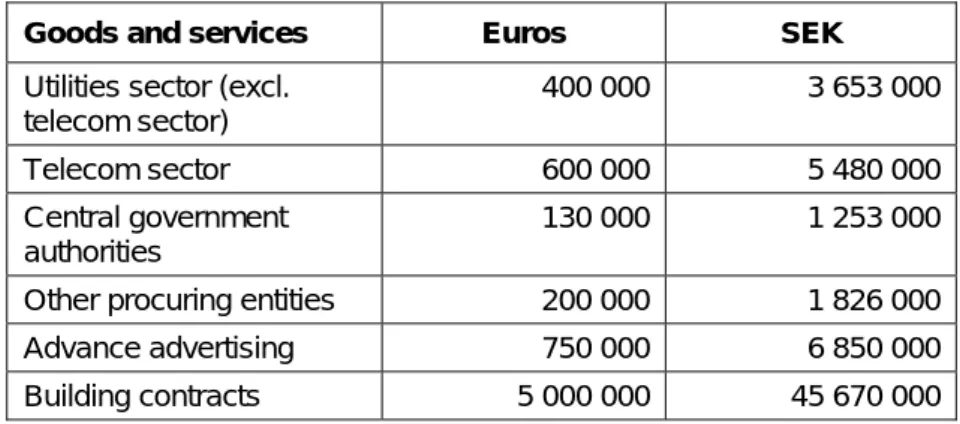
Table 2.1 Current threshold values, effective 1 January 2006
Goods and services Euros SEK
Utilities sector (excl. telecom sector) 400 000 3 653 000 Telecom sector 600 000 5 480 000 Central government authorities 130 000 1 253 000
Other procuring entities 200 000 1 826 000
Advance advertising 750 000 6 850 000
Building contracts 5 000 000 45 670 000
Source: NOU
Depending on the value of the procurement, LOU refers mainly to six separate types of procurement procedure: simplified procurement,
restricted procurement, direct procurement, open procurement, selective procurement and negotiated procurement.
Procurement procedures below the threshold values
The commonest procedure for procurements below the threshold values is called simplified procurement. Simplified procurements must be advertised in an electronic database that is generally accessible or via another form of advertising that creates effective competition, for example, the national press or a trade periodical. Simplified procurement offers somewhat greater scope for negotiation than procurements above the threshold value.
In selective procurement, the contracting authority is required through an advertisement to invite suppliers to apply for participation in the
procurement. Here, too, the invitation to tender must be advertised in an electronic database that is generally accessible.
Moreover, much procurement takes place in the form of direct procurement, without prior advertising. For this, the procurement value must be below a certain “low value”, or particular circumstances must be present. A major problem is that non-legitimate direct procurement also occurs.
Procurement procedures above the threshold values
Open procurement is the commonest procedure for purchases above the threshold values. Here, the advertisement must be published in the EU database of advertisements for public procurement. Restrictive procurement, too, only occurs for procurements above the threshold values. This consists of a two-stage procedure in which the suppliers first have to apply to submit a tender.
Above the threshold value, negotiated procurement is permitted in all
situations in the utilities sector, although on an extremely restrictive basis in the case of other procuring entities. The procedure may be divided into two categories: with and without prior advertising.
Exemption from LOU in the field of innovation
LOU allows certain exemptions defining when the law does not apply. These vary from sector to sector, depending on whether the procurement is for goods, services or building contracts. One example consists of exemptions from contracts for research and development services, where the directive allows exemptions for:
“...research and development in cases other than those where the service is one solely concerning the conduct of the contracting authority's own affairs and is wholly remunerated by the contracting authority”7
The effect of this is an exemption for research and development services, where the benefit accrues wholly or in part to a party other than the contracting authority, or where the services are financed to a greater or lesser extent by an external organisation.
The EU Directive states the following grounds for the exemption:
“Pursuant to Article 163 of the Treaty, the encouragement of research and technological development is a means of strengthening the scientific and technological basis of Community industry, and the opening-up of public service contracts contributes to this end. This Directive should not cover the co-financing of research and development programmes”8
In procurement of goods and services, there is no equivalent exemption in LOU for contracts for research and development. On the other hand, certain scope is allowed for negotiated procurement. In such cases, a contracting authority may be released from the obligation to advertise in
7
LOU, (Law on public procurement), section 5, article 1. 8
the procurement of goods and category “B” services, as well as below the threshold values in the following situations:
1. what is being procured concerns research, development, studies or experiments, provided that the procurement is not for profit, or is intended to cover research and development costs, or restricts the possibilities for competition in subsequent procurement with a similar purpose; and
2. what is being procured may be supplied only by a particular supplier for technical or artistic reasons, or due to a sole right. In the “utilities sector”, the rules comprise separate provisions and similar exemptions from the requirement to advertise.
The first exemption is considered to apply only if the acquisition is limited to development of a pure prototype that is not intended for commercial use. The second exemption may be applicable if a contracting authority is seeking a specialist knowledge or technology that demonstrably is only in the possession of a certain supplier.
Even if the procurement does not need to be advertised, the invitation to tender document must be drawn up, tender qualification and examination carried out and procurement contracts signed. Other suppliers who learn of the procurement may be entitled to submit tenders or to apply to submit tenders and have them examined.
In the case of building contracts, the above-mentioned exemptions may be cited as grounds for applying the negotiated procurement procedure with prior advertising.
The procurement process
The actual performance of a procurement may be described as a process in several stages.
Preparation
A fundamental principle of procurement legislation is that a contracting authority that intends to make a purchase must first identify and formulate its purchasing needs. Especially in the case of large-scale procurements, this may mean extensive preparation, partly to acquire information on the market concerned and to involve various stakeholders within the organisa-tion in this work. Most major public authorities have particular experts specialising in procurement issues. Part of their role lies in assessing whether the procurement is possible within existing framework
agreements, or whether a new procurement is necessary and, if so, what procurement procedure is the most appropriate.
Formulation of invitation to tender
The next step is to formulate an invitation to tender in writing. From this document, it must be clear what is to be procured, what requirements apply and what the procedure is for evaluating the tenders. The terms and
conditions stated in the invitation to tender must as a rule apply through-out the period of the agreement, including any options for renewal. If a contracting authority finds it necessary, during the procurement, to amend its requirements, the procurement must normally be restarted from the beginning. A properly formulated invitation to tender document thus plays an important role in determining the quality of the procurement process as it progresses.
Advertising
In normal circumstances, the procurement must then be advertised (see above). Depending on the type of procurement process chosen, different rules apply as to where the advertisement is to be published and how long the period must be between when the advertisement is published and when the tendering period expires.
Examination of tenders
When the tendering period expires, the tenders received are opened. In many cases, minutes of the opening of tender procedure and the subsequent processing are taken, to prevent areas of uncertainty, should any supplier later appeal against the decision. The tenders received are then examined to check whether they meet the requirements set in the invitation to tender. If any tender fails to meet all requirements, it is rejected. There is no opportunity for subsequently adding to or correcting tenders.
Finally, the tenders remaining are to be evaluated. This may be done in one of two ways: either the tender that is the most economically advantageous on the basis of the evaluation criteria stated – such as price, operating costs, quality, aesthetic and functional qualities, service and maintenance, environmental impact etc. – is accepted, or the one with the lowest price. Any offer not requested in the invitation to tender document may not be taken into account in the choice of supplier.
Award of contract decision and contract
Following the evaluation, the contracting authority takes an award of contract decision as to whether it intends accepting the winning tender in the tendering process. The contracting authority must wait at least ten
days before concluding a procurement contract, from the point in time when an announcement of the award of contract decision has been circulated to the participating tenderers.
If a supplier appeals against the decision within the period allowed, the county administrative court may rule that the procurement should be restarted, or that it may only be concluded once any fault has been remedied. The court may also rule with immediate effect that the
procurement may not be concluded while a court hearing is pending. Once the procurement is concluded, any supplier that considers it has incurred damage or loss may sue the contracting authority for damages at a district court in Sweden.
Follow-up
Once deliveries have begun, it is important for continuous follow-up to be maintained to ensure that the supplier actually fulfils what is agreed in the contract.
Procurement in Sweden
Lack of statistics on public procurements
Despite the fact that public procurement involves very large sums of money and thus has major impact on both the business sector and the public sector, basic information about the scale of public procurement is largely lacking. For example, not even a list of the organisations subject to the legislation exists. Also lacking are reliable data on both what, and how much, is procured and what supplier enterprises are concerned.
According to Statistics Sweden’s national accounts, the public sector bought goods and services at a cost of SEK 279 billion and invested SEK 80 billion in 2005. This represents a total of around SEK 359 billion, or 13.4 percent of GDP. However, the figure does not include purchases by public-service corporations and state-owned and municipal enterprises, although they fall within the scope of LOU. On the other hand, certain procurements that are not covered by LOU are included, for example rental payments for premises and certain defence products.
On behalf of NOU, SCB compiles statistics on procurements in Sweden. The procurements that are included in NOU’s statistics comprised nearly SEK 128 billion in 2004. However, the statistics only include procurements performed by central government authorities and procurements in the utilities sector, as well as procurements above the threshold values conducted by municipalities and county councils etc., and associated
enterprises. An oft-quoted statistic from the European Commission is that public procurements in Sweden in 2002 represented 20.5 percent of GDP. It is not clear what this calculation is based on. In 2005, 20.5 percent of GDP was equivalent to around SEK 550 billion. All in all, there is much to suggest that the Commission’s figure may be an over-estimate.
Estimated 20,000 advertisements annually
On behalf of Nutek, Opic AB carried out a survey of advertisements for public procurements published in Sweden in 2005. Direct procurement – permitted or not – is thus not included.
Opic’s survey reveals that some 20,000 public procurement advertisements were published in 2005. The calculation does not take into account the fact that procuring entities can conduct coordinated procurements, in which they produce a joint invitation to tender document and a joint
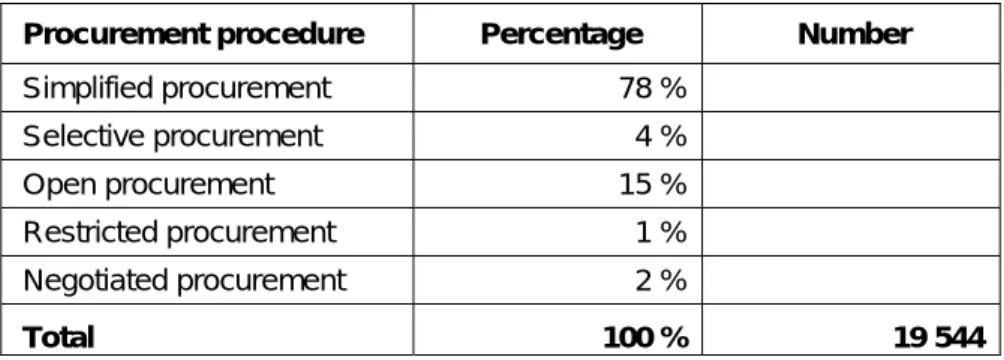
advertisement, but each of them takes its own award of contract decision. One advertisement can thus lead to several procurements. In some cases, more than 100 procuring entities may be behind a single advertisement. The table below shows that 82 percent of procurement advertisements refer to simplified procurement or selective procurement. These two forms of procurement are only possible for procurements that are within the EU’s threshold values and are thus outside the scope of the EU Directive on Public Procurement. The procedural rules mainly affect Sweden’s national rules, even if the fundamental principles of EU law must be observed. Only 15 percent of the advertisements refer to open procurements, i.e. the main rule in the EU’s rules on procurement.
Table 2.2: Procurement procedure for advertised procurements in 2005
Procurement procedure Percentage Number
Simplified procurement 78 % Selective procurement 4 % Open procurement 15 % Restricted procurement 1 % Negotiated procurement 2 % Total 100 % 19 544 Source: Opic AB
Municipalities and county councils account for 75 percent of procurements
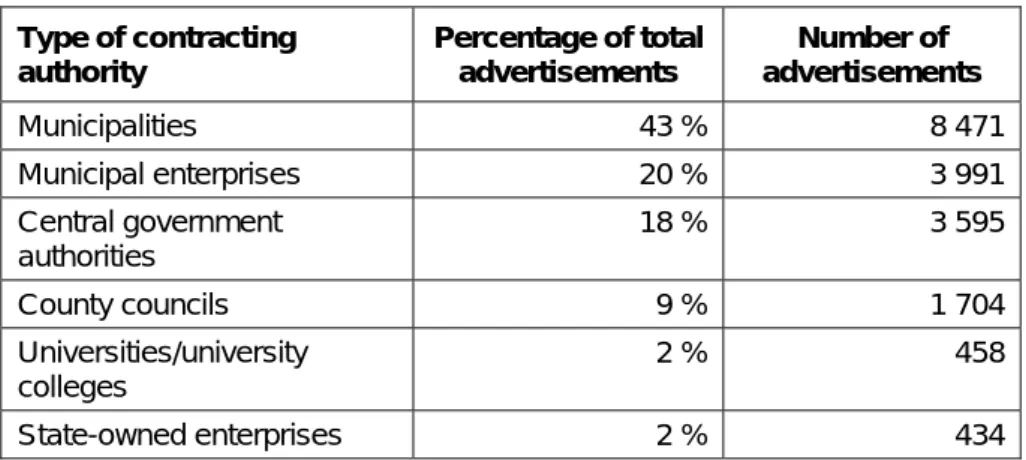
Public procurement is dominated by the municipal and county council sector. Municipalities are behind 43 percent of all public procurement advertisements, with municipal enterprises accounting for a further 20 percent. Procuring entities in the municipal and county council sector (i.e. municipalities, municipal enterprises and foundations, county councils, county council and municipal federations and county council owned enterprises and foundations) represent around 75 percent of all public procurement advertisements.
As mentioned above, it is also common for municipalities to coordinate procurements, i.e. a joint advertisement is formulated but separate award of contract decisions are taken. The implication is that the municipalities probably represent an even higher share of the total number of
procurements.
Table 2.3: Major procuring entities in 2005
Type of contracting authority Percentage of total advertisements Number of advertisements Municipalities 43 % 8 471 Municipal enterprises 20 % 3 991 Central government authorities 18 % 3 595 County councils 9 % 1 704 Universities/university colleges 2 % 458 State-owned enterprises 2 % 434 Source: Opic AB
NOU’s statistics also suggest that the municipalities and the county councils account for the major share of all procurements, in both volume and value. Municipalities and county councils are behind 60 percent of the number of procurements above the threshold values and 54 percent of the value.
Highest number of procurements advertised by the Swedish National Road Administration
According to Opic’s survey, in all 1,205 different procuring entities advertised at least one public procurement in 2005. The Swedish National Road Administration is the contracting authority responsible for the highest number of advertisements, 673, followed by the Municipality of Gothenburg and Banverket (Sweden’s national rail authority). The table shows that certain procuring entities are behind a large number of
procurements. 24 procuring entities published more than 100 public procurement advertisements during 2005.
Other procuring entities account for only a small number of procurements. Half of all procuring entities that advertised procurements in 2005
advertised only 1-4 procurements over the whole year. Of these 600 entitles, more than half are municipal enterprises, foundations or associations.
Table2.4: Highest number of advertised public procurements in 2005
Contracting authority Percentage Number
Swedish National Road Administration
% 673
Municipality of Gothenburg % 505
Banverket % 447
County Employment Board % 386
Municipality of Stockholm % 370 National Fortifications Administration % 352 Region of Skåne 213 Source: Opic AB
42 percent of advertisements for construction
To make it possible to describe what is being procured, the EU has created a list of codes for different product sectors. These are the CPV (Common Procurement Vocabulary) codes. The contracting authority states which codes are relevant. In many cases, more than one code is stated.
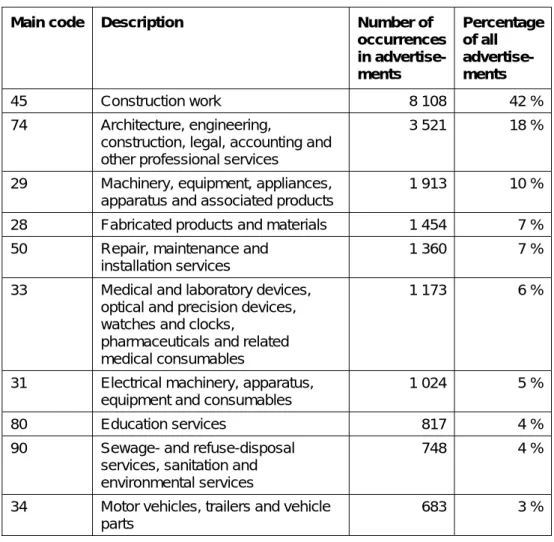
The results show that the dominant product category was “Construction”, which was quoted in 42 percent of all procurements. In second place – with 18 percent – came “Architecture, engineering, construction, legal,
Table 2.5: The ten most common CPV codes in public procurement advertisements in 2005
Main code Description Number of occurrences in advertise-ments Percentage of all advertise-ments 45 Construction work 8 108 42 % 74 Architecture, engineering,
construction, legal, accounting and other professional services
3 521 18 %
29 Machinery, equipment, appliances, apparatus and associated products
1 913 10 %
28 Fabricated products and materials 1 454 7 %
50 Repair, maintenance and
installation services
1 360 7 %
33 Medical and laboratory devices, optical and precision devices, watches and clocks,
pharmaceuticals and related medical consumables
1 173 6 %
31 Electrical machinery, apparatus, equipment and consumables
1 024 5 %
80 Education services 817 4 %
90 Sewage- and refuse-disposal services, sanitation and environmental services
748 4 %
34 Motor vehicles, trailers and vehicle parts
683 3 %
Source: Opic AB 2006. (Note that every advertisement may contain several CPV codes and the percentages may therefore add up to more than 100 %.)
3
Public procurement as a driver of
innovation
“Innovation” refers to the practical utilisation of knowledge and expertise in the form of new business models, new products (goods or services) or new processes. New business models concern how economic value or
organisational benefit is created. Product innovation concerns what is to be produced, i.e. new tangible goods or new intangible services. Process innovations concern how goods and services are produced, for example in the form of a new or improved production or distribution process.
The “degree of innovation”, or novelty value, is an important aspect of the commercial significance of the innovation. A distinction is often drawn between radical and incremental innovations.
• A radical innovation, i.e. an innovation with a high novelty value, may form the basis of competitive advantages over a long period, because it is difficult to copy. Such innovations often require a high degree of development and also often research activities. Initially, there will be considerable uncertainty as to future results.
• Incremental, or gradual, innovations may concern an improvement of or efficiency enhancement to a business model product or
process. This will be achieved mainly through various development measures, and the degree of uncertainty will be more limited. In this report, renewal refers to the effects on the activities of both
customers and suppliers, in connection with innovations or when existing business models, products or processes are distributed to customers who previously had no knowledge or requirement for them.
Innovation – a driver of growth and new jobs
The renewal that innovation generates in the business and public sectors plays a decisive role in the business development of enterprises and in the development of quality and efficiency in public sector organisations. Thus, innovativity in the business and public sectors is fundamentally important to the development of long-term productivity, which brings improved competitiveness and in the long run economic growth. It follows from this that the conditions for innovation and innovative activities represent one of the most important issues of economic policy nationally and regionally.
The climate of innovation, or the efficiency of innovation systems, has become a central element of long-term growth policy in most countries. In Sweden, it has been expressed in the national innovation strategy
Innovative Sweden.
Many different factors affect the efficiency of any innovation system. This means that focusing narrowly on single drivers, resources or participants is not enough. In any context, both quality and interplay between different participants, resources and drivers, have to be taken into account. One important factor that, however, is often neglected in connection with innovation policy, is the importance of demand, or the development of markets, for innovation. The development of markets is the most fundamental of economic drivers – or the incentive – for innovation and entrepreneurship.
Innovation research indicates that the interaction between customers/ users and suppliers/producers is very often the single most important factor to both volume and success of innovation processes.9 Prospective customers play in many cases a decisive role in determining the direction and nature of an innovation. While being the first buyers and users, they may also provide the foundation for a greater market potential. Certain leading researchers go so far as to claim that it is often the customers, rather than the producers, who are the most important source of innovation.10
Against this background, public-sector needs for goods and services play an important role in the innovation climate in all innovation systems. In many sectors, the needs and demand in public organisations form an important market for enterprises. In certain sectors, public customers even dominate total demand. Depending on how these needs are translated into demand, they may either act as a driver of innovation and renewal, or they may exert a conservative influence. The innovation-stimulating or
conservative effects of public-sector demand are especially important in
economies with a large public sector, such as in Sweden and the EU. A positive interaction between public-sector needs and demand, and creativity and innovativity in the business sector, can contribute strongly to renewal in the public sector and innovation and international
competitiveness in the business sector. Historically, dynamic development
9
Lundvall (1985), “Product innovation and user-producer interaction”. 10
Von Hippel (1988), The sources of innovation och Sörlin och Törnqvist (2000),
Kunskap för välstånd - Universiteten och omvandlingen av Sverige. (Knowledge for prosperity – the universities and the transformation of Sweden.)
blocs have played a significant role in the development of countries.11 A public-sector demand that focuses only on existing goods and services does not generate any drivers of development or innovation. It will also result in a low degree of development and renewal in public organisations. Against that background, it is important – to both the long-term quality of public organisations and the long-term development of competitiveness in the Swedish business sector – to monitor how public organisations conduct
their renewal and how this affects the demand for goods and services. Regular analysis, follow-ups, and evaluation of the above are necessary elements of any ambitious innovation policy.
Innovation and R&D
Innovation consists of the development and commercial exploitation of previously non-existent goods and services or new production and
distribution processes. On that basis, it is important to emphasise that for innovation to come about, a certain measure of development is always necessary. In the case of incremental innovation, the degree of develop-ment is often limited in scope. More radical innovation generally requires considerable development and often research too. Innovations therefore require development or research, often both. This process is generally known as research and development, or R&D.
It should be emphasised that official R&D statistics, both in Sweden and internationally, underestimate the total volume of development conducted in the business and public sectors. There are several reasons for this. The most important one is that R&D is an activity that above all generates intangible assets in the form of knowledge and expertise. This makes it generally difficult to quantify. As a result, what the statistics reflect is above all the activities that are formalised in organisational terms, for example via R&D units or R&D processes.
Against that background, the picture presented by R&D statistics for the development invested in innovation processes is far too limited. However, R&D statistics are in important indicator of innovation investments, since the organisationally formalised R&D processes often play a particularly important role in innovation processes and innovation systems.
Public-sector demand that is expressed in demand via public procurements can promote innovation by stimulating development or research
11
IVA (2005), Utmaningar för staten, näringslivet och forskningen. Om kunskap, strategier och tillväxtfrämjande aktiviteter på avreglerade marknader. (Challenges for the State, the business sector and the research sector. About knowledge, strategies and growth-promoting activities in deregulated markets.)
ments intended to create innovations. When this happens, it means that public organisations are calling for as yet non-existent solutions for public-sector needs.
The introduction of new solutions, innovations, into organisations
generally requires additional changes to the activities of the organisations. Renewal processes of this kind demand major resources of decisiveness and creativity. If technical innovations are to deliver a benefit to organisations, both organisational and process renewal is often necessary. Suppliers of new solutions, too, must normally introduce process and organisational changes if they are to be able efficiently to produce new goods or services.
Time horizon and degree of renewal
Organisations have both short- and long-term needs. Short-term needs often centre on increasing the efficiency of a relatively clearly defined activity. Long-term needs focus to a large extent on reviewing the qualitative content of different activities.
Organisations, both private- and public-sector, and the people who work in them, nearly always find it greatly easier to identify and define precisely immediate – or short-term – needs, rather than long-term ones. In commercial markets, this means that established business activities are constantly renewed by being transformed or replaced by others. This takes place mainly via competition between different enterprises, but also via competition between different business operations within different enterprises. One important consequence of this phenomenon is that some enterprises become established and grow while others contract or are driven out of business. It is this dynamic competition and continuous renewal in the creation of economic gain that fuels long-term growth. Public organisations are not exposed to competition in the same way as private-sector enterprises. This means that mechanisms for long-term renewal in the content and quality of operations – other than the pressure of market competition – are required in public organisations. If such mechanisms are not in place and working effectively, renewal will be low, with the risk of stagnation in the long-term quality of operations. The goods and services purchased by public organisations are part of the balance between the short-and long-term functions and needs of these organisations.
A factor fundamental to all human activities and to all human development is the drivers that exist for human creativity. For economic purposes, these are generally referred to as incentives. In organisations and communities there are often many types of incentives that form different patterns, often
described as incentive structures. Different types of incentive can interact in a way that strongly influences human and organisational behaviour in certain directions. On occasion, incentives work against each other. Incentive structures are equally important in public and private
organisations. Without clear incentives to drive an activity, there is little likelihood that it will move in the desired direction. Therefore, if it is desired that public authorities should renew their activities, it is important that they should be given clear incentives for doing so. If, in addition, public organisations are required to conduct their work of renewal in such a way as to promote innovation and renewal in the business sector, this should also be made clear in their incentive structures.
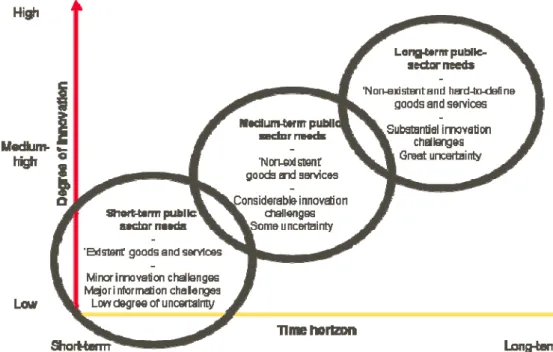
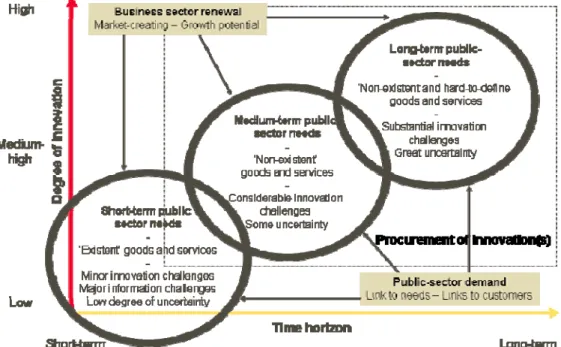
A policy aimed at promoting renewal in public organisations and in the business sector via public procurement, should be based on an under-standing of how the incentive structures of public authorities affect their processes of renewal. Ordinarily, these differ from sector to sector and from one type of public authority to another, but certain elements of the incentive structures are standard. One is the degree of innovation and the other is the time horizon. As in most innovation processes, the general rule is that the higher the novelty value – i.e. the more radical the innovation – the more advanced is the development work required. At the same time, the longer the time horizon that is allowed for the organisational develop-ment, the greater the uncertainty becomes in relation to important quality variables. See Figure 3.1.
Figure 3.1: General elements of analysis and policy in innovation-promoting public procurement
While organisations normally undergo major renewal over the long term, the problems lie in anticipating how such changes may and should present themselves. Generally speaking, the degree of unpredictability increases according to the length of the time horizon sought for the activity. Thus, an effective renewal activity cannot be built on predictions for the future or on linear projections for the activity on the basis of the current situation. Instead, the aim should be for a reasonable balance between short-term
efficiency and measures for organisational renewal.
Normally, the incentives for satisfying immediate or short-term needs strongly dominate all human activities. This also applies to public
organisations and in particular to the acquisition of goods and services by such organisations. In the case of slightly longer-term needs, it is often difficult for an organisation to define exactly what its demand is. Generally speaking, more is generally known about the function for which a solution is required than how to go about finding one. The product that needs to be purchased may not be available or may need to be developed. This means that, in general, considerable uncertainties will be associated with the procurement of goods and services needed to meet long-term require-ments. The risk of investment errors increases in the context of hard-to-predict renewal processes in public organisations.
Even if people are aware that renewal processes, linked to innovations, are necessary to the long-term quality of public organisations, the incentives for these kinds of investment are generally weak. In other words, the risks to management and personnel mostly far outweigh the rewards that may be expected if the work of renewal is successful.
In the even longer term, these needs may be genuinely difficult to predict. The task of formulating in specific terms how new solutions should be framed is complex. In processes to develop solutions of this type, there is a major risk that new solutions will not be implemented.
Private- and public procurement
In a modern, market-based economy, many attempted innovations will be in progress at the same time, with competition screening out the most financially profitable solutions. In these processes, there are will be major differences in how screening is performed in private enterprises and at public authorities.
Private-sector purchasing is not governed by the same procedural rules that control the activities of public authorities. On the other hand, private enterprises normally face competition in the markets in which their products exist. These products are constantly exposed to the pressure of
competition. If they are to remain competitive in the long term, enterprises must maintain product renewal i.e. continual improvements, and introduce wholly new products or processes in the form of innovations.
Generally speaking, enterprises can change suppliers whenever they wish, but may also choose to cultivate long-term relationships with suppliers and customers when they consider that it benefits the enterprise. Successful innovation processes often need long-term investments, in which case similarly long-term development relationships between customers and suppliers are important. Patterns of long-term relationships between different players develop, to the mutual benefit of both, enabling effective investments in innovation and renewal to take place. Development
relationships of this type are sometimes referred to as development blocs.12 Public authorities can also, generally speaking, change suppliers when they want. However they cannot enter into long-term relationships with
individual private enterprises, in the same way as public enterprises. Such relationships are not allowed for competition reasons, under the regulatory systems governing the activities of public authorities. This is especially true of the relationships comprising the procurement of goods and services, which are encompassed by LOU, the law on public procurement.
In the case of products for which the main demand comes from public authorities, the dynamic competition that exists in most markets typified by strong private-sector demand and supply is absent. Against that background, innovation and renewal of products for which the main
demand is from the public sector depends on developments being driven by the authorities themselves. Public authorities must not solely demand products that already exist, and procurement processes must be structured in such a way that they provide scope for suppliers to be innovative. Innovation depends on dynamic competition. Another condition is that buyers should exist for the new solutions that are developed. From the suppliers’ viewpoint, the existence of an initial buyer is critical to the initial introduction of an innovation. At the same time, the possibility for finding more buyers after the initial launch is also important to the incentives to enterprises to carry out the necessary development work. Development of markets for innovative solutions forms the basis of the creation of
economic value and jobs that may be generated in the business sector. If public authorities only procure products that already exist, and do not request new innovative solutions, the drivers of innovation and renewal in
12
Dahmén (1950), Svensk industriell företagarverksamhet 1919-1939. (Swedish industrial enterprise 1919-1939.)
large parts of public-sector dominated areas will be weak. This may lead to stagnation in quality and efficiency in the activities of public authorities. As a result, an important potential market driver of innovation in the business sector will also be constrained, in turn restricting competitiveness, growth and job creation in the business sector.
International and historical background
Many studies show that public-sector demand may impact very strongly on innovation and technological development at enterprises, and that this impact may be more important to growth in innovation than various forms of R&D support. Several explanations for this have been identified:
• many public organisations are demanding customers, often more demanding than private-sector ones
• in certain situations, public organisations are prepared to pay the higher prices that in many cases prevail at the start of an
innovation cycle
• public-sector demand may quickly create a critical mass in demand, if new solutions are spread across to other public authorities
• public-sector demand may send out strong user signals on a demonstration level to private-sector users;
• public-sector demand creates direct links to demand and the market, unlike pure R&D subsidies.
All in all, public procurement offers considerable potential for promoting innovation. Public procurement is a market-based tool that may be used in a complementary way with other forms of public R&D investment.
Public-sector demand as a driver of innovation and renewal is a type of demand-based innovation-promotion that historically has played an important part in economic renewal in Sweden and elsewhere in Europe. However, the importance of this type of innovation-promotion has declined in Sweden as the former public-private development bloc has been re-regulated within the scope of EU membership.
One important factor in Sweden’s successful technological-industrial economic history is that public-sector demand in sectors such as tele-communications, electricity generation and power distribution has created
exports, good growth and better delivery of public services to its citizens.13 However, there are indications that the legislation on public procurement that was introduced in 1994 and the commissioning/ contracting models that became common during the 1990s created a situation in which
innovation and technological development arising through procurement by public authorities declined considerably.
A study by Stenbeck (2004) examines the incentives for innovation within the commissioning/contracting model. When, in 1992, the Swedish National Road Administration introduced the commissioning/contracting model in operations and maintenance, one motive was to introduce
function-based contracts and thereby to set creative resources free. Ten years later, the price for operating and maintaining roads and railways had fallen by 22-27 percent. However, profits and savings seem to have been achieved by reorganisation rather than technological development. This has led commissioning and contracting parties to express disappointment at the results in technological terms, and express a certain degree of inability with regard to achieving innovation and renewal in the sector. The change noted may be because the new model focuses more on relatively short-term outcome goals, allowing little scope for developing new products and processes. This leads to savings over limited periods, but in the longer term, it brings a conservative influence to the activities of the public authorities and the competitiveness of the business sector.
The report Innovation-promoting public procurement – a preliminary study of international experiences describes how discussions on the use of procure-ment for innovation-promoting purposes have begun in recent years.14 Academic literature on the subject began to emerge in the 1980s, but the public debate at European level took longer to get going. However, over the past year (since mid-year 2005), major political discussions have surfaced. As part of these discussions, several ambitious reports have been produced and international workshops arranged, both at EU level and within a number of individual countries.15
13
IVA (2005), Utmaningar för staten, näringslivet och forskningen. Om kunskap, strategier och tillväxtfrämjande aktiviteter på avreglerade marknader (Challenges to the State, the business and the research sector. Knowledge, strategies and growth-promoting activities in de-regulated markets) and Marklund et al, (2004),
The Swedish National Innovation System 1970-2003. 14
Åström (2006), Innovationsfrämjande offentlig upphandling. En förstudie av internationella erfarenheter. The remainder of this section is based on this study. 15
The most important reports include More Research and Innovation – Investing for Growth and Employment: A Common Approach, COM(2005) 488 final, 2005,
Public Procurement for Research and Innovation – Developing Procurement Practices Favourable to R&D and Innovation, Expert Group Report, European