Sentiment Analysis for Bangla Microblog Posts
Thesis Report submitted in partial fulfillment of the requirement for the degree of
Bachelor of Science in Computer Science and Engineering
By
Shaika Chowdhury Wasifa Chowdhury Student ID: 10101037 Student ID: 10101038
[email protected] [email protected]
BRAC University, Dhaka, Bangladesh
DECLARATION
We hereby declare that this thesis is based on the results found by us. Materials of work found by other researchers are mentioned by reference. This thesis, neither in whole nor in part, has been previously submitted for any degree.
___________________ ___________________ Signature of Supervisor Signatures of Authors
ACKNOWLEDGMENTS
We want to express our gratitude to The Almighty for blessing us with patience and knowledge and giving us the opportunity to learn something new. We would also like to thank our parents and teachers for their support and encouragement.
TABLE OF CONTENTS
DECLARATION ... 2
ACKNOWLEDGMENTS ... 3
LIST OF TABLES AND FIGURES……….. 5
ABSTRACT ... 6
2. RELATED WORKS IN ENGLISH ... 9
3. LEXICON ... 11
3.1METHODOLOGY TO CONSTRUCT THE BANGLA SENTIMENT LEXICON: ... 11
4. METHODOLOGY ... 13
4.1 DATASET: ... 13
4.2 TWEETDESCRIPTION: ... 14
4.3 PREPROCESSING: ... 14
4.4 OUR APPROACH ... 17
4.4.1 TRAINING SET CONSTRUCTION: ... 17
4.4.1.1 SEMI-SUPERVISED: ... 17
4.4.1.2 SELF-TRAINING BOOTSTRAPPING: ... 17
4.4.2 FEATURE EXTRACTION: ... 20
4.4.3 CLASSIFIER: ... 23
4.4.3.1 SUPPORT VECTOR MACHINE: ... 23
4.4.3.2 MAXIMUM ENTROPY: ... 24
5. EXPERIMENTAL RESULTS AND EVALUATION... 25
5.1 EVALUATIONMETRICS: ... 25
5.2 RESULTSANDDISCUSSION: ... 27
6. CONCLUSION AND FUTURE WORKS ... 33
LIST OF TABLES AND FIGURES
TABLE 1:SAMPLE BANGLA TWEETS ... 15
TABLE 2:EXPERIMENTAL RESULTS OF PRECISION,RECALL AND F-MEASURE FOR SUPPORT VECTOR MACHINE (SVM)BOLDFACE: BEST PERFORMANCE (IN F-MEASURE) FOR A CLASSIFICATION LABEL ... 29
TABLE 3:EXPERIMENTAL RESULTS OF PRECISION,RECALL AND F-MEASURE FOR MAXIMUM ENTROPY.BOLDFACE: BEST PERFORMANCE (IN F-MEASURE) FOR A CLASSIFICATION LABEL. ... 30
TABLE 4:COMPARISON OF THE ACCURACY RATES ON THE TEST DATA USING SVM AND MAXENT WITH VARIOUS SETS OF FEATURES.BOLDFACE: BEST PERFORMANCE (IN ACCURACY) FOR A GIVEN FEATURE (ROW). ... 31
TABLE 5:ACCURACY OF SVM AND MAXIMUM ENTROPY IN [15] ... 32
TABLE 6:BANGLA POSITIVE POLARITY WORD LIST.NN,VM,JJ AND RB STAND FOR NOUN,VERB, ADJECTIVE AND ADVERB RESPECTIVELY.HIGHLIGHTED WORDS IN GRAY INDICATE TO THE INFLECTED AND MISSPELLED FORMS. ... 36
TABLE 7:BANGLA NEGATIVE POLARITY WORD LIST.NN,VM,JJ AND RB STAND FOR NOUN,VERB, ADJECTIVE AND ADVERB RESPECTIVELY.HIGHLIGHTED WORDS IN GRAY INDICATE TO THE INFLECTED AND MISSPELLED FORMS. ... 42
FIGURE 1:SYSTEM ARCHITECTURE ... 16
FIGURE 2:GENERAL BOOTSTRAPPING PROCESS USING LABELED AND UNLABELED DATA ... 20
ABSTRACT
Sentiment analysis has received great attention recently due to the huge amount of user-generated information on the microblogging sites, such as Twitter [1], which are utilized for many applications like product review mining and making future predictions of events such as predicting election results. Much of the research work on sentiment analysis has been applied to the English language, but construction of resources and tools for sentiment analysis in languages other than English is a growing need since the microblog posts are not just posted in English, but in other languages as well. Work on Bangla (or Bengali language) is necessary as it is one of the most spoken languages, ranked seventh in the world [13]. In this paper, we aim to automatically extract the sentiments or opinions conveyed by users from Bangla microblog posts and then identify the overall polarity of texts as either negative or positive. We use a semi-supervised bootstrapping approach for the development of the training corpus which avoids the need for labor intensive manual annotation. For classification, we use Support Vector Machines (SVM) and Maximum Entropy (MaxEnt) and do a comparative analysis on the performance of these two machine learning algorithms by experimenting with a combination of various sets of features. We also construct a Twitter-specific Bangla sentiment lexicon, which is utilized for the rule-based classifier and as a binary feature in the classifiers used. For our work, we choose Twitter as the microblogging site as it is one of the most popular microblogging platforms in the world.
1. Introduction
In recent years, microblogging sites have become a very popular source for publishing huge amount of user-generated information. One of the unique characteristics of these microblogging sites is that the messages that are posted by the users are short in length and users publish their views and opinions on different topics such as politics, religion, economics, business, and entertainment. These huge volumes of user-generated information on the microblogging sites are utilized for many applications. Product review mining is one such application where potential consumers go through the opinions expressed by previous consumers on different sites before acquiring a particular product or service, while companies analyze the feedbacks on different products or services posted by consumers on these sites to gain knowledge about which products or services to sell more and which should be improved. These microblogging sites are also used as a source of data for making future predictions of events, such as predicting election results. Here, we are not talking about going through just one or two user messages on a particular product or service and making a decision on that. Instead, millions of messages that are posted daily on the microblogging sites need to be checked, all the relevant posts for that product or service need to be extracted, different types of user opinions need to be analyzed, and finally the user opinions and feedbacks need to be summarized into useful information. For a human being, this is a very tedious and time-consuming work. This is where sentiment analysis comes in use.
Sentiment analysis or opinion mining is the automatic extraction of opinions, emotions, and sentiments from texts. Sentiments, opinions, and emotions are subjective impressions and not facts, which are objective or neutral. Through sentiment analysis, a given text can be classified into one of the three categories - positive, negative, or neutral. Sentiment analysis of texts can be performed at different levels like - document, sentence, phrase, word, or entity level. Since our domain is restricted to Microblogging sites, more specifically Twitter, as we only deal with Twitter corpus, we perform sentiment analysis at tweet level.
Much of the research work on polarity classification of Microblog posts has been implemented on the English language, but construction of resources and tools for sentiment analysis in languages other than English is a growing need since the microblog posts are not just posted in English, but in other natural languages as well. Work on other languages is growing, including Japanese ([2], [3], [4], [5]), Chinese ([6], [7]), German [8], and Romanian ([9], [10]). Much of the work on sentiment analysis for Bangla (or Bengali) language has been applied to the news corpus and blogs ([11],[12]), but we couldn’t find any research paper which focuses on the issue of extracting user opinions and views from Bangla Microblog posts. As will be discussed in section 4.2 of our paper, characteristics of the microblog domain are quite different from blogs and news corpus, so there is an opportunity for research in this domain for the Bangla language.
In this paper, we aim to automatically extract the sentiment or polarity conveyed by users from Bangla microblog posts. We assume that the microblog posts are shared by users to express opinions and subjective content, therefore, restricting our classification problem to a binary classification problem of solely identifying the overall polarity of the text as either negative or positive. We use a semi-supervised bootstrapping approach for the development of the training corpus which avoids the need for labor intensive manual annotation. From related works in English, support vector machine (SVM) and Maximum Entropy (MaxEnt) have proven to outperform other classifiers in this field. Hence, for classification, we use SVM and MaxEnt and do a comparative analysis on the performance of these two machine learning algorithms by experimenting with a combination of various sets of features. We also construct a Twitter-specific Bangla sentiment lexicon. For our work, we choose Twitter as the microblogging site as it is one of the most popular microblogging platforms in the world
The rest of this paper is organized as follows: Section 2 describes the related work. Section 3 discusses Bangla sentiment lexicon construction. Section 4 presents proposed methodology and Section 5 explains the performance evaluation measures and focuses on the experimental results and discussion. Finally, results are summarized and concluded in section 6.
2. Related Works in English
We briefly overview the main lines of research carried out on the English language. There are a large number of approaches that has been developed to date for classifying sentiments or polarities in English texts. These methods can be classified into two categories- (1) machine learning or statistical-based approach and (2) unsupervised lexicon-based approach.
Machine learning methods use classifiers that learn from the training data to automatically annotate new unlabeled texts with their corresponding sentiment or polarity. [14] is one of first papers to apply supervised machine learning methods to sentiment classification. The authors perform the classification on movie reviews and show that MaxEnt and SVM outperform Naïve Bayes (NB) classifier. One of the first papers on the automatic classification of sentiments in Twitter messages, using machine learning techniques, is by [15].Through distant supervision, the authors use a training corpus of Twitter messages with positive and negative emoticons and train this corpus on three different machine learning techniques- SVM, Naïve Bayes, and MaxEnt, with features like N-grams (unigrams and bigrams) and Part of Speech (POS) tags. They obtain a good accuracy of above 80%. [16] follow the same procedures as [15] to develop the training corpus of Twitter messages, but they introduce a third class of objective tweets in their corpus and form a dataset of three classes- positive sentiments, negative sentiments, and a set of objective texts (no sentiments). They use multinomial NB, SVM, and Conditional Random Field (CRF) as classifiers with N-grams and POS-tags as features. The authors of [17] use 50 hashtags and 15 emoticons as sentiment labels to train a supervised sentiment classifier using the K Nearest Neighbors (KNN) algorithm. In [18], the authors implement a 2-step sentiment detection framework by first distinguishing subjective tweets from non-subjective tweets and then further classify the subjective tweets into positive and negative polarities. The authors find that using meta-features (POS tags) and tweet-syntax features (emoticons, punctuations, links, retweets, hashtags, and uppercases) to train the SVM classifiers enhances the sentiment classification accuracy by 2.2%
learning methods have been widely employed and proven effective in sentiment classification, they normally depend on a large amount of labeled data, which is both time consuming and labor intensive work.
Unsupervised lexicon-based methods rely on manually or semi-automatically constructed lexical resources, such as lexicons, to identify the overall polarity of texts. Lexicon is a collection of strong sentiment-bearing words or phrases, which are labeled with their prior polarity, or the context-independent polarity most commonly associated with the lexicon entries. There are several lexicons in English which are available online such as - ANEW [19], General Inquirer [20], OpinionFinder [21], SentiWordNet [22] and WordNet-Affect [23]. One of the initial works to apply unsupervised techniques to sentiment classification problem is by [24]. In the paper, a document is classified as positive or negative by the average semantic orientation of the phrases in the document that contain adjectives or adverbs. The semantic orientation of a phrase is calculated as the Pointwise Mutual Information (PMI) with a positive seed word “excellent” minus the PMI with a negative seed word “poor”. This approach achieves an accuracy of 84% for automobile reviews and 66% for movie review. In [25], the authors manually develop a sentiment lexicon consisting of positive and negative sentiment-bearing words annotated with their POS tags. This sentiment lexicon, along with a set of rules, is used to first classify the tweets as subjective or objective and then further classify the subjective tweets as positive, negative or neutral. They use a corpus of political tweets collected over the UK pre-election period in 2010. For the task of correctly identifying that a document contains a political sentiment and then correctly identifying its polarity, they get 62% Precision and predict 37% Recall. Other works addressing this lexicon-based approach include [26] and [27]. However, methods based on lexical resources often have the problem of obtaining low recall values because they depend on the presence of the words comprising the lexicon in the message to determine the orientation of opinion [44]. And due to the varied and changing nature of the language used on Twitter, this approach is not suitable for our thesis work. Moreover, as such lexical resources are not available for many other languages
spoken in social media, like Bangla, hence this approach often becomes unsuitable for scarce-resource languages.
To overcome the problems of using a fully supervised machine-learning or unsupervised lexicon-based approach, some recent papers use a hybrid approach of employing both both lexicon and machine learning based approaches for their work. Works using hybrid approach include [53], [54] and [55].
For our thesis, we use a hybrid approach of firstly constructing a Bangla polarity lexicon that automatically labels a small training data, with the help of a rule-based classifier. We then identify the overall polarity of tweets using a semi-supervised machine learning approach.
3. Lexicon
As explained in section 2, several English polarity lexicons are available online, but we couldn’t find any Bangla polarity lexicon to be used for our work. One approach is simply translating an existing English lexicon in Bangla language using a bilingual dictionary. Although this approach can easily be implemented, it does not create a high accuracy resource due to the highly overloaded meaning of words, as shown in [9] and [28]. So, we construct a Twitter-specific Bangla polarity lexicon, by leveraging on lexical resources already available for the English language, such as SentiWordNet.
3.1 Methodology to construct the Bangla sentiment lexicon:
In order to create a Bangla sentiment lexicon, which contains Bangla words annotated with their corresponding polarity (positive/negative) and Part-of-Speech (POS), we first construct an initial word list, containing strong positive and negative sentiment-bearing words, using a Twitter corpus with emoticons. The
word list is then further expanded with the corresponding synonyms of the words in the wordlist.
To create the initial set of positive and negative word list, we collect two Bangla tweet corpora (these corpora were not used in training or test dataset) - one corpus contains tweets with all negative emoticons while the other corpus contains tweets with all positive emoticons. Emoticons are widely used by users in micro-blogging sites, like Twitter, to express emotion or sentiment about different topics. Hence, we assume that tweets with emoticons will hold strong positive and negative polarity words. All the tweets in the corpora are labeled as positive or negative according to their emoticon sign. We count the number of positive and negative emoticons for each tweet and annotate a tweet with the same polarity as the emoticon with the highest count. We use the emoticon list [29] for this task. All the words in the tweets are then marked with their POS tags and only adjectives, adverbs, nouns, and verbs are extracted, since previous studies on sentiment analysis ([30], [31]) have shown that these POS tags are strong indicators of subjectivity. All the extracted words are marked with positive or negative sentiment according to their tweet polarity. Note that the polarity given to the extracted words may not represent the actual sentiment of the words, since the polarity of the extracted words are merely assigned according to their tweet polarity (which is labeled using emoticons). Hence to verify whether the sentiment label that is given to each extracted word according to its tweet emoticon is actually its polarity, we further apply a filtering method using online bilingual dictionary and SentiWordNet. We firstly translate each extracted Bangla word in English using the online bilingual dictionaries Ovidhan [32] and Samsad [33] and then use SentiWordNet to check each of the translated word for its polarity, according to its POS. In SentiWordNet, a word with a specific POS can have many senses, and each sense is given 3 scores for positivity, negativity, and objectivity, indicating the strength of each of the three properties for that sense of the word. The 3 scores together are equal to 1. As we are dealing with positive and negative sentiment words, we only look at the positive and negative scores. So, if any sense for that POS of a word has a score greater than the threshold value of 0.6 for the corresponding polarity, then it is confirmed that the polarity
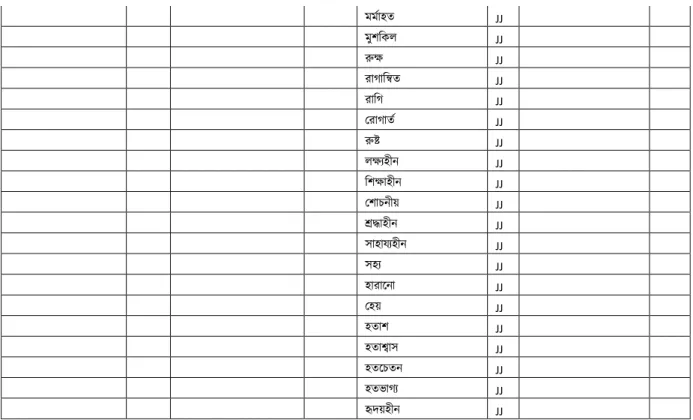
of the word is actually that of the tweet in which it appeared and hence added in the initial word list. In this way the initial word list is generated. The reason for using a high threshold value of 0.6 is to include only the strong opinionated words in our lexicon. The word list is further expanded by adding the synonyms of the words using online available Bangla Wordnet of Indian Statistical Institute [34]. The synonyms are given the same polarity as the words they are expanded from. We finally add the inflected and misspelled forms of the words in the word list to make our lexicon Twitter-specific. In this way, a total of 737 single words made up the lexicon, which is provided in Tables 6 and 7.
We use this Bangla polarity lexicon for the rule-based classifier and feature extraction. This is explained in the next section in our approach.
4. Methodology
Our system architecture, outlining the whole process, is shown in figure 1 below.
4.1 DATASET:
Our dataset is a collection of Bangla tweets downloaded by querying Twitter REST API v1.1 [35] over a span from May-November 2013. As Twitter API supports language filtering and allows specifying the language of the retrieved posts, the optional language parameter in the Twitter Search URL was set to ‘bn’ to extract all Bangla tweets. Eventually, we collected a total of 1300 tweets by polling Twitter API. We split this dataset into training set and test set, comprising 1000 and 300 tweets respectively. However, the tweets we retrieved contained English text as well; instead of filtering out the English text from the tweets, we include them as part of our training and test sets. Because English words express strong positive and negative sentiment, they will likely contribute in sentiment classification of our dataset.
4.2 TWEET DESCRIPTION:
Twitter users communicate by publishing short messages called ‘tweets’. A tweet is limited to 140 characters; the language used in tweets is very informal and contains various misspellings, punctuations, slang, new words, URLs and genre-specific terminology and abbreviation, e.g. RT for retweets and #hashtag [50]. Examples of presence of such features in Bangla tweets are shown in Table 1. However, these unique features are not seen in blogs and news corpus where the posts are longer and more formal.
4.3 PREPROCESSING:
The raw tweets data obtained through Twitter API are noisy and hence, are preprocessed. We perform pre-processing through three steps – tokenization, normalization, and POS Tagging.
For tokenization, NLTK’s Tokenizer [36] package is used. Tweets contain special tokens such as username (e.g., @user), URL link, hashtag (e.g., #রাগ (#angry)) and retweets (e.g., RT). As these tokens do not express any sentiment, they are removed from the dataset. RT is a special token which denotes retweets; every occurrence of this token is removed from the dataset. Username and URL links are first replaced with ‘AT-USER’ and ‘URL’ tokens respectively; then the AT-USER and URL placeholders are removed. The hashtagged words are dealt with by removing the hashtag character and afterwards, treating the non-hashtagged word as a candidate token in the dataset that expresses some sentiment. As our dataset contains both Bangla and English tweets, punctuation marks for both are removed. Furthermore, all Bangla punctuations and their usage is similar to that of English (e.g.,’!’,’;’,’?’,’,’) ,except for dari (‘।’), which is bangla equivalent of full stop. Therefore, only dari is removed using Bangla Unicode in regular expression; for all other punctuation marks, English Unicode is used. Special care is taken to ensure that colons and semicolons are not removed as often Twitter users use
emoticons (e.g., :), :(, ;)) to express sentiment; we use emoticons as a feature in feature vector during classification process and therefore need to keep these emoticons in our dataset. Similarly, all special characters (symbols not present in emoticons) are removed; parentheses are not eliminated to preserve the emoticons. Other normalization steps in pre-processing include: English tokens changed to lower case and English and Bangla stop words removed as these only serve functional purpose, but express no sentiment. Elongated words (e.g., মহাননন
(greattt)) are also identified and corrected using relevant regular expression; this is done for both Bangla and English words with character repetitions.
POS Tagging completes the preprocessing of tweets. POS Tagging of English tokens is done using NLTK POS-Tagger [37]. For Bangla, POS Tagging is performed by the Bangla Pos-Tagger Package [38]. An advantage of this pos-tagger is that it implements NLTK’S Brill Tagger; Brill Tagger works by first being trained on an initial POS-Tagger, and then based on transformation rules improves the tagging. As our corpus is Twitter specific, we provided our manually pos-tagged tweets, labeled using Bengali Shallow Parser [43], as the initial pos-tagger. As a result, Bangla tokens are pos-tagged more accurately.
Table 1: Sample Bangla Tweets
কি চমৎিার দেখা দেল... RT: @gf: হাসতেই আকি হাসতেই আকি :)) xXxD http://kcy.me/3ud8 #GoogleTranslate #fb @Kd হুম Samsung netbook এর performance েুলামুলিভাতে ভালই মতে হতে। @me @dee
৬০,০০০ টািার দমাোইল দ াতে Bluetooth োই। োইতল দসই আতেল হাতে ো দরতখ খাওেটা ভালা। #iPhone #Apple
♥ ♥ ♥ HP Pavilion DV7-7003TX ♥ ♥ ♥ োতেট িাড়া সেকিিুই ভাল লােতস !!!
আমার দেটেুি দেতি মাতেমাতে মৃেু গুড়গুড় আওয়াে আসতেতি। ঘটো কি? :S
@ssmm :P http://bit.ly/nRVYUX দমাোইতলর কেম করকলে কেতস, োও এই! এন্ড্রতয়ড ই ভালা :D
রােধাকের কমরেুতরর িােীোরায় laptop কেস্ফকরে হতয় এি েুেি মারা দেতিে। :( http://prothom-alo.com... শুদ্ধ রূতে োাংলা কিকখোর েেয #googletranslate এর কেিল্প োই :p:P
4.4 Our Approach
4.4.1 TRAINING SET CONSTRUCTION: 4.4.1.1 SEMI-SUPERVISED:
Semi-supervised refers to the machine learning techniques that include the unlabeled data along with the labeled data in the training process. As large amount of labeled data is often difficult to obtain while unlabeled data are in abundant, therefore semi-supervised learning techniques address this issue by incorporating unlabeled data in the training process to further improve the classification performance [39].
Traditional classifiers learn from large labeled data during training – this is known as supervised learning. Due to the lack of large labeled Bangla tweet dataset, the supervised learning approach is not suitable for this problem. Although it is possible to manually label the Bangla tweets, it becomes very labor-intensive and time consuming.
Whereas, although unsupervised methods work with unlabeled data, but the overhead is the need for a large domain-dependent Bangla sentiment lexicon or dictionary, which is not readily available for scarce-resource languages like Bangla.
In our case, we have a somewhat large unlabeled bangla tweet dataset available. Hence our choice is a semi-supervised approach as it builds better classifiers using large unlabeled data along with a small set of labeled data under appropriate assumptions ([39], [40]).
Among the different semi-supervised learning methods, we use self-training, which is a commonly used technique for semi-supervised learning.
Self-training bootstrapping is performed to develop our labeled training data set. Self-training bootstrapping works by first labeling a small dataset, then a classifier is trained on that small labeled data, and afterwards the trained classifier is applied on the set of unlabeled data. Instances of the unlabeled data, together, with their predicted labels, are added to the labeled training data [39]. The classifier is then retrained on this newly labeled data, and the process is repeated for several iterations.
So, following the steps of self training bootstrapping, at first we utilize the manually constructed Bangla lexicon, containing strong positive and negative sentiment bearing Bangla words, to label a small number of Bangla tweets based on a certain rule. Since our collected Bangla tweets also contain some English words in them, we use the online available English lexicon [56], which consists of around 6800 positive and negative sentiment words. We decided to use this specific English lexicon [56], because unlike other existing English lexicons, this lexicon consists of many misspelled words which appear frequently in social media content like tweets.
To make this rule-based classifier, we set the following rules, keeping in mind that tweets are short (restricted to 140 characters):
1. If countpositive > countnegative:
Label ‘positive’
2. If countnegative > countpositive:
Label ‘negative’
That is, words in tweets are compared with the words in the Bangla and Enlgish lexicons for a match. For every match, it is then checked if the word has a positive or a negative label in the polarity lexicons, and count for that label is incremented accordingly. If the count of positive words exceeds that of negative words, the Bangla tweet is labeled as positive and vice versa. Tweets without any lexicon
entry or with equal count of positive and negative words are discarded for our experiment.
Applying these rules, we got a small labeled dataset of 100 tweets maintaining an equal class ratio of 50 positive and 50 negative.
So this way, our initial small set of unlabeled tweets got labeled to be used to develop the training set.
Next, we train the classifier on this small labeled set of tweets. Once the classifier is trained and learns the patterns, it is applied to the unlabeled dataset. Our total unlabeled dataset has a size of 1000 tweets. For the first iteration of bootstrapping, the trained classifier is applied on 50 unlabeled tweets.
However, only those tweets with a high confidence are added to the labeled training set and the rest are cut off and added back to the unlabeled data set. To determine the tweets with confidence above a certain threshold, we find probability distribution over labels for the given feature set for each tweet and pick those 30 tweets out of the 50 labeled tweets as highly confident which have the highest probability distribution. We use probability distribution as it tells how likely the classifier thinks that a tweet belongs to a particular class/label.
Now this newly labeled bigger dataset is used to retrain the classifier, which is then applied on another portion of the unlabeled dataset. This way, we repeat the self-training bootstrapping until all the 1000 unlabeled tweets are labeled. One important point for the bootstrapping process is that for each iteration, class distribution in the labeled data is maintained by keeping a constant ratio across classes between already labeled examples and newly added examples [41].
Figure 2: General bootstrapping process using labeled and unlabeled data
4.4.2 FEATURE EXTRACTION:
In feature extraction, each tweet is represented as a set of features called a feature vector. Feature extraction is done on the training set developed, in order to use the extracted features in the training process to train the sentiment classifier.
The following set of features was used for each tweet:
Word N-Gram
Each tweet is represented as a contiguous sequence of N tokens called an N-gram. We use unigrams and bigrams for our work.
In unigram, N=1 and the presence/absence of each individual Bangla token in the tweet is the feature. For example, for the Bangla tweet
আমারভাললাগতাছেনা
(English translation) I am not feeling well
0. Given:
- A set L of labeled training examples - A set U of unlabeled examples - Classifiers Ci
1. Create a pool U’ of examples by choosing P random examples from U 2. Loop for I iterations:
2.1 Use L to individually train the classifiers Ci, and label the
examples in U’
2.2 For each classifier Ci select G most confidently examples and add
them to L, while maintaining the class distribution in L
2.3 Refill U’ with examples from U, to keep U’ at a constant size of P examples
The unigram representation is [‘আমার’, ‘ভাল’, ‘লাগতাছে’, ‘না’].
Similarly, in bigram, N=2 and every sequence of two adjacent words for each tweet is extracted as the feature.
For the Bangla tweet above the bigrams are, [[‘আমার’, ‘ভাল’], [‘ভাল’, ‘লাগতাছে’], [‘লাগতাছে’, ‘না’]]
Emoticon
Emoticons are the use of letters and symbols to convey facial expressions. In previous works [16], emoticons have shown to express strong positive or negative sentiment and thereby, proved very useful to sentiment analysis.
The Bangla tweets we retrieved also contain emoticons; so existence of emoticon token in the tweet is used as a feature.
The regular expression used to extract emoticons from tweets during preprocessing is adopted from Christopher Potts’ tokenizing script [42].
We use the emoticon polarity dictionary developed by Leebecker et al [29] as our emoticon lexicon. In that emoticon polarity dictionary, each emoticon is given a sentiment score ranging from -2 to 2. Instead of using sentiment score, we annotate the emoticons with their respective positive or negative sentiment label according to their sentiment score. Emoticons with positive sentiment score are mapped to positive; similarly, emoticons with negative sentiment score are mapped to negative.
Lexicon
As our Bangla polarity lexicon and the English lexicon [56] contain strong positive and negative sentiment expressing words, we use the word entries in the lexicons as features.
Pos-Tagging
Each individual token in the tweet is appended with a part of speech tag using the POS Tagger discussed in section 4.3. We use POS tagging along with lexicon as a combined feature. This feature is implemented in the same way as the lexicon feature, but instead of just matching each lexicon word entry, both the lexicon word and its part of speech tag need to match with the POS tagged tokens of tweet.
Negation
Although negation words don’t express any sentiment, they affect the overall sentiment of a tweet. Use of negation in Bangla is different from that in English. Unlike English, where negative words usually occur in the middle of a sentence, Bangla sentences frequently contain negation toward the end. An example is the tweet
আমারভাললাগতাছেনা
(English translation) I am not feeling well
Hence, we didn’t follow the negation handling method specified in [14], where every word following the negation word is appended with a ‘NEG’ suffix to reverse its sentiment.
Instead, we manually construct our own negation word list and use it as a binary feature.
Our Bangla negation list is the following,
[ “নাই”, “না”, “নয়”, “নাআ”, “ননই” , “নছহ” , “নায়” , “ননয়” ]
As Bangla is a highly inflected language, we include all the inflected forms of the base negation words as well.
Combinations of Features
We use the above mentioned features in combinations, with the expectation of better results. The following combinations were used:
Unigram + Bigram
Unigram + Negation
Unigram + Emoticon
Unigram + Negation + Emoticon
Unigram + Lexicon
Unigram + Lexicon + POS
All
4.4.3 CLASSIFIER:
After the training process, we then apply the trained classifier on the test dataset of 300 tweets so that new tweets are labeled as positive or negative.
In our work, we use two state-of-the-art classifiers, namely, Support Vector Machine and Maximum Entropy. Both have shown to be effective in previous text categorization studies [14].
4.4.3.1 SUPPORT VECTOR MACHINE:
Support Vector Machine (SVM) classifiers are non-probabilistic binary linear classifiers, that is, for a given set of training tweets, where each tweet is marked
as belonging to the positive sentiment class or the negative sentiment class, an SVM training algorithm builds a model that assigns new test tweets into one of the two possible classes. The basic idea of the classifier is to find a hyper-plane that separates the positive and negative sentiment classes with maximum margin (or the largest possible distance from both classes).
We use LIBSVM [45] package in python with a linear kernel for training and testing the Bangla Twitter data, with all parameters set to their default values.
4.4.3.2 MAXIMUM ENTROPY:
Maximum Entropy (MaxEnt or ME) is a probabilistic classifier which falls under the category of exponential models. Maximum Entropy has occasionally shown to give better results than Naïve Bayes classifier for text classification [46]. This is because, unlike Naïve Bayes, Maximum Entropy does not make assumption that features are conditionally independent. This is true for sentiment classification of tweets, where the word features comprising of individual word tokens obviously are not independent of each other. Hence we conducted our experiments using Maximum Entropy classifier.
Maximum Entropy model finds weights for the features to maximize the log-likelihood of the training data in order to improve the model. The probability of class c given a tweet d and weights λ is given by the following formula:
Our experiments are performed using MaxentClassifier [47] in NLTK’s Classify package. We use maximum iteration as the cut off parameter, setting it to five. Although more iterations generally improve accuracy [48], but due to the small
size of our dataset, further iterations did not have any additional effect on the accuracy obtained at five iterations.
5. Experimental Results and Evaluation
5.1 EVALUATION METRICS:
In order to evaluate the performance of the two learning algorithms used, namely Maximum Entropy and SVM, we first use the standard precision, recall and F-measure to F-measure the positive and negative sentiments for each classifier using various sets of features. We then use the accuracy metric to compare the overall performance of the two classifiers. Sentiment analysis task can be interpreted as a classification task where each classification label represents a sentiment. Hence, we define and calculate the four metrics for each label (positive and negative) the same way as in general classification task.
In a classification task, precision, recall, F-measure and accuracy are explained using four terms - true positive, true negative, false positive and false negative.
True Positive (tp) is defined as the number of tweets, from the test set, correctly
labeled by the classifier as belonging to a particular class or label.
True Negative (tn) is defined as the number of tweets, from the test set, correctly
labeled by the classifier as not belonging to a particular class or label.
False Positive (fp) is defined as the number of tweets, from the test set,
incorrectly labeled by the classifier as belonging to a particular class or label.
False Negative (fn) is defined as the number of tweets, from the test set, that are
not labeled by the classifier as belonging to a particular class or label but should have been.
Precision is the number of tweets in the test set that is correctly labeled by the classifier from the total tweets in the test set that are classified by the classifier for a particular class. That is,
Precision (P) =
Recall is the number of tweets in the test set that is correctly labeled by the classifier from the total tweets in the test set that are actually labeled for a particular class. That is,
Recall (R) =
F-measure is the weighted harmonic mean of precision and recall for a particular class. That is,
F-measure =
Accuracy is the percentage of tweets in the test set that the classifier correctly labels. That is,
Accuracy (A) =
To calculate precision, recall, F-Measure and accuracy, we use NLTK metrics module [49], which provides functions for calculating these metrics. For each classification label, we passed two sets, a reference set and a test set, as arguments into the NLTK metrics module functions- precision(), recall(), f_measure() and accuracy(). Reference set contains all the correctly labeled
tweets while the test setcontains the tweets classified by the classifier for a particular label.
5.2 RESULTS AND DISCUSSION:
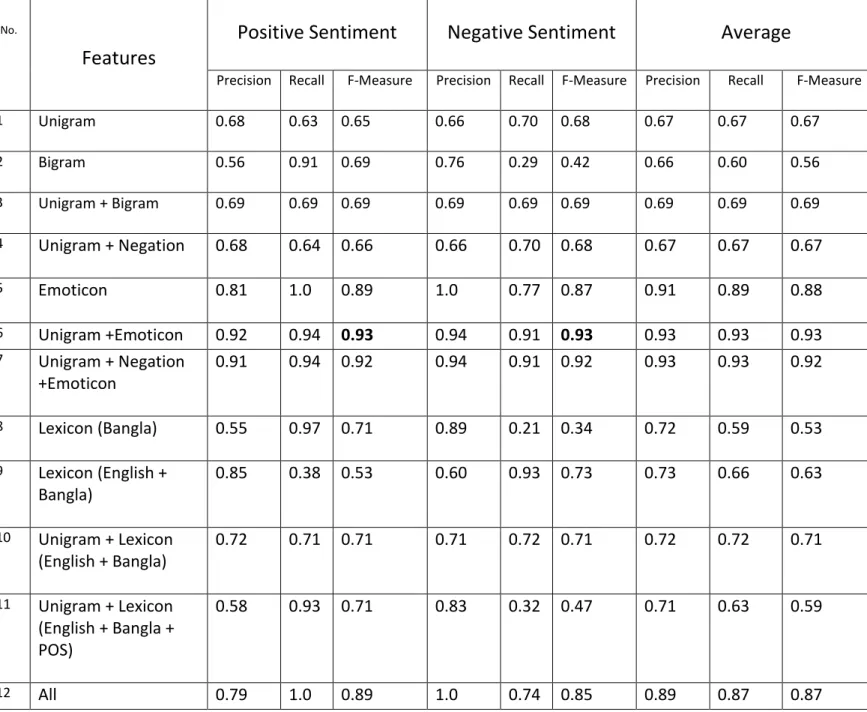
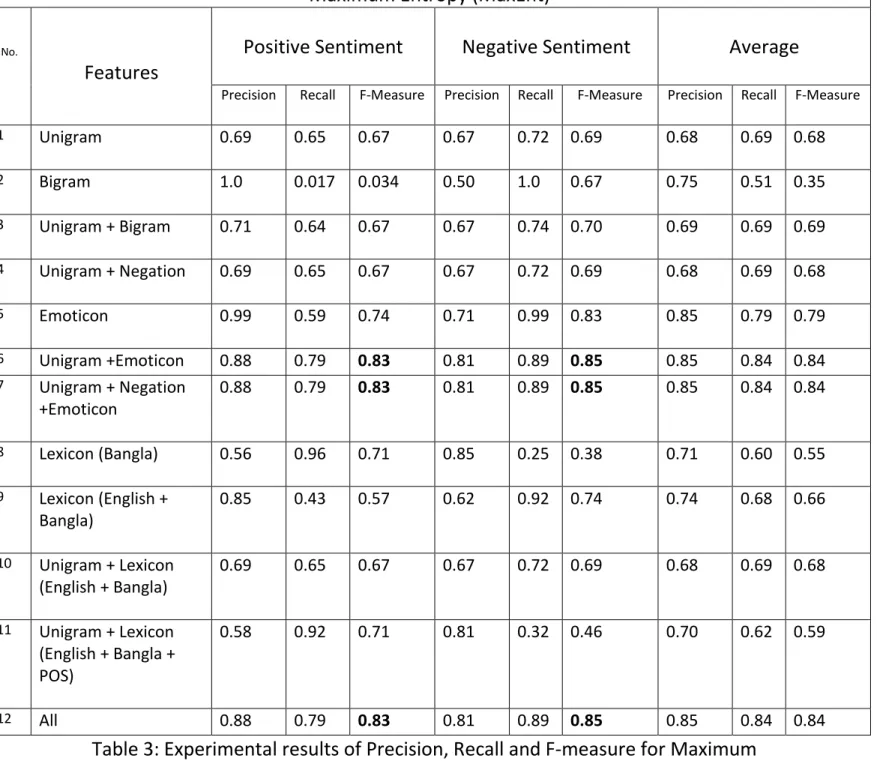
We provide the experimental results of precision, recall, and F-measure for the binary classification task using SVM and Maximum Entropy with various sets of features in Table 2 and Table 3. In Table 2, we can see that for SVM, we get the best F-measure score of 0.93, for both the positive as well as the negative sentiment label, when using a combination of unigrams and emoticons as feature. We can also see from Table 2 that using unigrams only or with other features like negation, bigrams, or lexicons give a score between 0.65-0.71, but when emoticons are added, there is an increase in F-measure by about 36.76% for both the sentiment labels. From this we can deduce that emoticon features play a crucial role in automatically identifying the sentiments of tweets, as Twitter users tend to express their feelings and opinions more with these emoticons than with words (n-grams) due the very short length of the tweets. We can see this same phenomenon in the case of Maximum Entropy in Table 3, which gives best score of 0.83 for positive sentiment label and 0.85 for negative sentiment label on the inclusion of emoticons with other features.
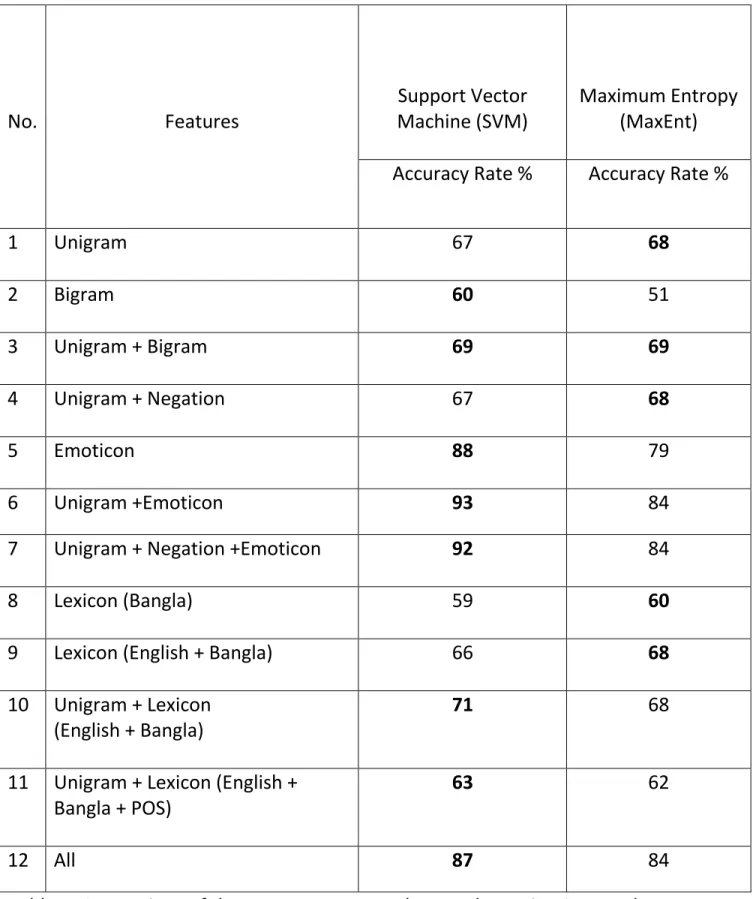
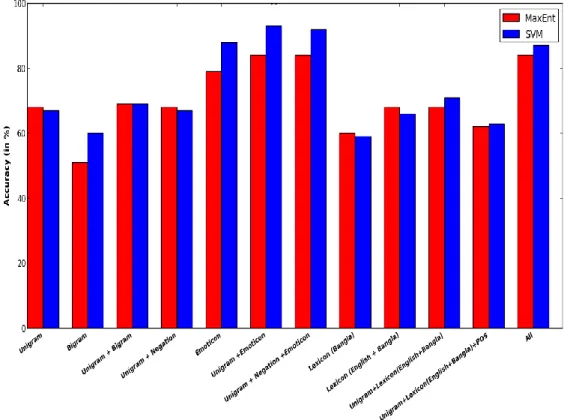
The accuracies of SVM and Maximum Entropy for the various feature sets used are given in Table 4, and we compare the overall performance, in accuracy, of the two classifiers in Figure 2. We can see from the table that the results of SVM and Maximum Entropy for all the sets of features are comparable, and overall, SVM slightly outperforms Maximum Entropy. Although for some features, Maximum Entropy gives slightly higher accuracy than SVM. We achieve the best accuracy of 93% for SVM when using unigrams with emoticons as feature. As explained above for Table 2 and Table 3, inclusion of emoticons feature greatly increases the performance of the classifiers as Twitter users tend to frequently use these emoticons to express subjective content in the short tweets. From the table, we
Inclusion of English lexicon features in addition to the Bangla lexicon features increase the accuracy of SVM by 7% and Maximum Entropy by 8%. Moreover, when unigram features are included with English and Bangla lexicon features, there is an additional increase in the accuracy by 5% for SVM and remain same for Maximum Entropy. But we observe a decrease in accuracy for both the classifiers when adding POS-based features with unigrams and lexicon features. This observation is consistent with several works in English Twitter sentiment analysis like [51], [52] and [15].
Since we couldn’t find any published baseline results for sentiment analysis on Twitter data for the Bangla language, we use related works on the English language to evaluate the performance of our classifiers. We compare our experimental results with [15], which is one of the first papers on this field on the English Twitter data. Table 5 shows the experimental results of [15] and we see that the authors only use 4 features- unigram, bigrams, unigrams with bigrams, and parts of speech to train SVM and Maximum Entropy. As we use many more features than given in Table 5, so we decided to evaluate our results only on the basis of the four features used by [15]. We can see that for all four features, our results given in Table 4 are lower than those reported in Table 5 by [15]. One reason for this could be that [15] use a much larger training dataset of 1,600,000 tweets compared to our one, which only comprised of 1000 training tweets, and as the unigram, bigram and POS features solely depend on the presence of words in tweets, hence our smaller training data gives lower accuracy rates for these four features. We examine that like [15], we achieve worst performance using bigrams for both SVM and Maximum Entropy. As stated in [15], using only bigrams as features is not useful because the feature space is very sparse. So, the authors suggested that it is better to combine unigrams and bigrams as features. In Table 4, we observe an improvement in the accuracy when using both unigrams and bigrams as features. For SVM, we see an increase in accuracy by 9% and for Maximum Entropy, there is a gain of 18% over the bigram feature accuracy. From Table 5, we can see that there is a drop in accuracy when using unigrams and POS as features, which is the same in our case as well, as shown in Table 4. Although [15] didn’t use emoticons as features in their binary
classification task, they suggested in their future work that emoticon features are very valuable and it would be useful to take emoticons into account when classifying test data. From our experimental results in Table 4, we can see that the use of emoticon features is indeed very useful and gives promising performance for both the classifiers.
Support Vector Machine (SVM)
No.
Features
Positive Sentiment Negative Sentiment Average
Precision Recall F-Measure Precision Recall F-Measure Precision Recall F-Measure 1 Unigram 0.68 0.63 0.65 0.66 0.70 0.68 0.67 0.67 0.67 2 Bigram 0.56 0.91 0.69 0.76 0.29 0.42 0.66 0.60 0.56 3 Unigram + Bigram 0.69 0.69 0.69 0.69 0.69 0.69 0.69 0.69 0.69 4 Unigram + Negation 0.68 0.64 0.66 0.66 0.70 0.68 0.67 0.67 0.67 5 Emoticon 0.81 1.0 0.89 1.0 0.77 0.87 0.91 0.89 0.88 6 Unigram +Emoticon 0.92 0.94 0.93 0.94 0.91 0.93 0.93 0.93 0.93 7 Unigram + Negation +Emoticon 0.91 0.94 0.92 0.94 0.91 0.92 0.93 0.93 0.92 8 Lexicon (Bangla) 0.55 0.97 0.71 0.89 0.21 0.34 0.72 0.59 0.53 9 Lexicon (English + Bangla) 0.85 0.38 0.53 0.60 0.93 0.73 0.73 0.66 0.63 10 Unigram + Lexicon (English + Bangla) 0.72 0.71 0.71 0.71 0.72 0.71 0.72 0.72 0.71 11 Unigram + Lexicon (English + Bangla + POS) 0.58 0.93 0.71 0.83 0.32 0.47 0.71 0.63 0.59 12 All 0.79 1.0 0.89 1.0 0.74 0.85 0.89 0.87 0.87
Table 2: Experimental results of Precision, Recall and F-measure for Support Vector Machine (SVM) Boldface: best performance (in F-measure) for a classification label
Maximum Entropy (MaxEnt)
No.
Features
Positive Sentiment Negative Sentiment Average
Precision Recall F-Measure Precision Recall F-Measure Precision Recall F-Measure
1 Unigram 0.69 0.65 0.67 0.67 0.72 0.69 0.68 0.69 0.68 2 Bigram 1.0 0.017 0.034 0.50 1.0 0.67 0.75 0.51 0.35 3 Unigram + Bigram 0.71 0.64 0.67 0.67 0.74 0.70 0.69 0.69 0.69 4 Unigram + Negation 0.69 0.65 0.67 0.67 0.72 0.69 0.68 0.69 0.68 5 Emoticon 0.99 0.59 0.74 0.71 0.99 0.83 0.85 0.79 0.79 6 Unigram +Emoticon 0.88 0.79 0.83 0.81 0.89 0.85 0.85 0.84 0.84 7 Unigram + Negation +Emoticon 0.88 0.79 0.83 0.81 0.89 0.85 0.85 0.84 0.84 8 Lexicon (Bangla) 0.56 0.96 0.71 0.85 0.25 0.38 0.71 0.60 0.55 9 Lexicon (English + Bangla) 0.85 0.43 0.57 0.62 0.92 0.74 0.74 0.68 0.66 10 Unigram + Lexicon (English + Bangla) 0.69 0.65 0.67 0.67 0.72 0.69 0.68 0.69 0.68 11 Unigram + Lexicon (English + Bangla + POS) 0.58 0.92 0.71 0.81 0.32 0.46 0.70 0.62 0.59 12 All 0.88 0.79 0.83 0.81 0.89 0.85 0.85 0.84 0.84
Table 3: Experimental results of Precision, Recall and F-measure for Maximum Entropy. Boldface: best performance (in F-measure) for a classification label.
No. Features
Support Vector Machine (SVM)
Maximum Entropy (MaxEnt) Accuracy Rate % Accuracy Rate %
1 Unigram 67 68 2 Bigram 60 51 3 Unigram + Bigram 69 69 4 Unigram + Negation 67 68 5 Emoticon 88 79 6 Unigram +Emoticon 93 84
7 Unigram + Negation +Emoticon 92 84
8 Lexicon (Bangla) 59 60
9 Lexicon (English + Bangla) 66 68
10 Unigram + Lexicon (English + Bangla)
71 68
11 Unigram + Lexicon (English + Bangla + POS)
63 62
12 All 87 84
Table 4: Comparison of the accuracy rates on the test data using SVM and MaxEnt with various sets of features. Boldface: best performance (in accuracy) for a given
features SVM Maximum Entropy
Unigram 82.2 80.5
Bigram 78.8 79.1
Unigram + Bigram 81.6 83.0
Unigram + POS 81.9 79.9
Table 5: Accuracy of SVM and Maximum Entropy in [15]
6. Conclusion and Future Works
In this paper, we discuss how we generate the training data in a bootstrapping semi-supervised way and perform sentiment analysis on Bangla Twitter data. We present our empirical results on the test data using two machine learning classifiers with various sets of features. The results of our experiments on the whole are encouraging for the task of detecting sentiment in Bangla microblog posts. We achieve a satisfying accuracy of 93% for SVM using unigrams and emoticons as features. We observe from our results that emoticons used as features play a crucial role in training the classifiers for the binary classification task. N-gram features (unigrams and bigrams) perform poorly in comparison to the baseline results in [15]. One of the reasons for this could be due to the smaller training dataset used for our experiments. Hence in future work, we plan to improve the classification accuracy by using a larger training dataset. For our work, we assumed that tweets are subjective and hence didn’t deal with the neutral class. But in real world, there exists objective tweets which do not express any sentiment and fall into the neutral class. For example, the following tweet, যাত্রীরলযাপটপথানায়জমাদিলটযাদিচালক (the taxi driver handed over the passenger’s laptop
to the police station), neither expresses a positive nor a negative sentiment, and hence it is classified as a neutral tweet. So, we need to handle these neutral tweets in future.
POSITIVE Total 280 words Noun Verb Adjective Adverb
অোকেলো NN আির্ষণ VM অিুণ্ঠ JJ অন্তরঙ্গভাতে RB অেুতোর্ NN আিৃষ্ট VM অন্তরঙ্গ JJ অেুিূলভাতে RB অেুরাে NN আিা VM অেুতেরণীয় JJ ঘকেষ্ঠভাতে RB অকভেন্দে NN উেতভাে VM অেরূে JJ কেেুণভাতে RB আির্ষণ NN িামো VM অেূেষ JJ কেভাতে RB আত্মাের NN েিন্দ VM অকভজ্ঞ JJ েীকেভতর RB আত্মমর্ষাো NN েেযািা VM অসাধারণ JJ ভাতলাভাতে RB আত্মসম্মাে NN েিাংসা VM অসাধারে JJ ভালভাতে RB আত্মসম্মােতোধ NN কেস্ময়কেমুগ্ধ VM আির্ষণীয় JJ মর্ষাোসম্পন্ন RB আের NN মো VM আেিষ JJ সঙ্গেভাতে RB আেতর NN শ্রদ্ধা VM আন্তকরি JJ সুকেধােেিভাতে RB আেিষ NN শ্রদ্ধাতোধ VM আেন্দির JJ আন্তকরিো NN দেহ VM আেকন্দে JJ আেন্দ NN সতন্তার্েেি VM আেন্দেেি JJ আেন্দগুতলা NN ভাতলাোসা VM আেন্দোয়ি JJ আেতন্দ NN ভাতলাোকস VM আেন্দেূণষ JJ আেতন্দর NN আেন্দময় JJ আেন্দলাভ NN আেন্দময়ী JJ আতেে NN আিাোেী JJ আতমাে NN উকচে JJ আহ্লাে NN উত্তম JJ উেিার NN উৎসাহী JJ উল্লাস NN উৎসাহেীয় JJ উল্লাতস NN উোর JJ উল্লাতসর NN উেিারী JJ িরুণা NN উের্ুক্ত JJ িলযাণ NN ঐশ্বকরি JJ িলযাতণ NN িল্পোেূণষ JJ িুিলো NN িল্পোেসূে JJ ক্ষমো NN িুিলী JJ খুকি NN খুকি JJ খুকিতে NN খুকির JJ খুকির NN দখাি JJ দখাি NN দেৌরোকিে JJ খুিীতে NN দেৌরেেেি JJ দর্ােযো NN গুরুত্বেূণষ JJ োকর NN গুরেেুেু JJ েৃকি NN ঘকেষ্ঠ JJ েৃকির NN চমৎিার JJ েুকষ্ট NN েয়ী JJ েুকষ্টকেধাে NN েয়র্ুক্ত JJ েুকষ্টসাধে NN েব্বর JJ েক্ষো NN দর্ােয JJ ধধর্ষয NN কিি JJ কেমষলো NN েক্ষ JJ
েযায়েরায়ণো NN োরুে JJ কেকরে NN কিধাহীে JJ েিন্দ NN েুেষান্ত JJ েকেত্রো NN ধেয JJ েকরতোর্ NN কেিঃস্বােষ JJ েকরেৃকি NN কেেুণ JJ েকরহার NN কেতরাে JJ েীকে NN েযার্য JJ দেমান্ধো NN েযায়েরায়ণ JJ দেম NN েযায়ের JJ েণয় NN েটু JJ েরমােন্দ NN েূণয JJ েিাংসা NN েকেত্র JJ েিাংসে NN েকেত্রীিৃে JJ েিাকন্ত NN কেয় JJ েিকি NN েীকেির JJ ূকেষ NN েীকেেূণষ JJ ূকেষর NN েরম JJ ভাতলা NN েরতমাৎিৃষ্ট JJ ভাল NN েিাংসেীয় JJ ভালু NN কেেয়ী JJ ভালই NN কেমুগ্ধ JJ ভালা NN কেস্ময়ির JJ ভালাই NN েহুমূলয JJ ভাতলাই NN ভােযোে JJ ভাতলার NN ভাতলা JJ ভাতলায় NN ভাল JJ ভাতলাোসা NN ভালু JJ ভাতলাোসার NN ভালই JJ ভাতলাোসায় NN ভালা JJ ভালোসা NN ভালাই JJ ভালুোসা NN ভাতলাই JJ ভালোসার NN ভাতলায় JJ ভালোসায় NN মঙ্গলির JJ ভরসা NN মঙ্গলেেি JJ মঙ্গল NN মঙ্গলোয়ি JJ মায়া NN মায়ােী JJ মো NN মধুময় JJ মোই NN মধুর JJ মোও NN মতোরম JJ মোর NN মতোমুগ্ধির JJ মোয় NN মতোহর JJ মমো NN মহাে JJ মমত্ব NN মকহমময় JJ মর্ষাো NN মহীয়াে JJ মকি NN লক্ষী JJ
শুভ NN লাভেেি JJ শ্রদ্ধা NN িাকন্তর JJ সক্ষমো NN দিাভে JJ সুখ NN শুভ JJ সুখই NN দশ্রষ্ঠ JJ সুকখই NN সক্ষম JJ সুখীই NN সুখী JJ সুতখ NN সুকখ JJ সুতখর NN সুকখে JJ সাধুো NN সাোকসতধ JJ সাধুোর NN সাধু JJ সামেষয NN সাধুসুলভ JJ দসাহাে NN সাোি JJ সেযোকেো NN দসৌভােযিালী JJ সেো NN দসরা JJ সেোর NN সকিি JJ সৎস্বভাে NN সৎ JJ দেহ NN সেী JJ দেহার্দ্ষো NN সেযোেী JJ সতন্তার্ NN সুেক্ষ JJ সন্তুকষ্ট NN সুেৃিয JJ স্ফুকেষ NN সন্তুষ্ট JJ স্ফুকেষর NN সুন্দর JJ স্বােলয NN সুেের JJ সুকেধা NN সুন্দকর JJ সম্মাে NN স্পষ্ট JJ কহে NN স ল JJ দোি NN স্বােষিূেয JJ সুকেচারেূণষ JJ স্বেষসুখোি JJ সম্মাকেে JJ সম্মােীয় JJ সম্মােয JJ সমেষ JJ সেষতশ্রষ্ঠ JJ সরল JJ সুস্থ JJ সসুন্দর JJ সুস্বােু JJ সহে JJ সহতেই JJ
Table 6: Bangla positive polarity word list. NN, VM, JJ and RB stand for Noun, Verb, Adjective and Adverb respectively. Highlighted words in gray indicate to the inflected and misspelled forms.
NEGATIVE Total 457 words Noun Verb Adjective Adverb
অেযাকহে NN অেযায় VM অিারণ JJ েুিঃখেেিভাতে RB অেৃকি NN অেিার VM অিলযাণসূচি JJ েুিঃখোয়িভাতে RB অোচার NN অেিন্দ VM অক্ষম JJ েুরেৃষ্টক্রতম RB অকেষ্ট NN অেমাে VM অতচো JJ েুভষােযক্রতম RB অেযায়াচরণ NN অেমাকেে VM অোো JJ েুভষােযেেিভাতে RB অেযায় NN অকেশ্বাস VM অজ্ঞাে JJ েুভষােযেিে RB অেুোে NN অশ্রদ্ধা VM অজ্ঞাে JJ কের্ণ্ণভাতে RB অন্তর্জ্ষালা NN অসম্মাে VM অতর্ােয JJ লজ্জািরভাতে RB অন্ততেষেো NN আঘাে VM অর্ো JJ দিািেেিভাতে RB অেুতিাি NN আেকিে VM অর্োেষ JJ অেিার NN আিিা VM অকেষ্ঠ JJ অেিৃকে NN আহে VM অেৃি JJ অেিমষ NN িাাঁেতি VM অধাকমষি JJ অেেযেহার NN িােতলা VM অধরা JJ অতেম NN িান্দুম VM অধরাই JJ অমােুর্ NN িান্না VM অোস্থাভােে JJ অমােুতর্র NN দেি VM অকেষ্টির JJ অিাকন্ত NN িষ্ট VM অেুকচে JJ অিাকন্ততে NN িষ্টতভাে VM অেেুিূল JJ অশ্রদ্ধা NN ক্ষকে VM অেুের্ুক্ত JJ অসেযোেী NN কখটকখট VM অেুেতর্ােী JJ অসোচার NN কখকটকমকট VM অেুরােহীে JJ অসতন্তার্ NN কখটকমট VM অেেষি JJ অসন্তুকষ্ট NN দখো VM অেিারি JJ অসুকেধা NN োলাোকল VM অেিারী JJ অস্বকি NN োকল VM অেিৃে JJ অসম্মাে NN োকলোলাে VM অেিৃষ্ট JJ অসহায়ো NN ঘৃণা VM অেকরকচে JJ অকহে NN দচাট VM অেকরজ্ঞাে JJ আতক্ষে NN র্জ্ালােে VM অেীকেির JJ আঘাে NN োতমলায় VM অেসন্ন JJ আঘাতে NN েঞ্ঝাতট VM অকেজ্ঞাে JJ আোইরা NN র্ন্ত্রণা VM অকেশ্বি JJ আেে NN েুিঃখ VM অেযেহার্ষ JJ আ তসাস NN েুিঃতখ VM অকভমােী JJ আিিা NN েুকিন্তায় VM অভর্দ্ JJ আিাভঙ্গ NN েীকড়ে VM অেষহীে JJ উোসীেো NN েীড়া VM অলস JJ ঔোসীেয NN দোহাে VM অিাকন্তির JJ ঔোসয NN েোকরে VM অিালীে JJ
িান্না NN েিােকি VM অতিাভে JJ িান্নািাকট NN কেেকড়ে VM অশুভ JJ িান্নার NN কেেতে VM অশ্রদ্ধ JJ দক্রাধ NN কেব্রে VM অশ্রদ্ধােেি JJ িলি NN কেভ্রান্ত VM অশ্রতদ্ধয় JJ দেি NN কেরক্ত VM অশ্লীল JJ িষ্ট NN দেেো VM অসুখির JJ িষ্টও NN েরোি VM অসুখী JJ িষ্টগুকল NN েহে VM অসৎ JJ িষ্টগুতলা NN ভুো VM অসেয JJ িতষ্ট NN দভাো VM অসতন্তার্েেি JJ িতষ্টর NN রাোতো VM অসুন্দর JJ িষ্টতভাে NN দলািসাে VM অসুকেধােেি JJ ক্ষে NN লজ্জাতোধ VM অস্বেন্দ JJ ক্ষকে NN লকজ্জে VM অস্বকিির JJ দখে NN সকন্দহাে VM অস্বকিেূণষ JJ খারাে NN সহা VM অসুস্থ JJ খরাে NN কহাংসা VM অসহায় JJ েরকম NN অসহয JJ ঘাে NN অসহেীয় JJ চাে NN অকহেিামী JJ চাতে NN অকহেির JJ দচাট NN আোইরা JJ েখম NN আত্নেেষী JJ র্জ্ালা NN আত্মাকভমােী JJ োলা NN আোল JJ র্জ্ালায় NN আিকিে JJ েুাঁকি NN আিাকেহীে JJ োতমলা NN আিািূেয JJ র্ন্ত্রণা NN আিাহীে JJ র্ন্ত্রো NN আিাহে JJ েিকল NN আস্হাহীে JJ েীব্র NN উগ্র JJ ত্রুকট NN উেৃঙ্খল JJ েুিঃখ NN উতেিযহীে JJ েু:দখর NN উকিগ্ন JJ েুিঃখই NN উতিেেূণষ JJ েুিঃতখ NN উদ্ভট JJ েুিঃখেুেষিা NN িাের JJ েুিঃসময় NN িকিে JJ েুিঃসমতয় NN িুৎকসে JJ েূরসময় NN িোিার JJ েূরসমতয় NN িের্ষ JJ দেমাি NN ক্রুকটেূণষ JJ দোর্ NN িরুণ JJ েজ্জাল NN িরুণতর্ােয JJ েুেষিা NN ক্রুদ্ধ JJ
েুেষযেহার NN দেিির JJ েুেৃষত্ত NN দেিেেি JJ েুকব্রষত্ত NN দেিোয়ি JJ েুষ্কৃে NN িুশ্রী JJ েুষ্কমষ NN িষ্টির JJ োিিো NN ক্ষকেিারি JJ োিিোর NN ক্ষকেির JJ কেেুষকদ্ধো NN ক্ষকেেেি JJ কেেুষকদ্ধোর NN ক্ষমোতলাভী JJ েীড়া NN ির্ষ্টোয়ি JJ েকরোে NN িড়া JJ েোরি NN দখতলা JJ েমাে NN খারাে JJ েহার NN খরাে JJ ালেু NN দোমড়া JJ কেোি NN দোাঁয়ারতোকেন্দ JJ কেেকত্ত NN েকেহীে JJ কেেে NN েরম JJ কেরক্ত NN ঘৃণাহষ JJ দেচারা NN ঘৃকণে JJ দেচারার NN ঘৃণয JJ দেেো NN কচন্তাকেমগ্ন JJ েযো NN কচন্তাকিে JJ েযাো NN কচকন্তে JJ েযোয় NN কচকন্তেতোধ JJ েেমাি NN েঘেয JJ ভুোকে NN েেেয JJ ভ্রম NN োলােুতে JJ ভুল NN দেকে JJ ভয় NN েকটল JJ কমেযাোেী NN র্জ্ালােেির JJ মন্দ NN েুু়ট JJ মমষতেেো NN র্ন্ত্রণািাের JJ মুকিল NN র্ন্ত্রণাির JJ রাে NN র্ন্ত্রণােেি JJ দরার্ NN র্ন্ত্রণােগ্ধ JJ দলািসাে NN র্ন্ত্রণাোয়ি JJ িিা NN র্ন্ত্রণাময় JJ দিাি NN র্ন্ত্রোময় JJ িূেযো NN েুে JJ িূেযোর NN েটস্থ JJ সাংিট NN েুিঃখির JJ সন্তাে NN েুিঃখােষ JJ সমসযা NN েুিঃকখে JJ সমসা NN েুিঃখেেি JJ সমসযাটা NN েুিঃখে JJ