Document downloaded from:
This paper must be cited as:
The final publication is available at
Copyright
Additional Information
http://hdl.handle.net/10251/151048
Lucas Alba, S.; Meseguer, J. (2017). Dependency pairs for proving termination properties of
conditional term rewriting systems. Journal of Logical and Algebraic Methods in
Programming. 86(1):236-268. https://doi.org/10.1016/j.jlamp.2016.03.003
https://doi.org/10.1016/j.jlamp.2016.03.003
Dependency pairs for proving termination properties of
conditional term rewriting systems
ISalvador Lucasa, Jos´e Meseguerb aDSIC, Universitat Polit`ecnica de Val`encia bCS Dept. at the University of Illinois at Urbana-Champaign
Dedicated to the memory of Bernhard Gramlich
Abstract
The notion ofoperational termination provides a logic-based definition of ter-mination of computational systems as the absence ofinfinite inferences in the computational logic describing the operational semantics of the system. For
Conditional Term Rewriting Systems we show that operational termination is characterized as the conjunction oftwotermination properties. One of them is traditionally called termination and corresponds to the absence of infinite se-quences of rewriting steps (ahorizontaldimension). The other property, that we callV-termination, concerns the absence of infinitely many attempts to launch thesubsidiary processes that are required to perform a singlerewriting step (a
vertical dimension). We introduce appropriate notions of dependency pairs to characterize termination, V-termination, and operational termination of Con-ditional Term Rewriting Systems. This can be used to obtain a powerful and more expressive framework for proving termination properties of Conditional Term Rewriting Systems.
Keywords: Conditional term rewriting, dependency pairs, program analysis, operational termination
1. Introduction
Conditional Term Rewriting Systems (CTRSs [6, 11, 24]) extend Term Rewrit-ing Systems (TRSs [5, 36, 41]) by addRewrit-ing a (possibly empty)conditional partc
to each rewrite rule`→r, thus obtaining aconditional rewrite rule `→r⇐c. The addition of such conditional partsc substantially increases the expressive-ness of programming languages that use them (e.g.,ASF+SDF[8],CafeOBJ[15],
ELAN[7],Haskell[23],OBJ[19], orMaude[9]) and often clarifies the purpose of
IPartially supported by the EU (FEDER), Spanish MINECO projects TIN 2013-45732-C4-1-P and TIN2015-69175-C4-1-R, GV project PROMETEOII/2015/013, and NSF grant CNS 13-19109. Salvador Lucas’ research was partly developed during a sabbatical year at UIUC.
the rules to make programs more readable and self-explanatory. For instance, in functional programs, the use ofguardsandlocal definitions(by means ofwhere
clauses) is customary.
Example 1. The following Haskell program implements the well-known quick-sortalgorithm [36, Section 1]:
split x [] = ([],[]) split x (y:ys) | x <= y = (xs,y:zs) | otherwise = (y:xs,zs) where (xs,zs) = split x ys qsort [] = []
qsort (x:xs) = qsort ys ++ (x:qsort zs) where (ys,zs) = split x xs
This program can be understood as a CTRS (borrowing from [36, Section 1]; we have added rules to compare natural numbers in Peano’s notation (withleq), and for implementing Haskell’s appendingoperator++for lists with app):
leq(0, x) → true (1)
leq(s(x),0) → false (2)
leq(s(x),s(y)) → leq(x, y) (3)
app(nil, xs) → xs (4)
app(cons(x, xs), ys) → cons(x,app(xs, ys)) (5)
split(x,nil) → pair(nil,nil) (6)
split(x,cons(y, ys)) → pair(xs,cons(y, zs)) (7)
⇐ leq(x, y)→true,split(x, ys)→pair(xs, zs)
split(x,cons(y, ys)) → pair(cons(y, xs), zs) (8)
⇐ leq(x, y)→false,split(x, ys)→pair(xs, zs)
qsort(nil) → nil (9)
qsort(cons(x, xs)) → app(qsort(ys),cons(x,qsort(zs))) (10) ⇐ split(x, xs)→pair(ys, zs)
Note the following:
1. a guardbin the Haskell program (e.g.,x <= yandotherwise, which here means that the condition x <= ydoes nothold) is translated as a boolean test b →∗ true or b →∗ false. The intended meaning is that the boolean
expression b is evaluated by rewriting (in zero or more steps, denoted as
→∗) and then the outcome is checked to see whether it is true or false,
respectively.
2. where clauses defining pattern matching conditions p=e for an expres-sionewhose valueis matched against a patternpare translated as rewrit-ing conditions e→∗ p. The intended meaning is that e will be evaluated
(Refl) x→∗x (Cong)
xi→yi
f(x1, . . . , xi, . . . , xk)→f(x1, . . . , yi, . . . , xk) for allf∈ Fand 1≤i≤k=arity(f)
(Tran) x→z z→∗y x→∗y (Repl) s1→∗t1 . . . sn→∗tn `→r for`→r⇐s1→t1· · ·sn→tn∈ R
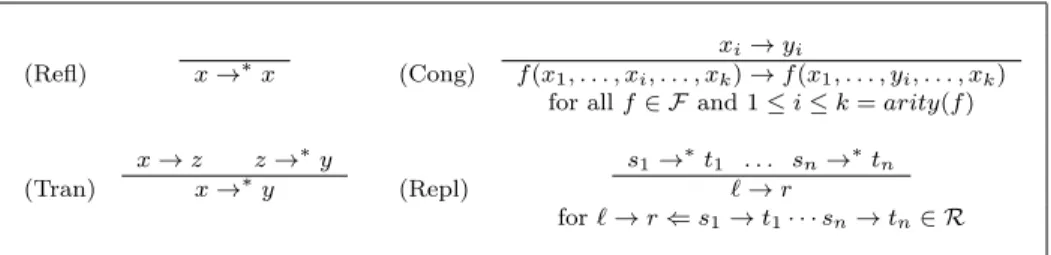
Figure 1: Inference rules for conditional rewriting (x, y, z, x1, . . . , xk, y1, . . . , ykare variables)
and the outcome matched against p. In this way, variables in p become instantiated to expressions which are then used in the right-hand side of the rule to return the final result of the computation. Thus, part of such a computation is accomplished in the conditional part of the rules.
The example illustrates two practical uses of conditional rules when defining functions:
1. Testingboolean conditions before applying a rule, as in (7) and (8). 2. Local reductions of specific expressions followed by matching against a
pattern in order to obtain pieces of information which can be used to build the outcome as in rules (7), (8), and (10).
Although severaltransformationshave been envisaged toremovethe conditional part of the rules, thus yielding an ‘equivalent’ TRS (see [31, 35, 37, 39] and the references therein), programmers still find conditional rules valuable when writing programs in the aforementioned languages.
1.1. Termination,V-termination, and operational termination of CTRSs
The semantics of rewriting-based computational systems is often described by means of the transitions induced by therewriting steps. Theone-step rewrit-ing relation →R on terms induced by a CTRS Ris the basis to describe any
accomplished evaluation or transformation of expressions. In this setting, the
absence of infinite rewrite sequences t1→R t2→R · · · arises as a natural
defi-nition ofterminating behavior for CTRSs. However, computations with CTRSs with rules ` →r ⇐ s1 →t1, . . . , sn → tn (i.e., the conditional part of a rule
consists of a sequence of pairs si→ti, for 1≤i≤n) are defined by means of
anInference System where each rewriting steps→Rtrequires aproof. Figure
1 shows the inference system for conditional rewriting.1 This proof also affects thetermination behavior ofR, representing a differentdimension of it.
1All rules in this system areschematicin that each inference rule B1···Bn
A can actually be used under any instance σ(B1)···σ(Bn)
σ(A) of the rule by a substitution σ. For instance,
(Repl) actually establishes that, for every rule`→r⇐s1 →t1, . . . , sn→tn in the CTRS
R, every instanceσ(`) by a substitutionσrewrites intoσ(r) provided that, for eachsi→ti, with 1≤i≤n, the reachability conditionσ(si)→∗σ(ti) can beproved.
Assume that we have aninterpreter for a logicL, i.e., aninference machine
that, given a theorySand a goal formulaϕ, tries to incrementally build a proof tree forϕ. Intuitively, we callS terminating if for anyϕthe interpreter either finds a proof in finite time, or fails in all possible attempts also in finite time. The notion ofoperational terminationcaptures this idea, meaning that, given an initial goal, an interpreter will either succeed in finite time in producing a closed proof tree, or will fail in finite time, not being able to close or extend further any of the possible proof trees, after exhaustively searching all such proof trees [26]. Besides implying termination in the usual TRS sense, operational termination also captures a‘vertical’ dimensionof the termination behavior which is missing in the usual “without infinite reduction sequences” definition of termination (the ‘horizontal’ dimension).
Example 2. The following CTRSR:
g(a) → c(b) (11)
b → f(a) (12)
f(x) → x⇐g(x)→c(y) (13)
is terminating in the usual sense: there is no infinite rewrite sequence. This is easily proved in this particular case because the underlying TRSRu:
g(a) → c(b)
b → f(a)
f(x) → x
which is obtained fromRby removing the conditional part of the rules(see [6, page 324] and [36, Definition 7.1.2], for instance), is terminating.
However, Ris notoperationally terminating: we have an infinite proof tree for the inference system for CTRSs in Figure 1 (substitutions provide the neces-sary match of rules against the different goals; the labels indicating the applied rules have been conveniently shortened):
g(a)→c(b) (Rp) b→f(a) (Rp) c(b)→c(f(a)) (C) . . . f(a)→a c(f(a))→c(a) (C) c(a)→∗c(b) c(f(a))→∗c(b) (T) c(b)→∗c(b) (T) g(a)→∗c(b) (T) f(a)→a (Rp)
Note that the rightmost uppermost goal c(a)→∗ c(b) remains open due to the
left-to-right evaluation strategy for the goals, which first takes over the infinite branch on its left. This infinite proof tree concerns asinglerewriting stepf(a)→
a. However such a step is indeed possible; the use of(Refl)instead of (Tran)
g(a)→c(b) (Rp) c(b)→∗c(b) (Rf )
g(a)→∗c(b) (T)
f(a)→a (Rp)
Available tools for proving operational termination of CTRSsR(e.g.,AProVE
[18] orVMTL[38]) rely ontransformationsUthat prove operational termination ofRas termination of the TRSU(R). However, this transformational approach has substantial limitations.
Example 3. The following CTRSR[36, Example 7.2.51]
h(d) → c(a) (14)
h(d) → c(b) (15)
f(k(a),k(b), x) → f(x, x, x) (16)
g(x) → k(y)⇐h(x)→d,h(x)→c(y) (17)
is operationally terminating2 but U(R) (where U is the transformation in [36,
Definition 7.2.48]) is not terminating: U(R) consists of rules (14), (15) and
(16)together with the following rules that replacethe conditional rule (17)
g(x) → U1(h(x), x) (18)
U1(d, x) → U2(h(x), x) (19)
U2(c(y), x) → k(y) (20)
withU1 andU2 new function symbols. Ohlebusch displays the following cycle:
f(k(a),k(b),U2(h(d),d)) →U(R) f(U2(h(d),d),U2(h(d),d),U2(h(d),d))
→+
U(R) f(U2(c(a),d),U2(c(b),d),U2(h(d),d)) →+U(R) f(k(a),k(b),U2(h(d),d))
In this paper we define the notion ofV-termination, which captures thevertical
dimension of the termination behavior of CTRSs. We provide auniform defini-tion of terminadefini-tion andV-termination of CTRSs as the absence of specific kinds of infinite proof trees. We prove that operational termination is just the con-junction of termination andV-termination. We use these results to develop a methodology toprove or disprove termination,V-termination, and operational termination of CTRSs. In the TRS setting an interesting approach to develop methods for proving termination of (variants of) rewriting is the extension or generalization of the Dependency Pair (DP) approach for TRSs [1]: the rules
` → r that are able to produce infinite sequences are those whose right-hand sidercontains (possibly recursive)function calls which are represented as new
2Ohlebusch provesRquasi-reductive, which implies itsquasi-decreasingness, which in turn
rulesu→v, calleddependency pairs and collected in a new TRSDP(R). Pairs inDP(R) determinedependency chains whose finiteness characterizes termina-tion ofR. In this paper we generalize the DP approach to all aforementioned termination properties of CTRSs.
1.2. Our contributions
The contributions of this paper (after Section 2, which introduces some pre-liminary notions and definitions) can be summarized as follows:
1. In Section 3 we introduce the notion ofV-termination as the absence of a specific kind of infinite proof trees. We prove that operational termination is the conjunction of termination and V-termination. We also introduce a generic notion of minimality of terms and a number of generic results that are the basis for the developments in the subsequent sections. 2. We provide a complete characterization of termination of CTRSs using
dependency pairs (Section 4). Although our main goal is the development of methods for proving and disprovingoperational termination of CTRSs, a first consideration of the problem of proving termination of CTRSs is useful because: (i) the adaptation of our methodology to characterize termination using dependency pairs is simpler, and (ii) the dependency pairs introduced to analyze termination of CTRSs are also used to analyze operational termination of CTRSs. Our analysis and results apply to arbitrary CTRSs, without any restriction on the shape of the rules` →
r⇐c beyond a general requirement for`not being a variable, something that is fulfilled in most cases.
3. We provide a completecharacterization ofV-termination of CTRSsusing dependency pairs (Section 5). As in the previous case (termination of CTRSs) the obtained dependency pairs are also used to prove operational termination of CTRSs as discussed in the next item.
4. Operational termination of CTRSs can be proved by using the previously introduced dependency pairs for proving termination and V-termination of CTRSs. In Section 6 we show that this can be more efficiently done by considering smaller sets of dependency pairs.
5. Section 7 introduces a new kind of chains, called O-chains, which provide a simpler characterization of operational termination of deterministic 3-CTRSs. We also show how to useO-chains of dependency pairs to prove and disprove termination, V-termination and operational termination of CTRSs using the different kinds of dependency pairs introduced above. Section 8 summarizes in more detail our contributions, discusses related work, and briefly describes the practical use of the ideas developed in this paper in the recent version of the termination toolmu-term [3]. Section 9 discusses future work and concludes.
This paper is an extended and completely revised version of [28, Sections 3 and 4]. In particular, we have invested a substantial effort in thefoundational
The characterization of operational termination in terms of different kinds of proof trees in Section3 is completely new. Sections 4 and 5 about termination andV-termination of CTRSs are also completely new. We have simplified the definition of the 2D DPs given in [28]. And the corresponding notion of chain has been slightly changed to make it more precise. We also provide full proofs of all results.
This paper is dedicatedin memoriamto Bernhard Gramlich, who made impor-tant contributions, in particular, to the analysis of computations with condi-tional rewrite systems. He passed away in June 2014, during the preparation of a first version of this paper, where we pay attention to some of his contributions.
2. Preliminaries
The material in this section follows [36]. A binary relationRon a setA is
terminating if there is no infinite sequence a1 R a2 R a3· · ·. Given relations
R,S⊆A×A, we letR◦S={(a, b)∈A×A| ∃c∈A, aRc∧c Sb}.
2.1. Signatures, Terms, and Positions
Throughout the paper,X denotes a countable set of variables andFdenotes a signature, i.e., a set of function symbols {f,g, . . .}, each having a fixed arity given by a mapping ar : F → N. The set of terms built from F and X is T(F,X). Var(t) is the set of variables occurring in a termt.
Terms are viewed as labelled trees in the usual way. Positions p, q, . . . are represented by sequences of positive natural numbers used to address subterms oft. We denote the empty sequence by. Given positionsp, q, we denote their concatenation as p.q. Positions are ordered by the standard prefix ordering:
p≤qif ∃q0 such that q=p.q0. If pis a position, and Qis a set of positions, thenp.Q={p.q |q∈Q}. The set of positions of a termt isPos(t). Positions of nonvariable symbols int are denoted asPosF(t). The subterm at position p
oftis denoted ast|p, and t[s]p ist witht|p replaced bys.
We write s t, read t is a subterm of s, if t = s|p for some p ∈ Pos(s)
and st if st and s =6 t. We write s 4 t and s 7 t for the negation
of the corresponding properties. The symbol labeling the root of t is denoted as root(t). A context is a term C ∈ T(F ∪ {2},X) with a ‘hole’ 2 (a fresh constant symbol). We writeC[ ]p to denote that there is a (usually single) hole 2 at positionpof C. Generally, we write C[ ] to denote an arbitrary context and make the position of the hole explicit only if necessary. C[ ]=2is called
theemptycontext.
2.2. Substitutions, renamings, and unifiers
A substitution is a mapping σ:X → T(F,X). The ‘identity’ substitution
x7→xfor all x∈ X is denoted ε. The set Dom(σ) ={x∈ X | σ(x)6=x} is called thedomain ofσ.
Remark 4. We do not impose that the domain of the substitutions be finite. This is usual practice in the dependency pair approach, where a single substitu-tion is used to instantiate an infinite number of variables coming from renamed versions of the dependency pairs (see below). When substitutions with finite
domain are assumed, we explicitly call them finitesubstitutions.
A renaming is a bijective substitution ρ such that ρ(x) ∈ X for all x ∈ X. A finite substitutionσ such that σ(s) = σ(t) for two terms s, t ∈ T(F,X) is called aunifier ofsandt; we also say thatsandtunify (with substitutionσ). If two terms s and t unify, then there is a unique most general unifier σ (up to renaming of variables) such that for every other unifier τ, there is a finite substitutionθsuch thatθ◦σ=τ.
2.3. Conditional Rewrite Systems
An (oriented) CTRSRis a pairR= (F, R) whereFis a signature andRa set of rules`→r⇐s1→t1,· · ·, sn→tn. In this paper we assume that` /∈ X.
As usual,` andr are called the left- and right-hand sides of the rule, and the sequences1→t1,· · · , sn →tn (often abreviated toc) is theconditional partof
the rule. Labeled rules are written α:`→ r⇐c, where αis a label, which is often used by itself to refer to the rule.
Rewrite rules ` → r ⇐ c are classified according to the distribution of variables among`,r, andc, as follows: type 1, ifVar(r)∪ Var(c)⊆ Var(`);type 2, if Var(r) ⊆ Var(`); type 3, if Var(r)⊆ Var(`)∪ Var(c); and type 4, if no restriction is given. A rule of typen is often called an n-rule. A rewrite rule
αis aproper n-rule if for allm < n,αisnot anm-rule. Ann-CTRS contains onlym-rules for m≤n. A TRS is a 1-CTRS whose rules have no conditional part; we write them`→r.
A 3-CTRSRis calleddeterministicif for each rule`→r⇐s1→t1, . . . , sn→
tn in R and each 1 ≤ i ≤ n, we have Var(si) ⊆ Var(l)∪S i−1
j=1Var(tj).
Given R = (F, R), we consider F as the disjoint union F = C ] D of sym-bolsc ∈ C (calledconstructors) and symbolsf ∈ D (called defined functions), whereD={root(`)| (`→r⇐c)∈R} andC =F − D. If necessary we may writeCR and DR to make explicit the CTRSRwhich is used to establish the
partition ofF into constructor and defined symbols. Termst ∈ T(F,X) such that root(t)∈ Dare called defined terms. P osD(t) is the set of positionspof
subtermst|p such thatroot(t|p)∈ D. 2.4. Proof trees
Given an atom A (in the CTRS logic) of the form s → t or s →∗ t for
terms s and t, we write pred(A) to refer to its predicate symbol → or →∗,
respectively. We also writeleft(A) to denote termsofA. A finite proof treeT
(for the inference system in Figure 1) is either: (i) anopen goal, simply denoted as G, where G is of the forms →t or s→∗ t for terms s, t; then, we denote
root(T) =G; otherwise, (ii) is aderivation tree with rootG, denoted as
T1 · · · Tn
whereGis as above,T1,. . . ,Tnare finite proof trees (forn≥0), andρ: B1...BA n is
an inference rule such thatG=σ(A), root(T1) =σ(B1), . . . ,root(Tn) =σ(Bn)
for some substitutionσ. We writeroot(T) =G. We say that a finite proof tree
T isclosed if it contains no open goals.
A finite proof tree T is a proper prefix of a finite proof tree T0 if there are one or more open goals G1, . . . , Gn in T such that T0 is obtained from T by
replacing each Gi by a derivation tree Ti with root Gi. We denote this as
T ⊂T0. An infinite proof tree T is an infinite increasing chain of finite proof trees, that is, a sequence{Ti}i∈Nsuch that for alli,Ti ⊂Ti+1. Note that, for all
i∈N, root(Ti) =root(Ti+1); then, we write root(T) =root(T0). We consider two infinite trees {Ti}i∈N and {T
0
i}i∈N equivalent, written {Ti}i∈N ≡ {T
0
i}i∈N,
iff (∀i)(∃j)Ti⊂Tj0 and (∀i)(∃j)Ti0 ⊂Tj. This captures the intuitive idea that
both chains have the same infinite limit.
Remark 5. There can be different (equivalent) ways to represent the same in-finite proof tree T as an infinite increasing chain {Ti}i∈N of finite proof trees
Ti. This is due to the possibility of replacing one of more open goals in Ti by proof trees to obtainTi+1. For instance, consider the following sequence3:
1. T0 is a goalG0.
2. T1 is S1 GG10 O1 whereS1 is a closed proof tree andG1andO1are open
goals.
3. T2 is
S1 S10 O1
G0 whereS
0
1 is a closed proof tree with root G1. 4. T3 is
S1 S10
S2 G2 O2
O1
G0 whereS2 is a closed proof tree andG2 andO2
are open goals.
5. T4 is S1 S10 S2 S20 O2 O1 G0 whereS 0
2 is a closed proof tree with root G2. 6. T5is
S1 S10
S2 S02 S3 G3 O3
O2
O1
G0 whereS3is a closed proof tree andG3
andO3 are open goals. 7. . . .
Note that, for all i≥ 0, Ti ⊂Ti+1 as required. Thus, {Ti}i∈N can be used to represent an infinite proof tree T. However, {T0
i}i∈N (where Ti0 = T2i for all
i∈N) also represents T because{Ti}i∈N≡ {T
0
i}i∈N.
A finite proof treeT iswell-formed if it is either an open goal, or a closed proof tree, or a derivation tree
T1 · · · Tn
G (ρ)
where there isi, 1≤i≤n, such thatT1, . . . , Ti−1are closed,Ti is a well-formed
but not closed finite proof tree, and Ti+1, . . . , Tn are open goals. An infinite
proof tree iswell-formed if it is an increasing chain of well-formed finite proof
~ T1 ~ Tn .. . Gn O~n .. . G1 O~1 G0
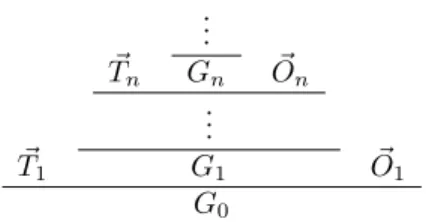
Figure 2: Structure of an infinite well-formed proof treeT
trees. Intuitively, well-formed (finite or infinite) proof trees are the proof trees that an interpreter would incrementally build when trying to solve one condition at a time from left to right.
Remark 6. Infinite well-formed proof trees T have a singleinfinite branch as shown in Figure 2 where for alli≥1,T~i are sequences of closed proof trees and
~
Oi are sequences of open goals. For all i≥0, goal Gi is the root of the infinite subtree immediately above it. Formally,T is the limit of the sequence {Si}i∈N, whereS0=G0 and for alli≥0,Si+1 is obtained from Si by replacing the open goalGi by
~
Ti+1 Gi+1 O~i+1
Gi . Note that, for all i≥0,Si⊂Si+1, as required.
Definition 7. Let T be an infinite well-formed proof tree as in Figure 2. We call the infinite sequence(Gi)i∈N the spine of T, denoted spine(T).
2.5. Conditional rewriting
We writes→R t(resp.s→∗Rt) iff there is a finite well-formed proof tree for
s→t(resp.s→∗t) usingR. We often dropRfrom→
Ror→∗Rif no confusion
arises. Note that s →R t if and only if there is p∈ Pos(s), ` → r ⇐ c ∈ R
and a substitution σ such that σ(u) →∗
R σ(v) for all u → v ∈ c, s|p = σ(`)
andt=s[σ(r)]p. We can make this explicit by writings p
→Rt. We also write
s >p→R t if there is q > p such that s
q
→R t. It is easy to prove that s →∗R t
holds if and only if there is a sequences1, . . . , sn of terms for somen≥1 such
thats=s1,t=sn and for alli, 1≤i < n,si →Rsi+1; in particular, we write
s−→>∗t iffs→∗t and for alli≥0,s
i >
→si+1 holds.
The following definitions introduce some basic combinators for proof trees which are used to connect the usual rewriting notation based on sequences and the corresponding proof trees. First we consider the use of thecongruencerule. Definition 8. LetRbe a CTRS,s, tbe terms,T be a proof tree with root(T) =
s→t, andC[ ]be a context.
1. If T is a finite proof tree, thenC[T] is the finite proof tree
T
.. . (C)
2. If T is an infinite proof tree{Ti}i∈N for finite proof trees Ti, i≥0, then
C[T]is the infinite proof tree{C[Ti]}i∈N.
The following definition concerns the repeated use of rule(Tran). Note that we do not try to cover all possible uses of the rule, but only those which are useful in our development (see also Proposition 10 below).
Definition 9. For alli ≥0, let ti be terms and, for all i≥1, let Ti be finite proof trees with root(Ti) = ti−1 → ti. We write the infinite sequence of such trees asT1, T2, . . . Letn∈Nandube a term. Then
1. Tr(T1, . . . , Tn)is given by: T1 T2 Tn tn→∗tn (Rf ) .. . (Tr) t2→∗tn (Tr) t1→∗tn (Tr) t0→∗tn (Tr) 2. Tru(T1, . . . , Tn)is given by: T1 T2 Tn tn→∗u .. . (Tr) t2→∗u (Tr) t1→∗u (Tr) t0→∗u (Tr)
If S is an infinite proof tree {Si}i∈N with root(S) = tn−1 → tn, then
Tru(T1, . . . , Tn−1, S)is the infinite proof tree{Tru(T1, . . . , Tn−1, Si)}i∈N.
3. IfT is a finite proof tree with root(T) =tn →∗u, then TrT(T1, . . . , Tn)is given by: T1 T2 Tn T .. . (Tr) t2→∗u (Tr) t1→∗u (Tr) t0→∗u (Tr)
If S is an infinite proof tree {Si}i∈N with root(S) = tn →∗ u, then TrS(T1, . . . , Tn) is the infinite proof tree{TrSi(T1, . . . , Tn)}i∈N.
4. Tr∞u (T1, T2, . . .)is given as the limit of the infinite sequence{Si}i∈N, where
S0 is
T1 t1→∗u
t0→∗u
and for all i > 0, Si+1 is obtained from Si by replacing the open goal
ti →∗ uby the derivation tree
Ti+1 ti+1→∗u
ti→∗u
(Tr)
Note that, for alli≥0,Si⊂Si+1, as required.
The following result is obvious from the definitions above and is tacitly used in the sequel; in this result, we writeproof tree to indistinctly refer to a finite or infinite proof tree.
Proposition 10. Let Rbe a CTRS,s, tbe terms andC[ ]be a context.
1. IfT is a closed (resp. infinite, well-formed) proof tree, thenC[T]is closed (resp. infinite, well-formed).
2. For all i≥1, letsi, ti be terms such that ti =si+1 andTi be finite proof trees with root(Ti) =si→ti. Letn∈Nandube a term. Then
(a) If for all i, 1≤i≤n,Ti is a closed proof tree, then Tr(T1, . . . , Tn) is closed.
(b) If for alli,1≤i < n,Tiis a closed proof tree andTnis a well-formed proof tree, then Tru(T1, . . . , Tn)is a well-formed proof tree.
(c) If for all i, 1 ≤ i ≤ n, Ti is a closed proof tree and T is a well-formed proof tree with root(T) =tn→∗u, then TrT(T1, . . . , Tn)is a well-formed proof tree.
(d) If for all i ≥1, Ti is a closed proof tree, then Tr∞u(T1, T2, . . .) is a
well-formed proof tree.
3. Operational termination of conditional rewriting revisited
LetRbe a CTRS. A termt such that there is no infinite well-formed proof tree T with left(root(T)) = t is called operationally R-terminating (or just
operationally terminating). Actually, we have the following.
Proposition 11. Let R be a CTRS. A term t is operationally terminating if and only if there is no infinite well-formed proof treeT with root(T) =t→∗ u
for any termu.
Proof. The only if part is obvious. The if part follows by contradiction.
Assume thattis operationally nonterminating but no goalt→∗uhas an infinite
well-formed tree for any term u. Then, there is an infinite well-formed proof treeT withroot(T) =t→vfor some termv. Then,T∞=Tru(T) is an infinite
well-formed proof tree withroot(T∞) =t→∗u, leading to a contradiction. 2
A CTRS R is called operationally terminating if every term is operationally terminating. Termination can be seen as ahorizontal dimension of operational termination that concerns the absence of infinite sequences of rewriting steps: a termtis said to beR-terminating (or justterminating if no confusion arises)
if there is no infinite rewrite sequencet=t1 →t2→ · · · starting from t. And Ris said to beterminating if every term is terminating. Actually, termination of terms can also be characterized in aproof-theoretic way, as follows.
Proposition 12. LetRbe a CTRS. A termtis terminating if and only if there is no infinite well-formed proof tree T such that left(root(T)) = t and for all
G∈spine(T), pred(G) =→∗.
Proof. By contradiction. For theif part, iftis not terminating, then there is
an infinite rewrite sequencet=s1→Rs2→R· · · →Rsn→R· · ·. For alli≥1,
letTi be the closed proof tree of si→si+1. Letube an arbitrary term. Then,
T =Tr∞u (T1, T2, . . .) is an infinite well-formed proof tree withroot(T) =t→∗u and for allG∈spine(T),pred(G) =→∗, leading to a contradiction. For theonly
if part, if there is an infinite well-formed proof tree T with left(root(T)) = t
and for allG∈spine(T),pred(G) =→∗, then, the only rule that can generate
such a tree is (Tran), i.e.,T is as follows:
T1 Tn .. . Gn (Tran) .. . (Tran) G1 (Tran) G0 (Tran)
where for alli≥1,Ti is a closed proof tree with root(Ti) =si →si+1. Thus,
there is an infinite rewrite sequencet =s1 →R s2 →R · · · →R sn →R · · · for
some termss1, . . . , sn, . . .. that contradicts termination oft. 2
We define now another termination property, called V-termination, which expresses avertical dimension of operational termination.
Definition 13 (V-termination). LetRbe a CTRS. A termtis said to beV -terminatingiff there is no infinite well-formed proof treeTsuch that left(root(T)) =
t and spine(T) contains infinitely many goals G satisfying pred(G) =→. We say thatRis V-terminating iff every term isV-terminating.
We characterize operational termination of CTRSs as the conjunction of ter-mination and V-termination. This formalizes the idea of termination and V -termination beingthe two dimensions of operational termination.
Theorem 14. A CTRS Ris operationally terminating if and only if it is ter-minating andV-terminating.
Proof. IfRis operationally terminating, then there is no infinite well-formed
proof tree. Then,Ris terminating (by Proposition 12) and V-terminating. For the if part, we reason by contradiction. If R is terminating and V -terminating but operationally non-terminating, then there is an infinite well-formed proof treeT. By Proposition 12,spine(T) contains an infinite number of goalsGsuch thatpred(G) =→. This contradictsV-termination ofR. 2
LetHT, VT, and OT denote, respectively, the properties of termination, V -termination, and operational termination. Theorem 14 states the equivalence
((∀t)OT(t))⇔((∀t)HT(t)∧VT(t)) However, the equivalence
(∀t) (OT(t)⇔HT(t)∧VT(t))
doesnot follow from Theorem 14.4 In fact, the latter equivalence does not hold in general (although (∀t) (OT(t)⇒HT(t)∧VT(t)) obviously holds).
Example 15. Consider the following CTRS R
a → b⇐c→d (21)
c → c (22)
Here,a is terminating andV-terminating but operationally nonterminating.
In order to obtain a characterization of operational termination of terms, we have to consider an additional termination property
Definition 16. Let R be a CTRS and t be a term. We say that t is VH -terminating, written VHT(t), iff there is no infinite well-formed proof tree T
with left(root(T)) =tand spine(T) = (Gi)i∈Nsuch that there isn∈Nsatisfying that for alli≥n, pred(Gi) =→∗.
Note that, if we letn= 0 in Definition 16, we obtainHT(t) (according to Propo-sition 12). Thus, this property isstrongerthan termination, i.e., (∀t)VHT(t)⇒
HT(t). For instance,a in Example 15 is notVH-terminating. Proposition 17. Let Rbe a CTRS andt be a term. Then,
OT(t)⇔VHT(t)∧VT(t)
Proof. Theonly if part is obvious. For theif part, we reason by
contradic-tion. IfOT(t) does not hold, then there is an infinite well-formed proof treeT
withleft(root(T)) =t. Letspine(T) = (Gi)i∈N. Sincet isV-terminating, there
isnsuch that, for alli≥n,pred(Gi) =→∗. This contradictsVHT(t). 2
Proposition 17 tells us that we need the stronger propertyVHT(t) (together withVT(t)) to characterize operational termination of a term t (i.e., OT(t)). However, the following result shows that there is no point in defining a newVH -termination property for CTRSs (namely (∀t)VHT(t)) beyond termination: Proposition 18. Let Rbe a CTRS. Then,((∀t)VHT(t))⇔((∀t)HT(t)).
Proof. We have already noticed that for all termst,VHT(t)⇒HT(t) holds. Hence, the implication ((∀t)VHT(t))⇒((∀t)HT(t)) is immediate. We prove that ((∀t)HT(t))⇒((∀t)VHT(t)) by contradiction. If there is a termssuch that VHT(s) does not hold, then there is an infinite proof tree T such that
left(root(T)) = s and for spine(T) = (Gi)i∈N there is n ≥0 such that for all
i ≥n, pred(Gi) =→∗. Let T0 be the infinite well-formed proof tree which is
obtained as the subtree of T with root Gn. Note that spine(T0) = (Gn+i)i∈N
and for allG∈spine(T0),pred(G) =→∗. Letu=left(G
n). By Proposition 12, HT(u) doesnot hold, contradicting that ((∀t)HT(t)) holds. 2 Now, Theorem 14 can be seen as a consequence of Propositions 17 and 18:
Ris operationally terminating ⇔
(∀t)OT(t) ⇔ (by definition)
(∀t) (VHT(t)∧VT(t)) ⇔ (by Proposition 17) ((∀t)VHT(t))∧((∀t)VT(t)) ⇔
((∀t)HT(t))∧((∀t)VT(t)) ⇔ (by Proposition 18) Ris terminating andV-terminating (by definition) Thus, in the following we focus on termination rather thanVH-termination. Notation 19. In the following, we adopt a uniform notation to designate terms and CTRSs with different (terminating,V-terminating, and operationally termi-nating) properties by usinglabelsH, V, Oto speak ofH-,V-, andO-terminating terms and CTRSs, respectively. By chosingH to designate terminating terms, we stress that termination is the horizontal dimension of operational termina-tion. We also letΛ ={H, V, O}to collect all these termination behaviors. 3.1. Minimality
As remarked in the introduction, the dependency pair approach is the ba-sis of most automatic tools for proving termination properties of (variants of) TRSs. Our methodology for the adaptation of the Dependency Pair approach for TRSs to other variants of rewriting or other extensions of rewrite systems makes explicit previous developments in [1, 17, 21, 22] and involves:5
1. The definition of a notion ofminimal non-λ-terminating term (or justλ -minimal, for λ ∈ Λ) which can be used to investigate λ-termination by restricting the attention to a smaller subset of non-λ-terminating terms. 2. The investigation of thestructure of rewrite sequences starting from such
λ-minimal terms.
3. The definition of a notion ofdependency pair, which is able to capture all infinite sequences starting fromλ-minimal terms.
4. The definition of an abstract notion of λ-chain, which can be used to
characterize λ-termination as the absence of infiniteλ-chains.
5This methodology has been successfully applied to, for instance,context-sensitive
In this section we therefore prove some technical results which are used in the rest of the paper to prove our results about using dependency pairs to prove termination properties of CTRSs. These results are parametric onλ∈Λ.
For non-λ-terminating terms we introduce the following notion and then prove some essential facts that will be used later.
Definition 20 (Minimality). Let R be a CTRS, λ ∈ Λ and t be a non-λ -terminating term. We say that t is λ-minimal if every strict subterms of t is
λ-terminating. Let Tλ-∞ be the set of minimal non-λ-terminating terms.
The following lemma shows that non-λ-terminating terms always contain a λ
-minimal term.
Lemma 21. Let R = (F, R) be a CTRS, λ ∈ Λ and s ∈ T(F,X). If s is non-λ-terminating, then there is a subtermt of s(st) such thatt∈ Tλ-∞.
Proof. By structural induction. If s is a constant symbol, take t = s. If
s=f(s1, . . . , sk), we assume thats6∈ Tλ-∞ (otherwise, again let t=s). Then,
there is a strict subterm s0 of s (ss0) which is non-λ-terminating. By the induction hypothesis, there ist∈ Tλ-∞ such thats0t, i.e.,st. 2
Corollary 22. Letλ∈Λ. A CTRSRisλ-terminating iff Tλ-∞=∅.
Subterms and reducts ofλ-terminating terms areλ-terminating as well. Lemma 23. Let R= (F, R) be a CTRS, λ∈Λ, and s, t∈ T(F,X). If s is
λ-terminating, then:
1. If st, then tisλ-terminating.
2. If s→∗
Rt, then tisλ-terminating.
Proof. Ifλ=H, then the proofs are analogous to the well-known proofs for
terminating terms in the TRS setting [21, 22]. Assumeλ∈ {V, O}.
1. We reason by contradiction. Assume that s = C[t] for some context
C[ ]. Iftis non-λ-terminating, then there is an infinite well-formed proof treeT (of the appropriate shape, depending onλ) as in Figure 2, where
G0=root(T). We consider two cases:
(a) IfG0=t→ufor some termu, thenC[T] is an infinite well-formed proof tree withroot(C[T]) =s→C[u]. If λ=O, this already con-tradicts OT-termination of s. If λ = V, then by our assumptions on T, spine(T) contains an infinite number of goals Gi satisfying pred(Gi) =→. Hence C[T] is an infinite well-formed proof tree
and spine(C[T]) contains an infinite number of goals Gi satisfying pred(Gi) =→. This contradictsV-termination ofs.
(b) If G0 = t →∗ ufor some term u, then the first inference rule that applies toG0in T is (Tran). We consider two cases:
i. There are goals G ∈ spine(T) such that pred(G) =→. Then, there ism >0 such that, for alli, 1≤i < monly thetransitivity rule (Tran) has been applied, i.e., T~i contains a single closed
proof treeTi withroot(Ti) =ui−1→ui for some term ui; O~i is
empty and Gi =ui →∗ u. Then, T~m is empty, Gm =um−1 →
um is the root of an infinite well-formed subtree Tm∞ ofT, and
~
Om consists of a single open goalum→∗ u. Thus, we can build
the following infinite well-formed proof treeT0
T10 C[Tm∞] C[um]→∗u .. . G01 (Tran) C[t]→∗u (Tran)
(where Ti0 = C[Ti] and G0i = C[ui] → u for all i, 1 ≤ i < m)
which already contradicts λ-termination of s if λ = O. Fur-thermore, ifλ=V, sinceT0 still contains an infinite number of goals G∈spine(T0) satisfyingpred(G) =→, it also contradicts
λ-termination ofs.
ii. For allG∈spine(T) we havepred(G) =→∗. Note that, in this
case, we can only haveλ=O. Then for all i≥1,T~i consists of
a closed proof treeTi withroot(Ti) =ui−1 →ui for some term
ui; O~i is empty andGi =ui →∗ u. Thus, for alli≥1, we can
replace eachTi byTi0 =C[Ti]. Thus, we obtain:
T10 Tn0 .. . G0n (Tran) .. . (Tran) G01 (Tran) C[t]→∗u (Tran)
where, for all i ≥ 1, G0i = C[ui] →∗ u which contradicts O
-termination ofs. 2. Since s →∗ t, there are termst
0, . . . , tn such that, for all i, 0 ≤ i ≤ n,
ti →R ti+1has aclosed proof treeTi+1and we lett0=sandtn =t. Thus,
there is a finite well-formed proof tree T = Tr(T1, . . . , Tn) for s →∗R t.
Assume that t is not λ-terminating (for λ ∈ {V, O}). Then, there is an infinite well-formed proof treeT0 of the appropriate shape (depending on
λ). We consider two cases:
(a) Ifroot(T0) =t→ufor some termu, we letT00 be
T0 u→∗u0 t→∗u0 (Tran)
for some termu0 to obtainTrT00(T1, . . . , Tn), an infinite well-formed
proof tree with roots→∗u0, which contradictsλ-termination ofsas
(b) If root(T0) = t →∗ u for some term u. Again, the infinite
well-formed proof tree TrT0(T1, . . . , Tn) with root s →∗ u contradicts
λ-termination ofs.
2
Non-λ-terminating inner reducts ofλ-minimal terms areλ-minimal as well. Lemma 24. Let R be a CTRS, λ ∈ Λ, and t ∈ Tλ-∞. If t
>
−→∗ u and u is
non-λ-terminating, thenu∈ Tλ-∞.
Proof. All rewritings below the root oftare issued on λ-terminating terms
that remain λ-terminating by Lemma 23. Then, strict subterms of u are all
λ-terminating. Since uis non-λ-terminating,u∈ Tλ-∞. 2
Given a signature F and f ∈ F, we letf] (often just capitalized, e.g., F)
be a fresh symbol associated tof. Let F] ={f] |f ∈ F } (assume F ∩ F] =
∅). For t = f(t1, . . . , tk) ∈ T(F,X), we write t] to denote the marked term
f](t
1, . . . , tk). And given a marked term t =f](t1, . . . , tk), where t1, . . . , tk ∈
T(F,X), we writet[to denote the termf(t1, . . . , tk)∈ T(F,X).
Proposition 25. Let Rbe a CTRS andλ∈ {H, V, O}. Ift∈ Tλ-∞, thent] is
λ-terminating.
Proof. (Sketch) By contradiction. If t] is not λ-terminating, then there is
an infinite well-formed proof tree T with left(root(T)) = t]. Let spine(T) =
(Gi)i∈N. We consider the three possible cases forλ:
• λ=H. By Proposition 12, we may assume that root(T) =t] →∗ ufor
some term u and for all i ∈ N, Gi = si →∗ u for some terms si (with
t] =s0). Since no rule inR can remove the mark from (the root of)t],
this means that there is a strict subtermti oft] (and hence oft!) starting
an infinite rewrite sequence. This contradicts minimality oft.
• λ=V. There are infinitely manyG∈spine(T) withpred(G) =→. The first of such goals corresponds to the application of a ruleα:`→r⇐c
withcnonempty to a reductuoft], i.e.,t]→∗
Ruso thatTbecomes infinite
because of attempts of evaluation for some of the conditions in c. Since the root symbolf]oft]is marked, we can assume thatt]=f](t
1, . . . , tk),
u=f](u
1, . . . , uk), and for alli,1≤i≤k, ti→∗ui. Thus, the reduction
with α is attempted on uj for some j,1 ≤ j ≤ k. Hence, tj (a proper
subterm oft) is non-V-terminating, contradicting minimality oft. • Ifλ=O, then the only missing case in the previous two points is thatt]
reduces to a term u(i.e.,t]→∗ u) to which a ruleα:`→r⇐c with c
nonempty is attempted but now one of the left-hand sidesvof a condition
v →w ∈c starts an infinite rewriting sequence (after instantiation with the matching substitution). Thus, there is n ∈ N such that for all i > n, pred(Gi) =→∗ but pred(Gn) =→. This case, however, leads to a
2 Notation 26. In the following, rather than talking of H-terminating or H -minimal terms, we will use terminating and minimal terms as these notions already exist in the literature. Similarly, rather than TH-∞, we use the usual
notation T∞ for TRSs (see [21], for instance) to denote the set of H-minimal
terms (minimal nonterminating terms in [21]).
In general, the sets of minimal nonterminating, non-V-terminating and opera-tionally nonterminating terms arenot related by inclusion.
Example 27. Termain Example 15 is minimal operationally nonterminating, but it is terminating andV-terminating. Thus,TO-∞6⊆ T∞∪ TV-∞. As for
f(a) → f(a) (23)
a → b⇐a→b (24)
f(a)is not terminating and, since a is terminating, f(a)∈ T∞. However, f(a)6∈
TO-∞ (because a∈ TO-∞). Therefore, T∞ 6⊆ TO-∞. Actually,for this example,
TO-∞={a} andT∞={f(a)}, i.e.,T∞∩ TO-∞=∅. Now, with
a → a (25)
f(x) → b⇐f(x)→b (26)
we havef(a)∈ TV-∞, but f(a)∈ T/ O-∞ (andf(a)∈ T/ ∞) because a is
nontermi-nating. Therefore,TV-∞6⊆ TO-∞.
In the following we investigate practical approaches to prove termination, V -termination and operational -termination of CTRSs using dependency pairs. Since many definitions and results apply to arbitrary CTRSs, we do not im-pose any specific restriction on CTRSs when formulating them. Instead, when a specific restriction is required for some result (typically type 3 and determin-ism) we will make it explicit in its statement.
4. Dependency pairs for proving termination of CTRSs
In this section we consider the analysis of termination of CTRSs following themethodology summarized in the first paragraphs of Section 3.1.
4.1. Infinite rewrite sequences starting from minimal terms
Our first result in this section is Proposition 29. It establishes that every infinite rewrite sequence starting from a minimal term t = f(t1, . . . , tk) first
rewritest1, . . . , tk to obtaint0=f(t01, . . . , t0k). Then, a ruleα:f(`1, . . . , `k)→
r⇐c applies at the root oft0. Proposition 29 below also tells us that, either: 1. the right-hand side r of α depends on other rules in R, i.e., there are
2. αisnot a 2-rule, i.e.,rcontains an extra variable x∈ Var(r)− Var(`). Definition 28. Let Rbe a CTRS. The set of defined subterms of a termt is:
DSubterm(R,t) ={t|p|p∈ PosD(t)}.
Proposition 29. Let Rbe a CTRS and t∈ T∞. There exist α:`→r⇐c∈
R, a substitution σ, andu∈ T∞ such thatt
>
−→∗σ(`) → σ(r)u, and either
1. there iss∈ DSubterm(R,r),`7s, such that u=σ(s), or
2. there isx∈ Var(r)− Var(`)such that σ(x)u.
Proof. Consider an infinite rewrite sequence starting fromt. By definition of
T∞, all proper subterms oftare terminating. Therefore,thas an inner reduction
to an instanceσ(`) of the left-hand side of a ruleα:`→r⇐s1→t1, . . . , sn→
tn ofR: t >
−→∗ σ(`) → σ(r) withσ(si)→∗σ(ti) for all i, 1≤i≤n, andσ(r)
is nonterminating. Thus, we can write t =f(t1, . . . , tk) and ` =f(`1, . . . , `k)
for somek-ary defined symbolf, andti→∗σ(`i) for alli, 1≤i≤k. Since all
ti are terminating, by Lemma 23 (withλ=H), σ(`i) and all its subterms are
also terminating. Hence,σ(`) is also minimal: σ(`)∈ T∞. By Lemma 23, σ(y)
is terminating for ally ∈ Var(`). Sinceσ(r) is nonterminating, by Lemma 21, it contains a subtermu∈ T∞: σ(r)u, i.e., there is a positionp∈ Pos(σ(r))
such thatσ(r)|p=u. We have two cases:
1. If p∈ PosF(r), then, since u∈ T∞, root(u) ∈ D and there is a defined
subterm s of r, s ∈ DSubterm(R,r), such that u = σ(s). Note that s
cannot be a strict subterm of`, i.e.,`7s. Otherwise,u=σ(s) would be
a subterm ofσ(`), thus failing to be minimal.
2. Ifp /∈ PosF(r), then there isx∈ Var(r) such thatσ(x)u. Sinceσ(y) is
terminating for ally∈ Var(`), it follows thatx∈ Var(r)− Var(`).
2
The proof of case 1 in Proposition 29 is analogous to [21, Lemma 1] (for TRSs). Case 2 is specifically due to the use of conditional rules (with extra variables in the right-hand side). The following definition collects the rules that are used in the first and second cases of Proposition 29, respectively.
Definition 30. LetRbe a CTRS. Let DRules(R)be the set of rules inRwhich
dependon other defined symbols inR:
DRules(R) ={`→r ⇐c∈ R |r ∈ T/ (C,X)}
The set of rules inRwhose right-hand sides contain extra variablesis: ERules(R) ={`→r ⇐c∈ R | Var(r)− Var(`)6=∅} Note that, ifRis a 2-CTRS, thenERules(R) =∅.
Example 31. ForRin Example 2,D={b,f,g},C={a,c}, and DRules(R) = {(11),(12)}, i.e.,
g(a) → c(b)
b → f(a)
However,(13)∈/DRules(R) because(13)is
f(x)→x⇐g(x)→c(y)
with right-hand sidex∈ T(C,X). SinceRis a2-CTRS, ERules(R) =∅. ForR in Example 3, D={f,g,h}, C ={a,b,c,d,k}, DRules(R) ={(16)}
and ERules(R) ={(17)}.
As a corollary of Proposition 29, we have the following result.
Theorem 32. Let Rbe a CTRS. For allt∈ T∞, there is an infinite sequence
t=t0 > −→∗ σ1(l1) → σ1(r1) t 1 > −→∗ σ2(l2) → σ2(r2) t 2 > −→∗ · · ·
where, for alli≥1,(αi:li→ri⇐ci)∈ R,σi are substitutions such thatσi(x) is terminating for allx∈ Var(`i), and termstiare minimal termsti∈ T∞ such
that either:
1. αi ∈DRules(R)and there is a defined subterm si of ri, risi, `i 7si,
such that ti=σi(si), or
2. αi∈ERules(R)and there isxi ∈ Var(ri)− Var(`i)such thatσi(xi)ti.
Remark 33. Item 2 in Proposition 29 concerns proper 3- and 4-rules only. According to the proof of Proposition 29, this is because instancesσ(x)of vari-ables x that occur in the left-hand side ` of the rule α in Proposition 29 are
terminating. This cannotbe ensured for variablesx∈ Var(r)− Var(`)and this is the reason for including item2in Proposition 29. In the following section we investigate conditions to avoid this.
4.2. Preservation of terminating substitutions
In the following, given a CTRSR, a substitutionσ, andV ⊆ X, we say that
σisterminating overV ifσ(x) is terminating for allx∈V.
Definition 34 (Preserving terminating substitutions). LetRbe a CTRS andα:`→r⇐c∈ R. Let σ be a substitution terminating overVar(`). We say thatαpreserves termination ofσiffσis terminating overVar(r)whenever
σ(s)→∗
R σ(t)for alls→t∈c. We say thatRpreserves terminating
substitu-tionsif for all substitutionsσ andα:`→r⇐c∈ R, if σ is terminating over
Var(`), thenαpreserves termination ofσ.
Rules ` → r ⇐ c that preserve terminating substitutions ensure that, if the conditionss→t ∈c are all satisfied by a substitution σ whose bindingsσ(x) are terminating for allx∈ Var(`), then any other bindingσ(y) for a (possibly
new) variabley∈ Var(r) is terminating as well. Considering Definition 34, the following refinements of Proposition 29 and Theorem 32 are obvious:
Proposition 35. Let Rbe a CTRS which preserves terminating substitutions. Then, for all t ∈ T∞, there exist ` → r ⇐ c ∈ DRules(R,t), a substitution
σ, and a term u ∈ T∞ such that t
>
−→∗ σ(`)
→ σ(r) u, and there is
s∈ DSubterm(R,r),`7s, such thatu=σ(s).
Proof. By Proposition 29, infinite rewrite sequences starting from minimal
nonterminating terms can proceed in two precise ways. Either: 1. there iss∈ DSubterm(R,r),`7s, such that u=σ(s), or 2. there isx∈ Var(r)− Var(`) such thatσ(x)u.
Condition 2, though, does not apply as Rpreserves terminating substitutions (i.e.,σ(x) is terminating) anduis nonterminating. 2 Corollary 36. Let R be a CTRS which preserves terminating substitutions. For allt∈ T∞, there is an infinite sequence
t=t0 > −→∗ σ1(l1) → σ1(r1) t 1 > −→∗ σ2(l2) → σ2(r2) t 2 > −→∗ · · ·
where, for alli≥1,(li→ri ⇐ci)∈DRules(R),σi is a substitution such that
σi(x)is terminating for all x∈ Var(`i), and ti ∈ T∞ is such that ti =σi(si) for somesi∈ DSubterm(R,ri),`i7si.
The following fact easily follows from Definition 34.
Proposition 37. Every 2-CTRS preserves terminating substitutions.
Theorem 32 and Corollary 36 are the basis for our next results, which provide several new methods for proving termination of CTRSs.
4.3. Dependency pairs for termination of CTRSs
In the following, given a CTRS R, we obtain a new CTRS R0. Each rule
in R0 is obtained from a rule ` →r ⇐ c ∈ R by marking the left-hand sides
` and also using subterms v in the right-hand side r. The obtained rules are of the form`] → v0 ⇐ c where v0 = v if v ∈ X and v0 = v] otherwise. For
historical reasons, we usually call them pairs.6 In our definitions we assume that the signaturesF0 of such new CTRSs R0 are obtained by just extracting
all function symbols (with the corresponding arity) from the obtained rules7
`]→v0 ⇐c. The following set of horizontal dependency pairs corresponds to rules issuing root steps in infinite minimal sequences (see Theorem 32, item 1):
6The first presentation of the DP approach for TRSs [1] clearly distinguished between
rewrite rules and dependency pairs (even usinghu, vi rather than u → v for the latter), although syntactically they are isomorphic structures. This difference became less relevant in other presentations like [21] and [16, 17]. The original terminology, however, is useful as it stresses the differentrole of pairs and rewrite rules (fromR) in the DP approach.
7See [40] for an interesting discussion about the formal use of this assumption in termination
analysis in the TRS setting. See also [36, Section 8.7] and the references therein for related considerations for CTRSs.
Definition 38. Let R be a CTRS. The CTRS DPH(R) of horizontal
depen-dency pairs is:
DPH(R) ={`]→v]⇐c|`→r⇐c∈DRules(R),v ∈ DSubterm(R,r), `7v}
Example 39. ForRin Example 1,DPH(R)consists of the rules:
LEQ(s(x),s(y)) → LEQ(x, y) (27)
APP(cons(x, xs), ys) → APP(xs, ys) (28)
QSORT(cons(x, xs)) → APP(qsort(ys),cons(x,qsort(zs))) (29) ⇐ split(x, xs)→pair(ys, zs)
QSORT(cons(x, xs)) → QSORT(ys)⇐split(x, xs)→pair(ys, zs) (30)
QSORT(cons(x, xs)) → QSORT(zs)⇐split(x, xs)→pair(ys, zs) (31) Example 40. ForRin Example 2,DPH(R)is:
G(a) → B (32)
B → F(a) (33)
ForRin Example 3,DPH(R) ={F(k(a),k(b), x)→F(x, x, x)}.
The following set ofcollapsing dependency pairs corresponds to rules extracting minimal terms from substitution bindings in infinite minimal sequences (see Theorem 32, item 2):
Definition 41. Let R be a CTRS. The CTRS DPC(R) of collapsing
depen-dency pairs is:
DPC(R) ={`]→x⇐c|`→r⇐c∈ERules(R),x ∈ Var(r)− Var(`)}
Example 42. ForRin Example 1,DPC(R)consists of the rules:
SPLIT(x,cons(y, ys)) → xs (34)
⇐ less(x, y)→true,split(x, ys)→pair(xs, zs)
SPLIT(x,cons(y, ys)) → zs (35)
⇐ less(x, y)→true,split(x, ys)→pair(xs, zs)
SPLIT(x,cons(y, ys)) → xs (36)
⇐ less(x, y)→false,split(x, ys)→pair(xs, zs)
SPLIT(x,cons(y, ys)) → zs (37)
⇐ less(x, y)→false,split(x, ys)→pair(xs, zs)
QSORT(cons(x, xs)) → ys⇐split(x, xs)→pair(ys, zs) (38)
QSORT(cons(x, xs)) → zs⇐split(x, xs)→pair(ys, zs) (39)
ForRin Example 2,DPC(R) =∅. ForRin Example 3,
DPC(R) ={G(x)→y⇐h(x)→d,h(x)→c(y)}.
Definition 43. In the following, DPHC(R)is:
4.4. Characterization of termination of CTRSs
An essential achievement of the DP approach is thecharacterization of ter-mination of a TRSR as the absence of infinitechains of dependency pairs in
DP(R), the set of dependency pairs associated to R[1]. In this TRS setting, given a subsetP ⊆DP(R) of dependency pairs, a (P,R)-chain is a (possibly in-finite) sequenceu1→v1, u2→v2, . . .of (renamed versions of) rulesui→vi∈ P
together with a substitutionσsuch that σ(vi)→∗Rσ(ui+1) for alli≥1. Note
the different role of rules inP andR: rules inP (calledpairs) are the compo-nentsof the chain; rules inRare used toconnectconsecutive pairs by rewriting. In the following we generalize this approach to prove termination of CTRSs. First, we introduce a suitable notion of H-chain that can be used with our dependency pairs in Section 4.3 to model the infinite sequences of minimal terms whose structure is described by Theorem 32 above. Our H-chains are sequences of renamed variants of rulesP ⊆DPHC(R), which we also callpairs.
Such pairs are connected by means of rewriting steps issued not only withR, but also using a TRSQwhich is used toextract andmark (minimal) subterms (Theorem 32).
Remark 44. In the remainder of the paper, unless stated otherwise,P,Q, and
Rare CTRSs having possibly different signatures.
In the following definition, given a TRSQ, we write Q ={` →r | `→ r∈ Q, `r} andQ]=Q − Q.
Definition 45. Let P andRbe CTRSs andQbe a TRS. A(P,Q,R)-H-chain is a finite or infinite sequence of (renamed) rules ui → vi ⇐ ci ∈ P, which are viewed as “conditional dependency pairs”, together with a substitution σ
satisfying that, for all i ≥1 and all s → t ∈ ci, σ(s) →∗R σ(t). Also, for all
i≥1, there is a termwi such that:
1. If vi∈ X − V/ ar(ui), thenσ(vi) =wi→∗Rσ(ui+1). 2. If vi∈ X − Var(ui), thenσ(vi) −→∗ Q◦ →Q] wi→ ∗ Rσ(ui+1).
A(P,Q,R)-H-chain is called minimalif for all i≥1,wi isR-terminating.
As usual, in Definition 45 we assume that for alli, j≥1,i6=j,Var(ui→vi⇐
ci)∩ Var(uj →vj ⇐cj) =∅ (renaming substitutions are used if necessary).
In the following, given a signatureF, we write
Emb(F) = {f(x1, . . . , xk)→xi|f ∈ F, k=ar(f),1≤i≤k}
M](F) = {f(x
1, . . . , xk)→f](x1, . . . , xk)|f ∈ F, k=ar(f)}
wherex1, . . . , xk are fresh variables. Here,Emb(F) is used toextract fromσ(x)
(for acollapsing rule`→x⇐c ∈ P) any minimal nonterminating subterm u
which may be inside. Clearly, if st, then s−→ ∗
Emb(F)t. And we then use M](F) to mark the root (defined) symbolf ofu(i.e.,f =root(u)) so thatu]
Definition 46. For signatures F andF0, we let
EM](F,F0) =Emb(F)∪ M](F0).
We now provide a new characterization of termination of CTRSs.
Theorem 47 (Termination). Let R= (F, R) = (C ] D, R)be a CTRS.
1. If there is no infinite minimal (DPHC(R),EM](F,D),R)-H-chain, then
Ris terminating.
2. If there is an infinite (DPHC(R),EM](F,D),R)-H-chain, then R is not
terminating.
Proof.
1. By contradiction. IfRis nonterminating, then there is a minimal termt
starting an infinite minimal sequence. By Theorem 32, this sequence has the following form:
t=t0 > −→∗ σ 1(`1) → σ1(r1) t1 > −→∗ σ 2(`2) → σ2(r2) t2 > −→∗ · · ·
where, for alli≥1, (αi:`i →ri ⇐ci)∈ R,σiare substitutions such that
σi(x) is terminating for allx∈ Var(`i), and terms ti ∈ T∞ are minimal
nonterminating terms such that either
(a) αi ∈ DRules(R) and there is a defined subterm si of ri, ri si,
`i 7si, such thatti=σi(si). In this case,`]i →s ] i ⇐ci ∈DPH(R) andσ(s]i) =σ(si)]=t ] i→∗R σ(` ] i+1).
(b) αi ∈ERules(R) and there isxi∈ Var(ri)−Var(`i) such thatσi(xi)
ti. In this case, ` ] i → xi ⇐ ci ∈ DPC(R) and σ(xi) −→∗ Emb(F)ti.
Since ti is minimal, root(ti) ∈ D and we have ti
→M](D) t
] i →∗R
σ(`]i+1).
Note that, in both cases, by Proposition 25, t]i isR-terminating. Thus, we obtain an infinite minimal (DPHC(R),EM](F,D),R)-H-chain.
2. Let (ui→vi ⇐ci)i≥1 be an infinite (DPHC(R),EM](F,D),R)-H-chain.
If we remove allmarksfrom any term in this chain and restore the contexts which were removed from the rules ofRto obtain the pairs inDPHC(R),
we obtain an infinite rewrite sequence witnessing nontermination ofR.
2 Example 48. Consider the CTRSRin Example 2. WithDPH(R)as in
Exam-ple 40 andDPC(R) =∅ (Example 42), the longest(DPHC(R),EM](F,D),R)
-H-chain consists of(32)followed by (33). Thus,Ris terminating.
Example 49. Consider the following 3-CTRS R, which is obtained from the
2-CTRS in Example 2 by a small change in rule (13)to yield(42):
g(a) → c(b) (40)
b → f(a) (41)
Note that DRules(R) ={(40),(41)}. Again,DPH(R)is as in Example 40, but
DPC(R) consists now of a single rule
F(x) → y⇐g(x)→c(y) (43) WithEmb(F) given by c(x) → x (44) f(x) → x (45) g(x) → x (46) andM](D)as follows: b → B (47) f(x) → F(x) (48) g(x) → g(x) (49)
there is an infinite(DPHC(R),EM](F,D),R)-H-chain
B→(33)F(a)→(43)b→(47)B→(33)F(a)→(43)b→(47)· · ·
witnessing thatRis notterminating.
The followingsimpler characterization of termination for CTRSs that preserve terminating substitutions is obtained from the proof of Theorem 47 by using Corollary 36 instead of Theorem 32.
Corollary 50. A CTRSRwhich preserves terminating substitutions is termi-nating if and only if there is no infinite minimal(DPH(R),∅,R)-H-chain.
Corollary 51 (Termination of 2-CTRSs). A 2-CTRS R is terminating if and only if there is no infinite minimal(DPH(R),∅,R)-H-chain.
4.5. Termination of which (type of ) CTRSs?
Term Rewriting Systems having rules `→rwith extra variables (i.e., vari-ablesy ∈ Var(r) such that y /∈ Var(`)) arenot terminating: since r=r[y], we can define amatching substitutionσto obtain an infinite rewrite sequence:
`→r[`]→r[r[`]]→ · · · as follows: σ(x) =xfor allx∈ X − {y} andσ(y) =`.
The notion of type of a CTRS (see Section 2.3) provides a more precise characterization of where extra variables are allowed. In this setting, proper
4-CTRSs are intrinsicallynonterminating if the proper 4-rule`→r⇐cisnot
unsatisfiable. Indeed, if there is a substitutionσsuch that σ(s)→∗Rσ(t) holds for alls→t∈cbutαis aproper 4-rule, then there is a variabley∈ Var(r) such
thaty /∈ Var(`)∪ Var(c) andr=r[y]. Thus, we just need to writeσ(y) =σ(`) to obtain an infinite rewrite sequence:
σ(`)→σ(r[y]) =σ(r)[σ(`)]→σ(r)[σ(r)[σ(`)]]→ · · ·
Our treatment of termination applies to CTRS of arbitrary type. However, the previous observation shows that 3-CTRSs are a more realistic target when proofs of termination are attempted. The following example shows, however, thatdeterminism(which is an important mechanism to control the role of extra variables in CTRSs) doesnot play an essential role to achieve termination. Example 52. Consider the following nondeterministic 3-CTRSR:
a→x ⇐ x→b (50)
Since DPH(R) = ∅, DPC(R) = {A → x ⇐ x → b}, Emb(F) = ∅ and
M](D) = {a → A}, there is no infinite (DP
HC(R),EM](F,D),R)-H-chain
andRis terminating. However, for the nondeterministic 3-CTRS R0:
a→x ⇐ x→a (51)
we have DPH(R0) = ∅, DPC(R0) = {A → x ⇐ x → a}, Emb(F) = ∅ and
M](D) = {a → A}. There is now an infinite (DP
HC(R0),EM](F,D),R0)
-H-chain with substitutionσ(x) =a:
A→a→A→a→ · · ·
Therefore,R0 is nonterminating.
In the following, we will investigate operational termination of CTRSs. Since nontermination implies operational nontermination, we cannot expect that 4-CTRSs (without useless rules) are operationally terminating. What about non-deterministic3-CTRSs? Note thatRin Example 52 (which is terminating) is
not operationally terminating: there is an infinite well-formed proof tree ..
.
a→a a→∗b
a→∗b a→a
3-CTRSsRwith a proper nondeterministic 3-rule`→r⇐Vn
i=1si→tiwithout
unsatisfiable conditions will be operationally nonterminating: there isi, 1≤i≤
nandy ∈ Var(si) such thaty /∈ Var(`)∪S i−1
j=1Var(tj). If there is a substitution
σsuch that σ(sj)→∗ σ(tj) holds for allj, 1≤j < i, then it is not difficult to
see that an infinite well-formed proof tree like the previous one is possible. Remark 53. In the analysis ofV-termination and operational termination that we develop in the following sections we focus on deterministic 3-CTRSs, al-though our analysis of operational nontermination applies to arbitrary CTRSs.
5. Dependency pairs for provingV-termination of CTRSs
In this section we consider the analysis of V-termination of deterministic 3-CTRSs. Again, we follow themethodologyalready summarized in Section 3.1.
5.1. Infinite computations starting from minimal non-V-terminating terms
Proposition 54 below establishes that, for t∈ TV-∞, there is a precise way
for an infinite computation to proceed. Roughly speaking, a ‘true’ conditional rule `→ r ⇐ Vn
i=1si → ti with n > 0 must be used to try a failed root-step
on a reduct oft. The reason of this ‘failure’ is that the evaluation of one of the conditionssi turns into an infinite climbing in the proof tree. Then, there is
a V-minimal subterm which is an instance of a nonvariable subterm of one of theleft-hand sides si of a conditionsi→ti (the infinite computation continues
through thevertical dimension). The set of ‘proper’ conditional rules ofRis:
CRules(R) ={`→r ⇐c∈ R |c is not empty}.
Obviously,CRules(R) =∅ if and only ifRis a TRS.
Proposition 54. Let Rbe a deterministic3-CTRS andt∈ TV-∞. There exist
α:`→r⇐Vn
j=1sj→tj∈CRules(R)and a substitution σsuch that
t −→>∗σ(` 1) →σ(r1)t1 > −→∗ · · · −→>∗σ(` m) →σ(rm)tm > −→∗ σ(`) (52)
for rules`k →rk⇐ck∈DRules(R), where
1. for allk,1≤k≤m,
(a) for alls→t∈ck,σ(s)→∗σ(t)and
(b) tk =σ(vk)∈ TV-∞ for somevk ∈ DSubterm(R,rk)
2. there isi,1≤i≤nsuch that for all j,1≤j < i,
(a) σ(sj)isV-terminating,
(b) σ(sj)→∗σ(tj), and
(c) there isv∈ DSubterm(R,si)such that`7v andσ(v)∈ TV-∞.
Proof. Sincet is non-V-terminating, there is an infinite proof treeT:
T1 T2 Tm∞ .. . (C) C[σ(`)]→C[σ(r)] (C) C[σ(r)]→∗u .. . (Tran) u2→∗u (Tran) u1→∗ u (Tran) t→∗u (Tran)
1. for allk, 1≤k < m,Tk is a closed proof tree withroot(Tk) =uk−1→uk
for some termsuk (beingu0=t), 2. C[ ] is a context, and
3. T∞
m is an infinite well-formed proof tree
Tm,1· · ·Tm,i−1 Tm,i∞ Gi+1· · ·Gn
σ(`)→σ(r) (Rp)
where:
(a) for all j, 1 ≤ j < i, Tm,j are closed proof trees withroot(Tm,j) =
σ(sj)→∗σ(tj),
(b) for all j,i < j≤n,Gj=σ(sj)→∗σ(tj) are open goals, and
(c) T∞
m,iis an infinite well-formed proof tree withroot(Tm,i∞) =σ(si)→∗
σ(ti) andspine(Tm,i∞) having infinitely many goalsGwithpred(G) =→.
The existence ofT (which isTru(T1, . . . , Tm−1, C[Tm∞]) for short) implies that of
a sequencet→∗C[σ(`)] for some ruleα:`→r⇐Vn
j=1sj →tj ∈CRules(R)
such that for allj, 1≤j < i,σ(sj)→∗σ(tj). Assume that the lengthN of this
sequence is the shortest possible. We prove by induction onN that a sequence of the form (52) exists.
1. If N = 0, then t = C[σ(`)]. Since σ(`) is obviously non-V-terminating and t ∈ TV-∞, we must have t = σ(`) (i.e., the context C[ ] is empty).
Therefore, we have a sequence like (52) as required with m = 0. Since
root(Tm,i∞) =σ(si)→∗σ(ti), we have thatσ(si) is notV-terminating. We
can assume (by a minimality argument on i) that for all j, 1 ≤ j < i,
σ(sj) is V-terminating, and σ(sj) →∗ σ(tj). Clearly, α ∈ CRules(R).
And by Lemma 23, for all j, 1 ≤ j < i, σ(tj) and all its subterms are
V-terminating. Since R is deterministic, σ(x) is V-terminating for all
x∈ Var(si). Sinceσ(si) isV-nonterminating, by Lemma 21 it contains
a subterm u ∈ TV-∞: σ(si)u, i.e., there is a position p∈ Pos(σ(si))
such thatσ(si)|p =u. The case p /∈ PosF(si) is not possible; otherwise
there isx∈ Var(si) such thatσ(x)u. Since σ(y) isV-terminating for
ally∈ Var(si) we get a contradiction. Thus,p∈ PosF(si). Then there is
a subtermvofsi,siv, such thatu=σ(v). Sinceroot(v) =root(u)∈ D
(by minimality ofu),vis a defined term: v∈ DSubterm(R,si). Note that
v cannot be a strict subterm of `, i.e.,`7v. Otherwise, u=σ(v) would be a subterm ofσ(`), thus failing to be minimal.
2. If N > 0, then we have t →p t0 →∗ C[σ(`)]. Note that t0 is non-V
-terminating. We consider two cases according top:
(a) If p > , then, by minimality of t, the reduction step is issued on a V-terminating term t|p by means of a rule `0 → r0 ⇐ c0, i.e.,
t0 =t[σ(r0)]p. By Lemma 23,σ(r0) isV-terminating and, sincet0
non-V-terminating and all its immediate subterms areV-terminating,t0
is also minimal. By the induction hypothesis, there is a sequence
t0 −→>∗σ(`1)→ σ(r1)t 1 > −→∗ · · · −→>∗σ(` m) →σ(rm)tm > −→∗σ(`)