A preliminary version of this paper is published in the proceedings of the 30th Annual International Conference on the Theory and Applications of Cryptographic Techniques—Eurocrypt 2011 [33]. This is the full version.
Efficient Authentication from Hard Learning Problems
Eike Kiltz∗ Ruhr-Universit¨at Bochum Krzysztof Pietrzak† IST Austria Daniele Venturi University of Trento David Cash Rutgers University Abhishek Jain
Boston University and MIT
Abstract
We construct efficient authentication protocols and message authentication codes (MACs) whose security can be reduced to the learning parity with noise (LPN) problem.
Despite a large body of work—starting with theHBprotocol of Hopper and Blum in 2001— until now it was not even known how to construct an efficient authentication protocol from LPN which is secure against man-in-the-middle (MIM) attacks. A MAC implies such a (two-round) protocol.
Contents
1 Introduction 2 1.1 Our Contribution . . . 3 1.2 Efficiency . . . 5 1.3 Subsequent Work . . . 7 2 Definitions 7 2.1 Notation . . . 7 2.2 Authentication Protocols . . . . 8 2.3 Message Authentication Codes . 9 2.4 Hard Learning Problems . . . 9 2.5 Hoeffding Inequality . . . 133 Two-Round Authentication with
Active Security 13
3.1 Proof of Completeness . . . 14 3.2 Proof of Security . . . 14
3.3 Avoiding Checking . . . 17
4 Message Authentication Codes 17
4.1 First Construction . . . 18 4.2 Second Construction . . . 22
References 32
A Extensions 32
A.1 Trading Key Size for Communica-tion Complexity . . . 32 A.2 An alternative Two-Round
Au-thentication Protocol . . . 33 A.3 Generalization to LWE . . . 34
B A Technical Lemma 35
∗
Supported by a Sofja Kovalevskaja Award of the Alexander von Humboldt Foundation and the German Federal Ministry for Education and Research.
†
Supported by the European Research Council, ERC Starting Grant (259668-PSPC) and ERC consolidator grant (682815 - TOCNeT).
1
Introduction
Authentication is among the most basic and important cryptographic tasks. In the present paper we construct efficient (secret-key) authentication schemes from the assumption that the learning parity with noise (LPN) problem is hard. Informally, this problems asks to distinguish noisy inner products from random. We construct the first efficient message authentication codes (MACs) from LPN, but also simpler and more efficient two-round authentication protocols that achieve a notion called active security. Prior to our work, the only known way to construct an LPN-based MAC was via a relatively inefficient generic transformation [23] (that works with any pseudorandom generator), and all interactive LPN-based protocols with security properties similar to our new protocol required at least three rounds and had a loose security reduction. Our constructions and techniques diverge significantly from prior work in the area and will hopefully be of independent interest.
The pursuit of LPN-based authentication is motivated by two disjoint concerns, one theoretical and one practical. On the theoretical side, the LPN problem provides an attractive basis for provable security [3, 5, 6, 32, 27, 41]. It is closely related to the well-studied problem of decoding random linear codes, and unlike most number-theoretic problems used in cryptography, the LPN problem does not succumb to known quantum algorithms. On the practical side, LPN-based authentication schemes are strikingly efficient, requiring relatively few bit-level operations. Indeed, in their original proposal, Hopper and Blum [27] suggested that humans could perform the computation in their provably-secure scheme, even with realistic parameters.
Each of our theoretical and practical motivations, on its own, would be sufficiently interesting for investigation, but together the combination is particularly compelling. LPN-based authentication is able to provide a theoretical improvement in terms of provable security in addition to providing better efficiency than approaches based on more classical symmetric techniques that are not related to hard problems. Usually we trade one benefit for the other, but here we hope to get the best of both worlds.
Before describing our contributions in more detail, we start by recalling authentication protocols, the LPN problem, and some of the prior work on which we build.
Authentication protocols. An authentication protocol is a (shared-key) protocol where a prover P authenticates itself to a verifierV. We recall some of the common definitions for security against impersonation attacks. A passive attack proceeds in two phases, where in the first phase the ad-versary eavesdrops on several interactions between P and V, and then attempts to cause V to accept in the second phase (where P is no longer available). In an active attack, the adversary is additionally allowed to interact withP in the first phase. The strongest and most realistic attack model is a man-in-the-middle attack (MIM), where the adversary can arbitrarily interact with P and V (with polynomially many concurrent executions allowed), and wins if it can make V accept in any execution where at least one message was changed.
The LPN problem. Forτ <1/2 and a vectorx∈Z`
2, define the distribution Λτ,`(x) onZ`2×Z2 by (r,rTx +e), where r ∈
Z`2 is uniformly random and e ∈ Z2 is selected according to Berτ,
the Bernoulli distribution over Z2 with parameter τ (i.e., Pr[e = 1] = τ). The LPNτ,` problem
is to distinguish an oracle returning samples from Λτ,`(x), where x ∈ Z`2 is random and fixed, from an oracle returning uniform samples. It was shown by Blum et al. [5] that this is equivalent
Pτ,n(s∈Z`2) Vτ0,n(s∈Z`2)
R
←
−
R←$ Z`2×ne←$ Bernτ
z:=RT·s+e
−
→
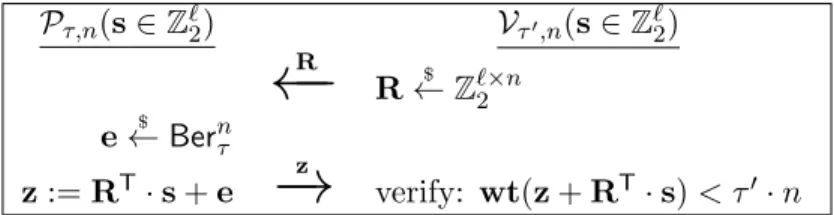
z verify: wt(z+RT·s)< τ0·n Figure 1: TheHBprotocol, secure against passive attacks.to the search version of LPN, where one needs to find x given oracle access to Λτ,`(x) (cf. [31,
Thm.2] for precise bounds). We note that the search variant of LPN is efficiently solvable when there is no noise (i.e. when τ = 0) using Gaussian elimination, for this we just need ` samples with linearly independent r’s. The best algorithms take time 2`/log` when τ > 0 is treated as a constant [6, 34, 24, 46, 9, 8, 7].
Authentication protocols from LPN. Starting with the work of Hopper and Blum [27], several authentication protocols based on the LPN problem have been proposed. Their original elegant protocol is simple enough for us to recall right away. The shared secret key is a binary vector
s ∈ Z`2. The interaction consists of two messages. First V sends a random challenge r∈ Z`2, and thenP answers with the bitz=rTs+e, wheree∈Z2 is sampled according to Berτ. Finally, the
verifier accepts ifz=rTs.
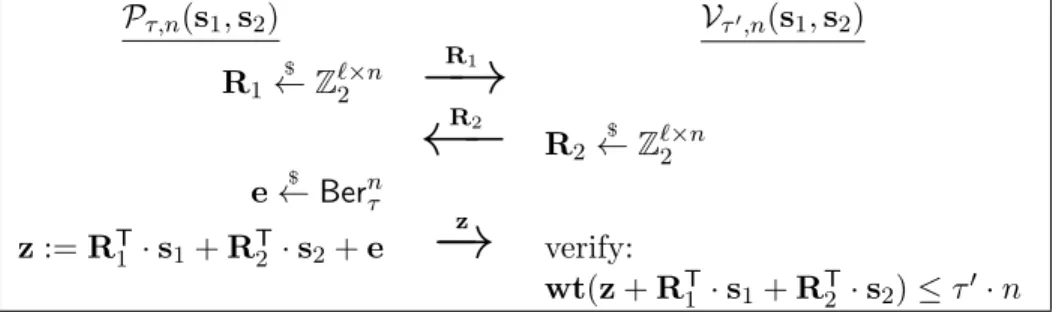
This basic protocol has a large completeness error τ (as V will reject ife = 1) and soundness error 1/2 (as a random r, z satisfies rTs = z with probability 1/2). This can be reduced via sequential or parallel composition. The parallel variant, denoted HB, is illustrated in Figure 1 (we represent severalrwith a matrixRand the noise bits are now arranged in a vectore). The verifier accepts if at least aτ0 fraction (whereτ < τ0 <1/2) of thenbasic authentication steps are correct. The 2-roundHBprotocol is provably secure against passive attacks, but efficient active attacks are known against it. This is unsatisfying because in several scenarios an adversarywill be able to mount an active attack. Subsequently, Juels and Weis [28] proposed an efficient 3 round variant of HB, called HB+, and proved it secure against active attacks. Again the error can be reduced by sequential repetition, and as shown by Katz, Shin and Smith via a non-trivial analysis, parallel repetition works as well [30, 31]. The protocol (in its parallel repetition variant) is illustrated in Figure 2.
Gilbertet al.[20] showed thatHB+can be broken by a MIM attack. Several variantsHB++[11],
HB∗ [16], HB-MP [37] were proposed to prevent the particular attack from [20], but all of them were later shown to be insecure [21]. In [22], a variant HB# was presented which provably resists the particular attack from [20], but was shown susceptible to a more general MIM attack [38]. However, no improvements in terms of round complexity, security or tightness of the reduction over
HB+ were achieved: 3 round protocols achieving active security√ε(assuming LPN isε-hard) are the state of the art.
1.1 Our Contribution
We provide new constructions of authentication protocols and even MACs from LPN. Our first contribution is atwo-round authentication protocol secure against active adversaries (this is
men-Pτ,n(s1,s2) Vτ0,n(s1,s2) R1 $ ←Z`2×n
−→
R1 R2←−
R2 $ ←Z`2×n e←$ Bernτ z:=RT1 ·s1+RT2 ·s2+e z−
→
verify: wt(z+RT 1 ·s1+RT2 ·s2)≤τ0·n Figure 2: The HB+ protocol, secure against active attacks.tioned as an open problem in [28]) which moreover has a tight security reduction (an open problem mentioned in [31]). As a second contribution, we build two efficient MACs, and thus also get two-round authentication protocols secure against MIM attacks, from the LPN assumption. Unlike some previous proposals, our constructions are not ad-hoc, and we give a reduction to the LPN problem. Our authentication protocol is roughly as efficient as theHB+protocol but has twice the key length. Our MACs perform roughly the same computation as the authentication protocol plus one evaluation of a pairwise independent permutation of an ≈2`bit domain, where `is the length of an LPN secret.
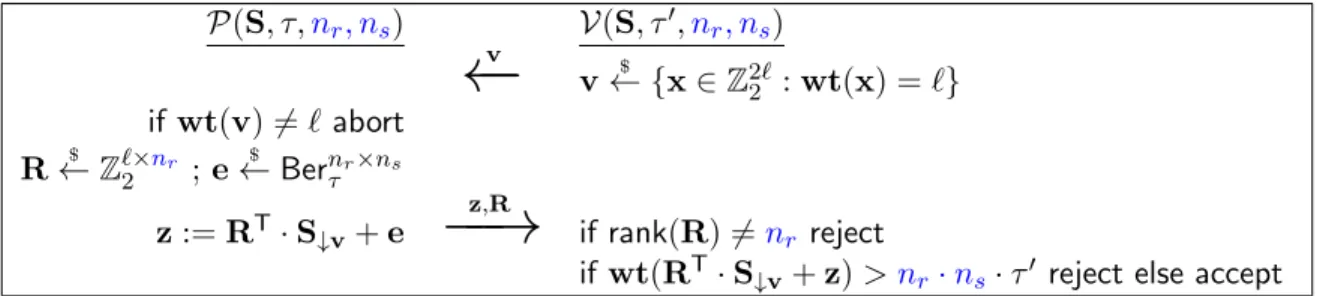
2-round authentication with active security. Our first contribution is a two-round authen-tication protocol which we prove secure against active attacks assuming the hardness of the LPN problem. Our protocol diverges considerably from all previous HB-type protocols [27, 28, 31, 22], and runs counter to the intuition that the only way to efficiently embed the LPN problem into a two-round protocol is via anHB-type construction.
We now sketch our protocol. InHBand its variants, the prover must compute LPN samples of the formRT·s+e, whereRis the challenge chosen by the verifier in the first message. We take a different approach. Instead of sendingR, we now let the verifier choose a random subset of the bits of s to act as the “session-key” for this interaction. It represents this subset by sending a binary vector v ∈ Z`2 that acts as a “bit selector” of the secret s, and we write s↓v for the sub-vector
of s which is obtained by deleting all bits from s where v is 0. (E.g. if s = (1,1,1,0,0,0)T,v = (0,1,1,1,0,0)T thens↓v= (1,1,0)T.) The prover then picks Rby itself and computes noisy inner
products of the form RT·s↓v+e. Curiously, allowing the verifier to choose which bits ofs to use
in each session is sufficient to prevent active attacks. We only need to add a few sanity-checks that no pathological vorR were sent by an active adversary.
Our proof relies on the recently introduced subspace LPN problem [40]. In contrast to the active-attack security proof ofHB+[31], our proof does not use any rewinding techniques. Avoiding rewinding has at least two advantages. First, the security reduction becomes tight. Second, the proofs also work in a quantum setting: our protocol is secure against quantum adversaries assuming LPN is secure against such adversaries. As first observed by van de Graaf [43], classical proofs using rewinding in general do not translate to the quantum setting (cf. [45] for a more recent discussion). Let us emphasise that this only means that there is no security proof for HB+ in the quantum setting, but we do not know if a quantum attack actually exists.
MAC & man-in-the-middle security. In Section 4, we give two constructions of message authentication codes (MACs) that are secure (formally, unforgeable under chosen message attacks) assuming that the LPN problem is hard. It is well known that a MAC implies a two-round MIM-secure authentication protocol: the verifier chooses a random message as challenge, and the prover returns the MAC on the message.
As a first attempt, let us try to view our authentication protocol as a MAC. That is, a MAC tag is of the formφ= (R,z=RT·fs(m) +e), where the secret key derivation functionfs(m)∈Z`2 first uniquely encodes the messagem into v∈Z2`
2 of weight ` and then returnss↓v by selecting `
bits from secrets, according to v. However, this MAC is not secure: given a MAC tag φ= (R,z) an adversary can ask verification queries where it sets individual rows ofRto zero until verification fails: if the last row set to zero was the ith, then the ith bit of fs(m) must be 1.1 Our solution
is to randomize the mapping f, i.e. use fs(m,b) for some randomness b and compute the tag as
φ= π(R,RT·fs(m,b) +e,b), where π is a pairwise independent permutation (contained in the
secret key). We can prove that if LPN is hard then this construction yields a secure MAC. (The key argument is that, with high probability, all non-trivial verification queries are inconsistent and hence lead toreject.) However, the security reduction to the LPN problem is quite loose, concretely, assuming the LPN problem ishard and the adversary makesQqueries we get security of roughly Q√. Moreover there’s a non-uniformity issue as we need to know , or at least have a good guess on it, to achieve this bound (concretely, the optimal choice of parameter µ used in the protocol depends on, cf. Corollary 4.3).
We also give another construction with a much tighter reduction and completely uniform reduc-tion achieving security roughly Q. For this, we instantiate the above MAC with a different secret key derivation functionfs(m,b) =s0+S·v(wherev=h(m,b) andh(·) is a pairwise independent hash). The drawback of our second construction is the larger key size, as the secret key contains a matrixS∈Z`2×µ. The security reduction uses a technique from [13, 4] that we needed to adapt to the case of LPN.2
1.2 Efficiency
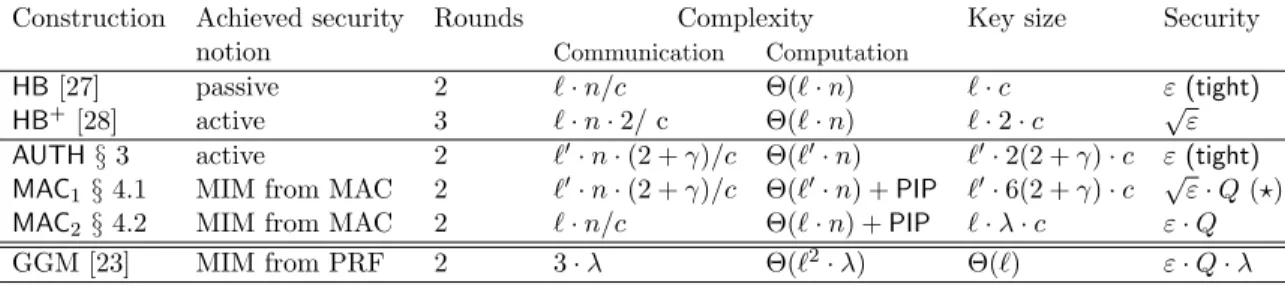
Figure 3 gives a rough comparison of our new authentication protocols with theHB,HB+ protocols and, as a reference, also the protocol one gets by using the PRF constructed via the classical tree-based GGM construction [23] when the underlying PRG is instantiated with LPN. λ denotes a statistical security parameter, say λ= 80. Qdenotes the total number of queries made during the attack. The second row in the table specifies the security notion that is (provably) achieved under the LPNτ,` or “subset LPN” SLPN∗τ,L,`0 assumption (all notions will be defined in §2.4). Typical
parameters suggested for HB type protocols [34] are`= 768, τ = 0.05, at this level they estimate ε≈2−80security forLPNτ,`, which is sufficient for schemes with a tight security reduction like for
passive security of HB or active security of our AUTH protocol (cf. the last column in Figure 3). The SLPN∗τ,L,`0 assumption reduces to LPNτ,`0−g with an additive loss of Q/2g, so we should set
`0 ≈`+ 80, say`0 = 850.
The reduction for all these protocols (except GGM) loses an additional additive Q·2−Θ(n) 1
While we believe the above scheme would be secure in case verification queries are not allowed, this is of limited interest in practice. Furthermore, the main technical difficulty in building an efficient MAC from LPN seems to be ensuring the secretsdoes not leak from verification queries.
2
An earlier version of this paper adapted a technique originally used by Waters [44] in the context of IBE schemes that has been applied to lattice based signature [10] and encryption schemes [1].
Construction Achieved security Rounds Complexity Key size Security notion Communication Computation
HB[27] passive 2 `·n/c Θ(`·n) `·c ε(tight) HB+[28] active 3 `·n·2/ c Θ(`·n) `·2·c √ε AUTH§3 active 2 `0·n·(2 +γ)/c Θ(`0·n) `0·2(2 +γ)·c ε(tight) MAC1 §4.1 MIM from MAC 2 `0·n·(2 +γ)/c Θ(`0·n) +PIP `0·6(2 +γ)·c √ε·Q(?)
MAC2 §4.2 MIM from MAC 2 `·n/c Θ(`·n) +PIP `·λ·c ε·Q
GGM [23] MIM from PRF 2 3·λ Θ(`2·λ) Θ(`) ε·Q·λ
Figure 3: A comparison of our new authentication protocols with the HB, HB+ protocols and the classical GGM construction. The trade-off parameterc(1≤c≤n) and the termPIPare explained in the “Communication vs. key size” paragraph below. The value ε refers to the hardness of the
LPNτ,` orSLPN∗τ,L,`0 problem. In the last (security) column we ignore additive terms of the form
Q·2−Θ(n). (?) is a non-uniform reduction, see discussion in §4.
term, where n is the number of repetitions required to amplify the security of a basic protocol which only achieves constant soundness and security. The hidden constant in Θ(·) depends on τ and, for AUTH and MAC1, on another parameter γ >0. An upper bound on the 2−Θ(n) term for
AUTHis 2e−2(12− 1 2+γ) 2` + 2e−2(14− τ 2) 2n
(cf. §3.2), to make this term<2−80 it suffices to setn= 360 and γ = 0.75. Summing up, with `0 = 850, τ = 0.05, n= 360, γ = 0.75 we provably get around 80 bits security forAUTH assuming LPN provides 80 bits security for `= 786, τ = 0.05.
Computation complexity counts the number of binary operations over F2. Communication complexity counts the total length of all exchanged messages.3 The last row in the table states the tightness of the security reduction, i.e. what exact security is achieved (ignoring constants and higher order terms) assuming theLPNτ,` problem isε-hard.
The prover and verifier in the HB,HB+ and our new protocols have to perform Θ(`·n) basic binary operations, assuming the LPNτ,` problem (i.e., LPN with secrets of length `) is hard. This
seems optimal, as Θ(`) operations are necessary to compute the inner product which generates a single pseudorandom bit. We will thus consider an authentication protocol or MAC efficient, if it requiresO(`·n) binary operations. Let us mention that one gets a length-doubling PRG under the
LPNτ,` assumption with Θ(`2) binary operations [17]. Via the classical GGM construction [23], we
obtain a PRF and hence a MAC. This PRF, however, requires Θ(`2·λ) operations per invocation (where λis the size of the domain of the PRF) which is not very practical.
Communication vs. key size. For all constructions except GGM, there is a natural trade-off between communication and key size, where for any constant c (1 ≤ c ≤ n), we can decrease communication by a factor of c and increase key size by the factor c (cf. Appendix A for how exactly this can be done). For the first three protocols in the table, the choice of cdoes not affect the computational efficiency, but it does so for the MAC based construction: to compute or verify
3
For MAC and PRF based constructions, we consider the communication one incurs by constructing a MIM secure 2-round protocol from the MAC (or PRF) by having the prover compute the MAC (PRF output) on a random ρ-bit challenge message. If the adversary can observe Qexecutions and make qattempts to convince a verifier, the probability of a successful break is at mostQ·q/2ρ (plus the security of the MAC/PRF). As we define security for
q= 1, settingρ:=λfor our statistical security parameterλ= 80 is sufficient. For the PRF based construction an output length ofλis sufficient.
a tag one has to evaluate a pairwise independent permutation (PIP) on the entire tag of length l:= Θ(`·n/c).
There are two standard ways how to construct a PIP π overF2l, which we briefly review below together with their corresponding computational complexity:
• Defineπ(x) :=a·x+b∈F2lfor randoma, b∈F2l. Thus the computational cost of evaluating the PIP is one multiplication of twombits values: Asymptotically, such a multiplication takes onlyO(llogllog logl) time [42, 18], but for smalll (like in our scheme) this will not be faster than using schoolbook multiplication, which takes Θ(l2) time.
• Define π(x) :=A·x+b∈ {0,1}l, where we now interpret the input as anl-bit vector, and
whereAis a Toeplitz matrix4 of dimension land b is a randoml-bit vector. The product of any Toeplitz matrix with any vector takes timeO(llogl) [29, 2], but note that the description ofπnow requires to store roughly 3lbits (whereas the previous solution just requires 2lbits). The PIP term in the table accounts for the above complexity. For parameters ` = 850, n = 360, γ = 0.75 as above and trade-off c = n (which minimizes the tag-length l) we get l ≈ 2400 (2(1 +γ)`plus a statistical security parameter) forMAC1and l≈930 forMAC2 (`plus a statistical security parameter). Hence, depending on the parameters, the evaluation of the PIP may be the computational bottleneck of our MACs.
1.3 Subsequent Work
An abridged version of this paper appeared as [33]. Our results inspired several follow-up works on the problem of efficient authentication from hard learning problems. In [15], Dodis et al. started a systematic study of randomized MACs and showed how to replace the PIP from our MAC constructions with a pairwise independent hash function (leading to more efficient schemes). Heyse
et al.[25] considered a variant of our actively secure authentication protocol based on the Ring-LPN problem (introduced in [36]) which simultaneously achieves a very short key and low communication complexity. The hardware efficiency and side-channel security of Lapin was analysed in [19].
Lyubashevsky and Masny [35] built three-round authentication protocols from LPN that are man-in-the-middle secure for sequential sessions. In [12], Cash, Kiltz and Tessaro show how to reduce the round complexity to two rounds via a generic transformation from active security to sequential man-in-the-middle security.
2
Definitions
2.1 Notation
For a positive integer k, [k] denotes the set {1, . . . , k}; [0] is the empty set. For a, b ∈ R, ]a, b[= {x ∈R ; a < x < b}. We denote the set of integers modulo an integer q ≥1 by Zq. We will use
normal, bold and capital bold letters likex,x,X to denote single elements, (column) vectors and matrices over Zq, respectively. X[i] denotes the i-th column vector of matrix X. x[i] denotes the
i-th element of vectorx.
For a vector x∈Zmq ,|x|=m denotes the length ofx; wt(x) denotes the Hamming weight of
the vector x, i.e. the number of indices i ∈ {1, . . . ,|x|} where x[i] 6= 0. For v ∈ Zm
2 we denote by v its inverse, i.e. v[i] = 1−v[i] for all i. For two vectors v ∈ Z`
2 and x ∈ Z`q, we denote by
4Such a matrix is constructed by picking the entries of the first row and column uniformly at random from{0,1}, and then copying each value all along its corresponding diagonal.
x↓v ∈Zqwt(v)the vector (of lengthwt(v)) which is derived fromxby deleting all the bitsx[i] where
v[i] = 0. If X∈ Z`2×m is a matrix, then X↓v denotes the sub-matrix obtained by deleting the ith
row if v[i] = 0. We also extend Boolean operators to vectors, i.e., for two vectors x,y ∈ Zm
2 we definex∧v=z∈Zm
2 withz[i] =x[i]∧y[i] andx∨v=z∈Zm2 wherez[i] =x[i]∨y[i].
A function in λis negligible, written negl(λ), if it vanishes faster than the inverse of any poly-nomial in λ. An algorithm A is probabilistic polynomial time (PPT) if A uses some randomness as part of its logic (i.e.,A is probabilistic) and for any input x∈ {0,1}∗ the computation ofA(x) terminates in at most poly(|x|) steps.
2.2 Authentication Protocols
An authentication protocol is an interactive protocol executed between a prover P and a verifier V, both PPT algorithms. Both hold a secret x (generated using a key-generation algorithm K executed on the security parameter λ in unary) that has been shared in an initial phase. After the execution of the authentication protocol, V outputs either accept or reject. We say that the protocol has completeness errorαif for all secret keysxgenerated byK(1λ), the honestly executed protocol returns rejectwith probability at mostα.
Passive attacks. An authentication protocol is secure against passive attacks if there exists no PPT adversaryAwho can win the following game with non-negligible probability: In a first phase, we sample a key x← K(1λ), and thenA gets to see any number of transcripts from the protocol execution betweenP(x) andV(x) (including V’s final decisionaccept orreject). In a second phase Ainteracts withV(x), and wins if the verifier outputs accept. Here we only give the adversary one shot to convince the verifier.5
Active attacks. A stronger notion for authentication protocols is security againstactive attacks. Here the second phase is the same as in a passive attack, but in the first phase, the adversaryAis additionally given access toP(x). For two-round protocols there is no difference between concurrent and sequential execution of the sessions with the prover.
We say an authentication protocol is (t, Q, ε)-secure against active adversaries if every adversary A, running in time at most t and making Qqueries to the honest prover, has probability at most εto win the above game.
Man-in-the-middle attacks. The strongest standard security notion for authentication proto-cols is security against man-in-the-middle (MIM) attacks. Here, the adversary can interact con-currently in many sessions between the prover and the verifier. The adversary gets to learn the verifieraccept/rejectdecisions, and wins whenever it manages to let the verifier accept in a session where it changed at least one of the messages sent by the prover or the verifier. One can construct two-round authentication schemes which are secure against MIM attacks from basic cryptographic primitives like MACs, which we define next.
5
By using a hybrid argument one can show that this implies security even if the adversary can interact ink≥1 independent instances concurrently (and wins if the verifier accepts in at least one instance). The use of the hybrid argument loses a factor ofkin the security reduction.
ExpufMAC−cma(A, λ) Qtag,Qvrfy :=∅ K ← K(1λ) ATag(·),Ver(·,·)(1λ) Return ∃(m, φ)∈ Qvrfy s.t. m6∈ Qtag ∧V(K, m, φ) =accept Oracle Tag(m) Qtag :=Qtag∪ {m} φ← T(K, m) Return φ Oracle Ver(m, φ) Qvrfy :=Qvrfy∪ {(m, φ)} Return V(K, m, φ) Figure 4: Experiment ExpufMAC−cma(A, λ) defining uf-cma security ofMAC.
2.3 Message Authentication Codes
A message authentication codeMAC={K,T,V}is a triple of algorithms with associated key space K, message spaceM, and tag space T.
• Key Generation. The probabilistic key-generation algorithm K takes as input a security pa-rameterλ∈N (in unary) and outputs a secret keyK ∈ K.
• Tagging.The probabilistic authentication algorithmT takes as input a secret keyK ∈ Kand a messagem∈ M and outputs an authentication tagφ∈ T.
• Verification. The deterministic verification algorithm V takes as input a secret key K ∈ K, a message m∈ Mand a tag φ∈ T and outputs {accept,reject}.
If the T algorithm is deterministic one does not have to explicitly define V, since it is already defined by theT algorithm asV(K, m, φ) =accept iffT(K, m) =φ.
Completeness. We say that MAC has completeness error α=α(λ) if for allm∈ M andλ∈N
Pr[V(K, m, φ) =reject: K ← K(1λ);φ← T(K, m)]≤α.
Security. The standard security notion for a MAC is unforgeability under a chosen message attack (uf-cma). Formally this is the probability that the experimentExpufMAC−cma(A, λ) of Figure 4 outputs 1. The experiment features an adversary A that issues tag queries on messages m, and verification queries on pairs (m, φ); the adversary is successful if she ever asks a verification query (m, φ) that is accepted, for some messagemnot previously asked to the tag oracle (i.e.,Ahas found a valid forgery). We say thatMACis (t, Q, ε)-secure against uf-cma adversaries if for anyArunning in time t, and asking a total number of Q queries to her oracles, we have Pr[ExpufMAC−cma(A, λ) = 1]≤ε.
2.4 Hard Learning Problems
LetBerτ be the Bernoulli distribution overZ2 with parameter (bias)τ ∈ ]0,1/2[ (i.e., Pr[x= 1] =τ if x ← Berτ). For ` ≥ 1, Ber`τ denotes the distribution over Z`2 where each vector consists of ` independent samples drawn from Berτ. Given a secret x∈Z`2 and τ ∈]0,12[ , we write Λτ,`(x) for the distribution overZ`2×Z2 whose samples are obtained by sampling vectorsr
$ ←Z` 2ande $ ←Berτ outputting (r,rT·x+e).
2.4.1 Learning Parity with Noise
The LPN assumption, formally defined below, states that it is hard to distinguish Λτ,`(x) (with a
random secret x∈Z`
2) from the uniform distribution on `+ 1 bits denoted U`+1.
Definition 2.1 (Learning Parity with Noise). The (decisional)LPNτ,` problem is (t, Q, ε)-hard if
for every distinguisher Drunning in time tand making Qqueries,
Pr h DΛτ,`(x)= 1; x←$ Z`2 i −Pr DU`+1 = 1 ≤ε.
It will sometimes be convenient to think ofU`+1 as LPN samples with uniform errors, note that for any x, the distributions Λ1/2,`(x) and U`+1 are the same.
2.4.2 Subspace Learning Parity with Noise
We now define the (seemingly) stronger subspace LPN assumption (SLPN for short) introduced in [40]. Here the adversary can ask for inner products not only with the secret x, but with any affine function Ax+b of x where A can be any (adversarially and adaptively chosen) matrix of sufficiently high rank. For minimal dimension d≤`, a secretx∈Z`
2 and any A∈Z` ×`
2 ,b∈Z`2 we define the distribution
Γτ,`,d(x,A,b) =
⊥ ifrank(A)< d Λτ,`(A·x+b) otherwise
and let Γτ,`,d(x,·,·) denote the oracle which on input A,b outputs a sample from Γτ,`,d(x,A,b).
Definition 2.2 (Subspace LPN). Let`, d∈Z whered≤`. The (decisional) SLPNτ,`,d problem is
(t, Q, ε)-hard if for every distinguisher D running in timet and makingQqueries,
Pr h DΓτ,`,d(x,·,·)= 1; x←$ Z`2 i −Pr h DU`+1(·,·)= 1 i ≤ε,
whereU`+1(·,·) on input A,b outputs a sample ofU`+1 ifrank(A)≥dand ⊥otherwise.
The following proposition states that the subspace LPN problem mapping to dimension d+g is almost as hard as the standard LPN problem with secrets of length d, the hardness gap being exponentially small in g. This proposition is a special case of Theorem 1 from [40]. To be self contained we include a proof of this proposition, but first we state a much simpler result, which will be used in the construction of our second MAC, namely that the subspace LPN problem is exactly as hard as the LPN problem if d=`, i.e., the subspace must span the entire space.
Proposition 2.3. For any `∈Zif the LPNτ,` problem is (t, Q, ε)-hard then the SLPNτ,`,` problem
is (t0, Q, ε)-hard where t0 =t−poly(`, Q)
Proof. Given a Λτ,`(x) sample (r,rTx+e), for anyA,bwhererank(A) =`, we can transform it into
a Γτ,`,`(x,A,b) sample (ˆr,ˆrT(Ax+b) +eby setting ˆrT=rTA−1 and outputting (ˆr,rTx+e+ˆrTb).
We now have
(ˆr,rTx+e+ ˆrTb) = (ˆr,ˆrTAx+e+ ˆrTb) = (ˆr,ˆrT(Ax+b) +e)
It just remains to check that e and ˆr have the right distribution. The error e in the subspace LPN sample is exactly the same value as in the LPN sample and thus also distributed as Berτ.
ˆ
rT is uniform as required, to see this recall that r is uniform and A has full rank. Using this transformation, we can use any distinguisher forSLPNτ,`,`from uniform to distinguishLPNτ,` from
uniform with the same advantage.
Proposition 2.4. For any`, d, g∈Z(where`≥d+g), if the LPNτ,d problem is (t, Q, ε)-hard then
the SLPNτ,`,d+g problem is (t0, Q, ε0)-hard where
t0=t−poly(`, Q) ε0=ε+Q/2g.
Proof. LetD0 be an adversary with advantageε0 for the SLPN
τ,`,d+g problem, from thisD0 we will
construct an D with advantage ε ≥ ε0 −Q/2g for the LPNτ,d problem. W.l.o.g., we assume that
the oracle queries of D0 are of the formA,bwithb=0since (ˆr,ˆz)7→(ˆr,ˆz+ ˆrTb) reduces queries with arbitrary b to queries withb=0.
Our D will transform the samples of the form (r,rTx+e) it gets (where e is either sampled according to Berτ or uniform) into samples (ˆr,ˆrTAxˆ+e) for any A ∈ Z`2×` of rank ≥ d+g. In particular, LPN samples are mapped to SLPN samples, and random samples are mapped to random samples. For each of the Q queries made by D0, the transformation will fail with probability at most 2−g, which is where the Q/2g loss in distinguishing advantage comes from. We now formally defineD.
Initially, DΛδ,d(x) (where δ is either τ or 1/2) samples W ←$ Z`×d 2 ,w
$
← Z`2 which (implicitly) defines the secret ˆx=Wx+wfor the transformation. Now, DΛδ,d(x)invokesD0, and answers every queryA of D0 as follows.
If rank(A) < d+g return ⊥ to D0. Otherwise, query the oracle Λδ,d(x) to get a sample
(r,rT·x+e). Define the set S ⊆Z`
2 of solutions to the system of linear equations: S =ny: yTAW=rTo⊆Z`2
Note that ifAWhas rank dthen S is non-empty. D samples ˆr← S$ and outputs the sample
(ˆr,rTx+ ˆrTAw+e), (2.1)
Note that D runs in time t0 (as it must invoke D0) plus some poly(`, Q) overhead as claimed. It remains to show that simulation performed byD is correct. This is shown in the following claims.
Claim 2.5. If V=AW has (full) rank d, then rˆ← S$ is uniformly random (given A,W,w). Proof of Claim. We show that for any v ∈ Z`
2, Pr[ˆr = v | W,A,w] = 2−`. First, as r ∈ Zd2 is uniform, Pr[vTAW = rT] = 2−d, if this does not hold, then v 6= ˆr. Otherwise, ˆr is sampled at
uniform from an `−ddimensional linear space, and thus Pr[v= ˆr|vAW=rT] = 2d−`. We get Pr[ˆr=v|W,A,w] = Pr[vTAW=rT] Pr[v= ˆr|vTAW=rT] = 2−d2d−`= 2−`.
Proof of Claim. We can rewrite the samples of Eq. (2.1) as
(ˆr,rTx+ ˆrTAw+e) = (ˆr,ˆrTAWx+ ˆrTAw+e) (since ˆr∈ S) = (ˆr,ˆrTA(Wx+w) +e)
= (ˆr,ˆrTAxˆ+e) which is a sample from Γδ,`,d+g(ˆx,A) as required.
Claim 2.7. The probability that the setS is empty is at most 2−g.
Proof of Claim. Recall that the setS can possibly be empty only whenV=AW∈Z`2×d has rank less thand, whereA∈Z`2×` has rank ≥d+gand W
$ ←Z`2×d.
Denote with ∆(d, g) the probability that a random matrix in Z(2d+g)×d has rank less than d. Since the matrixAhas rank at leastd+g, we can assume, without loss of generality, that the first d+g rows of A are linearly independent. Since the matrix W is random, the upper (d+g)×d matrix ofV=AWis random inZ2(d+g)×dand thus it has rank less thandwith probability at most ∆(d, g). We conclude thatV has rank strictly less thandexactly with the same probability. Using Lemma B.1, we see that this probability is bounded by 2−g.
Applying the union bound, we can upper bound the probability that for any of the Q queries the matrixV=AWhas rank less thandbyQ·2−g. This error probability is thus an upper bound on the gap of the success probabilityε0 ofD0 and the success probabilityεwe get in breaking LPN using the transformation.
Finally, we need to consider the fact that the queries A chosen by D0 are chosen adaptively. To show that adaptivity does not help in picking an A where AW has rank < d we must show that the view ofD0 is independent ofW (except for the fact that so far no query was made where
rank(AW)< d). This holds as the secret ˆx=Wx+wused in the simulation is independent ofW
as it is blinded with a uniform w. In fact, the only reason we use this blinding is to enforce this independence.
2.4.3 Subset Learning Parity with Noise
For some of our constructions, we will only need a weaker version of theSLPNτ,`,dproblem that we
call subset LPN. As the name suggests, here the adversary does not ask for inner products with
Ax+b for anyA (of rank ≥d), but only with subsets of x(of size≥d). It will be convenient to explicitly define this special case. For x,v ∈ Z`
2, let diag(v) ∈ Z`2×` denote the matrix with v in the diagonal and zero elsewhere, and let
Γ∗τ,`,d(x,v) := Γτ,`,d(x,diag(v)) =
⊥ ifwt(v)< d Λτ,`(x∧v) otherwise.
Definition 2.8 (Subset LPN). Let`, d∈Zwhered≤`. TheSLPN∗τ,`,d problem is (t, Q, ε)-hard if for every distinguisher Drunning in time tand making Qqueries,
Pr h DΓ∗τ,`,d(x,·)= 1;x←$ Z` 2 i −Pr h DU`+1(·)= 1 i ≤ε,
Remark 2.9. Γ∗τ,`,d(x,v) samples are of the form (r,rT↓vx↓v +e) ∈ Z`2+1, where e $
← Berτ. To
compute the inner product only r↓v ∈ Zwt2 (v) is needed, the remaining bits r↓v ∈ Z`2−wt(v) are irrelevant. We use this observation to improve the communication complexity (for protocols) or tag length (for MACs), by using “compressed” samples of the form (r↓v,rT↓vx↓v+e)∈Zwt2 (v)+1.
2.5 Hoeffding Inequality
We will several time use the following tail inequality known as Hoeffding’s inequality.
Theorem 2.10 ([26]). Let X1, X2, . . . , Xn be i.i.d. Bernoulli variables with Pr[Xi = 1] = p and
X=Pn
i=1Xi (so E[X] =np). Then, for ≥0,
Pr[X−np≥n] ≤ e−22n Pr[|X−np| ≥n] ≤ 2e−22n.
The above also holds if the Xi are sampled without replacement.
3
Two-Round Authentication with Active Security
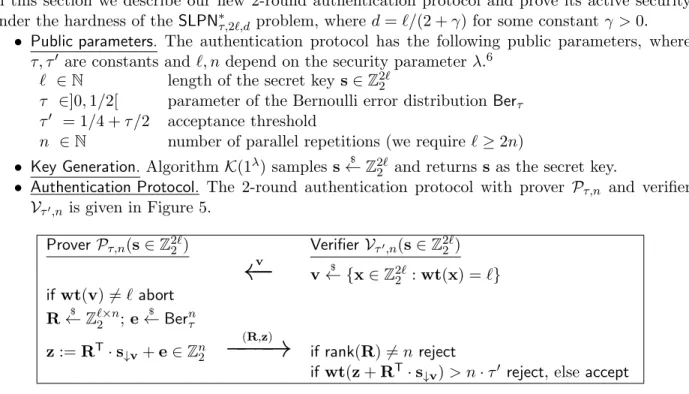
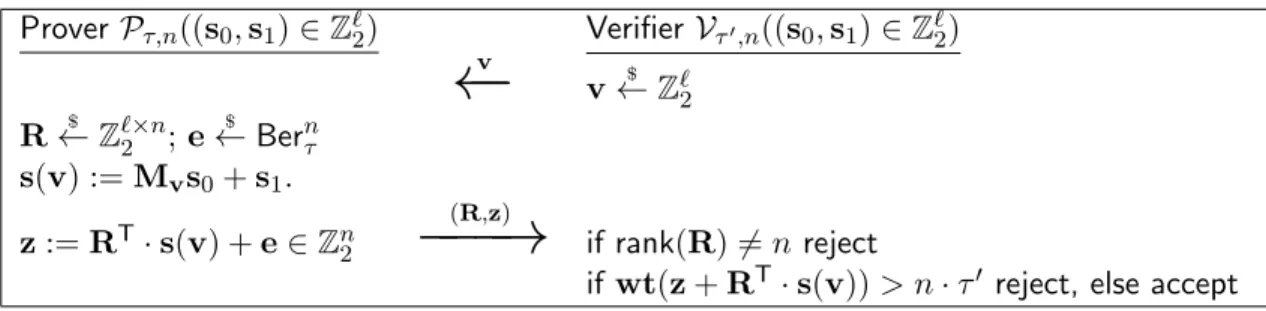
In this section we describe our new 2-round authentication protocol and prove its active security under the hardness of the SLPN∗τ,2`,d problem, whered=`/(2 +γ) for some constant γ >0.
• Public parameters. The authentication protocol has the following public parameters, where τ, τ0 are constants and `, ndepend on the security parameterλ.6
` ∈N length of the secret key s∈Z2`
2
τ ∈]0,1/2[ parameter of the Bernoulli error distributionBerτ
τ0 = 1/4 +τ /2 acceptance threshold
n ∈N number of parallel repetitions (we require `≥2n) • Key Generation.Algorithm K(1λ) samples s←$ Z2`
2 and returnss as the secret key.
• Authentication Protocol. The 2-round authentication protocol with prover Pτ,n and verifier
Vτ0,n is given in Figure 5. ProverPτ,n(s∈Z2` 2 ) VerifierVτ0,n(s∈Z2` 2 ) v
←
−
v← {$ x∈Z2` 2 :wt(x) =`} ifwt(v)6=`abort R←$ Z`2×n;e←$ Bernτ z:=RT·s↓v+e∈Zn2 (R,z)−−−→
if rank(R)6=nrejectifwt(z+RT·s↓v)> n·τ0 reject, elseaccept
Figure 5: Two-round protocolAUTH with active security from the LPN assumption. 6The acceptance threshold τ0
below can be any value in-between τ and 1/2. As we set it closer to 1/2, the soundness error increases while the completeness error decreases. For concreteness, we setτ0 exactly in-betweenτ and 1/2.
Theorem 3.1. For any constant γ >0, let d=`/(2 +γ). If the SLPN∗τ,2`,d problem is (t, nQ, ε) -hard then the authentication protocol from Figure 5 is (t0, Q, ε0)-secure against active adversaries, where for constants cγ, cτ >0 that depend only on γ and τ respectively,
t0 =t−poly(Q, `) ε0 =ε+Q·2−cγ·`+ 2−cτ·n = ε+Q·2−Θ(n).
The protocol has completeness error 2−c0τ·n+ 2n−` ∈2−Θ(n) (as `≥2n) where c0
τ >0 depends only
onτ.
3.1 Proof of Completeness
We first bound the completeness errorαof the authentication protocol. For anyn∈N,τ ∈]0,1/2[, let ατ,n:= Pr[wt(e)> n·τ0: e $ ←Bernτ] (T hm.2.10) ≤ e−2(1/4−τ /2)2ndef= 2−c0τ·n (3.1) denote the probability that n independent Bernoulli samples with bias τ contain more than a τ0 := 1/4 +τ /2 fraction of 1’s (i.e., n(1/4 +τ /2)−nτ = n(1/4−τ /2) more than the expected number).
The verifier performs the following two checks. In the first verification step, the verifier rejects if the random matrix R does not have full rank. By Lemma B.1 (cf. Appendix B) the probability of this event is ≤ 2n−`. Now, let e :=z+RT·s
↓v denote the noise added by Pτ,n. Then, in the
second verification step, the verifier rejects if wt(e) > n·τ0. From Eq. (3.1), we have that this happens with probabilityατ,n. It follows that α≤2n−`+ 2−c
0
τ·n.
3.2 Proof of Security
We first define some more terms that will be used later in the security proof. For a constantγ >0, let d = `/(2 +γ) (as in Theorem 3.1). Let α0`,d denote the probability that a random substring of length ` chosen from a string of length 2`with Hamming weight `, has a Hamming weight less thand=`/(2 +γ). Using the Hoeffding bound we see there’s a constant cγ >0 s.t.
α0`,d (T hm.2.10) ≤ 2e−2 1 2− 1 2+γ 2 ` def = 2−cγ·`. (3.2)
Forτ0 = 1/4 +τ /2, let α00τ0,n denote the probability that a random bitstring y∈Zn2 has Hamming
weight wt(y) ≤n·τ0. From the Hoeffding bound, it follows that there exists a constant cτ > 0
(only depending on τ), such that (below we use 1/2−τ0 = 1/4−τ /2) α00τ0,n := 2−n· bn·τ0c X i=0 n i (T hm.2.10) ≤ 2e−2(14− τ 2) 2 ndef = 2−cτ·n. (3.3) We now prove security of the authentication protocol. Consider an oracle O which is either the subset LPN oracle Γ∗τ,2`,d(x,·) or U2`+1(·), as defined in Definition 2.8. We will construct an adversaryBO that usesA (who breaks the active security ofAUTH with advantage ε0) in a black-box way such that:
Pr[BΓ∗τ,2`,d(x,·)= 1]≥ε0 and Pr[BU2`+1(·) = 1]≤α00
τ0,n+Q·α0`,d .
Thus BO can distinguish between the two oracles with advantage ε := ε0 −Q·α0`,d −α00τ0,n =
Setup. Initially,BO samples x∗ ←$ Z2` 2 , v∗ $ ← {y∈Z2` 2 :wt(y) =`}.
The intuition of our simulation below is as follows. Let us first assumeOis a subset LPN oracle Γ∗τ,2`,d(x,·) with secret x. To simulate the prover during the first phase we have to produce answers φ = (R,z) to each query v ∈ {y ∈ Z22` : wt(y) = `} issued by A. The simulated answers will have the same distribution as the answers of an honest prover Pτ,n(s ∈ Z2`
2 ) where
s= (x∗∧v∗) + (x∧v∗). (3.4) Thus one half of the bits of s come from x∗, and the other half come from the unknown secretx(for which we use the oracleO). In the second phase we giveAthe challengev∗. As
s↓v∗= (x∗∧v∗)↓v∗=x∗↓
v∗ is known, we will be able to verify ifAdid output a valid answer.
On the other hand, if O is the uniform oracle U2`+1(·), then after the interaction with the prover we will show thats↓v∗= (x∗∧v∗)↓v∗ is information theoretically hidden, and thus A
cannot succeed except with exponentially small probability.
First phase. In the first phaseBOinvokesAwho expects access toP
τ,n(s∈Z22`) . We now specify how BO samples the answer φ = (R,z) to a query v ∈ {y ∈ Z22` :wt(y) =`} made byA. Let
u∗ :=v∧v∗ u:=v∧v∗.
1. BO queries its oraclentimes on the inputu. If the oracle’s output is⊥(this is the case ifwt(u)< d), then BO outputs 1 and stops. Otherwise let ˆR
1∈Z22`×n,z1 ∈Zn2 denote thenoutputs of the oracle.
2. Sample ˆR0 $
←Z22`×n and setz0= ˆRT0 ·(x∗∧u∗).
3. Return φ = (R = ˆR↓v ∈Z`2×n,z =z0+z1 ∈Zn2), where ˆR is uniquely determined by requiring ˆR↓v∗ = ˆR0 and ˆR↓v∗ = ˆR1.
Second phase. Eventually,A enters the second phase of the active attack expecting a challenge from Vτ0,n(s∈Z22`).
1. BO forwardsv∗ as the challenge to A. 2. Aanswers with some (R∗,z∗).
3. BO checks if
rank(R∗) =n and wt(z∗+R∗T·x∗↓v∗)≤n·τ0. (3.5)
The output is 1 if both checks succeed and 0 otherwise.
Claim 3.2. Pr[BU2`+1(·)= 1] ≤ α00
τ0,n+Q·α0`,d.
Proof of Claim. Recall that we defined B such that it will output 1 and stop in the first phase of the experiment whenever it receives ⊥as output from its oracle. We definedU2`+1(·) to output⊥ if it is queried on an input u= v∧v∗ where wt(u)< d. Since v∗ ← {$ y∈ Z2`
2 :wt(y) =`}, for any v, the probability thatwt(v∧v∗)< dis (by definition)α0`,d as defined in Eq. (3.2). Using the union bound, we can upper bound the probability that wt(v∧v∗) < d for any of the Q different
v’s chosen by the adversary in the first phase as Q·α0`,d.
If we did not output 1 in the first phase and in the second phase R∗ does not have full rank thenB outputs 0 by definition. Therefore, we now consider the case whererank(R∗) =n.
The answers φ = (R,z) that the adversary A obtained from BU2`+1(·) in the first phase are independent of x∗ (i.e., z =z0+z1 is uniform as z1 is uniform). Sincex∗↓v∗ is uniformly random
and R∗ has full rank, the vector
y:=R∗T·x∗↓v∗+z∗
is uniformly random over Zn2. Thus the probability that the second verification in Eq. (3.5) does not fail is Pr[wt(y)≤n·τ0] =α00τ0,n.
Claim 3.3. Pr[BΓ∗τ,2`,d(x,·)= 1] ≥ ε0
Proof of Claim. We will show that B outputs 1 with probability ≥ ε0 if the subset LPN oracle accepts subsets of arbitrary small size (and does not simply output⊥on inputsvwherewt(v)< d), i.e.,
Pr[BΓ∗τ,2`,0(x,·)= 1]≥ε0. (3.6) This then implies the claim using
Pr[BΓ∗τ,2`,d(x,·)= 1]≥Pr[BΓ
∗
τ,2`,0(x,·)= 1]
which holds as the oracles Γ∗τ,2`,d(x,·) and Γτ,∗2`,0(x,·) behave the same except on inputs v with
wt(v)< d in which case the former outputs⊥, andB will then immediately output 1. Eq. (3.6) holds as:
• The answers φ = (R,z) that BΓ∗τ,2`,0(x,·) gives to A’s queries in the first phase of the attack have exactly the same distribution as what A would get when interacting with an honest proverPτ,n(s∈Z22`) where the “simulated” secrets is defined in Eq. (3.4).
To see this, recall that on a query v from A, adversary BΓ∗τ,2`,0(x,·) must compute n SLPN samples ( ˆR,z= ˆRT·(s∧v) +e) and then forward the compressed version of this samples to A (that is, (R,z=RT·s
↓v+e) where R= ˆR↓v, cf. Remark 2.9). We next show that the
z computed byB indeed have exactly this distribution. In the first step,B queries its oracle withu=v∧v∗ and obtains noisy inner products ( ˆR1,z1) with the part ofs↓v that contains
only bits fromx, i.e.,
z1 = ˆRT1 ·(x∧u) +e= ˆRT1 ·(s∧u) +e.
In the second step,B samplesn inner products ( ˆR0,z0) (with no noise) with the part ofs↓v
that contains only bits from the knownx∗, i.e.,
z0 = ˆRT0 ·(x∗∧u∗) = ˆRT0 ·(s∧u∗).
In the third step,B then generates ( ˆR,RˆT·(s∧v) +e) from the previous values where ˆRis defined by ˆR↓v∗ = ˆR0 and ˆR↓v∗ = ˆR1. Usingv=u+u∗, we get
z = z0+z1
= RˆT0 ·(s∧u∗) + ˆRT1 ·(s∧u) +e
= RˆT·(s∧v) +e.
• The challengev∗ sent initially to A is uniformly random, and therefore has the same distri-bution as a challenge in an active attack.
• BΓ∗τ,2`,0(x,·) outputs 1 if Eq. (3.5) holds, which is exactly the case when A’s response to the challenge was valid. By assumption this probability is at leastε0.
3.3 Avoiding Checking Pτ,n(s∈Z2` 2 ,bv∈Z22`,bz∈Z2n) Vτ0,n(s,bv,bz) v
←
−
v←$ Z2` 2 R←$ Z22`×n;e←$ Bernτ z:=RT·(s∧(v+bv)) +bz+e (R,z)−−−→
ifwt( z+RT·(s∧(v+bv))+bz)> n·τ0reject, elseaccept
Figure 6: By blinding the values v,z with secret random vectors bv,bz we can avoid checking whether wt(v) =` and rank(R) =nas in the protocol from Figure 5.
One disadvantage of the protocol in Figure 5, compared to HBstyle protocols, is the necessity to check whether the messages exchanged have the right form: the prover checks if v has weight `, while the verifier must make the even more expensive check whetherRhas full rank. We note that it is possible to eliminate these checks by blinding the exchanged messages vand z using random vectors bv ∈ Z2`
2 and bz ∈Zn2 respectively, as shown in Figure 6. The analysis of this protocol is similar as for the protocol in Figure 6, we thus just sketch a proof emphasising the differences.
The setup phase is as before, except thatB apart fromx∗ and v∗ also samples randombv and
bz. In the first phase BO will answer A’s queries as before, except that we use v+bv instead of v and finally also add bv to the answer (just so when O is an SLPN oracle we get the same distribution as in the protocol). Also the second phase is identical, except that we use the challenge
v∗+bv (so the actual subset used to answer the challenge isv∗+bv+bv =v∗).
Letα∗`,d denote the probability that a random string of length`has Hamming weight less than d, then we have Pr[BU2`+1(·) = 1] ≤ α00
τ0,n+Q·α∗`,d, this is basically as in Claim 3.2, except that
α`,d0 is replaced withα∗`,d. Asbvis uniformly random, the probability thatwt((v+bv)∧v∗)< dis α`,d∗ (in which case the oracle will ouput ⊥), using the union bound this will not happen in any of theQqueries except with probability at most Q·α`,d∗ . In this argument we also must use the fact that the answers that B sends to A are uniformly random, and thus do not leak any information about bv (except from what can be deduced from the fact that B has not already output 1 and stopped). If we come to the second phase, the probability that A comes up with a valid answer (R∗,z∗) is at mostα00τ0,n as at this point bz, and thus also the string w= z+RT·(s∧v∗)
+bz, is uniformly random given A’s view, which implies that Pr[wt(w)> n·τ0]≤ατ000,n.
The proof that Pr[BΓ∗τ,2`,d(x,·) = 1] ≥ ε0 is almost analogous to the proof of Claim 3.3.
4
Message Authentication Codes
In this section, we construct two message authentication codes whose security can be reduced to theLPN assumption. Our first construction is based on the 2-round authentication protocol from Section 3. We prove that if the LPN problem is ε-hard, then no adversary making Q queries can forge a MAC with probability more than Θ(√ε·Q). The construction is somewhat non-uniform as to achieve this security, one must set a parameter in the construction as a function ofε (cf. Remark 4.4). Our second construction has no such issues and achieves better security Θ(ε·Q).
The efficiency of this construction is similar to that of the first construction, but a larger key is required.
4.1 First Construction
Recall the 2-round authentication protocol from Section 3. In the protocol the verifier chooses a random challenge subsetv. To turn this interactive protocol into a MAC, we will compute this v
from the messagemto be authenticated asv=C(h(m,b)), wherehis a pairwise independent hash function, b ∈ Zν
2 is some fresh randomness and C is some encoding scheme. The code C is fixed and public, while the function h is part of the secret key. The authentication tag φ is computed in the same manner as the prover’s answer in the authentication protocol. That is, we sample a random matrix R∈Z`2×n and compute a noisy inner product z:= RT·s↓v+e, where e
$ ←Bernτ. We note that using (R,z,b) as an authentication tag would not be secure, and we need to blind these values. This is done by applying a pairwise independent permutation (PIP)π—which is part of the secret key—to (R,z,b)∈Z2`×n+n+ν.
Remark 4.1. In the construction it’s sufficient to just use almost pairwise independent functions and permutations. In fact, if the message space M is a priory unbounded, we have to settle for almost pairwise independence (as the description of a pairwise independenthis linear in the length of the inputs it can process).
Construction. The message authentication code MAC1 = (K,T,V) with associated message space Mis defined as follows.
• Public parameters. MAC1 has the following public parameters.7 `, τ, τ0, n as in the authentication protocol from Section 3 µ∈N output length of the hash function
ν ∈N length of the randomness C:Zµ2 →Z22` encoding, where∀ y6=y0 ∈Z
µ
2 we have wt(C(y)) =` and wt(C(y) +C(y0))≥0.9`.
• Key generation. Algorithm K(1λ) samples s ←$ Z22`, a pairwise independent hash function h : M ×Zν
2 → Z
µ
2 and a pairwise independent permutation π over Z
`×n+n+ν
2 . It returns K = (s, h, π) as the secret key.
• Tagging.Given secret keyK= (s, h, π) and messagem∈ M, algorithmT proceeds as follows. 1. R←$ Z`2×n,b←$ Zν 2,e $ ←Bernτ 2. v:=C(h(m,b))∈Z2` 2 3. Return φ:=π(R,RT·s↓v+e,b)
• Verification. On input a secret-key K = (s, h, π), message m ∈ M and tag φ, algorithm V proceeds as follows.
1. Parseπ−1(φ) as (R∈Z`2×n,z∈Zn2,b∈Zν2). Ifrank(R)6=n, then returnreject 2. v:=C(h(m,b))
3. Ifwt(z+RT·s↓v)> n·τ0 returnreject, otherwise returnaccept
7The code Ccan be constructed as follows. We first sample a random matrix C ∈
Zµ2×` and map y ∈ Z µ 2 to
C(y) = (c∈Z`2,c0 ∈Z2`) wherec=CT·y andc0=c. A random codeC has high distance with high probability andC(y) = (c,c0) has weight exactly`.
Theorem 4.2. For µ = ν ∈ N, a constant γ > 0 and d := `/(2 +γ), if the SLPN∗τ,2`,d problem is (t, nQ, ε)-hard then MAC1 is (t0, Q, ε0)-secure against uf-cma adversaries, where for constants cγ, cτ >0 that depend only on γ and τ respectively, and forQ=Qtag+Qvrfy,
t0≈t, ε= min ε0/2−Q 2 2µ , ε0 2µ+1 −Qtag·2 −cγ·`−Q vrfy·2−cτ·n .
MAC1 has completeness error 2−c
0
τ·n+ 2n−`∈2−Θ(n) where c0
τ >0 depends only on τ.
Corollary 4.3. Choosing µ s.t. 2µ = 4Qε02 in the above theorem, we get ε= min{ε0/4, ε02/8Q2−
Q·2−Θ(n)}. The 2nd term is the minimum here, and solving for ε0 gives ε0≤3Q·
q
ε+Q·2−Θ(n). (4.1)
Remark 4.4 (about µ). Note that to get security as claimed in the above corollary, we need to choose µ as a function of Q and εsuch that 2µ ≈4Q2/ε0 for ε0 as in Eq. (4.1). Of course we can just fixQ(as an upper bound to the number of queries made by the adversary) andε(as our guess on the actual hardness ofSLPN∗τ,2`,d). But a too conservative guess onµ(i.e. choosingµtoo small) will result in a construction whose security is worse than what is claimed in the above corollary. A too generous guess on the other hand will make the security reduction meaningless, though we do not have any attacks on the MAC for largeµ.
We now give some intuition for the proof of Theorem 4.2. Every query (m, φ) toV and querym toT defines a subsetv(as computed in the second step in the definitions of bothVandT). We say that a forgery (m, φ) is “fresh” if thev contained in (m, φ) is different from allv’s contained in all the previousV andT queries. The proof makes a case distinction and uses a different reduction for the two cases where the first forgery found by the adversary is more likely to be fresh, or more likely to be non-fresh. In both cases we consider a reduction BO which has access to either a uniform oracle O = U or a subset LPN oracle O = Γ∗. Adversary BO uses an adversaryA who can find forgeries for the MAC to distinguish those cases and thus break the subset LPN assumption. In the first case, where the first forgery is likely to be non-fresh, we can show (using the fact that a pairwise independent permutation is used to blind the tag) that if BO’s oracle is O = U, even a computationally unbounded A cannot come up with a message/tag pair (m, φ) that contains a non-fresh v. Thus we can distinguish the cases O = U and O = Γ∗ by just observing if A ever makes a V query (m, φ) that contains a non-fresh v (even without being able to tell if (m, φ) is valid or not).
If the first forgery found by Ais more likely to be fresh, we can use a similar argument as in the proof of our authentication protocol in the last section. An additional difficulty here is that the reduction has to guess the fresh v∈Z22` (for which there are 2µ possibilities) contained in the first forgery and cannot choose it itself as in the protocol. This is the reason why the reduction loses a factor 2µ.
Proof of Theorem 4.2. The proof of completeness is essentially the same (and we get exactly the same quantitative bound) as the proof of completeness for the protocol in Figure 5 as claimed in Theorem 3.1.
We now prove security. As in the theorem statement, we set µ = ν (but for clarity we will keep the different letters µ for the range of h and ν for the length of the randomness). Let A
be an adversary running in time t0 that breaks the uf-cma security of MAC1 in the experiment
ExpufMAC−cma
1,A,λ with advantage ε
0. Let Q
tag and Qvrfy denote the number of queries that A makes
to the tag and verification oracles respectively, such that Q = Qtag+Qvrfy. We assume that A
never makes the same verification query twice (sinceV is deterministic, repeating queries gives no additional information toA) and also that she never makes a verification query (m, φ) whereφwas received as the output from the tag oracle on input m. Since the completeness error of MAC1 is 2−Θ(n), this is basically without loss of generality (as the answer would almost certainly beaccept). Every verification query (m, φ) and tag querym defines a subsetv (as computed in step 2. in the definitions of bothV and T).
By definition, in the uf-cma experiment, with probability ε0 the adversary A at some point makes a verification query (m, φ) where: (i) φ was not received as output on a tag query m, and (ii) V(K, m, φ) = accept. We say that such a forgery (m, φ) is “fresh” if the v defined by (m, φ) is different from all v’s defined by all the previous verification and tag queries. Let Efresh
denote the event that the first forgery found by A is fresh. We will consider the two cases where Pr[Efresh]> ε0/2 and Pr[Efresh]≤ε0/2 separately.
The casePr[Efresh]≤ε0/2. Given A, we will construct an adversary B1O who can distinguish O= Γ∗τ,2`,`(s,·) fromO =U2`+1(·) (as in Definition 2.8) with advantage
ε0/2−Q 2
2µ. (4.2)
BO1 samplesπ, h(but nots) as defined by K. Next, it invokesA(who expects to attackMAC1 with a key (s, h, π)) answering its queries as follows:
• Tag queries. IfA makes a tag querym, thenBO
1 does the following: 1. Sampleb←$ Zν2 and computev:=C(h(m,b)).
2. Query the oracleO forntimes on inputv: fori= 1, . . . , n let (R[i],z[i])← O$ (v). 3. Return φ:=π(R,z,b) whereR= [R[1], . . . ,R[n]] and z= [z[1], . . . ,z[n]] to A.
• Verification queries. IfAmakes a verification query (m, φ),B1O simply answers withreject. If any tag or verification query contains avwhich has appeared in a previous query, BO
1 outputs 1 and 0 otherwise. (Note thatBO1 can compute the value vin a verification query as it knowsπ, h.)
Claim 4.5. If O= Γ∗τ,2`,`(s,·), then B1O outputs 1 with probability≥ε0/2. Proof of Claim. The answers to the tag queries of A computed by BO
1 have exactly the same distribution as in the uf-cma experiment (where the secret key is (s, h, π)). (Note that each tag query yields a vector v with hamming weight exactly `.) The answers to the verification queries (which are always reject) are correct as long asA does not query a valid forgery. The probability that the first valid forgery found byAisnot fresh isε0−Pr[Efresh]≥ε0−ε0/2≥ε0/2, which is thus
a lower bound on the probability that BO1 outputs 1.
Claim 4.6. If O=U2`+1(·), then B1O outputs 1 with probability< Q2/2µ.
Proof of Claim. The answers thatAobtains on a tag querymfromBU2`+1(·)
1 (i.e.,π(R,z,b) where
R,z,bare sampled uniformly) are uniformly random, and in particular independent ofhorπ. The answers to verification queries are alwaysreject, and thus contain no information abouth, π either. Then, we have that vi = vj (where vi = C(h(mi,bi)) is defined by the i-th tag or verification
then is also an upper bound on the probability thatBO
1 outputs 1. Amakes a total of Q queries. Assume that up to the (i−1)th query, all thev’s were distinct.
If the ith query is a tag query mi, a fresh bi is sampled which will collide with a previous bj
(j < i) with probability at most (i−1)/2ν. Assuming no such collision happened, the probability thath(mi,bi) =h(mj,bj) for anyj < ican be upper bounded by (i−1)/2µ (here we use the fact
that the answers that Agets fromBU2`+1(·)
1 are uniformly random, and thus Ahas no information about the functionh).
If the ith query is a verification query (mi, φi), then using the fact thatπ is a pairwise
indepen-dent permutation (and A has no information about it) we get that π−1(φi) = (Ri,zi,bi) contains
abi which will collide with a previousbj (j < i) whereφj 6=φi with probability at most (i−1)/2ν.
If we have no such collision, then also (mi,bi) 6= (mj,bj) for all j < i as for j where φi = φj
we must have that mi 6= mj.8 If (mi,bi) 6= (mj,bj) for all j < iwe can again upper bound the
probability thath(mi,bi) =h(mj,bj) for some j < i by (i−1)/2µ.
We showed that for the ith query (no matter if it’s a tag or verification query) the probability that h(mi,bi) = h(mj,bj) for some j ≤ iis at most (i2−ν1) +
(i−1)
2µ . Taking the union bound over all i,1 ≤i ≤Q, we can upper bound the probability that h(mi,bi) =h(mj,bj) for any i6= j as
PQ i=1 (i−1) 2ν + (i−1) 2µ
≤Q2/2µ (recall thatµ=ν) as claimed.
The casePr[Efresh]> ε0/2. In this case,Awill make tag/verification queries, where with
probabil-ity> ε0/2, at some point she will make an accepting verification query (m, φ) that defines a freshv. We now construct an adversaryBO2 that usesAas a black-box, and can distinguishO= Γ∗τ,2`,d(s,·) from O=U2`+1(·) (as in Definition 2.8) with advantage
ε0
2µ+1 −Qtag·α 0
`,d−Qvrfy·α00τ0,n. (4.3)
The construction of BO
2 is very similar to the adversary B that we constructed in the proof of Theorem 3.1 (where we proved that the authentication protocol in Figure 5 is secure against active attacks). The queries to the prover in the first phase of an active attack directly correspond to tag queries. However, we now have to additionally answer verification queries (we will always answer reject). Furthermore, we cannot choose the challenge v∗. Instead, we will simply hope that (in the case where O= Γ∗τ,2`,d(s,·)) the v contained in the first valid verification query (i.e., forgery) that A makes is fresh (which by assumption happens with probability ε0/2). Moreover, we will hope that it is the unique v∗ (out of 2µ possible ones) for which BO2 can verify this. This gives us a distinguishing advantage of nearly (ε0/2)/2µ = ε0/2µ+1 as stated in Eq. (4.3). We do lose an additional additive term Qtag·α0`,d as there is an exponentially small probability that the
transformation of subspace LPN samples to tag queries will fail, and moreover an exponentially small termQvrfy·α00τ0,n which accounts for the probability thatAcorrectly guesses an accepting tag
even in the case where O=U2`+1(·). BO
2 samplesπ, h(but nots) as defined by K, andy∗ $
←Zµ2 , s∗ ←$ Z2`
2 . Letv∗ :=C(y∗). Next, BO2 invokes A and answers its queries as follows (the intuition for the sampling below is given in the proof of Claim 4.8).
• Tag queries. The answer φto a tag querym∈ M is computed byBO
2 as follows:
8Recall that we assume thatAdoes not repeat queries and does not ask verification queries (m, φ) if φwas the output of a tag querym.
1. Sampleb←$ Zν
2 and computev:=C(h(m,b)). Letu:=v∧v∗ and u∗ :=v∧v∗.
2. Fori= 1, . . . , n, let (R0[i],z0[i])← O$ (u),R00[i]←$ Z2`
2 and z00[i] :=hR00[i],s∗∧u∗i. Define R = [R[1],R[2], . . . ,R[n]] and z = [z[1], . . . ,z[n]] where R[i] := (R0[i]∧u+
R00[i]∧u∗)↓v and z[i] :=z0[i] +z00[i].
3. Return φ:=π(R,z,b) toA.
• Verification queries. IfAmakes a verification query (φ, m), thenBO
2 always answersreject, but also makes the following check:
1. Parsey:=π−1(φ) as [R∈Z`2×n,z∈Zn
2,b∈Zν2] and compute v:=C(h(m,b)). 2. Ifv6=v∗, processing this query is over, otherwise go to the next step.
3. Ifrank(R) =nand wt(RT·s∗↓v∗+z)≤n·τ0 (i.e. we have a forgery) output 1 and stop.
IfA has finished its queries, B2O stops with output 0.
Claim 4.7. If O=U2`+1(·), then B2O outputs 1 with probability≤Qvrfy·α00τ0,n+Qtag·α0`,d.
Proof of Claim. The proof of this claim is almost identical to the proof of Claim 3.2, except that here we have an additional factorQvrfyas we have to take the union bound over allQvrfyqueries, whereas
in Claim 3.2 the adversary was (by definition of an active attack) only allowed one guess.
Claim 4.8. If O= Γ∗τ,2`,d(s,·), then BO2 outputs 1 with probability≥ ε0
2µ+1.
Proof. The proof of this claim is similar to the proof of Claim 3.3. That is, one shows thatB2 with oracle access to Γ∗τ,2`,0(s,·) (i.e., the subset LPN oracle accepts subsets of arbitrarily small size) perfectly simulates the experiment and thus receive a fresh forgery fromAwith probability at least ε0/2. Unlike in Claim 3.3, hereB2 will only be able to recognise a fresh forgery if it’s using avthat is equivalent tov∗, this accounts for the extra 2−µ factor.
Summing up, usingA we can break the subset LPN assumption with advantage which is given either by Eq. (4.2) or Eq. (4.3), i.e.
ε= min ε0/2− 2Q 2 2µ , ε0 2µ+1 −Qtag·α 0 `,d−Qvrfy·ατ000,n . 4.2 Second Construction
We now give the construction of another MAC based on the hardness of the LPN problem. The main difference fromMAC1 from the last subsection is the way we generate the valuess(v). In the new construction we define s(v) = s0+S·v, where S ∈ Z`2×µ and s0 ∈ Z`2 are both part of the secret key. Moreover, in the computation of a tag, the output is masked via another vectors00∈Zn2 that is also included in the secret key. The construction borrows ideas from [4], that we needed to adapt to the case of LPN.
Construction. The message authentication code MAC2 = (K,T,V) with associated message space Mis defined as follows.
• Public parameters. MAC2 has the following public parameters. `, τ, τ0, n as in the authentication protocol from Section 3 µ∈N output length of the hash function
ν ∈N length of the randomness
• Key generation.AlgorithmK(1λ) samplesS←$ Z`2×µ,s0 $ ←Z`
2,s00 $ ←Zn
2 and chooses an almost pairwise independent hash functionh:M ×Zν
2 →Z
µ
2\ {0}, as well as a pairwise independent permutation π over Z`2×n+n+ν (cf. Remark 4.1). It returns K = (S,s0,s00, h, π) as the secret key.
• Tagging.Given secret key K= (S,s0,s00, h, π) and messagem∈ M, algorithm T proceeds as follows. 1. R←$ Z`2×n,b $ ←Zν2,e $ ←Bernτ 2. v:=h(m,b) 3. s(v) :=s0+S·v 4. Return φ:=π(R,s00+RT·s(v) +e,b)
• Verification.On input a secret-keyK = (S,s0,s00, h, π), message m∈ Mand tagφ, algorithm V proceeds as follows.
1. Parseπ−1(φ) as (R∈Z`2×n,z∈Zn2,b∈Zν2). Ifrank(R)6=n, then returnreject 2. v:=h(m,b)
3. s(v) :=s0+S·v
4. Ifwt(z+s00+RT·s(v))> n·τ0 returnreject, otherwise returnaccept
Theorem 4.9. For µ=ν ∈N, if the SLPNτ,`,` problem is (t, nQ, ε)-hard (by Proposition 2.3 this
problem is as hard asLPNτ,`), thenMAC2 is(t0, Q, ε0)-secure against uf-cma adversaries, where for
constants cτ, c0τ >0 that depend only on τ, and forQ=Qtag+Qvrfy,
t0≈t ε = min ε0/2−Q 2 2µ, ε0 8µQvrfy −Qvrfy·(2−c 0 τ·n+ 2−cτ·n) .
MAC2 has completeness error 2−c
0
τ·n+ 2n−`.
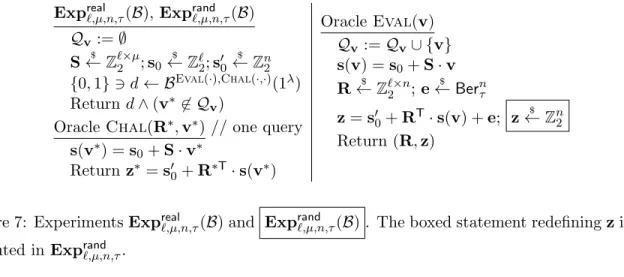
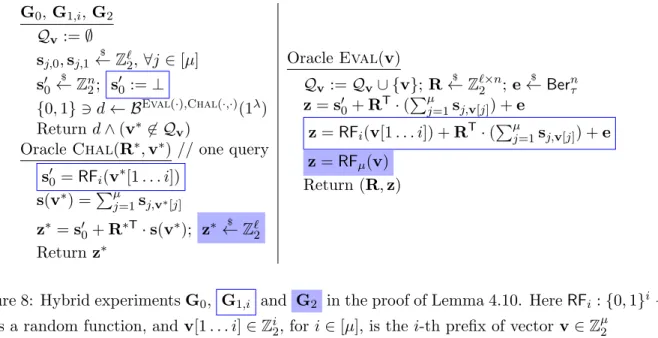
We now give intuition for the proof of Theorem 4.9. Similar to the proof of Theorem 4.2, we distinguish fresh and non-fresh forgeries. Here the new and interesting case is when the the first forgery found by the adversary is fresh. In the analysis we move to a mental experiment where tags computed by the tag oracle are uniform and independent from the secret key. The technical heart of the proof is to show that such a modification defines an indistinguishable distribution, assuming that the standard LPN assumption holds. More in detail, consider the two experiments defined in Figure 7. In the “real experiment”, the answers from the Eval(v) oracle have the same distribution as the values (R,z) from a tag on message m such that h(m,b) =v; in the “random experiment”, the answers from theEval(v) oracle are uniform. Oracle Chal(R∗,v∗), which can be queried at most once, essentially corresponds to the output of a verification query on a fresh forgery (m∗, φ∗), such thath(m∗,b∗) =v∗. The lemma below states that it is hard to distinguish the two cases. Its proof uses a hybrid technique from [13, 4].
Lemma 4.10. Let `, µ, n, τ ∈N. Assume that the LPNτ,` problem is (t, nQ, ε)-hard. Then, for all
adversaries B running in time t0≈t, and askingQ queries to the Eval(·) oracle, we have that
Pr
h
Expreal`,µ,n,τ(B)) = 1i−PrhExprand`,µ,n,τ(B)) = 1i