REPORT
ON THE 6
THJOINT CROSS-BORDER
EMC MARKET SURVEILLANCE CAMPAIGN
(2014)
SOLAR PANEL INVERTERS
(Grid-connected PV inverters and optimisers intended to be used by consumers)
2
CONTENTS
S/N ITEM PAGE
A. EXECUTIVE SUMMARY 3
B. ELEMENTS OF THE CAMPAIGN 5
1. Reasons for the campaign 5
2. Scope of the campaign 5
3. Participation in the campaign 6
4. Timing 6
5. Sampling 6
6. Documents 6
7. Tests performed 6
C. RESULTS 8
1. Number and origin of products 8
2. Administrative compliance 8
2.1 CE marking 8
2.2 EC Declaration of conformity 9
2.3 Technical documentation (TD) 9
3. Compliance with harmonised standards 10
3.1 Emissions requirements 10
3.2 Study of emissions below 150 kHz 10
3.3 Study of DC side 10
4. Other evaluations 10
34.1 DoC compliance vs. compliance with emissions requirements 10 4.2 Technical documentation vs. compliance with emission requirements 11
5. Overview of compliance 11
D. CONCLUSIONS AND RECOMMENDATIONS 12
1. Conclusions 12
3
A.
EXECUTIVE SUMMARY
As a result of discussions at the 35th EMC Administrative Cooperation Working Group (EMC ADCO) and an impact assessment procedure it was agreed that the sixth joint cross-border EMC market surveillance campaign should assess the compliance of grid-connected solar panel inverters (and optimisers) intended to be used by consumers. Solar photovoltaic (PV) modules generate electricity from sunlight. Using an inverter, this electricity can be fed into the mains electrical supply of a building, or directly into the public electricity grid. Grid-connected solar panel systems intended to be used by consumers are already widely used throughout Europe and the market is growing continuously.
This report provides an overview of the findings and makes recommendations on next steps and future actions.
The primary purpose of the campaign was to assess the compliance of the equipment under test (‘EUT’), samples randomly taken from the market, with the provisions of the EMC Directive:
Compliance with the harmonised standards on emissions;
Compliance with pre-selected administrative requirements of the EMC Directive; Study of emissions below 150 kHz and Study of DC side (optional);
Improve information exchange between market surveillance authorities; Raise the profile of EMC to consumers and stakeholders.
Fourteen national Market Surveillance Authorities (‘MSA’) EMC ADCO members participated in the campaign, 55 products were assessed between the 1st January 2014 and the 30th June 2014. In general, the level of compliance with the administrative and technical requirements was considered very low. Overall, only 5 (9%) of the Equipment Under Test (‘EUT’) were assessed as compliant.
Based on this campaign EMC ADCO has formulated conclusions and recommendations which can be found in Chapter D of this report.
Administrative compliance
The results of the administrative assessment of EUT showed:
Approximately a third (38%) were considered to be administratively compliant.
All but one EUT had the CE marking, 52 (95%) were assessed as meeting the correct formatting requirements.
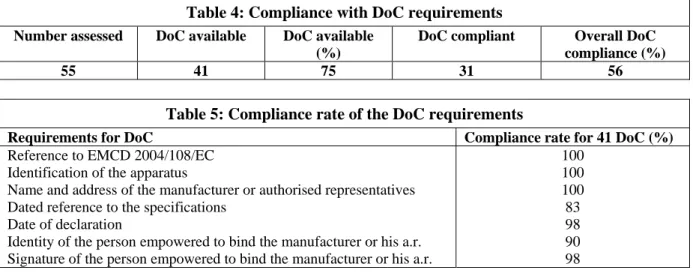
Declarations of Conformity (DoC) were available for 41 EUT. 10 of the supplied DoC had non-compliances. Overall, 56% of assessed DoC was acceptable.
From the requested 19 Technical Documentation (‘TD’), 17 were supplied. Of those, 12 were found to be compliant (63% overall compliance).
4
Technical compliance with harmonised standards
For the purposes of this campaign, technical compliance is to be understood as compliance with an applicable harmonised standard1.
The results of the technical assessment of solar panel inverters showed that approximately a third of 54 EUT tested were compliant (33% overall compliance).
Study of emissions below 150 kHz
37 EUT were assessed technically; 14 of them (38%) were found compliant to EN 55011 Table 8 limits at mains terminals in the frequency range 9 kHz-150 kHz.
Study of DC side
42 EUT were assessed technically; 18 of them (43%) were found compliant to EN 61000-6-3 emission requirements to the DC power port.
1
‘harmonised standard’ means a European standard adopted on the basis of a request made by the Commission for the application of Union harmonisation legislation (Regulation (EU) No 1025/2012).
5
B.
ELEMENTS OF THE CAMPAIGN
1.
Reasons for the campaign
As a result of discussions at the 35th EMC Administrative Cooperation Working Group (EMC ADCO) and an impact assessment procedure it was agreed that the sixth joint cross-border EMC market surveillance campaign should assess the compliance of grid-connected solar panel inverters (and optimisers) intended to be used by consumers. Solar photovoltaic (PV) modules generate electricity from sunlight. Using an inverter, this electricity can be fed into the mains electrical supply of a building, or directly into the public electricity grid. Grid-connected solar panel systems intended to be used by consumers are already widely used throughout Europe and the market is growing continuously.
2.
Scope of the campaign
The primary purpose of the campaign was to assess the compliance of samples taken from the market with the provisions of the EMC Directive. Administrative compliance was checked against the CE marking and Declaration of Conformity. General marking requirements, user information and Technical documentation were assessed on an optional basis. For the purposes of this campaign it was decided to assess compliance with the EMC essential requirements (emissions) by testing against a relevant harmonised standard2. Immunity aspects were not assessed.
Other marking requirements and Technical Documentation (‘TD’) will be assessed on a voluntary basis. For the purposes of this campaign technical compliance with the EMC essential requirements (emissions) will be carried out by testing against a relevant harmonised standard2.
It was also encouraged that MSA will examine the performance of the DC side (where not already covered by the harmonised standard) and arrange for testing below 150 kHz to be performed in addition, to gather information on the levels of emission currently produced by these products, to assist in future standards-making.
The campaign was also intended to provide MSA with the opportunity to participate in EMC market surveillance, to improve the exchange of information and to raise economic operator and consumer’s awareness of the need for conformity with the requirements of the EMC Directive.
It was agreed that following the analysis of the results of the campaign, a report would be prepared and presented to the EMC Working Party for subsequent publication by the Commission. The present document constitutes the report of the campaign.
2
EUT were assessed against harmonised Standards displayed in the DoC (if available). If no DoC was available assessment was carried out against EN 61204-3:2000
6
3.
Participation in the campaign
Participation in the campaign was voluntary, and was open to all members of EMC ADCO. Each MSA was responsible for the costs of obtaining the EUT and tests.
Fourteen European countries participated in the campaign: Austria, Cyprus, Finland, Germany, Ireland, Lithuania, Luxembourg, Malta, The Netherlands, Romania, Slovenia, Sweden, Switzerland and the United Kingdom.
4. Timing
The campaign commenced on the 1st January 2014. The information gathering, testing and data reporting phases of the campaign were of six months duration, ending on the 30th of June 2014. Within that period, MSA carried out their actions to their own timescales.
5. Sampling
The aim was to obtain the broadest possible view of the EUT on the European market. Therefore, a quasi-random sampling process was applied to include a wide range of prices, sources and manufacturers (national, EEA, and imported from third countries). Double sampling was avoided by uploading the following information of selected products to ICSMS:
• Country of National Authority • Name and address manufacturer 3
-• Name and address of the importer (if applicable) 4 • Type/Model
• Other verification of the product
6. Documents
A Code of Practice was drawn up to provide guidance and a common understanding of the purpose of the campaign and to ensure, as far as possible, the adoption of harmonised practices during the carrying out of the campaign. The results of the assessment of each EUT were recorded on a common electronic data input form for EMC (EMC DIF).
7. Tests
performed
Solar panel inverters do not have own product family standard. For the purposes of the campaign it is agreed to assess compliance to the EMC essential requirements by measuring against the harmonised standards according to the DoC issued by the manufacturer. If the manufacturer has applied EN 55011 or EN 61000-6-3, testing has been done in accordance with the standard applied by the manufacturer. If a DoC was not
3
Referred to Article 9.2 of EMCD 2004/108/EC
4
7
available for the product or the manufacturer has used a harmonised standard different than EN 55011 or EN 61000-6-3 the assessment was done against EN 55011 using the limits of class B equipment.
Current harmonised standards used for emissions:
EN 55011:2009 + A1:2010 Industrial, scientific and medical equipment - Radio-frequency disturbance characteristics - Limits and methods of measurement
EN 55011:2009 could appear in DoC for products placed on the market before 1.7.2013
EN 55011:2007 + A1:2007 could appear in DoC for products placed on the market before 1.9.2012 EN 55011:2007 could appear in DoC for products placed on the market before 1.11.2009
EN 55011:1998 + A1:1999 + A2:2002 could appear in DoC for products placed on the market before 1.11.2009.
EN 61000-6-3:2007 + A1:2011 Electromagnetic compatibility (EMC) - Part 6-3: Generic standards - Emission standard for residential, commercial and light-industrial environments.
EN 61000-6-3:2007 could be used until 12.1.2014
EN 61000-6-3:2001 + A11:2004 could appear in DoC for products placed on the market before 1.12.2009. Study of emissions below 150 kHz and Study of DC side (optional):
It has become apparent recently that emissions below 150 kHz can be very high from some types of products and these can produce significant disturbance on the mains network. This campaign provided an excellent opportunity to gather information on emission levels in the range 9 - 150 kHz from a variety of manufacturer's products, to increase understanding of current emission levels.
EN 55011, in Table 8, provides limits at mains terminals in the frequency range 9 kHz-150 kHz for induction cooking devices. This requirement is therefore not applicable from a standards view but the standard does provide the test method and limits that could be used for information gathering (and reported separately to avoid confusion).
In case the DoC gives standards in which measuring the DC side (DC power port) is not included, MSA’s were encouraged to measure the DC side according to EN 61000-6-3.
8
C. RESULTS
1.
Number and origin of products
MSA had to report on the country where EUT has been manufactured; the information “Made in” present either on the EUT itself, on its packaging or on the accompanying documents and finally from the DoC (where available). The “country of origin” therefore refers not generally to the economic operator who is responsible for placing the product on the EU market.
A total of a fifty-five (55) products were selected and evaluated, as follows Table 1: Number and origin of products
Country of origin
Number of evaluated solar panel inverters
Level of compliance of assessed administrative and technical requirements during the campaign:
number (%) China / Taiwan * 19 0 (0 %) EU / Switzerland 32 5 (16 %) Other countries** 3 0 (0 %) Unknown 1 0 (0 %) All origins 55 5 (9 %)
* Three products from Taiwan
** One from Israel, and two products from Thailand
Conclusion: solar panel inverters were mainly of EU (58 %) and China / Taiwan (35 %) origin. Due to the small number of assessed products, no statistically valid conclusions can be extracted on this group.
2. Administrative
compliance
The EUT were assessed for the presence and format of CE marking, the availability and compliance of the DoC and traceability aspects (technical Documentation was checked on a voluntary basis).
38 % of the EUT fulfilled the assessed administrative requirements. Table 2: Compliance with administrative requirements
Number checked Number compliant Compliant (%)
55 21 38
2.1 CE
marking
All but one of the assessed EUT were CE marked, 2 did not fulfil the formatting requirements, 52 EUT (95 %) were assessed as compliant.
Table 3: Compliance with CE marking requirements
Number assessed Not fulfil CE mark layout Missing CE mark CE marking compliance Overall CE marking compliance (%) 55 2 1 52 95
9
2.2
EC Declarations of Conformity (DoC)
MSA assessed 55 EUT against the DoC requirements. From 55 requested DoC 41 were made available. From those 41 available, 31 were found compliant, this represents 56 % overall compliance (i.e. out of 55 EUT).
Table 4: Compliance with DoC requirements
Number assessed DoC available DoC available
(%)
DoC compliant Overall DoC
compliance (%)
55 41 75 31 56
Table 5: Compliance rate of the DoC requirements
Requirements for DoC Compliance rate for 41 DoC (%)
Reference to EMCD 2004/108/EC Identification of the apparatus
Name and address of the manufacturer or authorised representatives Dated reference to the specifications
Date of declaration
Identity of the person empowered to bind the manufacturer or his a.r. Signature of the person empowered to bind the manufacturer or his a.r.
100 100 100 83 98 90 98
Analyses of the name and address of the manufacturer and (if not located within EC/EEA/EFTA) name and address of the importer were made. 22 out of 55 EUT were manufactured in a third country. From those 10 DoC were made available (45%).
2.3
Technical documentation (TD)
MSA requested TD for 19 of the 48 EUT, however 17 were supplied.
Of those 12 were found to be compliant. This represents 63% of the total EUT (19) assessed against the TD requirements.
Table 6: Compliance with TD requirements
Number assessed TD available TD available (%) TD compliant Overall TD
compliance (%)
10
3.
Compliance with harmonised standards
3.1 Emissions
requirements
The measured result was compared directly with the limit in the harmonised standard without taking into account the measurement uncertainty. A failure was recorded if any emission exceeded a certain limit when measured with the appropriate detector.
54 EUT were assessed for emissions, 36 EUT were found not compliant with the emission requirements (67%). The technical compliance rate of the products tested for emissions was as follows:
Table 7: Compliance with the emissions requirements
Number tested Number compliant % compliant
54* 18 33
* One product was not tested.
3.2
Study of emissions below 150 kHz
9 out of 14 MSA take part at the study of emissions below 150 kHz. 37 EUT were tested, and 14 of them (38%) were found compliant to EN 55011 Table 8 limits at mains terminals in the frequency range 9 kHz-150 kHz.
3.3
Study of DC side
10 out of 14 MSA take part at the study of DC side. 42 EUT were tested, and 18 of them (43%) were found compliant to EN 61000-6-3 emission requirements to the DC power port.
4. Other
evaluations
4.1
DoC compliance vs. compliance with emissions requirements
EUT with a correct DoC had a higher rate of technical compliance than those with no DoC. Table 8: DoC compliance vs. compliance with emissions requirements
DoC Number of DoC* Number of emissions
compliant products Emissions compliant products (%) Not available 13 2 15 Available- Not correct 11 6 55 Available- correct 30 13* 43
11
4.2
Technical documentation vs. compliance with emission requirements
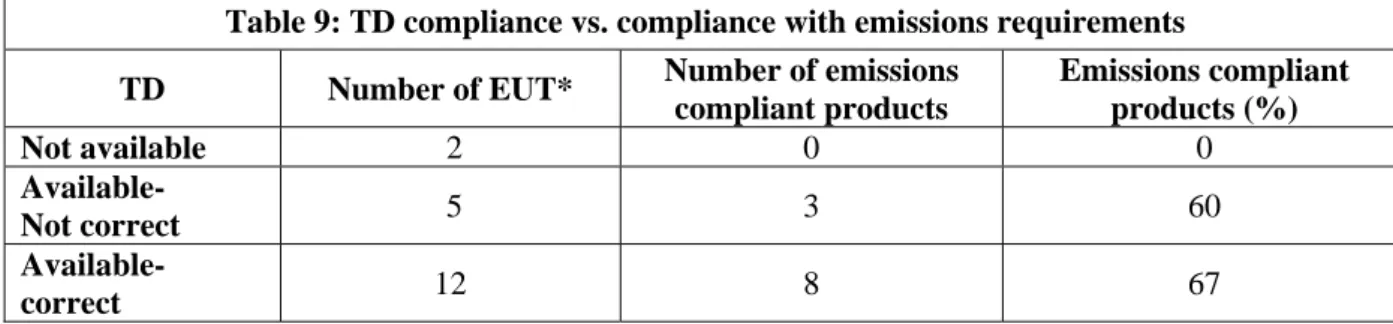
Nineteen EUT were checked on technical documentation.Table 9: TD compliance vs. compliance with emissions requirements TD Number of EUT* Number of emissions
compliant products Emissions compliant products (%) Not available 2 0 0 Available- Not correct 5 3 60 Available- correct 12 8 67 * 29 not checked
5.
Overview of compliance
Table 10 summarises the overall compliance of EUT in terms of emissions against harmonised standards, overall administrative, CE marking and Declaration of Conformity requirements.
Table 10: Overview of compliance Number
assessed Overall (%) Emissions (%)*
Administrative Overall adm.
(%) CE marking (%) DoC (%)
55 9 33 38 95 56
12
D. CONCLUSIONS
AND
RECOMMENDATIONS
1. Conclusions
The majority of EUT - 32 (58 %) - were of EU / EFTA origin.
Approximately a third (33 %) of the EUT met the disturbance emissions compliance tests.
Approximately a third (38 %) of the EUT met the administrative requirements (as assessed).
All but one assessed EUT (54) were CE marked (2 were incorrectly formatted).
A quarter (25%) of DoC was not provided, and 75 % of the DoC provided were correct.
Nearly all (91 %) of the EUT were assessed as overall non-compliant.
Study of emissions below 150 kHz (optional): approximately a third of the EUT (38%) were found compliant to EN 55011 Table 8 limits at mains terminals in the frequency range 9 kHz-150 kHz.
Study of DC side (optional): approximately a half of the EUT (43%) were found compliant to EN 61000-6-3 emission requirements to the DC power port.
From the results obtained of the solar panel inverters under test, the majority did not meet the harmonised standards that would provide a presumption of conformity with the EMCD.
The EUT represented a large sample of the products available on the market and it is clear that much remains to be done by manufacturers in terms of compliance.
The impact assessment for the 6th EMC market surveillance campaign has proven its justification.
Performing this campaign was challenging because of the nature of the product and complexity of measurements / study (of emissions below 150 kHz and of the DC side). This led to a decreasing number of participants.
The campaign showed that the market for solar panel inverters is not as large as for other targets of previous campaigns. Therefore the number of the EUT in this campaign has decreased.
The use of ICSMS for sampling EUT was very helpful. However some MSA has not used this tool for exchange of information.
Some MSA had difficulties to fill in the EMC DIF. The correct completion of the EMC DIF remains a target for alignment of cooperation between MSA.
The resource in conducting this type of campaign is significant. Activities including preparation (eg. drafting its Code of practice), coordination, tests and analysis of the results and the drafting of the report are carried out by EMC ADCO members supplemental to their national activities.
2. Recommendations
It is recommended that:
The results of the campaign should be publicised widely throughout Europe and the other countries where the products originate. Publicity should target all economic operators in the area of solar panel industry.
13
MSA should take the results of this campaign into consideration when making their multi annual plan as stated in the Regulation (EC) 765/2008.
The results of the optional measurements (study) of this campaign should be forwarded to the European Standardisation bodies in order to take into account in the development of the future standards for the solar panel inverters.
An impact assessment - for the selection of suitable targets - should be performed before future campaigns.
The adoption of the product to target and the preparation of the Code of Practice for future campaigns should start well in advance (more than one year) in order to be better prepared.
MSA who did not participate should be encouraged to join in future campaigns. Regulation (EC) 765/2008 promotes in article 25 this type of cooperation and actions between MSA.
A similar campaign should be considered on the same basis after a certain period to assess the effect on the market.
Trainings should be organised at national basis for Market surveillance staff that have to work with the EMC DIF in order to harmonise its use. The EMC DIF should be used for information exchange and requests of cooperation.
MSA shall use ICSMS in the future campaigns for sampling and exchange of information.
For future campaigns, EMC ADCO should seek support from the Commission in accordance with article 32 of the Regulation (EC) 765/2008. This could include technical and administrative support.