Evaluation of the Victorian
Framework Coaching Program
Dr Delwyn Goodrick
i
Table of Contents
Executive Summary ... iv
1. Introduction ... 10
1.1 Structure of the Report ... 10
1.2 The Victorian Framework Coaching program: Background and Rationale ... 11
1.2.1 Policy Context ... 11
1.2.2 Support for Early Years Services ... 12
1.2.3 Rationale for the Coaching... 12
1.2.4 The Victorian Pilot Coaching Program ... 13
1.3 Aims and Objectives of the Coaching Program (2011-2013) ... 14
1.3.1 A Program Logic for the Coaching program ... 15
2. Evaluation of the Victorian Framework Coaching program... 21
2.1 Framing the Evaluation ... 21
2.2 Evaluation Methods and Sources ... 22
2.3 Scope of the Evaluation ... 25
2.4. Audience and Key Stakeholders ... 25
2.5 Limitations of the Evaluation ... 25
3. The Coaching Program (2011-2013) ... 28
3.1 Key Components of the Coaching Program ... 28
3.2 Modifications to the Coaching program - Lessons Learned ... 29
3.3 Services included in the Victorian Framework Coaching Program ... 31
3.4 The Coaches ... 33
3.5 Resources Used by Coaches to Support Services ... 34
4. Evaluation Findings ... 36
4.1 Key Evaluation Question 1: What were the strengths and weaknesses of program design and implementation? ... 37
Consultancy Component ... 37
What was the value of the consultancy visits? ... 38
Coaching Component ... 40
How Did the Coaches Work with the Services? ... 40
Developing an effective working relationship with the service ... 41
ii
Structure of the Coaching Visits ... 43
Use of Coaching Resources ... 45
Action Plans ... 47
Facebook Page ... 48
4.2 Key Evaluation Question 2: How did the coaching program influence educators’ practices? ... 50
Educators’ satisfaction with the program ... 50
Outcomes for educators ... 53
Confidence in Explaining the VEYLDF ... 53
Changes in practice and alignment with the Victorian Early Years Learning and Development Framework ... 54
Comparison with Pilot Coaching Program Outcomes ... 58
Influence on the educational leadership team ... 60
4.3 Key Evaluation Question 3: What difference did the coaching program made to services? ... 61
Level of Engagement of Services with the Program ... 62
Service barriers at the start of the program ... 64
Service barriers at mid-point of the program ... 65
Services at program conclusion ... 66
Specific Improvements in Services ... 67
Performance on NQS Ratings ... 69
Service Culture and Educator Practice ... 72
4.4 Service Impact Profiles ... 77
Theme: Building professional identity ... 77
Theme: Increasing educator knowledge ... 81
Theme: Working towards the National Quality Standard ... 84
Case Synthesis ... 87
5. Implications and Recommendations ... 88
iii
Acknowledgements
Appreciation and acknowledgement is extended to the educators that participated in the evaluation, either through their completion of the state wide survey, their participation in interviews during evaluation service visits or their willingness to participate in follow up service profiles. I would also like to acknowledge the support and collegiality of Bridget Healey and Darlene Leach from the Department of Education and Early Childhood Development, and Ms Melodie Davies and Ms Helen Lawrence, the coaching advisor from Gowrie Victoria who were also extremely supportive throughout the evaluation.
Thanks is also extended to the four coaches, Julie Barron, Lisa Dekker, Di McCauley-Downey and Judy Swift for your openness and willingness to share your experience as coaches with the program.
iv
Executive Summary
The Victorian Framework Coaching Program (VFCP or ‘coaching program’) was funded by the Victorian Department of Education and Early
Childhood Development, to support early childhood educators and
services better align their practices to the Victorian Early Years Learning and Development Framework (VEYLDF). The Department engaged Gowrie Victoria to deliver the program from June 2011 to June, 2013. Four coaches, experienced in early childhood education and care were employed by Gowrie Victoria to provide face-to-face coaching to services. Fifty-four services were involved in the coaching program. The coaching program built on lessons learned from the implementation of a pilot coaching program with 92 services. A review of this pilot found that coaching was an effective mechanism to support educators in embedding the VEYLDF into practice.
The 2011-2013 program comprised two key components:
• Consultancy services to develop and strengthen leadership capacity and governance mechanisms in services; and
• Coaching services provided face-to-face to support educators to embed the VEYLDF into their work with children and families. The consultancy component included two initial consultancy visits, followed by 6 face to face days of coaching over 16 months. Coaches developed action plans with the educational leadership team and
provided on-site observational support to educators. Print materials and links to online resources were made available to reinforce coaching. A ‘Theory to Practice’ visit to Gowrie early childhood centres was also incorporated to extend educators' knowledge of potential strategies to improve programming and enhance environments that support children’s learning and development.
The Department of Education and Early Childhood Development
commissioned an evaluation of the VFCP in June 2013. The intention of the evaluation was to identify and document the processes and outcomes of the program and determine how, if at all the program had supported early childhood educators to embed the VEYLDF into their practice. A mixed methods evaluation approach was adopted to address a subset of key evaluation questions in three outcome domains – design and implementation, educator outcomes and service level outcomes. Evidence sources and methods included secondary data analysis of consultant and coaching reports, interviews with six managers,
end-of-v program survey, and individual and group interviews with coaches and the coaching advisor.
Findings
Overall, the coaching program was found to be effective in increasing the visibility of the VEYLDF and its implications for practice. It is clear that for many services the program shifted practices in line with the VEYLDF, but it cannot be claimed that the VEYLDF has been embedded into practice across all services.
Design and Implementation of the Program
• The continuity of coaches from the pilot coaching program (2010-2012) to the coaching program (2011-2013) was beneficial. Coaches in the program were able to flexibly structure their approach according to service and educator needs.
• Interviews revealed that the face-to-face contact with the coach within the service context was important to facilitate reflection on practice and progress practice change.
• The coaches were unable to work with all educators across all services. In larger services the coaches primarily worked with the educational leadership team, relying on these educators to share and spread feedback to other educators within the service. Where possible coaches directly observed practice and provided feedback to other educators while working within the service. Consistency in intensity and scope of these teachable moments was often not possible due to dynamics of an early childhood service
environment.
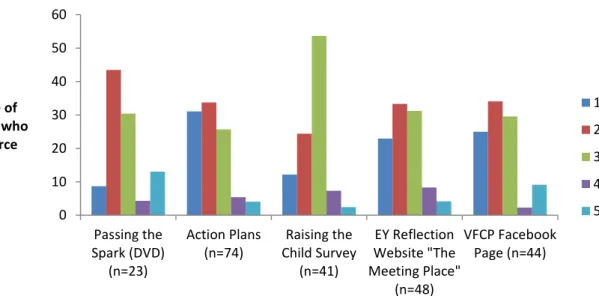
• A range of resources supplemented coaching. Coaches provided educators with materials and templates, and referred them to existing print and online materials. Educators appreciated simple templates and resources to guide improvement. Sixty-five percent of educators responding to the end of program survey reported that the action plans were the most useful resource provided by the coach. These one page templates focused on a specific action and associated strategies to progress the identified action.
• There was a lack of continuity between the consultancy component and the coaching component of the coaching program. The
consultancy visits were designed to provide a supportive basis for coaching by strengthening the governance and leadership of services. While the intention was sound, two days consultancy was insufficient to address the structural and operational barriers experienced by some services. The dynamic nature of the services
vi and the timing of the consultant to coach handover at the end of 2011 also meant that some of this information had changed and/or was no longer relevant by the time the coaches began coaching visits.
• Gowrie Victoria recommended all services included in the program could benefit from coaching following the consultancy visits. It is clear that services with multiple barriers did not gain as much value from coaching as other services in the program. It may be that criteria to inform decisions about progression to the coaching stage were not sufficiently specified.
• The two to three month gap between coaching visits was too long to sustain momentum of educators. Coaches and educators
indicated that agreed actions were often not completed in between visits, particularly if the service manager or director did not
recognise the need to provide time and focus to progress agreed tasks.
Changes in Educators' Knowledge and Skills
• Face-to-face coaching allowed coaches to observe and provide targeted feedback on educators’ practice. Educators were highly satisfied with the coaching program. Eighty-nine percent of
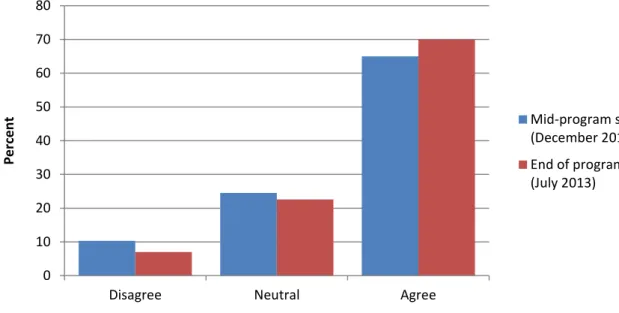
educators responding to the end of program survey indicated they would recommend the program to other educators. Sixty-nine percent of educators felt that the program was more valuable or much more valuable than other professional development they had been involved in.
• The coaching program made explicit links between observed practice and concepts within the VEYLDF. Coaches linked observations of practice to specific concepts (e.g., intentional teaching) making them tangible rather than theoretical. This process validated and reinforced educator practice in these domains.
• Educators reported that they believed the program had improved their practice in all areas of the VEYLDF, with more educators reporting improvements to reflective practice, ensuring children's success in their learning and development, and providing families with information. Secondary data from coaching reports and interview data from coaches reinforced the improvements observed in reflective practice and environments for children. • Over sixty-five percent of educators responding to the end of
program survey indicated that the coaching program had influenced their practice and increased the alignment of their
vii practice to the VEYLDF. Coaches noted variability in educators’ knowledge and skills of the VEYLDF practice principles across the program timeframe; some educators may be over-estimating their capacity to put the principles into practice. The degree of
improvement was associated with extent of contact with the coach and the educators' engagement with the VEYLDF, the individual’s motivation and existence of service level barriers, such as
turnover, group dynamics or educational leadership within the service that inhibited practice change.
• The ‘Theory-to-Practice’ visit to Gowrie Victoria reinforced coaching messages and the practice principles. Most educators interviewed as part of the evaluation indicated that the visit gave them
practical, low-cost ideas they were able to put in practice within their service. Some of the educators interviewed during the evaluation reported that the Theory to Practice visit played a as pivotal role in their understanding of concepts in the VEYLDF.
Outcomes for Services
• Most services demonstrated some level of commitment to the coaching program across the program timeframe. By midpoint in the program coaches indicated that 34 of the 54 services were engaged with the coaching program. Engagement was reinforced by two factors, the impetus for improvement resulting from the introduction of the National Quality Framework (NQF) and
upcoming service rating visits, and the reputation and credibility of Gowrie Victoria as the coaching provider.
• All services progressed on the Village Indicators, a set of indicators of quality at the service level. Improvements in reflective practice, physical environments, and quality of collaborative reflective practice were highlighted as key outcomes attributed to the
coaching program. Specific changes to programming and meeting scheduling were also presented as tangible indicators of change. While there was evidence of the intention of services to maintain the changes, the sustainability of these improvements is not known.
• Classification of services at the end of the program revealed that eleven of the 54 services were identified as consolidating on the Village Indicators, indicating considerable progress across the program timeframe. The remaining 43 were classified as
progressing or remaining at a beginning stage. This is indicative of the time that service level change takes to occur, the service
viii context, and points to the differential value of coaching to services involved in the program.
• Coaching works best when undertaken under the right conditions. The coaching program worked most effectively with services that were highly engaged, had strong leadership supportive of the VEYLDF, and experienced few operational and service level barriers that would inhibit practice change. Improvements were patchy in services experiencing multiple barriers and were limited to changes in specific rooms or attitude or practice change in key individuals within the service. Operational or structural interventions may be required for services with significant barriers.
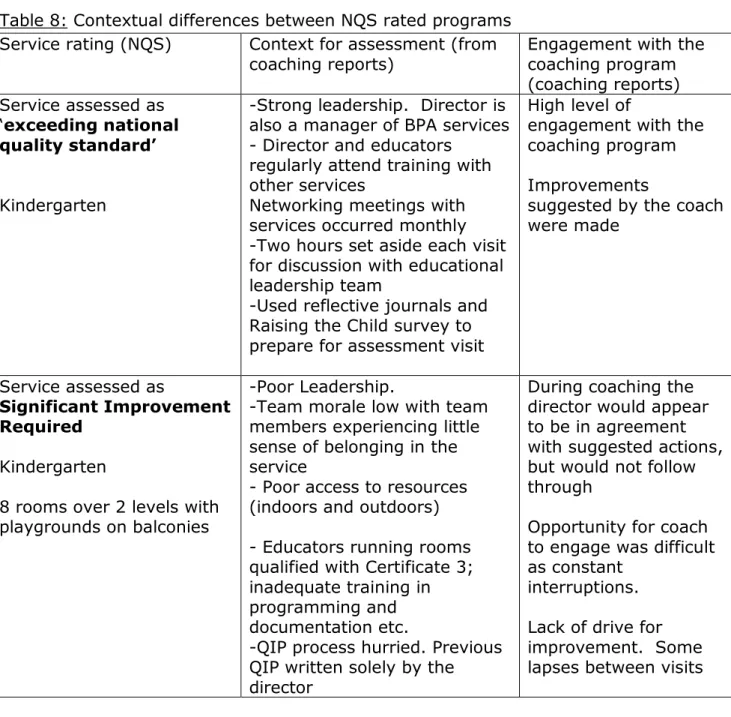
• Ten of the 54 services have had an NQS visit and rating during the course of the coaching program. Of the ten services, one service was rated as ‘exceeding’ the standard requirements, three
achieved ‘meeting,’ five services achieved ‘working towards’ and one service received ‘significantly needing improvement’. A comparative analysis of the service classified as ‘exceeding’ with the service classified as ‘significant improvement required’
reinforced the importance of engagement, understanding of the VEYLDF, leadership and service capacity.
Synthesis and Recommendations
In a period of significant reform, support for implementation of new
concepts, principles and approaches is required. The Department offers a suite of interventions targeted to identified needs. The coaching program was an initiative that was designed to strengthen educators’ practice and enhance service leadership and governance and was developed in
recognition of the interdependence of these elements to quality early childhood programs. It is clear that the outcomes of the coaching program at educator and service level have been variable, with some educators and services making significant changes in line with the VEYLDF, while others have found it challenging to align their practices with the VEYLDF.
The following recommendations are proposed on the basis of the
evaluation evidence presented in this report. The recommendations are presented in three domains: the design and scope of coaching
interventions, strengthening educator outcomes, and monitoring and evaluating coaching initiatives.
ix
Recommendations
Design and Scope of Interventions
It is recommended that criteria for selection of services that may benefit from coaching be more tightly specified to maximise the return on
investment. Diagnostic criteria may include evidence of existing leadership and good governance. Other interventions may be more appropriate for services experiencing significant operational or structural barriers.
It is recommended that coaching interventions be tailored to the
differential needs and requirements of services. Shorter, more intensive periods of coaching may be warranted to support specified actions agreed by the educational team and to maintain the momentum of change in some service contexts.
It is recommended that professional learning opportunities be extended to educational leaders to enhance pedagogical skills and enhance
leadership skills within the service. Enhancing educational leaders’ skill base will potentially strengthen the sustainability of support interventions across the service.
Strengthening Educator Outcomes
It is recommended that further opportunities (such as use of social media or educator service visits) be promoted to support services to network and cross-pollinate ideas, strategies and experiences. These
opportunities could be explicitly linked with and reinforce existing print form or online resources that support educators’ professional practice. It is recommended that coaching be supplemented by provision of structured materials or resource books that can be used for record keeping and maintained after program conclusion to promote sustainability.
Monitoring and Evaluating Coaching Interventions
It is recommended that a tool or series of tools be developed to enable a more robust and trackable evidence base of educator level or service level change. Ideally, this tool would enable both numerical and narrative comparison of service status and change relevant to service improvement over time.
The Victorian Department of Education and Early Childhood Development (DEECD) and Gowrie Victoria commissioned an independent evaluation of the Victorian Framework Coaching program in June 2013. The coaching program was funded by the Victorian Department of Education and Early Childhood Development and delivered by Gowrie Victoria across 54 early childhood services in Victoria between June 2011 and June 2013.
This report presents the findings of the outcome evaluation of the program. It is intended that the findings presented in this report will be used primarily for summative purposes to shape decisions about the merit and worth of the program, and to inform the development of further initiatives to strengthen the quality of early childhood services to benefit Victorian children.
1.1 Structure of the Report
The report is divided into six sections.
Section 1 provides an overview of the policy context, and background to the coaching program. It includes the aims and objectives of the program and describes the major components. This section presents a program logic diagram to clarify the relationships between inputs, activities and intended outcomes.
Section 2 outlines the purpose of the evaluation, key evaluation questions, audience and the evaluation approach used for the external evaluation. An evaluation data matrix summarises sources of evidence and evaluation methods.
Section 3 presents findings related to the design and implementation of the coaching program. This section identifies the services involved, the key elements of coaching, and the pedagogical underpinnings of the coaching model adopted by the coaches.
11
Section 4 presents findings related to the outcomes of the program at the educator and service level. The section
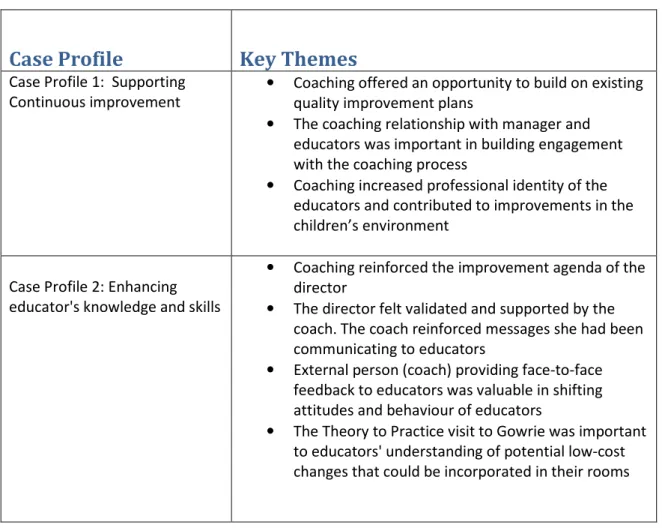
outlines the strengths and weaknesses of program design, then addresses educators’ outcomes and describes outcomes for services. Three service impact profiles are included at the end of the section to reinforce key themes outlined in the aggregated findings.
Section 5 summarises the lessons learned, key implications and recommendations emerging from a synthesis of evaluation findings. The focus of this section is on the implications of implementation of the coaching program for strengthening the application of the Victorian Early Years Learning and Development Framework (VEYLDF).
1.2 The Victorian Framework Coaching program: Background and Rationale
1.2.1 Policy Context
The Victorian Early Years Learning and Development Framework (VEYLDF) for all children from birth to eight years was released in November 2009. Implementing the VEYLDF is a partnership between the Policy and Strategic Projects Division, Department of Education and Early Childhood Development (DEECD) and the Early Years Unit, Victorian Curriculum and Assessment Authority (VCAA). Implementation began formally in 2010.
The VEYLDF aligns with Being, Belonging and Becoming: The Early Years Learning Framework for Australia (EYLF) and
My Time, Our Place: A Framework for School Age Care, and shares of the same five Learning and Development Outcomes. A key feature of the VEYLDF is its scope 0-8 years (rather than 0-5 years of the EYLF) and a set of eight practice principles which provide guidance to all early childhood professionals about the most effective ways to work with children and families.
The approved learning frameworks define a series of expected quality practices in the education and care of children. They are based on a compelling national and international evidence base that points to the critical link between a child's early learning experiences and their educational and social outcomes.
12
Alongside the development and implementation of the EYLF and VEYLDF is the National Quality Framework for Early Childhood Education and Care (NQF) i n t r o d u c e d i n 2012. The NQF requires services to address a series of quality standards that align with an approved learning framework. Together the approved learning frameworks (including the EYLF and the VEYLDF) and the National Quality Standard are key drivers designed to inform the provision of high quality early childhood education and care programs across Victoria.
1.2.2 Support for Early Years Services
The Department of Education and Early Childhood Development has developed a range of initiatives to support services in quality improvement.
Coaching was viewed as one potential mechanism to support services and educators in understanding and applying the VEYLDF in their practice with children. A pilot coaching program was developed and implemented from 2010-2011 with 92 services. This was followed by an extension of the program to an additional 54 services from 2011-2013, and it is this program that it is the focus of this report.
Coaching brings together an experienced practitioner familiar with the EYLF and VEYLDF, and educators who are
knowledgeable about the service context and the children with whom they work. Together educators and coaches reflect on, discuss and review observed practices in situ.
1.2.3 Rationale for the Coaching
Coaching can be described as a structured process based on an ongoing relationship between two or more people for the purpose of professional learning and improvement of professional practice (Armstrong & Geddes, 2009).
The relationship between the coach and the educator is critical and the level of engagement of the educator with the coach appears to be an important prerequisite for professional learning (Levin, 2010). While terms such as mentoring or teaching are often used interchangeably with the term coaching, the distinction that orients this evaluation is that
coaching is purposefully focused on supporting educators to learn and adopt new approaches to inform their work with children. Mentoring, in contrast, may be designed to support professional goals defined by the educator. Coaching
13
processes are therefore designed to support the goals of coaching, not necessarily focus on educators' individual or career goals (as in mentoring). It is important to note that as they are external to the service, coaches do not manage the performance of individuals, but rather support individuals through a developmental process.
Simpson (2010) identified the most frequently cited positive attributes of coaching. As a critical friend, with no vested interest in the organisation as an employer or employee, the coach offers:
• the opportunity to talk things through, discuss vulnerabilities and sensitivities
• the opportunity to reflect, to explore actions and their consequences, and to think of other alternatives • support to the individual in coping with the complexities of the workplace
• an opportunity to explore ways of responding to challenging tasks and difficult people
• a means to assist individuals to identify and affirm strengths and address personal and professional barriers to good practice, and support to learn about new tools and strategies.
Early childhood educators are often professionally isolated within the services in which they work. While they may have some access to one-off professional learning programs, they may have few opportunities for ongoing professional development that supports them in their workplace context.
1.2.4 The Victorian Pilot Coaching Program
The first iteration of this program, known as the Victorian Early Years Pilot Coaching Program (VEYCP)1 ran from June 2010 to December 2011 and involved 92 Victorian early childhood services. The intention of this pilot was to align educators' practice with the VEYLDF. Gowrie Victoria was contracted to provide coaching services.
On the basis of review of the pilot and DEECD priorities, the coaching program was extended to a new group of 54 early childhood services. No services involved in the first wave were involved in the second wave. Services were selected for the coaching program on the basis of screening criteria, which is described later in this report.
1
14
The focus of this evaluation is on the coaching program, including the two-day consultancy, implemented from September 2011 to June 2013.
1.3
Aims and Objectives of the Coaching Program (2011-2013)
The coaching program is best characterised as a capacity building initiative designed to support the VEYLDF practice principles across early childhood education and care services in Victoria.
The aim of the Victorian Framework Coaching program was to support educators to embed the Early Years Learning Framework for Australia (EYLF) and the Victorian Early Years Learning and Development Framework (VEYLDF) into their everyday practice with children, families and other professionals.
The provision of high quality education and care requires educators with knowledge and skills, and services with strong governance and leadership that support continuous improvement. The program was therefore designed to influence educators within services to align their practice with the VEYLDF and to progress service quality more broadly. Following two consultancy visits focussed on leadership and governance, the coaching was implemented from September 2011 to June 2013 with 54 services. The program was funded by DEECD. As with the pilot coaching
program, Gowrie Victoria was contracted to provide coaching services and manage the program. Four coaches, who had previously been engaged as coaches in the pilot program, were appointed by Gowrie to provide the coaching to
specifically selected services across Victoria.
The coaching program was designed to lead to intentional changes at both the individual (the practitioner) and at organisational (the service) levels. The program was conducted over an eighteen month period, including an initial two-day consultancy visit that focused on strengthening leadership and governance. This initial two-day visit was also intended to generate a preliminary assessment of the service in preparation for coaching. Six days of coaching was then provided over the remaining 16 months of the program.
15
In the mid-program evaluation report (prepared by Gowrie Victoria) the following sub-objectives were defined for educators, educational leaders and services as a whole.
For educators:
• Demonstrate a sound understanding of the VEYLDF practice principles
• Demonstrate a sound understanding of the five learning and development outcomes
• Contribute to a learning community (of professionals) and culture of continuous improvement. For educational leaders:
• Understand the role of leadership and the process of change • Develop skills in giving constructive feedback
• Contribute to a learning community of leaders and a culture of continuous improvement.
For the Service:
• Service has progressed according to quality indicators (known as the Village Indicators).
1.3.1 A Program Logic for the Coaching program
In planning the program, DEECD and Gowrie Victoria developed a monitoring and evaluation framework to guide the monitoring and documentation of both program processes and outcomes. A program logic map was initially developed by the Department and Gowrie Victoria to focus attention on the key activities and intended outcomes of the coaching program.
16
Essentially a logic map is a one-page depiction of the relationship between resources, activities and intended outcomes. In other words, it shows the relationship between what is done and what happens as a result. Such maps are useful in understanding an initiative's intent, and also for developing tailored performance measures and evaluation options. The logic map is important in developing propositions that can be tested during the evaluation.
As this external evaluation evolved, the logic map was elaborated and a slightly revised logic map was developed. The revised logic is presented in Figure 1. The diagram should be read from left to right. It depicts the evaluator's
understanding of the key drivers, resources, key activities and the intended outcomes. The external evaluation primarily focused attention on the relationship between coaching program outputs and short-term and intermediate outcomes.
The program was designed to progress a set of outcomes. But the relationship between the work undertaken as part of coaching and the results or signs of progress in services are complex and non-linear. Similar resources and strategies sometimes generate very different results. Outputs are reasonably proximate and traceable to inputs, but outcomes are interdependent and influenced by contextual factors. A brief summary of the key elements depicted in the logic model is presented below.
Critical Issues
The need for the coaching program was based on a consideration of the existing context of reform. Drivers for the coaching program were identified. These drivers were based on evidence derived from the pilot coaching program and from policy insights from implementation of other service improvement initiatives. The three key drivers were:
• There are gaps in leadership and governance in some services that inhibit quality improvement • Educators struggle with the practice implications of the VEYLDF and the EYLF
• The introduction of the NQF will require services to demonstrate quality practices and alignment of the work with an approved learning framework
17
Inputs
Fifty-four services participated in the program. Gowrie Victoria was contracted to provide the coaching and manage the program.
The total amount of the coaching contract with Gowrie Victoria was $601,586.00. This equated to an amount of $186,950.00 for the consultancy component and $414,636.00 for the coaching component.
Coaching was provided by early childhood specialists who had been involved as coaches in the prior implementation of the pilot program. Four coaches were appointed to provide the coaching.
The coaches made a range of resources available to educators within services that participated in the program.
Resources included action plans, a set of service level indicators (the ‘Village Indicators’) to help services assess current status and areas for improvement, a dedicated Facebook page, reference and use of an Early Years reflection website, and other existing materials, such as practice guides, that were readily available from the DEECD website and on DVD to support implementation of the VEYLDF. While most resources were also used in the pilot program, the Facebook page and the Village Indicators were developed specifically for this program.
An evaluation framework was developed jointly between Gowrie and DEECD representatives to guide monitoring and evaluation of the program during implementation.
Activities
Eight days of face-to-face support was provided to the 54 services over an 18 month period. An initial two day consultancy visit was undertaken to facilitate a governance and leadership platform for the coaching visits. Six days of coaching was provided to the services over the ensuing 16 months of the program, which equated to approximately one visit every two to three months. Coaches worked with the educational leadership team within each service, while also observing and providing feedback to as many educators as possible during coaching visits. In between visits coaches maintained email and occasional phone contact. Coaches also participated in monitoring mechanisms such as a mid-program survey, and discussed and reviewed service progress in monthly coaching meetings with the other coaches.
Outcomes
In the short term (the first year of the program) it was anticipated that there would be shifts in practices at both the educator and service level. At the educator level it was expected that educators would improve
capacity for reflective practice and that educators develop and implement action plans to support practice improvements. It follows that these educators would then develop an improved understanding of the VEYLDF and exhibit more confidence in applying the practice principles to their work with children and families.
At the service level it was anticipated that the consultancy visits and the coaching process would contribute to enhanced capacity of the leaders of early childhood services, and that the services would have improved governance systems in place to support ongoing quality improvement. In the intermediate term these services would then be in the position to provide better support to educators in implementation of the VEYLDF, and there would be improved consistency in programming and practice across the service.
In the longer term, outside of the program timeframe, achievement of these short and intermediate term outcomes was associated with an
20 increased focus on quality improvement and involvement by all educators and services in supporting improved outcomes for children.
Assumptions
The face to face coaching model is based on three key assumptions. Coaching works when quality improvement strategies are tailored to context, supported by service leadership and personalised to the needs of educators:
• Quality improvement occurs when support initiatives are tailored to context
Early childhood education and care is provided by services that are diverse in terms of geographical location, leadership and history, qualifications and number of educators, characteristics of children and families attending the service, and many other attributes that influence service provision. An understanding of service context is important in developing effective quality improvement strategies. Support can then be tailored to the opportunities identified.
• The sustainability of quality improvement depends on leadership support, strong governance and sound operational practices within services
Any targeted intervention has the potential to lift quality temporarily. While pockets of good practice may be identified, educators cannot maintain high quality without support from the service and other educators. Sustainability is threatened when there is a lack of leadership and governance support. Service leaders that encourage and support educators to implement the VEYLDF practice principles w ill more likely contribute to sustainable quality improvement. • Educators are more likely to respond to personalised approaches
that support practice improvement
Many early childhood professionals value face-to-face contact and feedback on their practices. Timely feedback and suggestions provided where and as practice occurs are likely to enhance
educators’ understanding and capacity to change. Direct feedback on practice is an important supplement to professional learning resources provided to support application of the VEYLDF.
Conversations about practice and reflection reinforce educators' confidence and capacity to implement change.
21
2. Evaluation of the Victorian Framework Coaching program
The key evaluation question orienting the evaluation of the Victorian Framework Coaching program was, 'How, if at all, did the coaching program support early childhood educators to embed the Victorian Early Years Learning and Development Framework into practice?'In order to answer the overall question, the following sub-questions were also addressed:
1. What were the strengths and weaknesses of program design and implementation (including consultancy phase, coaching phase and materials)?
2. What changes in educators' practice (knowledge and skills) resulted from the coaching program?
3. How did the coaching program influence processes and practices at the service level?
4. What are the lessons learned about what is required to support early childhood services in Victoria?
2.1 Framing the Evaluation
The evaluation questions require knowledge about the work undertaken with the 54 services, and rely on an understanding of what outcomes, both intended and unintended, resulted from the coaches' visits.
In an intervention of this nature it can be challenging to disentangle the influence of coaching from other influences in the environment, such as other educational opportunities experienced by the educators, their
progressive development as educators over time in a role, and changes in service leadership or approach. In most policy contexts this is a reality that confronts attribution of change to a particular intervention, however the triangulation of evidence across multiple sources, and with multiple methods, contributes to confident and plausible claims about observed outcomes. Attribution of outcomes to the program is made by directly seeking evidence of a causal pathway from the intervention (the coaching) through to the outcomes.
The program logic provided an overview of the linkages between inputs, activities and outcomes of the program and described a set of
assumptions about how change would occur. The evaluation focused on documenting the contribution of the coaching program to these
outcomes, recognising that many other factors will have potentially influenced educators' practice over the program timeframe.
22 A set of propositions about the program that can be tested in the
evaluation follow from a consideration of the program logic. The propositions are:
• That face-to-face coaching was an effective strategy to support educators to embed the VEYLDF in practice
• That the dose of the program (two day consultancy followed by six coaching visits) was sufficient to bring about intended outcomes • That the content, structure and frequency of coaching were
sufficient.
• That the coach had sufficient contact with the educators at the service (beyond the educational leader/director) to bring about change in their practice OR that the educational leader will coach other educators to achieve the outcomes.
• That the program constitutes an efficient and effective use of government resources (i.e., it generates positive net benefit and is the most efficient means of generating these benefits).
The final assumption was not tested in this evaluation due to the lack of comparable cost data and lack of specificity about the scope of outcomes across services.
The evaluation was framed to understand the ways in which the service context and the intended coaching process influenced actual coaching processes and achievement of intended outcomes. This information will provide important information for future policy decisions to support educators and services.
2.2 Evaluation Methods and Sources
A mixed methods approach to the evaluation was undertaken. Given the timeframe for data collection and analysis, it was decided to undertake evaluation activities concurrently rather than stage them sequentially. The evaluation included:
• the development and implementation of an end of program survey (end June, 2013)
• Six service visits (four rural and two metropolitan) with three of the four coaches on their final coaching visits (June, 2013)2
• Follow up visits to two additional services to conduct interviews with the director or manager of the service
• Topical interviews with 16 service educators across the service visits
2
As the evaluation was contracted in the final two months of the program, the evaluator was only able to attend the final service visit with coaches. It is acknowledged that the final visit is likely to be different from previous visits in the nature of coaching activities and in coaching format.
23 • Attendance at the end of program celebration. Attendance was
primarily used as an opportunity to make contact with services for follow-up interviews and to promote survey completion
• Individual and small group interview with the four coaches, and overall coaching advisor at Gowrie Victoria
• Secondary document analysis and review of coaching reports and documentation (including Village Indicators, mid-term reports and coaching survey)
• Three profiles of services (assessed as Beginning, Progressing or Consolidating on final service rubric), and presentation of their response to coaching (positive and negative) based on interviews with the director/manager
A summary of the evaluation methods and sources according to key evaluation question is presented in Table 1.
Specific details of each element of the evaluation is described in the technical appendix accompanying this report.
24
Table 1: Evaluation Questions and Data Matrix
Key Evaluation Question Information Requirements Data Sources Method of data collection or retrieval
What were the strengths and limitations of the program design?
Description of the coaching intervention and activities undertaken by coaches, quality of content, design (coaching model)
- Observation at 6 services (last coaching visit)
- Secondary data - coaching reports - Coaches (x 4) and coaching advisor -Educators (16) and 6 managers across 8 services
- Fieldwork notes - Document analysis
- Individual interviews - Individual interviews and
informal conversational interviews What changes in educators’
practice resulted from the coaching program?
Views of a wide range of
stakeholders about the value of coaching and of this specific intervention (self-report from educators and coaches reports)
-4 coaches plus overall coaching advisor (Gowrie Victoria)
- educators participating in mid-program and end of mid-program survey and/or interviews
- Interviews and coaching reports
-End of program survey and interviews at service visits (x 8)
How did the program influence and improve processes and practices at the service level?
What were the most significant changes that occurred in services participating in the program? What is the likely sustainability of these changes?
Managers and/or directors of participating services
Coaches
Case impact profiles and review of services rated through NQS
- Interviews
- Coaching reports and interviews with coaches
5. What are the lessons learned about what is required to support early childhood services in Victoria?
How does coaching compare with other professional development options?
What strengthened and inhibited effective implementation of the coaching program?
-Costing information from Gowrie Victoria
- Coaches
- Service Impact profiles
(x3) re implementation of the coaching program
- Retrieval from Gowrie Victoria records
- Interviews (individual and group)
25
2.3 Scope of the Evaluation
The external evaluation was conducted over a four month period – in the final stages of the program and in the subsequent three months post-program. All primary data collection and analysis was undertaken during this time.
In addition the evaluator had access to a range of secondary documentation, including a mid-program report, coaching progress notes and assessments, and service level information about each of the services involved, which had been generated by the Gowrie Victoria coaching team.
This report focuses on the coaching program and its influence on educators and services. Measuring the direct impact of the coaching program on children and families is outside the scope of this report.
2.4. Audience and Key Stakeholders
The key audiences for this evaluation are the Early Childhood and School Education Group at the Department of Education and Early Childhood
Development, and Gowrie Victoria. The report is intended to inform decisions about the future support for educators in early childhood services and to guide decisions about the coaching program's merit and worth as a mechanism for aligning practice to the VEYLDF.
There is a range of key stakeholder groups that will also be interested in the findings of the evaluation, most notably the services that were involved in the coaching program. During interviews and service visits many of the educators expressed interest in reading a summary of the evaluation.
2.5 Limitations of the Evaluation
The evaluation relied on a range of methods and sources to generate claims about the value of the program. However, there are a number of limitations that need to be acknowledged.
Limited scope in observing coaching: The evaluator attended service visits with three of the four coaches to six services to better understand the contexts in which coaching occurred and to build engagement with managers and educators to participate in follow up interviews.
As the evaluator was contracted within the final two months of the program only one coaching visit remained at this time. It was therefore not possible to select a spread of services according to criteria of interest (for example, type of
service). Instead the visits were largely opportunistic. While diversity was apparent (metropolitan and rural, size of service), these services are not necessarily representative of the broader range of services involved in the program. The information gleaned from these visits was very rich and helpful in exploring reactions to the program, and given their diversity in geography, size and characteristics patterns are apparent. The purpose of the qualitative data
26 gathered through these visits was depth rather than breadth, and understanding rather than generalisation to other services.
Reliance on either self-report data of change, or on coaches narrative accounts of change: There was no systematic way to systematically track shifts in practice at the educator or service level. The mid-program survey and end of program survey provided a global level of comparison, but as the surveys were
anonymous it is not possible to detect individual or service level shifts through the survey. A set of service level indicators, known as Village Indicators (and described later in this report) were used as a global assessment of service progress, alongside other proxy data to generate the report's conclusions. This is not necessarily a limitation in a policy level evaluation where the intention is to understand the mechanisms that supported or inhibited change, but ideally there would have been comparable educator or service level data across the program timeframe.
Limited representation of stand alone kindergartens: The qualitative data gathered during the evaluation painted a rich picture of the way in which
coaching worked or didn't work for educators and managers within long day care services. However, there was limited time to conduct service visits and a total of eight services were included in the final sample. No standalone kindergartens were represented and it is acknowledged that these services may have similar or different experiences. Twenty five of the 100 respondents to the survey were from a funded kindergarten program. Overall, no discernible differences were found in responses to the program from other service types, but with the low number of respondents it is not possible to claim this with any degree of certainty.
Response rate to end–of-program survey: The end of program survey was completed by 100 educators and the information was useful in understanding the experiences of a range of educators with the coaching program. The total population of possible educators influenced by the coaching program is not known, but it is reasonable to conclude that this number of respondents is not necessarily representative of the educators that participated in the program across the state. It is inappropriate therefore to generalise findings to the whole population of educators who participated in the program.
The evaluator made several follow ups to increase the number of responses, including posts on the Facebook page and direct encouragement to complete at the end of program forum (held at Gowrie Victoria). There was a similarly low response rate to the mid-program survey, even with the added impetus from coaches working with the service. This may indicate that written or online survey completion is not the most appropriate method for educators working within busy education and care environments, or may speak to a low level of engagement of educators to provide feedback.
27 Lack of collated comparison data: The evaluation framework developed by
Gowrie and DEECD early in the program was very useful for informing the evaluation. The evaluator had access to a range of information generated
through the program, including global qualitative assessments from consultants of service status on the Village Indicators pre-coaching, a mid-program survey and evaluation report (Gowrie Victoria), and email correspondence and
associated progress notes from the coaches. There was a large amount of uncollated material, and, given the descriptive qualitative focus, it was challenging to compare progress across time across all services.
Classification was based on the evaluator's analysis of patterns in core elements over time (for example, engagement with the program, commitment to embed the VEYLDF), but as the assessments provided were global, the interpretations also remain at this level. Interviews with managers and educators were helpful in understanding the importance of context on these elements.
28
3. The Coaching Program (2011-2013)
This section of the evaluation report provides a descriptive overview of the coaching program, the major components, the coaches’ involvement and the services that participated in the program.
3.1 Key Components of the Coaching Program
There were two key components of the coaching program:
• Consultancy services to develop leadership capacity and strengthen governance mechanisms in services; and
• Coaching services to provide face-to-face to support educators to embed the VEYLDF into their work with children and families.
Two initial visits by a consultant from Gowrie Victoria were conducted in the first part of the program. The intended purpose was to build a governance and
leadership platform to support the coaching initiative and to assess their
readiness to engage with coaching. The consultants made a judgement that all services could benefit from the coaching program.
A preliminary assessment of the service according to a set of service level indicators of quality (known as the ’Village Indicators’) was generated and work was begun on action plans for service improvement. This service level
information was shared with coaches to enable them to gain a preliminary picture of the service before coaching began.
Over the ensuing 16 months, six days of face-to-face coaching was then
provided to educators within each service by a coach. The coaching process was underpinned by a strength-based philosophy, an approach that identifies
opportunities to acknowledge and enhance existing educator skills, through an appreciation of the context in which educators work. Coaches primarily worked with educational leadership teams within the service, recognising their potential influence in spreading coaching messages to other educators, but they made attempts to observe other educators during coaching visits as well.
The coaches focused on making connections between the EYLF, the VEYLDF and the NQF showing educators the synergies among them and linking their
observations of educators’ practice with concepts in the learning frameworks. For example, coaches talked to the educators about intentional teaching and
reinforced the concept by drawing on an example of intentional teaching they had observed within the educators’ practice.
Resource materials to support and reinforce the coaching sessions included an online forum for educators, a dedicated Facebook page and support materials, such as action plans and associated templates.
29
3.2 Modifications to the Coaching program - Lessons Learned
Coaching is only one of several interventions necessary to lift quality in early childhood contexts. Coaching had been trialled with 92 services across Victoria between September 2010 and December 2011 and found to be an effective way to improve understanding of learning frameworks (evaluation report, Griffith University).
Rather than reproduce the same model and either extend the timeframe of coaching and/or offer it to additional services, DEECD and Gowrie modified the program on the basis of findings from implementation and recommendations identified in the external evaluation of the first phase pilot coaching program (2010–2011).
The most notable changes to the program model were:
• specified criteria for service inclusion in the program based on need or identified risk,
• including two initial consultancy visits with management at each service to understand and strengthen leadership and governance prior to the
inception of coaching,
• a focus for the coach on the leadership team rather than identified change agent to mitigate issues arising from high staff turnover; and
• a Theory-to-Practice visit to Gowrie for educators, which enabled educators to visit Gowrie Victoria (Carlton or Docklands) to observe programming in practice.
The table below outlines the original model and the coaching program model offered in 2011–2013.
30 Table 2: Comparison of coaching programs
Features Pilot coaching program (2010-2011) Coaching program (2011-2013)
Number of services 92 54
Selection of services Expression of interest and criteria for selection
Specified criteria of service need for coaching
Expression of Interest by services Types of services involved 4 Family Day Care
4 Out of School Hours Care 1 Kindergarten cluster/OSHC 32 Kindergarten
1 Long Day Care and Kindergarten 44 Long Day Care
3 Preschool
1Multifunctional Aboriginal Children's Service (MACS) 36 LDC 11 Kindergarten 4 LDC/Kindergarten 1 LDC/Occasional care 1 OSHC 1 LDC/OSHC Timeframe of coaching process 16 months 16 months
Program 6 visits 2 consultancy visits and 6 coaching visits
Number of Coaches 6 4
Preparation and support offered to Coaches
Professional development offered to coaches in approved learning frameworks and NQF (2011)
monthly coach meeting
All four coaches had been engaged in the project so no further professional
development in this area was required -Monthly coaching meetings
Working Relationship Work with change agents in service and other educators where possible
Work primarily with a nominated educational leadership team to enhance spread across service, build leadership capability and foster sustainability. Reach (observe and provide feedback) to as many other educators as possible in time/scope of visits
Scope of Visits 1. Relationship building 2. Practice principles audit
3. Reflective practice and Practitioner Inquiry Projects
4. Linking learning frameworks to NQS quality areas 1 and 5
5. Quality Improvement Plan 6. Review and Final directions
Consultancy Visit (x2 days):
-identify leadership and governance issues in the service
- build leadership capacity
- initiate a quality improvement plan (QIP) - Coaching Visits (x6). Specific tools used when judged appropriate by the coach
Materials and other resources offered to services coaching meetings
Monthly phone contact Rural network meetings Practice principles audit Practitioner inquiry project Quality Improvement Plan Online Forum- the meeting place
Coaches maintained the resources used in the pilot in the coaching program. New elements included:
- Discussion and assessment of leadership and governance (completion of village
31 Features Pilot coaching program (2010-2011) Coaching program (2011-2013)
Chat room
Early Years Learning Framework DVD/ppt Early Years reflection website
Online photo gallery Reflective journal Gowrie website
indicators with each service in consultancy visit and during coaching program) -Facebook page introduced for educators - ‘Theory to Practice’ visit to Gowrie to see programming in practice
3.3 Services included in the Victorian Framework Coaching Program
Analysis of National Childcare Accreditation Council data, regulatory information and the CHISOL database had identified the need for additional services to be provided with intensive support. This support was intended to provide the conditions for them to embed the VEYLDF and the EYLF in everyday practice in readiness for the National Quality Standard.
The 54 services involved in the coaching program were not representative or typical of all early childhood services.
Specific criteria for selection in the program were:
• The service was not meeting service quality measures such as licensing (compliance data) and/or National Childcare Accreditation Council data. • The service had expressed a willingness to work on improvement.
• The service was not involved in other pilots/trials (e.g., Universal Access pilots, NQF field trials) or coaching/mentoring projects led by the
Department.
Rural Departmental staff approached services to discuss the program, and services were required to submit an expression of interest form and sign a memorandum of understanding signifying their commitment to the coaching program.
A complete listing of services that participated in the program is included in Appendix 1.
Services were selected from across the state of Victoria. The geographical diversity in location of the services is shown in the following diagrams.
33
3.4 The Coaches
Four experienced specialists in early childhood were appointed as coaches. All coaches had previously worked as coaches in the pilot program.
Each coach was appointed to coach a number of services depending on full- or part-time employment. Two of the coaches were employed full time and two part-time on two days and one day a week respectively. One of the full-time coaches also took on the role of coaching coordinator, and was also was involved in providing coaching services to 13 services. In addition the coaching
coordinator for the pilot program provided an overall coaching advisory role to the program.
As the coaches lived in various parts of regional Victoria, they were generally allocated to services within their home region. Some services were, however, some distance from the coach’s home base and significant travel time was required (up to 5 hours car or train travel).
Six coaching days were offered to each nominated service. The coaching visits were to occur over an 16-month period, which equated to approximately one visit every two to three months. Coaches maintained email and phone contact in between visits on an informal basis.
Table 3 provides an overview of the number of services per coach according to employment status.
Coach Number of Services
Coach 1 (Coaching Coordinator and coach)
13 services
Coach 2 (1 day per week) 8 services
Coach 3 (Full time) 20 services
Coach 4 (2 days a week) 13 services
A feature of the coaching program was that the coaches met with one another once a month as a form of peer supervision and to maintain a track on progress at services. This was also an important opportunity for coaches to debrief about their challenges and share strategies. Informally, the coaches maintained
contact via phone calls and email. Protocols were in place for coaches to report serious incidents or breaches of the regulations to the Quality Assessment and Regulation Division (DEECD).
34
3.5 Resources Used by Coaches to Support Services
A range of resources (materials and tools) were used by coaches to support services during the coaching program. Coaches referred educators to a
dedicated Facebook page, and to a dedicated website and related practice guides and resource materials supporting the VEYLDF and the EYLF readily available on the DEECD webpage.
In coaching sessions coaches used a number of other tools developed explicitly for the purpose of coaching. The tools included a set of indicators (known as the ’Village Indicators’) to assess service status and progress, action plans to guide educators in trialling and implementing specific actions between coaching visits, and the ‘Raising the Child survey’ developed by Gowrie to enable services to assess the quality of relationships between educators and children and their families. These three resources are described below in more detail.
These resources were used at differing stages according to the coaches’
assessment of their potential value. For example, Village Indicators were a key tool to aid the educational leadership team in reflecting on their service as a whole. Action plans were used for specific areas of improvement and to
encourage services towards a more comprehensive Quality Improvement Plan (QIP).
Village Indicators
Village Indicators were developed for use by services and coaches to identify the status of their service, or, as this title indicates, the health of their village. The term references the popular quotation, "it takes a village to raise a child," and reflects the coaches' philosophy that educators practice is situated within a context. If the service and the wider service system and families (or village) is not healthy and strong, it is unlikely that individual educators will be able to sustain practice change, and it is less likely that children will be receiving high quality education and care. The importance of the service governance and leadership base to practice improvements was a key finding from the initial pilot coaching program and it was believed that this tool would assist in identifying issues and progressing changes.
The Village Indicators were reviewed at key points within the program to guide reflection about the status of the service in terms of their service philosophy, continuous improvement, pedagogical leadership, professional development, group dynamics and engagement.
The Village Indicators are included in Appendix 2. Action Plans
The action plan was a one page matrix that identified a specific area for improvement. The matrix incorporated a number of headings relating to the
35 identified area. They were: strengths of the services, goals/priority, responsible person, strategies, evidence/deliverables, target date and progress/status. Action Plans were related to the services’ Quality Improvement Plans. Coaches used action plans as a user-friendly introduction to the more substantive
requirements of a QIP.
The consultants undertaking the consultancy visits developed action plans with the educational leadership team. They were intended to assist educators to recall and implement agreed actions in between coaching visits. Action plans continued to be used on a regular basis, when identified as appropriate by the coach, to assess improvement. Coaches also encouraged educators to use action plans themselves to progress practice changes.
The action plan template is included in Appendix 3. Raising the Child Survey
The raising the child survey was designed as a diagnostic tool for services. A secondary intention was to extend leadership capacity within services. In the coaching program the survey was used in three ways:
1. It was used by coach to assess the quality of the interactions and educational program within the service or any particular room. The indicators were then used as a catalyst for discussion with the educational leader and team within the service.
2. It was used by educational leader to assess the program within a room. The raising the child survey was suggested as a tool for the educational leaders to use according to their readiness to use it in identifying strengths and
opportunities for improvement
3. It was used by educators as a tool for self-reflection and to facilitate discussion with other educators within the service.
36
4. Evaluation Findings
The overall key evaluation question orienting this evaluation was 'How, if at all, did the coaching program support early childhood educators to embed the Victorian Early Years Learning and Development Framework into practice?' The synthesis of the evidence from the evaluation provides a partial answer to this question. It cannot be claimed that the coaching program resulted in the VEYLDF being embedded in all educators’ practice, but it is clear that the program has increased the visibility of the VEYLDF in services that participated and contributed to heightened reflective practice of educators. The program has also continued to some tangible improvements, particularly in indoor and outdoor environments for children.
The majority of services in the coaching program still experience service
leadership, governance and situational barriers that inhibit consistent application of the VEYLDF.
To more fully understand the outcomes of the coaching program, four specific sub-questions relating to the quality of program design, the outcomes achieved at both the service and educator level, and lessons learned about strategies that support quality improvement are addressed.
The findings from the evaluation are therefore presented according to the following second-level questions:
1. What were the strengths and weaknesses of program design and implementation?
2. What changes in educators' practice (knowledge and skills) resulted from the coaching program?
3. How did the coaching program influence processes and practices at the service level?
4. What are the lessons learned about what is required to support early childhood services in Victoria?
37
4.1 Key Evaluation Question 1: What were the strengths and
weaknesses of program design and implementation?
The findings from the pilot program contributed to program design modifications to the coaching program. The three most notable changes were:
• including a two-day consultancy visit prior to commencing coaching to build a leadership and governance platform for coaching
• a focus on the educational leadership team rather than an identified change agent within the service to mitigate risk to continuity in cases of high staff turnover; and
• a theory into practice visit to Gowrie to demonstrate effective programming in practice.
This section provides an assessment of program design. It also provides an overview of how services were recruited into the program, identifies effective elements of the coaching process, and reviews the quality of materials from the perspective of educators and coaches.
Consultancy Component
The introduction of the consultancy component prior to coaching was based on lessons learned from the coaching pilot project about the importance of
leadership capacity and good governance as a foundation for a quality service. These consultancy visits were conducted by representatives from Gowrie
Victoria, not the coaches, and completed before the coaching process began. The need for additional consultants to scope the services was required because of the transition overlap from the pilot to the 2011-2013 coaching program. As four of the coaches involved in the pilot coaching program were appointed to be the coaches in the 2011-2013 coaching program they were unable to undertake consultancy visits due to a clash in commitments with the pilot program.
One aim of the initial visit was to build rapport with educators, service
management and, if possible licensees of the services. A diagnostic assessment was carried out in addition to time allocated to discuss the expression of interest and the services' commitment to the quality improvement plan. Consultants then spent time with all educators observing programs in action and reviewing the director’s response to the initial assessment. At the end of the visit an action plan was devised in consultation with the service director.
The action plan was documented on a single page action plan template relating to one specific area the service agreed needing to improve (e.g., outdoor environments). The development of action plans focused on informing the services’ Quality Improvement Plan (QIP). QIPs were a lengthier, more
substantive document that included all areas of the service and identified the support required for the educational leadership team within the service.