
Demographic Changes in the Working World
Dr Götz Richter, Silke Bode, Dr Birgit Köper
Contents
1 Background 2
2 Aims and Structure of the Report 2
3 Facts and Figures on the Demographic Change in Germany 2
4 State of Research 3
4.1 The Development of Professional Capacity 3
4.2 Work-related Health Hazards 4
4.3 Work Disability and Age 5
4.4 Retirement Age 6
4.5 Disability Pension 6
4.6 Age- or Ageing-Appropriate Work? 6
4.7 Identification of Work-related Health Hazards in Operation 7
5 Recommendations – Prevention as the Key to Healthy Ageing in Work 7
6 Conclusion 8
7 References 9
Introduction
The world of work is undergoing comprehensive changes. These include the structural change – almost three out of four workers are employed in the service sector – and more complex work demands, as well as a changing employment behaviour. Demographic change in this context represents a driver, i.e. the challenges of the world of work need to be managed with an older and shrinking workforce. Here the preventive measures, such as the humane design of working conditions, stand in the foreground, to sustain the employees’ ability to work in the course of their employment.
1 Background
Under the influence of globalisation, marketisation, technical developments and structural changes towards a service and knowledge society, the working world today is characterised by high complexity and dynamics. To be successful in the long term, companies must meet these requirements. At company level, these developments lead to increasingly severe pressure to change, with ever-changing and more complex demands on employees.
At the same time, the demographic development in Germany shows that until 2030 the workforce will decline by about 6 million, so that it will be necessary that employees remain pro-ductive in the company until they reach retirement age, while increasing the participation of the different groups of workers where possible (e.g., women, people with migration back-ground).
Although the determination of the age pension access in the past was not oriented to the (individual) capacity of each wor-ker, the increase of this limit makes a critical examination of the particular work situation of ageing workforces necessary. At the same time, presented evidence shows that the calendrical age has only a limited impact on the performance of the indi-vidual. However, it follows that the physical and mental stress on working life and the resources available have a significant impact on performance and health. Depending on personal circumstances, lifestyle, stress and demands, employment his-tory, possibilities for support, health promotion and the further training of workers, there are extremely big differences in the productivity of older employees. Capacity to work in terms of ability and readiness to perform depends much on individual circumstances but also on working conditions and work or-ganisation throughout the whole working life.
The designs of good work and health promotion are not the only challenges for demographic change, but extraordinarily important fields of activity. Particularly with regard to careers and the prevention of cumulative stressors, work has to meet the evaluation criteria of good job design. Significant design fields in this sense are ergonomics, work organisation, qualifi-cation and training.
2 Aims and Structure of the Report
Against the background of the described initial situation it is clear that the challenge of demographic change is not only con-fined to the question of dealing with an ageing workforce but also covers diversity and the issue of the various contributing multidisciplinary approaches. Not all issues raised in this re-port can be simultaneously taken up in their interdisciplinary complexity. The focus of this paper is on the definition of re-quirements for the design of work with the objective of the long-term well being of workers (age- and ageing-appropriate design of work). The main question is: How can the ability to work be maintained throughout the occupational career? Espe-cially with the age of retirement at 67, effective since 01.01.2012, a change of perspective is emerging. The attention shifts from
the question “Is it possible to stay in the work process until the retirement age?“ to the question “How is it possible to stay healthy and fit up to retirement age and beyond?“ It is about identifying limiting and enabling factors, or combinations of factors, and to look at their mutual interaction. In this perspec-tive it is to borne in mind that participation in paid work is a resource for individual health – to discuss work exclusively in terms of stress and demands would be too shortsighted. Moreover, cumulative stress-creating and stress-relieving ef-fects would have to be sensibly analysed in their interaction in life and career, even though such an analysis is associated with a plethora of methodological challenges (see Chapter 4). The focus of the following discussion is on the findings about the connection between ageing and work-related health haz-ards, professional performance, as well as the role of work design and prevention. For this, some data on demographic change in Germany is presented in the next Chapter (3). As suggested in Chapter 1, one cannot clearly answer the ques-tion, until what age and under what conditions employees can and want to meet the (changing) demands of the working world in an efficient and healthy way. One-dimensional state-ments fail due to the high performance variance of older wor-kers, the availability of longitudinal data on career profiles and the fact of a dynamically changing environment. Despite these methodological challenges, research findings provide leads on design requirements in the work context concerning specific work-related risk factors and differences between older and younger people in terms of disability and diagnostic groups (Chapter 4).
The resulting approaches for designing ageing- and age-ap-propriate work are presented in Chapter 5. Chapter 6 will then summarise the key messages of the paper in the form of a conclusion.
3 Numbers, Dates, Facts about the
Demographic Change in Germany
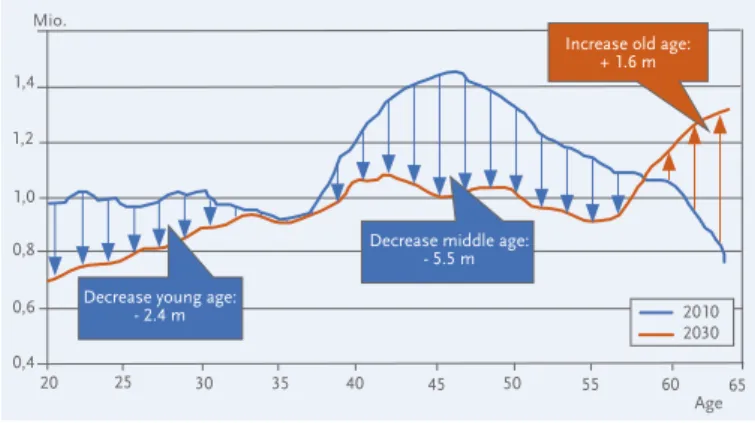
The ageing and shrinking of a population result from the in-terplay of age-specific fertility, mortality and net migration rates. A population ages when the older age groups relatively increase in number. The population shrinks when the number of people decreases. By the year 2030 in Germany, the strongly populated age groups that are now approaching middle age will move into the higher age level, and the younger age groups will be more weakly represented (Henseke/Tivig, 2011). Figure 1 shows that by 2030, an increase in the age-group size will only occur at the age of 60. The age groups up to 30 years and from 40 to 60 years will shrink considerably.
Figure 1: Age structure of the population aged 20 to 64, 2010 and 2030. Source: Federal Ministry of the Interior, 2012.
Data: Federal Statistical Office, 12th coordinated population forecast, variant 1-W2
Consequently, the demographic development changes the size and composition of the labour force. Already from 2012, the age group of 20 to 64-year-olds will significantly lessen to 6.3 million by 2030. Today the working age population from 20 to 64 years numbers about 50 million people. The potential labour force in the age group between 20 and 34 years will decrease by 2.4 million people until 2030. For 35 to 59-year-olds, the decline will even be 5.5 million people. In contrast, the potential labour force in the age group 60 years and over increases significantly by about 1.6 million. In the coming years, a declining number of employed persons, which on average are also getting older, will have to be responsible for both their own livelihood and that of a growing number of people in retirement (Federal Ministry of Labour and Social Affairs, 2010; Fuchs/Söhnlein/Weber, 2011). Forecasts suggest that in the context of this development it will also come to a lack of skilled workers. It is not yet clear whether this is an industry-specific or region-related phenomenon or a universal development. Although already in several occupa-tional categories and regions bottlenecks have been determi-ned in supplying the economy with professionals, one cannot yet speak of a general shortage of skilled workers in Germany (Federal Employment Agency, 2011).
Not only the labour supply changes in size and age structure, the employment behaviour also changes. Examples are on one hand, the increasing work participation of women and, on the other, the extension of the working life phase as well as the delay of retirement from work itself. In 2011, a new employ-ment high was reached with an average of more than 41 million employees.
Demographic change is a driver for the changing world of work at many levels. The longer-term view of employment by indus-try shows a remarkable structural change from the production sector to the service sector. Thus, in 2011, nearly three-quarters of all workers in Germany had their jobs in the service sector (Federal Statistics Office, 2012). The rapid development of in-formation and communication technologies leads to new care-er fields, but also to a pcare-ermanent accessibility and the blurring of boundaries between work and private life. The so-called nor-mal employment (permanent full-time employment) erodes and is replaced by atypical employment, which includes tem-porary employment, mini-jobs or temtem-porary jobs, which are to a growing proportion also precarious. The fast changing world
of work also leads to the need for continuous adaptation of skills and lifelong learning (Schmid, 2010).
4 State of Research
The longitudinal view of the impact of factors that harm and promote health at work on the employment behaviour and the health of individual employees is restricted due to methodo-logical problems and the ever-changing conditions in the la-bour market.
However, there are extensive data on the participation of older employees, such as on the basis of statistics on disability, early retirement, the amount of social insurance contributions, or work participation. These, however, only allow analyses on the correlations and not causal statements. In interpreting these data it is to be taken into account that workers now face new challenges with the dynamic work changes – for example in terms of flexibility, dealing with uncertainty, and the challenge of adapting to the dynamic change – which in the past were not available in this form. The impact of these new demands made on the employees with respect to the potential accumulation of stress over time is still largely unclear.
General hypotheses, however, about the declining productivity of older workers could not be confirmed. Rather, the develop-ment of the performance over time depends on a variety of factors. How these affect each other, and whether and/or how their effect on each other is cumulative, compensatory or neu-tral, is also unclear. Nevertheless, there are a number of find-ings in relation to the development of various service areas, particularly related to risk factors, health problems and diagno-ses, information on reasons for reduction in earning capacity, etc., which in particular affect older workers. Especially, various features of work design already provide a variety of leads for de-signing ageing- and age-appropriate work, and are presented in the following sections.
4.1 The Development of Professional Capacity
Within the framework of the so-called deficit hypothesis it was previously assumed that ageing is associated with a linear de-crease of physical and cognitive functions. This was disproved by various studies in the 1970s. It is now assumed that a dif-ferential model of ageing, which states that different service types might with ageing develop in different directions. When looking at the parameters of speed, flexibility, endu-rance, strength and coordination, a function of age-related physiological changes can be detected. The performance drop is level until age around 40 years, but steepens later on. De-pending on the activity, the effects of the performance drop are more or less visible. Maintz (2003) thus stated that for most areas of activity: “Due to the high-level reserve capaci-ties of the healthy organism, however, there is little risk that the performance falls below the labour requirements. But at high physical demands in the workplace, the decline in physical fitness for the elderly may indeed be problematic.“ (Maintz, 2003: 2) Important sensory functions such as vi-sion and hearing may decline after about the age of 40 years. Not only the physical functions, but also the cognitive func-tions are subject to change with old age. Cognitive funcfunc-tions Mio. 1,4 1,2 1,0 0,8 0,6 0,4 20 25 30 35 40 45 50 55 60 65 2010 2030
Decrease young age: - 2.4 m
Decrease middle age: - 5.5 m
Increase old age: + 1.6 m
can be divided into so-called crystalline and fluid functions. Crystalline features are, e.g., experiential knowledge and the capacity of judgment, i.e. more stable and stored knowledge and the handling of it. Experience, knowledge and judgment are very well pronounced in the elderly and usually they grow with age. Fluid or control functions include the change bet-ween attention and tasks, information processing speed and reaction, the simultaneous execution of two or more activi-ties, the suppression of distracting irrelevant information, the constant refreshing of working memory and the planning of action sequences. The functional change accompanying age is described as a shift from fluid to crystalline features. This shift takes place, however, within a broad range. A mentally stimulating lifestyle, mentally challenging work and physical and mental training have a positive effect on the cognitive competence of the elderly (Falkenstein/Wild Wall, 2009). Two findings are particularly relevant to the question of miti-gating factors for the age-related functional change in the working world. Firstly, ageing as a progressive process slow-ly opens up a period for the development of compensation strategies, by which the declining fluid functionality, but also altered physiological functions, can be compensated. Second, an analysis to cognitive flexibility and working memory pro-vides evidence of a negative relationship between neurophy-siological changes and the long-term exposure to monotonous activities and chronic stress (Gajewski/Falkenstein, 2009). However, more relevant to the question of the relationship of the development of professional performance with employ-ment is the effectiveness of compensation strategies rather than the experimentally detectable limit. Through selection, optimisation and compensation strategies (SOC strategies, see Baltes/Baltes, 1990), older people are able to compen-sate age-accompanying changes. The professional capacity also benefits from the experience and expertise gained in the course of professional life.
In summary, ageing is understood as a dynamic process of change of the physical and cognitive functions. With it the inter-individual diversity and variety increase with age. Direc-tion, dynamics and range of the transformation process have so far been redesigned to a limited extent for their integration into the work system. Thus, the efficiency in certain areas (e.g. physical strength, sensory performance, speed of information processing) decreases with ageing, but increases in other areas (e.g. communicative skills, life and work experience, overview of complex situations) (Maintz, 2003).
4.2 Work-related Health Hazards
On average, the number of symptom-free life years of people in Germany is increasing, just as the life expectancy (Federal Health Monitoring 2006). Differences between different socio-economic groups are, however, very much evident, so that the average values have only a limited validity. These differences seem to be created at a young age. Thus, significant health dis-parities can be seen at young ages, sometimes even in ado-lescence prior to entry into the labour force (Dragano, 2007). Work then plays a central role in the development of the health of workers in the further course of life. They spend their entire employment period for the most part of the day in a work
situation and are exposed here to either beneficial or harm-ful factors. There are a number of factors at work for which a hazardous impact on health can be assumed, especially for older workers, such as high physical and mental stress and disqualifying work activities (Kistler et al., 2006).
The state of scientific knowledge about age-critical working conditions is however not uniform in the literature. On one side, there are a variety of case studies and cross-sectional analyses, yet on the other side longitudinal or cohort stu-dies are missing. A major problem in the implementation of longitudinal studies on ageing in the workplace lies with the rapid changing world of work. Since the conditions of the work situation can hardly be kept stable and thus verifiable, health conditions or changes in health can only be assigned to poorly defined causes. It can therefore be assumed that the results of long-term studies have only limited meaning for the derivation of future recommendations. Therefore, an evidence-based derivation of standards and action guidelines is thus not expected, so that recommendations must be given primarily on the basis of plausibility.
Answers to the question “How is it possible to stay healthy and fit up to retirement age and beyond?“ can be divided into two categories. One is about trying to identify work-related risk factors that prevent healthy ageing at work.
The preceding description of the relationship of work and age-ing shows that the transformation of the physical and cog-nitive capacities in the course of employment is significantly affected by the conditions of professional performance. Not the education or the occupation held, but the actual vocation practiced and the specific conditions of performance are rele-vant to the individual dynamics of professional ageing. Whether the developmental path of individual functional ca-pacities in the course of the career is more strongly deter-mined by health or illness or by accelerated or slowed profes-sional ageing thus depends on the specific conditions of an activity and its environment. In discussions, often the occupa-tion and not the work performance is seen as an independent variable, because official statistics and empirical studies use the profession as a criterion for differentiation. In addition, job profile, work equipment, work organisation and condi-tions are subject to a continuous process of change, so that quasi-experimental research designs with longitudinal section and control groups cannot be realised. Further differentiation is based on the fact that, in addition to stress and strain, quali-fication and motivation have significant influence on health in the occupational career.
Relationships between diseases and employment conditions are subject to a variety of scientific studies. These are mostly cross-sectional studies. Studies on the link between health and working conditions on an individual basis can barely be found, which is also due to the limitations described. Boede-ker/Barthelmes (2011) have provided a synopsis of the state of scientific knowledge, an analysis of the BiBB/BAuA survey, as well as social insurance records, of work-related health hazards and occupations with a high disease burden. These
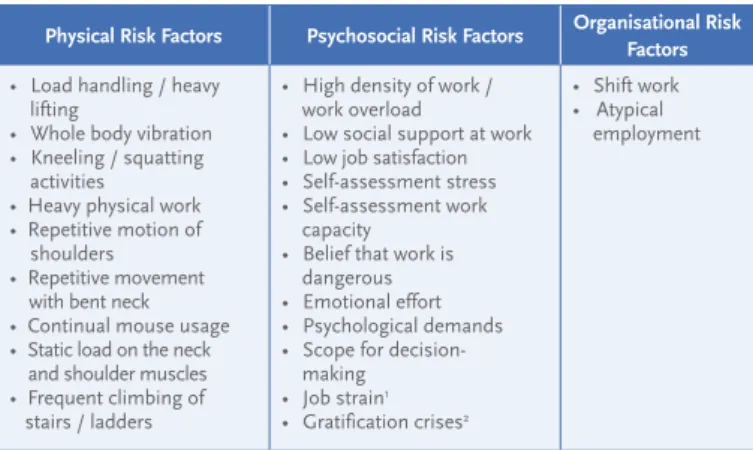
factors provide important information for designing age-ap-propriate work. The mentioned meta-analysis of systematic reviews in German and in English identifies the following par-ticularly important work-related risk factors:
The above risk factors have potentially negative effects on health, especially if several of these factors simultaneously termine the work situation. Empirical research confirm the de-mand-control model, in particular the hypothesis of the high-strain jobs, where low decision latitude and high psychologi-cal stress meet. This is connected with an increase of physipsychologi-cal health problems, particularly (in men) in the cardiovascular area. Further studies also find a connection to diminished well-being, low job satisfaction and burnout. In the empirical test of the model of gratification crises, the effort-reward im-balance is linked to an increased risk of psychiatric disorders, depression, burnout, and alcohol dependence. In addition, a link also exists to coronary heart disease and hypertension, psychosomatic complaints and work-related welfare (Ulich/ Wülser, 2009; Nyberg, 2009).
4.3 Work Disability and Age
Another indicator of the answer to the question, of how age-critical the employment in an occupation is, can be obtained from the records of disability by age comparison (Ministry of Labour and Social Affairs 2011). Disability is distributed very unevenly between occupational groups. The distribution of the disability risk by age in the ten occupations with the high-est burden of disease confirmed the growing differences in professional ageing between the professions as well as the increasing inter-individual differences within the professional groups. When interpreting the data at the level of professional groups, one must consider that activity changes made in the course of a career are not considered, such as a change from a non-stressful activity to a so-called referral activity. A classi-cal example is the change from a physiclassi-cally straining activity in production to a less stressful one, for example, as a gate-keeper. At the same time, the so-called „healthy worker effect“ must be considered. This indicates a positive selection,
ac-Physical Risk Factors Psychosocial Risk Factors Organisational Risk Factors • Load handling / heavy
lifting
• Whole body vibration • Kneeling / squatting activities
• Heavy physical work • Repetitive motion of shoulders • Repetitive movement with bent neck • Continual mouse usage • Static load on the neck and shoulder muscles • Frequent climbing of stairs / ladders
• High density of work / work overload
• Low social support at work • Low job satisfaction • Self-assessment stress • Self-assessment work capacity
• Belief that work is dangerous • Emotional effort • Psychological demands • Scope for making • Job strain1 • Gratification crises2 • Shift work • Atypical employment Table 1: Especially Significant Work-related Risk Factors
cording to which the less healthy people have already left ear-lier, and the total population of the elderly is only composed of healthy individuals. Another result is the comparison by age when considering the sick days per case. The elderly are inca-pacitated less often but much longer than younger people. In Figure 2 it can be seen that young workers have only 5 days of incapacity per case, as opposed to 22 days for over 65 years. The incidence of disability, however, is much higher among young workers (172 cases of work incapacity per 100 insured). This fact is not only linked to biological age, but also attributed to the stress accumulation in the course of life and its possible chronification.
With age, work-typical physical stress becomes more notice-able. The greatest differences in the volume of sick days be-tween the age groups are seen in the diagnostic groups “dis-eases of the musculoskeletal system“ and “dis“dis-eases of the circulatory system“. By way of example, the BAuA research project F1996 “Job-specific disability due to musculoskeletal diseases in Germany“ has examined this problem and, on the basis of a broad study of 18.5 million records, has identified the professions with special need for prevention. “For dis-eases of the back it could be clearly demonstrated that work incapacities are frequently and clearly age-related with this di-agnostic group. The overwhelming importance of back pain is well known and is also confirmed by this data analysis. It stresses that especially employees of both sexes in industrial and technical jobs have an increased risk of work disability due to back problems. Affected are professions where it must be assumed that the employees here are exposed to typically high physical stress.“(Liebers/Caffier, 2009: 110)
1 Beside the physical and psychosocial risk factors, the work organisation can be a risk factor for the health of the employees. “Job strain“ is a model that explains
the origin of occupational stress in combination with high demands and low control and decision latitude (Karasek, 1979). High demands combined with high control and decision scope, however, can increase the regenerative capacity.
2 The gratification crisis (Siegrist, 1996) is a mismatch between effort and reward. This can occur if the efforts made are remunerated with too little income,
social support, recognition, job security and career opportunities. These factors could cause failure stresses, which may eventually lead to cardiovascular or gastrointestinal problems, damage to the immune system and the musculoskeletal system (active distress).
Figure 2: Disability for different age groups; Source: Federal Ministry of Labour and Social Affairs, 2011
Age Gesamt 15-20 20-25 25-30 30-35 35-40 40-45 45-50 50-55 55-60 60-65 ≤ 65 172 5 6 8 10 11 12 14 16 19 23 22 7 141 104 101 104 106 109 116 125 116 114 32
Cases per 100 insured Days per case
The key finding of the analysis of work-related health risks in life and professional career is the need to differentiate and take biographical aspects into account. In order that profes-sionally induced health risks cannot be attributed to elders as individual characteristics, the knowledge of occupational health hazards, especially in their long-term consequences must be disseminated much more in the world of work. 4.4 Retirement Age
The average retirement age varies considerably in different oc-cupational groups. According to the Federal Statistical Office, of all persons who were retired in 2009, only half (50.0 %) went into retirement normally because of their age. 27.8 % of retirees have retired for health reasons, while 22.2 % used early retire-ment or have moved from unemployretire-ment to retireretire-ment. In different occupations health reasons play a variable role in giving up work to retire. Especially in occupations associated with strenuous physical activity or high public traffic, there is a high risk to resign from employment because of health reasons.
Especially persons who had worked in high-and low-construc-tion jobs went into retirement for health reasons (46.9 %). A similar increase was the case for people in development trades, for example, heating engineers, floor tilers, and uphol-sterers (45.4 %), as well as painters and finishers (39.5 %). By far the fewest were engineers, chemists, physicists and mathe-maticians who went to retire for health reasons (14.6 %). Also relatively low were the corresponding proportions for profes-sions that are mainly practiced in the office. However, also in such jobs a fifth of the people‘s health was crucial enough to retire prematurely. The practised profession, or rather the range of activities and their stress and resource patterns, therefore seems to be a predictor of health-related premature career exits. High physical stress and limited scope for ac-tion in the profession increase the likelihood of an early labour market exit (Bödeker et al., 2006).
4.5 Disability Pension
The disability pension must be considered in the context of the development of the labour force participation of older workers.
Indeed, in recent years, the labour force participation of older people between 55 and 64 years has increased significantly in Germany (Institute of the German Economy in Cologne, 2011). There are several reasons for this: first, a favourable demographic situation (baby boomers move into the higher age groups), the increase in women‘s employment, and the reform of the labour market and pension system. However, the allocation of employment opportunities is not uniform in older age groups, but is especially dependent on the skill level. The labour participation of older people with a low skill level is about half as high as the elderly with a high level of education. In addition, there are considerable variances in the industries. The participation rate of 60-year-olds is, for example, signifi-cantly lower in the construction industry than in the public administration (Brussig, 2009; Brussig, 2010), which is not surprising in light of the development described in Section 4.2 of the physical performance in old age.
The average retirement age based on age in 2010 was 63.8 years for men and 63.3 years for women. The average age of retirement due to disability is considerably lower: 2010 it was 50.9 years for men and 49.8 years for women. When conside-ring this diagnosis, due to which a pension for reduced earn-ing capacity comes into force, it is clear that most of the em-ployees will retire due to mental and behavioural disorders (total: 39.3 %, men 33.4 %, women: 45.6 %). After diseases of the musculoskeletal system and connective tissue with 14.7 %, neoplasms follow with 13.3 %, and cardiovascular dis-eases with 10.0 %.
Remarkably, the retirements due to mental and behavioural disorders alone increased by 19,513 pensions from 2006 to 2010, due to reduced earning capacity in the year; the share of 32.5 % increased to 39.2 % (DRV Bund, 2011).
4.6 Age- or Ageing-Appropriate Work?
The division of workers into age groups to derive meaningful facts on performance from these categories is characterised by certain arbitrariness, in particular because with increasing age, the inter-individual differences in physical and cognitive Figure 3: Reasons for retirement differentiated by occupation, source:
Federal Statistical Office 2010
Figure 4: New pensions from 2007 to 2009 due to four important diagnosis groups; Source: Federal Ministry of Labour and Social Affairs 2011
Early retirement / Unemployment Health condition
Building and construction trades 46,9 19,2 33,9
45,4 18,7 39,4 39,5 21,1 47,4 36,4 16,2 30,8 23,7 45,5 55,9 22,0 22,1 49,5 20,4 30,2 59,3 19,9 20,8 51,2 14,6 34,2 50,0 27,8 22,2 35,9 Timbering and development trades,
upholsterers Painters, finishers Unskilled Laboure Miners, stonecutters and processors Organisational, administrative and clerical occupations Services consultants Authors and Artists Engineers, chemists, physicists,
mathematicians Overall
Selected Occupations in Per Cent:
Retirement 14.014 13.979 14.394 12.222 11.803 11.567 11.354 11.220 11.002 12.114 11.651 12.214 4.734 4.510 4.374 12.477 12.323 12.520 35.463 31.124 25.256 26.287 29.006 28.632 Retirements Men Retirements Women
Diseases of the musculoskeletal system and connective tissue Mental and behavioural disorders
Cardiovascular diseases Neoplasms 2007 2009 2007 2008 2009 2007 2008 2009 2007 2008 2009 2008
sized enterprises (Sczesny/Keindorf/Droß, 2011) confirmed this picture. The majority of the surveyed company owners or managers is aware of the legal responsibility for health and safety, but this responsibility to carry out the risk analysis, its documentation and the derivation of the necessary measures, holds a diffuse character. One reason could be that the basic knowledge in terms of legal obligations is not associated with expertise about tools and support. The implementation of the hazard assessment is only an indicator of the level of labour protection; a humane workplace design is possible without it. But systematic design requires the use of instruments to analyse the situation and with a view to deriving interventions therefrom.
5 Recommendations – Prevention as
Key to Healthy Ageing in Work
The retention of work ability over the entire course of employ-ment is a crucial strategy for healthy ageing. The increase in the statutory retirement age and the goal of closing the gap between the actual and the statutory retirement age re-quire ageing- and age-appropriate activities. In particular, the strong, professional group-specific variance in health-related retiring from working life makes flexible working conditions, vigour saving methods and a new culture of work necessary (Federal Ministry of Labour and Social Affairs 2012). The core element of this strategy is to achieve an expanded prevention culture in companies and administrations.
Job design and work organisation are a particular focus of operational measures. Systematic load changes and learning incentives are key factors at work that enable healthy ageing. The age-accompanying inter-individual differentiation of the professional performance profiles can be addressed through the implementation of the principle of differential work design (Ulich 1978, 2010). The work science means by this the simul-taneous availability of alternative work patterns from which the employees can choose. This principle ensures the optimal development of the personality in dealing with work activity in the context of individual features. The implementation of this principle signifies the move away from the search for the “one right way“ to perform work activities and work processes. For workers, this brings a significant increase in autonomy and control over their own working conditions. This is espe-cially why this approach is an important contribution for the age(ing)-appropriate working world (cf. e.g. Society of Occu-pational Science, 2012; Zieschang/Freiberg, 2011).
Maintaining motivation and cognitive performance ability are additional essential components of ensuring the ability to work. Only if one manages to permanently maintain the mental flexibility throughout lifelong learning it is possible in the course of one’s life to change activities that can lead to stress changes. The knowledge of physical, psychosocial and organisational risk factors must be used for professional development planning for individuals and organisations. Life-long learning offers companies the chance to flexibly deploy staff while the employees are being spared one-sided and little beneficial health burdens.
performance increase. In the future, this calls for more focus on competence-oriented or life-stage-/life-situation-relevant operations (Kistler et al., 2006). Especially concepts of health-centred work organisation should not begin only with seniors who are already suffering from performance limitations. Rather, it is to promote the performance ability of workers already at the start of working life. This is reflected in the approach to the ageing-appropriate job design, which is characterised by the fact that a prospective and healthy working design is the focus for all workers. Currently, definitely work activities, tasks and conditions still exist that do not allow healthy ageing at work. Especially, the combination of bad high demands and low resources are predictors of health complaints and the as-sessment whether continued work until retirement is possible in the current activity (Karasek, 1979; Kistler et al., 2006). This explains why especially those groups of employees that are af-fected by high absenteeism exercise low-skilled activities with high proportions of heavy physical work and low individual freedom of action. In contrast, in industries and occupations that are associated with high skill and great creative freedom early retirements because of disability hardly matter.
Age-differentiating approaches are presently gaining in im-portance in labour and tariff politics (e.g. tariff agreement on “demographic change design“ in the iron and steel industry (2006), or tariff agreement “working life and demography“ of the chemical industry (2008)) as well as in the organisa-tion of work. In particular the results funded by the German Research Foundation priority programme “Age-Differentiated Work Systems“, and also the concepts developed in the “Age-appropriate Working Conditions“ model program to combat work-related diseases, of the Ministry of Labour and Social Af-fairs (Matthai/Morschhäuser, 2010), provide important sug-gestions.
4.7 Identification of Occupational Hazards in the Company The above physical, psychosocial and organisational risk fac-tors provide an approach for the prevention of work-related health risks. In order to extend the time of the working life in the workplace, occupational health hazards must be identified in the workplace. For this, legal frameworks, institutions and instruments are available. However, surveys show different uses of the instruments according to company type. In the BiBB/BAuA employment survey (2006) employees responded very differently on the question of whether in the past two years in their workplace a hazard analysis has been carried out: In companies with fewer than 20 employees 18.1 % indi-cate that a risk assessment was carried out. In companies with 20 to 99 employees it is 27.1 %, in establishments with 100 to 499 employees 38.4 %, and in companies with more than 500 employees it is 43 %.
Hence especially in small businesses, the conditions for a systematic management of work-related health hazards seem to be missing. The preservation of health and qualifi-cation, as well as the humane design of work, are however building blocks for healthy ageing in employment. A recent study commissioned by the BAuA on the knowledge in the field of occupational health and safety in small and
medium-and beyond, changing the age structure of many companies. At the same time, resulting from the dynamics of the world of work, new challenges for occupational health and safety arise, for example by the erosion of the standard employment rela-tionships, permanent availability or ongoing restructurings. All these developments require management and/or adaptive measures on the political and operational level to ensure good quality of work. A significant actuating variable in this context is the age- and ageing-appropriate design of work.
A central starting point is to maintain employees’ ability to work throughout their career, in terms of performance and motivation, as the work context is a significant factor with re-gard to healthy ageing. Also important are the personal dis-position, the lifestyle, and specific socio-structural aspects, in particular the healthy design of working conditions. With the present state of research gaps still remain in terms of the causal relationship between working conditions, ageing and health. Nevertheless, it is possible to systematically derive design approaches for age(ing)-appropriate work from the many cross-sectional studies of health-promoting and inhib-iting factors. A preventative approach, which integrates dif-ferential work design, the preservation of cognitive function throughout lifelong learning and activity change, as well as the strengthening of health competence, can contribute to the management of demographic change in companies. The careful analysis of the related health hazards in the work-place identifies physical, psychosocial and organisational risk factors and is thus the starting point for appropriate interven-tions.
Overall, the management of demographic change is a cross-sectional task. Beside the world of work, it directly affects all social, economic, educational and health policies. Steps in many fields are required so that “healthy ageing on the job“ can be a reality for all employees and that the “new start in the age-appropriate world of work“ can succeed (Federal Ministry of Labour and Social Affairs, 2010). These requirements were recognised in the demography strategy of the Federal Govern-ment and impleGovern-mented with orders to the different ministries. As a specialised federal research institution, the BAuA is com-missioned to conduct research on issues of health and safety at work, as well as to develop and also to advise on issues of humane work design. With this the BAuA supports the neces-sary change in key areas of the working environment today. The working time is an additional important building block
for age(ing)-appropriate working conditions. Shift and night work as well as highly flexible demand-driven work patterns are forms of working time that can always lead to substantial impairments (Beermann, 2008). Here, ageing-appropriate work arrangements can reduce physical and psychosocial stress to some degree and for this especially the location and distribution of work play an important role. The work science has developed solid recommendations for practice, allowing for a good age-sensitive design of working time models, such as compliance with the findings in the ergonomic design of night and shift work, the shortening of work shifts or even the introduction of short breaks. Since not every problem of work time design can be solved in the interest of health, accompa-nying health-promoting measures, where applicable, are very important.
Raising the retirement age makes it difficult for early retirement from gainful employment – therefore the maintenance of health and the prevention of specific risk factors have increased impor-tance. Healthy ageing in work is thus an important prerequisite for the acceptance of the extension of employment time with employees and companies, and is also an important strategy for the prevention of future skills shortages.
The existing legal and institutional framework conditions can ensure only to a limited extent that existing knowledge about reliable occupational health hazards is implemented in the workplace. Therefore, the extension of working life not only re-quires overcoming the “early retirement culture“ with compa-nies and employees, but also a new culture of work health and safety. The DGUV Rule 2 of the accident prevention regulation „occupational physicians and occupational safety specialists“ has prepared steps towards securing the necessary institu-tional cultural and organisainstitu-tional change in the workplace. Here humane work design in shaping demographic change is explicitly mentioned by the Occupational Safety Act to be the task of the operational support for company doctors and safety specialists (Richter/Wettberg, 2011). Also clearly de-fined is that, due to demographic change, the occurring need for counselling can be a subject matter of operational support (DGUV Rule 2, 1.6).
The dynamics of the changing world of work also lead to spe-cial challenges in occupational safety. With the increase in temporary work, contract work and temporary employment, measures of internal occupational health and safety access are limited by time. This raises the question of how inter-organisational occupational health and safety laws can be designed to provide safety and health and minimise health hazards at work for these groups of employees in the future.
6 Conclusion
Demographic change has a significant impact on the change in the working world and the situation in the establishments. On one hand, the range of applicants for apprenticeships and professional positions will decline. On the other hand, the large baby-boomer generation currently reaches their 50th year
Falkenstein, M. / Wild-Wall, N. (2009): Einfluss arbeits- und lebensstilbezogener Faktoren auf die kognitive Leistungs-fähigkeit. In: INQA (Hrsg.): Förderung und Erhalt intellektuel-ler Fähigkeiten für ältere Arbeitnehmer. Abschlussbericht des Projekts Pfiff, Dortmund
Fuchs, J. / Zika, G. (2010): Arbeitsmarktbilanz bis 2025: De-mografie gibt die Richtung vor. IAB-Kurzbericht, 12/2010, Nürnberg
Gajewski, P. / Falkenstein, M. (2009): Fluide kognitive Funk-tionen bei Beschäftigten in der Automobilindustrie. In: INQA (Hrsg.): Förderung und Erhalt intellektueller Fähigkeiten für ältere Arbeitnehmer. Abschlussbericht des Projekts Pfiff, Dortmund
Gesellschaft für Arbeitswissenschaft (2012): Gestaltung nach-haltiger Arbeitssysteme – Wege zur gesunden, effizienten und sicheren Arbeit, Bericht zum 58. Kongress der GfA, Heidelberg Gesundheitsberichterstattung des Bundes (2006): Gesund-heit in Deutschland
Henseke, G. / Tivig, T. (2011): Deutschland im demografi-schen Wandel. Ein Vergleich mit Japan, Rostock
Institut der Deutschen Wirtschaft Köln (2011): Karriere und Beruf 50plus: Wege zu demografischer Fitness und mehr Be-schäftigung, Köln
Karasek, R. A. (1979). Job demands, job decision latitude, and mental strain: implications for job redesign. Administrations Science Q, 24, 285-307
Kistler / Ebert / Guggemos / Lehner / Buck / Schletz (2006) in: Bundesanstalt für Arbeitsschutz und Arbeitsmedizin (Hrsg.): Altersgerechte Arbeitsbedingungen, Dortmund / Berlin / Dresden
Liebers, F. / Caffier, G. (2009): Berufsspezifische Arbeitsun-fähigkeit durch Muskel-Skelett-Erkrankungen in Deutschland. Bundesanstalt für Arbeitsschutz und Arbeitsmedizin, Dortmund Maintz, G. (2003): Arbeit bis 67? – Überlegungen aus arbeits-medizinischer Sicht, Dortmund
Matthäi, I. / Morschhäuser, M. (2009): Länger arbeiten in ge-sunden Organisationen. Praxishilfe zur alternsgerechten Ar-beitsgestaltung in Industrie, Handel und öffentlichem Dienst, Berlin
Nyberg, A. (2009): The Impact of Managerial Leadership on Stress and Health Among Employees, Stockholm
Richter, G. / Wettberg, W. (2011): Neuer bedarfsorientierter Ansatz durch DGUV V2. Sifa auf neue Anforderungen vorberei-ten. In: BAuA Aktuell 2/2011
7 References
Baltes, P. B. / Baltes, M. M. (Hrsg.) (1990): Successful aging: perspectives from the behavioural sciences / European Net-work on Longitudinal Studies on Individual Development (ENLS), Cambridge
Beermann, B. (2008): Nacht- und Schichtarbeit – ein Problem der Vergangenheit?
Bödeker, W. / Barthelmes, I. (2011): Arbeitsbedingte Ge-sundheitsgefahren und Berufs mit hoher Krankheitslast in Deutschland. Synopse des wissenschaftlichen Kenntnis-standes und ergänzende Datenanalysen
Bödeker, W. / Fiedel, H. / Friedrichs, M. / Röttger, Ch. (2006): Kosten der Frühberentung. Abschätzung des Anteils der Ar-beitswelt an der Erwerbs- und Berufsunfähigkeit und der Folgekosten. 1. Auflage. Bremerhaven: Wirtschaftsverlag NW Verlag für neue Wissenschaft GmbH. (Schriftenreihe der Bun-desanstalt für Arbeitsschutz und Arbeitsmedizin: Forschungs-bericht, Fb 1080)
Brussig, M. (2009): Die Erwerbsbeteiligung älterer Arbeit-nehmer/-innen in Deutschland im Wandel. Perspektiven der Arbeitsmarktforschung, in: Zeitschrift für Gerontologie und Geriatrie, 42:281-286
Brussig, M. (2010): Anhaltende Ungleichheiten in der Erwerbs-beteiligung Älterer; Zunahme an Teilzeitbeschäftigung, Alters-übergangsreport 2010-03, Duisburg / Düsseldorf 2010 Bundesagentur für Arbeit (2011): Perspektive 2025: Fachkräfte für Deutschland, Nürnberg
Bundesanstalt für Arbeitsschutz und Arbeitsmedizin (Hrsg.) (2011): Qualitätssicherung in der Demografieberatung, Bielefeld Bundesministerium des Innern (2012): Demografiebericht. Bericht der Bundesregierung zur demografischen Lage und künftigen Entwicklung des Landes, Berlin
Bundesministerium für Arbeit und Soziales (Hrsg.) (2010): Aufbruch in die altersgerechte Arbeitswelt. Bericht der Bun-desregierung gemäß §154 Abs. 4 Sechstes Buch Sozialge-setzgebung zur Anhebung der Regelaltersgrenze auf 67 Jahre Bundesministerium für Arbeit und Soziales (Hrsg.) (2011): Sicherheit und Gesundheit bei der Arbeit 2009. Unfallverhü-tungsbericht Arbeit, Dortmund / Berlin / Dresden
Dragano, N. (2007): Gesundheitliche Ungleichheit im Le-bens-verlauf, APuZ 42/2007
DRV Bund (2011): Rentenversicherung in Zeitreihen, Oktober 2011, DRV Schriften Band 22
Federal Institute for Occupational Safety and Health
Friedrich-Henkel-Weg 1-25 D-44149 Dortmund, Germany Source: www.baua.de/dok/4994594 Revised: August 2012 Service-Telephone 0231 9071-2071 Fax 0231 9071-2070 [email protected] www.baua.de
Sczesny, C. / Keindorf, S. / Droß, P. (2011) in: Bundesanstalt für Arbeitsschutz und Arbeitsmedizin (Hrsg.): Kenntnisstand von Unternehmen auf dem Gebiet des Arbeits- und Gesund-heitsschutzes in KMU, Dortmund
Siegrist, J. (1996): Adverse Health Effects of High-Effort/Low-Reward Conditions. Journal of Occupational Health Psycho-logy, 1(1), 27-41
Statistische Ämter des Bundes und der Länder (2012): Arbeits-märkte im Wandel, Wiesbaden
Statistisches Bundesamt (2010): Später in den Ruhestand? Wiesbaden
Ulich, E. (1978): Über das Prinzip der differentiellen Arbeitsge-staltung. Industrielle Organisation, 47
Ulich, E. (2010): Arbeitspsychologie, Stuttgart
Ulich, E. / Wülser, M. (2009): Gesundheitsmanagement in Un-ternehmen. Arbeitspsychologische Perspektiven, Wiesbaden Zieschang, H. / Freiberg, S. (2001): Ergonomic design of work-place – Prevention for all generations, in: Contemporary Ergo-nomics and Human Factors. p. 299-306, London

![A linguistic approach for knowledge extraction from an Arabic text (Une approche linguistique pour l’extraction des connaissances dans un texte arabe) [in French]](data:image/gif;base64,R0lGODlhAQABAIAAAP///wAAACH5BAEAAAAALAAAAAABAAEAAAICRAEAOw==)