Copyright by
Rachel Elisabeth Berman 2013
The Dissertation Committee for Rachel Elisabeth Berman
certifies that this is the approved version of the following dissertation:
Does time perception underlie delay discounting?
Committee:
_____________________________________________ Caryn Carlson, Supervisor
_____________________________________________ David Tucker, Co-Supervisor
_____________________________________________ David Schnyer _____________________________________________ Marc Lewis _____________________________________________ Darrell Worthy
Does time perception underlie delay discounting?
by
Rachel Elisabeth Berman, B.A.
Dissertation
Presented to the Faculty of the Graduate School of The University of Texas at Austin
In Partial Fulfillment Of the Requirements
For the Degree of Doctor of Philosophy
The University of Texas at Austin August, 2013
Acknowledgements
Thank you to Nick for everything; the rest of my family for support, neat books, and love; David Tucker for science, clinical everything, and inhuman patience; Anthony Stringer for clarity and criticism; and all my buddies and supervisors in Austin, Atlanta, and Boston for being overall great humans.
Does time perception underlie delay discounting?
Rachel Elisabeth Berman, Ph.D. The University of Texas at Austin, 2013
Supervisors: David Tucker and Caryn Carlson
Abstract. Delay discounting, the belief that rewards decline in value over time, is a phenomenon observed in several clinical disorders, including Attention Deficit / Hyperactivity Disorder (ADHD), substance abuse disorders, and other impulse control disorders. Delay discounting behavior is characterized by a tendency to choose smaller, more immediate rewards over larger, more delayed rewards. This tendency has been associated with behavioral impulsivity and inability to delay gratification observed in the aforementioned clinical disorders.
It has been suggested that time perception may be a salient feature of delay discounting. If the larger, longer-term reward is perceived as being more temporally remote, its relative value decreases and is associated with greater cost, and one becomes more likely to choose the more immediate reward over the longer-term (though optimal) choice. Time perception has been studied in clinical populations, with increased variability of responses as well as both under-production and overestimation of time intervals observed in those with ADHD and other disorders
associated with impulsivity.
The present study used informational feedback via a metronome to change belief regarding duration of a second- either increasing or decreasing it by
approximately 20%. Participants were 132 college-aged students with and without a diagnosis of ADHD. Measures of impulsivity and ADHD symptomatology were
collected as well, and participants completed several cognitive tasks measuring working memory and processing speed to explore the impacts of these measures on delay discounting and time perception. While participants were able to reliably incorporate the altered second belief into short estimations of time (i.e., less than a minute), the manipulation failed to generalize to longer-duration temporal
estimations, and it did not affect delay discounting. Neither ADHD symptomatology, impulsivity, nor performance on the cognitive tasks were related to delay
discounting behaviors, though a working memory measure was correlated with baseline (pre-manipulation) time and one longer duration estimation. This lends support to a relationship between working memory and temporal perception, though the relationship between temporal perception and delay discounting remains elusive. Directions for future studies to clarify the role of temporal processing and ADHD in delay discounting are discussed.
Table of Contents
Chapter 1: Introduction……… 1
Chapter 2: Background and Previous Work……….6
1. Delay Discounting……….….6
2. Impulsivity and Delay Discounting………18
3. Time Perception…….………....22
4. ADHD and Time Perception……….…..30
5. Working Memory and Delay Discounting……….34
6. Processing Speed and Delay Discounting……….36
7. Working Memory, Processing Speed, and ADHD………….37
Chapter 3: Summary and Hypotheses……….……39
Chapter 4: Methods……….…44
1. General Design...44
2. Setting...44
3. Tasks...44
4. Procedure...53
5. Participants and Recruitment...54
Chapter 5: Results...57
1. Summary of Collected Data...57
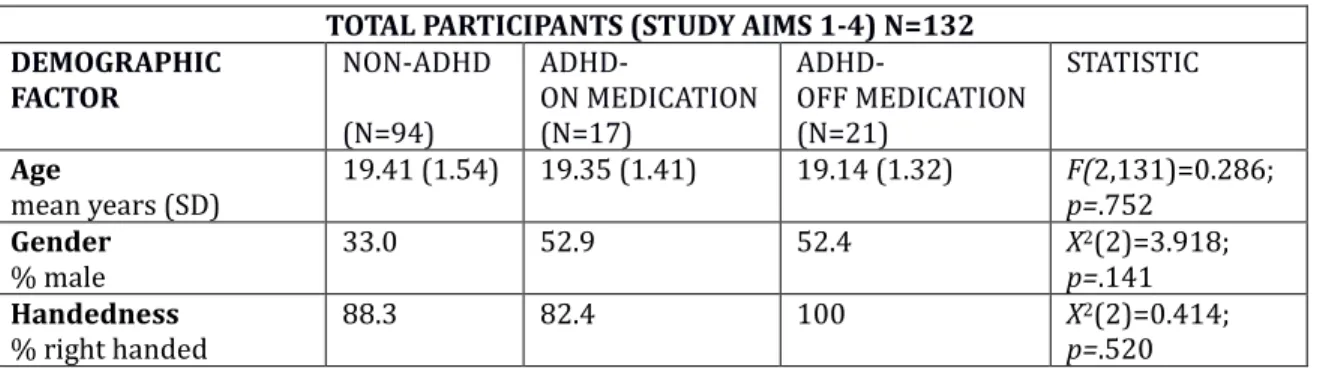
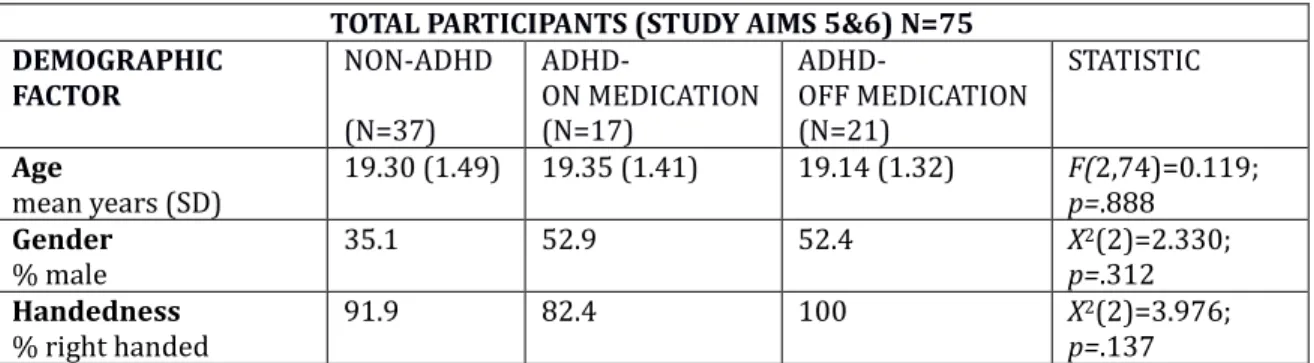
2. Group Characteristics...57
3. Randomization to Metronome Group………...……...64
4. Results for Study Aims ...71
Chapter 6: Discussion...92
Appendices………107
Chapter 1: Introduction
Delay discounting is a widely studied tendency to prefer smaller, sooner rewards over larger, later rewards (Kirby & Marakovic, 1996). For example, if one is offered the choice of receiving $20 or $25 with no strings attached, right now, nearly everyone would choose the $25. However, if we alter the scenario to offering $20 right now, or $25 in three months, many people will choose the $20 now despite the fact that the $25 has greater monetary value. What has changed? In this case, the future reward has been devalued with respect to the present reward- its subjective value has decreased as the variable of time has been introduced. However, not all people will respond to this scenario in the same way.
Some studies have found that people that exhibit greater levels of certain aspects of impulsivity, especially those with clinical disorders such as substance abuse/dependence disorders (e.g., addictions to nicotine, alcohol, cocaine, etc), attention-deficit/hyperactivity disorder (ADHD), and other impulse control disorders, tend to devalue future rewards at a steeper rate than those exhibiting lower levels of impulsivity (e.g., Reynolds, 2006; Scheres, Lee, & Sumiya, 2007; Green & Myerson, 2004). For these individuals, the future reward appears to lose value much faster than for a non-impulsive individual. The basis for this preference for the sooner reward, even as its monetary value is lowered, is not well understood.
At this time, the relationship between impulsivity and delay discounting is not clear. Because the valuation of rewards changes as a function of time, it may
stand to reason that there may be some temporal aspect that at least partly
underlies the phenomenon of delay discounting. Research supports the hypothesis that impulsivity is related to differential temporal processing, with the finding that greater impulsivity is associated with over-estimation of time durations and under-production of time intervals (e.g. Berlin & Rolls, 2004; Glicksohn et al., 2006). For example, in the over-estimation of time intervals, an actual 10-second interval is estimated to have lasted 12 seconds. An example of under-production of a time interval would be when asked to tap when 10 seconds have gone by, the individual instead taps after only 8 seconds, having believed the interval was longer. Thus they have under-produced the desired time interval.
Previous studies have examined the correlations between impulsivity, time perception, and delay discounting, but these studies have not explored possible causal links that may exist between these variables. In order to investigate whether a difference in temporal processing causes differential rates of delay discounting, an experimental manipulation is warranted. The present study manipulates an aspect of time perception by using an altered metronome that provided false feedback to convince the participant a second is longer or shorter than it is. This study then examines if this manipulation affects rates of delay discounting. Comparison of results within and between a normative group and an ADHD group allows us to attempt to clarify the nature of the relationship between impulsivity in and out of
the context of ADHD, and susceptibility to the manipulation and its effects on delay discounting.
Additionally, there are several other cognitive processes whose relationships with temporally myopic decision-making (delay discounting) have not been
thoroughly examined. To further understand what factors may underlie the complex behavior involved with delay discounting, it is worthwhile to examine other factors that may be possibly associated with delay discounting, including working memory and processing speed. These factors are important to examine because as outlined previously, delay discounting has been found to correlate with measures of
impulsivity; this is coupled with the finding that decreased performance on
measures of working memory and processing speed have also been correlated with higher impulsivity, including in clinical populations with ADHD and other impulse control disorders (Finn et al., 1999). Because degree of delay discounting has been correlated with both intelligence and impulsivity (see section 2.2), examining specific processes that are shared by both may further clarify what aspects of cognition underlie this type of decision-making.
Specifically, the objectives of the present study are the following: 1. To examine how feedback from a device regarding the length of a second can influence explicit temporal duration estimations; 2. To determine if this local manipulation of temporal perception affects rates of delay discounting; 3. To examine how
manipulation of temporal perception affects an ADHD population’s delay
discounting rates; 4. To examine how self-reported impulsivity may moderate the effects of time perception on delay discounting; 5. To examine how processing speed and working memory may affect delay discounting.
It is hypothesized that 1. feedback and training to a false metronome will affect time interval estimates, with exposure and training to 50 beats per minute (bpm), but labeled as 60 bpm / 1 beat per second, inducing under-estimations of time intervals. Exposure and training to 70 bpm (labeled also as 60 bpm / 1 beat per second) will induce over-estimations of time intervals. 2. Those who have been exposed to the slow tempo (50 bpm) will show decreased rates of delay discounting in a delay discounting task; those exposed to the fast tempo (70 bpm) will show increased rates of delay discounting. 3. The ADHD group will exhibit results similar to the non-ADHD group, but with a smaller effect size due to inherent greater variability of time perception. 4. Higher levels of trait impulsivity in all groups will be associated with higher rates of delay discounting. 5. Slower processing speed and decreased working memory capacity will be associated with higher rates of delay discounting.
The remainder of this document is structured as follows. The background and previous review section (Chapter 2) defines and gives a review of the delay discounting literature, a review of time perception and impulsivity research, and how these are explicitly expressed in normal populations and those with ADHD.
Chapter 3 will discuss in more depth the current study’s aims and hypotheses. Chapter 4 details the methodology and materials of the current study. Chapter 5 presents the results of the current study, and Chapter 6 is a discussion of those results.
Chapter 2: Background and Previous Work
The purpose of this section is to provide a contextual understanding of the topics discussed and examined in this study, and to operationally define the terms used throughout.
2.1 Delay Discounting
What is Delay Discounting?
As previously mentioned, delay discounting (also referred to in the literature as temporal discounting, time discounting, and hyperbolic discounting) is a tendency to assign lower value to an outcome or reward because of its location in the future. Stated succinctly, the general rule is “the sooner, the better” (Kirby & Marakovic, 1996). Delay discounting may manifest both as the tendency to choose a reward now to one of equal objective value later in time (e.g. $10 now vs. $10 in a month), or the tendency to choose an objectively smaller reward now to a larger reward later in time (e.g. $10 now vs. $15 in a month). In this paper, primarily the second
distinction will be addressed as it more realistically reflects the variance of choices present in day-to-day lives- it is difficult to equalize non-monetary choices.
Though most commonly associated with monetary reward choices, which are secondary reinforcers, similar delay discounting behaviors occur with primary rewards, such as with juice (McClure et al., 2007). Delay discounting has also been observed in non-human primates, with findings that rhesus monkeys delay discount
saccharine administration in a similar way to human’s behavior with money and juice (Freeman et al., 2009). It has been observed when the intertemporal interval is as short as seconds (Gregorios-Pippas et al., 2009) and as long as many years.
What is the Importance of Delay Discounting?
Delay discounting permeates our lives at many junctures. In one form, it may manifest itself as deciding to put off a bill one month and instead using the money for other pursuits, even though when the bill arrives next month it will include a late fee. Another example would be a recent graduate refusing to put away money
toward retirement- the time that will elapse before the money can be enjoyed feels impossibly long and it is felt that the money is better spent in the here and now, enjoying youth. Beyond the realm of money, delay discounting can have other significant impacts: the child with ADHD spends the night playing video games rather than studying for an exam, as the immediate value of playing the game is perceived as greater than studying now and doing well on the next day’s exam. Or perhaps the heroin addict chooses to take another pleasurable hit at the expense of living a healthy, longer life.
The above are all negative consequences of varying severity to delay
discounting. If the outcomes are suboptimal, how can it be that this behavior pattern has been preserved in our species? It may be that a tendency toward delay
and our species (like any other) is largely concerned with furthering a genetic line rather than an individual living long into the future. Nevertheless, delay discounting is largely maladaptive, associated with numerous negative outcomes, including drug dependence (see Reynolds, 2006, for review), obesity (Weller et al., 2008), and pathological gambling (Alessi & Petry, 2003). Greater understanding into this phenomenon may enable us to better understand and treat clinical outcomes associated with it.
How can we Characterize Delay Discounting?
Delay discounting can be characterized by the indifference point, the point at which a present option is equally preferred to a future option. Both options, present and future, have the same subjective value to the participant. For example, Person A equally prefers to receive $20 today or $100 a year from today. We can say the indifference point for $100 in a year for person A is $20. Another participant, Person B, equally prefers $80 today when compared with $100 in the future. Person B’s indifference point for $100 in the future would be $80. In this example, person A is exhibiting a steeper decline in value assigned to his future rewards- this would be increased delay-discounting. Person B is exhibiting a relatively more shallow decline in value- though is still exhibiting delay discounting, albiet at a decreased rate when compared with person A.
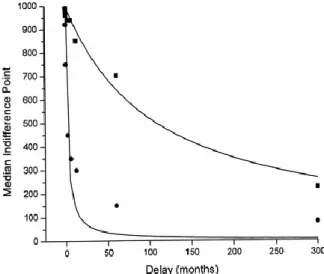
The “steepness” of delay discounting can be described mathematically as a hyperbolic (rather than exponential) curve with the following equation:
kD A V 1
where A is the objective value or magnitude of a delayed reward, V is the current subjective value of that reward, D is the delay to delivery of the reward, and
k is a free parameter that describes the “steepness” of the discounting curve (Kirby, 1997). A high k value would represent greater rates of delay discounting, typified by person A. A lower k value would describe lower rates of delay discounting (but still delay discounting), typified by person B. For illustrative purposes, two sample
hyperbolic discounting curves are shown below, one steep and one shallow (adapted from Coffey et al., 2003):
Figure 1: Two hypothetical delay discounting curves depicting how the relative value of an object measured by the indifference point (the point that two objects of
different objective value are viewed as subjectively equal) changes over time. The leftmost curve is steep, corresponding to a higher k value, while the rightmost curve
Over time, people’s delay discounting curves flatten: as time extends outwards, the delay discounting curve becomes more shallow. Kirby (1997) describes this hyperbolic curve as “an attenuation in rate of devaluation with
increasing delay: value is discounted most precipitously over relatively short delays but moderates as delay length increases.” For example, something that is perceived to be worth $100 a year from now will be perceived to be roughly worth the same a year and a day from now and preferences to receive the money in a year or a year and a day will not be strongly differentiated- there will be greater indifference for either option. Compare this with the option of receiving $100 today vs. $100
tomorrow. Though the difference in time is the same (1 day), the preference will be much stronger in comparing today with tomorrow as the decline curve in subjective value, k, is steeper per unit of time in the near future when compared with the further future (Thaler, 1981).
It is important to note that the delay discounting curve for an individual is not fixed; it has been shown to vary in response to various internal and external manipulations. For example, a repeated-measures study found that participants exhibited much steeper delay discounting curves when they were deprived of sleep versus having adequate sleep (Reynolds & Schiffenbauer, 2004). Though often thought of as a trait measure, it is perhaps more accurate to consider it a state-measure. Neurobiological evidence exists that differential brain regions are
activated as delay discounting curves shift both within and between subjects (e.g., review by Peters & Buchel, 2011).
Neurobiological Correlates.
Currently, there is relatively little work that has examined the neurobiological
substrates that underlie delay discounting, considering its role in suboptimal human behavior. An article by Monterosso et al. (2006) reviews some of the important findings. Several structural studies have found that the ventromedial prefrontal cortex (mPFC), including the orbitofrontal cortex (OFC), plays a role in determining the subjective value of delayed rewards (Bechera, Damasio & Damasio, 1994). Specifically, lesion studies have shown that patients with mPFC lesions show difficulties with decision making, and have been described as having a strong preference to choose immediate rewards rather than invest in future rewards
(Bechara et al., 1996, 1999). Animal studies also support the role of the OFC in delay discounting. OFC lesions in rats produce greater preference for smaller immediate rewards over larger future rewards (Mobini et al., 2002).
McClure et al. (2004) conducted the first functional magnetic resonance imaging (fMRI) study of delay discounting. This study found that activation during temporal decision making favoring delayed rewards was greater in lateral prefrontal and posterior parietal cortices. Conversely, the corticolimbic system was activated by immediate reward opportunities. These results were replicated when the reward
was juice rather than money (McClure 2007). A similar study examined delay
discounting in cocaine addicts and demonstrated diminished activation of mPFC and ventral striatum in general reward processing, coupled with behavioral preferences for the smaller, sooner reward (Potenza, 2008).
A functional magnetic resonance imaging (fMRI) study by Kable and Glimcher (2007) found evidence that the subjective value of delayed rewards is represented explicitly in several brain regions. In this study of 10 normative participants, increased activation of ventral striatum, mPFC, and posterior cingulate cortex was associated with both objective increase of reward, and, importantly, choosing the delayed choice when it was perceived as more valuable. Decreased activation of these areas was observed when the delay to the reward increased. A follow-up study by the same authors found increased ventral striatal, mPFC, and medial OFC (mOFC) activation when participants favored the smaller immediate reward, while choice of the delayed reward was associated with greater lateral OFC and lateral PFC
activations. These brain areas have previously been implicated in the reward-processing stages of decision making (Rogers et al., 2004).
A study by Wittmann et al. (2007) supports this finding that differential brain regions are activated in response to choosing long or short term rewards: in a
hypothetical delay discounting task, activation of striatum, specifically the caudate and putamen, covaried positively with perceived delay of reward, with amount of
activation coding for delay of reward. This, however, is somewhat at odds with other studies implicating greater striatal activation with smaller delays.
A study by Tanaka et al. (2004) found differential activation of the striatum and insula depending on the behavior strategy participants learned in response to a delay discounting task. Specifically, they found that when participants learned to select the smaller, immediate reward, ventroanterior regions of the above structures and lateral OFC regions showed increased activation. This is contrasted with greater dorsoposterior activation of the striatum and insula when participants learned to delay gratification and choose the delayed option. In addition, when choosing the larger delayed reward, dorsolateral PFC, inferior parietal cortex, the dorsal raphe nucleus, and the cerebellum were also activated. Based on these results, they
hypothesized that ventroanterior regions of the striatum and insula are recruited for short-term reward prediction, and the dorsoposterior regions implicated in long-term reward prediction.
In short, these fMRI findings indicate distinct neuronal activation when participants choose immediate or delayed rewards in a delay discounting task. Greater medial, striatal, limbic and paralimbic activation is observed when participants favor the short-term reward, while greater lateral, parietal and prefrontal cortical activation was associated with the executive control activated when participants were able to or learned to choose the delayed choice (Wittmann, 2007).
There is also evidence for white matter differences that may contribute to delay discounting behavior. A diffusion tensor imaging (DTI) study by Olson et al. (2009) found that less impulsive decision making on a delay discounting task (i.e. more often choosing the optimal delayed reward choice) in a normative sample of 9-23 year olds was associated with higher fractional anisotropy and lower mean diffusivity of white matter tracts in bilateral frontal and temporal lobes. Fractional anisotropy is thought to reflect white matter density, axonal diameter, and
myelination; in combination with mean diffusivity it can be used to predict the integrity of various brain structures. The results of this study indicate better white matter integrity is associated with more optimal decision making, at least in the ages studied.
Economic and Psychological Theories of Delay Discounting
Like any human behavior, the underlying variables that drive delay discounting are likely to be many. Most studies examining delay discounting have focused on
characterizing the phenomenon rather than exploring its causal roots. However, there have been several studies that have attempted to answer the question of what underlies delay discounting.
There have been several economic theories put forth by researchers to explain the delay discounting phenomenon. One theory we can call the interest theory, is the belief that the rewards taken immediately may increase in value over time, and eventually overtake the value it would have offered if taken in the future (Frederick et al., 2002). In other words, $100 received today could somehow gain interest, via some mechanism like investment, and ultimately be worth more than $100 in the future. However, it is unclear how this mechanism could account for the similar delay discounting curves observed in non-monetary reward paradigms, such as with juice; or in non-humans that presumably cannot account for this type of interest.
Similarly, there may be a belief that money offered in the future may be worth less than it is now, due to inflation, a tendency for a unit of currency to devalue with time. However, this also would not fully explain delay discounting for the same reasons the interest theory would not. Because delay discounting has been observed on the order of seconds and minutes, it would seem unlikely to assume that money could devalue on such a small time scale. This does not, however, rule out a more broad belief in the uncertainty of the future. People may fear the long-term reward will never come, or at least be less certain of this outcome. This theory makes sense from an evolutionary perspective and has been supported in a study that found people with steeper discounting curves fared better in a simulated foraging task (Critchfield & Atteberry, 2003). In this study, participants were placed on teams
with a goal of collecting the highest amount of limited resources. The measure that best predicted individual success within each group was steeper delay discounting (measured by a separate task), suggesting the importance of taking the smaller, sooner reward in competitive situations with limited availability of resources that may mimic past environments.
A review by Angott (2010) includes working memory as a factor in delay discounting. It is generally understood that taxing working memory interferes with responding in a way that require more cognitive control. Hinson, Jameson and
Whitney (2003) reported just this with regard to delay discounting: loading working memory in participants steepened their delay discounting curves. This may support a conclusion that the brain reverts to a more “automatic” strategy of processing rewards, and that this strategy is biased toward choosing the smaller more immediate rewards. This is in line with the previous discussion of the neurobiological dual processing systems discussed previously.
Withholding a reward for the future can induce unpleasant sensations. Loewenstein (1992) in analyzing the works of the economist Senior (1936), described how interest is “compensation to the holder of capital for enduring the pain of abstaining from consumption, which he viewed as among the most painful exertions of human will” (p. 8). Evidence supporting this theory includes the finding that when utilizing self-regulatory skills during a period of waiting for a reward, children are able to wait longer for the reward (Mischel, 1974). This distraction
technique theoretically lessened the “pain” of waiting and lends support to the theory that greater attention to the delay increases the likelihood people will not be able to stand the wait and choose a sooner reward.
This idea of perception of relativity of reward value and temporal interval has produced two primary psychological theories proposed to account for the
discounting: perceived value-based accounts, and perceived time-based accounts. Loewenstein (1996) hypothesized that in the same manner that sensory proximity determines the strength of the appetitive response (e.g. greater saliva production and subjective reports on desire when French fries are placed directly in front of a hungry person, compared with those French fries across a football field), temporal proximity could affect the steepness of devaluation of rewards. This theory focuses on the perceived value of the rewards, whereas the perceived-time-based accounts focus on the perception of the delays as a significant contributing factor in delay discounting.
In the perceived-time-based accounts, it is hypothesized that we experience decreased sensitivity to longer time horizons; that is we do not perceive time objectively, but rather subjectively, where a week in the future is not perceived precisely equal to seven 24- hour periods that we have experienced this week (Ebert & Prelec, 2007). Kim and Zauberman (2009a) found in a correlational study that this decreased sensitivity to longer future time intervals, combined with a variable of individual time contraction (how long or short individuals perceive an interval of
time to be), predicts the steepness of the delay discounting curve. Specifically, they reported that greater contraction of time units (perceiving a time interval as longer) was associated with a steeper delay discounting curve, whereas diminishing
sensitivity to future time was associated with a more shallow curve. Interestingly, an unpublished follow up to this study (Kim and Zauberman, 2009b) found no
relationship between delay discounting and trait impulsivity, which has been historically associated with delay discounting. Despite this finding, many other studies to be discussed in the next section have provided evidence that the trait of impulsivity is linked with delay discounting in some way.
2.2 Impulsivity and Delay Discounting
The concept of impulsivity is a complex one, and there has understandably been difficulty converging on a unified definition. Moeller et al. (2001) describes impulsivity as “a predisposition toward rapid, unplanned reactions to internal or external stimuli with diminished regard to the negative consequences of these reactions to the impulsive individual or others.” The Diagnostic and Statistical Manual of Mental Disorders, 4th edition (DSM-IV-TR) characterizes impulsivity as “a failure to resist an impulse, drive, or temptation to perform an act that is harmful to the person or others” (American Psychiatric Association, 1994). It would seem intuitive that someone with high levels of impulsivity may have difficulties optimizing their choices on a delay-discounting task that relies on being able to
withhold an immediate reward for a future reward. People with ADHD that exhibit higher impulsivity exhibit especially steep delay-discounting curves (Scheres, Lee, & Sumiya, 2008), though these curves flatten with administration of methylphenidate, a stimulant that affects the dopaminergic system (Sheils et al., 2009) (please see later discussion of ADHD).
Components of Impulsivity
The trait of impulsivity is thought to express itself across various domains, which can be grossly separated into dissociable cognitive and motor aspects. Motor impulsivity has been characterized by patterns of performance seen on tasks that require the participant to inhibit a prepotent motor response. For example, in a Go/NoGo stop signal task, participants are asked to respond to a stimuli with a motor response; however when some signal is provided before the stimuli, like an auditory signal, then participants are directed to withhold their response. The inability to withhold this response has been characterized as motor impulsivity and can be dissociated from measures of cognitive impulsivity mentioned above
(Kaladjian et al., 2007). Logan, Schachar, and Tannock (1997) found that self-reported impulsivity correlated positively with inability to withhold a prepotent motor response on a stop signal task.
Robert at el. (2009) outlined many of the cognitive components of
under the umbrella of cognitive impulsivity include impatience, impulsive decision making (including reward decision making and speed of decision making), impaired reward learning, risk-taking, reflection impulsivity (a tendency to gather insufficient information before making a choice), and delay aversion for gratification. It is easy to see how many of these concepts could map on to delay discounting behavior. A study by Alessi and Petry (2003) did find a significant relationship between cognitive impulsivity and delay discounting in pathological gamblers. However, despite the intuition that self-reported impulsivity and delay discounting should be linked, the relationship is tentative, with few studies finding a strong relationship between the two (Kirby et al., 1999; Crean et al., 2000; Kirby and Petry, 2004; Reynolds, 2006). Correlations found in such studies tend to be low, often limited to subscales of self-reported impulsivity measures.
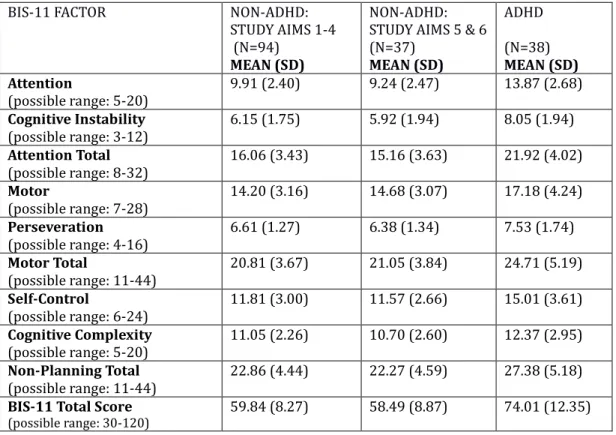
A scale commonly used to measure self-reported impulsivity is the Barratt Impulsiveness Scale-11 (BIS). Principle component analysis by Patton, Stanford, and Barratt (1995) of the BIS has found it loads on the following six primary order factors: attention, motor, self-control, cognitive complexity, perseverance, and cognitive instability. Further analysis by the same team has yielded three broad secondary factors onto which the BIS loads: attentional impulsiveness, motor impulsiveness, and nonplanning impulsiveness. A study examining the relationship between delay discounting and the BIS finds only the nonplanning factor of
impulsivity to be consistently associated with delay discounting in normative adults (de Wit et al., 2007).
A larger exploratory analysis of the hierarchicial structure of 11 self-reported impulsivity scales, including the BIS, found at least 7 principal components of
impulsivity: Prepared/Careful, Impetuous, Divertible, Thrill and Risk Seeking, Happy-Go-Lucky, Impatiently Pleasure Seeking , and Reserved (Kirby and Finch, 2010). According to this study, delay discounting rates loaded on Impatiently Pleasure Seeking, and correlated with the impulsiveness and venturesomeness scales from Eysenck et al.’s personality scale developed in 1985, the I7. The authors of this study support a discounting model of impulsivity first proposed by Ainslie in 1975: impulsive choices arise because of the way the relative present values of delayed rewards change with the passage of time (Kirby and Finch, 2010). This leads to the important question of the role that time perception is playing in delay
2.3 Time Perception
Time perception is an adaptive function that facilitates the ability to predict and anticipate events, as well as organize and plan sequences of actions (Mangels, Ivry, & Shimizu, 1998). Several studies have noted the link between time perception,
impulsivity, and an inability to delay gratification with increased rates of delay discounting (e.g. Reynolds and Schiffbauer, 2004; Takahashi , 2005; Barratt, 1983; van den Broek et al., 1992; Glicksohn, Leshem, & Aharoni, 2006). Supporting the hypothesis that the time perception may be playing a main role in delay discounting, it has been found that the same event taking place in past vs. future is valued
differently (Caruso, Gilbert, & Wilson, 2008). Because perception of time is an important variable when studying delay discounting, it is worthwhile to explore precisely how it may be contributing to this type of decision making.
Lashley (1960) stressed the importance of temporal perception, writing that processing of complex stimuli relies on the ability to process order, interval, and duration of events. Temporal perception can be contrasted with more spatial
processing and comparisons, such as those differentiating between angles of bars of light shone on the retina. Though virtually all complex processing combines aspects of both spatial and temporal dimensions, we will focus on time perception in this review.
How is time perception studied?
There are four chief methods in use to study time perception, as outlined by Wittmann and Paulus (2008): 1. A verbal estimation of time duration, in which a participant is asked to judge how long an elapsed time interval lasted; 2. a time duration task, in which participants are asked to judge when they believe a given duration of time has elapsed; 3. duration reproduction tasks, in which participants are exposed to a fixed interval of time and asked to reproduce it (i.e. reproducing a given tempo); and 4. duration comparison tasks, in which multiple intervals are presented and participants pick which was longest or shortest. Methods 1 and 2 require that participants explicitly translate their experience of passage of time into seconds and minutes, while methods 3 and 4 measure a judgment of relativity that does not require second/minute translation.
Cognitive Model of Time Perception
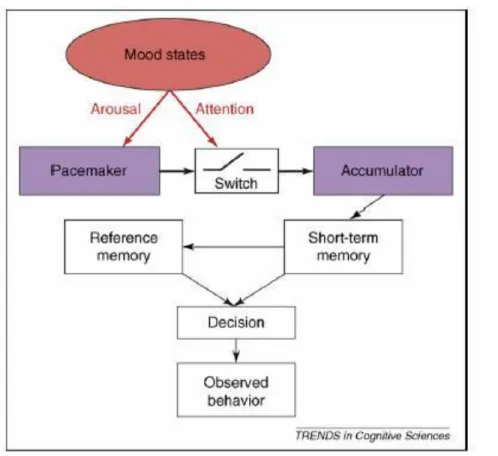
The prevalent cognitive model of time perception, referred to as the “pacemaker-counter process,” assumes the existence of an internal clock system that generates and tracks temporal units (Zakay & Block, 1997). Wittman & Paulus (2008) outline this cognitive model established by Zakay & Block of time perception: a generator of units (or pulses of time) is referred to as the “pacemaker”, and its tempo is mediated
by arousal, which in turn is moderated by various mood states. Mood state also moderates attention, and attention acts as a switch that turns on a mechanism to count the pulses of time generated by the pacemaker. This count is then transferred to short-term memory storage, and is used as a reference against a previously stored representation of what constitutes a “second” or “minute”. A decision regarding this comparison is ultimately made, and the observed behavior output is the result of this decision (see Figure 2) (Pouthas & Perbal, 2004).
In this cognitive model, it is important to note that the pacemaker’s rate of generating time pulses can be altered by arousal and mood states; it is not a constant internal time generator. The subjective experience of time duration is the amount of pulses counted by the accumulator as they feed into memory stores. This model implies that increased rates of pulses of time would lead to greater
estimations of duration, as more pulses equals more time. Similarly, it predicts slowed rates of pulses generated by the pacemaker would induce underestimations of time duration. It has been found that increased arousal, in the form of anxiety, is associated with the perception of a slowing of time (i.e., overestimation of duration), presumably via a faster pacemaker (Wittman et al., 2006).
Attention can also affect time perception in this cognitive model: increased attention to time causes the accumulator (as opposed to the pacemaker as outlined above) to switch on, allowing for a greater number of “pulses,” or subjective
temporal units, to generate, which would induce overestimations of time. This phenomenon can be observed in normative individuals: when staring at a clock during a less engaging lecture, time seems to slow. The cognitive model explains this as increased attention causing increased pulses to accumulate, thus creating the subjective experience of increased duration of time. Similarly, in line with the saying “time flies when you’re having fun”, a lack of attention to the explicit passage of time will result in fewer time pulses being accumulated, and an underestimation of time duration (Burle & Casini, 2001). Smokers attempting to quit nicotine experience a
subjective slowing of time associated with increased perception of temporal
duration, which is associated with greater attention to the passage of time (Sayette et al., 2005).
Another cognitive model of time perception is called the oscillator process model, which asserts that perception of time is based on a non-linear, dynamic system that attends to temporal intervals embedded in sequences of signals, such as music, speech, and movement (Jones & Boltz, 1989; Grondin, 2010). In this model, regularly repeating features of stimuli induce future-oriented attention, and create a “predictive state”- a tendency to predict the rhythmic pattern of stimuli. Temporal processing here relies on the synchronicity of attended internal rhythms (derived from predictions from external stimuli) with perceived external rhythms. An internal oscillator allows the internal attending rhythm to approach the external stimuli rhythms. Though this model can account for temporal processing, the pacemaker-counter process is currently the dominant view (Grondin, 2010).
Neurobiological Correlates of Time Perception
Many structures have been implicated in time perception, though in this review focus will be placed on the cerebellum, cerebral cortex, and basal ganglia, as they have received the most study in regard to explicit time judgment. Ivry, Keele, and
Diener (1988) found that lesions to the cerebellum increase the variance of interval reproductions. These patients also exhibited diminished ability to discriminate between brief time intervals, while their ability to discriminate intensity of sounds remained intact. Imaging studies have implicated both lateral and medial regions of the cerebellum in temporal processing across a range of durations, ranging from milliseconds (Lewis & Miall, 2003) up to approximately 24 seconds (Tracy et al., 2000).
Several regions of the cerebral cortex have been associated with time
perception. Most of the literature has focused on the frontal and parietal cortices, as well as the supplementary motor area (SMA), as being the primary areas associated with time perception. A review by Grondin (2010) highlights several studies that implicate various structures: dorsolateral PFC has been associated with brief (<1 sec) time interval processing (Pouthas et al, 2005); while activation of the general right PFC has been associated with short as well as supra-second time processing (Koch et al., 2002). It is thought that the “accumulator” from the pacemaker-counter cognitive model of time perception is located in frontal cortex regions (Pfeuty, Ragot, & Pouthas, 2003). Binkofski & Block (1996) reported a case study of a previously healthy man who had a lesion of the left superior PFC: its effects included perceiving time much faster than previously. The man reported that his world appeared to be moving in fast-forwarded motion.
SMA activation has been observed when judging time intervals, as when participants are asked to explicitly count seconds (i.e. “one thousand, two one-thousand” or “one mississippi, two…”) (Hinton et al., 2004). Transcranial magnetic stimulation of the parietal lobe (specifically, right posterior parietal cortex) has also been associated with interval duration processing. TMS-induced disruption of this area resulted in decreased ability to discriminate time intervals, while the ability to discriminate tonal intervals remained intact (Alexander, Cowey, & Walsh, 2005).
Finally, the basal ganglia have been studied as a component of time
perception: fMRI studies have found it is most likely involved with early temporal processing and the encoding of time intervals (Rao et al., 2001). Both the caudate and putamen are activated during short as well as longer time interval processing (Pouthas et al., 2005; Hinton & Meck, 2004). These brain regions are hypothesized to correlate with various aspects of the cognitive pacemaker-process model of
temporal perception, as outlined by Grondin (2010): temporal perception depends on frontal-striatal circuits. The command to “start timing” travels from cortical areas to the striatum via topographically-linked fibers. Single-unit studies in monkeys have shown that cells in the striatum previously firing at non-united intervals then synchronize and create a pattern of neural activity, which is hypothesized to correspond to the cognitive pacemaker (Beiser and Houk, 1998). The striatum encodes these bursts of activity, and receives a message from the substantia nigra to stop firing: when dopamine antagonists (specifically for the D2 receptor) are
administered, interval duration estimations decrease significantly (Meck, 1986). This phenomenon is mirrored in Parkinson’s patients whose substantia nigra is dysfunctional (Malpani et al., 1998). It is hypothesizd that the striatal activity is recorded via these dopamine bursts as the interval length (Rammsayer, 2008).
Dopamine has been implicated in several studies as playing a significant role in time perception; or at least that its manipulation affects time perception.
Administration of a D2 receptor antagonist has been shown to decrease pacemaker speed in both animals and humans (Rammsayer, 1993). In contrast, administration of D2 receptor agonists appears to increase the temporal pacemaker in animals (Cheng, MacDonald, & Meck, 2006). When patients with depleted dopamine levels with Parkinson’s Disease are administered dopamine replacement therapy (DRT), the normally decreased pacemaker is restored to “normal” rates (Pastor et al., 1992). This is compared with over-reproduction of a second when DRT is suspended
(Malpani et al., 1998). This dopamine theory, which places significant emphasis on optimal dopamine levels for accurate time perception, integrates well with findings on time perception issues in ADHD. In addition, the previously mentioned structural studies of temporal perception correspond with areas implicated in ADHD: the frontal cortex, basal ganglia, and cerebellum (Giedd et al, 2001).
2.4 ADHD and Time Perception
A primary time-processing deficit has been suggested as a neuropsychological endophentype of ADHD. Numerous studies have found an impaired sense of timing ranging from the scale of milliseconds to multiple seconds in ADHD populations (Barkley, et al., 2001; McInerney & Kerns, 2003; Smith et al., 2002; Valko at al., 2010). Marx et al. (2010) found that children, adolescents, and young adults with ADHD exhibited difficulties with both time discrimination and time reproduction when compared with age-matched normative controls. Valko et al. (2010) found these deficits continue to exert their effects well into adulthood.
Although in several studies a bias toward temporal overestimation in those with ADHD is observed, the most consistent finding is that people with ADHD exhibit more variability in their response behaviors: the error variability is more erratic than the normative population (Castellanos & Tannock, 2002). These findings have been explained by various hypotheses, many of which implicate to a degree dopamine dysfunction (Levy & Swanson, 2001; Lowe et al., 2004; Sagvolden et al., 2005). One explanation of the finding of impaired timing sense is that dysregulated dopamine contributes to working memory deficits, impaired response inhibition, and poor executive functioning (Barkley, 1997). Thus second-to-second experience and responses to the environment appear to be impaired. Interestingly,
system, has been found to decrease response variability and resulted in more
precise performance on temporal processing tasks, attributed to an enhancement in working memory (Baldwin et al., 2004).
There are also neurobiological structural differences that support an intrinsic time perception deficit in those with ADHD: reductions in volume of prefrontal (Mostofsky, et al., 2002), basal ganglia (Semrud-Clikeman et al, 2000) and cerebellar (Castellanos et al., 2002) regions, all associated with time perception and
processing, have been observed in those with ADHD when compared with normative controls.
Gilden and Marusich (2009) found evidence for a contracted sense of timing in ADHD manifesting as a loss of rhythm perception or feeling at slowed tempos. This is contrasted with normative controls who were able to maintain and “feel” the rhythm at significantly slower tempos than the ADHD group. This lends evidence to the theory that the implicit working memory system of those with ADHD may be compromised and be affecting sense of time. This contraction of time may underlie the finding that durations are often overestimated by people with ADHD.
Sonuga-Barke et al. (2010) have proposed a triple pathway model to explain some of the cognitive and motivational deficits observed in ADHD. This model emphasizes a primary temporal processing deficit, in addition to poor inhibitory control and increased delay aversion. These three components were shown to be
dissociable in an ADHD population, and separated participants from normative controls.
Other Factors Affecting Time Perception
In addition to intrinsic attentional difficulties, several other factors have been found to affect time perception. As predicted by the previously discussed prevalent
cognitive model of time perception, explicit attention to time is associated with temporal over-estimation (Twenge et al., 2003). Several physiological states are associated with differences in time perception: an increase in body temperature is linked with temporal overestimation (Hancock, 1993), as is an increase in
adrenaline brought about during stressful events (Eagleman at al., 2005). Emotional factors appear to play a role as well: happiness induced by happy music led to underestimation of interval duration, while sadness induced by sad music was associated with temporal overestimation (Bisson, Tobin, & Grondin, 2009). However, markedly less emphasis has been placed on the influence of more external factors and their effects on time perception.
External Tempo and Time perception
Very few studies have examined the effects of external tempo on time perception. Zakay, Nitzan, & Glicksohn (1983) found that judgment of time intervals depended
on the tempo set by a buzzer. Specifically, there was a direct relationship between tempo and time interval duration estimation: overestimations of time were associated with fast tempo, while underestimations associated with slow tempo. This would be in line the cognitive model of temporal perception: faster tempo would be interpreted as more time units being ticked off (the internal pacemaker being influenced by the external stimulus with greater arousal associated with faster tempo), with greater overall accumulation, and thus overestimation of time, with the opposite holding true for slow tempo. Feedback, or contextual information, during a temporal reproduction task also increases later accuracy: when participants are required to tap along in time with an accurate clock, they are more accurate at later estimating time (Dutke, 2005).
Wearden, Philpott, and Win (1999) found that short trains of clicks at different tempos were able to induce overestimation of duration of an auditory stimulus that followed the clicks. They also included a condition with clicks and no clicks preceding the tone stimuli. The tone stimuli were in reality the same duration for all conditions. When a tone was preceded by clicks at 5 Hz, the tone was judged as lasting longer than the tone preceded by no clicks. A tone preceded by clicks at 25 Hz was judged to last longer than a tone preceded by clicks at 5 Hz. They were unable to create a condition in which the duration of the tone was perceived as shorter than it was. This finding was replicated in 1996 by Penton-Voak et al., with the proposed explanatory mechanism being that the clicks were speeding up an
internal pacemaker. Possible biological substrates of such a pacemaker were not explored in these papers.
Several studies have examined the impact of tempo on time estimation within the marketing field, typically studying how ambient tempo affects estimations of time spent shopping). Polkosky & Lewis (2002) found that faster auditory tick rates while on hold on a phone were associated with temporal overestimation (as well as greater anxiety, stress, and impatience). Slower ticking was associated with
temporal underestimation, but also induced greater stress than a silent condition. Finally, at least one electrophysiology study examined the effect that external tempo has on internal states. In this EEG study, it was hypothesized that external visual information may directly affect some internal timekeeping mechanism (Johannes et al., 1997). The study found that when flashes of light with a set tempo were shown to participants, the alteration of brainwave patterns was associated with more accurate predictions of when the light will flash next.
2.5 Working Memory and Delay Discounting
Working memory is the part of the cognitive system that is used to hold a limited amount of information in the focus of attention (Hinson, Jameson, & Whitney, 2003). It provides temporary storage and processing of information for use in guiding behavior (Baddeley, 2007). Deficits in working memory are linked with poorer
learning, comprehension, and academic achievement (De Jong, 1998; Gathercole, Pickering, Knight, & Stegmann, 2004). Working memory is necessary for performing complex tasks such as planning, problem solving, and decision-making.
Several studies have found that increasing demand on working memory is correlated with less optimal performance on versions of the Iowa Gambling Task, a probability-based decision making task (Worthy, Otto, & Maddox, 2012; Dretsch & Tipples, 2007; Bechera & Martin, 2004). However, there are limited studies that have examined more directly the relationship between working memory and time-based decision-making tasks like delay discounting. Hinson, Jameson, & Whitney (2003) found that by placing a load on working memory capacity during a computerized delay discounting task, they could steepen (increase) the k value of participants’ delay discounting curves. Participants who had greater demand on their working memory made more impulsive choices and favored suboptimal temporally proximal rewards over delayed optimal rewards. However, a later review of this study
provided an alternative explanation of these findings, stating that increased working memory load appeared to merely increase the likelihood of random responding on the delay discounting task, rather than eliciting a clear preference for the immediate choice (Franko-Watkins, Pashler, & Rickard, 2006).
While the 2003 study did examine increasing working memory load and its effects on k, studies that examine intrinsic working memory capacity and its relationship with delay discounting are largely absent from the literature. An
exception is a 2008 imaging study by Shamosh et al. that found intrinsic working memory capacity predicted delay discounting in normative controls, though only via mediation by Full Scale IQ. In addition, a study by Bickel et al. (2011) found that working memory training decreased k discounting values in a sample of people with stimulant addictions.
Though these few studies have examined the relationship between working memory and delay discounting in primarily normative populations, a literature search finds no studies that examine working memory capacity in an ADHD population and its effects on delay discounting. Impaired decision-making
performance on the Iowa Gambling Task has been observed in children with ADHD, but this task does not explicitly involve judgments involving the passage of time (Garon, Moore, & Waschbusch, 2006). Therefore, a measure of working memory capacity in an ADHD clinical population will provide information about the relationship between working memory and delay discounting.
2.6 Processing Speed and Delay Discounting
Processing speed refers to the speed of cognitive processes involved in selecting, preparing, and executing a response. Processing speed is a significant component of overall IQ, is correlated with working memory, and has been found to account for a high degree of age-related memory decline in non-demented older adults (Fry & Hale, 1996). Salthouse (1996) has proposed that slower processing
speed may leave more time for information stored in working memory to decay, which would lead to lower effective working memory capacity.
Despite the close linkages between processing speed and both working memory and overall IQ, its independent contribution to delay discounting is understudied. A 2008 unpublished master’s dissertation found no relationship between processing speed and delay discounting in a sample of normative participants (Rambo, 2008). A 2006 study by Hoffman et al. found no significant relationship between trails A or the Stroop color/word (non-interference condition) tasks with delay discounting rates in a group of methamphetamine-addicted
individuals. No studies were found that examined the relationship between processing speed and delay discounting in a clinical population with known impairment with processing speed such as an ADHD group.
2.7 Working Memory, Processing Speed, and ADHD
Deficits of both working memory and processing speed in people with the diagnosis of ADHD are widely cited. A meta-analysis of 26 studies found that
working memory deficits were associated with the diagnosis of ADHD, independent of comorbidity with other language learning disorders and general intellectual ability (Martinussen et al., 2005). Processing speed deficits have been observed in ADHD populations in a large number of studies (see Jacobson et al., 2011 for a review; Shanahan et al., 2006).
It has been hypothesized that working memory deficits may play a causal role in many of the cognitive / behavioral deficits seen in ADHD, such as disorganization, inattentiveness, poor social skills, and hyperactivity (Kofler, Rapport, Bolden, & Altro, 2008). In addition, underlying working memory deficits may also be responsible for delay aversion and impulsivity (Rapport et al, 2001).
A proposed inverse relationship between processing speed and perceived time passage has been suggested in a theory paper by Goddard (2000), who
hypothesized that this could relate to ADHD. Specifically, he wrote that ADHD could be caused by a distorted sense of time in which time passes so quickly that
Chapter 3: Summary and Hypotheses
To summarize, delay discounting is a behavior manifesting a tendency to devalue future rewards with respect to present rewards. This behavior is associated with many clinical populations and has been shown to be associated with poor outcomes. To better understand what underlies delay discounting, we may examine the
primary variable that is changing within the paradigm, the variable of time. Several clinical populations (notably, ADHD), have been shown to have deficits, or at least differences, in time perception. The purpose of this study is to determine if an altered sense of time in the seconds-range is associated with decision tasks involving longer delays.
Additionally, the relationship between delay discounting and working memory and processing speed is understudied, especially in an ADHD population. Though several studies have examined the effects that manipulating working
memory via loading or training has on delay discounting in normative and substance abuse groups, no known studies have examined the role that intrinsic working memory and processing speed capacity may play in delay discounting. Significant working memory and processing speed deficits are observed in those with ADHD compared with normative controls, as is increased delay discounting. This study will examine to what degree working memory and processing speed capacity may
Optimal decision-making requires the ability to maintain, access, and manipulate stored information and compare it to another piece of information. If working memory capacity is decreased, then presumably fewer pieces of
information can be accurately maintained, manipulated, and compared with other pieces of information. With the many comparisons and values to consider in delay discounting (both money values, both time values), it may be possible that lower working memory capacity may interfere with making the less impulsive choice.
In addition, processing speed may be related to the construct of the “internal pacemaker,” with faster processing speed associated with a faster pacemaker / sense of time. The prevalent theory of cognitive time-keeping suggests that a faster
internal temporal pacemaker is associated with greater estimations of time durations (due to greater accumulation of temporal units). However, those with ADHD tend to have greater variability in estimations of time duration but consistently slower processing speed. Therefore further exploration into the interaction between processing speed, working memory, sense of time, and decision-making is warranted.
Hence, the current study has the following specific aims:
(1) To establish if feedback from a device regarding the length of a second can influence temporal duration estimations;
(2) To determine if this manipulation of local temporal perception affects rates of delay discounting;
(3) To explore how this manipulation of local temporal perception affects delay discounting in an ADHD population;
(4) To explore the role self-reported impulsivity may be playing in the relationship between manipulated temporal perception and delay discounting.
(5) To determine if intrinsic working memory and processing speed capacity have a significant influence on delay discounting;
(6) To explore how working memory capacity and processing speed affects timing training to a metronome.
Hypotheses
It is hypothesized that
(1) Feedback from a false metronome will affect brief (~20 sec) time interval estimates in the following ways: active feedback training to 50 beats per minute (bpm), but labeled as 60 bpm / 1 beat per second, will induce under-estimations of brief time intervals. Active feedback training to 70 bpm (labeled also as 60 bpm / 1 beat per second) will induce over-estimations of time intervals.
(2) Those who have been trained with the slow tempo (50 bpm) will show decreased rates of delay discounting in a delay discounting task with respect to those trained with the fast tempo (70 bpm).
(3) The clinical ADHD group will exhibit delay discounting patterns similar to the non-ADHD group in response to the metronome training, but the effect will be smaller due to inherent greater variability of temporal perception in the ADHD group.
(4) Higher levels of trait impulsivity in all groups will be associated with higher rates of delay discounting, with high impulsivity and exposure to fast metronome correlated with steepest delay discounting.
(5) Working memory capacity will have a significant influence on delay discounting; specifically, lower working memory capacity will be associated with increased delay discounting rates. Processing speed capacity will have a significant influence on delay discounting; specifically, slower processing speed will be associated with increased delay discounting rates.
(6) Working memory capacity will influence time estimation. Specifically, lower working memory capacity will be associated with
a. less accurate time estimations of both short-term and long-term time intervals
Processing speed capacity will influence time estimation. Specifically, slower processing speed will be associated with
a. less accurate time estimations of both short-term and long-term time intervals
b. more training trials needed to reach criterion on metronome task
Chapter 4: Methods
4.1 General Design
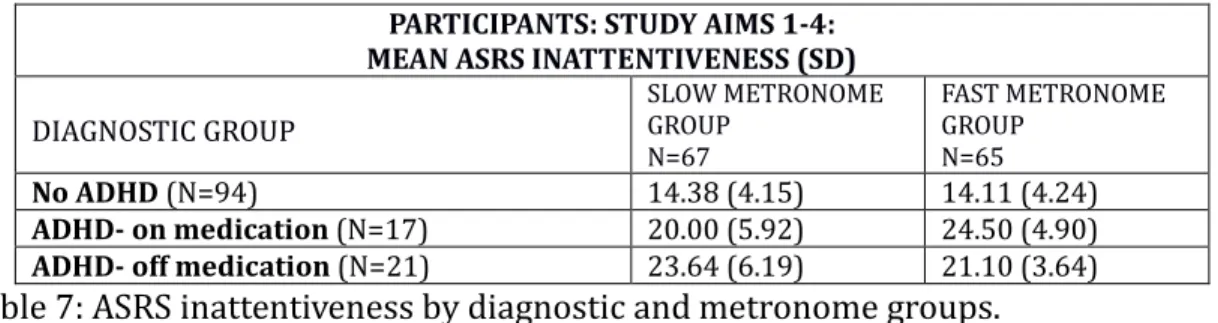
This study examined the effects of exposure and training to a slow metronome (“S”) or fast metronome (“F”) on delay discounting in an ADHD and non-ADHD
population. Additionally, it examined how impulsivity, working memory, and processing speed may moderate these results. Metronome condition (slow or fast) and diagnostic group (no ADHD, ADHD on medication, ADHD off medication) were main independent variables, k (steepness of delay discounting) was the main dependent variable, and self-reported impulsivity (obtained from the BIS-11),
working memory capacity, and processing speed were other predictor variables. The specific statistical test used for each aim of the study is described below in the results.
4.2 Setting
The study took place in the Seay Building at the University of Texas at Austin, within the Clinical Neuropsychology Lab.
4.3 Tasks Demographic / ADHD questionnaire (see Appendix A)
Information on gender and age was collected. Information on ADHD diagnosis (how many years with diagnosis, subtype) and medication (medication name, dosage, whether or not the participant was currently on medication) was collected as well.
Metronome Task
Participants were randomized to either the slow (S) or fast (F) metronome group. Participants were advised that since this is a study about timing, they would have to remove any watch and put away their cell phones. They were then provided with sham educational material (see Appendix B), which emphasized the
importance of accurate time-perception, with such statements as “studies have shown that accurate prediction of time intervals predict later success, wealth, and self-reported happiness” and “we are attempting to train people to be more accurate time keepers so that more people can experience these measures of success”. The statements were provided to attempt to induce greater motivation and adherence to the manipulation.
After reading through the sham education materials, participants entered a room with a computer and metronome. The researcher was equipped with a smartphone onto which a metronome program application (“Mobile Metronome”) had been loaded. Participants were told that the metronome was set to 60 beats per minute, one beat per second. The researcher explained that the goal was to learn
how to more accurately estimate time durations by getting an improved sense of the accurate length of a second. The researcher then “verified” the rate of the
metronome with the smartphone by playing synchronous beats for several seconds (however, the smartphone was set to match the rate of the metronome, rather than 1 beat per second). The participant was asked to listen to the metronome and
encouraged to tap along with the beat “to really get a feel for the length of a second.” The metronome then was started and continued running for approximately 20 seconds. Participants were not told how much time had elapsed.
Following this exposure, the metronome was turned off and the participant was asked to indicate when they believed 20 seconds have elapsed. Timing
commenced with a stopwatch so the researcher could record how much time had passed. Participants’ answers were recorded. Participants were required to show a consistent under or overestimation of the time interval (depending on the tempo target), with consistency defined as at least 3 trials below or above the target time. Specifically, exposure to the metronome set to 70 bpm had to yield three estimations of a 20 second interval equal to or under 18 seconds to be considered successful training. Exposure to the slower metronome (50 bpm) had to yield three estimations equal to or over 22 seconds to be successful. It was planned to provide up to 10 learning trials, though 7 was the maximum number needed by any single participant. The minimum number of trials administered was 3. The number of
training trials required to achieve 3 trials within the specified range was recorded as an index of “trainability” to the manipulation.
Barratt Impulsiveness Scales-11 (BIS-11) (see Appendix C)
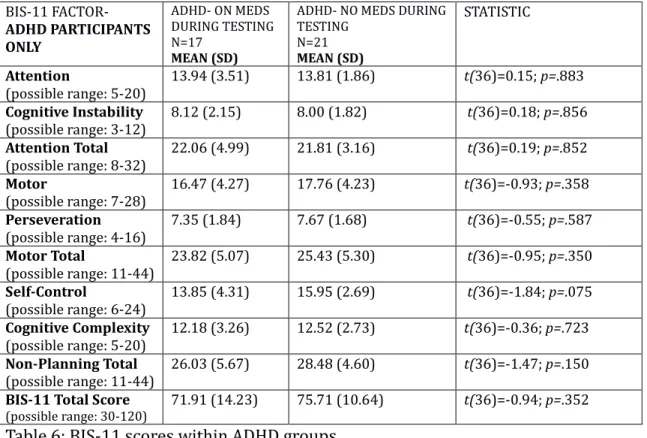
The BIS-11, a self-report questionnaire, has been validated in impulsive and normative populations. It consists of 30 items that have been divided into three subscales: attentional (inattention- 5 items and cognitive instability- 3 items), motor (motor impulsiveness- 7 items and lack of perseverance- 4 items), and nonplanning (lack of self-control- 6 items and intolerance of cognitive complexity- 5 items). Total points for each subscale and total score on the entire BIS-11 were used in the
present study. While some previous studies (e.g. Swann et al, 2002) have shown that high impulsivity is correlated with steeper delay discounting, this finding has not been consistent and requires further exploration.
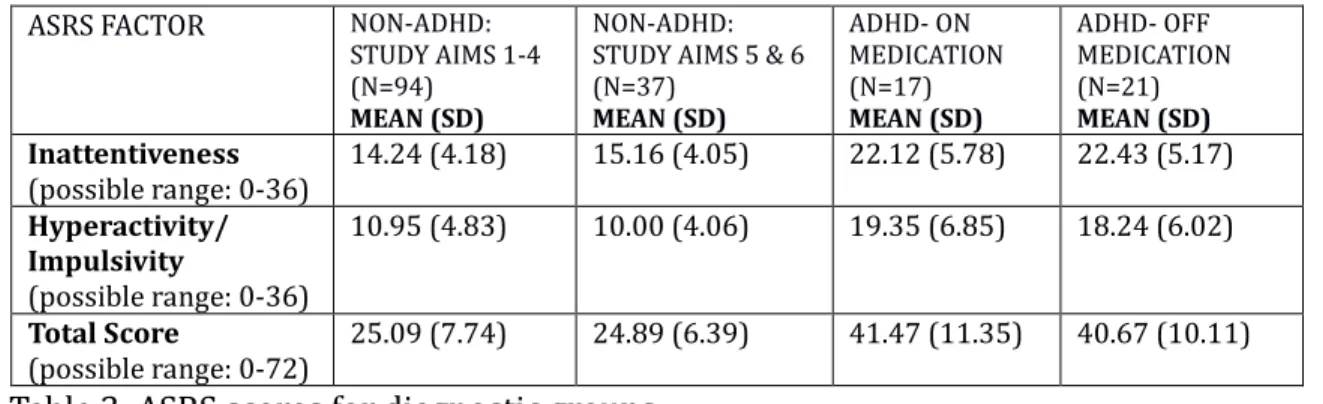
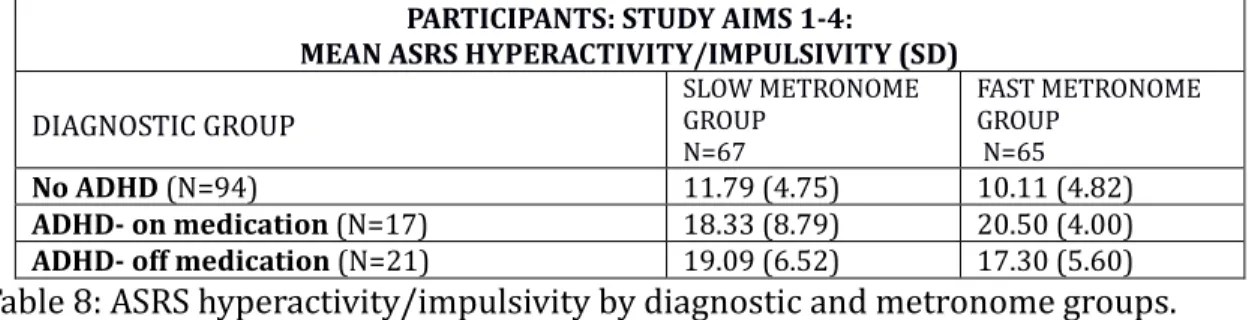
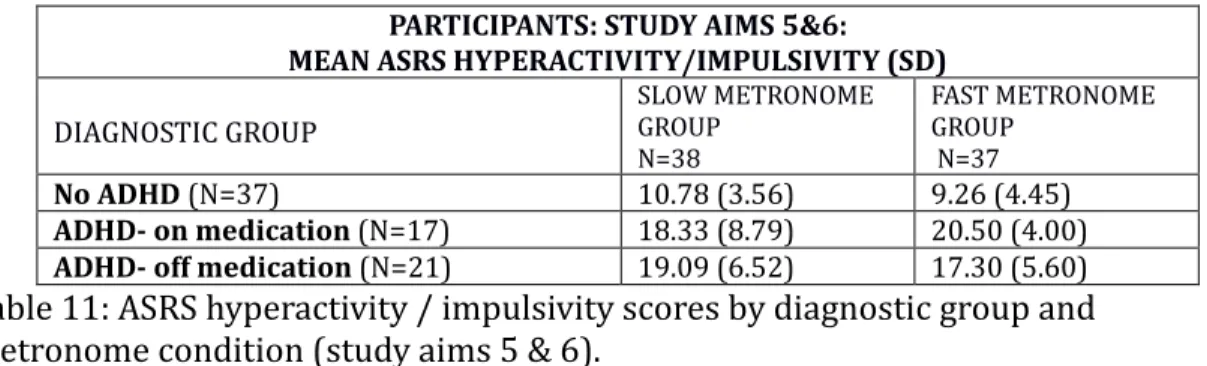
Adult Self-Report Scale Symptoms Checklist (ASRS); Adler, et al., 2005; (Appendix D) The ASRS, a self-report questionnaire designed to examine ADHD, has been validated in ADHD and normative populations. It consists of 18 questions separated into inattentive and hyperactive/impulsive categories. Of the 18 questions, there are 9 in the Inattentive section and 9 in the Hyperactive/Impulsive section,
corresponding to the DSM-IV criteria for ADHD. Each question is rated on a 5-point likert scale, yielding values between 0 (corresponding to “never”) and 4
(corresponding to “most of the time”). The total sums of points for both the Inattentive and Hyperactive/Impulsive symptom sections were entered into the model separately to examine the effects of ADHD symptomatology on the relevant study aims.
Wechsler Adult Intelligence Scale-IV (WAIS-IV): Matrix Reasoning
In this task, participants examine a visual design or set of designs and are presented with 5 options to pick from to best complete the design. This task
incorporates visual processing and abstract, spatial reasoning. Performance on the Matrix Reasoning task served as a performance-based IQ measurement to ensure that groups did not differ in IQ. Raw scores (ranging from 0-26 for number of correct items achieved before the discontinuation rule of 3 incorrect in a row) were used as performance variables rather than age-corrected scaled score to allow greater variability of scores within the very narrow age range of participants tested. Participants were also required to provide an estimation of how much time they believe they spent on the Matrix Reasoning task. They were not warned beforehand that they would be required to make this estimation. This estimation served as another measure of time processing on a somewhat larger scale than the 20-second estimations, allowing for an examination of the generalizability and duration of any effects the manipulation may have had.