Ph.D Thesis
Software Restructuring: Understanding
Longitudinal Architectural Changes and
Refactoring
July 2018
Matheus Paixao
A report submitted for the fulfillment of the requirements for the degree of Doctor of Philosophy of
University College London Computer Science Department
I, Matheus Paixao, confirm that the work presented in this thesis is my own. Where information has been derived from other sources, I confirm that this has been indicated in the thesis. The work presented in this thesis is original work undertaken between September 2014 and July 2018 at University College London.
Tables 1 and 2 below present work that has been published and/or submitted between September 2014 and July 2018. First, I list the work that compose this thesis (No. 1–4), each of which is discussed in detail in this thesis (Chapters 3–5). Next, I include my co-authored publications that, although relevant to my PhD, are not discussed in this thesis.
No. Publication My contributions to the work 1 M. Paixao, M. Harman, Y. Zhang, Y. Yu
An Empirical Study of Cohesion and Coupling: Balancing Optimisation and Disruption
IEEE Transactions on Evolutionary Computation, 2017
I proposed the research questions based on the litera-ture review and the experience obtained in a previous publication (No. 5). I designed the experiment with suggestions from the other authors. I manually down-loaded the 233 releases of the 10 systems we studied. I adapted the static analysis tool that extracted the struc-tural modularisation of all releases. I implemented all search algorithms and performed all results analyses. The paper has been written by all authors.
2 M. Paixao, J. Krinke, D. Han, M. Harman CROP: Linking Code Reviews To Source Code Changes
Proceedings of the International Working Conference on Mining Software
Repositories (MSR’18)
I proposed the creation of a new code review dataset that would provide code review data linked to com-plete copies of the code base for open source software systems. I designed the mining framework. I adapted D. Han’s original scripts to download the code review data and the snapshots of each system. I designed and implemented the heuristics that linked the code review data with the snapshots. I implemented the scripts that processed the raw data, extracted the relevant informa-tion, and built the dataset to be easily accessed. The paper has been written by all authors.
3 M. Paixao, J. Krinke, D. Han, C. Ragkhitwetsagul, M. Harman Are Developers Aware of the Architectural Impact of Their Changes?
Proceedings of the 32nd IEEE/ACM International Conference on Automated Software Engineering (ASE’17)
I proposed this empirical study to investigate how de-velopers perform architectural changes on their daily basis. I designed the experiments in cooperation with Dr. Krinke and Prof. Harman. D. Han mined the code review data used in the work. I wrote the scripts to link code reviews to git commits in all systems. I adapted a static analysis tool to extract the struc-tural modularisations of all systems from source code. I implemented the scripts to compute the structural metrics of cohesion and coupling for all reviews. I manually inspected all reviews with significant im-pact on the structural architecture. D. Han and C. Ragkhitwetsagul each inspected half of the reviews to complement my manual analysis. The paper has been written by all authors.
4 M. Paixao, J. Krinke, D. Han, C. Ragkhitwetsagul, M. Harman The Impact of Code Review on Architectural Changes
Work in progress submission to the IEEE Transactions on Software Engineering, 2018
This paper is a journal extension of our previous con-ference paper (No. 3). I proposed the extension of the dataset used in the previous paper, which generated the CROP dataset (paper No. 2). I proposed the new research question that investigates the evolution of ar-chitectural changes during code review. I designed and executed the new qualitative investigation of the refactorings that degrade the system’s structure. The paper has been written by all authors.
No. Publication My contributions to the work 5 M. Paixao, M. Harman, Y. Zhang
Multi-objective Module Clustering for Kate
Proceedings of the Symposium on Search Based Software Engineering (SSBSE’15)
I designed the experiment alongside Prof. Harman and Dr. Zhang. I manually extracted Kate’s structural modularisation and implemented the Two-Archive search algorithm that was later used in the evaluation. The paper has been written by all authors.
6 C. Ragkhitwetsagul, M. Paixao, M. Adham, S. Busari, J. Krinke, J. H. Drake
Searching for Configurations in Clone Evaluation – A Replication Study
Proceedings of the Symposium on Search Based Software Engineering (SSBSE’16)
I assisted C. Ragkhitwetsagul in designing the exper-imental framework, running the experiments and col-lecting the results. I assisted with the writing of the paper.
7 G. Guizzo, M. Bazargani, M. Paixao, J. H. Drake
A Hyper-heuristic for Multi-Objective Integration and Test Ordering
in Google Guava
Accepted for publication in the
Proceedings of the Symposium on Search Based Software Engineering (SSBSE’17)
I wrote the scripts to extract the structural modulari-sation of Google Guava from its source code.
8 J. Wilkie, Z. Halabi, A. Karaoglu, J. Liao, G. Ndungu, C. Ragkhitwetsagul, M. Paixao, J. Krinke
Who’s this? Developer identification using IDE event data
Proceedings of the International Working Conference on Mining Software
Repositories (MSR’18)
I assisted the main authors in designing the research questions. I assisted with the writing of the paper.
9 D. Han, J. Krinke, M. Paixao, G. Rosa, C. Ragkhitwetsagul
Bad Style Can Get Your Code Change Rejected
Submitted to the33rd IEEE/ACM International Conference on Automated Software Engineering (ASE’18)
I manually inspected code style violations during code review to complement the full manual inspection per-formed in the paper. I assisted with the writing of the paper.
10 C. Ragkhitwetsagul, M. Paixao, J. Krinke, G. Bianco, R. Oliveto
Toxic Code Snippets on Stack Overflow Submitted to the IEEE Transactions on Software Engineering, 2018
I manually inspected pairs of code clones to com-plement the full manual inspection performed by C. Ragkhitwetsagul. I assisted with the writing of the paper.
The complexity of software systems increases as the systems evolve. As the degradation of the system’s structure accumulates, maintenance effort and defect-proneness tend to increase. In addition, developers often opt to employ sub-optimal solutions in order to achieve short-time goals, in a phenomenon that has been recently called technical debt. In this context, software restructuring serves as a way to alleviate and/or prevent structural degradation.
Restructuring of software is usually performed in either higher or lower levels of granularity, where the first indicates broader changes in the system’s structural architecture and the latter indicates refactorings performed to fewer and localised code elements. Although tools to assist architectural changes and refactoring are available, there is still no evidence these approaches are widely adopted by practitioners. Hence, an understanding of how developers perform architectural changes and refactoring in their daily basis and in the context of the software development processes they adopt is necessary.
Current software development is iterative and incremental with short cycles of development and release. Thus, tools and processes that enable this development model, such as contin-uous integration and code review, are widespread among software engineering practitioners. Hence, this thesis investigates how developers perform longitudinal and incremental architec-tural changes and refactoring during code review through a wide range of empirical studies that consider different moments of the development lifecycle, different approaches, different automated tools and different analysis mechanisms. Finally, the observations and conclusions drawn from these empirical investigations extend the existing knowledge on how developers restructure software systems, in a way that future studies can leverage this knowledge to pro-pose new tools and approaches that better fit developers’ working routines and development processes.
This thesis investigates how developers perform software restructuring at both high and low levels of granularity in real-world software systems. The studies we describe aim at evaluating commonly believed and accepted assumptions researchers have in regard to how developers restructure software systems, where our results confirm some of these assumptions while providing new insights for others. Our observations expand the current empirical knowledge in software restructuring, which will influence future empirical studies in this area. Moreover, our conclusions will serve as the groundwork for the research and development of new automated approaches to assist software developers when performing software restructuring.
The research presented in this thesis has been published in 3 academic publications at high-level software engineering and computer science venues. In total, the work performed during this PhD has span out 10 research papers. Moreover, 2 papers composed by the later studies reported in this thesis are currently being prepared for submission.
Other researchers and the academic community will benefit not only from the results and observations from the research presented in this thesis but also from the methodology and datasets produced. The framework we designed to identify significant architectural changes (see Chapter 5), for example, has already been adopted by other researchers in related empirical studies on software architecture.
In addition, the code review dataset we collected for the fulfillment of the empirical studies we report in this thesis has been separately published and made available for the research community. At the time of writing, 2 internal research projects within the UCL’s computer science department are making use of this dataset. Moreover, I have been personally contacted by researchers from other universities and research institutes from the Netherlands, Japan, Brazil and Scotland to make me aware they are using our dataset for their own research projects.
Finally, all the results, datasets, manual classifications and source code generated by the research reported in this thesis has been made available for the research community. This allows for complete replication and extension of all the research we carried on during this PhD.
A PhD degree is not easy. Through every single part of the journey I had the help, assistance and support of many people. I will try to express my gratitude in the next few paragraphs.
First and foremost, I would like to thank my supervisory team. I thank Prof. Mark Harman for being my main supervisor for the first 2 years of my PhD, which helped me understand what it meant to do a PhD in a such a different university, country and culture. I will hold dearly on my memory all the moments we spent together, which included not only academic but also personal and professional guidance and counselling. In particular, I will most certainly remember the week we spent in Brazil, in which I can guarantee solidified and shaped my visions of what means to be a sucessful researcher.
I would like to equally thank Dr. Jens Krinke, who became my main supervisor on the second half of my PhD and drove me to the finish line in amazing fashion and support. I appreciate the belief you had in accepting a student halfway through the journey, in which I could see the same support and dedication as if I have been your student since the beginning. I thank you for the slight change in topic, which made fall in love with parts of software engineering research I would most certainly not be exposed to.
Last but not least, I thank Dr. Yuanyuan Zhang who stayed alongside the journey from beginning to end to provide not only academic support but mostly tips on how to handle my supervisors, smart advice on my smaller tasks and general guidance through the journey. Be certain your help was imperative to my success, and I fully believe and support in your new adventure in life.
During my entire PhD I’ve always felt grateful to be part of CREST, mostly due to the amazing people that make it exist. In particular, my PhD colleagues who made the whole thing a bit less stressful and always funnier and more enjoyable. Chaiyong Ragkhitwetsagul, Bobby Bruce, Carlos Gavidia and DongGyun Han, thank you for every moment we spent. To CREST’s other members I thank for the insightful discussions, moral support and amazing work which I became familiar with.
Living abroad is certainly not easy. Hence I thank Rafael Carmo for first making all the arrangements for my moving to London and second for the three years we shared in the city. Lauren O’Neill and Brynne Inglish easily became my favorite americans. Thank you for the two years of company, conversations, cultural exchange, and of course, beer. Thank you Juliana Ramos for this last year of support. To all four of you guys, it was a blast.
To all my ‘outside UCL friends’, thank you for the company, parties, silly moments and sometimes insightful life advice and experiences. I would add the name of the group here if this was not a formal document, but you know who you are.
I thank the Brazilian National Council for Scientific and Technological Development (CNPq) which funded my PhD and my 4 years of living in London.
I could not forget to thank my parents who first provided me with such excellent education and later supported me in all my academic decisions.
Finally, I thank Mariana Maia for all the calls, conversations and advice during this journey. Thank you for all the times you flew more than 3,000km to spend a couple (sometimes more) of days with me. We really made it happen, to our own surprise. Your coffee unfortunately ceased to be the best, but in exchange I found much more to thank you for this time.
1 Introduction 14
1.1 Problem Statements . . . 15
1.2 Goal and objectives . . . 16
1.3 Contributions . . . 17
1.4 Thesis Organisation . . . 18
2 Literature Review and Background 19 2.1 Software Architecture and Modularisation . . . 19
2.2 Software Evolution and Architectural Degradation . . . 22
2.2.1 Empirical Evidence of Software Architectural Degradation . . . 22
2.2.2 Software Architectural Debt . . . 23
2.3 Software Architecture and Modularisation Metrics . . . 25
2.3.1 Software Architecture and Modularisation Quality Metrics . . . 25
2.3.2 Software Architecture and Modularisation Change and Similarity Metrics 31 2.4 search-based Software Modularisation for Architectural Restructuring . . . . 34
2.4.1 Foundations of search-based Modularisation . . . 35
2.4.2 Software Evolution and search-based Modularisation . . . 39
2.4.3 Multi-objective search-based Modularisation . . . 40
2.4.4 User Interactive search-based Modularisation . . . 43
2.4.5 Disruption Caused by search-based Modularisation Approaches . . . 43
2.4.6 Practitioners’ Perception of Software Modularisation . . . 44
2.5 Software Refactoring . . . 45
2.5.1 Refactoring Operations . . . 45
2.5.2 Manual Refactoring vs Automated Refactoring . . . 47
2.5.3 Developers’ Intentions When Refactoring . . . 48
2.6 Software Code Review . . . 50
3 An Empirical Study of Cohesion and Coupling: Balancing Optimisation and Disruption 52 3.1 Introduction . . . 53
3.2 Related Work and Background . . . 56
3.2.1 Modular Structure Representation . . . 56
3.2.2 Modular Structure Quality Metrics . . . 57
3.2.3 Modular Structure Disruption . . . 58
3.4 Empirical Study . . . 61
3.4.1 RQ1: Is there any evidence that open source software systems respect structural measurements of cohesion and coupling? . . . 61
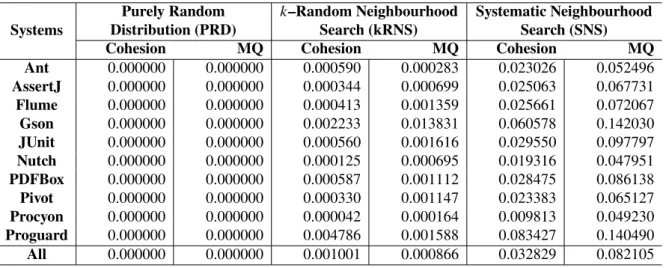
3.4.2 RQ2: What is the relationship between raw cohesion and the MQ metric? 65 3.4.3 RQ3: What is the disruption caused by search-based approaches for optimising software modularisation? . . . 70
3.4.4 RQ4: Can multiobjective search find allocations of classes to packages with a good trade-off between modularity improvement and disruption of the original modular structure? . . . 72
3.4.5 RQ5: What is the modularity improvement provided by the multiob-jective search for acceptable disruption levels? . . . 76
3.5 Qualitative Analysis . . . 80
3.6 Threats to the Validity . . . 82
3.7 Conclusion . . . 83
3.8 Conclusions From the Chapter . . . 84
4 CROP: Linking Code Reviews to Source Code Changes 85 4.1 Introduction . . . 85
4.2 Harvesting the CROP . . . 87
4.2.1 Code Review in Gerrit . . . 87
4.2.2 Challenges in Mining Gerrit Review Data . . . 88
4.2.3 Mining Code Review Data From Gerrit . . . 88
4.3 Storing the CROP . . . 89
4.4 Grinding the CROP . . . 90
4.5 Conclusion . . . 91
4.6 Conclusions From the Chapter . . . 91
5 Are Developers Aware of the Architectural Impact of Their Changes? 93 5.1 Introduction . . . 93
5.2 Background . . . 96
5.3 Experimental Design . . . 97
5.3.1 Code Review Data . . . 97
5.3.2 Computing the Difference in Structural Cohesion and Coupling for Reviewed Changes . . . 99
5.3.3 Identification of Reviews with Significant Architectural Changes . . . 100
5.3.4 Manual Inspection and Classification of Reviews . . . 101
5.4 Validation of Experimental Design . . . 104
5.4.1 Measurement of Architectural Change . . . 104
5.4.2 Threshold Sensitivity Analysis . . . 104
5.5 Experimental Results . . . 105
5.5.1 RQ1: What are common intents when developers perform significant changes to the architecture? . . . 105
5.5.2 RQ2: How often are developers aware of the architectural impact of their changes on a day-to-day basis? . . . 107
5.5.3 RQ3: How do awareness and intent influence architectural changes on
a day-to-day basis? . . . 108
5.5.4 RQ4: How do architectural changes evolve during code review? . . . 112
5.6 Qualitative Analysis of Refactorings that Degrade the Architecture . . . 114
5.7 Discussion . . . 116
5.7.1 Architectural Awareness Expectations and Observations . . . 116
5.7.2 Tool Support for Architectural Changes During Code Review . . . 116
5.7.3 Leveraging Code Review Data for Empirical Studies . . . 118
5.8 Threats to the Validity . . . 118
5.9 Related Work . . . 119
5.10 Conclusion . . . 121
5.11 Conclusions From the Chapter . . . 121
6 Are Developers Refactoring When Refactoring? 123 6.1 Introduction . . . 123
6.2 Experimental Design . . . 125
6.2.1 Code Review Data . . . 125
6.2.2 Identification of Refactoring Operations . . . 126
6.2.3 Manual Inspection and Classification of Reviews . . . 128
6.3 Experimental Results . . . 128
6.3.1 RQ1: What are common intents when developers perform refactoring operations? . . . 128
6.3.2 RQ2: What are common refactoring operations employed under differ-ent intdiffer-ents? . . . 129
6.3.3 RQ3: How often do developers have the intent of refactoring but do not employ any refactoring operation? . . . 130
6.3.4 RQ4: How do changes that employ refactoring operations evolve during code review? . . . 133
6.4 Threats to the Validity . . . 136
6.5 Related Work . . . 137
6.6 Conclusion . . . 138
6.7 Conclusions From the Chapter . . . 139
7 Conclusion and Future Work 140 7.1 Summary of Contributions . . . 140
2.1 Technical debt quadrant (Fowler, 2009) . . . 24
2.2 Example of a Module Dependency Graph used to represent the modular structure of a software system . . . 25
2.3 Example of different modularisations of the same system . . . 31
2.4 Generic framework for search-based software modularisation . . . 36
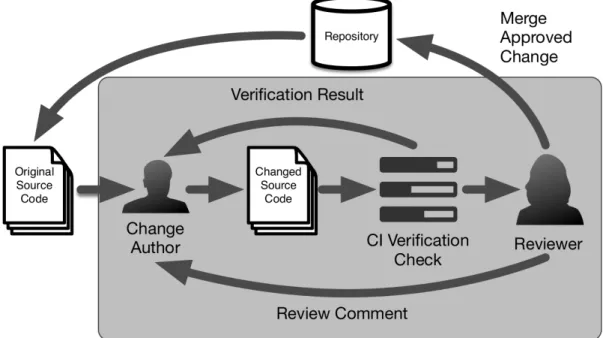
2.5 General process of modern code review . . . 51
3.1 Cohesion and MQ differences for 30 modularisations found by Bunch forPivot 2.0.2when compared to the original developers’ implementation . . . 68
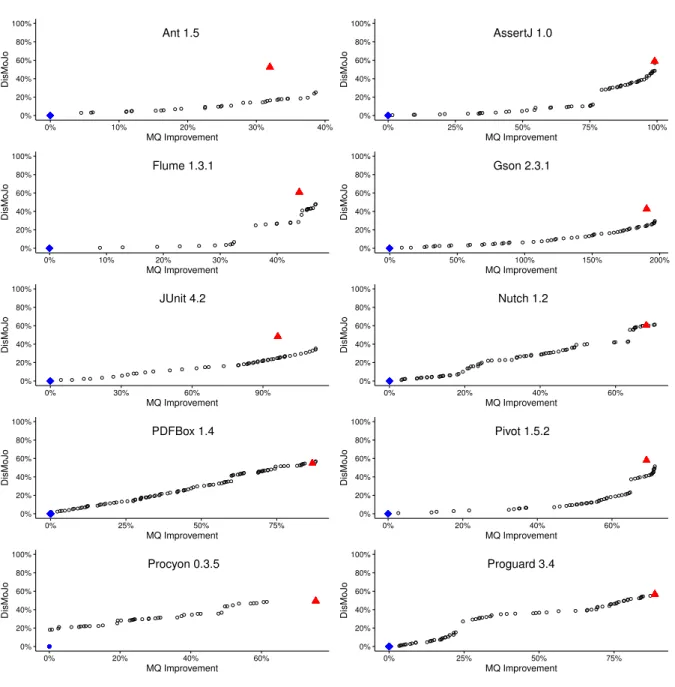
3.2 Pareto fronts reporting the trade-off between MQ and DisMoJo for the package-free multiobjective search . . . 74
3.3 Pareto fronts reporting the trade-off between MQ and DisMoJo for the package-constrained multiobjective search . . . 75
4.1 Code review process in Gerrit. . . 87
4.2 The framework employed to mine code review data from Gerrit and link it to complete versions of the code base. . . 89
5.1 Framework for the identification of code reviews with significant changes to the system’s architecture. . . 99
5.2 Classification of reviews with significant architecture changes for each of the most common intents. . . 107
5.3 Distribution of cohesion and coupling for reviews where we found evidence of architectural awareness and for reviews where we did not. . . 111
6.1 Number of reviews that employ different refactoring operations grouped by intent.131 6.2 Distribution of refactoring evolution patterns grouped by system. . . 134
6.3 Distribution of refactoring evolution patterns grouped by intent. . . 135 6.4 Distribution of added and removed refactoring operations during code review. 136
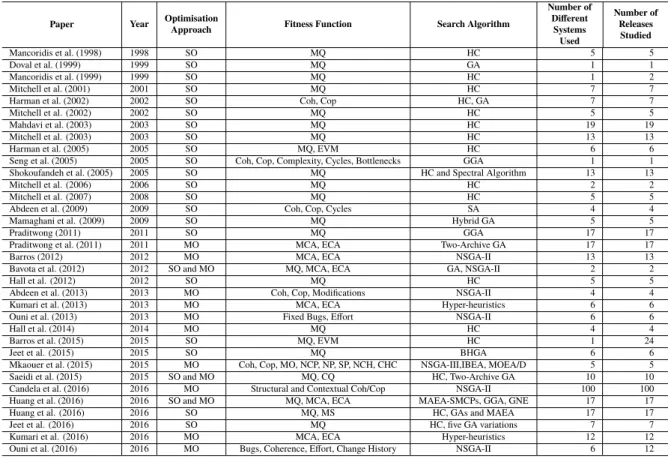
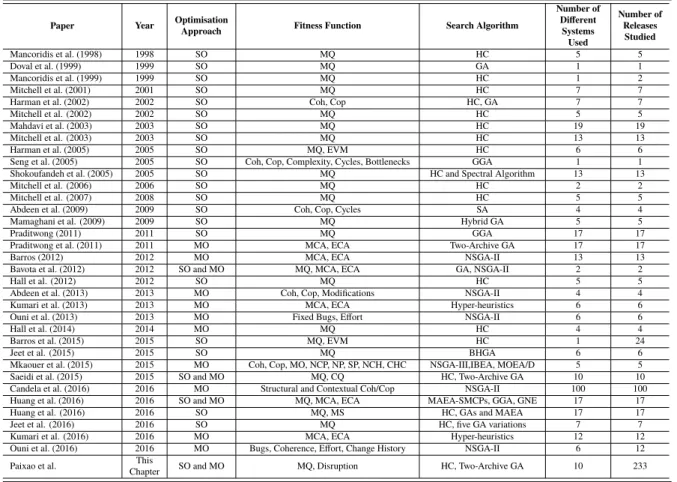
2.1 Related work in search-based Software Modularisation sorted by year of publication . . . 35 3.1 Related work in search-based Software Modularisation sorted by year of
publication . . . 57 3.2 Open source systems used in the empirical evaluation of cohesion/coupling
behaviour and optimisation. . . 60 3.3 Likelihood of finding a modular structure with superior measurements of
structural cohesion/coupling than that produced by the systems’ developers, according to 3 search strategies. . . 62 3.4 Cohesion, Coupling and MQ results with standard deviation for Neighbourhood,
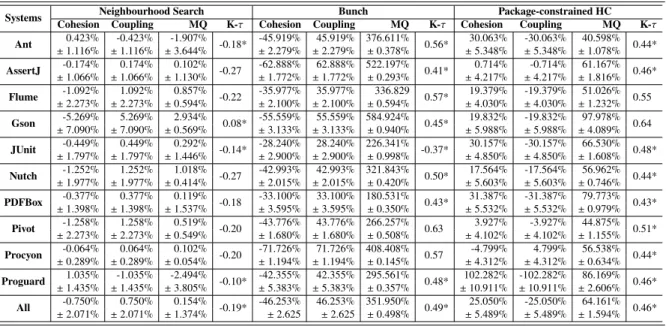
Bunch and Package-constrained searches for improved modularisations. . . . 66 3.5 Disruption to the modular structure caused by Bunch and Package-constrained
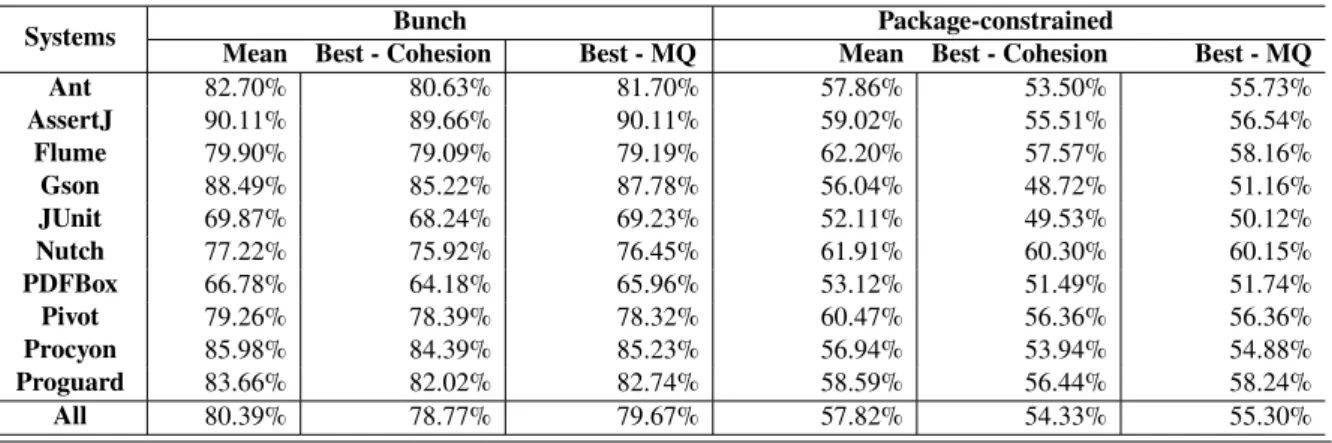
search-based approaches for modularisation improvement. . . 71 3.6 ‘Natural disruption’ levels caused by developers during the systems’ evolution,
as assessed by three different methods. . . 78 3.7 Modularity improvement, as assessed by cohesion and MQ, that can be achieved
within the lower and upper bounds of the ‘acceptable disruption’ level. . . 79 3.8 Detailed results for all releases of JUnit. For each release, we report the raw
cohesion and MQ values for the original developers’ implementation and the results achieved by both Bunch and Package-constrained search. . . 80 3.9 Modularisations suggested by the package-constrained multiobjective search
for JUnit 4.0. . . 82 4.1 Statistics about each project currently in CROP . . . 91 5.1 Descriptive statistics for the systems under study. . . 99 5.2 Number of reviews identified as outliers according to different architectural
aspects. . . 101 5.3 Tags being used in the manual classification of code reviews. . . 102 5.4 Examples of code reviews classified under different intents. . . 102 5.5 Examples of code reviews identified with different types of architectural awareness.103 5.6 Number of reviews that performed architecturally significant changes grouped
by different intents. . . 106 5.7 Number of reviews, for each intent, where the architecture is not discussed, is
5.8 Number of reviews that either improved or degraded the systems’ cohesion and coupling for different intents and the subset of reviews with evidence of developers’ awareness. . . 109 5.9 The evolution of architectural changes during code review. . . 113 6.1 Descriptive statistics for the systems under study. . . 126 6.2 Refactoring operations detected by RefMiner and the code elements affected
by each operation . . . 127 6.3 Number of reviews that performed refactoring operations for each system. . . 127 6.4 Intents considered when classifying reviews that performed refactoring operations.128 6.5 Number of reviews that performed refactoring operations grouped by different
intents. . . 129 6.6 Number of reviews with a refactoring intent that did not employ any refactoring
operation grouped by system. . . 132 6.7 Reasonings behind reviews with a refactoring intent but no refactoring operations.133
The development of software systems requires constant change and evolution due to its naturally iterative and incremental nature (Lehman, 1979; Lehman et al., 1997). The system’s architecture establishes a foundation for its development and evolution, as it guides developers’ activities such as the introduction of new features, the enhancement of existing features and refactoring. However, a software system tends to grow in complexity as it evolves, which usually leads to architectural deterioration and erosion (de Silva and Balasubramaniam, 2012). In this thesis, we consider the software architecture to be the structural organisation of source code elements, i.e., the high-level decomposition of source code into submodules and/or subcomponents and the dependencies between these elements.
Technical debt is a concept first coined by Cunningham (1993) to describe ‘not quite right’ decisions during software development. Technical debt commonly refers to sub-optimal engineering decisions made to achieve a short-time goal, such as a faster delivery time. As technical debt can be manifested during the complete lifetime of a software project, researchers tend to report studies that focus on a particular type of technical debt, which include, but is not limited to, requirements debt, design debt, code debt and test debt (Li et al., 2015).
In the context of this thesis, we deal with architectural debt (Kruchten et al., 2012), which can be understood as architectural decisions and modifications that deteriorate the structural architecture of a software system. Such deterioration affects important architectural properties such as maintainability and comprehensibility which, in some cases, might lead to a complete re-development of software systems (van Gurp and Bosch, 2002; van Gurp et al., 2005). In recent studies, not only architectural debt has been listed as the most dangerous type of technical debt (Ernst et al., 2015), but also the accumulation of architectural debt has been observed to cause increased maintenance effort (Xiao et al., 2016) and bug-proneness (Mo et al., 2015) of files involved in such architectural decisions.
Software restructuring can be employed as a method for the reverting of structural degradation and the prevention of architectural debt. Developers restructure software systems at different levels of granularity, from the changes and improvements of high-level modules and subsystems to localised refactorings of code elements and functions. Researchers have proposed a number of approaches to automatically assist developers when performing software restructuring. For example, search-based software modularisation (Mancoridis et al., 1998, 1999; Mitchell and Mancoridis, 2006; Praditwong et al., 2011) has been evaluated as an automated technique to improve the high-level structure of software systems. In addition, tools for automated recommendation and application of refactorings (Tsantalis et al., 2008; Sales et al., 2013; Silva and Valente, 2017; Tsantalis et al., 2018) have been developed to assist developers in low-level restructuring operations.
However, to this date, there is no evidence to suggest that such automated approaches have been widely adopted by software engineering practitioners. On the contrary, recent empirical
studies have revealed that search-based modularisation approaches can be highly disruptive (Hall et al., 2012), and that refactoring operations might actually lead to structural problems instead of improvements (Cedrim et al., 2017; Tufano et al., 2017). Thus, more research is necessary to better understand how software developers perceive and perform software restructuring. Moreover, these studies need to take into account the current models and practices of software development, so that the conclusions drawn from these studies can lead to actionable findings.
The process of code review is widespread in the software development industry, with evidence of adoption by companies like Microsoft (Bacchelli and Bird, 2013), Google (Kennedy, 2006) and Facebook (Tsotsis, 2011). During code review, software changes undergo a process of peer review in which developers communicate and exchange feedback regarding the change until the code is merged into the system. Empirical evidence has been reported that code review enables the detection of bugs related to maintainability that would otherwise be merged to the system’s code base without code review (Mantyla and Lassenius, 2009; Beller et al., 2014). Moreover, code review has been shown to substantially improve code quality, knowledge transfer and social communication (Bacchelli and Bird, 2013; Rigby and Bird, 2013).
1.1 Problem Statements
This thesis covers several interconnected topics surrounding software restructuring, ranging from high-level architectural evolution to low-level refactorings. The research problems tackled in this thesis are described next.
As previously mentioned, the structural architecture of a system tends to become more complex as the system evolves (Lehman, 1979; Lehman et al., 1997; de Silva and Balasubramaniam, 2012). In this context, tools and approaches that employ search-based software modularisation have been proposed as a way of optimising the existing structure of a software system by considering architectural quality metrics. However, very few of these studies have actually validated the quality metrics they use to optimise the systems, and even fewer studies evaluated the disruption caused by such approaches. Hence, in the context of the architectural evolution of software systems, we answer the following questions:
To what extent do developers respect structural metrics of software modularisation? What is the disruption caused by state of the art approaches for search-based software modularisation?
How search-based modularisation can be used to find trade-offs between architec-tural improvement and strucarchitec-tural disruption?
Any sort of approach for architectural debt amelioration and/or prevention, including search-based software modularisation, as discussed above, suggests a set of architectural modifications to be performed by the system’s developers. However, to the best of our knowledge, there are no empirical studies that investigate how developers perform architectural changes on their daily basis. Without knowing the developers’ workflow, perceptions and directions when performing
architectural modifications, approaches for the prevention and amelioration of architectural debt will likely not be uptaken by practitioners. In this context, the code review process has recently emerged as a major aspect of software development and quality control, being adopted by both industrial and open source software development. Thus, by analysing the data generated during the code review process, we answer the following questions:
How do developers perform architectural changes during code review?
Does the code review process assist developers in performing better architectural changes?
Technical and architectural debt is tackled not only by high-level restructuring, such as the architectural changes mentioned above but also through low-level restructuring at code and class level, in a practice that became known as software refactoring. When first proposed, refactoring was seen as code transformations with the sole purpose of improving the system’s structure (Fowler et al., 1999). However, recent studies have shown that refactoring is sometimes used with other goals and at different times during the software development lifecycle (Murphy-Hill et al., 2012). Thus, this thesis makes again use of the data generated during the code review process to investigate the circumstances and context in which developers employ refactoring operations on their daily basis. We answer the following questions:
What are common intents when developers employ refactoring operations? How do refactoring operations evolve during code review?
To answer all the questions presented above, this thesis presents a series of empirical studies surrounding the practice of software restructuring. We investigate current practices of restructuring at different granularity levels by analysing data from real-world software systems, which generates actionable findings for both industrial and academic software engineering practitioners, as discussed as follows.
1.2 Goal and objectives
The goal of this thesis is tostudy software restructuring at different granularity levels to better
understand how software developers perform restructuring on their daily basis. To achieve this
goal, we establish the following objectives:
1. To study official subsequent releases of software systems to understand the high-level architectural evolution of software systems. By performing this empirical study, we can validate whether real-world software developers design systems that respect existing metrics of architectural quality. Moreover, we can study the disruption caused by state of the art approaches for high-level restructuring to propose new approaches for automated architectural improvement that takes the disruption caused by the tool into account during the improvement process.
2. To study data from the code review process to understand how developers perform architectural modification on their daily basis. By performing this empirical study, we can identify not only the most common situations in which developers perform architectural changes but also whether such changes improve or degrade the systems’ structural quality. Moreover, by studying code review data we can obtain insights on how developers perform restructuring on their daily basis so that we use this knowledge to propose tools and approaches that better fit currently used development models and processes.
3. To study data from the code review process to understand how developers perform software refactoring on their daily basis. By performing this empirical study, we can identify the context in which developers commonly employ refactoring operations. Since any approach or tool to automate software restructuring will at the end suggest a series of low-level refactorings, we need to understand how developers currently perform refactoring on their daily basis. This way we will be able to propose tools that better fit their habits, increasing the usability and acceptability of such approaches by developers.
1.3 Contributions
This thesis makes contributions to be exploited by both industrial and academic software engineering practitioners. The most important contributions are listed next:
1. This thesis shows that real-world software systems respect metrics of structural archi-tecture quality. Moreover, we show that state of the art tools for search-based software modularisation exhibit high levels of disruption to the existing structure. These are important findings both the research community and tool developers can use when proposing or developing new tools for software architecture improvement and support. 2. Hence, this thesis proposes a new approach for automated software modularisation that
employs multiobjective optimisation to improve the structural architecture of a software system while minimising the disruption to the existing architecture. Tool developers can pick up the approach we proposed to develop and/or enhance existing tools for search-based software modularisation.
3. This thesis shows that developers mostly perform architectural changes when implementing new features in the system or while enhancing existing features. Moreover, we show that developers are often not aware of the architectural changes they are suggesting and/or reviewing during code review. These are relevant insights for both academic and industrial practitioners. Academics tend to focus their studies and analysis on instances of refactoring, but we show that most of the time developers perform architectural modifications when working on features. Similarly, industrial practitioners need to be made aware of changes that significantly modify the system’s architecture in order to achieve a better reviewing process.
4. This thesis shows that refactoring operations are mostly employed when working on features. Similarly to the previous contribution, we show that refactoring operations
are mostly used when developers are implementing a new feature or enhancing existing ones. This indicates a paradigm shift for the research on software refactoring, where the community needs to acknowledge refactoring not only as a way to improve the system’s quality but also as a tool for the preparation of new features and extensions.
5. This thesis provides the largest open dataset to date on search-based modularisation, where other researchers can use to benchmark and compare future approaches for automated modularisation.
6. This thesis provides a comprehensive code review dataset that links code review informa-tion with complete copies of the system’s code base at the time of review. Such data can be used for research in software engineering that spans beyond the topics covered in this thesis.
1.4 Thesis Organisation
Chapter 2presents the literature review and background for this thesis. It covers the early work on software architecture and structure, followed by empirical studies and reports on software evolution and architecture degradation. Next, we discuss different metrics proposed along the years to measure architectural quality followed by a literature review on search-based software modularisation. Finally, we discuss software refactoring and the code review process.
Chapter 3presents an empirical study that investigates state of the art search-based modular-isation approaches in the context of software evolution. In this chapter, we address the first set of problem statements discussed in Section 1.1. Moreover, this is the chapter in which we tackle objective number 1 in this thesis (see Section 1.2) and present contributions 1, 2 and 5 (see Section 1.3).
Chapter 4presents the code review dataset we use in the rest of the thesis. It describes the methodology used to select the systems and the mining process we employed to acquire the data. This chapter discusses the contribution number 6, as discussed above.
Chapter 5presents an empirical study on how developers perform architectural modification on their daily basis. It covers the second set of problem statements described in this thesis. In this chapter, we address our objective number 2 and present contribution number 3.
Chapter 6presents an empirical study on how developers employ refactoring operations on their daily basis. It covers the final set of problem statements described in this thesis. In this chapter, we address our objective number 3 and present contribution number 4.
This chapter presents the literature review and background of this thesis. We start in Section 2.1 by discussing the early work and foundations of research and practice on software architecture. In Section 2.2, we discuss the problem of architectural degradation during software evolution followed by work which presented empirical evidence of architectural degradation in real-world software systems. Additionally, we present and discuss problems caused by architectural debt, which is a side effect of architectural degradation.
Next, in Section 2.3, we present software architecture and modularisation metrics that have been proposed, evaluated, and used in the literature. We focus our discussion on metrics that have been used to measure architectural quality, and consequently, employed as fitness functions for search-based software modularisation. We also discuss metrics that have been proposed to measure architectural change and similarity.
In section 2.4, we present the background and literature on search-based software modularisa-tion as an approach for architectural restructuring. We present the foundamodularisa-tions of search-based modularisation and discuss the different scenarios in which search-based modularisation has been evaluated, such as software evolution, multiobjective search-based modularisation and user interactive search-based modularisation. We present related work that attempted to evaluate the disruption caused by search-based modularisation approaches. Moreover, we discuss the work that evaluated the developer’s perception of software modularisation.
In addition, in Section 2.5, we discuss the background of software refactoring, with an emphasis on presenting the most commonly employed refactoring operations. Moreover, we discuss the work that compared manual and automated refactoring, as well as work that investigated the developers’ intentions behind software refactoring.
Finally, in Section 2.6, we discuss the foundations of modern code review and its adoption in current software development. In addition, we discuss empirical studies that evaluated the usefulness of code review in terms of bug identification, knowledge transfer, and social communication.
2.1 Software Architecture and Modularisation
The concepts and ideas of organising different programs and procedures into independent modules are as old as the field of software engineering itself. The work by Parnas (1972) defines a modularisation as a set of modules, where a module“is considered to be a responsibility
assignment rather than a sub-program”. This was a paradigm change at the time since most
software engineers used to modularise their systems based on the necessary subroutines to achieve the overall goal, where the modularisation was essentially a sequence of input/output
steps. The idea of responsibility assignment might be considered the basis for nowaday’s programming languages and software development approaches.
In the same work, Parnas (1972) describes a series of criteria to consider in order to proper modularise programs in high-level modules according to the new responsibility assignment paradigm. One of the criteria described in the paper, and perhaps the most relevant and influential, was the concept of ‘information hiding’, which includes the design of modules’ interfaces that will reveal as little as possible from the modules’ inner workings. The benefits of this software design model were advocated to include shortened development time, greater flexibility and enhanced comprehensibility.
Parnas (1979) later extended these ideas to what he coined as ‘program families’. In this context, a program is part of a family when it shares commonalities among other programs in the same family, which might include subroutines and the usage of certain modules. At that time, common program families were programs that run in different hardware, programs that perform the same functionality but use different formats of input/output, and programs that perform the same functionality but differ in algorithms and data structures. The author claims that the interfaces and commonly used modules should be as generic as possible while individual implementations of modules should be as specialised as possible.
In a highly influential paper, Parnas et al. (1984) identified that commercial software development at that time was not following the software engineering principles defined and advocated by academics, especially in terms of modularisation and separation of concerns. Thus, the authors performed a study that attempted at recreating an in-flight aircraft system by rigorously following the modularisation concepts designed in academia. As a result, even though the academic practices had to be re-evaluated and adapted to cope with such a large-scale system, the authors noticed a higher quality code base in the academic project in comparison to its commercial counterpart. The software developed with academic consultancy was observed to be more comprehensible by new developers and to have an easier traceability between functionalities and bugs to specific modules’ implementations.
The initial concepts of software modularisation introduced in the early work described above influenced the work by Garlan and Shaw (1993), which introduced software architecture as a new and emerging area within software development. The work described architectural styles commonly observed in software systems at the time, which include, but are not limited to, pipes and filters, data abstraction and object-orientation, and layered systems. Each architectural style was described in details, with possible applications and systems that would fit each different style.
Software systems quickly evolved to the point where a system would make use of more than one architectural style within its structure. In this context, practitioners and academics noticed that the complete architecture of a system could not be completely and precisely described in a single model. Moreover, the architecture has become a key artefact in the communication and understanding of the system among different stakeholders (Rozanski and Woods, 2011).
Thus, Kruchten (1995) proposed the ‘4 + 1’ view model for software architecture. In this model, the system’s architecture has more than one view, where each view is tailored to a different subset of stakeholders. These concepts were later standardised in the IEEE Standard 1471 and the ISO Standard 42010.
viewpoints (Rozanski and Woods, 2011). Each of these viewpoints is listed and described as follows.
Development Viewpoint
This architectural viewpoint describes the architecture to support the system’s development. This view is commonly described by the source code’s structure, such as the classes diagrams and packages distribution. The development view is targeted at stakeholders involved in developing, building and testing the system.
Context Viewpoint
This view describes the system’s relationships and interactions with its environment, such as the people and external systems it interacts with.
Functional Viewpoint
The functional viewpoint describes the system’s main runtime elements. It defines their responsibilities, interfaces and primary interactions.
Information Viewpoint
This architectural view depicts how the system stores, process and distributes information. It consists of not only database layouts but also models of how the data is processed and coordinated between modules.
Concurrency Viewpoint
This viewpoint describes the concurrency aspects of the system, including the units which run in parallel, the data exchanged between modules, and mechanisms to avoid concurrency issues.
Deployment Viewpoint
The deployment view describes the environment in which the system is deployed. It includes hardware specifications, processing nodes, networking connections and storage facilities.
Operational Viewpoint
This architectural view indicates how the system will be operated, administered, and supported when it is running in its production environment.
For the rest of this thesis, for all systems we discuss and analyse, we focus on the development view of the software’s architecture. This is the view that is mostly used by software developers and is the one that drives software comprehensibility, maintainability and evolution. Hence, from now on, we use software architecture and modularisation to describe the source code
organisation of a software system, including its high-level decomposition in submodules and/or subcomponents and the dependencies between these elements.
2.2 Software Evolution and Architectural Degradation
Apart from specific cases, software development largely revolves around the concept of evolution and adaptation. Requirements constantly emerge during development and/or production, so that changes need to be constantly made in order to cope with this everchanging scenario that includes new features, improvements to existing features, and bug fixing. Lehman (1979) pointed out this need for adaptation as one of the intrinsic elements of software development and encouraged the software engineering community to embrace it. In fact, processes for incremental software development were created largely to cope with this need for constant adaptation and evolution.
In this seminal work, Lehman (1979) proposed five laws of software evolution that although being revisited later (Lehman, 1996; Lehman et al., 1997), still remain as well accepted concepts by the software engineering community. The laws describe the natural need for change in software systems, alongside the consequent attempts to conserve the stability and familiarity. However, for the context of this research, the 2nd Lehman’s law of software evolution is the most relevant:
“As an evolving program is continuously changed, its complexity, reflecting
deteriorating structure, increases unless work is done to maintain it or reduce it”.
(Lehman, 1979)
In this quote, Lehman refers to the fact that the complexity of software systems will continu-ously grow as the systems evolve. Although ‘complexity’ might have different interpretations for different artefacts in a software system, Lehman mentions structural degradation as a proxy for this increased complexity. Indeed, structural architecture degradation is sometimes attributed to one of the biggest factors for the deterioration of a software system as a whole (de Silva and Balasubramaniam, 2012).
The software architecture establishes a crucial foundation for the development and evolution of a software system. It guides the development of new features and the enhancement of existing features during software evolution. As such, the degradation of such important artefact affects several quality properties of a software system under constant changes and evolution, such as maintainability, comprehensibility, and extendability. In the next section, we present empirical evidence of architectural degradation on real-world software systems, followed by problems that arise from a degraded structural architecture.
2.2.1 Empirical Evidence of Software Architectural Degradation
A wide number of case studies indicate that architectural degradation is a constant problem software practitioners have to deal in industry. Eick et al. (2001) present the study of a large C/C++ system over 15 years of development. The authors propose a set of indices to indicate
the increase in the structural complexity and the problems caused by such a phenomenon. The data shows a clear relationship between increased degradation in the structural architectural and increased number of bugs and maintenance effort.
Godfrey and Lee (2000) present an attempt to extract the structural architecture of the Mozilla’s internet browser from its source code. During this exercise, the authors identified a great number of undesirable dependencies between core modules of the system. Such degradation of Mozilla’s structural architecture finally led to a full rewrite of some modules from scratch (van Gurp and Bosch, 2002; van Gurp et al., 2005).
Evidence of structural degradation has also been found for Ant, one of the most popular Java building tools (Barros and Farzat, 2013; Barros et al., 2015) . The authors performed an extensive study based on reverse engineering and data analysis of all releases of Ant until the moment of publication. A large suite of metrics was employed, and the results indicate a large decrease in terms of modularity quality over the years. A visual comparison of the structural architecture of Ant in its first and latest releases presents a clear increase in modular complexity.
Wermelinger et al. (2011) performed a study of the structural architecture of Eclipse’s high-level plugins and modules. The authors found evidence of a large increase in modularity complexity and dependencies. Such degradation in modularity was traced back to specific releases of Eclipse. In a subsequent study, the authors contacted the Eclipse developers as a way to get feedback on their analysis. The developers confirmed that the architectural problems found by the authors are well-known issues by the development team and that such problems were indeed introduced at the releases identified by the authors.
Case studies with similar findings have been reported for several other large software systems such as Vim (Godfrey and Lee, 2000), FindBugs (Sutton, 2008) and Linux kernel (van Gurp and Bosch, 2002).
Le et al. (2015) performed a large empirical study involving 14 open source projects, involving popular systems such as Hadoop, Log4j, and Xerces. The authors employed a systematic procedure to extract the structural architecture of each system throughout its development history and measure the amount of change. The results show a large change in the structural architecture during the systems’ development history, both at high-level system granularity and low-level components granularity. Although this study does not link the amount of architectural change with a decrease in quality properties, it shows how often architectural changes occur at different level of granularities in software systems.
Evidence of structural architecture degradation has been presented in more papers than we can discuss in this thesis. For the interested reader, we refer to surveys such as the ones performed by de Silva and Balasubramaniam (2012) and Williams and Carver (2010).
2.2.2 Software Architectural Debt
Technical debt is a concept first coined by Cunningham (1993) to describe ‘not quite right’ decisions during software development. The analogy implies that making bad development decisions have the same effect as taking a financial loan, in which it will benefit the development team in the short term, but also complicate future developments and enhancements if not paid. This analogy has been widely adopted in industry (Ernst et al., 2015) as a way to easily
Figure 2.1: Technical debt quadrant (Fowler, 2009)
communicate maintenance costs and decisions to non-technical stakeholders (Brown et al., 2010; Kruchten et al., 2012).
Figure 2.1 presents the technical debt quadrant proposed by Fowler (2009). As one can see, Fowler differentiates decisions in deliberate and inadvertent. Previously, the degradation of a software system was attributed to poor and erroneous decisions made by developers, where such degradation is mostly caused by developers’ mistakes. The technical debt analogy brought in the idea that developers might make ‘not quite right’ decisions deliberately, as an attempt to reach a short-term goal such as delivery time. Thus, the technical debt literature focuses not only on identifying degradation but also the decisions that led to that degradation and the problems caused by such decisions in the long term.
Ernst et al. (2015) performed a large empirical study with software engineering practitioners to investigate their perceptions of technical debt. As a result, developers pointed out architectural decisions as the most expensive debt to pay, and the one with more damaging potential on the evolution of the system. This kind of debt has become known as Architectural Debt.
Xiao et al. (2016) proposed a method to identify and quantify architectural debt in software systems. The approach uses previously evaluated architectural smalls as indicators of architec-tural anomalies. The authors extract the strucarchitec-tural architecture of 7 systems throughout their development history and automatically identify the architectural anomalies. The results show that most of the architectural anomalies tend to aggregate more and more files as the systems evolve. This is referred to as the accumulation of architectural debt. Moreover, the authors show that files involved in the architectural anomalies tend to require more maintenance effort than files that are not involved in architectural anomalies. Finally, the authors used linear regression models to describe the increase in maintenance effort based on the growth of architectural debt, as an analogy to how much interest the developers are paying because of the architectural debts.
A similar study was performed by Mo et al. (2015), where the authors identified ‘hotspots patterns’ in 10 software systems. These hotspots can be considered sources of architectural debt and architectural smells. Results show that files involved in the hotspots are more bug-prone than files not involved in the hotspots.
2.3 Software Architecture and Modularisation Metrics
This section discusses the most common and used metrics in software architecture and modularisation research. They are divided into quality and similarity metrics.
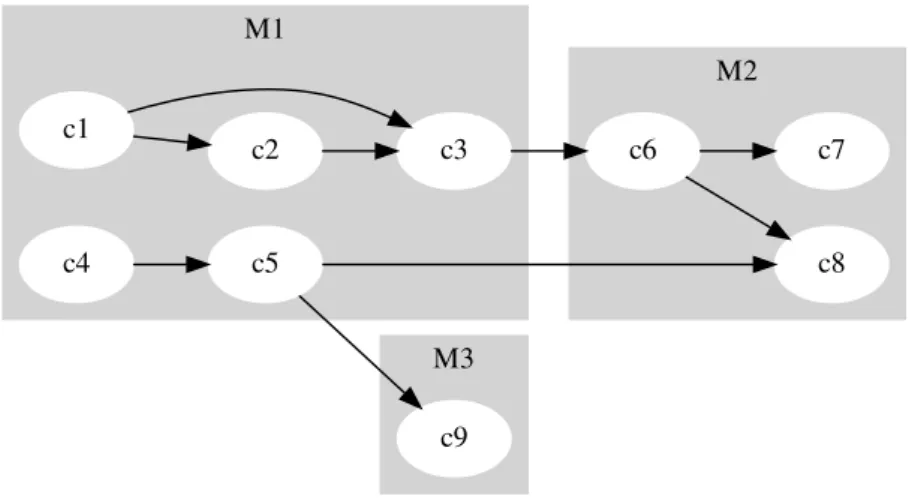
To better explain each metric, we make use of a module dependency graph (MDG). An MDG is a directed graphG(C,D)where the set of nodesCrepresents the code elements in the system and D represents the dependencies between code elements. Clusters of nodes in the MDG indicate the system’s high-level modules.
The MDG example presented in Figure 2.2 will be used to illustrate the following discussed metrics. M1 M2 M3 c1 c2 c3 c6 c4 c5 c8 c9 c7
Figure 2.2: Example of a Module Dependency Graph used to represent the modular structure of a software system. Nodes represent code elements and edges represent dependencies between elements. Clusters of nodes (grey regions) indicate high-level modules.
2.3.1 Software Architecture and Modularisation Quality Metrics
The concepts of cohesion and coupling are the among the most important quality criteria in the software architecture and modularisation community. Researchers and practitioners advocate that software entities should be highly cohesive and loosely coupled. However, many different metrics for the computation of cohesion and coupling have been proposed, discussed and evaluated in the literature, where the underlying measurements range from syntactical dependencies between components to semantical relationships and historical co-changes.
Needless to say, there is no standardised and accepted definition of cohesion and coupling. Hence, in this section, we summarise some of the metrics for cohesion and coupling that have been proposed in the software engineering literature. In this section, we do not try to advocate in favour of some metric or another as we aim at simply depicting how wide the range of metrics is. In Chapters 3 and 5, we do make use of a subset of these metrics, where the motivation for the choice of metric is presented at the respective chapter.
We subdivide this section in metrics that attempt to measure cohesion and coupling separately, followed by metrics that combine both concepts in a single measurement. Next, we describe metrics that quantify quality properties in software architecture and modularisation other than cohesion and coupling. Finally, we discuss the theoretical validation of such metrics.
Cohesion Measurements
The following metrics attempt at measuring the concept of cohesion in a given software system.
Raw Cohesion
The simplest way of measuring the cohesion of a modularisation is by the sum of all of the intra-edges of the MDG, i.e., edges that are confined in the same high-level module. This metric is often referred to as raw cohesion and is commonly used as the basis for the computation of more refined cohesion measurements. The values of raw cohesion for the MDG in Figure 2.2, for example, would becohesion=6.
Lack of Structural Cohesion
In the work by Candela et al. (2016), the authors propose and evaluate new metrics for the computation of structural cohesion and coupling. The Lack of Structural Cohesion is inspired by the original Lack of Cohesion of Methods (LCOM) (Chidamber and Kemerer, 1994). Given a certain modularisation, this metric considers a file as a code element and computes the lack of structural cohesion of the modularisation as:
LStrCoh =
Ín
j=1LCOFMj
n , (2.1)
where LCOFMj represents the Lack of Cohesion of Files for high-level module Mj. LCOFMj
is computed as the number of pairs of files in Mj without a structural dependency between
them. Modules with a high amount of unrelated files will be scored a high LCOF, and, accordingly, modules with only a few unrelated files will be scored a low LCOF. Since this metric measures thelackof cohesion in the modularisation, a low value LStrCohindicates a cohesive modularisation.
Consider the MDG in Figure 2.2, for example. The lack of cohesion of files would be computed as LCOF(M1)= 6, LCOF(M2) =0 and LCOF(M3)= 0. Therefore, the Lack of Structural Cohesion of this modularisation is computed asLStrCoh = 6+03+0 = 2.
Tight Class Cohesion (TCC)
The Tight Class Cohesion metric was originally proposed by Bieman and Kang (1995), where the cohesion is measured at class level by leveraging the connections and dependencies between methods. The TCC cohesion metric is computed as:
TCC(C)= N DC(C) N× N−1
2
(2.2)
where N DC(C) represents the number of direct connections, i.e., dependencies between methods, in classC. N indicates the number of methods in classC. Hence, the TCC computes cohesion as the relative number of dependencies between methods in a class given the total number of methods in a class.
Consider each high-level module in Figure 2.2 to be a class in the system, and each component to a method inside the class. The TCC of each class would be computed as
TCC(M1)= 4 5×5−21 = 0.4,TCC(M2)= 2 3×3−21 =0.66 andTCC(M3)= 0 1×1−21 =0.
Attributes-based Cohesion Metrics
Not all cohesion metrics employ dependencies between components to measure cohesion. Given an object-oriented system, the community has proposed a series of metrics that use the shared attributes between methods as a way to measure how cohesive the methods, and the classes, are.
The Class Cohesion (Bonja and Kidanmariam, 2006), Sensitive Class Cohesion (Fernández and Peña, 2006) and Low-level Similarity Base Class Cohesion (Al Dallal and Briand, 2010) are examples of metrics that employ shared attributes to compute the cohesion of a class. Since the MDG representation does not allow for attributes modelling, we will not depict how these metrics are computed. We point the interested reader to the original papers that propose and describe each metric.
Coupling Measurements
In the following paragraphs, we present metrics that attempt at computing the coupling of a software system.
Raw Coupling
Similarly to the raw cohesion, the raw coupling metric is the simplest way of measuring the coupling of a software system. It is computed as the sum of all of the inter-edges of the MDG, i.e., edges that cut across different high-level modules. The values of raw coupling for the MDG in Figure 2.2, for example, would becohesion =3.
Coupling Between Objects
The CBO metric has been originally proposed by Chidamber and Kemerer (1994), where the CBO of a certain high-level module is simply given by the number of other high-level modules
that it interacts with. Hence, considering the MDG in Figure 2.2, this metric would be computed asC BO(M1)=2,C BO(M2)= 1 andC BO(M3)=1.
Structural Coupling
Candela et al. (2016) used a coupling measurement that is similar to the ones previously presented in this section. In their work, the structural coupling of a modularisation, StrCop, is computed as
StrCop =
Ín
j=1FanOutMj
n , (2.3)
where FanOutMj indicates the number of files outside module Mj that present dependencies to
files insideMj.
Given the MDG example in Figure 2.2, the FanOut would be computed asFanOut(M1)=3,
FanOut(M2) = 2 andFanOut(M3) = 1. Thus, the Structural Coupling would computed as
StrCop= 3+23+1 = 2.
Conceptual Coupling Between Classes
Similarly to the cohesion metrics discussed above, there are coupling metrics that employ information other than dependencies between components to measure the coupling of a software system. The CCBC metrics was originally proposed by Poshyvanyk et al. (2009), and it considers the lexical information extracted from comments and identifiers to measure the coupling between two components.
Thus, the CCBC between two source code components is computed as the average textual similarity between the components, where the textual similarity is computed using Latent Semantic Indexing (LSI). The CCBC values are in the {0. . .1}, where 0 represents two components having a totally different lexical similarity, while 1 represents two classes containing exactly the same text.
Logical Coupling
Finally, it is worthy to mention what has been recently called logical coupling, an approach to measure coupling between objects that rely on versioning and change history. Inspired by the seminal paper of Zimmermann et al. (2005), this approach extracts information from version control systems to identify groups of files that are constantly changed together. This approach has been originally proposed to uncover connections and relationships between files that cannot be found through static or dynamic analysis. Hence, the coupling between two objects is given by how often these files are changed together in the same commit.
Combinations of Cohesion and Coupling
The following sections depict metrics that combine cohesion and coupling measurements into a single quality metric.
Modularisation Quality (MQ)
MQis a metric originally proposed as the fitness function for search-based software modu-larisation approaches (Mancoridis et al., 1998). It has evolved over the years so that only the current (and most used) version will be presented here. The formulation ofMQis presented in Equations 2.4 and 2.5. MQ = N Õ k=1 M F(Mk) (2.4) where, M F(Mk)= 0, ifik =0 ik ik + jk 2 , ifik > 0 (2.5)
The Modularisation Quality (MQ) of a certain modularisation is given by the sum of the Modularisation Factor (M F) of each moduleMk in the modularisation. M F(Mk)represents the
trade-off between cohesion and coupling for modulek, whereik is the number of intra-edges
within modulek(cohesion), and jk is the number of inter-edges leaving or arriving at modulek
(coupling). Since inter-edges will be double counted in different modules, jk is divided by 2.
When considering the MDG example, the values of M F would be M F(M1) = 0.72,
M F(M2)= 0.66 andM F(M3)=0. Consequently, MQ =0.72+0.66+0=1.38. If a module has only a single code element, itsM Fwill be equal to 0 sinceik =0. Therefore, MQ considers
not only the trade-off between cohesion and coupling but also the distribution of code elements between modules.
EVM
The EV M metric stands for Evaluation Metric Function, and it was originally proposed by Tucker et al. (2001). Harman et al. (2005) later adapted EV M to be used in the context of software modularisation. EV M’s formulation is presented in Equations 2.6, 2.7, and 2.8.
EV M = N Õ k=1 CS(Mk) (2.6) where,CS(Mk)= |Mk| Õ i=1 |Mk| Õ j=i+1 USE(i, j) (2.7) and,USE(i, j)= ( +1, ifuses(i,j) ∨uses(j,i) −1, otherwise (2.8)
TheEV M of a certain modularisation is given by the sum of the Cluster Score (CS) of each high-level moduleMk. CS(Mk)is computed by iterating over each pair of code elements in
modulek and incrementing 1 in the score if there is a dependency between these elements; otherwise, the score is decremented by 1.
When considering the example, the values ofCSwould beCS(M1)= −2,CS(M2)= 1 and
CS(M3)=0. Consequently,EV M = −2+1+0=−1. Differently fromMQ,EV M does not take inter-edges into account.
Quality Metrics other than Cohesion and Coupling
When measuring the quality of an MDG, some authors also showed concerns about the distribution of code elements in high-level modules. In fact, this was one of the criteria used by Wu et al. (2005) to assess the quality of a software modularisation algorithm. In the ideal scenario, one would have a balanced distribution of elements, avoiding both modules with few elements and modules with too many elements.
In order to cope with this, the number of isolated modules can be used as a quality criteria. A module is considered to be isolated when it is composed of a single code element. In the example, moduleM3is an isolated one. Other authors have also used the difference between the number of elements of the biggest and smallest modules as a quality criteria. Considering the MDG example, the biggest module isM1with 5 modules, and the smallest one isM3with 1 module. Thus, the module size difference would be 4.
Theoretical Validation of Cohesion and Coupling Metrics
Software measurement is a long-studied topic in software engineering, and as such, many guidelines have been proposed to properly validate a certain metric. In one of the most influential papers on the topic of software metrics, Kitchenham et al. (1995) presents a framework for the proposal and validation of software metrics. The authors describe two methods for the validation of a software metric, e.g.,theoreticalandempirical, where the first ensures that the metric respects a series of basic properties and the latter serves as additional support for the proposed measurement.
To the best of our ability, we performed an analysis of the papers that originally proposed the cohesion and coupling metrics discussed above. We have not identified a paper in which the proposed metric was both theoretically and empirically validated according to the guidelines proposed by Kitchenham et al. (1995). In particular, the theoretical validation is the one lacking the most in the studied papers. Very few authors describe the properties which the proposed metrics hold. Even though most papers perform an empirical validation of the metrics, such experiments do not employ the strategies proposed in the guidelines.
Nevertheless, the presented cohesion and coupling metrics figure among the most accepted measurements of such aspects in state-of-the-art software engineering research. In addition, a few of those have been extensively validated through studies with developers, which despite not being sufficient for a thorough validation (Kitchenham et al., 1995), support their use in empirical studies.
2.3.2 Software Architecture and Modularisation Change and Similarity
Metrics
Similarity metrics, as the name suggests, are used to measure the similarity between two different modularisations of the same system. The two modularisations presented in Figure 2.3 will be used to illustrate the similarity metrics discussed in the remainder of this section.
M1 M2 M3 c1 c2 c3 c6 c4 c5 c8 c9 c7 (a) Modularisation A M1 M2 c1 c2 c3 c6 c4 c5 c8 c9 c7 (b) Modularisation B
Figure 2.3: Example of different modularisations of the same system
MoJo
M oJowas the first similarity metric proposed for software modularisation (Tzerpos and Holt, 1999). It measures the distance between two modularisations by counting the number of operations necessary to transform one modularisation into the other. M oJoconsiders only two operations: Move andJoin, where the first consists in moving one code element to another high-level module and the second consists in joining two high-level modules. ForM oJo, both operations have the same weight when computing the similarity. Consideringmno(A,B)to be the minimum number of operations to transform modularisation Ain modularisation B, the
M oJo(A,B)metric is defined in Equation 2.9.
M oJo(A,B)=min(mno(A,B),mno(B,A)) (2.9) It is important to notice thatmno(A,B)is not always equal tomno(B,A), so the minimum value between the two is taken as the M oJo value. However, when the direction of the comparison is relevant, one should usemno(A,B)as theM oJovalue. Considering the example in Figure 2.3,mno(A,B)=2 since it is possible to transform A in B by joining modulesM2and
M3and then movingc5fromM1toM2. Sincemno(B,A)is also equal to 2, theM oJometric is assigned asM oJo(A,B)=2.
TheM oJometric will always have a known minimum and maximum value for a particular system. WhenAandBare equal modularisations,M oJo(A,B)= 0. On the other hand, when
AandBmodules are placed in completely different clusters,M oJo(A,B)= N, whereN is the number of modules in the system. Thus, the ‘quality’ metricQindicates a normalised version ofM oJo:
Q(A,B)=(1− M oJo(A,B)
N ) ×100% (2.10)
Finally, the computation of theM oJometric is not straightforward; therefore, an optimal algorithm to calculateM oJois provided by Wen and Tzerpos (2003).
EdgeMoJo
As one can notice, the original M oJo does not consider the dependencies between code elements in the similarity calculation. It does not matter how much cohesion and coupling is changed between two different modularisations. Such flaw inM oJowas indicated by Mitchell and Mancoridis (2001). Wen and Tzerpos (2004a) then proposedE dgeM oJo, a new version of M oJo that considers dependencies between elements to compute the similarity of two modularisations.
In theM oJometric, allMove operations have the same weight in the similarity computation. Differently, inE dgeM oJo, theMove operations that alter the cohesion and coupling of the system have a bigger weight than the ones that do not. For eachMove operation