ADVERTIMENT. La consulta d’aquesta tesi queda condicionada a l’acceptació de les següents
condicions d'ús: La difusió d’aquesta tesi per mitjà del servei TDX (www.tesisenxarxa.net) ha estat autoritzada pels titulars dels drets de propietat intel·lectual únicament per a usos privats emmarcats en activitats d’investigació i docència. No s’autoritza la seva reproducció amb finalitats de lucre ni la seva difusió i posada a disposició des d’un lloc aliè al servei TDX. No s’autoritza la presentació del seu contingut en una finestra o marc aliè a TDX (framing). Aquesta reserva de drets afecta tant al resum de presentació de la tesi com als seus continguts. En la utilització o cita de parts de la tesi és obligat indicar el nom de la persona autora.
ADVERTENCIA. La consulta de esta tesis queda condicionada a la aceptación de las siguientes
condiciones de uso: La difusión de esta tesis por medio del servicio TDR (www.tesisenred.net) ha sido autorizada por los titulares de los derechos de propiedad intelectual únicamente para usos privados enmarcados en actividades de investigación y docencia. No se autoriza su reproducción con finalidades de lucro ni su difusión y puesta a disposición desde un sitio ajeno al servicio TDR. No se autoriza la presentación de su contenido en una ventana o marco ajeno a TDR (framing). Esta reserva de derechos afecta tanto al resumen de presentación de la tesis como a sus contenidos. En la utilización o cita de partes de la tesis es obligado indicar el nombre de la persona autora.
WARNING. On having consulted this thesis you’re accepting the following use conditions:
Spreading this thesis by the TDX (www.tesisenxarxa.net) service has been authorized by the titular of the intellectual property rights only for private uses placed in investigation and teaching activities. Reproduction with lucrative aims is not authorized neither its spreading and availability from a site foreign to the TDX service. Introducing its content in a window or frame foreign to the TDX service is not authorized (framing). This rights affect to the presentation summary of the thesis as well as to its contents. In the using or citation of parts of the thesis it’s obliged to indicate the name of the author
Unsupervised Entity Linking using
Graph-based Semantic Similarity
By: Ali M. Naderi
Advisors: Prof. Horacio Rodriguez, Prof. Jordi Turmo
TALP Research Center, Department of Computer Science
Technical University of Catalunya (BarcelonaTech)
This dissertation is submitted for the degree of
Doctor of Philosophy
I would like to dedicate this thesis to my loving wife and parents who have given me everything . . .
Declaration
I hereby declare that except where specific reference is made to the work of others, the contents of this dissertation are original and have not been submitted in whole or in part for consideration for any other degree or qualification in this, or any other university. This dissertation is my own work and contains nothing which is the outcome of work done in collaboration with others, except as specified in the text and Acknowledgements. This dissertation contains fewer than 65,000 words including appendices, bibliography, footnotes, tables and equations and has fewer than 150 figures.
By: Ali M. Naderi December 2015
Acknowledgements
I would like to express my gratitude to Prof. Horacio Rodríguez and Prof. Jordi Turmo for their supervision, valuable Advice, and support throughout the course of this research works. Many thanks go to the people in the TALP group for their comments. Finally, the technical assistance provided by “Universitat Politecnica de Catalunya" (UPC) is gratefully acknowledged.
The research in this thesis project is carried out within the frameworks of two projects: a)KNOW2project (Language understanding technologies for multilingual domain-oriented information access)1, between 4 universities and 9 EPOs (Ente Promotor Observador: Observ-ing Promoter), and funded by the Spanish Ministry of Science and Innovation, and b)SKATeR project (Scenario Knowledge Acquisition by Textual Reading)2, between 6 universities and 6 EPOs, and also funded by the Spanish Ministry of Science and Innovation.
KNOW2 Project. As a key aspect in KNOW2 project, knowledge mining is emerging as the enabling technology for new forms of Multi-Lingual Information Access (MLIA, which encompasses both terms), as it combines the last advances in text mining, knowledge acquisition, natural language processing, and semantic interpretation. Question answering, information access based on entities, cross-lingual information access, and navigation via cross-document relations are examples of new applications and tasks that are being adopted both by start-ups and consolidated companies such as Google, Yahoo and Microsoft. KNOW2
1KNOW2 Project (TIN2009-14715-C04-04) –http://ixa.si.ehu.es/know2 2SKATeR Project (TIN2012-38584-C06-01) –http://nlp.lsi.upc.edu/skater/
emulated and improved current MLIA systems with research to enable the construction of an integrated environment allowing the cost-effective deployment of vertical information access portals for specific domains. The predecessor of KNOW2 (KNOW project)3already enhanced Cross-Lingual Information Retrieval and Question Answering technology with improved concept-based NLP technologies.
SKATeR Project. The aim of the ongoing SKATeR (Scenario Knowledge Acquisition by Textual Reading) consists in advancing the state-of-the-art in the integration of textual processing, semantic interpretation, inference and reasoning, detection and generalization of events, scenario induction and its exploitation in a number of advanced content-based domain applications. Given the current state-of-the-art in those areas, it is also planned to develop intuitive collaborative interfaces which will allow communities of users to improve the knowledge for different domains, including multilingual communities.
Research in the area of Knowledge mining is orienting towards the use of Knowledge Base (KB) augmentation techniques to improve the results of MLIA systems. Entity Linking (EL) task as an important part towards the KB augmentation can be considered as the subject of significant study to advance the goals defined under the projects KNOW2 and SKATeR.
ix
Abstract
Nowadays, the human textual data constitutes a great proportion of the shared information resources such as World Wide Web (WWW). Social networks, news and learning resources as well as Knowledge Bases (KBs) are just the small examples that widely contain the textual data which is used by both human and machine readers. The nature of human languages is highly ambiguous, means that a short portion of a textual context (such as words or phrases) can semantically be interpreted in different ways. A language processor should detect the best interpretation depending on the context in which each word or phrase appears. In case of human readers, the brain is quite proficient in interfering textual data. Human language developed in a way that reflects the innate ability provided by the brain’s neural networks. However, there still exist the moments that the text disambiguation task would remain a hard challenge for the human readers. In case of machine readers, it has been a long-term challenge to develop the ability to do natural language processing and machine learning. Different interpretation can change the broad range of topics and targets. The different in interpretation can cause serious impacts when it is used in critical domains that need high precision. Thus, the correctly inferring the ambiguous words would be highly crucial. To tackle it, two tasks have been developed: Word Sense Disambiguation(WSD) to infer the sense (i.e. meaning) of ambiguous words, when the word has multiple meanings, andEntity Linking(EL) (also called,Named Entity Disambiguation–NED,Named Entity Recognition and Disambiguation–NERD, orNamed Entity Normalization–NEN) which is used to explore the correct reference ofNamed Entity(NE) mentions occurring in documents. The solution
to these problems impacts other computer-related writing, such as discourse, improving relevance ofsearch engines,anaphora resolution,coherence, andinference.
This document summarizes the works towards developing an unsupervised Entity Linking (EL) system using graph-based semantic similarity aiming to disambiguate Named Entity (NE) mentions occurring in a target document. The EL task is highly challenging since each entity can usually be referred to by several NE mentions (synonymy). In addition, a NE mention may be used to indicate distinct entities (polysemy). Thus, much effort is necessary to tackle these challenges. Our EL system disambiguates the NE mentions in several steps. For each step, we have proposed, implemented, and evaluated several approaches. We evaluated our EL system in TAC-KBP4 English EL evaluation framework in which the system input consists of a set of queries, each containing a query name (target NE mention) along with start and end offsets of that mention in the target document. The output is either a NE entry id in a reference Knowledge Base (KB) or a Not-in-KB (NIL) id in the case that system could not find any appropriate entry for that query. At the end, we have analyzed our result in different aspects. To disambiguate query name we apply a graph-based semantic similarity approach to extract the network of the semantic knowledge existing in the content of target document.
Keywords: Entity Linking, Named Entity Disambiguation, Knowledge Base Population, Graph-based Semantic Similarity.
Table of contents
List of figures xv
List of tables xvii
Nomenclature xxiii
1 Introduction 1
1.1 EL Applications . . . 4
1.2 Problem Definition . . . 6
1.3 Hypothesis . . . 9
1.4 The Proposal and Contributions . . . 9
1.5 Overview of this Document . . . 14
2 State of The Art 17 2.1 Early History and Recent Works on EL . . . 17
2.2 EL Architecture and Approaches . . . 19
2.2.1 Query Expansion . . . 20
2.2.2 Candidate Generation . . . 21
2.2.3 Methods for Candidate Ranking . . . 22
2.2.4 NIL Clustering . . . 24
2.4 Wikipedia, a valuable KB in EL task . . . 28
3 Methodology 31 3.1 Document Preprocessing . . . 31
3.2 Candidate Generation and Filtering . . . 40
3.3 Candidate Ranking . . . 44
3.3.1 Candidate Ranking using Local Information . . . 45
3.3.2 Candidate Ranking using Global Information . . . 53
3.3.3 NIL Clustering . . . 60
4 Evaluation and Result Analysis 63 4.1 Evaluation Framework . . . 63
4.1.1 Evaluation Task Definition . . . 64
4.1.2 Evaluation Metrics . . . 66
4.1.3 Evaluation Data . . . 66
4.2 Evaluation Results and Analysis . . . 68
4.2.1 Improvements . . . 70
4.2.2 Result Analysis . . . 73
5 Conclusions and Future Work 83
References 87
Appendix A Evaluation Results 95 Appendix B List of Publications 101
List of figures
2.1 General EL System Architecture . . . 19
3.1 The architecture of our EL system. . . 32
3.2 The architecture of the RCNERC system. . . 34
3.3 Two techniques for acronym expansion. . . 39
3.4 A sample graph structure. . . 51
3.5 A sample graph structure withα relation. . . 54
3.6 Extracting those NE mentions having significant semantic relation with query nameq. The dotted lines represent weak semantic relations less than the predefined threshold (in our experiments, set to 0.01). . . 55
3.7 An example indicating a set of graphs and also the semantic relations between the topics in the graphs. †: n.b. the topics and the relation between them are indicated as filled vertices and dotted lines, respectively. In the Figure 3.7b, the biggest vertex indicates the first topic and the smallest one shows the last topic. . . 58
3.8 An Example for the NIL Clustering approach. . . 59
4.1 A sample target document for the query name “ADA" from the TAC 2013 data set. . . 64
4.2 The results of BL_SYS and F_SYS measured byB3+F1 and the accuracy over the TAC-KBP 2014 Mono-Lingual (English) EL evaluation data set. . 71 4.3 The recall, precision and F1 of each three phases of RCNERC system. . . . 74 4.4 The distribution of candidates for each query in the candidate generation step
(initial candidates) and in the candidate filtering step (filtered candidates). . 77 4.5 Frequency of the the queries by the number of candidates. . . 78 4.6 TheB3+precision and recall of Local (a), Global (b) and Local+Global (c)
List of tables
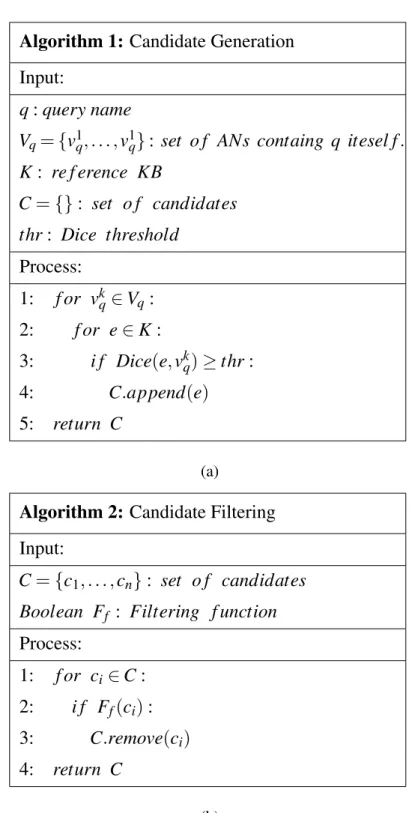
3.1 The rules used in the Combination phase. X, Y, or Z illustrates PER, ORG, and GPE and “−" represents “N/A" or “MISC" query types. . . 36 3.2 The patterns used for type amendment and candidate filtering. . . 37 3.3 The Algorithms used for the Candidate Generation step (a) and for the
candidate filtering step (b). . . 41 3.4 The Algorithm used for Candidate Ranking step. . . 45 3.5 The Algorithm used for NIL Clustering step. . . 60
4.1 An entry sample in the reference KB. The entry represents the geo-political entity “Parker, Florida" associated with its facts and document (wikitext). . 68 4.2 Training data for TAC-KBP 2014 EL task. . . 69 4.3 The F_SYS results measured by the accuracy, B-cubed, and B-cubed+
met-rics over TAC-KBP 2014 Mono-Lingual (English) EL evaluation data set. . 70 4.4 The Accuracy error rate in candidate generation and candidate filtering steps. 79 4.5 The impact of improvement modules on the F_SYS results (measured by the
B3+F1 metric). . . 81
A.1 The results obtained by BL_sys over TAK-KBP 2014 Mono-Lingual (En-glish) EL evaluation data set. . . 96 A.2 continued. . . 97
A.3 The results obtained by F_sys over TAK-KBP 2014 Mono-Lingual (English) EL evaluation data set. . . 98 A.4 continued. . . 99
Nomenclature
List of symbols
α the weight assigned to each linkh
βϕi,ϕj degree of similarity betweenϕiGqandϕj∈Gc
βmi,mj The degree of similarity betweenmi∈Gqandmj∈Gc
Λ set of all pairs
λi ith pair composed by the query nameqand each NE mention D a collection target documents
KT set of all entities around the world
ϕi ith binary vector (a row matrix)
C set of candidates
CD(v) degree centrality for vectorv
ci ith candidate in set C
CLR set of NIL clusters
clrnew new NIL cluster
dq target document corresponding to queryq
E∗ set of incoming edges
Ec set of candidate graph edges
ei ith entity
Eq set of query graph edges
Ff Filtering function
Gc candidate graph
Gq query graph
hi ith link
Hq,c a set of links betweenGqand eachGc
idq query Id
idclr NIL cluster Id
K Knowledge Base
li ith lemma inLλ
LT bag of lemmas of all pairsΛ
Lλ set of lemmas forλ
levmi,mj Leveshtein distance metric to measure differences between two stringsmiandmj
Nomenclature xxi
Mso set of NE mentions occurring in the query sentence
NIL not-in-KB entity
q query name
qnil NIL query
so query sentence
TG set of topics for graphG
ti ith topic inTG
thr threshold
thrnil NIL threshold
Vc set of candidate graph vertices
Vq set of Alternate Names (AN); set of query graph vertices
viq ith AN for query nameq
We weight of each incoming edge e
wi ith word inWλ
Wλ context betweenqandm
XcandSc score symbols obtained by each candidate
List of abbreviations and acronyms
ACE Automated Content Extraction
DUC Document Understanding Conference
EL Entity Linking
ERD Entity Recognition and Disambiguation
HAC Hierarchical Agglomerative Clustering
IE Information Extraction
IR Information Retrieval
KB Kowledge Base
KBP Knowledge Base Population
KD Knowledge-based Disambiguation
LDA Latent Dirichlet Allocation
NE Named Entity
NED Named Entity Disambiguation
NER Named Entity Recognition
NERC Named Entity Recognition and Classification
NERD Named Entity Recognition and Disambiguation
NIST National Institute of Standards and Technology
RCNERC Rule-based Combination NERC
SD Supervised Disambiguation
Nomenclature xxiii
T REC Text REtrieval Conference
U D Unsupervised Disambiguation
Chapter 1
Introduction
Recently, the needs of world knowledge for Artificial Intelligence (AI) applications are highly increasing. A system intelligence can be measured by amount of its interaction and knowledge about the real world entities. As an appearance of the world knowledge, a KB is a crucial resource to keep and categorize facts, entities and their relations. Large scale KB has been proved to be valuable for many natural language processors such asquestion answering [48],information extraction[73],coreference resolution[76] andword sense disambiguation [26]. The Internet is growing to be a wide and complex global KB known as theSemantic Web, according to theWorld Wide Web Consortium(W3C). A KB helps towards process of huge amount of information in a short span of time. A well-structured KB reduces a firm cost by decreasing the amount of human resources’ time spent aiming to discover information about - among countless possibilities - trade laws or firm policies and objectives. However, the high cost of manual elicitation to create the KB, forces toward automatic acquisition from text. This requires two main abilities.
1. extracting relevant information of mentioned entities including attributes and relations between them (Slot Filling), and
The scope of the achieved work presented in this document is limited to the EL task.
EL has recently observed many attentions from the researchers, especially for IE purposes. A traditional IE task includes three main steps:
• NE Recognition and Classification: Detecting NE mentions occurring in target docu-ments and classify them different entity types such as such as Person, Organization or GeoPolitical entities. There are several relevant work in [2, 14, 19, 50, 83], and the review article by Nadeau and Sekine [61].
• Coreference Resolution: Group two or more NEs and other anaphoric mentions in a document or a set of documents that refer to the same real world entity. For example, "Mr. President", "B. Obama", and "Barack Obama" occurring in a set of documents might refer to the same entity [3, 69, 89, 94].
• Relation Extraction: The relation extraction task is to determining the relation between two NEs occurring in the target documents. As an example, occurring two person names regarding to the football match, a relation extraction system should return sport, match, and football as answer [5, 86].
This traditional view over IE has received considerable attention. However, they are not often the only structured information. Another task that has recently observed many attention is NED. It includes disambiguation of a NE mentions occurring in target documents and linking them to the correct entities in the KB. However, the NED task alone is not enough in a new defined IE task, especially for automatic KBP tasks. In the recently defined IE task, the new extractions must be merged with previously extracted information in the reference KB. It in turn requires linking extracted information in text to entries in a KB and determining whether any duplicate exists between the information. If yes, to update the corresponding entry. In the case that there is no entry corresponding to new extraction information, a new entry should be created in the KB to locate that information.
3
Entity Linking (EL), also known asrecord linkageor grounding is an important step towards addressing the goals of KB augmentation and can also be used in other areas such as topic detection,machine translation, and information retrieval. It can also be viewed as an unsupervised Named Entity Disambiguation (NED) problem at large scale. EL is the task of referring a NE mention in a document to the unique entity within a reference KB. A NE mention is a mention that uniquely refers to an entity by its proper name, acronym, nickname, alias, abbreviation or other alternate name. Entities can have different types such as person (e.g.“James Taylor"), organization (e.g. “Microsoft"), and geo-political entities (e.g. “New York City"). In the EL task, new extractions must be merged with previously extracted information in KB. As an example for linking NEs to a reference KB (e.g. Wikipedia), when seeing the text “American politician Chuck Hagel", the NE mention “Chuck Hagel" should be linked the Wikipedia entity “http://en.wikipedia.org/wiki/Chuck_Hagel". A system input in the EL
task1is defined as:
• a knowledge baseK={e1, . . . ,en} ⊆KT, whereei∈K is theith entity in theK and
KT is the set of all entities around the world.
• a query nameqoccurring in a target documentdq∈D, whereD is the collection of target documents.
The system output is either:
• the entityeito whichqrefers, or
• NILif such an entity does not exist inKB.
The task is formalized as a function: link(q,K) = ei if 1≤i≤n NIL otherwise (1.1)
wherelink(q,KB)is the function to detect the correct entity for a query name. In other words, given a set of queries, each of which consisting of a query name (target NE mention) and a document in which the query name occurred, and the start and end offsets of the query name, the system should provide the identifier of the KB entity to which the query name refers if existing, or a NIL Id if there is no such KB entry. The EL system is also required to cluster together queries referring to the same Not-in-KB (NIL) entities and to provide a unique ID for each cluster.
1.1
EL Applications
EL is a new task in the field of NLP which has attracted many attentions in the recent years. It has a high potential for being improved with a wide range of applications. Following, some applications in the business environment are explained.
• Recently, the activity of security threats (e.g., extremist groups) is highly increasing in the virtual environments such as forums, weblogs, and social networks like Facebook and Twitter. The security agencies may gather many unstructured information about them. Manual extraction of mentions (e.g. persons, organizations, locations, and future events) from the unstructured data is however highly time consuming and is against the essence of these threats that need velocity in reaction. EL would be an appropriate
1.1 EL Applications 5
solution to automate the process of mapping necessary information from the huge amount of unstructured documents to the structured data during a short span of time.2
• EL systems can be used in the platform of all human-computer/robot dialogue systems. To communicate, these systems should firstly infer the speech dialogue. This in turn requires disambiguation of NE mentions in the human dialogue. As an application, an EL system can be applied in the humanoid robots and assistive machines such as diagnosis systems. In addition, it could be used in wide range of embedded systems such as natural language processors embedded within new generation of cars, tv, mobile devices.
• It can be used for all systems that use a KB. In general, a KB is not a static collection of information, but a dynamic resource that may itself have the capacity to learn, for instance, as part of an AI expert system. To this end, a KB needs continuous augmentation of its entries (update). However, manual augmentation of entries is highly time consuming. For this purpose, EL systems are highly beneficial in order to automate the elicitation of structured information from documents and help IE to create/update entries in KB.
• EL system can be used to annotate texts with semantic information. One example is the Wikify![57] which automatically generates a link to Wikipedia for each disambiguated NE mentions existing in the target documents. This technique is also used by news agencies to provide significant information for their clients. Another application is in the digital libraries where the goal is to cluster and link the same authors both in papers and in citations [33].
2For this reason, the EL task within KBP contests in the framework of TAC is supported by U.S. Department
• EL can be used for a broad range of applications in companies with different subjects of activity. In the companies that focus on the email services, it can be applied to process the email messages and to extract upcoming events and task along with their dates. Subsequently, it can link them to a calendar. Several companies work on knowledge discovery task focusing in the real-life entities. For instance, some financial companies used such systems to monitor events like company mergers and other financial activities like bilateral contracts and product releases.
1.2
Problem Definition
EL is the task of referring Named Entity (NE) mentions occurring in a natural language text to their correct entities (persons, organizations, and geo-political entities) in a reference KB. EL task is non-trivial due to highly ambiguous nature of human language. In the task, text processors are usually faced to many challenges in correctly linking mentions. The EL task is challenging for three main reasons:
1. Polysemy. One query name may be used to refer distinct entities. It can be interpreted in different ways depending on the context in which it appears. As an instance for person entities, consider the following sentence:
“George Bush brought to the White House a dedication to traditional American values and a determination
to direct them toward making the United States a kinder and gentler nation.",
“George Bush" might refer to either “George H. W. Bush", the 41st President of the United States, or “George W. Bush", 43rd President of the United States.
1.2 Problem Definition 7
The polysemy may also exist given that some entities are incompletely referred. Query names can bepseudonymsornicknames, and are often acronyms. Organization and geo-political entities are also faced to these challenges. “ABC" can be referred to more than hundred entities such as “American Broadcasting Company" or “Australian Broadcasting Company". The query name “Georgia" can be linked to either “Georgia (country)" or an American state. In addition, two NE mentions may overlap. For instance, in the following sentence:
“The University of York, is a research-intensive plate glass university located in the city of York, England. In 2012 York joined the Russell Group in
recognition of the institution’s world-leading research and outstanding teaching.",
“University of York" is an overlapping mention that refers to both “University of York" as an organization and also to “York" as a geo-political entity. In addi-tion, the second and third occurrences of “York" in the quotation above refer to a geo-political entity and to an organization entity, respectively. The ambiguity can be more challenging. For instance, in the sentence:
“The Big Apple is hosting a famous soccer match.",
the “Big Apple" refers to “New York City". In discussion fora, e.g., blogs and other social media documents such as tweets, the texts might contain orthographic irregularities such as misspellings which make the EL even harder. For instance, in the sentence:
the NE mention “James Hatfield" can refer to the American author. But, the correct form of “Hatfield" is “Hetfield" referring to the main songwriter and co-founder of heavy metal band, Metallica.
2. Synonymy. One entity in the KB can be referred by several query names. For example, in the following sentence:
“Former American president George W. Bush (a.k.a. Bushie, Dubya) is widely known to use nicknames to refer to journalists, fellow politicians, and members of his White House staff.",
“Bushieand “Dubya are synonym and both referring to “George W. Bush", 43rd President of the United States. Besides,Metonymycan sometimes be a form of synonymy by which an entity is called not by its own name but rather by the name of something associated in meaning with that entity. For example, consider the following sentence:
“Hollywood is a neighborhood in the central region of Los Angeles, California. It is notable for its
place as the home of the entertainment industry, including several of its historic studios.",
the “Hollywood" is used as a metonym for the U.S. film industry.
3. Absence. Many query names occurring in the target documents are referring to not-in-KB (NIL) entities. Indeed, for that query names there are not a mapping entity in the reference KB. An EL system should detect them. Each set of NIL query names referring to the same not-in-KB entity should be clustered together in a group.
1.3 Hypothesis 9
These examples indicate that EL task is faced to many challenges. Tackling these chal-lenges would be very tough without extracting the semantic knowledge from the neighboring context of those NE mentions. In next section, we will briefly describe our approach to overcome these difficulties. Consequently, in the Section 3 our approach would be explained in detail.
1.3
Hypothesis
The hypothesis behind this work is based on this fact that query names existing in a document are usually coherent. They form an inter-related semantic network and each group of mentions can be clustered by one or more topics. Furthermore, in a document with different and distinct subjects, the mentions are usually more correlated whenever their offsets in the document get closer. Thus, to disambiguate a query name we extract this network between the NE mentions existing in the target document. To this objective, we present an unsupervised approach to disambiguate NE query names. Our system generates a network of relations using a graph-based method and based on semantic similarity between the NE mentions.
1.4
The Proposal and Contributions
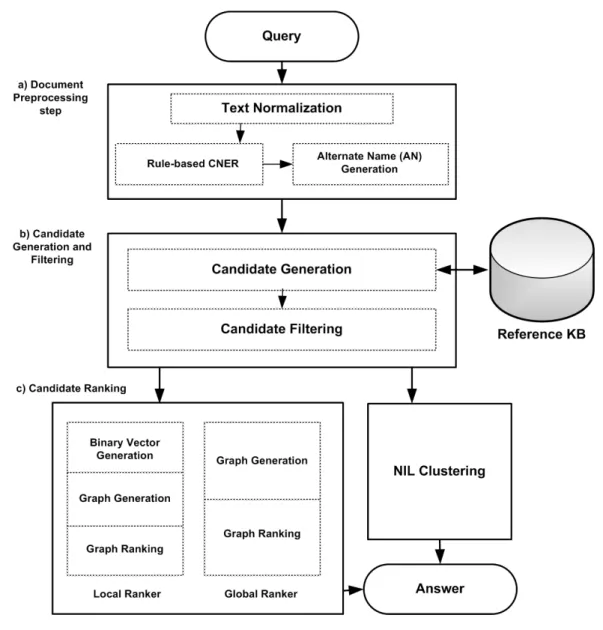
Recently some researchers proposed their EL systems following supervised disambiguation techniques. These approaches are however faced to lack of enough annotated training data. Semi-supervised and unsupervised techniques are alternatives to overcome this problem. To tackle the challenges mentioned in 1.2 we have developed an unsupervised EL system. It disambiguate query names occurring in the target documents in a pipeline. It includes Document Preprocessingstep to preprocess the target document (Section 3.1),Candidate Generation and Filtering step to generate a set of candidates generated for each query
name and then to filter-out the least reliable (Section 3.2), Candidate Ranking step to rank candidates in order to find out the best matching KB candidate for each query name (Section 3.3) andNIL clusteringstep to cluster those queries without any candidate in KB (Section 3.3.3). For each step, we have proposed techniques to tackle the facing challenges.
Briefly, in the document preprocessing step we apply several techniques (described in Section 3.1) to normalize the document and expand the information in order to assist the process of disambiguation. In this step, we applied a Rule-based Combined NERC (RCNERC) system to distinguish query names in the target document. This is a combination of three NERC systems that is able to amend the result of named entity recognition using predefined rules. In addition, in this step the system applies other techniques such as text normalization, acronym expansion, pattern extraction to enrich the target document. In the candidate generation and filtering step the system initially generates a set of candidates for each query and it then applies a rule-based approach to filter-out noisy candidates from the set of whole candidates. It helps to obtain a discriminative set of candidates that increases the system accuracy in linking task. In the candidate ranking step we proposed our unsupervised disambiguation approach that uses graph structure towards ranking candidates. It discovers the semantic knowledge laid in the context of document. To tackle the highly ambiguous nature of EL task it is crucial to exploit the semantic relations between NE mentions in the target document. Since our method is unsupervised it does not have the defect of supervised approaches that is the lack of enough annotated data for training. Finally, for the NIL Clustering step, we have applied a term clustering approach that groups all same not-in-KB queries in a cluster indicating a new entity in the KB.
Meanwhile, our research in this area spans over several areas within the field of NLP, and we believed that a number of distinguishable contributions are contained in our work. We want to highlight them, listing them below in what we consider their order of decreasing relevance:
1.4 The Proposal and Contributions 11
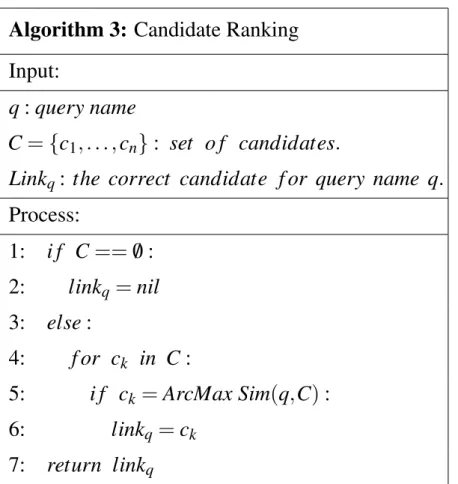
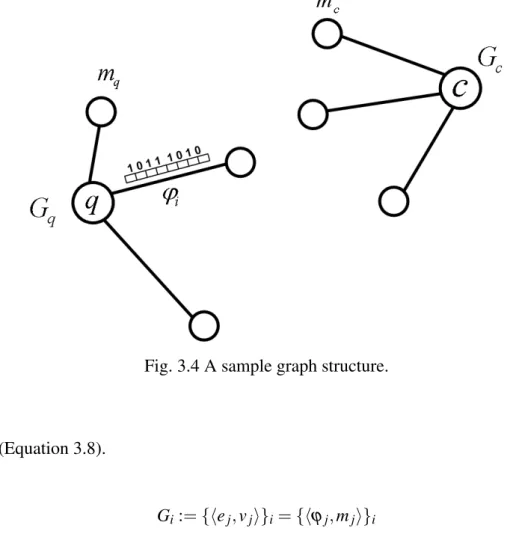
• C.1: Unsupervised Disambiguation using Local Information. We have proposed an unsupervised graph-based approach using local information occurring in the target document (henceforth,local ranker). In our experiments, thelocal informationrefers to the data existing in a sentence where the query name occurs. The hypothesis behind it, is based on this idea that a relevant semantic relation occurs often between query name and each NE mention (the pair⟨query name, NE mention⟩) in the same sentence. The system uses these semantic relations to rank candidates. To this end, it extracts the context between each pair in the same sentence. A binary vector (a row matrix) is then assigned to the context elements (bag of lemmas) between each pair. In order to rank the candidates, the system generates a star graph for the query name and one for each candidate. The system computes the similarity between query graph and each candidate graph. The goal is to select the most similar candidate to the query name. Central vertex of query graph is labeled with the query name and central vertex of each candidate graph is labeled with the candidate name. Other vertices in the graphs are labeled with those NE mentions existing in the set of pairs. Each edge is labeled with the semantic relation existing between the linked entities. This is represented by a binary vector corresponding to each pair. The system ranks each candidate based on the degree of similarity between query graph and each candidate graph. Details are described in Section 3.3.1.
• C.2: Unsupervised Disambiguation using Global Information. We have proposed an Unsupervised graph-based approach that takes advantage of global information (henceforth,global ranker) existing in the target document. This information is the semantic knowledge not only existing in the query sentence (the sentence where the query name occurs) but also the information lied in other sentences of the target document (in our experiment, a text window of 3 sentences, the query sentence and
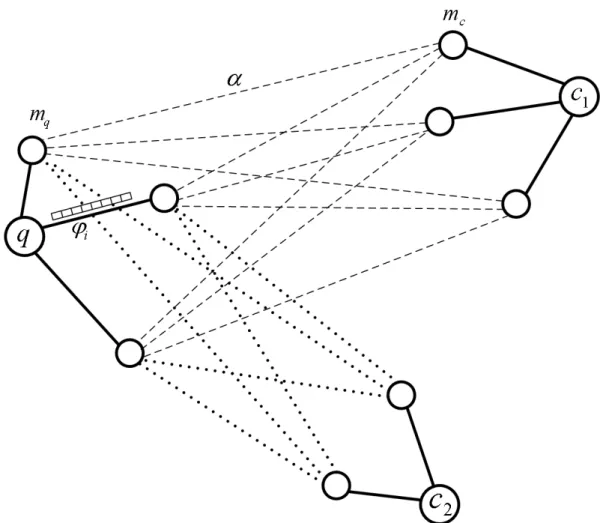
the previous and following ones). In this approach, we consider the fact that NE mentions existing in a document are usually coherent. They form an inter-related semantic network and each group of mentions can be clustered by one or more topics. The system exploits the semantic networks between NE mentions. The first approach (local ranker) computes the semantic similarity just from the target document. On the contrary, the second approach (global ranker) computes the semantic similarity using world knowledge, specially using DISCO3and based on the statistical analysis of very large text collections (in our experiment, English Wikipedia). The system generates a graph for the query name and one for each candidate. Each NE mentions occurring in the text window (three sentences) of the target document, would be a vertex in the query graph (excluding query name). Likewise, each NE mention, recognized from the first 10 sentences4of each candidate’s document, is a vertex for this candidate graph (excluding query name). The relations (edges) are the semantic similarity (measured by DISCO) between each two vertices. The system thereupon computes the most important vertices as the topics for each graph. The topics are recognized by computing degree centrality for each vertex. Finally, the system ranks the candidates based on degree of similarity between the topics in the query graph and each candidate graph. Details are described in Section 3.3.2.
• C.3: Combined Disambiguation approach. In some queries, the query sentence does not contain any NE mention (the sentence just has the query name). In such cases, the system cannot apply the local ranker. To solve this problem, the system initially tries to apply the local ranker. If the query sentence contains no NE mentions (except, the query name), the global ranker will be used. We have evaluated both ranking
3DISCO is a NLP tools which allows to retrieve the semantic similarity between arbitrary words –http:
//www.linguatools.de/disco/disco_en.html
4We consider the fact that the first sentences in each candidate’s document are more informative. It is a
1.4 The Proposal and Contributions 13
approaches, separately. We realized that the local ranker has a better performance for those queries having more than two candidates and the global ranker has better performance for the queries having two candidates. In order to improve the results, we combined these two approaches. Using this technique, the results obtained by the combination approach improved (Figure 4.6).
• C.4: NIL clustering using Alternate Names (ANs).A large amount of the queries refer to the entities that are not present in the reference KB (NIL queries). For those queries, the system clusters them in groups, each referring to a same Not-in-KB entity (NIL Clustering). We proposed a NIL clustering approach. The system consider the first NIL query as a NIL cluster. The next NIL queries and their properties (query name and Alternate Names–ANs) are compared with existing NIL clusters. ANs are the name variants for a query name. The comparison uses a fuzzy matching techniques based on the Dice similarity between each cluster’s properties and the new query name (and its ANs). In each comparison if the dice similarity is more than a predefined threshold (in our experiment, set to 0.8), the new NIL query will be joined to that cluster. Otherwise, the system generates a new cluster for this query. Details are explained in Section 3.3.3.
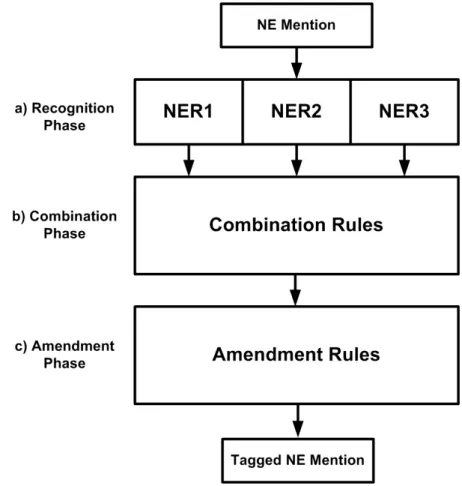
• C.5: NE Recognition and Classification using Rule-based Combination Approach (RCNERC). In this research, we have proposed a Rule-based Combination NERC (RCNERC) system (three-phase NERC system explained in Section 3.1). The first step is calledrecognition phaseand is responsible for detecting and classifying query names to PER (person), ORG (organization), GPE (geo-political entity), MISC (miscel-laneous), and N/A (not-available) types using three NERC systems (Stanford, Illinois, and Senna). The second step is calledcombination phaseand combines the classifica-tion results based on the majority voting between three NERC systems. Finally, the third step is calledamendment phaseand modifies the results of combination phase by
a set of predefined rules. [55] presented a combination NERC technique for linking entities. Compared with this work, we applied a further step (amendment phase). This phase takes advantage of pattern extraction and matching to modify NERC annotations. Our RCNERC system significantly improved the final results of the EL system. It demonstrated that although the candidate ranking is a crucial step in EL systems, without a reliable NERC approach, its performance would dramatically be decreased.
• C.6: Three-phase Candidate Filtering.The accuracy of EL systems in ranking candi-dates is exponentially reduced whatever the number of candicandi-dates (for each query) is increased. Thus, it requires a method to filter-out those candidates which are unlikely the correct answer. The candidate ranking step is afterward applied to the rest of candidates. We proposed a rule-based candidate filtering method to reduce the prob-ability of selecting a wrong entity in the reference KB during the candidate ranking step. [71] and [39] presented a candidate filtering method for EL task. They applied a title matching in order to filter-out the candidates. In our filtering technique, we use a wider range of rules in three main categories: 1) Title Matching, 2) Type Matching and 3) Pattern Extraction and Matching (Section 3.2). This technique helps to obtain a discriminating set of candidates that increases the system accuracy.
1.5
Overview of this Document
The rest of this document is organized as follows: Chapter 2 gives a review of the state of the art and the development of EL systems:
• This Chapter explains about the early history of EL.
• In continue, it describes different part of the most popular EL system architecture as pipeline and presents literature review on each part of the EL system.
1.5 Overview of this Document 15
• And finally, several evaluation framework for EL task are described in this chapter.
Chapter 3 presents our approach and the state of the work that has been carried. This Chapter is organized in three sections:
• Document Processing section where at the outset the documents are preprocessed.
• Document Generation and Filtering step where a set of candidates for each query are generated and noisy ones are filtered.
• Candidate Ranking section where the best candidate for each query is chosen. This section itself includes three parts: a) Candidate Ranking using Local Information, b) Candidate Ranking using Global Information and c) NIL clustering where the system clusters each group of NIL queries referring to a same not-in-KB entity.
Chapter 4 describes the evaluation framework and analysis of results. This section includes:
• Introducing the evaluation framework that we used in our experiments containing a) evaluation task definition, b) evaluation metrics and c) evaluation data.
• presenting the evaluation results and analysis of them.
Chapter 2
State of The Art
This section presents an overview of early history of EL (Section 2.1), the general architecture of EL systems as well as the research done towards different EL approaches (Section 2.2). A sketch of the evolution in EL evaluations is presented (Section 2.3) and finally, the Wikipedia as a valuable KB is briefly reviewed in Section 2.4.
2.1
Early History and Recent Works on EL
Recent works focused on EL in its contemporary history are inspired from the antecedent research on Word Sense Disambiguation-WSD which is the task of detecting the correct sense of a word in text. For instance, the word "bar" can be meant as an obstacle, load, rod, arrow or court. The correct sense of a word in the text is determined given its neighborhood. Even two occurrences of a word in the same document may have different senses depending their close neighborhood. Many studies achieved on WSD are quite relevant to EL. [45] presented its unsupervised WSD algorithm using machine readable dictionaries. Also, [95] proposed its algorithm for unsupervised WSD. The algorithm is based on two powerful
constraints that words tend to have one sense per discourse and one sense per collocation -exploited in an iterative bootstrapping procedure. EL is a recent task inspired by WSD.
By analogy, both EL and WSD tasks tackle synonymy and polysemy challenges existing in the human language. However, there are differences between the tasks. In EL task, the candidates are located in the KB (e.g., Wikipedia, DBpedia). In WSD task, the candidates are placed in the sense repositories (usually WordNet-WN senses) [32]. In addition, the candidate generation step in WSD supposes that this lexical database is a complete resource. On the contrary, the EL task may deal with the queries that are not in the KB. In such cases, the query is tagged as NIL [7, 52]. The NIL clustering step is applied and the NIL query will be added to the KB as a new entry. As another difference, the NE mentions in the EL task usually vary more than lexical mentions in WSD. Therefore, the EL task requires a wider candidate generation process [44, 90]. The earliest work on the EL task were presented by [7] and [17]. Their goals were to link NEs occurring in the documents to their corresponding entries in Wikipedia. They did not use the term EL in their works and they applied different approaches. [17] used heuristic rules and Wikipedia disambiguation markup for mapping from NE mentions to their Wikipedia entries. [7] suggested an approach for not-in-KB entities by learning a NIL threshold to determine whether the entity exists in the reference KB. Besides, earlier EL studies were focused at each time on disambiguation a NE mention just using its neighborhood and usually based on supervised models [7, 34, 57, 58]. However, due to the lack of enough informative context, a global process of the target document using semantic analysis of multiple NE mentions is more strong. Some recent works later applied this approach by disambiguating a set of relevant mentions simultaneously which is calledcollective approaches, usually through supervised or graph-based reranking models [11, 12, 17, 18, 20, 22–24, 30, 31, 34–36, 42, 43, 47, 58, 74, 78, 85]. Several measures to choose the “collaborators” includecollaborative learning[12],ensemble ranking[42, 74], co-occurred concept mentions [53, 70],topic modeling[11, 93], relation extraction[13],
2.2 EL Architecture and Approaches 19
coreference[70],semantic relatedness[13, 38, 70],Neighborhood Expansion with Pseudo-Relevance Feedback[21],meta-paths[38] andsocial networks[11, 38]. In our work, we have also took advantage of the collaborators and have proposed our methods to generate the networks of similar NE mentions in each target document.
2.2
EL Architecture and Approaches
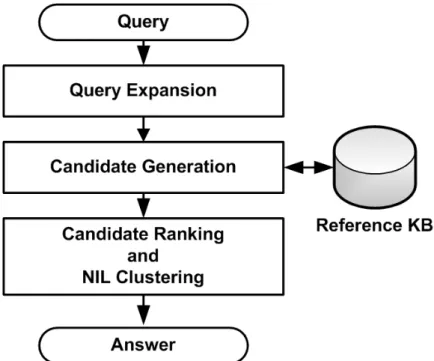
The EL approaches provided by the researchers usually follow a common architecture in several major steps. The differences are in proposing diverse techniques for each step of this architecture. Figure 2.1 shows a general architecture for EL systems including three major steps. They are described in the following sections.
2.2.1
Query Expansion
Expanding the query from its context can effectively reduce the ambiguities of the query name, under the assumption that two name variants in the same document refer to the same entity. For example, without the query expansion, the query nameRothis linked to seventy-six entities in Wikipedia, but its expansionJohn D. Rothis only linked to two entities [97]. Thus, query expansion is performed as the first step for EL. This step often includes a classification of the query into the possible entity types PER (e.g., George Washington), ORG (e.g., Microsoft), GPE (e.g., Heidelberg city). The GPE is abbreviation ofGeoPolitical Entity, a geographical area which is associated with some sort of political structure (different from natural toponyms as rivers, mountains, seas, etc.). Following, some popular techniques for the query expansion are described.
• Wikipedia Hyperlink Mining. A hyperlink is a structural component that connects the web page to a different location. The Wikipedia pages contain many hyperlinks having useful information for the query expansion. The method extracts the name variants of an entity in KB by leveraging the knowledge sources in Wikipedia: “titles of entity pages", “disambiguation pages"1, “redirect pages"2and “anchor texts". With the acquired name variants for entities in KB, the possible KB candidates for a given query name can be retrieved by string matching. If the query name is an acronym, it can be expanded from the target document. [10, 98] employed the Wikipedia hyperlink mining for the query expansion. For specific types of NE more focuses approaches can be used as person name grammars for PER, acronym expansion/compression or suffix removing for ORG and geo-disambiguation techniques for GPE.
• Coreference resolution.Several queries can be expanded based on source document coreference resolution. The goal is to explore NE mentions that have relations, shared 1http://en.wikipedia.org/wiki/Wikipedia:Disambiguation
2.2 EL Architecture and Approaches 21
events, common attributes or co-occurrences with the query name in the same target document. When two NE mentions are coreferential, the one is usually a full form (the antecedent) and the other is an abbreviated form or an acronym (a proform or anaphor). When a query name is acronym, the technique helps to expand the full form of this mention. [10] used a Chinese name coreference resolution system to get the possible name variants for each query name.
• Statistical Models. With a set of expansions extracted from the target document for a query name, the method applies a supervised learning algorithm to infer which expansions are valid. Each⟨queryname,expansion⟩pair, in the form of feature vector, is presented to a classifier (e.g., SVM). A NIL response is returned if there are no positively classified expansions. Otherwise, the candidate with highest confidence score is selected. [98] employed a statistical model based on SVM to expand queries. [96] presented a query expansion feature set to be used by the classifier.
2.2.2
Candidate Generation
A KB always contains a huge number of entities. It is impractical a brute-force searching to consider whole entities in the KB for linking NE mentions. Thus, candidate generation step is a solution to retrieve the most important entities in the KB that can potentially be candidates for the query name. This module selects the KB entities that might correspond to the query name, typically with basis on string similarity. The common methods to generate candidate set is described following.
• Fuzzy Title Matching. The fuzzy title matching (aka, approximate title matching) is the technique of finding the KB entities that match a string pattern in their title approximately (rather than exactly). For each query, the EL system generates a set of candidates using fuzzy title matching (e.g., Dice similarity). In this technique, the
system explores those candidates with a Dice similarity between the query name and the candidate title higher than a predefined threshold. [10, 59] used the fuzzy title matching similarity to generate candidates from the KB.
• Information Retrieval (IR).IR obtains information resources relevant to query from a collection of information resources. Searches can be based on metadata or on full-text indexing. [67] used the IR technique to generate the candidates. In their system, the KB was loaded into an IR engine. It retrieved top 100 candidates for each query. In three separate experiments they load the KB information to the IR engine, first just KB titles, second title and infoboxes, and finally, the entire KB documents. In their evaluation, the best recall was obtained by the last experiment.
2.2.3
Methods for Candidate Ranking
This step sorts the retrieved candidates according to the likelihood of being the correct referent. The ranking methods in the state of the art can be classified into supervised methods, unsupervised methods and knowledge-based methods [66]. These methods are described following.
• Supervised Disambiguation (SD).The first category applies Machine Learning (ML) techniques for inferring a classifier from training (manually annotated) data sets to classify new examples. Researcher proposed different methods for SD. ADecision List [82] is a SD method containing a set of rules (if-then-else) to classify the samples. [41] used learning decision lists forAttribute Efficient Learning. [49] introduced another SD method,Decision Tree, that has a tree-like structure of decisions and their possible consequences. C4.5 [77], a widely used algorithm of learning decision trees was outperformed by other supervised methods [60]. [40] studied on theNaive Bayes classifier. This classifier is a supervised method based on the Bayes’ theorem and is
2.2 EL Architecture and Approaches 23
a member of simple probabilistic classifiers. The model is based on computing the conditional probability of each class membership depending on a set of features under the hypothesis of conditional independence. Although the model seems, at first glance, too heavy in practice it works well in this task. [60] demonstrated good performance of this classifier compared with other supervised methods. [51] introducedNeural Networks. The model is presented as a system of interconnected neurons usually organized into an input layer, an output layer and a set of intermediate (hidden) layers. Although [87] showed an appropriate performance by this model, the experiments were performed with a small size of data. However, the dependency to large amount of training data is a major drawback, [66]. Recently, different combination of supervised approaches have been proposed. The combination methods are highly interesting since they could cover the weakness of each stand-alone SD methods [66]. SD systems obviously rely on the set of supervised (annotated) training sets, and, so on a highly costly human work. This is why researchers have moved to unsupervised or semi-supervised methods. As whatever semi-supervised approach, SD can suffer the problem of lacking enough supervised data for training. For facing this problem unsupervised methods have been proposed.
• Unsupervised Disambiguation (UD).The underlying hypothesis of UD is the distribu-tional hypothesis, i.e., a word can be defined by the company it has. Indeed, each word is correlated with its neighboring context. Co-located words generate a cluster tending to the same sense or topic. No labeled training data set or any machine-readable resources (e.g. dictionary, ontology, thesauri) are applied for this approach [66]. Con-text Clustering[84] is a UD method by which each occurrence of a target word in a corpus is represented as a context vector. The vectors are then gathered in clusters, each indicating a sense of target word. A drawback of this method is that, a large
amount of un-labeled training data is required. [46] studied on Word Clustering a UD method based on clustering the words which are semantically similar. Later on, [72] proposed a word clustering approach calledclustering by committee(CBC). [91] described another UD methodCo-occurrence Graphsassuming that co-occurrence words and their relations generate a co-occurrence graph. In this graph, the vertices are co-occurrences and the edges are the relations between co-occurrences.
• Knowledge-based Disambiguation (KD).The goal of this approach is to apply knowl-edge resources (such as dictionaries, thesauri, ontologies, collocations, etc.) for disam-biguation [4, 8, 27, 45, 56]. Although these methods have lower accuracy compared with supervised techniques, they use to have a wider coverage [66].
2.2.4
NIL Clustering
Queries are tagged as NIL (Not-In-KB) when no entity in the KB corresponds to them (or we are not able to select the appropriate one). So NIL implies that a new entry could be included into the KB. In a set of documents, several NE mentions may refer to a same NIL entity. In the KBP contest, all NE mentions related to the same NIL entity should be grouped by the same id (e.g. NIL001, NIL002, . . . ). So each NIL cluster could correspond to a new entry in the reference KB. Several techniques have been applied to this task (provided that the query has been classified as NIL):
• Name String Matching. This technique consists in grouping queries by term matching. For instance, two NIL queries with the name “ABC" would be clustered together and, so, would be given the same NIL ID. A query name may contain fragments of other query names. To this end, the fuzzy string matching is applied. It clusters all NIL queries with the Dice similarity between the query names higher than a predefined threshold. [9, 10, 37, 53, 79, 81] used the name string matching to cluster NIL queries.
2.2 EL Architecture and Approaches 25
• Hierarchical Agglomerative Clustering (HAC).In this approach, those query names referring to the same Not-in-KB entity are clustered using HAC algorithm. Hierarchical clustering can be approached by top-down and bottom-up algorithms. The Bottom-up algorithm (aka., HAC) treats each query names as a singleton cluster at the outset and then sequentially merge (or agglomerate) pairs of clusters as long as two clusters exceeded a similarity threshold. [59, 75, 98] presented their works using this approach. In contrary, top-down approach works by starting with a root cluster, where all the candidates are placed and then recursively splitting the clusters based on the most likely partition in each stop.
• Graph based clustering. Using this approach, a graph structure is generated for the clustering. [97] employed the graph-based approach to cluster the NIL queries. They usedSpectral Graph Partitioning (aka., Spectral clustering) [68] to generate the globally optimized entity clusters. The results obtained by the spectral graph partitioning usually outperform the traditional clustering algorithms such as k-means or minimum-cut [97].
• Topic Modeling. Topic modeling is a statistical model to explore the topics underlying the documents. The topic modeling approaches are widely used in different NLP appli-cations [97]. Latent Dirichlet Allocation(LDA) is a common topic model approach that was first presented as graphical model for topic discovery by [6]. The topics are probability distributions over words. [92, 97] used the topic modeling for the NIL clustering.
• Linking to Larger KB and mapping down.This approach clusters NIL queries using a larger KB. [79] explored the NIL query names in full dump of Wikipedia. From 2,250 queries evaluated, their approach tagged 1,263 to NIL. 56% of the NIL queries were
linked to the full dump of Wikipedia and 44% of NIL queries had no reference in the KB.
2.3
EL Evaluation Frameworks
The EL problem is currently receiving substantial attention in the IR community, given its recent inclusion as a specific task in the NIST-sponsored3Automated Content Extraction4 (ACE) evaluations (i.e., the ACE-2008 cross-document co-reference resolution task), and in theText Analysis Conference5(i.e., the Knowledge Base Population task, referred to as TAC-KBP). In addition, theEntity Recognition and Disambiguation(ERD) challenge6is recently organized to focus on this task. These frameworks are described following:
• ACE Evaluations. The Automatic Content Extraction 2008 ACE cross-document co-reference resolution task is pioneer organized evaluation for defining the recent EL task. The objective of the NIST-sponsored ACE series of evaluations was to develop human language technologies that provide automatic detection and recognition of key information about real-world entities, relations, and events in source language text and to convert that information into a structured form, which can be used by follow-on processes, such as classification, filtering and selection, database update, relationship display, and many others. An ACE system produces information about objects discussed in the source language text. The strings of text are not the objects, but are merely mentions of the real-world objects about which information should be extracted. These objects have included, over the course of the evaluations, various types of entities, relations, events, values, and temporal expressions. The emphasis has 3http://www.nist.gov
4http://www.itl.nist.gov/iad/mig/tests/ace/ 5http://www.nist.gov/tac/
2.3 EL Evaluation Frameworks 27
been on object coreference resolution, such that all data pertaining to the same unique ACE object are collected into a single XML-formatted “record" on a per document basis.
• TAC-KBP Evaluations. As the most important challenging competition, EL evaluation a task within the Knowledge Base Population (KBP) track at Text Analysis Conference (TAC) has been the subject of significant study over the past seven years. Since the first KBP track held in 2008, the research in the area of EL has greatly developed. TAC is organized and sponsored by the U.S. National Institute of Standards and Technology (NIST) and the U.S. Department of Defense. TAC has commenced its activity since 2008 and developed out of NIST’sText REtrieval Conference(TREC) andDocument Understanding Conference(DUC). The main goal of the KBP track at TAC is to gather information about a specific entity that is scattered among the documents of a large collection, and then use the extracted information to populate an existing KB.
• ERD Evaluations. A recent notable contribution to research in the field of EL was made by the participants of the ERD. As the most structured challenging competition7, ERD has commenced its activity since 2014 in the content of SIGIR conference8 whereby the organizers intended to improve the results of search engines based on the recognized entities in the searched queries. The objective of an ERD system is to recognize mentions of entities in a given text, disambiguate them, and map them to the entities in a given entity collection or KB. The Challenge is composed of two parallel tracks. In the “long text" track, the challenge targets are pages crawled from the Web; these contain documents that are meant to be easily understandable by humans. The “short text" track, on the other hand, consists of web search queries that are intended
7The ERD organized and sponsored by Google and Microsoft. 8http://sigir.org/sigir2014/
for a machine. As a result, the text is typically short and often lacks proper punctuation and capitalization.
• GERBIL: General Entity Annotator Benchmarking Framework. The GERBIL [88] is an evaluation framework for NED task. The idea behind this framework is to provide researchers with easy-to-use interfaces that allow evaluation of annotation tools on multiple datasets. It aims to ensure that researchers can derive meaningful insights pertaining to the extension, integration and use of annotation applications. GERBIL provides the results to allow them to easily compare the strengths and weaknesses of their implementations with respect to the state of the art. With the permanent experiment URIs provided by this framework, the reproducibility and archiving of evaluation results can be ensured. Besides, the framework generates data in machine-processable format, allowing for the efficient querying and post-processing of evaluation results.
2.4
Wikipedia, a valuable KB in EL task
The Wikipedia is the most important KB which is widely used for different tasks, especially within the TAC-KBP tracks. Several unique characteristics of the Wikipedia are broadly used in the EL task such as infobox property of each Wikipedia page. The infobox property can be used to disambiguate the query names. In addition, each entity is assigned to one or more than one categories. These types of characteristics have made Wikipedia very popular for the researchers specially those acting in the EL task. The Wikipedia structure contains several features includingredirection pages,disambiguation pages,infoboxes, categories, andhyperlinks, which can be used to disambiguate query names:
2.4 Wikipedia, a valuable KB in EL task 29
• Categories: To each entity in the Wikipedia, one or more categories can be allocated. These categories indicate the topic associated to each Wikipedia entity.
• Hyperlinks: Each entity occurring in the context of a Wikipedia page of other entities is referred to by a hyperlink. This Characteristic generates a large network of semantic knowledge over the Wikipedia KB.
• Redirect Pages: For each possible AN for each Wikipedia entity, there is a redirect page. For instance, "D.C." is redirected to the Wikipedia page "Washington, D.C.". There are many samples from this type existing in the Wikipedia.
• Disambiguation Pages: Several entities in the Wikipedia use the same title. For instance, "ABC" refers to more than one hundred entities. For such names there is a disambiguation page which is considered as a characteristics of Wikipedia. In each page, a set of possible entities, each of which with a short description and corresponding to that name are suggested.
• Infoboxes: An infobox is a structured table located in the right sides of Wikipedia pages. It summarizes the main information existing in the context of that entity page. The information inside the infoboxes usually use as facts in different NL task, especially, the EL task. The infobox format follows existing templates, that are suggested to be followed by Wikipedia editors. Currently for English Wikipedia more than 10,000 template exist.
Chapter 3
Methodology
This section describes the methodology we used during development of the proposed EL system. The EL system developed during this research follows the typical architecture in the state of the art (Figure 3.1). In general, the system links entities in a pipeline including three main steps: a) document preprocessing, b) candidate generation and filtering, and c) candidate ranking and NIL clustering. Details of each step are provided next.
3.1
Document Preprocessing
Input to our EL system consists of:
1. a reference KB,
2. a target document,
3. a query (a NE denomination together with an offset in the target document, i.e. an entity mention in the target document.). The requested entity mention is also called a query name.
Fig. 3.1 The architecture of our EL system.
Highly ambiguous query names often occur in the target documents: they may refer to several entities in KB. In such cases, document preprocessing is the first step of the EL task in the system and can reduce the ambiguity and enrich the documents through finding variants of each query name, query type annotation and integrating more discriminative information. In order to preprocess the target document, the system applies the following techniques:
3.1 Document Preprocessing 33 Query Information Extraction. In order to proceed each query, the system extracts queries’ information consisting of a query Id (queryId), a name string (queryName), target document Id (docId), and the start and end offsets where the name string occurs (begOfst,endOfst). This information is used in different parts of system according to the needs. The most important one is the query name which is the same as NE mention occurring in the specific offset of the target document.
Text Normalization. To goal of this step consists of removing noise from documents and providing basic structure to them. The target document has to be normalized in order to be used in further steps. A normalized document can increase the accuracy of the system in linking candidates. Non-textual part of documents and HTML tags (e.g., in Web documents) are considered noise. Besides, textual part of documents are splitted into sentences using a statistical sentence boundary detection tools called Splitta [28]. It includes proper tokenization and models for sentence boundary detection. Its models are trained from Wall Street Journal news and the Brown Corpus.
Rule-based Combination NERC Approach (RCNERC). The NE Recognition and Clas-sification (NERC)1is one of the initial steps in the linking task which can enrich the target document by annotating and classifying the query names to different types. It can help to filter-out those candidates with type different to each query type. Our system classifies queries into three entity types:
• PER: to indicate person type entities (e.g., “George Washington", the first presi-dent of the United States). Usually, a huge amount of query names occurring in the documents categorized as PER.
Fig. 3.2 The architecture of the RCNERC system.
• ORG: to represent organization type entities (e.g., “Microsoft", an American multi-national technology corporation). A considerable occurrences of query names with the ORG type are in the form of acronym.
• GPE: to represent geo-political entities (e.g., “Heidelberg city", a city situated on the River Neckar in south-west Germany). There are some cases that select the correct query type between ORG and GPE would be highly challenging. We will discuss it later on.
An accurate NERC system has high impact on the final result of the system. We particularly focused on this step to provide a NERC system as accurate as possible. For this reason, the first step was to reduce the error rate of the NERC system. Each NERC system (even those
3.1 Document Preprocessing 35
in state of the art) has an error rate. To minimize this ratio, we proposed a three-phase NERC approach as indicated in Figure 3.2.
1. Recognition and Classification Phase.In this phase we have used three major state-of-the-art NERC systems including Stanford [25]2, Illinois [80]3and Senna [16][15]4.
• Stanford: Stanford NER is a Java implementation of a Named Entity Recognizer. It provides a general implementation of (arbitrary order) linear chain Conditional Random Field (CRF) sequence models.
• Illinois: It uses several features to achieve new state of the art performance on the NER task using four fundamental design decisions: text chunks representation, inference algorithm, using non-local features and external knowledge.
• Senna: It outputs a host of NLP predictions: part-of-speech (POS) tags, chunking (CHK), NER, semantic role labeling (SRL) and syntactic parsing (PSG).
Each NERC system provides their results that could be PER (person), ORG (organi-zation), GPE (geo-political entity), MISC (miscellaneous), and N/A (not available). Some documents such as discussion fora (blogs, forums) do not often follow a standard structure and query names are usually lowercase. Thus, we run NERC system two times, one without any change on the document and next by uppercasing all the words (excluding stopwords). By this technique, many query names annotated by N/A type can be recognized.
2. Combination Phase. In the second phase, the system incorporates the results of all NERC systems (Stanford, Illinois, and Senna) using a combination technique and based on the majority voting. The idea behind that is that query type having the 2http://nlp.stanford.edu/software/CRF-NER.shtml
3http://cogcomp.cs.illinois.edu/page/software_view/NETagger 4http://ml.nec-labs.com/senna/
X X X
−→
X
X X Y
−→
X
X Y Z
−→
3rd Phase
X X
–
−→
X
X
–
–
−→
X
–
–
–
−→
3rd Phase
Table 3.1 The rules used in the Combination phase. X, Y,