Document-Level Machine Translation
Quality Estimation
A Thesis submitted to the University of Sheffield for the degree of Doctor of
Philosophy in the Faculty of Engineering
by
Carolina Scarton
Department of Computer Science
University of Sheffield
I would like to acknowledge the EXPERT project (EXPlointing Empirical appRoaches to Translation - Marie Curie FP7 ITN n. 317471) for the financial support, the opportunity to networking with the brightest minds in the Machine Translation area and for supporting and encouraging internships.
Special thanks must go to my supervisor, Lucia Specia, for her guidance and friendship throughout the last three years. Lucia is always kind and positive, which makes the difference during the “dark periods” of the PhD life. She also gave me unconditional support from correcting my English writing mistakes to discussing crucial research ideas, without which this PhD would not be possible. It has been an amazing opportunity to work with her and her team in Sheffield.
Special thanks to Rob Gaizauskas and Eleni Vasilaki, that were members of my PhD panel committee, for their extremely helpful advice at the early stages of my research. I am also thankful to my PhD examiners, Marco Turchi and Mark Stevenson, for making the viva process a fruitful chat that resulted in the improvement of this thesis.
Many thanks to Constantin Orasan for the hard work done in organising the EXPERT project, and to all senior and early stage researches involved in this project, mainly to Josef van Genabith, from Saarland University in Germany, and Manuel Herraz and Alex Helle, from Pangeanic in Spain, for supervising me during my secondments. Special thanks must go to Liling, Rohit, José Manuel, Marcos, Mihaela, Peggy, Stefania, Karin, Andrea, Katrin, Ashraf, Katja and Jörg from Saarland University for the collaboration and friendship during my time in Saarbrücken, and to Varvara, Hannah, Hoang and Carla, EXPERT early stage and experienced researches that I had the opportunity to interact with in Sheffield.
I am also very thankful to my Master’s supervisor Sandra Maria Aluísio and to Magali Sanches Duran, from the University of São Paulo, for all the support and collaboration along all these years. I would also like to thank all teachers from the Professora Alva Fabri Miranda and Colégio Técnico Industrial schools and lectures from the University of São Paulo that played an important role in my education.
Many thanks to my colleagues in the Natural Language Processing group for making the work environment very pleasant. Especially to Fred, Kashif, Daniel, Gustavo, Roland, Karin, David, Andreas and Ahmet for all the conversations about research and non-related topics, all the coffee breaks and all after-work drinks.
Many thanks to my friends Kim, Wilker, Marialaura, Miguel, Victor, Teo, Tiago, Clau-dia, Jorge, Angela, Raluca, Marta, Umberto, Eletta, Carol and Fer for making part of my unforgettable time outside Brazil. I would also like to thank my jiu-jitsu team at The 5 Rings Grappling Academy (The Forge), especially my coaches John, Gregg and Paulinho. Special thanks must also go to Lara, João, Iara, Raquel, Camila, Diego, Shimizu, Bigão, Tiago, Boulos, Vilma, Luiz, Bete, Silvana, Célio and Eduardo, my Brazilian friends that, apart from the distance, were always there for me.
Many many thanks to my future husband, Brett, for all the patience, support and love. I would also like to thank Natalie, Michael, Cyril and Gisselle (Brett’s family) for accepting me as part of their family, which helps a lot when I am homesick. Special thanks must go to my parents Luis and Lourdes and my brother Daniel for all the love, for believing in me and for supporting me in pursuing my dreams even though it kept us apart. Many thanks also to Rita, Sidnei, Sofia, Pedro, Vó Dalva, Vó Maria, Natalia, Carlos, Inês, Paulo and Lucas (my family) for all the support and love during these three years. Finally, very special thanks to my beloved granddad Antonio for everything that I have learnt from him and for his love during the time he was here with us.
Assessing Machine Translation (MT) quality at document level is a challenge as metrics need to account for many linguistic phenomena on different levels. Large units of text encompass different linguistic phenomena and, as a consequence, a machine translated document can have different problems. It is hard for humans to evaluate documents regarding document-wide phenomena (e.g. coherence) as they get easily distracted by problems at other levels (e.g. grammar). Although standard automatic evaluation metrics (e.g. BLEU) are often used for this purpose, they focus onn-grams matches and often disregard document-wide information. Therefore, although such metrics are useful to compare different MT systems, they may not reflect nuances of quality in individual documents.
Machine translated documents can also be evaluated according to the task they will be used for. Methods based on measuring the distance between machine translations and post-edited machine translations are widely used for task-based purposes. Another task-based method is to use reading comprehension questions about the machine translated document, as a proxy of the document quality. Quality Estimation (QE) is an evaluation approach that attempts to predict MT outputs quality, using trained Machine Learning (ML) models. This method is robust because it can consider any type of quality assessment for building the QE models. Thus far, for document-level QE, BLEU-style metrics were used as quality labels, leading to unreliable predictions, as document information is neglected. Challenges of document-level QE encompass the choice of adequate labels for the task, the use of appropriate features for the task and the study of appropriate ML models.
In this thesis we focus on feature engineering, the design of quality labels and the use of ML methods for level QE. Our new features can be classified as document-wide (use shallow document information), discourse-aware (use information about discourse structures) and consensus-based (use other machine translations as pseudo-references). New labels are proposed in order to overcome the lack of reliable labels for document-level QE. Two different approaches are proposed: one aimed at MT for assimilation with a low requirement, and another aimed at MT for dissemination with a high quality requirement. The assimilation labels use reading comprehension questions as a proxy of document quality.
The dissemination approach uses a two-stage post-editing method to derive the quality labels. Different ML techniques are also explored for the document-level QE task, including the appropriate use of regression or classification and the study of kernel combination to deal with features of different nature (e.g. handcrafted features versus consensus features). We show that, in general, QE models predicting our new labels and using our discourse-aware features are more successful than models predicting automatic evaluation metrics. Regarding ML techniques, no conclusions could be drawn, given that different models performed similarly throughout the different experiments.
Table of contents
List of figures ix
List of tables xiii
List of Acronyms xv
1 Introduction 1
1.1 Aims and Objectives . . . 6
1.2 Contributions . . . 7
1.3 Published Material . . . 9
1.4 Structure of the Thesis . . . 10
2 Machine Translation Evaluation 13 2.1 Manual Evaluation . . . 14
2.2 Automatic Evaluation Metrics . . . 16
2.3 Task-based Evaluation . . . 20 2.3.1 Post-editing Effort . . . 21 2.3.2 End-user-based Evaluation . . . 24 2.4 Quality Estimation . . . 28 2.4.1 Introduction . . . 28 2.4.2 Document-level Prediction . . . 31
2.4.3 Previous Work on Linguistic Features for QE . . . 35
2.4.4 QUEST++: a Toolkit for QE . . . 38
2.5 Discussion . . . 39
3 Discourse Processing 41 3.1 Discourse Processing Background . . . 42
3.2.1 Topic Modelling . . . 44 3.2.2 Word Embeddings . . . 46 3.2.3 Lexical Cohesion . . . 47 3.3 Coreference Resolution . . . 50 3.3.1 Anaphora Resolution . . . 51 3.3.2 Local Coherence . . . 53
3.4 Small Units of Discourse . . . 55
3.4.1 Discourse connectives . . . 55
3.4.2 RST . . . 58
3.5 Discussion . . . 61
4 Document-level QE: Feature Engineering 63 4.1 Document-aware Features . . . 65
4.2 Discourse-aware Features . . . 67
4.2.1 Large Units of Discourse and Topics . . . 68
4.2.2 Coreference Resolution . . . 72
4.2.3 Small Units of Discourse . . . 73
4.3 Word Embeddings Features . . . 75
4.4 Consensus Features . . . 75
4.5 Feature Analysis . . . 76
4.6 Discussion . . . 83
5 Document-level QE: Prediction 85 5.1 Experimental Settings . . . 86
5.2 Experiments with a Large Corpus: FAPESP Data . . . 89
5.2.1 MT System-specific Models . . . 90
5.2.2 MT Multiple-systems Models . . . 93
5.3 Experiments with Multiple Language Pairs: WMT Data . . . 95
5.4 Experiments with HTER: LIG corpus . . . 104
5.5 Problems with Automatic Metrics as Labels for Document-level QE . . . . 105
5.6 Discussion . . . 110
6 New Quality Labels for Document-level QE 115 6.1 Preliminary Experiments . . . 116
6.1.1 Experimental Settings . . . 116
6.1.3 Two-stage Post-editing . . . 119
6.2 Dissemination: Two-stage Post-editing . . . 123
6.3 Assimilation Labels: Reading Comprehension Tests . . . 131
6.3.1 Experiments with CREG-mt-eval Corpus . . . 132
6.3.2 Experiments with the MCtest-mt-eval Corpus . . . 142
6.4 Discussion . . . 147
7 Conclusions 149 7.1 Future Work . . . 151
A QUEST++ features 153 B Guidelines for quality annotation of MT outputs at paragraph level: discourse errors 161 B.1 Presentation . . . 161 B.2 Definitions . . . 161 B.3 Examples . . . 162 B.3.1 Coherence . . . 162 B.3.2 Cohesion . . . 164 B.4 Task description . . . 166 References 169
List of figures
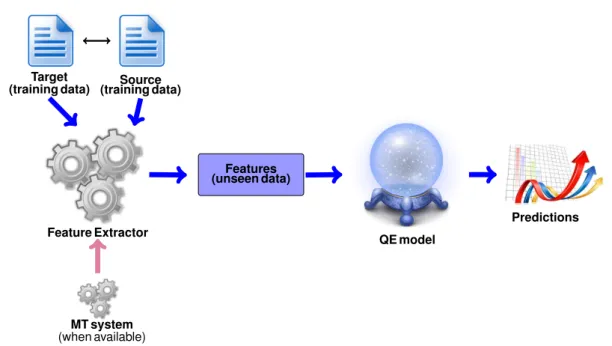
2.1 General framework of Quality Estimation: training stage . . . 31 2.2 General framework of Quality Estimation: predicting quality of unseen data 32 2.3 QUEST++ framework structure . . . 39
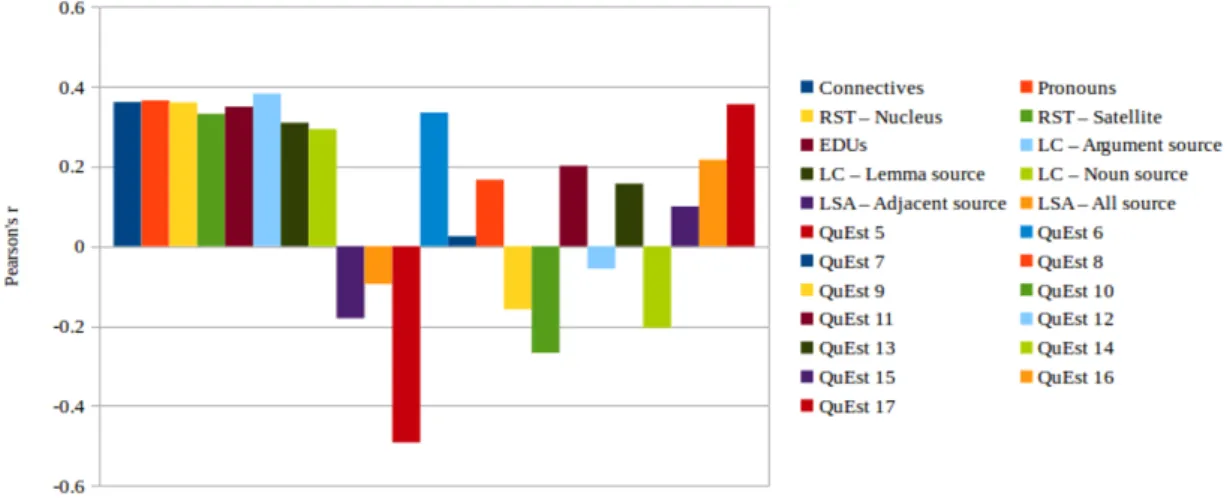
3.1 Example of RST relation between two EDUs. . . 59 4.1 Pearson’srcorrelation between target features and HTER values on the LIG
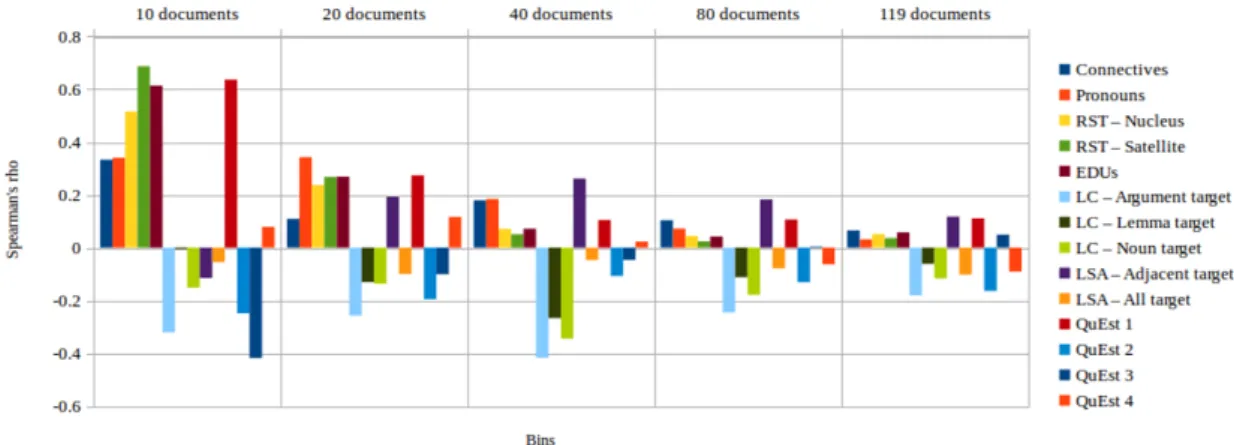
corpus. . . 79 4.2 Spearman’sρ correlation between target features and HTER values on the
LIG corpus. . . 79 4.3 Pearson’s r correlation between target features and HTER values on the
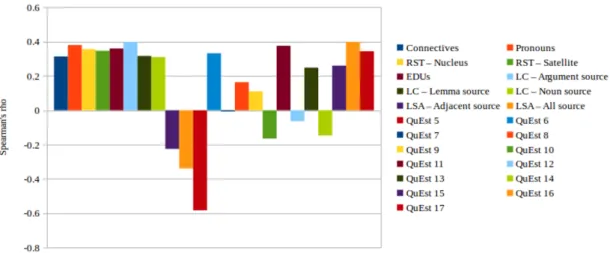
Trace corpus. . . 80 4.4 Spearman’sρ correlation between target features and HTER values on the
Trace corpus. . . 81 4.5 Total number of pronouns and number of incorrectly translated pronouns for
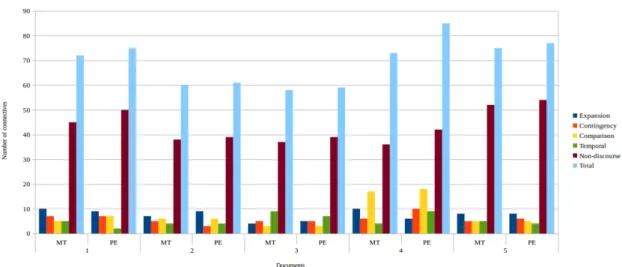
the top five documents in the LIG corpus. . . 82 4.6 Number of connectives in the MT and PE versions of the top five documents
in the LIG corpus. . . 83 4.7 HTER values versus percentage of incorrectly translated pronouns in a
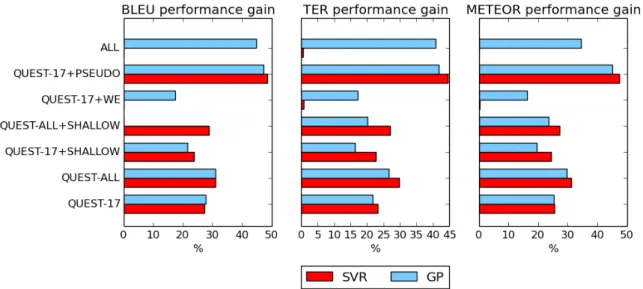
ran-dom sample of 30 documents from the LIG corpus. . . 84 5.1 Performance gains in terms of MAE of the QE models for MOSES documents. 92 5.2 Performance gains in terms of MAE of the QE models for SYSTRAN
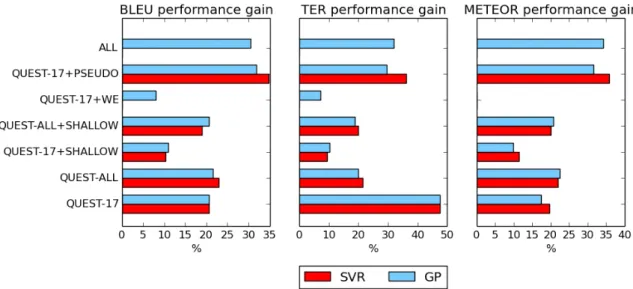
documents. . . 93 5.3 Performance gains in terms of MAE of the QE models for MIXED documents. 94 5.4 Performance gains in terms of MAE of the QE models for WMT EN-DE
5.5 Performance gains in terms of MAE of the QE models for WMT EN-ES documents. . . 98 5.6 Performance gains in terms of MAE of the QE models for WMT EN-FR
documents. . . 99 5.7 Performance gains in terms of MAE of the QE models for WMT DE-EN
documents. . . 101 5.8 Performance gain in terms of MAE of the QE models for WMT ES-EN
documents. . . 102 5.9 Performance gains in terms of MAE of the QE models for WMT FR-EN
documents. . . 103 5.10 Performance gains in terms of MAE of the QE models for LIG documents. 105 5.11 Data distribution of true and predicted values of the best systems predicting
BLEU, TER and METEOR for MIXED scenario in the FAPESP dataset. . . 110 5.12 Data distribution of true and predicted values of the best systems predicting
BLEU, TER and METEOR for EN-DE in the WMT dataset. . . 111 5.13 Data distribution of true and predicted values of the best systems predicting
BLEU, TER and METEOR for DE-EN in the WMT dataset. . . 111 5.14 Data distribution of true and predicted values of the best systems predicting
BLEU, TER, METEOR and HTER for LIG dataset. . . 112 6.1 HTER between PE1 and PE2 for each of the seven paragraphs in each set. . 121 6.2 Performance gains in terms of MAE of the QE models predicting BLEU,
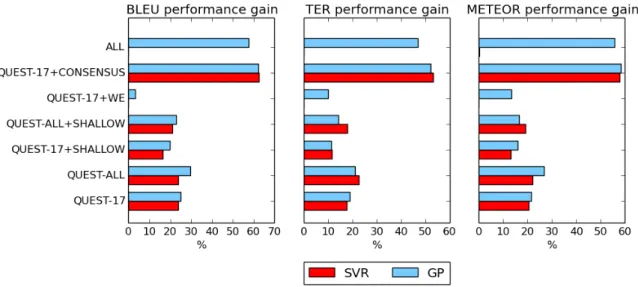
TER and METEOR. . . 128 6.3 Performance gains in terms of MAE of the QE models predicting the new
dissemination labels. . . 129 6.4 Data distribution of true and predicted values of the best systems predicting
BLEU, TER and METEOR. . . 130 6.5 Data distribution of true and predicted values of the best systems predicting
DISS-HTER, DISS-LC-W2, DISS-LC-P and DISS-LC-M. . . 131 6.6 Performance gains in terms of MAE of the models predicting the new
RC-CREG labels and the automatic metrics in the reference corpus. . . 142 6.7 Distribution of correct answers in original and machine translated documents
in the MCtest corpus. . . 143 6.8 Confusion matrix of the best models for the classification task on MCtest
6.9 Confusion matrix of the best models for the classification task on MCtest with five classes. . . 146
List of tables
5.1 Thresholds on Pearson’srcorrelation coefficients used in our experiments. . 88
5.2 Results for MOSES system in terms of Pearson’srcorrelation. . . 91
5.3 Results for SYSTRAN system in terms of Pearson’srcorrelation. . . 92
5.4 Results for MIXED in terms of Pearson’srcorrelation. . . 94
5.5 Overall performance, in terms of BLEU, of MT systems submitted to WMT shared tasks . . . 95
5.6 Results for WMT EN-DE in terms of Pearson’srcorrelation. . . 96
5.7 Results for WMT EN-ES in terms of Pearson’srcorrelation. . . 98
5.8 Results for WMT EN-FR in terms of Pearson’srcorrelation. . . 99
5.9 Results for WMT DE-EN in terms of Pearson’srcorrelation. . . 100
5.10 Results for WMT ES-EN in terms of Pearson’srcorrelation. . . 101
5.11 Results for WMT FR-EN in terms of Pearson’srcorrelation. . . 102
5.12 Results for LIG in terms of Pearson’srcorrelation. . . 105
5.13 Statistic dispersion and central tendency metrics for the FAPESP dataset. . . 108
5.14 Statistic dispersion and central tendency metrics for the WMT dataset. . . . 109
5.15 Statistic dispersion and central tendency metrics for the LIG dataset. . . 109
6.1 WMT paragraph-level corpus statistics. . . 117
6.2 Fleiss inter-annotator agreement for the SUBJ task. . . 119
6.3 Spearman’sρrank correlation for the SUBJ task. . . 119
6.4 Averaged HTER values and Spearman’sρ rank correlation for PE1 against MT and PE1 against PE2. . . 121
6.5 Example of changes from PE1 to PE2. . . 122
6.6 Counts on types of changes made from PE1 to PE2. . . 123
6.7 Results of different models predicting BLEU, TER and METEOR in terms of Pearsonrcorrelation. . . 127
6.8 Results of different models predicting our new labels for dissemination in terms of Pearsonrcorrelation. . . 127 6.9 Statistic dispersion and central tendency metrics for all metrics and new
labels derived from the two-stage post-editing method. . . 130 6.10 Number of documents, average number of words and questions per document
in CREG-mt-eval and MCtest-mt-eval corpora. . . 132 6.11 Example of a document in the CREG corpus and its machine translation . . 133 6.12 Question grades, marks and frequency of the marks in CREG-mt-eval. . . . 135 6.13 Test takers agreement per set. . . 136 6.14 Number of words per set. . . 136 6.15 Test takers Fleiss’ Kappa agreement per document. . . 137 6.16 Average inter-annotator agreement, overall quality (in terms of BLEU) and
overall test takers performance per system. . . 138 6.17 Types of question and their frequency in CREG-mt-eval. . . 138 6.18 Statistic dispersion and central tendency metrics for CREG-P and
RC-CREG-M. . . 140 6.19 Results in terms of Pearsonrcorrelation of the models predicting the new
RC-CREG labels and BLEU, TER and METEOR in the reference corpus. . 141 6.20 Results for the models performing a classification task on MCtest with three
classes. . . 145 6.21 Results for the models performing a classification task on MCtest with five
List of Acronyms
ACT Accuracy of Connective Translation
AS Automatic Summarization
BLEU BiLingual Evaluation Understudy
BP Brevity Penalty
CBOW Continuous Bag-of-Words
CCG Combinatory Categorical Grammar
CE Confidence Estimation
CREG Corpus of Reading Comprehension Exercises in German
CSLM Continuous Space Language Model
DLPT Defence Language Proficiency Test
EDU Elementary Discourse Unit
GP Gaussian Process
GTM General Text Matcher
HTER Human-targeted Translation Edit Rate
LC Lexical Cohesion
LDA Latent Dirichlet Allocation
LM Language Model
LSI Latent Semantic Indexing
LSTM Long Short-Term Memory
MAE Mean Absolute Error
METEOR Metric for Evaluation of Translation with Explicit ORdering
ML Machine Learning
MT Machine Translation
NIST National Institute of Standards and Technology
NLP Natural Language Processing
NP Noun Phrase
PCFG Probabilistic Context-Free Grammar
PDTB Penn Discourse Treebank
PE Post-Editing
PEA Post-Editing Action
POS part-of-speech
QE Quality Estimation
RA Readability Assessment
RBMT Rule-based MT
ROUGE Recall-Oriented Understudy for Gisting Evaluation
RST Rhetorical Structure Theory
RTM Referential Translation Machines
SCFG Synchronous Context-Free Grammar
SMT Statistical Machine Translation
SVD Singular Vector Decomposition
SVM Support Vector Machines
SVR Support Vector Regression
TER Translation Error Rate
TF-IDF Term Frequency - Inverse Document frequency
TOEFL Test of English as a Foreign Language
TOEIC Test Of English for International Communication
TM Translation Memory
TS Text Simplification
WMT Conference on Machine Translation
Chapter 1
Introduction
A major challenge in Natural Language Processing (NLP) is to find ways to evaluate language output taskssuch as Machine Translation (MT), Automatic Summarization (AS) and Text Simplification (TS). Although the nature of these tasks is different, they are related in the sense that a “target” text is produced given an input “source” text. Evaluation metrics for these tasks should be able to measure quality with respect to different aspects (e.g. fluency and adequacy) and should be scalable across different systems and datasets. Human evaluation is the most desirable approach, but it presents several drawbacks. Firstly, human evaluation is not immune to biases where humans would give scores based on their perception of automatic systems, for example. Secondly, this kind of evaluation is time-consuming, expensive and not available for on-demand cases (such as applications targeting directly the end-user). Finally, for some cases, humans can get confused and bored during the evaluation process, which makes it unreliable. Therefore, a significant amount of work has targeted measuring quality of language output tasks without direct human intervention.
In the MT area, the focus of this thesis, machine translated texts are mainly used in two scenarios: dissemination and assimilation (Nirenburg, 1993). Thedisseminationscenario concerns machine translated texts with the purpose of publication. An example is a news agency that may want to make their online English content available for readers of other languages. For that, the quality requirements are high and the final version of the translation is often edited and revised by humans.
MT can also be used for informationassimilation. For example, scientists around the world may wish to know the latest findings by the scientific community in Brazil about the Zica virus by machine translating Portuguese articles. In this case, the quality of the machine translated documents does not need to be perfect, as long as the text is understandable and the meaning of the source is preserved. More recently, with the broad availability and use of the
internet and social media, there is a third scenario, where the aim iscommunication. In this case, users apply MT technologies with the purposes of exchanging information, chatting, dating, ordering goods from foreign countries, among others. As with the assimilation scenario, the quality requirements are low: only the most important information needs to be understandable.
Therefore, a reliable evaluation framework should ideally take into account the purpose of the translation, the targeted audience and the type of the documents, among other as-pects. Human evaluation would be the most desirable, although it has several problems, as mentioned before, and, therefore, automatic evaluation metrics have been proposed to overcome the issues with human evaluation. The BiLingual Evaluation Understudy (BLEU) (Papineni et al., 2002), the Translation Error Rate (TER) (Snover et al., 2006) and the Metric for Evaluation of Translation with Explicit ORdering (METEOR) (Banerjee and Lavie, 2005) are widely used automatic evaluation metrics for MT. These metrics compare the outputs of MT systems with human reference translations. BLEU is a precision-oriented corpus-based metric that comparesn-grams (typicallyn=1..4) from reference texts againstn-grams in the
MT output, measuring how close the output of a system is to one or more references. TER measures the minimum number of edits required to transform the MT output into the closest reference texts at sentence level. METEOR scores MT outputs by aligning their words with words in a reference. The alignments can be done by exact, stem, synonym and paraphrase matchings at sentence level.
One limitation of these automatic metrics is that if the MT output is considerably different from the references, it does not really mean that it is a bad output. Another problem is that human effort is still needed to produce the references. Also, the matching or alignment methods are simplistic. For example, all errors are considered equally important (e.g. a wrong comma is as important a wrong main verb in a sentence) and it is generally not possible (or cumbersome) to customise the metrics for different purposes. Finally, and more importantly, these metrics cannot be applied in cases where the output of the system is to be used directly by end-users. For example, a user reading the output of Google Translate1for a given news text cannot count on a reference for that translated text.
Alternatively, the output of an MT system can be evaluated based on its applications. For example, post-editing can be used as a proxy to evaluate the effort of correcting a machine translation (Plitt and Masselot, 2010; Blain et al., 2011; O’Brien, 2011; Specia et al., 2011; Koponen et al., 2012). Therefore, human interaction is needed to correct the machine translation in order to achieve the same meaning as the source and ensure the fluency and
style of the translation. Human-targeted Translation Edit Rate (HTER) (Snover et al., 2006) is a metric that indirectly evaluates the effort needed to post-edit a sentence. It is calculated by applying TER between the machine translation and the post-edited machine translation (i.e., it replace the human reference with the post-edited version). The post-editing approaches for evaluation are normally linked to the use of MT dissemination purposes, where the quality to be delivered needs to be high.
Another task-based approach is the evaluation of machine translated documents using reading comprehension questions. The hypothesis behind this approach is that if humans are able to answer questions about a machine translated document, the document is considered as good, if not, the document is considered as bad (Tomita et al., 1993; Fuji, 1999; Fuji et al., 2001; Jones et al., 2005b,a; Berka, ˇCerný, and Bojar, 2011). This approach is often used to evaluate MT for the assimilation purpose, where an understandable version of the document is enough.
A more recent form of MT evaluation is referred to as Quality Estimation (QE). QE approaches aim to predict the quality of MT systems without using references. Features (that may or may not be related to the MT system that produced the translations) are extracted from source and target texts (Blatz et al., 2004; Specia et al., 2009a; Bojar et al., 2013, 2014, 2015, 2016b). The only requirement is data points with quality scores (e.g. HTER or even BLEU-style metrics) to train supervised Machine Learning (ML) models in order to predict the quality of unseen data. The advantage of these approaches is that they only need human intervention in order to produce enough data points to build the ML model for QE and, therefore, unseen data does not need to be manually annotated. QE systems predict scores that reflect how good a translation is for a given scenario and, therefore, can be considered a task-oriented evaluation approach. For example, HTER scores are widely used as quality labels for QE systems at sentence level, providing a measure of post-editing effort. A user of a QE system predicting HTER could decide whether to post-edit or translate sentences from scratch based on the scores predicted for each sentence.
So far, QE has been largely explored for word and sentence levels, with little work on document-level QE. Sentence-level QE (Specia et al., 2009a,b; Specia and Farzindar, 2010; Felice and Specia, 2012; Shah, Cohn, and Specia, 2013; Shah et al., 2015a) is the most explored of the three levels, with direct applications on the translation industry workflow. Word-level QE (Blatz et al., 2004; Ueffing and Ney, 2005; Luong, 2014) aims to give a quality score for each word in the translation. Its application include spotting errors, where systems could inform users about the quality of individual words. Both sentence and word levels have been continously explored at the Conference on Machine Translation (WMT),
through QE shared tasks. Document-level QE (Soricut and Echihabi, 2010; Scarton and Specia, 2014a; Scarton, 2015; Scarton et al., 2015) aims to predict a single score for entire documents, which has proven to be a hard task even for humans (Scarton et al., 2015).
In this thesis we focus on document-level QE because it has been less explored than other levels, it is useful for a number of applications and it has several challenges commonly found in other NLP tasks (e.g. AS).
Document-level QE can be used to evaluate machine translations of entire documents that need to be used “as is”, without post-editing (assimilation case). A scenario would be quality assessment of machine translated user generated content in e-services that deal with buyers from all around the world. For example, an English speaking user searching for a hotel in Greece might be interested in the reviews of other people that stayed in this hotel. However, the majority of the reviews are in Greek and, therefore, machine translating the reviews is the only option for the user who does not speak Greek. In this scenario, the user might be interested in the overall quality of the machine translated review that he/she is reading, in order to decide if he/she can trust it or not. An evaluation of quality per sentence is not useful, because the user is interested in the full document (review). In a similar case, e-services providers could also be interested in using MT to translate reviews from a language into another when they are starting to offer a product in a new country. Quality assessment of entire reviews is needed in order to select which reviews will be understood by the users and thus can be published.
Another application is to estimate the cost of post-editing machine translated documents (dissemination case). It is common for translation companies to hire freelance translators to perform translation tasks. Frequently, due to cost issues or disclosure agreements, the translators only receive a set of shuffled sentence for post-editing. Then, after receiving the post-editions, an in-house translator needs to revise the entire document, and correct document-wide problems. Such a complex scenario makes it difficult to clearly estimate the cost of a translation service.Therefore, a document-level cost estimation that takes into account the costs of the work performed by the freelancer (at sentence level) and the revision work would be useful for the translation industry.
We address the following challenges faced by QE for MT at document level:
Features Designing and identifying the best features for building the QE models is a challenge in QE. For document-level, the state-of-the-art features are based on pseudo-references (Soricut and Echihabi, 2010; Soricut, Bach, and Wang, 2012; Soricut and Narsale, 2012; Shah, Cohn, and Specia, 2013). Pseudo-referencesare translations produced by MT
systems other than the system we want to predict the quality of. They are used as “artificial” references to evaluate the output of the MT system of interest via traditional automatic evaluation metrics (e.g. BLEU). However, such features usually cannot be extracted in real-world scenarios since they make certain assumptions about the MT systems used to produce the pseudo-references (such as quality) that are often unavailable. Therefore, the design and evaluation of new features is needed. Another challenge in feature engineering for document-level QE is the use of linguistic information that goes beyond words or sentences.
Discourseis a type of linguistic information that often manifests itself document-wide. Since the state-of-the-art MT systems translate documents at sentence-level, disregarding discourse information, it is expected that the outputs of these systems will contain discourse problems. Because of that, recently there have been initiatives to include discourse information in MT (Marcu, Carlson, and Watanabe, 2000; Carpuat, 2009; LeNagard and Koehn, 2010; Zhengxian, Yu, and Guodong, 2010; Meyer and Popescu-Belis, 2012; Ture, Oard, and Resnik, 2012; Ben et al., 2013; Hardmeier, 2014), MT evaluation (Giménez and Màrquez, 2009; Giménez et al., 2010; Meyer et al., 2012; Wong and Kit, 2012; Guzmán et al., 2014) and also in QE at sentence level (Rubino et al., 2013). However, thus far there are no contribution on document-level QE that explores document-wide or discourse-aware features and effective ways of combining such features along with more shallow information.
Quality labels Another challenge in document-level QE is devising a quality score to predict. Previous research has used automatic evaluation metrics as quality labels for document-level QE (Soricut and Echihabi, 2010; Soricut, Bach, and Wang, 2012; Soricut and Narsale, 2012). However, our hypothesis is that traditional metrics, developed to evaluate outputs of different MT systems of the same source text, do not capture differences among machine translations of different documents, because they only capture generic errors that, although are useful for system-level evaluation, are not distinctive in terms of individual document quality (n-grams matching and word alignments, for example). This is even more problematic if the documents are translated by the same or similar MT system(s). This leads to low variation between the document quality scores and, therefore, all document scores are close to the average quality of the dataset. Another problem is that automatic evaluation metrics do not account for document-wide and discourse-aware problems, they are limited to superficial information aboutn-grams. Finally, automatic evaluation metrics are not targeted at a purpose and cannot be directly interpreted as an absolute quality indicator by the end-user (e.g. what does a BLEU score of 0.6 mean?). Therefore, new quality labels
ML models Investigating and developing ML models for QE is highly dependent on the task and on the quality labels provided. For instance, labels following a continuous distribution are more suitable to be used with regression models, whilst labels that follow a discrete distribution are more likely to be approached with classification models. Moreover, features of different nature (e.g. word embeddings versus handcrafted) may need to be treated differently inside the ML model. Therefore, different ML approaches need to be investigated in order to develop reliable studies in QE.
1.1 Aims and Objectives
The aims and objectives of this thesis are:1. Investigate novel shallow and deep information sources and ways of combining these sources for the task of document-level QE. More specifically:
(a) Sentence-level information and ways of aggregating it for document-wide ap-proaches.
(b) Latent variable models (e.g. Latent Semantic Analysis (LSA) (Landauer, Foltz, and Laham, 1998)) for modelling (shallow) discourse-aware features;
(c) Linguistic theories (e.g. Rhetorical Structure Theory (RST) (Mann and Thomp-son, 1987)) and tools available for modelling (deep) discourse-aware features; (d) Consensus of MT systems as features for document-level QE;
(e) Word embeddings as features for document-level QE;
2. Devise reliable quality labels for the task of document-level QE. More specifically: (a) Devise and acquire human-targeted task-oriented labels for assimilation purposes
using a method based on reading comprehension tests for data collection and linear combination approaches for devising the labels;
(b) Devise and acquire human-targeted task-oriented labels for dissemination pur-poses using a method based on two-stage post-editing for data collection and linear combination approaches for devising the labels;
(c) Understand how the documents are distinguished by the label and whether or not they capture discourse-aware phenomena.
3. Investigate appropriate ML models and techniques for QE at document-level. More specifically:
(a) Explore different approaches for modelling document-level QE: multiclass and ordinal classification and non-linear and bayesian regression;
(b) Investigate kernel combination approaches as a way of dealing of the peculiarities of features of different nature.
1.2 Contributions
This thesis introduces the following main contributions:
• A new method for document-level evaluation for dissemination purposes called two-stage post-editing. This method consists in post-editing sentences in two steps: firstly sentences are post-edited in isolation, without the influence of document context. The idea is to solve all sentence-level issues. After this stage, the post-edited sentences are put into document context and the same post-editor is asked to perform any remaining changes.2 These two stages aim to isolate document-aware problems and provide a
resource for a more reliable document evaluation;
• New approaches for devising quality labels for document-level QE from the two-stage post-editing method, aiming to penalise documents with more document-aware issues; • Two new methods for devising quality labels for document-level QE from reading comprehension tests (dissemination scenario), one evaluating documents by using open questions and another with multiple choice questions. In the first case, the document scores follows a continuous distribution, given that the open questions are marked following a continuous scale. Moreover, the question marks are linearly combined and weighted by the number of questions per document. In the second case, the multiple choice questions produces a discrete distribution, where there is an ordinal relation between the scores;
• Design and analysis of new feature sets for document-level QE. The new feature sets focus on different information types: document-aware (sentence-level information
2It is important to have the same translator to perform both steps in order to avoid changes related to
aggregated at document-level), discourse-aware (document-wide discourse informa-tion) and consensus (pseudo-reference-based). Features are analysed in terms of their correlation with quality scores and their effectiveness in building document-level QE models;
• Annotated corpora:
– FAPESP corpus with documents machine translated by three different MT sys-tems from English into Brazilian Portuguese (2,823 documents);
– WMT corpus organised by documents for English into German, Spanish and French (and vice-versa) with the purpose of document-level QE (474 documents for each language pair);
– WMT paragraph-level corpus for the paragraph-level QE shared task organised in WMT15 (1,215 paragraphs);
– A two-stage post-editing corpus that is a sample of WMT corpus in which the two-stage post-editing method was applied (208 documents);
– CREG-mt-eval corpus, based on the CREG corpus (Ott, Ziai, and Meurers, 2012), this corpus was translated by three different MT systems with an extra version with mixed sentences (one from each MT systems) and human translations for some documents as references (215 documents);
– MCtest-mt-eval, based on the MCtest corpus (Richardson, Burges, and Renshaw, 2013), with backward translation from English into German and back into English (660 documents).
• An extension of the QUEST++ framework for document-level QE. The document-level
module of QUEST++ was developed based on the existing sentence-level structures. A
document is considered a group of sentences and thus, 69 sentence-level features were adapted for document level. Moreover, nine new discourse features were also added into the framework;
• The organisation of WMT15 paragraph-level QE shared task and WMT16 document-level QE shared task. In the WMT15, the task consisted in predicting METEOR scores of paragraphs. The data used were taken from the WMT13 translation shared task. In WMT16, the task was predicting the quality of entire documents. Quality scores were devised from the two-stage post-editing method. The documents were selected from WMT08, 09, 10, 11, 12 and 13 translation shared tasks.
1.3 Published Material
Some parts of this thesis were published in the following:
• Carolina Scarton, Daniel Beck, Kashif Shah, Karin Sim Smith and Lucia Specia (2016): Word embeddings and discourse information for Quality Estimation. In the Proceedings of the First Conference on Statistical Machine Translation, Berlin, Germany, pp. 831-837.
• Ondˇrej Bojar, Rajen Chatterjee, Christian Federmann, Yvette Graham, Barry Haddow, Matthias Huck, Antonio Jimeno Yepes, Philipp Koehn, Varvara Logacheva, Christof Monz, Matteo Negri, Aurelie Neveol, Mariana Neves, Martin Popel, Matt Post, Raphael Rubino, Carolina Scarton, Lucia Specia, Marco Turchi, Karin Verspoor and Marcos Zampieri (2016): Findings of the 2016 Conference on Machine Translation. In the Proceedings of the First Conference on Statistical Machine Translation, Berlin, Germany, pp. 131-198.
• Carolina Scarton and Lucia Specia (2016): A Reading Comprehension Corpus for Machine Translation Evaluation. In the Proceedings of the Tenth International Con-ference on Language Resources and Evaluation (LREC 2016), Portorož, Slovenia, pp. 3652-3658.
• Carolina Scarton and Lucia Specia (2015): A quantitative analysis of discourse phe-nomena in machine translation. Discours - Revue de linguistique, psycholinguistique et informatique, number 16.
• Ondˇrej Bojar, Rajen Chatterjee, Christian Federmann, Barry Haddow, Matthias Huck, Chris Hokamp, Philipp Koehn, Varvara Logacheva, Christof Monz, Matteo Negri, Matt Post, Carolina Scarton, Lucia Specia and Marco Turchi (2015): Findings of the 2015 Workshop on Statistical Machine Translation. In the Proceedings of the Tenth Workshop on Statistical Machine Translation, Lisbon, Portugal, pp. 1-46.
• Carolina Scarton, Liling Tan and Lucia Specia (2015): USHEF and USAAR-USHEF participation in the WMT15 QE shared task. In the Proceedings of the Tenth Workshop on Statistical Machine Translation, Lisbon, Portugal, pp. 336-341.
• Lucia Specia, Gustavo Henrique Paetzold and Carolina Scarton (2015): Multi-level Translation Quality Prediction with QuEst++. In the Proceedings of ACL-IJCNLP 2015 System Demonstrations, Beijing, China, pp. 110-120.
• Carolina Scarton (2015): Discourse and Document-level Information for Evaluating Language Output Tasks. In the Proceedings of NAACL-HLT 2015 Student Research Workshop (SRW), Denver, CO, pp. 118-125.
• Carolina Scarton, Marcos Zampieri, Mihaela Vela, Josef van Genabith and Lucia Specia (2015): Searching for Context: a Study on Document-Level Labels for Translation Quality Estimation. In the Proceedings of the 18th Annual Conference of the European Association for Machine Translation (EAMT 2015), Antalya, Turkey, pp. 121-128. • Carolina Scarton and Lucia Specia (2014): Document-level translation quality
esti-mation: exploring discourse and pseudo-references. In the Proceedings of the 17th Annual Conference of the European Association for Machine Translation (EAMT 2014), Dubrovnik, Croatia, pp. 101-108.
• Carolina Scarton and Lucia Specia (2014): Exploring Consensus in Machine Transla-tion for Quality EstimaTransla-tion. In the Proceedings of the Ninth Workshop on Statistical Machine Translation (WMT 2014) - in conjunction with ACL 2014, Baltimore-MD, pp. 342-347.
Two tutorials (products of this thesis) were also given and one tutorial is being prepared: • QUEST++ tutorial preparation and presentation at Alicante University, Alicante, Spain
- 24/01/2016;3
• QUEST++ tutorial preparation and presentation at the International Conference on
the Computational Processing of the Portuguese Language (PROPOR 2016), Tomar, Portugal - 13/07/2016;4
• QUEST++ tutorial preparation to be presented at the 26th International Conference on
Computational Linguistics (COLING 2016), Osaka, Japan - 11/12/2016.5
1.4 Structure of the Thesis
In Chapter 2 we present a literature review of MT evaluation. Different kinds of evaluation approaches are discussed including manual evaluation, reference-based evaluation and human-targeted evaluation. This chapter also contains the detailed description of the QE task,
3http://staffwww.dcs.shef.ac.uk/people/C.Scarton/resources.html 4http://propor2016.di.fc.ul.pt/?page_id=705
including a discussion about all levels of prediction (word, sentence and document). Features for QE are also discussed, focusing on work that used linguistic information for QE at word and sentence levels.
Chapter 3 contains the literature review about discourse research for MT. We use a taxonomy of discourse (Stede, 2011) and categorise the research papers following it. A discussion of how each level is related to this thesis is presented in the end of each section.
Chapter 4 presents the document-level features used in this thesis. We separate the features in three classes: document-aware, discourse-aware and consensus features. In the end of this chapter we present a preliminary analysis of the correlation of discourse features with HTER.
In Chapter 5 we show our first experiments with document-level QE. BLEU, TER, METEOR and HTER are used as quality labels for document-level prediction. Three different datasets are used: FAPESP (English-Brazilian Portuguese), WMT (English into German, Spanish and French and vice-versa) and LIG (French into English). Finally, we discuss the results and evaluate the usefulness of automatic evaluation metrics as quality labels for document-level QE.
Chapter 6 presents our new labels, proposed in order to better evaluate documents for the task of document-level QE. Two approaches are introduced: one based on reading comprehension questions and another on a two-stage post-editing method. We then analyse the results achieved by the new labels by comparing them with automatic evaluation metrics results and discuss their effectiveness.
Finally, in Chapter 7 we summarise the thesis and provide a discussion of future directions for document-level QE research.
Chapter 2
Machine Translation Evaluation
Assessing the quality of documents is a challenge for many NLP tasks, starting from the question of definingquality. MT quality assessment is a subjective task that depends on various factors, including the purpose of the translation: what the text will be used for and by whom. Traditional MT evaluation uses generic metrics of error/correctness, focusing on the fact that machine translation sentences are likely to contain errors (Koehn, 2010). This kind of evaluation is useful for system comparisons and ranking of systems, but does not provide meaningful information on quality for the end-user.
As discussed in Chapter 1, automatically translated texts are mainly used in two scenarios: dissemination and assimilation (Nirenburg, 1993). Thedisseminationscenario concerns ma-chine translated texts with the purpose of publication and, therefore, the quality requirements are high. Forassimilation, the quality requirements are less strict: just the main information needs to be understandable.
In this chapter we describe the main evaluation approaches employed in MT. Section 2.1 presents human evaluation of machine translated texts. The settings evaluate sentences according to fluency and adequacy scores or rank MT systems.
Section 2.2 presents the use of automatic metrics for MT evaluation. Such automatic metrics, usually performed at sentence or corpus level, are reference-based: quality scores are acquired by evaluating similarities between the machine translated texts and human references. BLEU, METEOR and TER are the widely used metrics of this kind and are usually also employed for tuning MT systems.
In Section 2.3, task-based approaches for MT evaluation are discussed. Such approaches are useful if the purpose of the MT output goes beyond system evaluation and system tuning. Post-editing, the task of changing the MT output in order to achieve fluent and adequate translations, is used with the purposes of reducing costs of the translation process. For
example, a metric that evaluates the cost of post-editing a sentence (or a document) is useful to inform users about the indirect quality of the machine translation. Another task-based approach uses reading comprehension tests about the machine translated documents. In this case, the purpose is to evaluate whether or not the machine translation is comprehensible. A quality score can be devised by counting the correct answers that a human scored for each document. Finally, eye tracking techniques have also been explored to assess MT quality for task-based approaches.
In Section 2.4 we present QE: a kind of evaluation that focuses on predicting the quality of unseen data, by using models trained with data points labelled for quality. The general framework for QE is also presented, showing the modules for feature extraction from source and target texts and machine learning. QE is widely explored at sentence and word levels, with a considerable amount of work done in terms of feature engineering and ML research. Here, we focus on document-level QE, which is the main topic of this thesis. The creation of fully automated solutions that provide machine translated content directly to the end user is an example of the utility of document-level QE. Previous work on QE for sentence and word levels using linguistic features is also discussed in order to provide some background for our study on discourse information in Chapter 4. Finally, this section also includes the description of QUEST++, a tool with feature extraction and ML modules for QE, and our
contribution for the document-level QE module.
In the remainder of this thesis we use the terms “target” or “target text” as a synonym of “MT output”. The terms “source” or “source text” will refer to the input text given to the MT
system.
2.1 Manual Evaluation
Manually evaluating NLP tasks is probably the most intuitive way of assessment that one can think of. In MT, evaluating by hand whether or not a translation is good is an approach for quality evaluation. Such evaluations can be performed by bilingual evaluators (who can judge if the target preserves the source information) and monolingual evaluators (that need a reference translation in order to assess the machine translation). Traditionally, humans evaluate MT output at sentence level, although they may benefit from the full document in order to assess discourse problems (Koehn, 2010).
Human translation evaluation is a difficult task, since different translators can have different views on the same translation and, therefore, have different translation preferences. Manually evaluating machine translations is also problematic: humans can be biased by their
own preferences and, in consequence, the judgements variation between annotators is usually high. Moreover, different subjects can have different expectations about what the purpose of the translation is and, even if the guidelines are clear whether the purpose is dissemination or assimilation, these concepts are vague and humans will probably disagree in their evaluation. Finally, human evaluation is costly, time-consuming and, therefore, cannot be performed in real-time scenarios (e.g. gisting).
A kind of manual evaluation that has been largely employed in MT area assessesfluency
andadequacy(Koehn, 2010). Humans judgments of fluency check if a translation is fluent in
the target language, i. e. if it uses the correct grammar and idiomatic choices, disregarding its meaning. On the other hand, human judgements of adequacy check if a translation preserves the same meaning as the source (or reference(s)) (Snover et al., 2009). Both fluency and adequacy are often evaluated at sentence level in a 1 to 5 scale (1 being worst and 5 the best) (Koehn and Monz, 2006; Callison-Burch et al., 2007).
Although the concepts of fluency and adequacy can be considered easy to interpret, assessing them is not trivial. Humans have different perspectives of such concepts and, therefore, the scores from different evaluators can show high variation. Especially for adequacy, humans are capable of filling in the missing information without noticing problems with the machine translation (Koehn, 2010). Moreover, Fomicheva and Specia (2016) argue that, for human evaluation scenarios using reference translations only, annotators are heavily biased by the structure of the reference(s), giving bad scores for machine translations that highly differ from the reference(s), even though the meaning is preserved.
Another widely used human evaluation technique is to rank machine translation systems. For each source sentence, a fixed number of machine translations from different MT systems (normally five) are shown to the annotators and they are asked to rank the machine translations in a fixed scale, usually from 1 (best) to 5 (worst). Therefore, the ranking task encompasses the comparison of the machine translated sentences among themselves and against the source sentence (in some cases, a human reference of the sentence under evaluation can also be available). Ties are allowed, given that different MT systems can output the same or very similar machine translations. Ideally, the same set of sentences is evaluated by more than one annotator so that agreement scores can be computed. Koehn (2010) claims that this kind of evaluation is more consistent than the fluency/adequacy scores. This type of evaluation is the official evaluation of the MT shared tasks of WMT since 2008 (Callison-Burch et al., 2008, 2009, 2010, 2011, 2012; Bojar et al., 2013, 2014, 2015, 2016b).
Both fluency/adequacy scores and ranking cannot be directly extended to document level. Judging documents directly is unfeasible to humans, since documents encompass different
problems on different levels. Averaging sentence-level scores in order to have a document level scores is probably the most intuitive way. However, as we discuss later in Chapter 6, averaged sentence-level scores are not reliable in expressing document quality.
2.2 Automatic Evaluation Metrics
In order to overcome the shortcomings of manual evaluation (such as time and costs), auto-matic evaluation metricshave been proposed over the years. Such metrics automatically assess machine translations by comparing them to one or more human translations (called reference translations). Although this approach still requires human interaction, it is much less time-consuming and expensive, since it requires texts to be translated by humans only once and the same documents can be used to evaluate different MT systems.
Similarly to other NLP tasks, MT can also be evaluated by usingprecision,recalland f-measure. Precision is calculated as the ratio between the number of correct word matches (between target and reference) divided by the length of the target. Recall is the ratio between the number of correct word matches and the length of the reference. F-measure is the harmonic mean between the two metrics. Such metrics do not consider word order and they can be easily misleading. Short machine translations are more likely to show higher precision while recall can be maximised by having more repeated correct words on the machine translation than on the reference.
Therefore, more sophisticated metrics have been proposed in order to overcome the issues with precision and recall. BLEU, TER and METEOR are examples of widely used metrics for MT evaluation, although several other metrics have been proposed over the years. WMT annually organises a shared task on MT evaluation since 2008 (Callison-Burch et al., 2008, 2009, 2010, 2011, 2012; Macháˇcek and Bojar, 2013, 2014; Stanojevi´c et al., 2015; Bojar et al., 2016a).
Such automatic evaluation metrics are at sentence level. By aggregating sentence-level scores, a corpus level evaluation is achieved, the corpus being the test corpus (that can be composed of random disconnected sentences). For MT (mainly Statistical Machine Translation (SMT)) the context of the sentences is not important, given that the translation is performed sentence-by-sentence, disregarding context. Consequently, the traditional MT evaluation used to evaluate MT systems usually also deals with corpus made of random sentences. Therefore, automatic evaluation metrics are designed forsystem evaluation and comparisonmainly and not forabsolute quality assessment of translations. Finally, it is
common to refer to this kind of evaluation performed by such metrics assegment-leveland
system-levelevaluation.
Although recent advances include the use of discourse information (Joty et al., 2014) and sophisticated Long Short-Term Memory (LSTM)-based approaches (Gupta, Orasan, and van Genabith, 2015) for MT evaluation, there is no approach that addresses document-level assessment apart from aggregating sentence-level scores. The reasons for this are: (i) the majority of MT systems (mainly traditional SMT systems) perform translation sentence-by-sentence and, therefore, sentence-by-sentence-level evaluation is still important in this scenario; (ii) the aggregation of sentence-level scores lead to asystem-levelevaluation, mainly because the entire corpus can be composed by random sentences, and (iii) the evaluation of such metrics is done against manual evaluation (ranking) which is also done at sentence level.
Additionally, the traditional assessment procedure to evaluate automatic metrics per-formance relies on human rankings (Stanojevi´c et al., 2015). Humans are asked to rank sentences translated by different MT systems. These rankings are then used to evaluate the automatic metrics, by correlation scores (such as Pearsonr). As such, metrics are designed and often optimised to compare different systems.
In this section we present BLEU, TER and METEOR in detail, since these metrics are very popular, perform reasonably well and are used in the experiments presented in this thesis.
BLEU
BiLingual Evaluation Understudy (BLEU) is the most widely used metric for MT evaluation. This metric, proposed by Papineni et al. (2002), is a precision-oriented metric that also takes recall into account (penalising target sentences which are shorter than the references). It was designed to be used with more than one reference, although it is also possible to be used for cases where only one reference is available. Despite the fact that sentence-level approximations are also usually performed for evaluation at segment sentence-level, BLEU is a corpus-based metric that uses information from the entire corpus.
The precision in BLEU is amodifiedn-gram precisionwhere, for each targetn-gram, it is computed the maximum number of times that thisn-gram appear in any of the reference translation sentences. The total count of each candidate n-gram is then clipped by its maximum counts in the reference corpus. After that, the clipped values are summed and
divided by the total number of candidaten-grams in the entire corpus. Equation 2.1 shows how modifiedn-gram precision is calculated for the entire corpus.
pn=
∑
C∈{Candidates}n-gram∈∑ C
Countclip(n-gram)
∑
C′∈{Candidates}n-gram’∈∑ C′Count
(n-gram’) (2.1)
Although Equation 2.1 already penalises long candidate sentences, short sentences could wrongly maximise the precision. The solution proposed in BLEU was to multiply the Equation 2.1 by a factor called Brevity Penalty (BP)that is expected to be 1.0 if the
candidate’s sentence length is higher than all reference sentence length. BP is calculated for the entire corpus (Equation 2.2). First the closest values for matching reference and candidate sentences are summed for all sentences (r). Then, r/cis used in a decaying exponential
equation (cbeing the total length of the candidate corpus).
BP= 1 ifc>r e1−r/c ifc≤r (2.2)
Equation 2.3 shows the final BLEU equation (whereNis then-gram order andwn=1/N). Traditional BLEU usesN=4 (4-gram).
BLEU=BP·exp N
∑
n=1 wnlogpn ! (2.3) Since BLEU is a precision-oriented metric, values range from 0 to 100, being 0 the worst and 100 the best.METEOR
The Metric for Evaluation of Translation with Explicit ORdering (METEOR) was designed in order to overcome BLEU’s weaknesses, such as the lack of an explicit recall component, the use of n-grams with high order, the lack of explicit word matches and not providing a reliable sentence-level score (Banerjee and Lavie, 2005). METEOR computes explicit unigram alignments between words from target and reference translations. For cases with more than one reference, the reference that leads to the best final METEOR score is chosen.
In order to compare target and reference sentences, METEOR establishes alignments among the words. Each word in the target sentence must be aligned to zero or only one word in the reference. Such alignments are acquired in two stages. In the first stage, all possible
word-level alignments are retrieved by an external module. Such module can consider the following steps: “exact match” (where the word in the target should be exactly the same as in the reference), “stem match” (where stems are matched instead of words), “synonym match” (where words in the target can be matched to their synonyms in the reference) and “paraphrase match” (where entire phrases are matched, if they are defined as paraphrases in an external resource provided) (Denkowski and Lavie, 2014). Each step is applied in isolation and the order that they are applied matters. For example, if “exact match” is applied first and the word “dog” in the target was aligned to an exact match in the reference, this word will not be aligned again in the “stem match”, even though other alignments are possible.
In the second stage, the word alignments are selected according to the position of the words in both target and reference. In fact, what is expected from this stage is to penalise target sentences that show word ordering far from the expected in the reference. METEOR, then, accounts for the number of alignmentcrossesbetween the words and select the set of alignments that shows lesscrosses.
With the selected word alignments, the METEOR score is generated using a harmonic mean (Fmeanbetween precision and recall scores) (Equation 2.4). Precision (P) is the number of unigram alignments between target and reference divided by the number of words in the target and recall (R) is the number of alignments between target and reference divided by the number of words in the reference.
Fmean= P·R
α·P+ (1−α)·R (2.4) Finally, a penalty factor is added in order to take into accountn-gram alignments. The number of alignments between chunks of words (n-grams) is divided by the number of word alignments, as shown in Equation 2.5.
Penalty=γ·
ch
m
β
(2.5) The final METEOR score is defined by Equation 2.6. Parametersγ, β and α can be optimised to maximise correlation with human ranks.1
METEOR= (1−Penalty)·Fmean (2.6)
1In the recent versions of METEOR other parameters can be optimised in order to calculate weighted
METEOR is an f-measure-oriented metric and its values range from 0 to 100, where higher values mean better performance.
TER
Translation Error Rate (TER) (Snover et al., 2006) is a metric for MT evaluation that calculates the minimum number of edits needed to transform the target into one of the references. It was designed to be a more intuitive score when compared to BLEU and METEOR.
Theminimum number of editsis computed only between the target and the reference that requires less edits to be achieved. Such modifications (edits) can be insertion, deletion, substitution or shifts (when words change position into the sentence). Punctuations are also considered as words and the metric is often case-sensitive. The different type of edits are treated with equal costs. The minimum number of edits is then divided by the average length of the references (all references are included in the average) (Equation 2.7).
TER= minimum # of edits
average # of reference words (2.7) Since it is not computationally possible to calculate the optimal edit-distance with shifts (such problem isNP-Complete), TER uses approximations calculated in two steps. Firstly, dynamic programming is used to compute the number of insertions, deletions and substitutions. The set of shifts that most reduces the number of insertions, deletions and substitutions is obtained by using greedy search. Secondly, a minimum edit distance is used to calculate the remaining edit distance (the optimal is achieved by dynamic programming).
TER is an error-based metric, with values ranging from 0 to 100, where higher values lead to worse results.
2.3 Task-based Evaluation
As mentioned before, manual and automatic evaluation metrics are mainly designed to assess system performance in comparison to other systems. However, the purpose of MT can be different: one can be interested in whether or not a machine translation output “is good enough” for a given task. MT can be used for improving translation productivity andgisting, for example. In both cases, a task-oriented evaluation is more informative than scores related to number of errors in sentences according to human references.
In this section, we present two different task-oriented approaches for MT evaluation. Cost or effort of post-editing is useful when MT is being used in the translation workflow and the translation quality is required to be high (therefore, it is a scenario of dissemination) (Section 2.3.1). The use of Reading Comprehension tests aim to evaluate whether a machine translated text can be understandable even though it presents errors (assimilation) (Section 2.3.2).
2.3.1 Post-editing Effort
Post-editing is the task of checking and, when necessary, correcting machine translations. Such corrections are performed by humans2and the hypothesis is that correcting a machine translated text is faster than translating it from scratch. Globalisation and the need for information in different languages as fast as possible gave a higher importance for translation solutions that goes beyond the traditional human translation workflow. Consequently, there is a need to make the translation process faster and more accurate (Dillinger, 2014). Post-editing of machine translations is one approach associated to the use of MT for dissemination.
However, as expected, it is not always the case that correcting a machine translation is quicker than translating it from scratch. Some sentences have such low quality that the task of reading it, trying to understand it and correcting it is more time-consuming than translating it from scratch. Therefore, estimating post-editing effort to support the translator work in automatic ways (e.g. informing the translator whether or not it is worth post-editing a sentence) can be an informative metric in the translation process.
According to Krings (2001), post-editing effort has three dimensions: temporal, cognitive and technical. The temporal dimension is the most straightforward of the three. It is the direct measurement of the time spent by the post-editor to transform the MT output into a good quality post-edited version. Although cognitive aspects are directly related to temporal effort, they cannot be fully captured directly. Cognitive aspects encompass linguistic phenomena and style patterns; and their measurements can only be done by using indirect means of effort assessment (e.g. keystrokes pauses). For example, a simple change in a verb tense require much less cognitive effort than resolving an anaphora. Finally, the technical dimension involves the practical transformations performed in order to achieve the post-edited version. Such transformations can be insertion, deletion, shift or a combination of all of them. It is worth noting that the technical dimension focuses on the different operations without
2Although initiatives to automate post-editing already exists (Bojar et al., 2015), here we only refer to
accounting for the complexity of such operations as a function of linguistic properties of the text as it is done in the cognitive dimension.
As previously mentioned, the most intuitive and direct measure of post-editing effort is
post-editing time. The time taken to post-edit can be used as a proxy for quality: segments that take longer to be post-edited are considered worse than segments that can be quickly corrected. Koponen et al. (2012) argue that post-editing time is the most effective way of measuring cognitive aspects of the post-editing task and relating them to the quality of the machine translations. Plitt and Masselot (2010) use post-editing time (more specifically, words per hour) to measure the productivity gain of post-editing machine translated text in a real scenario of translation workflow, instead of performing translation from scratch. The words per hour metric shows high variation among different annotators, although post-editing is consistently less time-consuming than translation from scratch. The authors also show that MT reduces keyboard time (time that the translator spent typing) by 70% and pause time (time that translator spent thinking, reading and searching for references) by 30%. Although post-editing time seems to be a good metric of post-editing effort, it can be inaccurate and difficult to achieve. Firstly, the post-editing time is a very noisy metric, since the translators can get distracted or take breaks while translating a sentence. Secondly, a high variation among different translators’ post-editing time is expected, given that translators have different typing skills, translation experience and proficiency with the post-editing tool, among other aspects. In addition, post-editing time can encompass reading time, correction time and revision time, although the relationship among these factors is unclear.
Perceived post-editing effortis an alternative way of evaluating post-editing effort and it can capture cognitive aspects of post-editing. In this evaluation approach, humans are asked to give a score for the machine translated sentences according to alikert scale (Specia et al., 2011). This type of scores can be given with or without actual post-editing and they represent the humans belief on how difficult it would be (or it was) to fix the given machine translated sentences. In the first edition of WMT QE shared task in 2012 (Callison-Burch et al., 2012), thelikertscale varied from 1 to 5, where:
• 1 - The MT output is incomprehensible, with little or no information transferred accurately. It cannot be edited, needs to be translated from scratch.
• 2 - About 50% to 70% of the MT output needs to be edited. It requires a significant editing effort in order to reach publishable level.
• 3 - About 25% to 50% of the MT output needs to be edited. It contains different errors and mistranslations that need to be corrected.
• 4 - About 10% to 25% of the MT output needs to be edited. It is generally clear and intelligible.
• 5 - The MT output is perfectly clear and intelligible. It is not necessarily a perfect translation, but requires little to no editing.
Alternatively, cognitive aspects of post-editing can be measured viaeye-tracking. Eye-tracking techniques can measure fixation time (for how long the post-editor fixates on the text) or saccade time (movement of eyes). O’Brien (2011) measures fixation time and correlates it with General Text Matcher (GTM) (a similarity metric between the target and the reference sentences based on precision, recall and f-measure) (Turian, Shen, and Melamed, 2003). Fixation time shows correlation with GTM scores: low GTM scores shows high fixation time. In addition, post-editing pauses (extracted from keystroke logs) can also be viewed as an indirect measure of cognitive effort (Lacruz, Denkowski, and Lavie, 2014). Long pauses are associated with segments that demand more cognitive post-editing effort.
Blain et al. (2011) define Post-Editing Action (PEA) as a post-editing effort metric based onlinguistic information. The difference from “mechanical” edits (e.g. insertion, deletion, substitution) is that PEA is related to linguistic changes. Instead of simple word edits, PEA has a “logical” aspect that aggregates several “mechanical” edits together, based on the type of change. For example, if changing a noun in a sentence would mean changing the gender of an adjective in the same sentence, PEA would count only one change (the noun) while “mechanical” edits would take into account both changes (noun and adjective). In order to automatically identify the PEAs, Blain et al. (2011) use TER as proxy for for edit distance. The authors claim that informing users with PEAs information would help in cases where the MT quality is already high and the task is to perform light reviews.
In general, although cognitive effort is an important dimension of the post-editing process, its measurement is usually expensive and unreliable. Perceived post-editing effort can be highly influenced by differences in the view of annotators and how accepting of MT they are. Eye-tracking techniques and post-editing pauses are not immune to cases where the post-editor is not focused on the task and start to digress (a similar problem is presented in measuring post-editing time). On the other hand, linguistic-based approaches are expensive to be performed manually and require accurate NLP tools in order to be performed automatically and are, therefore, highly language-dependent.
Finally, post-editing effort can also be evaluated indirectly, by using a metric that takes into accountedit operations(technical effort). HTER is an example of such metrics. Pro-posed by Snover et al. (2006), in HTER post-edited machine translation are compared to the
original machine translation, by using TER. HTER then computes the minimum number of edits to transform the machine translation into the post-edited version. Although HTER is less time-consuming, it is still not a clear evaluation of post-editing effort to inform human translators. A human post-editor would probably focus on performing the task as fast as possible, instead of minimising the number of edits (Koehn, 2010). However, HTER is still widely used as an indirect measurement of post-edit effort (Bojar et al., 2013, 2014, 2015, 2016b).
Recent work has discussed the use of target-sidefuzzy match scoresin order to evaluate MT outputs (Parra Escartín and Arcedillo, 2015). Traditional Translation Memory (TM) fuzzy match scores are similarity scores between the sentence to be translated and the TM entries, ranging from 0% (no similar sentence was found in the TM) to 100% (an exact sentence was found in the TM). The translation industry normally operates discounts in costs