Bota, Horatiu S. (2018) Composite web search. PhD thesis.
https://theses.gla.ac.uk/38925/
Copyright and moral rights for this work are retained by the author
A copy can be downloaded for personal non-commercial research or study,
without prior permission or charge
This work cannot be reproduced or quoted extensively from without first
obtaining permission in writing from the author
The content must not be changed in any way or sold commercially in any
format or medium without the formal permission of the author
When referring to this work, full bibliographic details including the author,
title, awarding institution and date of the thesis must be given
Enlighten: Theses
https://theses.gla.ac.uk/ [email protected]
Horat
,iu S. Bota
Submitted in partial fulfilment of the requirements for the
Degree of Doctor of Philosophy
School of Computing Science
College of Science and Engineering
University of Glasgow
September, 2018
© Horat
,iu S. Bota
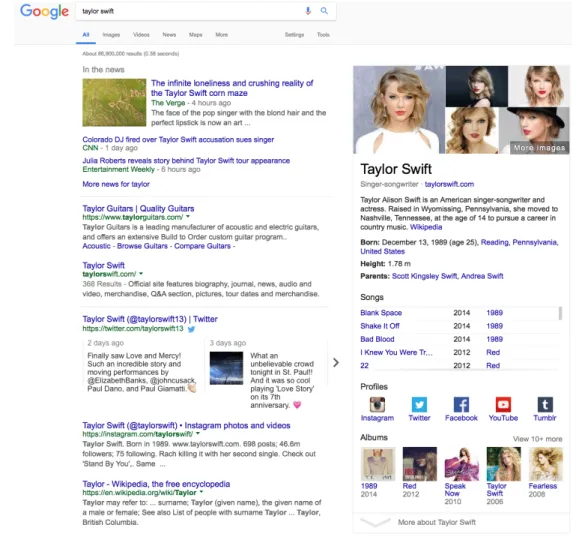
The figure above shows Google’s results page for the query “taylor swift”,
cap-tured in March 2016. Assembled around the long-established list of search results is content extracted from various source — news items and tweets merged within the results ranking, images, songs and social media profiles displayed to the right of the ranking, in an interface element that is known as an entity card. Indeed, the entire page seems more like an assembly of content extracted from various sources, rather than just a ranked list of blue links.
few years, with most commercial web search providers responding to user quer-ies with different types of results, merged within a unified page. The primary reason for this diversity on the results page is that the web itself has become more diverse, given the ease with which creating and hosting different types of content on the web is possible today.
This thesis investigates the aggregation of web search results retrieved from various document sources (e.g., images, tweets, Wiki pages) within information “objects” to be integrated in the results page assembled in response to user quer-ies. We use the terms “composite objects” or “composite results” to refer to such objects, and throughout this thesis use the terminology of Composite Web Search (e.g., result composition) to distinguish our approach from other methods of aggregating diverse content within a unified results page (e.g., Aggregated Search). In our definition, the aspects that differentiate composite information objects from aggregated search blocks are that composite objects(i) contain
res-ults from multiple sources of information, (ii)are specific to a common topic or
facet of a topic rather than a grouping of results of the same type, and(iii)are not
a uniform ranking of results ordered only by their topical relevance to a query. The most widely used type of composite result in web search today is the entity card. Entity cards have become extremely popular over the past few years, with some informal studies suggesting that entity cards are now shown on the majority of result pages generated by Google. As composite results are used more and more by commercial search engines to address information needs directly on the results page, understanding the properties of such objects and their influence on searchers is an essential aspect of modern web search science.
The work presented throughout this thesis attempts the task of studying com-posite objects by exploring users’ perspectives on accessing and aggregating di-verse content manually, by analysing the effect composite objects have on search behaviour and perceived workload, and by investigating different approaches to constructing such objects from diverse results. Overall, our experimental findings suggest that items which play a central role within composite objects are decisive in determining their usefulness, and that the overall properties of composite ob-jects (i.e., relevance, diversity and coherence) play a combined role in mediating object usefulness.
I hereby declare that except where explicit reference is made to the work of oth-ers, the contents of this thesis are original and have not been submitted in whole or in part for consideration for any other degree or qualification in this, or any other University.
This thesis is the result of my own work, under the supervision of Dr. Ke Zhou, Dr. John Williamson and Prof. Joemon M. Jose and references work done in col-laboration, specifically indicated in the text.
Horat,iu S. Bota
Abstract i Declaration iii 1 Introduction 1 1.1 Preamble . . . 1 1.2 Definition . . . 7 1.3 Thesis Statement . . . 8 1.4 Motivation . . . 9 1.5 Contributions . . . 17 1.6 Publications . . . 18 1.7 Thesis Structure . . . 19 2 Background 20 2.1 User Models of Search . . . 20
2.1.1 Information Retrieval . . . 22
2.1.2 Information Seeking . . . 22
2.1.3 Information Objects . . . 24
2.1.4 Relevance versus Usefulness . . . 25
2.1.5 Other Models of Search . . . 27
2.1.6 Other Types of Search . . . 28
2.2 System Models of Search . . . 30
2.2.1 Information Retrieval Models . . . 30
2.2.2 Evaluation of Retrieval Models . . . 39
2.2.3 Retrieval Across Collections . . . 45
2.2.4 Clustering and Composition . . . 50
2.3 Chapter Summary. . . 55
3 Searching the Web 56 3.1 Search Interactions . . . 56
3.1.1 Recording Search Interactions . . . 57
3.1.2 Types of Interactions . . . 59
3.2 Search Interfaces . . . 62
3.2.1 Search Results Presentation . . . 63
3.2.2 Assistance in Browsing Results . . . 66
3.2.3 Aggregated Search Results . . . 70
3.2.4 Entity Cards . . . 73
3.2.5 Other Search Interface Elements . . . 75
3.3 Chapter Summary. . . 76
4 Exploring Result Composition from the Users’ Perspective 77 4.1 Introduction . . . 77
4.2 Prior Work . . . 79
4.2.1 Composite Retrieval . . . 79
4.2.2 User Behaviour in Information Access . . . 79
4.3 Experimental Methodology . . . 80 4.3.1 Task Design . . . 81 4.3.2 Object-level Characteristics . . . 82 4.3.3 Limitations . . . 82 4.3.4 Experimental System . . . 83 4.4 Experimental Results . . . 84
4.4.1 Composite Object Contents . . . 84
4.4.2 Composite Object Characteristics . . . 91
4.5 Discussion and Conclusions . . . 93
4.6 Chapter Summary. . . 94
5 The Effect of Entity Cards on Search Behaviour and Workload 96 5.1 Introduction . . . 97 5.2 Prior Work . . . 100 5.3 Experimental Methodology . . . 101 5.3.1 Overview . . . 101 5.3.2 Input Variables . . . 105 5.3.3 Output Variables . . . 109 5.3.4 Study Details . . . 110 5.3.5 Statistical Methodology . . . 113 5.4 Experimental Results . . . 117 5.4.1 Preliminary Results. . . 117 5.4.2 Card Content . . . 120
5.4.3 Card Coherence . . . 127
5.4.4 Card Diversity . . . 135
5.5 Discussion and Conclusions . . . 140
5.6 Chapter Summary. . . 143
6 Composite Retrieval of Heterogeneous Web Search 145 6.1 Introduction . . . 146
6.2 Prior Work . . . 148
6.3 Result Composition Framework. . . 150
6.3.1 Problem Formulation . . . 150
6.3.2 Challenges . . . 152
6.4 Composite Object Selection & Ranking . . . 153
6.4.1 Produce Composite Objects . . . 154
6.4.2 Choose Objects . . . 156
6.4.3 Evidence and Estimation . . . 159
6.5 Experimental Setup . . . 161
6.5.1 Data . . . 161
6.5.2 Evaluation . . . 162
6.5.3 Baseline Systems . . . 164
6.6 Experimental Results . . . 165
6.6.1 Homogeneous Composite Retrieval . . . 165
6.6.2 Heterogeneous Composite Retrieval . . . 167
6.7 Discussion and Conclusions . . . 173
6.8 Chapter Summary. . . 174
7 Click Graph Representation Learning for Heterogeneous Documents 176 7.1 Introduction . . . 176
7.2 Prior Work . . . 179
7.2.1 Click Graphs . . . 180
7.2.2 Aggregated Search . . . 180
7.3 Data and Methods . . . 180
7.3.1 Click Log . . . 180 7.3.2 Click Graphs . . . 181 7.3.3 Propagation Algorithm . . . 185 7.3.4 Experimental Design . . . 187 7.4 Experimental Results . . . 190 7.4.1 Graph Connectedness . . . 190 7.4.2 Retrieval Effectiveness . . . 193
7.4.3 Modifying Graph Structure . . . 196
7.5 Chapter Summary. . . 201
8 Discussion and Future Work 203
8.1 Discussion . . . 203 8.2 Future Work . . . 207 8.3 Chapter Summary. . . 212 9 Conclusion 213 9.1 Summary of Contributions. . . 214 9.2 Summary of Conclusions . . . 215 9.3 Final Remarks . . . 218
2.1 Types of information searching. . . 28
4.1 Object-level characteristics. . . 83
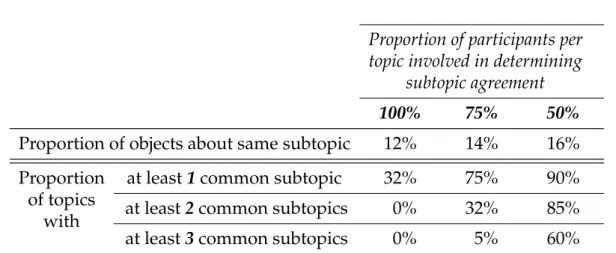
4.3 Subtopic agreement based on semantic similarity of titles assigned to composite objects by study participants. . . 86
4.5 Vertical origin of ornament documents. . . 90
4.6 Mean document relevance in multi-vertical composite objects. . . . 91
4.7 Correlation of criteria assessments with object pairwise preference 92
4.8 Linear correlation of composite object properties.. . . 93
5.1 Queries and task descriptions used in card study. . . 106
5.2 Questions associated with individual dimensions of perceived task workload, as shown to study participants at the end of card study.. 111
5.3 Experimental conditions in card study. . . 111
5.5 Summary statistics for card study outcome measures. . . 119
6.1 Verticals used in creating the federated search collection used in the algorithmic result composition study. . . 161
6.3 Evaluation of result composition approaches in a heterogeneous environment.. . . 166
6.4 Performance of various result composition approaches in a hetero-geneous web environment. . . 168
6.5 Comparison of best-performing result composition approaches in a heterogeneous web environment against all baselines. . . 169
6.6 Robustness of result composition approaches.. . . 172
7.1 Evaluation of direct ranking based on graph-learnt representations. 194
7.2 Evaluation of changes to graph structure and their impact on re-trieval performance. . . 198
7.3 Top 9 terms learnt under different algorithm and graph configura-tions for the head query“taylor swift”. . . 200
1.1 Web search results over the past two decades.. . . 3
1.2 A modern web search results page. . . 4
1.3 Web search functionality beyond the browser.. . . 11
2.1 A model of search byJärvelin and Ingwersen(2004) . . . 21
2.2 The cognitive communication system for information seeking by Ingwersen and Järvelin(2005) . . . 24
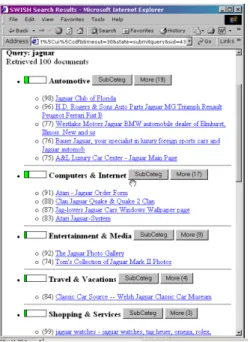
3.1 Result categorisation interface used inDumais et al.(2001). . . 67
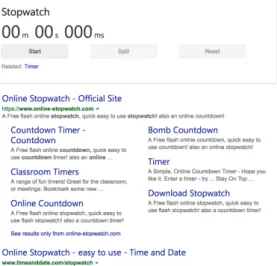
3.2 Example search interface in-line answers. . . 75
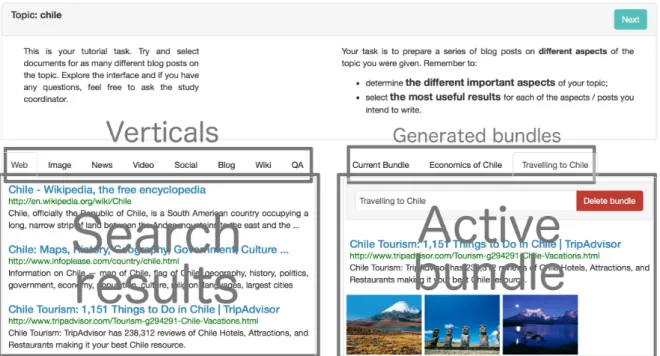
4.1 Interface of system used to manually construct composite objects. . 81
4.2 Average number of documents in composite objects. . . 86
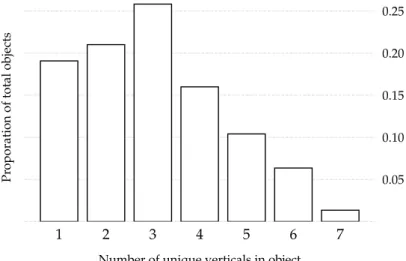
4.3 Number of unique verticals in all objects created by participants. . 87
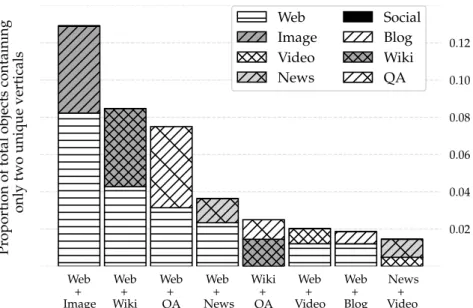
4.4 Vertical structure of two vertical composite objects. . . 88
4.5 Vertical structure of three vertical composite objects. . . 88
4.6 User indicated most influential criterion for object preference. . . . 91
5.1 Results page assembled by Google in response to the query“castro”. 98 5.2 Search interface used in card study. . . 102
5.3 Structure of entity cards used in card experiment. . . 104
5.4 Entity card structure and different experimental manipulations of entity cards. . . 108
5.5 Example statistical analysis used in card study. . . 115
5.6 Mean effect size of content manipulations in card study. . . 126
5.7 Mean effect size of coherence manipulations in card study. . . 134
5.8 Mean effect size of diversity manipulations in card study. . . 139
7.1 Example disconnected bipartite click graph. . . 182
7.2 Example augmented bipartite click graph. . . 184
7.4 Distribution of vertices across sub-graphs in the unmodified graph variant. . . 192
7.5 Distribution of heterogeneous documents across sub-graphs in the unmodified graph variant. . . 192
7.6 Distribution of query vertices across sub-graphs in different aug-mentations of the click graph. . . 197
8.1 High-level representation of a search engine’s indexing process, re-produced fromCroft et al.(2009, p. 15). . . 203
8.2 High-level representation of a search engine’s query process, re-produced fromCroft et al.(2009, p. 16). . . 204
8.3 High-level representation of a composite search engine. Top row illustrates the components of a composite search engine, whereas a subset of challenges associated with each component are illus-trated below. Components and associated challenges that are ex-plicitly addressed through work presented in this thesis are presen-ted within a solid contour. . . 205
Introduction
This thesis investigates the aggregation of web search results retrieved from vari-ous document sources (e.g., images, tweets, Wiki pages) within information “ob-jects”to be integrated in the results page assembled in response to user queries.
1.1
Preamble
From Surfers to Searchers
Beyond accurate use of nomenclature and technical details, theInternet, theWorld Wide web, search engines, the online are, today, terms synonymous with
informa-tion. Indeed, for many if not most users of the online, they are not only synonym-ous, but also become reality through the same outlet: Google’s results page.
How has “googling” become a synonym for finding information? How is it
that the web seems to containallthe information in the world?“Just google it”,“let me google that for you”,“ask google for a restaurant nearby”,“do you google yourself?”
— but rarely, if ever,“I couldn’t find it on Google”.
At 28 years of age (Berners-Lee et al.,1994), the web is now the default inform-ation repository in the world. Many factors have contributed to its phenomenal success, from advances in networking technology to the relatively low cost of be-coming a web user. But among the many technological advances that have driven the web’s global adoption, search is, arguably, the most influential. Search has re-duced information access to the simplest interaction paradigm: in exchange for a few keywords, for most practical purposes, search engines scan the entirety of the web1and return a list of documents ordered by their relevance instantly. Through
such simple and effective interaction, in contrast to following links or browsing
1In fact, search engines index less than 5% of pages available on the web, as seen at
categorised resources, search has established itself as the principal method of ac-cessing online information today.
Even though influential, search is, however, a new method of accessing in-formation on the web. The now dated idiom “surfing the web” is a reflection of
how web browsing initially involved following information from link to link2. The web was originally set up as an unstructured but linked information repos-itory; news websites might publish a list of news-worthy stories and the onus of locating relevant information, by following links, lay with the user. Although the option still remains, today, who“presumes to surf the web”any more? (Wilson et al.,
2010) The reason for this shift fromsurfingtosearchingis that, over the past
dec-ade, the web has grown beyond what is navigable from one link to the next and
searching has replaced surfing as the main path to information. And the online
continues to grow: more people access the web across cultures; a new addressing system is being deployed to accommodate the flood of devices joining the inter-net3; with more devices, more content is created and hosted on the web, which in turn makes search indispensable, etc.
The unrelenting growth of the web feeds the need for constant web search improvement. The two are locked in a feedback loop: the easier it is for web users to locate and consume information through search, the more worthwhile it is for creators to publish their content on the web,because it can be easily found
and consumed by vast populations of searchers. In the past few decades, hand in hand with the ever widening reach of the internet, this feedback loop has lead to an explosion of information on the web, in terms of both quantity and diversity of content. In turn, this vastness of diverse information creates the need for search systems that can not only “find the needle in the haystack” (i.e., locate and rank
relevant documents), but also expose, in a unified interface, the many types of content generated on the web.
Search tension
Two broad areas of research are at the core of web search advancement: (i)
al-gorithms (for retrieval, recommendation, etc.) and(ii)the use of search systems
(search interfaces, user modelling, etc.). Retrieval algorithms have developed
2Interestingly, in my first language, Romanian, the most popular idiom used to describe web interactions is“caut˘a pe net”, which literally means“search the net”. Similarly, in Spanish“búscalo en internet”is used. It seems cultures in which the internet became widely available only after
search became the principal method of accessing information online were never exposed to this
“surfing”of the web and did not even develop language to describe it.
3IPv6 is set to replace IPv4 as the new addressing system for devices connected to the internet because the IPv4 address space is too narrow to accommodate the sheer volume of devices.
(a) Infoseek (1997) (b) Google (2007) (c) Bing (2017)
Figure 1.1: Search result listings for the same query (“darter habitat”) as returned
by popular web search engines at various times over the past two decades. Fig-ures1.1aand1.1breproduced fromSearch User Interfaces (Hearst,2009, p. 2,
Fig-ure 1.1). FigFig-ure1.1ccaptured in December, 2017.
in various ways over the years, from incorporating users’ historical preferences into document ranking, to tailoring search results to users’ geographical context. More pertinent to this thesis, in addition to traditional, text-heavy resources, re-trieval algorithms have been developed to also rank different types of documents, such asimagesorvideos, as these documents became abundant on the web.
The workings of a search engine — in particular, its retrieval algorithm — are opaque to end users: how exactly the ranked list of documents is assembled is, for most people, a mystery. Changes to the machinery that ranks documents are, perhaps, less obvious to searchers. In contrast, web search interfaces are, from the user’s point of view, the entirety of a search system and any change brought to their configuration has immediate impact on how users perceive or interact with the system. Given that modern web search engines serve a broad user base, expressing extremely diverse information needs, any “improvement”
to the search interface is likely to be just as puzzling as it is helpful to different groups of searchers. As such, search interfaces are notoriously resistant to change. Figure1.1shows three web search interfaces observed over the past two decades; they are very similar, if not“nearly identical”(Hearst,2009). 4
However, these diverging concerns — on one hand, a rapidly changing, more and more diverse web (with retrieval algorithms better at organising this di-versity); on the other hand, search interfaces resistant to change, not least with respect to the types of content shown on the main page of results, so as not to
4This is not to say that research on user interfaces for search is lacking –Hearst(2009) provides an expert review of historic and recent developments in the area – but that its transition to main-stream web search is, perhaps, slower-moving than in the case of retrieval algorithms.
Figure 1.2: Search page assembled and returned for the query “taylor swift” by
the Google web search engine, displaying access to vertical search engines (top, below query box), aggregated search results merged within the ranked list of results, and entity card. Based on our definition, in this example, the entity card displayed on the right of the results listing is a type of composite object. Captured in March, 2016.
confuse certain segments of the user base — generated a certain tension underly-ing web search development. With more people creatunderly-ing, hostunderly-ing and searchunderly-ing for diverse content on the web, even the inflexible, “nearly identical”, web search
interface had to change to expose this diversity.
Modern web search engines address this tension by offering several solutions:
(i)they provide specialised services to access diverse content (e.g.,image,newsor map search, often referred to as vertical search services or just verticals) available
within a tabbed interface, on the main page of results; (ii)they merge blocks of
documents from different sources (i.e., verticals) into a unified results page (a paradigm that has become known in the research literature asaggregated search)
knowledge graph results) containing items extracted from different sources, on the
results page. Figure1.2shows all three elements that give searchers direct access to diverse content on a unified results page. It seems, then, at least in certain cases or for certain queries, that the search interface has changed significantly from the ranked list of blue links, a change driven primarily by the need to accommodate diverse content within a unified results page.
Diversity in unity
Do all results pages need to display heterogeneous content? Perhaps not: for instance, Bing report5that roughly 30% of the queries it receives are navigational
— meaning a searcher is trying to find a particular website like Facebook or BBC News, in which case, it is likely that a single result is of interest to the searcher. However, it remains that a majority of queries have informational or transactional intent, in which case presenting heterogeneous content on the results page might be useful. In fact,Arguello et al.(2009) indicate that 74% of queries (labelled by reviewers) require results from at least one other source in addition to general web search, suggesting that merging heterogeneous results into a unified page is an important aspect of improving search experience for a majority of queries.
The two methods of merging diverse content within a unified results page, ag-gregated search and entity cards, are relatively new additions to web search inter-faces. Although aggregated search has been available since the early 2000s ( Mur-dock and Lalmas,2008), it is, perhaps, Google that introduced it into mainstream web search in 2007, under the name ofuniversal search:
“Google’s vision for universal search is to ultimately search across all its content sources, compare and rank all the information in real time, and deliver a single, integrated set of search results that offers users precisely what they are looking for. Beginning today, the com-pany will incorporate information from a variety of previously sep-arate sources — including videos, images, news, maps, books, and websites — into a single set of results. At first, universal search res-ults may be subtle. Over time users will recognize additional types of content integrated into their search results as the company advances toward delivering a truly comprehensive search experience.”6
5Accessed December 2017:https://blogs.bing.com/search/2011/02/10/making-search-yours 6Accessed December 2017:
Why is there a need to integrate different types of documents available on the web directly into a unified results page, when isolated access to specific resources is available? The argument for a more diverse presentation of results can be made from multiple points of view — Arguello (2017) details this argument in-depth. A results page merging documents from different sources can: (i)show
search-ers that relevant content exists in particular verticals; (ii)provide searchers with
easy access to different sources of information; (iii) bring attention to diversity
in the information space, which can benefit searchers in understanding their in-formation need, in current or future searches; and (iv) show search results in a
diverse context (e.g., images next to the news article they were extracted from, on the same results page) which can help searchers assess their relevance. Perhaps the strongest argument for aggregated search is made by existing search engines (Google, Bing, Yandex, DuckDuckGo, Seznam, Naver, Baidu and others) which, over the past decade, have all adopted it as a way of merging and presenting diverse content on a unified results page.
Most aggregated search systems are based on a workflow that broadly in-volves two main tasks: vertical selectionandvertical presentation. Vertical selection
is concerned with predicting which sources of information are relevant to a given query, whereas vertical presentation is concerned with predicting where, merged in the ranked list of results, to place blocks of heterogeneous content. Typically, the results contained within each heterogeneous block are simply the top few res-ults returned by their corresponding vertical in response to the searcher’s query.
Even though widely adopted by modern search engines, aggregated search is limited in several aspects. To date, prior work has not investigated in detail which results from a particular vertical, rather than just the top few, to display on the results page (Arguello,2017). This is an important aspect of merging heterogen-eous content within a unified page as prior studies have shown that results from one source can influence user engagement with results from other sources ( Ar-guello and Capra, 2016). As such, understanding the interactions between het-erogeneous items can be informative for selecting which result to extract from verticals, rather than returning the top few. Secondly, limited effort has been put into understanding methods for thedisplayof heterogeneous content on the
res-ults page (Arguello and Capra (2014) is one such effort). It remains unclear, for instance, why, post-retrieval, heterogeneous content needs to be aggregated by type (e.g., a block of image results or a block of video results), rather than topic or other features, or structured in any other way. Indeed, work on aggregated search frequently mentions presentation aspects as core directions for future work ( Ar-guello,2017), where additional research effort is required.
The other method of merging heterogeneous content within a unified results page — through the use of entity cards — addresses some of the limitations of aggregated search. Introduced in mainstream web search in 20127, entity cards
bring together content extracted from various sources within a singular object dis-played on the results page. Besides providing the benefits of aggregated search (see above), entity cards also provide a summary of relevant content directly on the results page, they help users navigate topically diverse results by highlight-ing one or multiple facets reflected in the results page, and they support explor-atory search by highlighting entities related to a given query. Unlike aggregated search, entity cards merge together results ofdifferent types, rather than a single
type, structured around a common topic and are typically displayed contextually, not integrated in the ranked list of web results8. Figure1.2 shows an entity card
incorporating images, Wikipedia facts, social media profiles and other types of results within one object displayed to the right of the ranked web results.
Much like aggregated search, most popular web search engines today have adopted the display of entity cards. However, prior research effort regarding entity cards has focused primarily on the underlying representation mechanism (i.e., knowledge graphs or knowledge bases) rather than understanding what types of results searchers expect or how heterogeneous results interact within such objects, or how entity cards influence searcher behaviour. Even more, it is unclear whether entity cards are the only type of complex result aggregate that can be effectively merged within the results page. Our work aims to address these understudied aspects of merging heterogeneous content within a unified results page by studying the“composition”of results retrieved from various sources. The
definition of result composition, and how it relates to existing areas of heterogen-eous web search, is discussed in the following section.
1.2
Definition
Our work investigates the composition of web search results retrieved from vari-ous document sources (e.g., images, tweets, Wiki pages) within singular objects to
be integrated in the results page assembled in response to user queries. In our definition, composite objects contain complementary web search results that to-gether achieve a common informational goal (i.e., address a specific aspect of a
7Accessed December 2017:
https://googleblog.blogspot.com/2012/05/introducing-knowledge-graph-things-not.html
user’s query). We use the terms“composite objects”or“composite results”9to refer
to such objects, and we refer to the process through which they are constructed, either by searchers or algorithms, as“result composition”.10
We use the terminology of Composite Web Searchto distinguish the approach
discussed in this thesis fromAggregated Web Search. We emphasise that although
both approaches are concerned with merging heterogeneous results within a uni-fied results page, they differ with respect to the way they organise and expose diverse content on the results page within composite objects or aggregated search blocksrespectively. Specifically, the aspects differentiating composite objects from
aggregated search blocks are that composite objects(i)contain results from
mul-tiple sources,(ii)are specific to a common topic or facet of a topic, and(iii)are not
a uniform ranking of results ordered only by their topical relevance to a query. In contrast to composite objects, aggregated search blocks contain results from a single source of information (e.g., a block of image results), which are not or-ganised around the various facets of a topic, and are typically a ranking of items ordered by their topical relevance, without considering item complementarity. As an example, in on our definition, an entity card is an instance of a composite object, because its constituent items originate from different sources, are focused on a common topic or entity, and are organised to provide complementary in-formation that addresses a common search goal.
We use similar terminology as aggregated search when referring to special-ised search services for different types of media (e.g., images, videos, news) or search tasks (e.g., search for local business, scientific articles), namely the term
verticals. We useheterogeneousordifferentsources of information as synonyms for
verticals, to highlight the origin of diverse results, in contrast with general web search results. In this context — and throughout this thesis, unless explicitly men-tioned otherwise — the use of the termdiversityrefers to vertical diversity rather
than the explicit topical diversity of web search results (Santos,2012). Given this definition, we clarify the statement of this thesis next.
1.3
Thesis Statement
Integrating heterogeneous documents into a unified results page is difficult. Ag-gregated search — the current paradigm for selecting and displaying results from
9We also usecomplex results aggregateorcomplex aggregatesto refer to composite objects, without additional meaning, primarily to avoid excessive repetition.
10We also useaggregation of heterogeneous content within composite objects as a synonym forresult
different sources on a singular page — is limited to block-level merging of rank-ings. While more complex aggregates, containing and highlighting the connec-tions between heterogeneous documents (i.e.,composite results) can be constructed
and displayed effectively on a unified results page, their usefulness is constrained by (a)the relevance of a document (or group of documents) that play a central
role within the aggregate and(b)a complex interplay between the overall
prop-erties (i.e., relevance, diversity and coherence) of the aggregate. This statement will be defended through work which seeks to answer the following groups of research questions:
• Given a search task, how do users construct composite objects containing results extracted from different source? What properties of these manually constructed objects are important to searchers? What roles do individual documents play within composite objects constructed by searchers?
• What effect does the display of composite objects on a unified results page have on search behaviour? How do the properties of composite objects moderate this effect?
• When constructing composite objects algorithmically, how can object prop-erties (e.g., topical diversity or vertical diversity) be manipulated? What roles do individual documents play within composite objects? How do ma-nipulations of composite object properties interact with object effectiveness? • Given that documents extracted from different sources have varying struc-tures (e.g., videos vs. text-based documents), can vertical-agnostic docu-ment representations be learnt within a common feature space which enable more effective assessments of document similarity across verticals?
These research questions attempt to investigate two key aspects of creating complex aggregates containing documents from different sources: the interplay between search interactions and composite object properties, and how algorithmic formulations of composite objects can effectively operationalise object properties.
Answers to these research questions will provide practitioners of web search with a foundation on which to study and develop the integration of complex aggregate structures info unified result pages.
1.4
Motivation
interactions with web search systems or the implementation and evaluation of systems specialised for particular collections have been studied extensively over the past decades (Sanderson and Croft, 2012). In light of these comprehensive research efforts aimed at understanding web search, and recognising that com-mercial businesses define almost all aspects of what web searchistoday, several
questions need to be answered before developing our research topic further: 1. Why study web search more?
2. What could users“possibly need besides Google to search the web”? – Wilson
et al.(2010)
3. Why is the composition of heterogeneous web results an important topic? Answers to these questions motivate the research efforts presented here and pro-vide some insight as to why understanding complex result aggregates can be valuable for the future of web search.
Why study web search more?
Although the question may seem trivial, given that keeping web search techno-logy synchronised with a ubiquitous, dynamic and evolving web undoubtedly requires research effort, it is important to briefly clarify how extensively the sci-ence and technology behind web search impacts our world. In a 2011 attempt at quantifying the value of web search technology on the global economy, McKinsey & Company report11 that:
“The size of search can be hard to conceive. More than one trillion unique, worldwide URLs were indexed by Google alone by 2010. Some 90 percent of online users use search engines, and search represents 10 percent of the time spent by individuals on the web, totaling about four hours per month. Knowledge workers in enterprises spend on average five hours per week, or 12 percent of their time, searching for content. [ ... ] A conservative estimate of the global gross value created by search was $780 billion in 2009.”
Without dwelling on this particular point, it is enough to point out that improve-ments brought to the technology that drives web search have extremely far reach-ing effects both in terms of the number of people they affect, and the value they generate, thus justifying the further study of web search, in all its forms.
11Accessed December 2017:
In addition to the extensive impact of web search in its current, browser-based form, there are many emerging directions in the development of search that are understudied and which motivate further research in the field of web search. One of the emerging directions is the inclusion of web search functionality dir-ectly within specialised applications, such as Microsoft Office, Adobe Creative Suite or Windows and macOS. Figure1.3 shows several examples of such mod-ern in-application search experiences. These examples illustrate how web search is expanding beyond its traditional browser-bound environment and becoming embedded within various areas of human-computer interaction. These novel and understudied directions exemplify some of the many forms web search can take. These examples also highlight the interplay between accessing (e.g., finding a document online) and creating information (e.g., writing an article within a text editor) and how web search is permeating this boundary explicitly — for ex-ample, in productivity software with embedded web search functionality. It is, perhaps, at this boundary between retrieval and creation or assembly of inform-ation that understanding the relinform-ationship between different types of documents is important, and where our work may prove to be insightful as well.
(a) Web search function-ality integrated within the image editing soft-ware Adobe Photoshop.
(b) Web search function-ality available within the Microsoft Office applica-tion suite.
(c) Web search results merged within the Spot-light search functionality available on macOS sys-tems.
Figure 1.3: Several examples illustrating how web search is expanding beyond its traditional browser-bound environment and becoming embedded within various other areas of human-computer interaction.
To summarise and answer our question, on one hand, web search has extremely far reaching impact on our world and as such, any improvement to the techno-logy that drives it generates enormous value; on the other, web search, in itsquery to results-listinteraction style, is developing into a foundational layer upon which
of our technology-mediated access to information. Both views indicate the im-portance of web search and motivate its further study.
What else besides Google?
This question is concerned with two critical issues that face any researcher in-volved in the study of web search: (a) Given its adoption and overall success,
why is Google not good enough as it is? (b)Why is the study of web search a
matter for the public domain12, and not only specific to commercial search en-gines? Wilson et al. (2010) tackle the first issue head on in their monograph on future search user interfaces for the web:
“ The elegant way in which search results are returned has been well researched and is usually remarkably effective. [ ... ] Google is really good. For what is does. [ ... ] Search as embodied by the text box and keyword has framed our understanding of what the web is (schraefel,
2009). It turns out that this elegant paradigm is especially effective for 1-minute search [ ... ]. But many users have come to the web for substantive research that takes hours or weeks – find all songs written about poverty in the 1930s, prove that there are no patents that cover my emerging innovation, or locate the best legal precedents for my brief.
A second motivator for [ research on ] new search strategies is that the next generation web will offer fresh possibilities that go well beyond finding documents by way of keyword search.Hall and O’Hara(2009) stress that what we know as the web today, is the Document web, and not the web of Linked data that is imminently upon us. ”
There are many ways of searching the web and commercial web search engines today are optimised for a certain type of search that involves a query box, very few query terms (on average) and a results list — something they are, indeed, ex-tremely good at. It is with respect to different, and perhaps less studied, types of search interactions (e.g., slow search (Teevan et al.,2013), exploratory search ( Mar-chionini, 2006; White and Roth, 2009), serendipitous search (André et al., 2009;
Bordino et al., 2013; Rahman and Wilson, 2015)) that searchers may need some-thing that most modern search engines simply do not offer yet.13 Indeed,
ima-12Sponsored through public funds and conducted at public institutions.
13Unlike the previous section, where new areas of web search advancement refers to the applic-ation of keyword-driven search in new contexts, here novel search interactions refers to funda-mentally different approaches to extracting and interacting with information from the web.
gining a future for these novel types of web search requires research effort that is unconstrained by commercial interest.
Secondly, the main reason for studying web search in the public domain, even though it is almost entirely defined by commercial efforts, is that “web giants [ Google, Facebook and others ] [ ... ] are the closest thing we have to information utilities” (O’Neil, 2016, p. 211). As mentioned previously, web search underlies many, if not most, aspects of our technology-mediated interactions with inform-ation. In light of recent discussions on algorithmic fairness (Corbett-Davies et al.,
2017; Feldman et al., 2015; O’Neil, 2016) and excessive personalisation (Pariser,
2011) it has become apparent that biases — intentional or accidental — encoded within algorithms can lead to consequences that are harmful to both individu-als and communities (the fake news and filter bubble phenomena are some ex-amples of these consequences). It is, then, a matter of public virtue, if not out-right responsibility14, to scrutinise and understand algorithms, especially those that organise and retrieve documents from the web.
Relatively little effort has been made so far in quantifying algorithmic biases in web search (Mehrotra et al.(2017) is one such example) even though their ef-fects have been discussed widely (O’Neil,2016;Pariser,2011), as has the ethics of web search (Introna and Nissenbaum, 2000;Mager,2018). This is not surprising given that web search, today, is entirely opaque in order to preserve competitive advantage. For example, Google has been known to have “prohibited research-ers [ interested in investigating ] the biases of the search engine” (O’Neil, 2016,
op. cit.) Together, the issues of algorithmic fairness and mixed commercial
in-centives in web search suggest that the science and technology that drive these “information utilities” should become more and more a matter for the public do-main, in a way that can be scrutinised by those it affects. In the words of the very founders of Google: “(...) the issue of advertising causes enough mixed incent-ives that it iscrucialto have a competitive search engine that is transparent and
in the academic realm” (Brin and Page,1998a, emphasis added).
Returning to our research topic, why should, then, the study of result compos-ition be a matter for the public domain? Assembling results — and, in particular, placing items on the first page of results returned by a search engine — is be-coming as much about merging heterogeneous items (or groups of items) within a unified space, as it is about ranking and retrieval from homogeneous collec-tions. Web results, aggregated search blocks, entity cards (Bota et al.,2016;Hasibi et al., 2017;Navalpakkam et al., 2013), rich format ads (Lagun et al.,2016) or
line answers (Chilton and Teevan, 2011) are all competing for visual real-estate in what is shown to users. Often results pages contain enough information, as-sembled from various sources, that searchers have no need to explore results in detail and can access all the information they need directly on the first page of results. Merging items into a singular page is just as critical as ranking, and all layers of search, from document representation to retrieval, ranking and aggreg-ation, carry influence on what information users interact with;Ford and Graham
(2016) provide an interesting discussion on the social implications of complex information objects embedded within the search engine results page.
The work presented in this thesis is concerned with the aggregation of res-ults which, much like the entire machinery of web search, should be public. In addition, our work looks explicitly at the effects of displaying composite results within a traditional ranked-list setting on search behaviour, and as such, can be informative to all those who use modern web search.
Why study result composition?
As mentioned in the previous section, web search engines now deploy a vari-ety of “non-traditional” items on the results page. Assembled around the long-established ranked list of results are aggregated search blocks, rich format ads, in-line answers or entity cards. Indeed, the results page is often an assembly of diverse items extracted from various sources.
The composition of heterogeneous results into unified items displayed on the search page — e.g., in-line answers or entity cards — has become an indispens-able feature of modern web search interfaces. Chilton and Teevan (2011) show that more than one hundred different types of in-line answers are already being returned to users of Bing (although the authors report that, at the time, such res-ults were shown in less than 1% of sampled searches). Bota et al.(2016) indicate that entity cards are returned for entity oriented queries 67% of the time, which shows how prevalent these objects have already become. In a less formal setting,
Enge (2017) suggest that rich answers (i.e., in-line answers or entity cards) are now shown on more than 50% of the result pages returned by Google. Overall, presenting diverse results on a unified page is important to users, and due to the limitations of merging blocks of results from different sources within a ranked list of web documents, search engines are increasingly making use of complex result aggregates to expose and help users navigate diverse results. As such, un-derstanding how users interact with and consume heterogeneous content, how complex result aggregates (e.g., entity cards or other types of composite results)
can be created effectively, and how the properties of these aggregates influence user search behaviour is a major aspect of modern web search.
The content and properties of complex aggregates (e.g., entity cards, in-line answers) are even more important considering that users frequently satisfy their information need directly on the results page, rather than through the exploration of any result in particular — a phenomenon calledgood abandonment(Chuklin and
Serdyukov, 2012) in the research literature. Williams et al. (2016a) indicate the presence of complex aggregates (entity cards and in-line answers) on the results page as one of the factors that drive good abandonment in web search15.
Overall, the study of composite objects is important because, on one hand, these types of objects are being deployed more and more by current web search engines, and on the other, because their presence on results pages leads to atyp-ical user behaviours — e.g., atypatyp-ical eye gaze patterns (Navalpakkam et al.,2013) or good abandonment — which are insufficiently understood yet critical in ad-vancing modern web search. What information do users expect to find within these objects? How can these objects be described in terms of their properties? How do their properties influence user behaviour? How can results be aggreg-ated within such objects? These are relatively understudied questions that lie at the core of constructing complex result aggregates, and therefore central to mod-ern web search, that our work aims to answer.
Motivating scenario for result composition
To discuss in more detail the practical benefits of result composition, we revisit the example shown in figure1.2, illustrating Google’s response to the query“taylor swift”. Based on our definition, in this example, the entity card displayed on the
right of the results listing is a type of composite object. The entity card assists searchers by providing a summary of relevant and diverse content directly on the results page, but also by highlighting potentially interesting facts regarding its topic of focus, and by providing easy access to various other topics (i.e., related entities) or related sources of additional information (in this example, social me-dia profiles). As with aggregated search blocks, entity cards provide an overview of diversity in the information space. However, unlike aggregated search blocks, entity cards provide access to diverse content in a structured manner, with di-verse and complementary items being organised around a shared topic, and the overall object addressing a common informational goal.
In our example, imagine a searcher familiar with one of the more popular
songs by Taylor Swift, but unaware of her biography, other songs or albums, or other artists that create similar music. By issuing an ambiguous query to a search engine, the searcher is perhaps expressing an exploratory information need ( Mar-chionini, 2006), characterised by a desire to learn and discover more about their expressed topic. In such a scenario, integrating an entity card on the results page can help searchers not only resolve their exploratory information needs without having to click on specific results, by providing a summary of most relevant im-ages and biographical facts, as well as a list of popular songs in a visually sali-ent manner directly on the results page, but can also help them make sense of highly diverse (both topically and vertically) results. In addition, in explorat-ory search conditions, where searchers are not sure how to initiate a search or parse results returned by a search engine, it is perhaps reasonable to assume that entity cards organise and simplify results in such a way that aids searchers in refining their queries and comprehending the entirety of the results page — i.e., they enhance users’ search literacy (Wilson et al.,2016). Even though aggregated search blocks, like composite objects, expose diverse content on a unified results page, in contrast to entity cards, they do not organise this information. For in-stance, in our example, both the news and the social media aggregated search blocks are merged within the page. However, our searcher might find it difficult to understand how individual news items and tweets, for example, are related to each other on such a page or how they provide complementary information on their search topic, given that aggregated search results are merged within the ranking at block level, without highlighting the relationships or complementarity between the items they contain, across blocks or in relation to the result ranking.
In addition to entity cards, other types of composite objects could be use-ful in this scenario as well. In response to our user’s query (e.g., “taylor”), it is
not difficult to imagine a search system returning results that include both song videos and song lyrics, for example, or results that include both Taylor Swifts’ In-stagram16photos and her most recent tweets, perhaps displayed in a style similar
to how in-line answers (Chilton and Teevan,2011) are used in modern web search interfaces today. These types of results are, in our definition, composite objects and, as such, the work discussed throughout this thesis could be informative for the design and evaluation of such search systems. Indeed, given the heterogen-eous nature of modern web documents and the overall success of entity cards, it is likely that web search engines will make use of various types of composite results more and more in the future.
1.5
Contributions
Processing
Diverse
Web
Documents
Common
Document
Feature
Space
Retrieval
and
Composition
Presentation
of
Composite
Objects
Evaluation
of
Composite
Objects
The figure above shows a high-level, approximate representation of the result composition process, from a system-centric perspective. The components of this process that are explicitly addressed by our work are displayed with a solid con-tour. Within this representation, the main contributions of this thesis are:
1. An exploration of user-constructed composite objects. We approach the
res-ult composition problem from a user-centric perspective, by attempting to un-derstand how users interact with heterogeneous content in a search scenario, and how they manually construct composite objects that satisfy their informa-tion needs. Our work represents a first study of users’ perspectives on result composition for web search. We show that composite objects constructed manu-ally by users tend to contain a central document or set of documents which are perceived as more relevant and reflect the topic of the composite object. We also show that item diversity within composite objects is important to users, but that a hierarchy of object properties is not obvious. Our contribution addresses the evaluation component of the result composition process.
2. An analysis of composite object influence on user search behaviour.
Com-posite objects are already being used extensively by modern web search engines (e.g., entity cards). We conduct a large-scale study to investigate how different manipulations of entity card properties influence users’ behaviour in a traditional web search environment. Our work represents a first study investigating the interplay between composite object properties, search behaviour and user per-ceived workload. We report that composite objects influence both searcher beha-viour and perceived workload, and analyse the way composite object properties mediate this effect. Our analysis provides a complementary perspective on the evaluation component of the result composition process.
3. An algorithmic framework for constructing composite objects under con-straints. We adapt a general constraint clustering framework to the task of
con-structing composite objects from heterogeneous web search results. Our evalu-ation results demonstrate performance improvement over aggregated search or federated search when structuring the results page within ranked composite ob-jects. Our contribution is an algorithmic framework that can be used to con-struct composite objects, from highly heterogeneous results, while maintaining constraints on composite object properties. Our contribution addresses the re-trieval and composition components of the process described above.
4. A method for representing heterogeneous documents within a unified fea-ture space. We investigate the application of graph-learnt document
repres-entations to the retrieval and aggregation of heterogeneous content. Our study provides an in-depth analysis of click-graph structures with respect to the distri-bution of heterogeneous content within the graph, and proposes methods of ma-nipulating click graph structure in order to limit biases introduced by the skewed distribution of heterogeneous content across sub-graphs. Bridging the cross-vertical gap is a difficult problem, and our work is a first analysis of how graph-learnt representations can be used to effectively bridge this gap and provide a unified representation space for the construction of composite objects.
1.6
Publications
Most of the material presented here has appeared in several conference papers published during the course of this programme:
• Bota, Zhou, Jose and Lalmas(2014), Composite Retrieval of Heterogeneous Web Search, in Proceedings of the International Conference on World Wide Web, ACM, New York, NY, USA, pp. 119 – 130. This paper is at the core of chapter6.
• Bota, Zhou and Jose(2015), Exploring Composite Retrieval from the Users’ Perspective, in A. Hanbury, G. Kazai, A. Rauber and N. Fuhr, eds, Advances in Information Retrieval, Springer International Publishing, Cham, Switzer-land, pp. 13 – 24. This paper is at the core of chapter4. Best paper award at BCS ECIR 2015.
• Bota(2015), Heterogeneous Information Access Through Result Composi-tion, in Proceedings of the Symposium on Future Directions in Information
Access, BCS Learning & Development, Swindon, UK, pp. 20 – 24.
• Bota, Zhou and Jose(2016), Playing Your Cards Right: The Effect of Entity Cards on Search Behaviour and Workload, in Proceedings of ACM CHIIR, ACM, New York, NY, USA, pp. 131 – 140. This paper is at the core of chapter
5. Best paper award at ACM CHIIR 2016.
• Bota(2016), Nonlinear Composite Search Results, in Proceedings of ACM CHIIR, ACM, New York, NY, USA, pp. 345 – 347.
1.7
Thesis Structure
This thesis is structured into eight chapters:
• Chapters 1, 2 and 3 introduce the subject of our research, and review the theoretical (chapter 2) and applied (chapter3) contexts in which our work is placed.
• Chapters4and5are conceptually related, and discuss our user-centric con-tributions to the study of result composition.
• Moving from a user-centric perspective towards a system-centric one, chap-ters6and7discuss our algorithmic contributions with respect to result com-position on the web.
• Chapter8provides an in-depth discussion of our research outcomes as well as presents directions for future work in the space of result composition. • Finally, chapter9ends this thesis by summarising the key contributions and
Background
In this chapter, we discuss the background to many of the concepts used through-out this thesis, focusing primarily on the theoretical context, rather than applic-ation context, within which our work is based. Chapter 3 complements this chapter by providing a detailed background on the application context (i.e., web search) of our work. Prior research has defined much of the conceptual frame-work and vocabulary used when discussingsearch. As such, we begin this chapter
by attempting to explain whatsearchis, from a user-centric perspective, and how
it connects to related concepts, such asinformation retrievalorinformation objects.
2.1
User Models of Search
Search is an ambiguous term: searching for information on Fidel Castro for a school project, searching for an address on the street, searching for nutritional in-formation on a product label or for a better price in the supermarket, searching for words to express an idea — all these are instances of searching for information, that may or may not make use of search engine technology. In a holistic per-spective on searching for information,Kekäläinen and Järvelin(2002) introduce a model of search activity, later extended inJärvelin and Ingwersen(2004) and ex-amined inIngwersen and Järvelin(2005), that considers the multiple contexts in which searching for information occurs, taking into account the various personal, organisational and even cultural constraints that affect search behaviour.
In their model, searching for information can be viewed as a hierarchy of tasks, goals and processes, with their associated contexts, where each level of the hierarchy defines the context of its immediate subordinate. Figure2.1makes this hierarchy of tasks and goals explicit. At the top level of their search
Figure 2.1: Nested contexts and evaluation criteria for information seeking and information retrieval, extended from Kekäläinen and Järvelin (2002) inJärvelin and Ingwersen(2004). Reproduced fromIngwersen and Järvelin(2005, p. 322). and constraints on searching for information. For example, accessing and in-teracting with information in a safety critical environment, such as a hospital, compared to a library, has different (broad) implications on how people search for information. Nested within the socio-organisational context, there is a work context that defines more specific aspects related to searching for information (e.g., finding information about a general research topic, under certain long-term constraints such as time or budget). Within the work context, search goals are addressed through information seeking strategies, such as analysing and com-paring different pieces of information (e.g., finding and comcom-paring ways to struc-ture a background chapter). Finally, as the smallest component of the search hierarchy, information retrieval is most often embodied by keyword search, the activity through which searchers are trying to access a very specific, and often known1, piece of information (e.g., how to change reference style in LATEX). The
work presented in this thesis relates to the information retrieval and information seekingaspects of searching for information, and as such, we review these aspects
in more detail next.
2.1.1
Information Retrieval
Ingwersen and Järvelin (2005, p. 21) define the information retrieval compon-ent of the search model as “[t]he processes involved in the represcompon-entation, stor-age, searching, finding, filtering and presentation of potential information per-ceived relevant to a requirement of information desired by a human user in con-text”.Wilson et al.(2010, p. 16) clarify:
“Within the information retrieval (IR) context, the searcher’s goal is fo-cused on finding documents, document sub-elements, summaries, or surrogates that are relevant to a query. This may be an iterative pro-cess, with human feedback, but it usually is limited to a single session. Typical IR tasks involve finding documents with terms that match terms presented by the searcher, or finding relevant facts or resources related to a query. Typically, within each IR task, the searcher for-mulates queries, examines results, and selects individual documents to view. As a result of examining search results and viewing docu-ments, searchers gather information to help satisfy their immediate information-seeking problem and eventually the higher-level inform-ation need. The common element of all IR tasks as defined [ ... ] is the query-result-evaluation cycle conducted over a collection with the “unit” of information being the document, a sub-element of the docu-ment, a summary, or a document surrogate.”
In the user search model describe above, searching for web pages that contain certain terms (e.g., issuing the query“brexit” on Google) is an example
inform-ation retrieval task. Modern web search engines are very good at supporting these types of search tasks — and are slowly becoming better at supporting other types of tasks through in-line answers (Chilton and Teevan,2011) or widgets em-bedded directly in the results page (i.e., search with transactional intent (Broder,
2002;Rose and Levinson,2004), supported through various results page widgets, such as conversion tools, metronome, timer and other types of search assistance).
2.1.2
Information Seeking
Within the search model introduced above, information seeking is the task of satisfying a perceived “information need” (Shneiderman, 1997). This task
typ-ically assumes the initial recognition and specification of an information need, followed by the examination of search results and iteration through the query-result-evaluation cycle until a satisfactory outcome is achieved (i.e., a result is
found or the information need is satisfied) (Marchionini and White, 2007; Shnei-derman, 1997; White, 2016). Although enhanced by modern search technology, which extensively support information retrieval tasks, information seeking is common even outside technology-mediated information access, and is typically viewed a fundamental human activity (Marchionini, 1995) that is a component of planned behaviour (e.g., finding directions), decision making (e.g., finding the best car insurance), and the creation of new information (e.g., writing a thesis).
At the information seeking level, searchers define and employ strategies about where, how and whether to find information that addresses their information need (Wilson et al.,2010). They can choose to make use of an information retrieval system (e.g., Google), browse webpages or follow a trail of information (White and Huang,2010; White and Ruthven, 2006). Even more, they can consult prin-ted materials, ask friends or call information services. Information accumulaprin-ted through one or multiple information retrieval tasks, as part of the overall inform-ation seeking task, will then be examined and synthesised into a solution to the information need (Wilson et al.,2010). Search as the interplay between two main components, information retrieval and browsing on one hand, and the analysis and synthesis of results on the other, is often referred to as sensemaking in the
research literature (Pirolli and Card,2005;Russell et al.,1993).
Web search engines, as provided by popular commercial entities, make avail-able much of the infrastructure needed to perform extensive information retrieval tasks, but, historically, have offered limited support for broader information seek-ing efforts. However, modern web search interfaces have begun to integrate vari-ous types of search assistance tools that are aimed at providing information seek-ing support. For example, entity cards or in-line answers, as discussed in the previous chapter, extract and summarise relevant content from various sources in an attempt to address information needs directly on the results page, effect-ively reducing the query-result-evaluation cycle (or the number of information retrieval tasks in an information seeking strategy). In addition, the commercial web search engine Bing has recently started providing users with side-by-side summaries of controversial or highly debated topics (e.g., is coffee good for you?) directly on the results page2, in an effort to support decision making directly.
Other web search systems that aim to support information seeking – either by ex-posing search history, by enabling users to tag related documents or by allowing users to aggregate information across results – exist, yet are not widely popular3.
2Accessed March 2018:
https://blogs.bing.com/search-quality-insights/february-2018/Toward-a-More-Intelligent-Search-Bing-Multi-Perspective-Answers. 3Yippy.comis one such example.
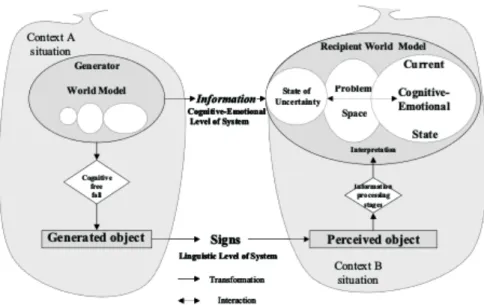
Figure 2.2: The cognitive communication system for information seeking, dis-playing the exchange of information objects from Generator (information object author) to Recipient (information object seeker). Reproduced from Ingwersen and Järvelin(2005, p. 33).
Although we do not explicitly investigate interactions between result com-position and information seeking in our work, result comcom-position can be viewed as an approach to providing information seeking support. By extracting content from various sources of information and assembling it around common topics in relation to a searcher’s query, result composition can help users assess and syn-thesise the diversity of the information space, as well as reduce the number of information retrieval tasks in their overall information seeking approach.
2.1.3
Information Objects
Ingwersen and Järvelin(2005, p. 19) define information objects as physical or di-gital entities “in a variety of media [, ] that belong to the information space of IR [ information retrieval ] systems, providing potential information” — they use the terms documents and information objects interchangeably, as do other studies in the area of Information Seeking and Retrieval (Belkin, 1978; Belkin and Cool,
2002;Belkin and Robertson,1976, and related). InIngwersen and Järvelin(2005), information objects are authored bycognitive actors. Actors, when generating
in-formation objects, are influenced (i) by the hierarchy of contexts in which they
are placed, and (ii) also by their own understanding (i.e., world model), defined
through their priorinformation seekingor information interaction behaviour.
The term information object is, therefore, deliberately general and recursive
refer to results, regardless of presentation style, or documents, regardless of type. This thesis claims to investigate the aggregation of web search results retrieved from various document sources (e.g., images, tweets, Wiki pages) within inform-ation objects. From a user-centric perspective on search modelling, our use of the
term information object follows previous usage and definitions, with composite
objects being “digital entities, in a variety of media, that belong to the inform-ation space of IR systems, providing potential informinform-ation”. Composite objects are also authored by cognitive authors, however through the mediation of al-gorithms for result composition (i.e., in the case of composite objects, the author is the algorithm designer and developer). As such, in addition to author context and their model of the world, algorithmic biases can also influence information objects derived from result composition.
2.1.4
Relevance versus Usefulness
Relevance is a complex topic in Information Science and Information Retrieval, and has been discussed extensively for more than half a century (Cleverdon,
1967). It is “a, if not the, key notion in information science in general and inform-ation retrieval in particular” (Saracevic, 1975) yet it is used in widely dissonant ways in the research literature. It has been systematically reviewed and examined in numerous studies (Borlund,2003a;Mizzaro,1997;Saracevic,2007a,b) conclud-ing that (i) relevance is a multidimensional cognitive concept, largely
depend-ent on searchers’ perception of information and their own information need situ-ation (Schamber et al.,1990), and that(ii)relevance is a dynamic concept, which
can take any meaning (e.g., topical relatedness, user satisfaction), and changes over time, or with users’ cognitive state. In some cases, relevance can even be irrelevant (Millan-Cifuentes et al.,2014).
We do not attempt to clarify the complexities of relevance here, but distin-guish between the two “types” of relevance used in this text: topical relevance
and user relevance(what we describe as usefulness). In our work, an information
object is topically relevant to a query if it is on the same topic, as assessed by a
person (Saracevic,1996) (i.e., a person determining topical relevance in a formal setting; a relevance assessor). For example, a web page containing a biography of Fidel Castro would be topically relevant to the query “fidel castro”, and would also be topically relevant to queries “cuban history” and “cuban politics”.
User relevance or usefulness takes into account other factors that go into a
searcher’s judgement of relevance, and has been proposed as a measure of search quality in numerous prior studies (Belkin et al.,2008;Cole et al.,2009;Mao et al.,
2016; Yilmaz et al., 2014). Usefulness is typically discussed in contrast with top-ical relevance and refers to the “highly situational4, subjective, user-perceived
usefulness” (Mao et al.,2016) of an information object. For instance,Yilmaz et al.
(2014) show that effort (e.g., the effort of scanning a document to locate relevant pieces of information) plays an important role in user satisfaction and that ef-fort needs to be considered together with topical relevance when the quality of a search systems is evaluated. This further supports prior work that conceptually distinguishes relevance from the utility (or usefulness) of a document to an ac-tual user, suggesting evaluation metrics should be utilitarian in nature (Saracevic,
1975,2007a,b). Cole et al.(2009) propose usefulness as a modern criterion for the evaluation of search systems, and clarify that:
“Usefulness is specifically distinguishable from relevance in several dimensions. Most strikingly, a usefulness judgment can be explicitly related to the perceived contribution of the judged object or process to progress towards satisfying the leading [ search-related ]