An Assessment of the Performance of Initial Public Offering
(IPOs) in Malaysia
Leila Yazdani* Sulaiman Aris
International Business School (IBS), Universiti Teknologi Malaysia, 54100 Kuala Lumpur * E-mail of the corresponding author: [email protected]
Abstract
Initial Public Offerings (IPOs) are largely underpriced in short term. This underpricing phenomenon has been well recognized in nearly all the stock markets in the world. Recent evidence suggests that underpricing is higher in a buoyant stock market. Most studies in the field of IPO have only focused on developed countries. Little is known about underpricing and it is not clear what factors influencing underpricing in developing country. Unlike in developed markets, this study analyzed the existence of underpricing issue of Malaysian IPOs listed in Bursa Malaysia from 2000 to 2008. This study then examines the impact of different use types of proceeds on IPO underpricing. In particular, four main influencing factors of underpricing including IPO size, market volatility, underwriter status and reciprocal of IPO price are investigated. A sample of 102 IPOs was selected and analyzed. Results show that the average market adjusted initial return is 9.4%. A regression analysis was conducted which resulted in positive impact of IPO size, market volatility, underwriter status and reciprocal of IPO price on underpricing. Therefore, this study provides a new perspective to analyze the underpricing problem by focusing on the multiple elements.
Keywords: IPO, underpricing, underwriter, Malaysia
1. Introduction and Problem Statement
The IPO or initial public offering is one of the famous facts within stock market in case of new firms, underwriters and investors. Initial Public Offerings (IPOs) present potential investors with a vehicle to earn superior returns. There have been numerous researches performed on the IPOs performance in many different markets (Bajo et al., 2014).
The IPOs performance achieved so many concentrations during previous two decades (Bahadir et al., 2015). The interest may be related to the value of IPOs for growth of economy and recruitment, but more common than not the concentration on substantial those profit benefits, which, they recommend to the investors Bessler and Thies (2007). Initial Public Offerings (IPOs) under-pricing i.e., a positive gain of a new stock on the listing day compared to its IPO offer price is a commonplace phenomenon in many markets. A large body of finance literature has proposed various model and hypothesis to explain this so - called under-pricing phenomenon. In other words, on average, an investor who subscribes new IPO issues for the suggested price or sells them all with a close price during day one can make positive returns. Hence, the investigation of IPO pricing and performance have been subjects of considerable academic and practical interest, and this will continue to dominate the research directed to IPOs.
Amongst the well-studied topics related to IPOs is their short-term performance which gives rise to a vast body of empirical research on the two main anomalies in IPOs. One of them is the presence of under-pricing in IPOs. Investors who subscribe for IPO shares and sell them during first trading day earn a positive return where closing price of first trading day is above offering prices. The persistent anomalous behaviour that characterize IPOs – under-pricing on the first day of a few IPO - have developed interest of researchers resulting in a great consideration to provide explanations and reasoning behind this phenomenon.
Under pricing can be seen as a fundamental feature of IPOs and is existent in almost every economy. It was an attractive subject due to it always has been a puzzle that why IPOs all are under-priced in such the way which result in huge initial positive average returns. While one company uses an IPO as first time ever, it follows then various patterns of fluctuations for share price. This type of anomalous pricing behaviour violates proper developed hypothesis of market or those IPO investors who have an advantage in gaining information, prior to IPO listing, generally exploits this opportunity and make profits via arbitrage.
The knowledge of the potential performance of Malaysian IPOs in the short run may bring the investors critical knowledge for making best decisions about selecting investment chances. This study is exploratory in nature and investigates whether there is an existence of under-pricing for those IPOs, which have been listed on the Bursa Main Board from year 2000 to 2008. Although there is a great deal of research that investigates these issues in most developed stock markets, only a few studies have been undertaken in the Malaysian context, particularly in the aftermath of Asian finance crisis that gripped much of the Asian region in 1997. Hence, this current research aims to study the initial. The aim of this research paper is to provide an empirical review of IPOs short term.
Research Journal of Finance and Accounting www.iiste.org ISSN 2222-1697 (Paper) ISSN 2222-2847 (Online)
Vol.6, No.3, 2015
2
Malaysia. This research will be of grade interest to investors, analysts, stockbrokers, fund managers and academicians. It will enlighten our understanding of aftermarket performance of the new issues and would be of great interest to eager investors.
This study discusses the pricing phenomenon with certain concentration on short run under-pricing. Based on past empirical study, explanatory factors used in the model are intended to test if factors can describe initial under-pricing of the IPOs in Malaysia. Priori expectations and definitions for each explanatory variable are elaborated here. Finally, the several hypotheses are proposed based on the literature to assess the relationship among the explanatory variables as well as magnitude for under-pricing.
2. What is an IPO?
IPO, initial public offering, is the time a firm, issuing company, offers selling shares of business to public for the first time, along the expectations to create a liquid market (Ritter 1991). The primary reason of listing a firm on the stock market is based on Espinasse (2011) to increase equity capital. Furthermore, since an IPO often is followed by an increase in media coverage the public attention the firm gets when “going public”, is considered, however as a secondary but positive aspect (Ritter 1991).
3. Performance of IPO
There have been numerous studies conducted on the performance of IPOs. Initial researches mainly concentrated on the under-pricing phenomenon. The performance of IPOs is consistent across different markets, i.e. initial under-pricing (high initial returns).
3.1 The Short Run Under-Pricing of IPOS
In order to approach the public, most companies use the mode of initial public offering of shares to investors. The issue of under-pricing in IPO has been an extensive area of investigations within financial community mainly in past 30 years. This under-pricing phenomenon has garnered enormous interest among the financial economists for several decades. In the early days, in elucidating the under-pricing phenomenon, some studies were focused on some specific factors. Early researchers such as Ibbotson (1975) and Logue (1973) recognized that the IPO shares tend to be under-priced, when companies go public, since the share price jumps on the trading’s first day. This means that, on average, an investor who acquires new issues with offered price and then selling them with close price in first day of the listing can get relatively large yields.
Using the data from 1990 till 1998, Loughran and Ritter (2000) realized that initial returns on IPOs averaged around 15 percent, which was equivalent to approximately USD 27 billion of potential IPO proceeds were left on the table as a result of under-pricing. Another observation by Ritter and welch (2002) documented that during the two-year period from 1999 to 2000, about USD 65 billion was left on the table from the IPOs raised. Jelic et al. (2001) using 182 IPOs on the KLSE Main Board over the period January 1980 to December 1995 documented that the degree of under-pricing appeared to be exceptionally evident during the hot issue periods of 1983-1985 and 1993- 1995.
Levis (1990) demonstrated that the under-pricing of IPOs can be accounted for by winner curse problem and the interest rate cost in his studies on 123 IPOs in London Stock Exchange for the period January 1985 to December 1988. After the allocation rate and interest rate cost was taken into account, the return of first day was not different significantly compared to zero. The degree of under-pricing varies significantly across markets. Loughran et al. (1994) provides an international survey of twenty- five (25) countries’ IPO performance from seven regional nations including Japan having 32.5% initial returns on average; 78.1% in Korea; 17.6% in Hong Kong; 27.0% in Singapore; 80.3% in Malaysia; 58.1% in Thailand and 45.0% in Taiwan. From their investigation, they found that steps taken by economies in Eastern Asia for minimizing regulatory intervention to fix IPO subscription prices has resulted in decreased IPO under-pricing during 1990s. While comparing returns for Asian IPOs and US IPOs, Ritter (2003) stated that IPOs in Asia have considerably better initial returns in comparison with US IPOs on average. For instance, in his research on initial returns of new listings in 33 countries, he observed that in developing markets it ranges from 13.6% - 388% whereas in developed markets, it ranges from 4.2% - 54.4%. Moreover he compared the amount of under-pricing in eleven countries in Asia having Singapore on top with average of 256.9% whereas Japan having the least average of 15.1%. Malaysia had
an average of 31.1%
3.1.1 IPO Size (size)
Size of the offering is defined as the offer price multiplied by the number of shares. The previous literature argues that IPOs bigger in terms of size signal their intrinsic value by a larger margin underpricing (Allen and Faulhaber, 1989; Grinblatt and Hwang, 1989). Therefore, it is expected to be a positive relationship among this factor and initial under-pricing as well.
3.1.2 Market Volatility (MV)
Empirical evidence proposes that IPOs which, go public when the market is hot (when the return in market is high) experience high returns in their first day. In some cases success of IPO issues is dependent on the timing of the issue, whether the whole market environment is bullish, bearish or flattish. In a market violated to a high level, IPO subscribers are likely to expect a higher return as compensation against the risk they take. The underwriters are likely to offer a lower price to prevent fall of the IPO stock’s intrinsic value below the offer price, even in cases that mode of the market is bearish. This could lead to a higher initial premium to subscribers. Thus, condition of the market at the issuing time of the IPO and listing of IPO is highly important. According to the method developed by Menyah et al. (1995), volatility of the market is quantified by the standard deviation of daily KLCI market returns over a period of two months or forty working days before the listing date. It is expected to be a positive relationship among this factor and level of initial under-pricing.
H2: Market volatility and level of initial under-pricing have a positive relationship. 3.1.3 Reciprocal of the IPO subscription price (RECIPO)
The higher is the subscription price, the harder it will be for an average investor to obtain the stocks since higher priced IPOs exceed the affordability of an average IPO investor. Therefore, the demand for lower priced IPOs is more than the demand for lower priced IPOs as the IPO can be priced extremely high. Hence, the level of initial under pricing considered sharing a positive relationship with reciprocal of IPO subscription price.
H3: IPO subscription price reciprocal and level of initial under pricing have a positive relationship. 3.1.4 Underwriters’ status (UW Status)
A considerable number of literatures have studied the impact of reputation from underwriter on IPOs initial performance, according to Beatty and Ritter (1986). Using the data covering 1980-1995, Jelic et al. (2001) studied Malaysian IPOs and discussed that on average, underwriter possessing a good reputation are more likely having a chance for raising initial under-pricing. These results are not consistent the results reported in studies on underwriters' role in different nations (Beatty and Ritter, 1986). On the other hand, Beatty and Welch (1996) propose that a negative relationship among the IPO under-pricing level and reputation of the underwriters could be reversed as a result of changes in the economic environment. Hence, reputation of underwriter and the level of initial under-pricing are expected to have a positive relation.
As per the review of previous literature, framework for this study was developed. Following are the hypotheses developed for this study;
H4: Underwriter reputation and level of initial under pricing have a positive relationship.
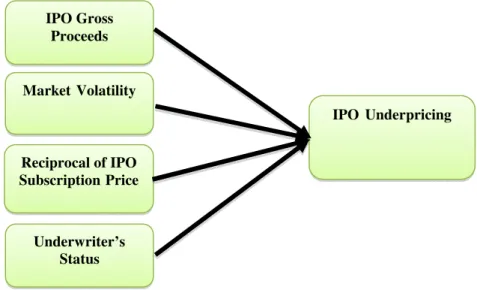
Based on the review of literature a framework was formulated to investigate the effect of IPO gross proceeds, market volatility, reciprocal of the IPO subscription price and underwriters’ status on the under pricing level.
Figure 1. Research Framework 4. Conclusion
This study explained and discussed literature related to finance and IPO under-pricing. A special consideration was given to the studies that focused on IPO size and sector, market volatility and underwriter’s performance. The reason to conduct literature review was to present all the current issues and debates related to under-pricing
IPO Gross Proceeds Market Volatility Underwriter’s Status Reciprocal of IPO Subscription Price IPOUnderpricing
Research Journal of Finance and Accounting www.iiste.org ISSN 2222-1697 (Paper) ISSN 2222-2847 (Online)
Vol.6, No.3, 2015
4
phenomenon having a special emphasis on IPO’s short-term under-pricing. It is well noted that all the companies require to raise capital in order to start-up their business, to have finances for new projects or to expand the current projects. Amongst the common ways to rise quick capital is to offer stocks visa initial public offering (IPO) by less established and newer companies. The IPOs under-pricing was a subject of the theoretical researches in many years. The existence of under-pricing in IPOs has been documented well both in under developed and developed markets. This study examines how IPO size, market volatility, underwriter status and reciprocal of IPO price affect IPO short term under-pricing. IPO underpricing is considered as amongst those glitches that has attracted a large attention from the researchers in the field of finance. In the same wake, this study also aimed to enhance the understanding of IPOs by probing the Malaysian Stock Exchange-Bursa Malaysia by examining the market-adjusted initial returns, and their short-term performance.
5. Suggestions for Future Research
Future studies on the current topic are therefore recommended. Further research in different market settings seems warranted. Splitting the sample of IPOs into hot and cold market sub-samples can extend the study. It is aimed to allow comparisons of underpricing levels different market conditions. It also allows for investigation into the differential in IPO initial returns between hot and cold markets as characterized by Ritter (1984), where the initial IPO return is observed to be generally higher in hot market than cold market. As, the purpose of this paper was to assessment of the performance of Initial public offering (IPOs) In Malaysia. This is an important issue for future research to see if the effect of IPO size, market volatility, underwriter status and reciprocal of IPO price on the performance of IPOs to other Islamic countries or is a country-specific characteristic. More firms need to be examined to identify the market characteristics that drive the returns but this requires the passage of time so that more IPOs can take place.
References
Allen, F. and G Faulhaber (1989), Signaling by Underpricing in the IPO Market, Journal of Financial Economics, 23, 303-323
Beatty, R., and J. Ritter (1986), Investment Banking, Reputation, and the Underpricing of Initial Public Offerings, Journal of Financial Economics, 15, 213-232
Beatty, R. and I. Welch (1996), Issuer expenses and legal liability in initial public offerings, Journal of Law and Economics, 34, 545-602.
Bahadir, S. C., DeKinder, J. S., & Kohli, A. K. (2015). Marketing an IPO issuer in early stages of the IPO process. Journal of the Academy of Marketing Science, 43(1), 14-31.
Bajo, E., Chemmanur, T. J., Simonyan, K., & Tehranian, H. (2014). Underwriter Networks in Initial Public Offerings. Available at SSRN 2456237.
Bessler, W. and Thies, S. (2007). The long-run performance of initial public offerings in Germany. Managerial Finance, 33 (6), 420-441.
Espinasse, P., (2011). IPO: A Global Guide. Hong Kong University Press.
Grinblatt, M., and C. Hwang, (1989). Signaling and the Pricing of New Issues, Journal of Finance, 44, 393-420. Ibbotson, R.G., Jaffe, J.F., (1975), Hot issue markets, Journal of Finance, 30., 1027-1042
Jelic, R., Saadouni, B., and Briston, R. (2001), Performance of Malaysian IPOs: underwriters reputation and management earnings forecasts, Pacific-Basin Finance Journal, 9, 457-486
Levis, M. (1990). The Winner's Curse Problem, Interest Costs and the Underpricing of Initial Public Offerings. The Economic Journal, 100(399), 76-89.
Logue, D., (1973), On the pricing of unseasoned equity issues: 1965-1969, Journal of Financial and Quantitative Analysis, January, 91-103
Loughran, T., Ritter, J., Rydqvist, K., (1994 updated 2000,) Initial public offerings: International insights, Pacific-Basin Finance Journal, 2, 165-199.
Menyah, K, Paudyal, K., and Inganyete, C.G., (1995), Subscriber return, underpricing, and long-term performance of UK privatization initial public offers, Journal of Economics and Business, 47, 473-495.
Ritter, J. R. (1984). The ‘hot issue’ market of 1980. Journal of Business, 15, 215-240. Ritter, J. R. (2003). Behavioral Finance. Gainesville: University of Florida.
Ritter, J. R., and Welch, I. (2002). A Review of IPO Activity, Pricing, and Allocations. Yale ICF Working Paper (02-01).