co
SCIENCE
&
TECHNOLOGY
April,
1971
Vol.
2
0, No.
4-IN THIS ISSUE:
The Computer, Stockbroker of the
Future
Using the Computer to Steal
Why the Public Dislikes Computers
Common Sense, Wisdom, General
Science, and Computers
Fleur-de-Iys - by computer
---PERIODICALS SEC
1263399045
0104
180
\oJSAN CARLOS ST
*01271
The
New York Times and
Computers and Automation
announce a practical guide to
the most elusive components in
computers and data processing . ..
PEOPLE
Who they are ...
What they do ...
Where they do it ...
Until now, it has been well-nigh
im-possible to keep track of the
thou-sands of highly skilled professionals
fngaged in the world's fastest
grow-mg profession.
The painstaking task required to
in-ventory the qualifications and
back-grounds of the 15,000 most
neces-sary professionals in every branch of
the computer field has now been
ac-complished. The oldest magazine in
the field, Computers and
Automa-tion, and the information retrieval
services of The New York Times
have pooled their resources to
pro-duce the Fifth Edition of
WHO'SWHOIN
COMPUTERS AND
DATA PROCESSING
This is the most extensive register of
computer professionals ever
pub-lished - the first of its kind in seven
years.
Itis arranged for your
con-venience in three volumes:
1. Systems Analysts and
Program-mers
2. Data Processing Managers and
Directors
3. Other Computer Professionals
(from professors of computer
sci-ence to attorneys versed in the
computer field)
Each of the more than 15,000
spe-cialists is covered by a separate
cap-sule biography detailing: Birth Date
... Education . .. Year Entered
Com-puter Field . .. Title . .. Honors . ..
Memberships . .. Special Skills (from
applications to logic to sales) ...
PLUS both home and business
ad-dresses. For example:
CHAPIN ... T_..I I _ _ _ _ • • • • _ _ • I L ___ • ''''''' ... I educ
ente tere age stru tan: Me hor ove AC Me
This
l.useful
agers,
ganiz~
confe
compl
who r
pIe wI
WI
81~
PIe
PR
me
OR
AI:
YO
I[]
I
C(ling
I
an«I
COlI
aniL~~
SAN JOSE
k'lI\JSLJC
LIBixJ\RY
ication Price.
~m
below will bring
set at the reduced
an immediate
sav-le regular price of
risk involved.
10-'Jtion.
COMPUTERS
[)CESSING
r
C. Berkeley
Ible hard-cover
!e set
I
Price $60
---_.,
.S AND DATA 5).
You
will bill ot fully satisfied.MPANY ORDER)
geographical list-I services, courses computer centers, lions of computer Order now at $20
Who's Who in Computers
ANDERSEN, Hans Peter Brostrup / console opera-tor / b: 1946 / ed: Denmark / ent: 1966 / m-i: B Ma P Sa / t: console operator / org: Tretorn Data Center, AB, 25225 Halsingborg, Sweden / pbh:
-/ h: Tranemansgatan 14 3:e van, S-252 44 Halsing-borg, Sweden
ANDERSON, Alfred O. / mathematician / b:
1928 / ed: BS, math / ent: 1953 / m-i: P / t: mathematician / org: Aberdeen Proving Ground, MD 21005 / pb-h: ACM / h: 602 Market St, Aberdeen, MD 21001
ANDERSON, Carl S. / systems analyst / b: 1934
/ ed: BS, Univ of Kansas School of Business / ent: 1962 / m-i: A Mg Sy / t: computing systems ana-lyst / org: The Boeing Co, 3801 S Oliver, Wichit:'l KS 67210 / pb-h: CDP / h: 806 N FloreJ1r~ -ita, KS 67212
ANDERSON, F,J
scientist I .-Berke Univ, neering Sy / t:
<-Sciences
90245/ p. for a 1 AIAA Ael
1969 / h: It. 90812
ANDERSON~
ed: Stanford l
director of ene Products, Inc, 1 \
/ pb-h: - / h: 6,
01778 / *C64
ANDERSON, Her,
b: 1927 / ed: Unh Mexico / ent: 1957 I
_w _" I t: staff associate / org: Sana _ .... lldia Base, Albu-querque, NM 87115 I yv-h: ACM, CDP, several papers / h: 501 Mesilla NE,Albuquerque, NM 87108
ANDERSON, Jess / systems specialist / b: 1935 /
ed: BA / ent: 1955 / m-i: A P Sy; research in physical sciences / t: specialist / org: Univ of Wis-consin, PO Box 6, Stoughton, WI 53589 / pb-h: several papers / h: 2838 Stevens St, Madison, WI 53705
ANDERSON, Kermit C. / systems analyst / b:
1943/ ed: BS, Penn State Univ / ent: 1969/ m-i: L Ma P Sy / t: systems analyst / org: Marsh &
McLennan,70 Pine St, New York, NY 10005 /
pb-h: - / pb-h: 2 Park Ave, Green Brook, NJ 08812 ANDERSON, Marilyn B. (Mrs.) / junior engineer
/ b: 1927 / ed: Miami Univ / ent: 1949 / m-i: P /
t: free lance programmer / org: - / pb-h: - / h: 2138 Hillcrest Rd, Redwood City, CA 94062 / *C64
ANDERSON, Richard C. / systems analyst / b:
1917 / ed: Univ of South Dakota / ent: 1960/
m-i: A B / t: specialist controllers staff / org: Bur-roughs Corp, 6071 Second Ave, Detroit, MI 48232
/ pb-h: - / h: 16090 Kinross, Birmingham, MI 48009 / *C64
ANDERSON, Stanley Gordon / systems analysis
/ b: 1940 / ed: MS - ',Univ of Illinois / ent: 1965 / m-i: F ~ - ~ial impact / t: informa-tion ". - ';!stern Electric Co Inc,
60540 / pb-h: ACM, 'W328 Liberty,
Win-~ident / b: 1929 / T orcester Poly tech
president / org: Ave, Waltham, tee on
Numeri-"insor Rd,
Sud-'luditor / b: TJniv / ent: processing " PO Box
h: 10256
_" programmer <oJ' / m-i: A P Sy / t: J"lng supervisor / org: Midway
_J-' University, St Paul, MN 55104 /
.. - / h: 441 Lynnhurst W, St Paul, MN 55104
ANDRADE, Luciano P. / programmer / b: 1918 /
ed: high school / ent: 1962 / m-i: P / t: senior computer programmer / org: HUD, Washington, DC 20410 / pb-h: - / h: 6419 Maplewood Dr, Falls Church, VA 22041
ANDREE, Richard V. / professor, author, lecturer, consultant / b:1919 / ed: BS, Univ of Chicago, PhD, Univ of Wisconsin / ent: 1948 / m-i: A Ma P Sy; writing, information science / t: professor of math, research associate in computing science /
org: Univ of Oklahoma, Norman, OK 73069 /
pb-h: ACM, AEDS, ASL, DPMA, MAA, NCTM, SIAM lecturer, American Assn for the Advance-ment of Science, American Math Society, Ameri-can Society for Engineering Education, Mu Alpha Theta, Pi Mu Epsilon, Sigma Xi, 3 fellowships, numerous committees, Who's Who in America,
Vol. 20, No. 4
April, 1971
Editor
Assistant Editors
Software Editor
Advertising Director Art Directors
Contributing Editors
Advisory Committee
Fulfillment Manager
Editorial Offices
Advertising Contact
Edmund C. Berkeley
Linda Ladd Lovett Neil D. Macdonald Stewart B. Nelson
Bernard Lane Ray W. Hass Daniel T. Langdale
John Bennett Moses M. Berlin Andrew D. Booth John W. Carr III Ned Chapin
Alston S. Householder Leslie Mezei
Ted Schoeters Richard E. Sprague
James J. Cryan Alston S. Householder Bernard Quint
William J. McMillan
Berkeley Enterprises, Inc. 815 Washington St., Newtonville, Mass. 02160 617-332-5453
THE PUBLISHER Berkeley Enterprises, Inc. 815 Washington St., Newtonville, Mass. 02160 617-332-5453
Computers and Automation is published monthly (except two issues in November) at 815 Washing-ton St., NewWashing-tonvi lie, Mass. 02160, by Berkeley Enterprises, Inc. Printed in U.S.A.
Subscription rates: United States, 11 monthly issues and two issues in November (one of which is a directory issue) - $1 B.OO for 1 year, $36.00 for 2 years; 12 monthly issues (without directory issue in November) - $9.50 for 1 year; $18.00 for 2 years. Canada, add 50¢ a year for postage; foreign,add $3.50 a year for postage. Address all U.S. subscription mail to: Berkeley Enterprises, Inc., 815 Washington St., Newtonville, Mass. 02160. Second Class Postage paid at Boston, Mass. Postmaster: Please send all forms 3579 to Berkeley Enterprises, Inc., 815 Washington St., Newtonville, Mass. 02160. © Copyright 1971, by Berkeley En-terprises, Inc.
Change of address: If your address changes, please send us both your new address and your old address (as it appears on the magazine address imprint and allow three weeks for the change to be made.
4
The magazine of the- design, applications, and implications
of information processing systems.
Computers and Applications
20 THE SCIENCE OF INFORMATION MANAGEMENT [A]
by Col. Carl J. Wein~eister III, U.S. Air Force
A development of two theses: (1) I nformation management systems
have failed because of inadequate attention to data base
construc-tion; and (2) A new science of information management must be
developed before really successful, large management information systems can evolve.
8 THE COMPUTER, BROKER OF THE FUTURE:
39
A Speculative Forecast [A]
by Dr. Oswald D. Bowlin and Dr. William P. Dukes, Texas Tech Univ., and Dr. William F. Ford, Transylvania Univ.
Plausible procedures for the design, development, and implementa-tion of COMBRONET, a hypothetical computerized brokerage net-work that could make stock brokers obsolete.
UNIVERSITY OF ILLINOIS INSTALLS CDC 6400 FOR DEVELOPMENT OF COMPUTERIZED EDUCATION
by Edward B. Bohanon, Control Data Corp.
[G]
Computer, the Mail, and Mailings
35 COMPUTERIZED JUNK MAIL [G]
by Congressman Cornelius E. Gallagher; Democrat, New Jersey A development
37 HURRAY FOR THE COMPUTERIZED LETTER! [G]
by A Computer Program and the Editor
36 ADDRESS LISTS BY COMPUTER [A]
by Michael Manson, Book Devt. Council & Univ. Mailing Service,
London, England
Computers and Crime
16 USING THE COMPUTER TO STEAL [A]
by Harvey S. Gellman, President, DCF Systems Ltd., Toronto
How computers are being used for fraud and theft - and what can be done to prevent this use.
Computers and Society
25 MORE AND MORE PEOPLE [A]
by E. Allen Arnold, Actuary, The Wyatt Company
How over-population affects our world .... and what actuaries might do about it.
39 RELEASE BY HOSPITALS OF MEDICAL DATA ON PATIENTS [G]
by Prof. C. C. Gotlieb, University of Toronto
Compu ters, Science, and Assassinations
32 THE RIGHT OF EQUAL ACCESS
TO GOVERNMENT INFORMATION [A]
by the National Committee to Investigate Assassinations, Washington, D.C.
Computers and the Philosophy of Science
6 THE MOST IMPORTANT
OF ALL BRANCHES OF KNOWLEDGE by Edmund C. Berkeley, Editor
[E)
Should it not be a compound of common sense, wisdom, judgment, science in general, and more? the concepts and principles which ap-ply in all subjects and which enable mistakes to be avoided?
27 COMMON SENSE, WISDOM, GENERAL SCI ENCE, ... The Most Important of All Subjects
-and its Relation to Computers by Edmund C. Berkeley, Editor
[A]
The names and characteristics of this subject; several decisive illus-trations of its application; and an argument for its importance.
56 THE C&A NOTEBOOK ON COMMON SENSE,
ELEMENTARY AND ADVANCED [N]
Announcement of a new publication by C&A devoted to common sense, wisdom, mistakes and how to avoid them, the computer testing of general principles, and related topics.
38 UNDERSTANDING,
AND MODELS FOR ACCOMPLISHING UNDERSTANDING [G] by Stuart H. Sanfield, Univac Division, Sperry Rand Corp.
35 THE COMPUTER:
A HIGHLY SKILLED IDIOT AND NOT A THINKER by John L. Anderson and the Editor
The Golden Trumpet
7 DATA PROCESSING MANAGEMENT ASSOCIATION OBSERVING 20TH ANNIVERSARY IN 1971
by James D. Parker, Jr., CDP, International President DPMA
38 PUBLISH YOUR ANNUAL INDEX IN DECEMBER by Geraldine Gieger, Esso Research and Engineering Co.
38 EDITING BY THE STAFF
[G]
[F]
[G]
OF "COMPUTERS AND AUTOMATION" - A BOUQUET [G] by James F. Muench, Computer Consultant
Computers and Puzzles
19 NUMBLES by Neil Macdonald
40 PROBLEM CORNER by Walter Penney, CDP
Reference Information
2,3 WHO'S WHO IN COMPUTERS AND DATA PROCESSING,
[C]
[C]
FI FTH EDITION - ANNOUNCEMENT [R]
55 THE COMPUTER DIRECTORY AND BUYERS GUIDE,
1970-ANNOUNCEMENT [R]
53,54 THE COMPUTER DIRECTORY AND BUYERS GUIDE, 1971
-ENTRY FORMS [R]
COMPUTERS and AUTOMATION for April, 1971
Front Cover Picture
The drawing on the front cover was another of the entries in the Eighth Annual Computer Contest of "Computers and Automation" (see the August 1970 issue). The artist is Steve Derby, 2411- B West Orange-wood, Phoenix, Arizona.
The drawing was produced using a GE 435 computer, a Calcomp Plotter, and a FOR-TRAN program.
Departmen ts
42 Across the Editor's Desk
42 Applications
43 Education News
44 Research Frontier
44 Miscell aneous
55 Advertising Index
40 Calendar of Coming Events
55 Classified Advertisements
52 Monthly Computer Census
50 New Contracts
51 New Installations
47 New Products and Services
7 Readers' Forum
Key
fA] - Article
[C] - Monthly Column
[E] - Editorial
[F] - Readers' Forum
[G] - The Golden Trumpet
[N] - Notice
[R] -" Reference Information
EDITORIAL
The Most Important of All Branches of Knowledge
It may be that there is a branch of knowledge which is the most important of all.
If so, I would maintain that it is a subject which used to have the name "wisdom" but nowadays does not have a recognized scientific name, or in any college a recognized department or faculty to teach it. This subject currently is a compound of common sense, wisdom, good judgment, maturity, the scientific method, the trained capacity to solve problems, systems analysis, operations research, and some more besides. Its earmark is that it is a general subject, not a special one like chemistry or psychology or astronautics. Useful names for this subject at this time are "generalogy" or "science in general" or "common sense, elementary and advanced".
Many editorials published in ~'Computers and Automa-tion" have in one way or another discussed or alluded to this subject:
Examples, Understanding, and Computers / Decem-ber 1964
The Barrels and the Elephant: Crackpot vs. Pioneer / May 1965
Some Questions of Semantics / August 1965 Perspective / April 1966
Computers and Scientific Models / May 1967
New Ideas that Organize Information / December 1967
How to Spoil One's Mind - As Well as One's Computer / August 1968
The Catching of Errors by Inspection / September 1968
Tunnel Vision / January 1969 The Cult of the Expert / May 1969
Computers, Language, and Reality / March 1970 Computers and Truth / August 1970
The Number of Answers to a Question/March 1971 In the editorial "The Cult of the Expert" we offered a leaflet that belongs in this subject, "Right Answers - A Short Guide for Obtaining Them". More than 600 readers asked for a copy; so clearly this subject is interesting to the readers of C&A.
This subject is related to computers and the computer field in at least two ways:
First, many of the general principles which this subject contains can be investigated in experimental or real situa-tions by means of a computer. In fact, far more can be investigated by computer than can possibly be investigated by ordinary analytical mathematics.
Second, since computer professionals are in charge of computing machines, many people consider these profes-sionals responsible for the worthwhileness of the results of computers. Because of "garbage in, garbage out", computer professionals have a responsibility to apply common sense and wisdom in at least three ways:
6
Input - in the selection and acceptance of the data
with which they begin;
Processing -
in the processing through a system;Output - in the interpretation and use of the
an-swers.
Then the computerized systems will produce stIQng struc-tures that human beings can use and rely on, and not weak structures which will crash with false information or ridicu-lous results.
This issue of "Computers and Automation" contains an article, "The Most Important of all Subjects, and its Relation to Computers", which deals with this subject. For more than a dozen years I have been studying this subject -ever since I searched in a very large and good public library for a textbook on common sense or wisdom and found none at all. There is, however, a great deal of information to be gathered on this subject because a large number of great men, ancient, medieval, and moder~, have ~~de
remarks and comments (usually while talkmg or wntmg about something else) that belong in this subject.
The subject of wisdom is particularly important in these modern days. The subject has been neglected, while special sciences have been cultivated. Investigators have pursued the special sciences with the enthusiasm of a child with a new toy. Specialized science and specialized technology have rendered our earthly world almost unrecognizable:
All major cities on the planet are only a few hours apart by jet plane.
Millions upon millions of people who otherwise would be dead are alive because of miracle drugs, - thus creating a population explosion;
Nuclear weapons if used can destroy mankind and civilization in a few hours, etc.
To deal with so many diverse, vast problems we need wisdom. To use wisdom we should study it.
The staff of "Computers and Automation" have decided that it is desirable to make the drawers full of information we have been collecting on this subject more accessible and more widely distributed. We have decided to publish twice a month a publication of newsletter type called "The C&A Notebook on Common Sense, Elementary and Advanced". See the article in this issue, and the announcement on the back cover for more details. (The first few issues of the Notebook are free.)
We invite you, our readers, to join us in the pursuit of this subject, as readers of the Notebook, and as partici-pators with us in the research and study.
Wisdom is a joint enterprise - and truth is not shaped so that it can fit into the palm of anyone person's hand.
~~C:-
__
~
EDITOR }
READERS' FORUM
DATA PROCESSING M.ANAGEMENT ASSOCIATION OBSERVING 20TH ANNIVERSARY
The Data Processing Management Association (DPMA) will observe its 20th anniversary in 1971.
The association's membership has· climbed to nearly 30,000 members belonging to 265 chapters in the U.S., Canada, and other countries.
The Data Processing Management Association (DPMA) was founded in 1951 as the National Machine Accountants Association. Its first organizational meeting was held in December 1949 when a group of 30 machine accountants met at the now razed Morrison Hotel in Chicago.
The name "machine accountant" was chosen to identify those associated with the operation and supervision of punched-card accounting machines.
The constitutional conference was held in Chicago in September, 1951, with a total attendance less than 100. The State of Illinois granted the association its official charter December 26 of that year.
By 1955, the organization had taken on an international character with the admission of Montreal as the first Canadian chapter. With the rapid advances in information processing techniques brought about by the introduction of computers, the nature of the association changed as mem-bership swelled from the ranks of management of electronic data processing.
The association assumed its present name in June, 1962; R. Calvin Elliott, DPMA's executive director, was selected to head up the association's administrative operations in May, 1960.
The association holds an annual international conference and business exposition. Seminars and educational pro-grams are presented at the local or regional level. DPMA international headquarters also provides other services.
Among these are a number of "firsts," which have been put forward by the association not only for its membership but for the entire EDP industry.
One is the Certificate in Data Processing (CDP) which is recognized as the most highly regarded certification pro-gram in its field. It is dedicated to the advancement of data processing and information management by the establish-ment of high standards based on a broad educational framework and practical knowledge.
Applicants for the CDP examination must have two years of college credits and three years of EDP experience. More than 11,000 out of 19,400 applicants have passed the examination since the first one given in New York Uni-versity in 1962.
Another educational program is the Registered Business Programmer Examination, which seeks to identify those reaching a level of competency as senior programmers. There are no academic or experience eligibility require-ments for this examination.
COMPUTERS and AUTOMATION for April, 1971
Both of these examinations were developed by the DPMA certification council and are given annually in about 100 test centers in colleges and universities in the U.S. and Canada.
Another first is a manual, "Guidelines for the Operation of Private Data Processing Educational Institutions", which is designed to help eliminate many of the problems which have risen with these rapidly growing schools. It was developed by a DPMAstandards committee, consisting of representatives of computer equipment makers, educators, private school administrators, and supervisory agencies.
DPMA's "Future Data Processors" program, an introduc-tory course for high school students, is the most extensive voluntary secondary education campaign ever launched by an organization with the objective of stimulating interest in EDP.
The association also publishes a survey of data pro-cessing courses offered by colleges and universities.
It is co-author of "Automatic Data Processing, Principles and Procedures," an introduction to EDP at the college level. The book, now in its second edition, has been called "the most complete introduction to one of the fastest-growing fields."
DPMA published in 1971 "An Executive Briefing on the Control of Computers," a new book for corporate execu-tives on how to get the most out of computer operations without being a computer expert.
It also publishes "Guidelines to Data Processing Manage-ment," a compilation of contributed papers by prominent national consulting firms and a "reference bible" to sound EDP management practices. It also publishes a monthly magazine to keep its membership abreast of EDP develop-ments.
In other areas, the association each year awards a number of $2,000 grants to Ph.D. candidates preparing a doctoral dissertation in the field of data processing, re-serving the right to make the paper available to its member-ship and the EDP community. In colleges and universities, local chapters sponsor and encourage the formation of student organizations interested in EDP. Individual chapter members serve as counselors for the Boy Scout computer merit badge program.
One of DPMA's most recent efforts has been the devel-opment of an audio-visual program as a very useful adjunct to its educational objectives.
Currently, DPMA is making available to chapters and other interested groups the following films: "Presentations to Management," "Human Relations and the EDP Man-ager ," "Man's Most Magnificent Machine ," "Wunderin Willie Builds a Computer ," and "The Key," the latter being an authoritative description of the CDP program.
THE
COMPUTER~
BROKER OF THE FUTURE:
A Speculative Forecast
"In the future, the present complementary relationship between computers
and stock brokers will in all probability be replaced by an increasingly
competitive relationship. This transformation is likely to occur because the
computer will soon have the capability to displace the broker in each of his
essential occupational functions. "
Dr. Oswald D. Bowlin and Dr. William P. Dukes College of Bus. Admn.
Dept. of Finance Texas Tech Univ. P.
O.
Box 4469 Lubbock, Texas 79400 andDr. William F. Ford
Inter-American School of Bus. Admn. Transylvania Univ.
Lexington, Kentucky 40508
8
Dr. Oswald D. Bowlin (left) is the Chairman of the Dept. of Finance and a Professor of Finance at Texas Tech University. He holds a B.A. and M.S. degrees from Texas A & M University, and a Ph.D. from the University of Illinois.
Dr. William Dukes ( center) is an Associate Pro. fessor of Finance at Texas Tech University. He received his M.B.A. degree at the University of Mich-igan, and his Ph.D. at Cornell University.
Dr. William Ford (right) is the Dean of the Inter-American School of Business Administration at Tran-sylvania University. He holds a B.A. degree from the University of Texas, and M.A. and Ph.D. degrees from the University of Michigan.
Dr. Bowlin, Dr. Dukes, and Dr. Ford have all published numerous articles in the field of finance.
The seemingly irrepressible force created by the advent of the digital computer has only begun to revolutionize American business. With the advent of third generation computers and the capability to interconnect these com-puters, the system of exchanging securities via brokers may soon become a thing of the past.
Up to now, most changes caused by the computer have been the result of its speed in computation, its ability to reduce human error, its indefatigability, and the fact that it has made practical a series of calculation procedures which could never have been implemented with the machinery of the pre-computer age. Moreover, the computer has had the important economic effect of creating and destroying occu-pational categories. For example, whole new occuoccu-pational specialties such as keypunch operators, computer program-mers, and computer hardware specialists have been intro-duced. On the other hand, the computer has also served to reduce the effective demand for workers who maintain and operate less efficient types of data processing machinery.
Present Role of Computers in Securities Markets
In securities markets, the computer has to date generally complemented the activities of stock brokers and traders. The nature of this relationship can best be discussed in the
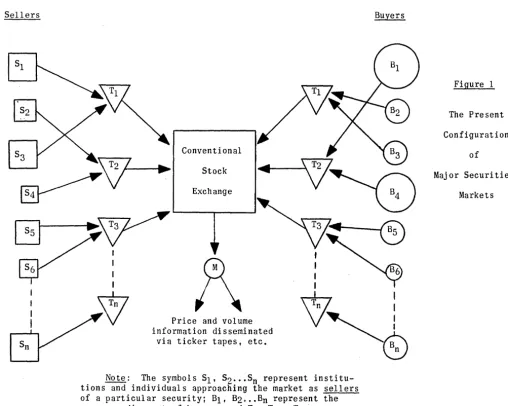
context of a simplified schematic diagram. In Figure 1, individuals and institutions approaching the market as
sellers
are represented by the rectangles on the left side of the diagram. Relatively large rectangles represent the sell orders of major institutional investors and well-to-do indi-viduals who trade in round lots. The very small scale rectangles represent the normal selling activities of smaller institutions and individual odd-lotters. On the right hand side of the diagram, the circles of various sizes represent the corresponding array of small to large scale investors who are approaching the market at a given moment asbuyers.
The triangles on both sides of the diagram represent brokerage houses that gather buy and sell orders from institutions and individual investors throughout the market. The block in the center represents a conventional stock exchange in which buy and sell orders are matched through time-honored labor intensive methods. Finally, the output vector labeled M indicates the stream of price and volume data generated by the stock exchanges and disseminated via their ticker tapes, telecommunications networks, news wires, etc. This process of trading securities provides a substantial amount of employment for floor traders, stock brokers and their logistic support personnel. The computer has been used mainly to speed communications between brokers and the floors of stock exchanges; as a means of expediting the follow-up handling of transactions and billings; and as aA DAY AT THE STOCK EXCHANGE
TODAY TOMORROW?
research tool in the analysis of investment opportunities. In the future, however, the present complementary relation-ship between computers and stock brokers will in all probability be replaced by an increasingly competitive process. This transformation is likely to occur because the computer will soon have the capability to displace the broker in each of his essential occupational functions. This paper presents a speculative note on the evolution of a fully automated securities exchange system that would eliminate the need for stockbrokers.
The Economic Imperative
It will be useful to begin by considering the basic economic rationale for the further development of the "Third Market" in securities. In recent months, total daily volume on the New York Stock Exchange (NYSE) has averaged roughly 10 million shares with the average share price varying between $43 and $49;. approximately 60 percent of all transactions have come· from institutional investors. A round-lot transaction in a stock selling for $44 a share would rate a commission of one-half of one percent plus $19 on both the buying and selling sides, or $41 for each side of the transactions.
If
we assume that the 10 million share volume is in the form of round-lot trans-actions, with each order of 1000 shares or less, the daily commissions earned would amount . to $8.2 million. 1 However, part of any day's trading will be in large block transactions of over 1000 shares, on which quantity dis-counts are allowed. For example, if large· block trading amounts to about 1 million shares per day, total brokerage fees would be reduced to approximately $7.9 million on a total volume of ten million shares.New Commission Rate Schedule for Brokers
A new commi~sion rate schedule has been proposed to the Securities and Exchange Commission (SEC) by the NYSE.2 The proposed increases range up to 50 percent for
most orders of $5,000 or less, and significant increases are even proposed for some transactions as large as 10,000 shares. 3 The Exchange estimated that the new rate schedule will generate about $500 million more in commissions than under the present schedule.
Under the new rate structure, then, average daily com-missions would rise to almost $10 million on a 10 million share day. The amount by which daily commissions fall short of $10 million will depend on the number and size of large block trades on which discounts are allowed.
With approximately 250 business days and daily com-missions approaching $10 million, the 60 percent of total brokerage charges applicable to institutional investors should amount to roughly $1.5 billion per year.
In addition, as more of the country's increasing wealth is funneled into financial institutions, daily volume could easily reach 20 million shares a day. Prior to 1965, volume exceeded 10 million shares on only five trading days.4 In 1966 the NYSE estimated that an average daily volume of 10 million shares would not be reached until about 1975. However, within the last two or three years, brokers have come to view a 10 million share day as inadequate to support the industry. With the rapid growth of financial institutions, even the 15 million share day is no longer exceptional, and a daily volume of 20 million shares may
10
not be far off. With an average volume of 20 million shares, brokerage charges to institutions would amount to at least $2.5 billion a year.
Since institutional investors are presently using com-puters for their normal business activities, a rather substan-tial amount of brokerage charges might be saved by ex-changing securities via these computers as well. These savings, coupled with economies in the personnel and telephone time achieved in executing transactions via the computer, should exceed the marginal costs of operating the automated system which is described below.
Revision of the System: Implementation
This. section of the study presents a thumbnail sketch of plausible procedures for the design, development, and implementation of a computerized brokerage network
(hereafter, COMBRONET). Again, it is assumed that insti-tutional investors and the various computer vendors will continue to make progress toward the development of compatible hardware and software systems. Once the mat-ing of computers has been achieved by electronic means, the process of exchanging securities through this medium might proceed roughly as follows.
COMBRONET (Computerized Brokerage Network)
During the early phase of its development, users of the COMBRONET would employ the price and volume data quoted in the NYSE and other conventional markets to establish their bids and offers. Then, each potential seller
would simultaneously transmit his preferred selling price to the entire COMBRONET. This transmission of information, of course, would occur either via long-distance telephone lines or a tele-communications system. Potential buyers
would also transmit their preferred bids to the network and the synchronized programs of their COMBRONET com-puters would then go to work to consummate trades.
If
the preferred buying and selling prices of two parties should happen to coincide, they would instantaneously be notified and the transaction would be completed. Assuming that preferred buying and selling prices of COMBRONET clients did not match, the programmed system would then search for a mutually agreeable price that falls within the limits the parties to the transaction chose to apply.A Theoretical Transaction
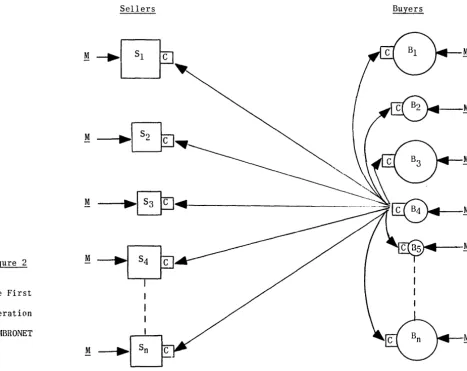
For example, assume that a group of institutional in-vestors are electronically tied into the COMBRONET sys-tem as illustrated in Figure 2. Firm B4 has decided to buy all, or any part, of a 10,000 share block of, say, Eastman Kodak. It has established a desired price of 60 but would go as high as 63. The COMBRONET program then functions to identify, say, Firm S3 as having the closest compatible order to purchase Eastman Kodak on the network. Assume further that Firm S3 has decided to sell its entire holding of 8,000 shares of Eastman Kodak at a preferred price of 65,
1 This does not include consideration of the temporary surcharge or service fee instituted in the spring of 1970.
2 Wall Street Journal, 1 July 1970, p. 12.
3 Ibid.
4 Taylor, Henry J. "Stock Price Rise Likely" Syndicated column
in Lubbock Avalanche-Journal. Lubbock, Texas, 24 July 1970, p.
B-6.
Sellers
Conventional
Stock
Exchange
I
t
I
I
Figure 1
The Present
Configuration
of
Major Securities
Markets
Price and volume information disseminated
via ticker tapes, etc.
~
i
~
Note: The symbols 51' S2."Sn represent institu-tions and individuals approaching the market as sellers of a particular securitYi Bl, B2 ••• Bn represent the corresponding set of buyers i and TI, T2 ••• Tn ·represent the network of brokers.
but would be willing to trade at a price as low as 62. The computer system would try 60 and 65 then 60 1/8-647/8 and, by an iterative process, continue to narrow the price spread at 1/8th intervals until the agreeable range is deter-mined to be 62-63, at which time the difference could be split the transaction completed at a p~ice of 6271. Each party to the transaction, of course, retains individual control of the iterative sequence by setting limits to the range of negotiable prices in its own program.
Reducing Paperwork - and Fraud
In addition, as a bonus, COMBRONET could be pro-grammed to record, store and electronically transfer evi-dence of ownership with much less need for physical handling of certificates and other "back office" functions. This would greatly reduce problems of fraud, pilferage, and accidental· loss in the physical handling of securities. Stock certificates, like gold, might then best be buried at Fort Knox. They would be physically gone, but not forgotten, thanks to the computer's memory circuits.
Since computerized trading of securities among institu-tional investors would substantially reduce the volume of shares exchanged in traditional markets, more volatile price fluctuations could be expected to develop. This would eventually undermine the usefulness of price information
COMPUTERS and AUTOMA nON for April, 1971
taken from conventional sources. To compensate for such an eventuality, the COMBRONET could inaugurate a sec-ond phase of its development by issuing a running account of its own previous transactions. This information could first supplement and eventually displace the price and volume data gathered from traditional sources.
COMBRONET as a Specialist
The COMBRONET could also be modified to perform the function of the specialist. For example, a cooperative users' fund could be established which would allow the system to be programmed to trade against pronounced deviations from the market trend. Thus, the cooperative fund's program would dictate on-balance buying during periods of heavy sell-offs in a security, and on-balance selling when speculative buying pressures obtain.
Development of this program would require detailed analyses of the past behavior of the specialists most success-ful. in maintaining an orderly market during crisis periods, such as the Eisenhower heart attack and the Kennedy assassination. By incorporating. the techniques of these individuals, the users' fund should be able to improve. the over-all stability of security markets. To assure the success of the program, a handful of the most effective specialists
[image:11.621.46.555.41.447.2]Sellers
M
M
~~~
______________________ _
~I----M Figure 2
The First
Generation
COMBRONET
M
Note: The symbols Bl, B2 ••. Bni Sl' S2 •.. Sn; and
M
correspond to Figur~ The symbol ~ represents each institution's computer program which ties the organization to the COMBRONET.from conventional markets could be invited to serve as program managers and offered a share of the proceeds of the fund.
The "Third Market" in One Giant Computer
Finally, as the number of subscribers to the COM-BRONET is expanded to include most large investors, it might become more economical to centralize the entire "Third Market" in one giant computer. This would involve having each institution tied only to the central computer, rather than directly to all other individual subscribers.
Referring back to Figure 1, this would complete the computerized and automated transformation of the secur-ities exchange industry in the following specific manner. First, the brokerage house (T) with all of its related employees and paraphernalia would gradually disappear as a functional unit in the system. Second, the human sounds, odors, and activities of the present conventional stock exchange would be replaced by the humming sounds of a third generation computer. All buy and sell orders for securities would be transmitted directly from institutional and individual investors to the central computerized brain of the fully mature COMBRONET. The computer would be elaborately programmed to instantaneously consummate
14
transactions and to record, store, and transmit all informa-tion relating to such transacinforma-tions.
It would be fitting, for nostalgic reasons, to locate this computer somewhere on Wall Street, perhaps beside an artificial buttonwood tree.
The Score at the End of Round One
At this point it may be useful to descend from the "iffy" world of assumptions and theoretical scenarios. In the real world, the first round of the battle between the broker and the computer has already been completed. Although brokers may have mistaken it for friendly or inconsequential sparring, they should recognize that a technical knockout may very well be the end result of the match.
The first step toward the implementation of a COM-BRONET was taken some years ago when a subsidiary of Standard and Poor's began putting price and volume data on tapes that could be fed into a computer system. This allowed computers to be programmed to answer specific questions about individual securities, and to compare their performance with that of other issues. In fact, computers are now being used· to indicate buy and sell decisions based on fundamental and/or technical factors.
[image:12.618.95.562.56.426.2]In addition to using computers for analytical work and storage of data, a system is currently being developed for security trading purposes. In 1969, Dana L. Thomas re-ported the beginning of such a system with the formation of Institutional Networks Corporation (instinet).s More recently, McClintick indicated that Instinet is being used by subscribers to block-trade directly with each other. 6 Other
firms, for example AutEx Service Corporation, are also developing major automated communications and trading systems.7 These systems can be regarded as precursors of the more comprehensive COMBRONET described above.8 The rapidly developing "Third Market", therefore, clearly has the potential to reduce listed stock trading through the conventional markets in the United States and, eventually, in foreign countries.
Reaction from the NYSE
The NYSE is counterpunching with its own Block Automation System (BAS), and thereby trying to head off Third Market competition. But the counterpunch is not enough. Exchanges must translate this automation into reduced costs to the institutional investor to meet the competitive threat posed by COMBRONET. Only if COM-BRONET costs to institutional investors should exceed conventional commission charges, can brokers afford to lower their guard.
A review of the commission rate structure is presently being conducted by the NYSE and the SEC. One of the purposes of the review is to consider selective increases in commission rates for large block transactions. This may indicate that the Exchange membership has failed to realize the potential impact of the competitive threat posed by the Third Market. Higher commission rates may simply acceler-ate the development of a low-cost COMBRONET system, just as high prices for natural raw materials have historically stimulated the development of synthetic substitutes.
Another purpose of the review is to restructure commis-sion rates in order to charge a higher proportion of brokers' expenses to the small investor. This could also result in a backlash, Insofar as the rate structure becomes oppressive to the small investor, he may turn increasingly to other institutions as an outlet for his savings. In addition to currently available options, such as mutual funds and certificates of deposit, he may also soon be able to trade securities on the Third Market through the facilities of large financial intermediaries and, ultimately, via telephone orders directly to the COMBRONET. The reviewers of commission rate structures would do well to keep these points in mind in setting the new fee schedule for small investors.
Changes in Competitive Conditions
In the jargon of economists, a policy of
raising
brokerage fees to investors may have been a rational reaction to rising5 Thomas, Dana L. "Computerized Gunslingers", Barron's, 24
March 1969, p. 34.
6McClintick, David, "Big Board Will Expand BAS", Wall Street Journal, 11 June 1970, p. 5.
7 Ibid.
II It should also be noted that computerized trading is displacing
conventional brokerage activities in real estate and commodity markets. For a brief discussion of these developments see Robert Strand's UPI release dated July 30, 1970.
COMPUTERS and AUTOMATION for April, 1971
costs when brokers enjoyed a monopoly position in the trading of securities. But the emergence of the Third Market is changing the competitive conditions in which brokers operate. To be specific, it is increasing the price (i.e. fee) elasticity of demand for their services. This, in turn, may cause higher fees to produce
smaller
rather thanlarger
profits, precisely because higher fees are encouraging the growth of the Third Market and may soon give birth to the COMBRONET.From the brokerage houses' point of view, this line of reasoning can only lead to one conclusion. They must look to lower costs of operation, rather than higher fees, as the way out of their cost-price squeeze. This will require replacing antiquated labor intensive methods of exchanging and handling securities with a more modern, computer-intensive system of operations. If they fail to perceive and act on this insight, institutional investors will do the job themselves by forming a COMBRONET-type system. That will sound the death knell for brokers.
Barriers to the Implementation of COMBRONET
There are a number of technical, legal, and psychological barriers which would have to be overcome before a COM-BRONET-type system could be fully implemented. The technical barriers have already been discussed briefly. In order to establish the COMBRONET market, the various institutional investors who would unite to form the net-work would have to obtain compatible machinery and programs to facilitate the necessary interchange of informa-tion.
Remedial Legislation Needed
It is also probable that the establishment of a COM-BRONET system would run afoul of the maze of regula-tions governing the exchange of securities. It will, therefore, probably be necessary to seek some remedial legislation to facilitate these new modes of exchanging securities in the Third Market. The same problem applies to the commercial banks that are anxious to add the securities brokerage function to the "full service" concept they are developing. If these institutions could obtain appropriate remedial legislation, our "cashless" society would soon evolve into one large automated system. It would be capable of handling all the financial needs of an individual, including the exchange of securities, using nothing more than a credit card to consummate each transaction. The demise of stock brokers' services to small investors would be a logical by-product of such a process.
Also, as the COMBRONET system is developed, previ-ously used regulatory authority becomes obsolete. In par-ticular, regulation of securities trading may begin to slip under the aegis of the Federal Communications Commis-sion, and out of the grasp of the Securities and Exchange Commission. This may create friction between these regula-tory agencies, and cause additional problems for developers of the COMBRONET; but that is another story.
Finally, it will take some time for individual and even institutional investors to become accustomed to the con-cept of trading securities via the computer, and without the benefit of personal contact with a broker. The machine, after all, cannot take a client out for cocktails and lunch at a Wall Street brokers' club - or console the client when the bottom has fallen out of his corner of the market. D
USING 'THE COMPUTER TO STEAL
"The typical computer centre offers an open invitation to the thief or
vandal; most computer systems are not presently protected against
destruc-tion, or unauthorized access or manipulation. "
Harvey S. Gellman, President DCF Systems Ltd.
74 Victoria St. Toronto 210, Ontario
I am not a gambler, yet I am willing to bet any computer user that his computer installation is vulnerable to theft and other abuse. I am confident that I would win my bet almost every time. Does this sound farfetched? It is not.
There are plenty of examples to show that most com-puter installations today have inadequate controls to pro-tect them against theft or damage to programs or data. Here are two examples:
Between 1959 and 1963, the manager of data processing for a stockbroker embezzled over $80,000 from the company by having cheques made payable to fictitious payees. The inadvertent return of a cheque revealed the thefts.
A group of enterprising individuals in an invest-ment firm embezzled customer funds and then told the customers that a service agency had process'ed 'their accounts incorrectly. Because the public is ready to believe a cry of "computer error", considerable time elapsed before the raid was discovered.
This last example reminds me of the story' about the man who looked at wildly incorrect results printed by a computer and said, "You know, it would have taken forty mathematicians working for three years to produce a mistake like this."
The typical computer centre offers an open invitation to the thief or vandal. My objectives are to describe the problem, show how serious it is, and suggest an approach for solving it. I will deal with damage to computer systems as well as fraud, because the action I will recommend will provide protection against both of these hazards.
16
What Is the Problem?
The problem can be stated simply: most computer centres do not have adequate data security. This means the computer systems are not protected against destruction or unauthorized access or manipulation.
The list of potential hazards includes: (1) accidental or malicious damage to computer programs or data stored in computer systems; and (2) theft of assets or private infor-mation.
Even though these hazards relate to computer installa-tions, they are rarely the fault of the computer. A com-puter will have breakdowns, but these are usually repair-able. The main hazards are due to people who fail to use proper operating and control procedures.
With computer systems, one employee can perform functions that were previously assigned to several business units. Unless there are proper controls, knowledgeable but unscrupulous employees can manipulate programs for their own benefit, and incompetent employees can cause damage by making errors.
What are the Risks?
The risks can be high. An organization can lose large amounts of money, vital information without which it cannot function, or secret information that may be of value to competitors. Unless an organization takes adequate steps to protect its computer systems from destruction, mal-function or manipulation, it can be badly hurt. In one organization, for example, a disgruntled member of the
computer room staff used a small magnet and erased information on nearly every reel of magnetic tape that contained the company's files and programs.
Who Suffers?
Who suffers most from these hazards - large or small organizations? I believe that all are almost equally vulner-able. The large organization's spectacular losses involving large sums of money get more publicity, but many inci-dents occur in small companies which feel the effects just as much as large ones. Small companies find it difficult to implement effective controls because the knowledge of how to manipulate the computer system may be concentrated in only one person.
No organization is safe. University computer systems have been used by unauthorized people who have tapped telephone lines and broken the code.
The Human Resources Administration, a New York antipoverty agency lost about $2 million during the first nine months of 1968 through phony Youth Corps payroll cheques processed by a computer at the rate of 100 a week. A policeman discovered a batch of the cheques when investigating an illegally parked, overdue rented car.
It is therefore clear that all organizations are vulnerable and their losses or damages can have serious effects on their customers and their employees.
Who Are the Culprits?
Who does the stealing or the damage? The list includes: 1. Computer centre personnel who are authorized to have access to computer equipment or files (ma-chine operators, programmers, librarians, repair-men, etc.)
2. People who create or handle incoming or out-going data.
3. Outsiders who wish to penetrate the system. Here are some examples.
• A manager of claims in a government-sponsored medical aid scheme introduced false doctor claims and directed the payment cheques to an office he had rented ina fictitious name.
• Programmers have stolen information from a payroll system for use in union bargaining.
• Programmers have stolen information from a pay-roll system and sold it to a life insurance company agent.
• Programmers and operators have sold name and address lists.
• At a large Canadian department store, a systems analyst placed orders for expensive appliances and coded them as "special pricing orders". Using his knowledge of the system information flow and procedures, he intercepted the documents as they reached the "special pricing orders" desk. He changed the list price to a nominal price of six or seven dollars and then put the forged documents back into the regular stream. The appliances were delivered to him and he paid his account prompt-ly. The practice was discovered by systems con-sultants called in to review the adequacy of the system's internal control procedures.
It is important to recognize that an inspired bungler can
sometimes do more damage than a thief or vandal. If a
COMPUTERS and AUTOMATION for April, 1971
computer centre does not have proper procedures and controls, then a programmer or machine operator can make serious mistakes. For example, he could erase a magnetic tape file containing several years' historical data.
Why Is the Problem Still Unsolved?
We have enough examples of inadequate data security to show that serious abuse is possible and that this problem deserves the attention of executives. Why then have most organizations not yet solved the problem? Stringent con-trols in non-computer systems are traditional, so why do managers fail to establish similar controls for computers? Especially when we all know that to err is human, but to really foul things up requires a computer.
Several reasons come to mind. The first is that in the early days, computer systems were developed haphazardly. People were happy when their computer programs finally appeared to work correctly; they had little patience with the problems of data security.
A second reason for lack of security is that some executives think that computer programs are complex and therefore difficult to manipulate. They do not realize that a skilled programmer can quickly alter computer programs to suit himself, do his stealing, then return the programs to their original state.
A third reason for lack of control is that senior execu-tives who are responsible for their organization's computer
systems have more pressing problems to worry about. They worry about the steady stream of complaints from users who get inadequate' service from the computer centre. They also worry about their own lack of understanding and control of the data processing activities and simply abdicate responsibility to their data processing manager.
Perhaps a fourth reason senior executives ignore the problem is because their expenditures for computer systems usually total less than 1 % of sales. They should be more concerned, because the effect of computers on their com-pany's performance can be significant. Just as I was willing to bet that most computer centres are vulnerable to theft and other abuse, I am equally willing to bet that most senior executives do not know how much money is being wasted, how much profit is being produced and what weaknesses exist in their computer systems.
The fifth reason is that many presidents do not realize how vulnerable their organizations are. A few months ago, for instance, there was a fire in the office building occupied by a large Canadian corporation. The computer centre floor escaped damage. When newspaper reporters asked the com-pany president what would have happened if the computer centre had been damaged by the fire, the president stated that it would have had virtually no effect on the company. That company's systems personnel were astonished by their president's statement, because they knew that if the fire had reached the computer centre, the accounts receivable and other vital records would have been destroyed.
The fact that many managers have the false impression that their auditors will protect them is a sixth reason for lack of data security. I submit that the auditor cannot protect them unless his knowledge of computer systems approaches that of the skilled programmer who sets out to modify data or programs without being detected. Is it realistic to expect auditors to have this kind of specialized skill, in addition to their other necessary skills?
Finally, many other people remain unworried about the
data security problem. They think that computer fraud or destruction occurs so rarely that they can safely ignore the problem. But these occurrences are not that rare. Many cases are hushed up. I will show later that the problem is probably growing more serious.
The unworried people seem to believe that these cases occur in fiction rather than in real life :
Those of you who saw the movie "Hot Millions" a few years ago may recall the key event one night when Peter Ustinov saw the cleaning lady hit the computer with her fist. The door on top of the computer opened and she was able to heat her teapot on the hot electronic equipment. Ustinov then used her method to unlock the computer and introduce false information into the computer's storage units. He thereby arranged to have dozens of cheques for large amounts paid out to his fictitious companies all over Europe.
In real life, events may be less amusing:
• A vice-president of a stockbrokerage firm em-bezzled about $250,000 by personally creating punched cards to transfer credits to his own count from the company's interest revenue ac-count.
• A few months ago, five men, including a bank Vice-president, were charged with defrauding two banks of more than $1 million by using a com-puter. Deposit slips for cash deposits were made out when the embezzlers were actually depositing cheques. Since cash deposits are recorded for im-mediate credit, cheques subsequently drawn ap-peared to be covered by the false cash deposits. If the deposits had been correctly made as cheque deposits, the computer would not have credited the money to the account immediately, so that when withdrawals were made the computer would have indicated insufficient funds available, with an uncollectable cheque on deposit. Ordinarily, a teller or branch manager would notice cheques deposited as 'cash and refuse to accept them. In this case, an assistant branch manager (one of the thieves) accepted the cheques. The scheme was uncovered by accident when a bank messenger failed to deliver a bundle of cheque deposits to the clearing house, leaving $440,000 worth of cheque withdrawals uncovered.
The Problem Is Getting Worse
Managers should be more concerned about data security because the problem will get worse unless something is done about it.
18
The importance of data security is growing because: 1. The growth in size and complexity of computer
systems makes errors harder to detect.
2. Computer systems eliminate many of the paper records.
3. There is a growing reliance by managers on com-puters, not just for financial data, but also for marketing, production, engineering and fore-casting information.
4. There is a continuing shortage of skilled systems personnel and this leads to the hiring .of.u~qual
ified people who are incapable of desIgnmg ade-quate controls.
Data Security in Time-Sharing Systems
The advent of time-sharing computer systems has also made the data security problem more difficult. In time-sharing systems, each user can have an electric typewriter, or a TV-tube terminal connected by telephone lines to a remote computer.
Such systems involve large, complex sets of computer' program instructions. These programs are prepared by people - none of whom is perfect. The complexity of these programs makes it extremely difficult for the designer to eliminate loopholes or "security trapdoors". A computer expert can penetrate such systems.
Professor E. L. Glaser of Case Western Reserve Univer-sity in Cleveland, is such a skilled, experimental penetrator. After learning the standard operating procedures for the system and then thinking about it for a few hours, he has been able to break into a system after five minutes at a terminal.
In one system that Professor Glaser tested, the securi.ty system was considered to be good, but he discovere~ one "trapdoor" in a relatively short time. He wrote a SImple program which went through every file in the system, found the owners' names and passwords, extracted all passwords and stored them in a new file after scrambling them so they could not be recognized. He was then able to read any file at any later time.
In another case, Professor Glaser tested the security measures of a new commercial time-sharing system. The security measures were again considered to be good, but again he found a number of "trapdoors". Within five minutes at a remote terminal he was able to "crash" the whole system, bringing it to a complete halt.
Another newly recognized hazard is that signals are transmitted from a computer installation unless the com-puter room is shielded. In one test, a truck equipp.ed with sensitive receiving equipment, as well as processmg and printing facilities, was parked near an unshielded computer centre. A high-speed printer driven by these signals pro-duced the same output as was printed in the centre.
When you think of the possibilities, both in the movies and in real life, perhaps you will agree with me that those managers who are not worried about their data security are deluding themselves.
Some Managers Are Getting Worried
During the past year, I have found that some executives are becoming concerned about some aspects of the prob-lem. One indication of this concern is the fact that a new data security service introduced in Toronto six months ago is selling very well. This service provides safe, off-site storage of magnetic tapes, disks, punched cards and other documents.
Perhaps people have been buying this protection because they have read about bomb scares and the increasing level of violence in our society. Because some people consider computers a potential threat to individual freedom, there have been a few attempts to destroy them. An example, right here in Canada, was the destn-lction of the computer centre by militant stlldents at ~ir George Williams Univer-sity in Montreal.
Some managers are becoming more conscious of the need to protect their computer systems. Perhaps eventually it will be as difficult to get into a computer room as into a safety deposit vault or a high security military area.