© 2019, IRJET | Impact Factor value: 7.211 | ISO 9001:2008 Certified Journal | Page 4472
Study on Increasing The Efficiency of The Existing Sequential Batch
Reactor of St.Joseph Engineering College
Mr Dheeraj
1, Ms Mohita
1, Mr Musthakeem Mohammed
1, Mr Kiran Kumar Raikar
1and
Mr Ajeeth B
21
UG Students, Department of Civil Engineering, SJEC, Mangaluru
2Assistant Professor, Department of Civil Engineering, SJEC, Mangaluru
---***---Abstract -
The present study was carried out to evaluatethe efficiency of SBR of St. Joseph Engineering College. Wastewater samples were collected in daily basis and analysis of various water parameters were performed. Such as COD, BOD, pH, Specific conductivity, Turbidity and hardness. Increase in aeration time resulted in decrease in the values of the water parameters. Usage of tubesettlers with algae resulted in better water quality. Our study on characteristics of wastewater resulted in reduction of aeration time 8hours to 5 hours.
Key Words: SBR; Tubesettlers; Algae; Aeration
1.INTRODUCTION
( Size 11 , cambria font)Sewage is 99% water carrying domestic water originating in kitchen, bathing, urine, washing clothes and night soil. Sewage also contains water borne pathogenic organisms of typhoid, jaundice, which originate from the night soil of the already infected person.
Sewage treatment is normally carried out by aerobic and anaerobic bacteria whereby there metabolize the organic matter and multiply themselves and which are settled out and disposed as sludge. Treated sewage as effluent can be reused to contribute to conservation of water in areas suffering from water scarcity. Direct discharge of sewage in to nearby natural water body or underground body may be one of the reason for water pollution.
To reduce pollution of the natural water body, treatment of sewage water is compulsory. The treatment of sewage is possible by various processes like Up-flow anaerobic sludge blanket (UASB), Activated sludge process, Oxidation pond, Trickling filter, Sequential batch reactor(SBR),Fluidized bed reactor, Membrane reactor, combi-treat technology etc. Out of these Sequential batch reactor(SBR) and Activated sludge process(ASP) have many applications.
1.1 Sequential batch reactor process
A Sequential batch reactor is a treatment process that consists of a sequence of steps that are carried out in the same enclosed structure, called as tank reactor. The SBR operation is based on “fill-and-draw” principle, consisting of five steps ,namely-fill, react, settle, decant and Idle.
During fill phase the basin receives influent water where influent brings food to the microbes in activated sludge, creating an environment for biochemical reactions. During react phase,no wastewater will enter the the reactor and aeration units and mechanical mixing are switched on. During settle phase activated sludge is allowed to settle under inactive state.Clarified treated effluent is removed from the tank in decant phase. The idle period is used when the system is waiting for enough effluent to process.
2. LITERATURE REVIEW
As per the study of Devendra Dohare, Mahesh Kawale (2014)on the biological treatment of wastewater using activated sludge process and sequential batch reactor process. In this paper they provided an overall information regarding activated sludge process and sequential batch process. When compared to other processes these two processes are considered to be widely used. The efficiency of the SBR is considered to be greater than that of ASP as it is of low cost and consumes less space for both continues and intermittent flow, thus SBR is preferred in selection of technology for biological treatment of wastewater.
© 2019, IRJET | Impact Factor value: 7.211 | ISO 9001:2008 Certified Journal | Page 4473
As per the work of Jency Nadayil, Devu Mohan et al(2015)aeration can be an effective method in treating domestic waste water, laboratory tests were conducted on the domestic wastewater and various parameters like COD, BOD and Turbidity were performed to study the effect of aeration in domestic wastewater. This paper mainly focuses on how the variation of various constituents takes place due to aeration. Diffused fine bubble aeration was conducted in a circular tank at flow rates of 4 L/minute,3 L/minute & 1.5 L/minute at time periods of 72 hours, 48 hours & 24 hours using aerators and the values of percentage reduction in COD, BOD and Turbidity were obtained. It was found that percentage removal of constituents increased as flow rate of aeration increased. Hence it was obtained that at a flow rate of 4 L/min at time period of 72 hours optimum removal of Turbidity, COD, BOD were found to be removed by and 37.72% , 95.71%, 95.88% respectively.
As per the work of Uzma Showkat & Ishtiyaq Ahmed Najar (2018) study was conducted to evaluate the performance of sewage treatment plant of 16.1MLD based on the SBR technology. Laboratory Tests were conducted to analyse the 14 different water parameters. Such as COD, pH ,Electric Conductivity, Magnesium, sodium, Potassium, Calcium, BOD, TSS, TDS, Ortho-Phosphate, Total Phosphorus & Nitrate Nitrogen were performed, It revealed that the SBR based treatment removed the unacceptable physiochemical properties of wastewater before discharging it into the water body, But reduction of total dissolved solids, total suspended solids and ortho-phosphate was low. Thus effluents might result in adverse effects on the receiving water body, as the waterbody may be already facing pollution load. Hence it is necessary to have continuous monitoring over the treatment process by concerned authorities to ensure best measures with respect to the treatment and discharge of wastewater to the receiving waterbody.
As per Prof. Ing. Alberto Bertucco’s (2013) thesis on Treating urban wastewaters with Microalgae: Batch and continuous flow experiments and preliminary process design. The possibility of combining existing activated sludge method with cultivation of microalgae was addressed. Growth of microalgae i.e. Chlorella Prothothecoides was tested in un-sterilized urban waste waters was tested by batch experiments which were carried out at different temperature conditions in order to replicate variation of annual temperature of influent wastewater of the treatment plant. During this process of temperature screening it was found that high dependence of growth rate of Chlorella Prothothecoides was constant on temperature variation. Further, the microalgae consortium from the wastewater was detected, and was grown in batch mode in order to distinguish its strain composition for future developments and researches. An examination of Chlorella Prothothecoides growth capacity in diluted sample of synthetic human urine was performed ,but the results failed due to the incorrect composition synthetic human urine.
Continuous flow experiments were performed using a flat panel photobioreactor both under a simulated daylight and by providing constant illumination, during these experiments the production of biomass and depletion of nutrients were observed and results were merged with the data received from the thesis work done previously. Finally, proposal was given for the three waste water treatment processes merged with microalgae production and were analysed by a preliminary process design approach.
3. METHODOLOGY
Preparation of model of sequential batch reactor(SBR) .
A small working model of SBR is constructed using acrylic sheet, silicon gum etc.
The SBR model is fabricated using transparent Acrylic sheets with square cross section.
Collection of sample from sewage treatment plant.
The wastewater sample is collected from the collection tank of the sewage treatment plant every day and various laboratorical experiments are done to determine characteristic.
Analysis of characteristics of wastewater before treating.
The characteristics such as BOD, COD, pH etc. are tested for the sample collected from wastewater collection pit.
Treatment of sample by SBR model.
The collected water is poured to SBR model i.e. fill phase.
Air diffusers are made to operate for certain time limit(aeration begins) i.e react phase.
After aeration, rest phase follows. Here sludge starts settling down, leaving behind clear water.
Now the clear water is extracted from the outlets i.e decant phase.
Repetition of the same procedure.
Treatment using tubesettlers with algae.
Algae from the neighbouring area is obtained.
Tubesettlers are introduced in order to create a controlled environment for the growth of algae
Algae obtained is grown within the tube settlers such that their chance of spreading is minimum
© 2019, IRJET | Impact Factor value: 7.211 | ISO 9001:2008 Certified Journal | Page 4474
Analysis of effluent characteristics of treatedwastewater.
The treated water from SBR model is collected and various tests like COD, BOD, pH etc. are conducted.
Details of the Existing SBR
SBR is of 3lakh capacity with 2 partition, each of 1.5 lakh capacity.
Aeration time-8 to 10 hours.
Settling time-30 to 40 mins
Acclimatization products are chlorine and lime stone.
Filtration bed consists of carbon filter and sand.
Source of waste water:
Boys and girls hostel have 124 and 97 washrooms.
There are 3 main blocks having 25 washrooms.
Bethania hall and dispensary has 20 washrooms.
Tubesettler
The tube settler’s channel collects solids into compact mass which promotes the solids to slide down the tube channel.
Fig -1: Tubesettlers
4. RESULTS
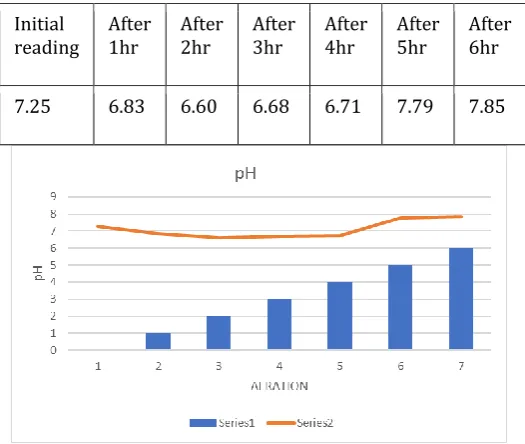
pH Test :Turbidity:
Specific Conductivity:
Initial
reading After 1hr After 2hr After 3hr After 4hr After 5hr After 6hr
0.526 0.482 0.432 0.421 0.418 0.385 0.364 Initial
reading After 1hr After 2hr After 3hr After 4hr After 5hr After 6hr
7.25 6.83 6.60 6.68 6.71 7.79 7.85
Initial
reading After 1hr After 2hr After 3hr After 4hr After 5hr After 6hr
[image:3.595.303.566.138.360.2]© 2019, IRJET | Impact Factor value: 7.211 | ISO 9001:2008 Certified Journal | Page 4475
Hardness Test:Initial
reading After 1hr After 2hr After 3hr After 3hr After 4hr After 5hr
116 100 104 102 102 86 82
COD :
Initial
reading After 1hr After 2hr After 3hr After 4hr After 5hr After 6hr
380 320 240 160 152 137 128
BOD :
Initial
reading After 1hr After 2hr After 3hr After 4hr After 5hr After 6hr
190 176 165 154 147 142 137
5. CONCLUSIONS
As per our study on characteristics of wastewater, we can conclude that aeration time required can be reduced from 8hours to 5 hours
Quality of the water can be maintained by usage of tubesettlers with algae.
ACKNOWLEDGEMENT
This paper expresses our gratitude to our institution and management for providing us with good infrastructure, qualified staff, whose guidance was of immense, help in completion of this paper successfully. Without their encouragement and guidance this project would not have materialized.
REFERENCES
[1] Metcalf & Eddy, Inc. Wastewater Engineering: Treatment, Disposal, Reuse.4th edition.
[2] Devendra Dohare, Mahesh Kawale(2014), Biological Treatment of Wastewater Using Activated Sludge Process and Sequential Batch Reactor Process,ISSN: 2277-9655,Scientific Journal Impact Factor: 3.449 ISRA), Impact Factor: 2.114
[3] Jency Nadayil, Devu Mohan et al(2015), A Study on effect of aeration on domestic wastewater (IJIRI)vol 3, issue 2, pp: (10-15) ISSN 2348-1218
© 2019, IRJET | Impact Factor value: 7.211 | ISO 9001:2008 Certified Journal | Page 4476
[5] Prof. Ing. Alberto Bertucco (2013) Treating urbanwastewaters with Microalgae: Batch and continuous flow experiments and preliminary process design, University of Padua, Department of Civil, Construction and Environmental Engineering [6] Siddhartha V. Pawar, Pooja D. Taralgatti,
International Journal of Science, Engineering and Technology Research (IJSETR) Volume 6, Issue 12, December 2017, ISSN: 2278 -7798